Balkans Bound, Part Seven: The Final Days in Pristina and Gračanica

This is the seventh and final installment of my daughter’s and my trip to Kosovo, Albania, and Montenegro in August 2026.

The Newborn Monument in Pristina, unveiled in the capital on February 17, 2008, when Kosovo declared independence

We left Peja and headed east toward Kosovo’s capital, Pristina — trading the mountains that had framed so much of our trip for rolling hills. Pristina sits in a flat valley, and at one point along the highway encircling the city, we caught a sweeping view of the entire capital spread out below us. It felt almost strange to see such a wide, open landscape after so many days of winding mountain roads.

We checked into our hotel in central Pristina. I had originally booked our final two nights near the airport but changed plans so we could spend a day exploring the city more easily. Once we settled into our room, we headed out for lunch nearby and then began a self-guided walking tour. Our first stop was the Newborn Monument, a large block-letter sculpture that celebrates Kosovo’s declaration of independence from Serbia on February 17, 2008. The monument changes its colors and design each year on that date, symbolizing the country’s evolving identity. Across the street, we visited the Heroines Monument, which depicts an Albanian woman formed from 20,145 metal pins — each representing the contributions and sacrifices of Albanian women during the 1989-1999 Kosovo War. The Newborn Monument felt celebratory and hopeful, while the Heroines Monument carried a quieter, somber weight. Facing one another, the two together formed a powerful message about the devastation of war and the hope that follows in its wake.

Left: C sits in the Newborn Monument; Right: the Heroines Monument

From there, we continued our walk along Mother Teresa Boulevard, a broad, pedestrian-only avenue lined with shops, cafés, and people out enjoying the day. We passed a statue of Mother Teresa herself — an important figure in Kosovo, as she was ethnic Albanian and is said to have found her spiritual calling in the small village of Letnica, in southern Kosovo. We followed the boulevard until we reached the Kosovo Parliament building, then crossed the street to the Çarshi Mosque. Built in 1389 to commemorate the Ottoman victory in the Battle of Kosovo, it is the oldest surviving building in Pristina. Behind it stands the National Museum of Kosovo, housed in an Austro-Hungarian building from 1889, though unfortunately it was closed for renovation during our visit.
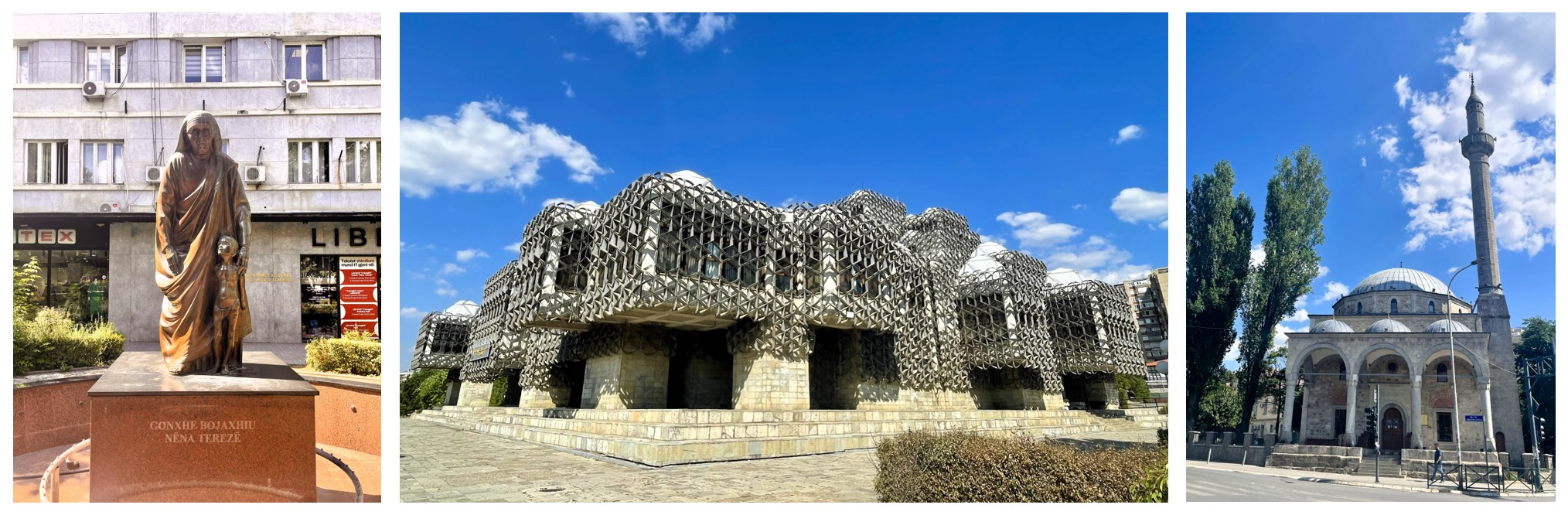
Sights of Pristina–Left: Statue of Mother Teresa in central Pristina; Center: the Brutalist/Futuristic beauty of the National Library of Kosovo; Right: the Çarshi Mosque, Pristina’s oldest building

We continued on to the campus of the University of Pristina to see the National Library, famous for its striking architecture — a brutalist design with a distinctive futuristic appearance. C, who has an interest in architecture and a surprising fondness for Brutalism (perhaps thanks to Washington, D.C.’s share of concrete buildings), had especially wanted to see it. Our final stop was the Cathedral of Saint Mother Teresa. Built between 2007 and 2017 and officially consecrated in 2017, it is the largest structure in Kosovo and the first cathedral built in the country since the 16th century.

In just a few hours of walking, I felt as though we had passed through centuries of Kosovo’s history — from Ottoman rule to war to hard-won independence. It was a beautiful day and a satisfying walk, but it carried a certain weight. While there isn’t an overwhelming amount to see in terms of traditional sightseeing, Pristina clearly has momentum. Construction cranes dotted the skyline, signs of an economic boom fueled in part by the Kosovar diaspora. The city felt youthful and hopeful. We spent the rest of the afternoon and evening resting up for our final day in the country.

Gračanica Monastery

On our last day, we packed up the car for one final sightseeing drive, heading to the town of Gračanica, just five miles from Pristina. Our goal was the 14th-century Serbian Orthodox Gračanica Monastery — the fourth and final of the UNESCO-designated Medieval Monuments in Kosovo that we would visit. Like the others, the monastery centers on a stand-alone church within a walled complex, its interior lined with offices and living quarters. Inside, the church walls are covered with magnificent frescoes depicting scenes from the Bible — vivid, detailed, and deeply expressive. It was beautiful, though also the busiest of the four UNESCO sites we’d seen, and the strictest about what visitors could and could not do.

Outside the monastery, we took a short walk around town. One of the first things we noticed — or rather, C did, with her knack for recognizing flags — was the presence of Serbian flags and the use of the Serbian language. It was a noticeable change from what we had seen elsewhere: in Prizren and Peja, Albanian flags and symbols were everywhere, while in Pristina, we had seen a modest number of Kosovar flags. Here, the Serbian presence was unmistakable. A statue of the legendary Serbian knight Miloš Obilić stands prominently in the town center, and nearby is the Missing Monument, a somber memorial honoring the Serbs who were kidnapped or went missing during and after the Kosovo War.
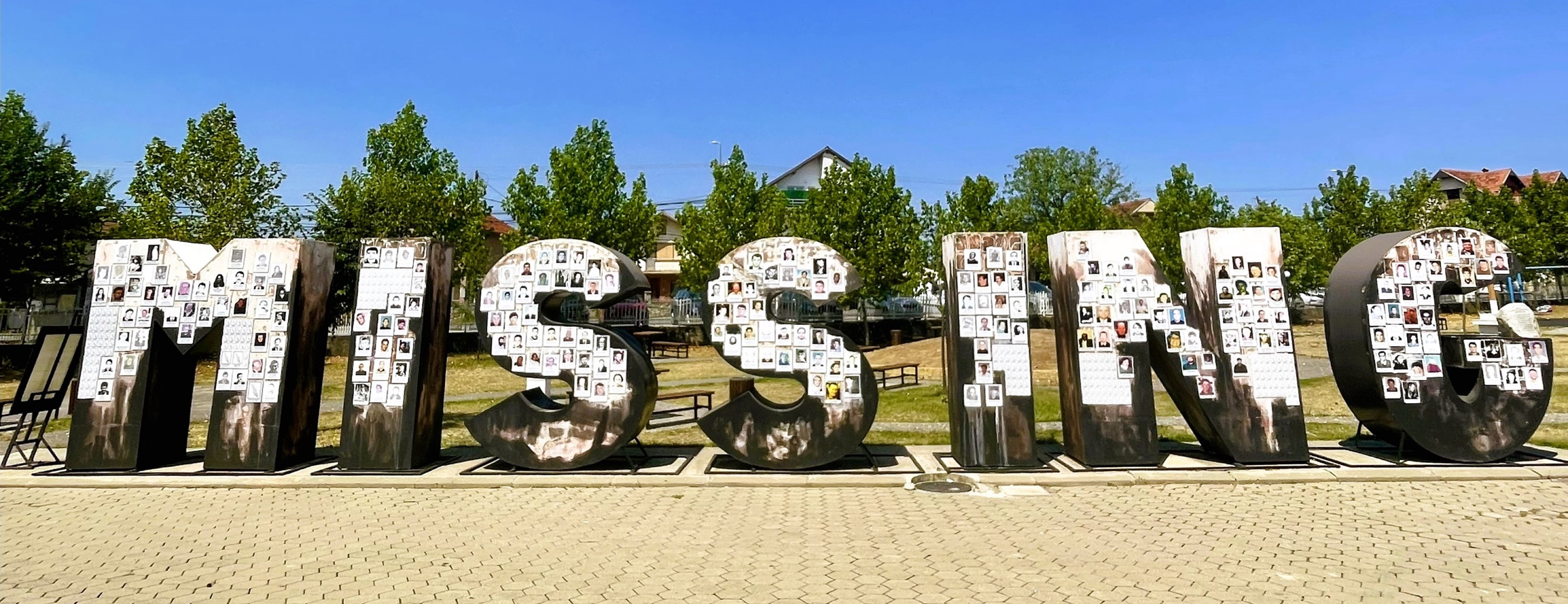
The Missing Monument in Gracanica

Even amid Kosovo’s visible economic growth and youthful optimism, reminders of the region’s divided past remain close at hand. I had thought I’d managed to keep politics at bay during our trip, but it was impossible to ignore the quiet signs everywhere — reminders of how deeply history, identity, and faith are still woven into daily life here, and how the past continues to shape the present.

For a change of pace — and to end our trip on a lighter note — we drove to the Bear Sanctuary Prishtina, a rescue center that provides care for brown bears once kept in captivity in Kosovo and Albania. The sanctuary is set on forested land by a lake, and the bears have large enclosures that give them room to roam and explore. It felt spacious and well-run, and as we followed the winding paths up and down the hillside, C and I got quite a workout. Watching the bears lounging and playing was a lovely way to close out our travels.
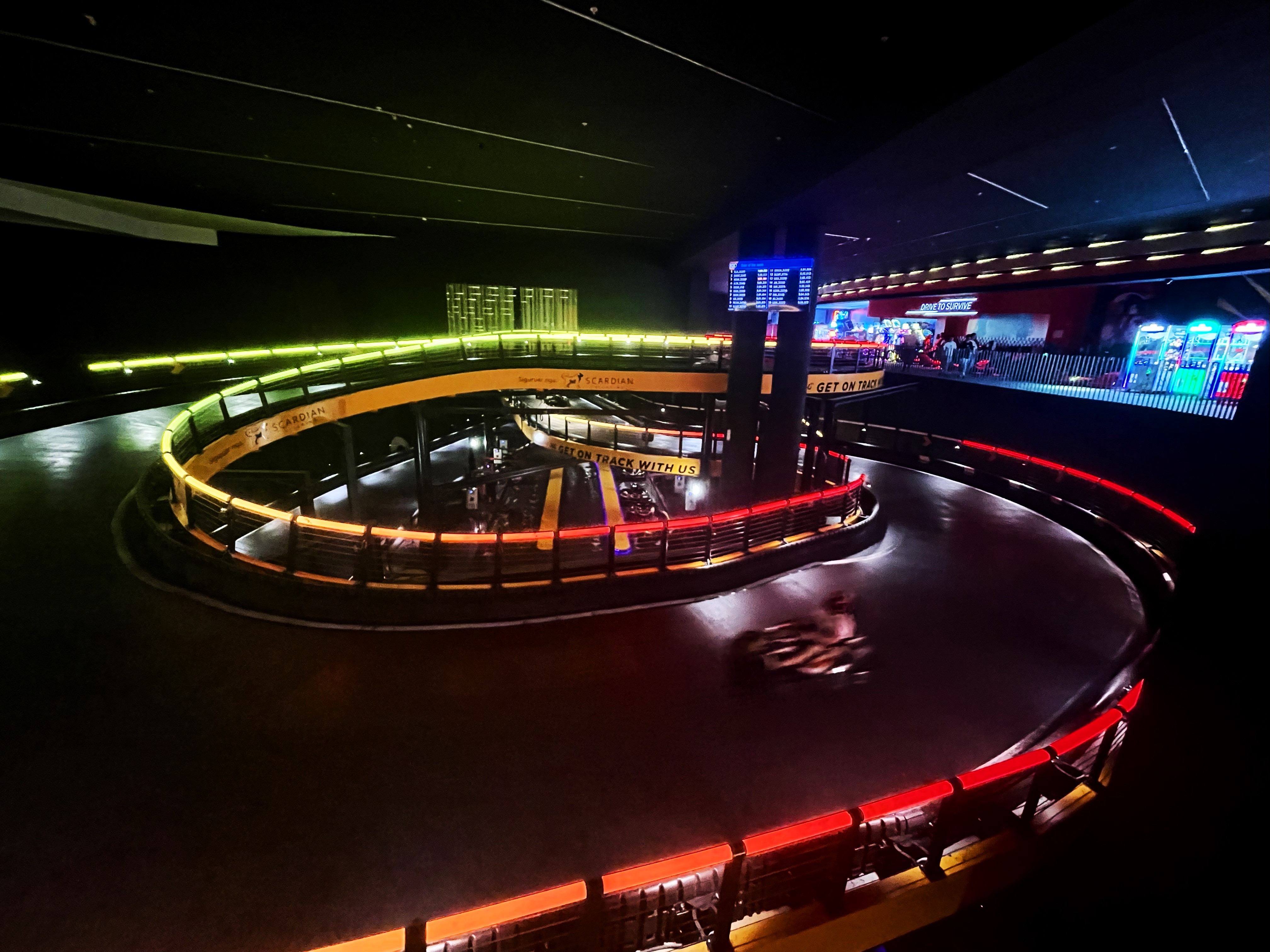
It was so fun go-karting on this track in the Pristina Mall!

I had one last surprise for C: for our final final activity of the vacation, we went to Prishtina Mall. At 1,233,140 square feet, it’s the largest shopping and entertainment center in southeastern Europe. We had lunch, did some window shopping, got gelato, and drove go-karts on a cool indoor track — yes, right inside the mall! It was the first time either of us had gone go-karting, and it was an absolute blast. Afterward, we drove to our hotel near the airport, returned the rental car, and spent our last night in Europe before the early morning flight that would begin our journey home.

Our two weeks in Kosovo, Albania, and Montenegro were everything I could have hoped for — full of adventure, discovery, and connection. We packed so much into those days, from mountain drives and monasteries to coastal towns and caves. More than anything, it was a memorable mother-daughter journey, one that I know neither of us will forget.
Balkans Bound, Part Six: Peja and the Monasteries of Dečani & Peć

This is the sixth installment of my daughter’s and my trip to Kosovo, Albania, and Montenegro in August 2026.

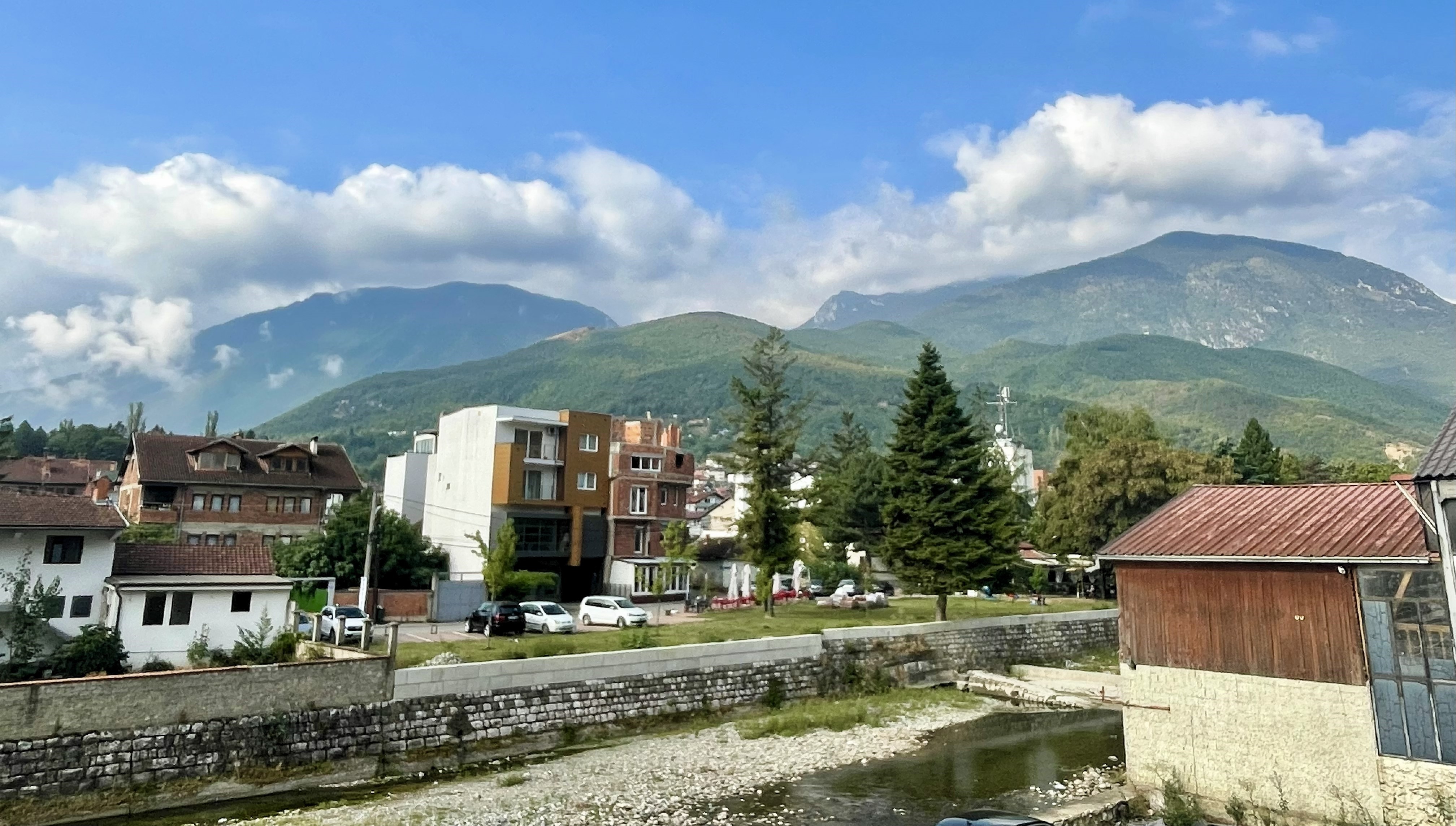
The view from our Peja hotel toward the Rugova Mountains

We left Podgorica on a smooth, straight highway, but about an hour later turned toward Kosovo and began to climb once more into the Accursed Mountains — the southernmost and highest subrange of the Dinaric Alps. The next ninety minutes took us along twisting mountain roads with sweeping vistas at every turn until we reached the Montenegrin border crossing. After the hiccups we’d faced entering Montenegro, I was grateful that this crossing went off without a hitch. Interestingly, the checkpoint wasn’t at the actual border; we still had about four miles to go before entering the narrow Kulla Pass, then another nine miles of serpentine road with breathtaking panoramic views before reaching Kosovar immigration.

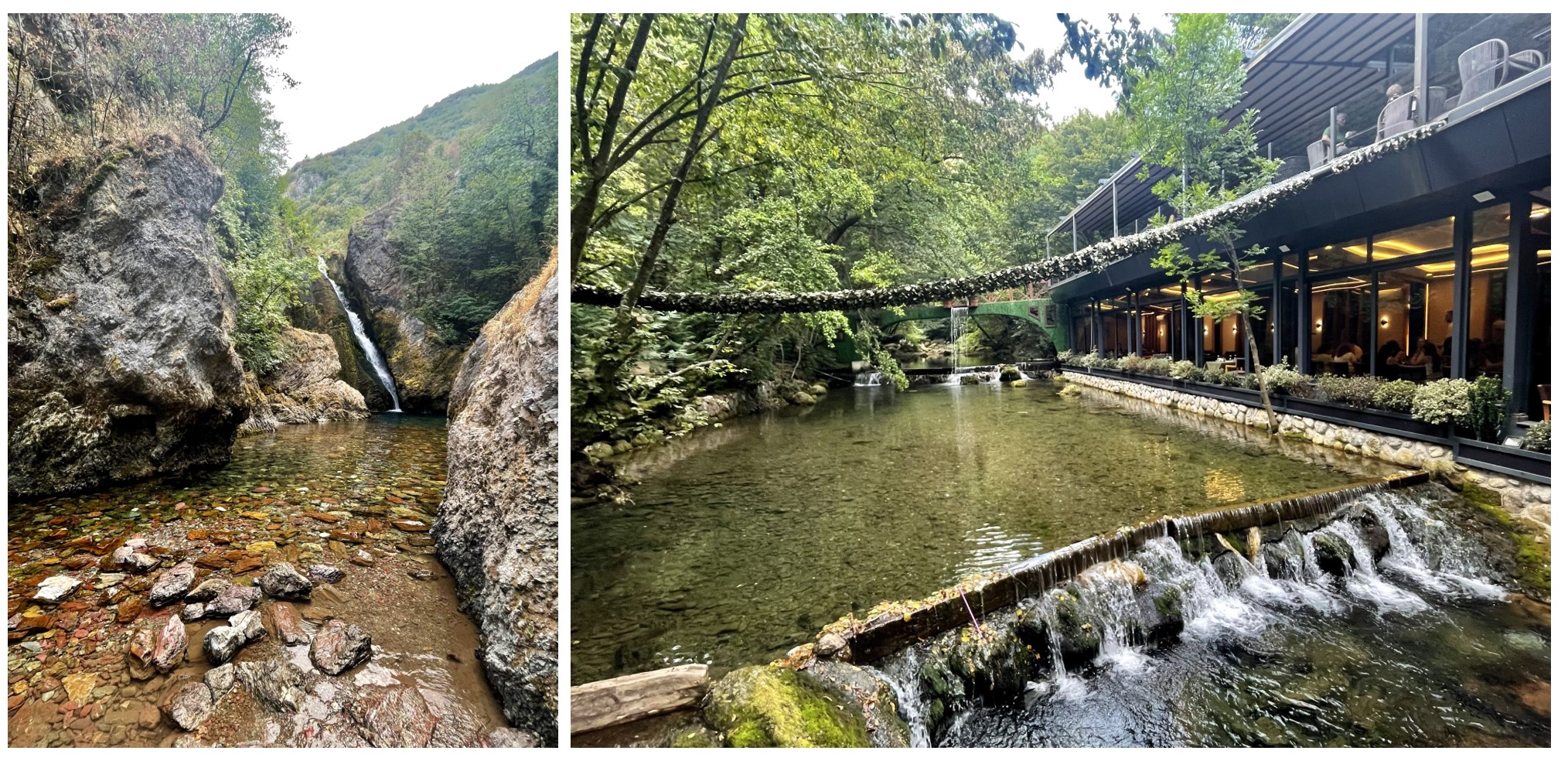
From the border, we descended toward Peja but stopped first at Ujëvara e Drinit Resort (Waterfall of the Drin Resort) for lunch and a view of the White Drin Waterfall. The resort was stunning — all dark wood and stone, blending well into the forest along the White Drin River. Despite it being a Monday, the resort was lively, full of families and friends enjoying a day out. I could not help but think that if I lived in Kosovo, this would be the perfect weekend getaway. After a lovely lunch, we took a short forest walk to the 75-foot waterfall. It may not have been the most spectacular waterfall I’ve seen, but it was undeniably pretty — and the forest setting was peaceful and restorative. From there, we continued on to Peja.

Left: A view of the White Drin Waterfall; Right: the White Drin as it flows past the restaurant at the Ujëvara e Drinit Resort

Arriving in Peja took longer than expected. It was still the summer holiday season, and many Kosovars living abroad were visiting their families. The roads were bumper-to-bumper, and Google Maps led me astray more than once. By the time we finally checked into our hotel, it was after 4 p.m. Though we were ready for an early evening after the long drive, we still took an hour to walk through the town.

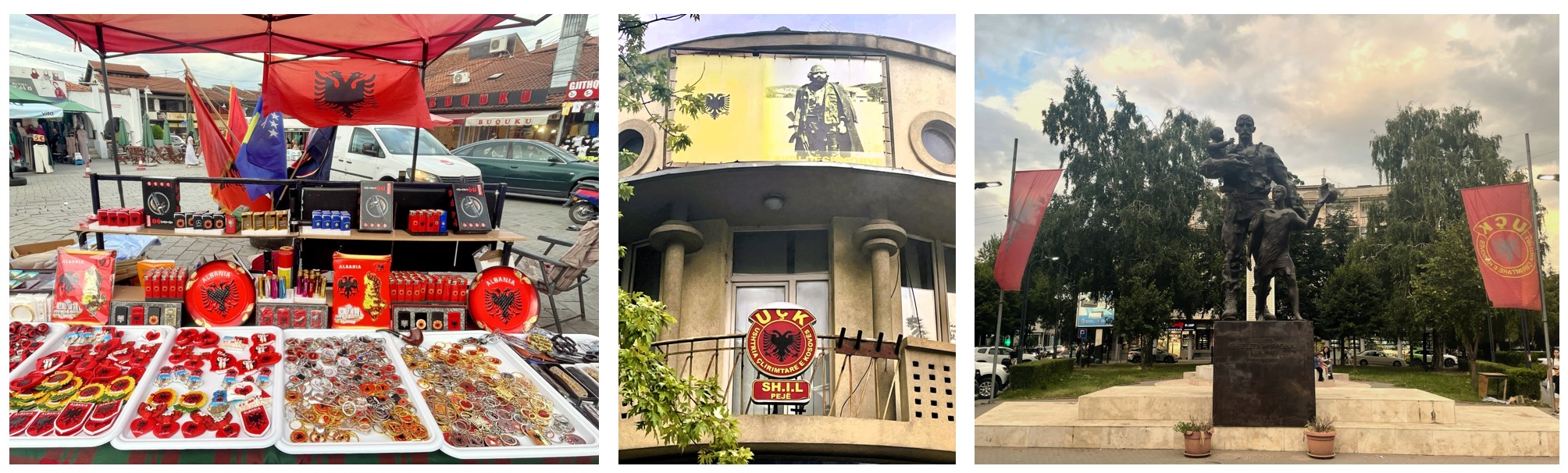
We walked a few blocks to the Peja Bazaar, which dates back to the Ottoman period and was once the center of trade in the city. The market was destroyed in 1999, during the Kosovo War, and rebuilt using the traditional style. Most of the shops weren’t aimed at tourists — they sold gold jewelry, carpets, furniture, clothing, toys, and other everyday goods. But one stall near the 15th-century Bajrakli Mosque at the market’s center stood out: it was filled entirely with Albanian paraphernalia, and I remembered back to when we were in Prizren.

When we were in Prizren, we saw many signs with the letters “UCK.” My daughter pointed one out and guessed it was supposed to be a bad word, missing a letter. After we kept seeing it — along with Albanian flags, placards on buildings, and other symbols — I decided to look it up. UÇK stands for Ushtria Çlirimtare e Kosovës, or the Kosovo Liberation Army. Curious, I asked a souvenir shop clerk if UÇK had become a political party, but he explained that it was disbanded in 1999. When I asked why, then, there were still so many signs and goods today, he said, “Because it is still important to Albanians and Albanian culture.” There were almost no Kosovar flags or souvenirs to be seen.

Reminders of war and Albanian ethnic identification in Peja

The following morning, C and I set off on another adventure — a visit to the Dečani Monastery, about ten miles south of Peja. Founded in the first half of the 14th century by Stefan Dečanski, King of Serbia, the monastery also serves as his mausoleum. It is one of four churches in Kosovo designated as UNESCO World Heritage Sites under the collective title Medieval Monuments of Kosovo, recognized for their blend of Byzantine and Romanesque styles and their remarkable wall frescoes. This was the second of those sites we visited, following Our Lady of Ljeviš in Prizren, and it is the largest medieval church in the Balkans.

I had not realized Dečani’s complicated history. Because Stefan Dečanski is such a significant figure in both Serbian history and the Serbian Orthodox Church, the monastery remains deeply important to Serbia today. Serbia placed the site under legal protection in 1947, but it now lies within Kosovo’s borders — though Serbia does not recognize Kosovar independence. To ensure the security of the site, the monastery has been under the protection of NATO’s Kosovo Force (KFOR) since 1999.

I, having not done my customary research, was, however, completely unaware of the above before setting out, and was taken aback when we reached a checkpoint on the road leading to the monastery. We passed through fine, but once at the site, we had to check in with KFOR soldiers, who asked for our passports, which, to my dismay, I had left behind. I could hardly believe how unprepared I was, and for a moment I thought we might have to drive all the way back to Peja to retrieve them. I offered my driver’s license instead and pleaded my case, and after a brief discussion with their command, the soldiers agreed to let us in.

Just a few photos of the extraordinary Decani monastery

The weather that day was perfect — bright, sunny, with a deep blue sky overhead. The church is enclosed within defensive walls that also contain administrative offices, dormitories, and a small hospital. Visitors are not permitted to enter any of those areas, only the church itself. The building is beautiful, constructed of pink and white marble that appears more white and golden in the sunlight. The doorframes and supraportes are intricately carved, each detail precise and deliberate.

Then we stepped inside — and I was not at all prepared for what awaited us. Every inch of wall and ceiling was covered in frescoes depicting scenes from Serbian history and Christian tradition. They were vibrant, detailed, and utterly stunning. Both C and I were transfixed, slowly wandering through the church with our heads tilted back.

The stunning Patriarchate of Peć

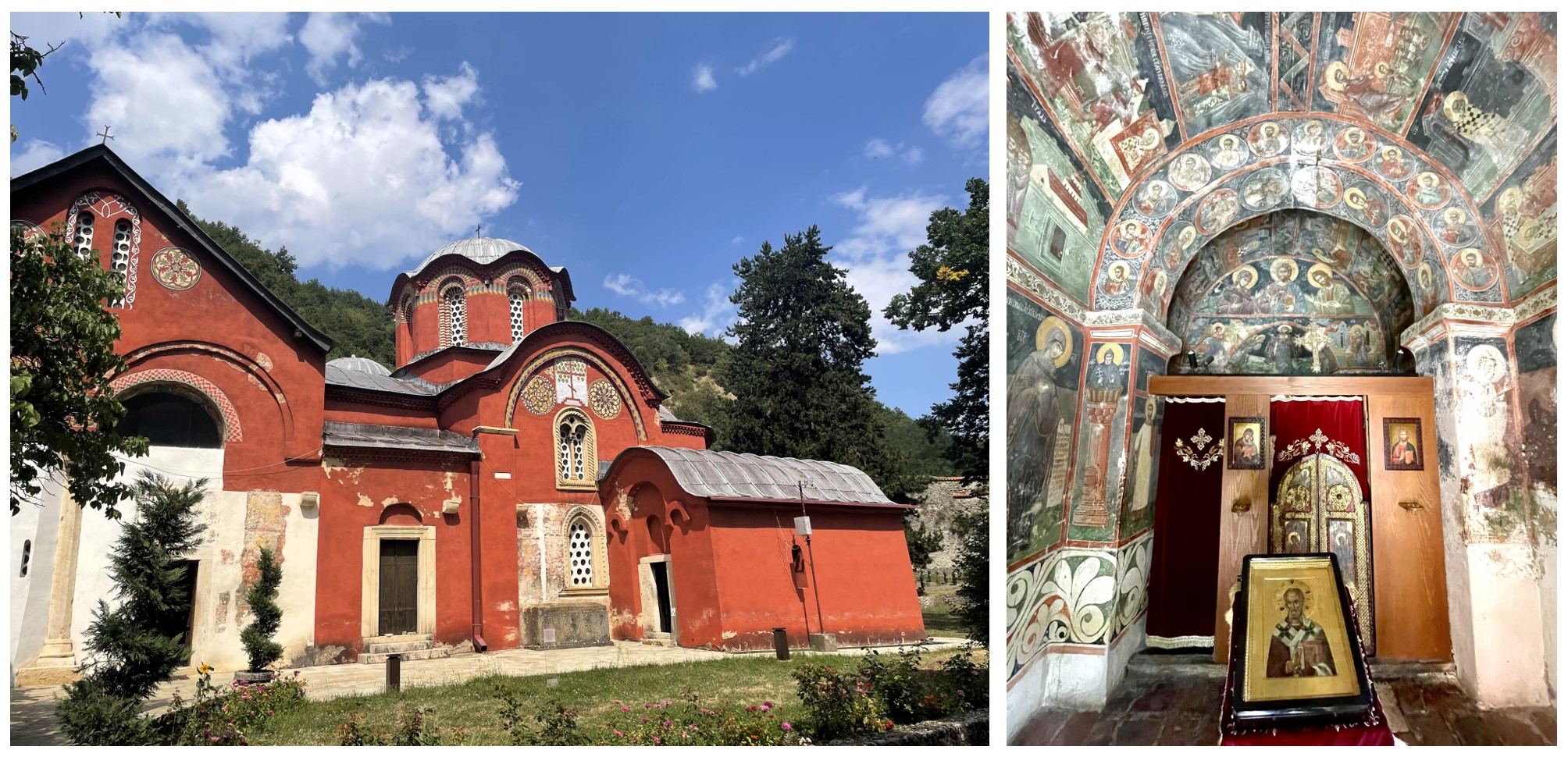
From Dečani, we headed back to Peja for lunch and to pick up our passports before continuing to the Patriarchate of Peć, another of the UNESCO-designated Medieval Monuments of Kosovo. The Peć monastery was guarded by police rather than KFOR, though passports were still required for entry. Unlike Dečani, Peć is set within a walled garden, and instead of marble, its 13th-century church has a bright red plaster exterior — the same color as when it was first built. There were also more visitors here; at Dečani, we had been two of only a handful, but Peć had at least a dozen, along with a few very watchful nuns. The frescoes, though less extensive than at Dečani, were just as beautiful. We enjoyed the visit, though by the end, we had certainly had our fill of ecclesiastical art for the day.

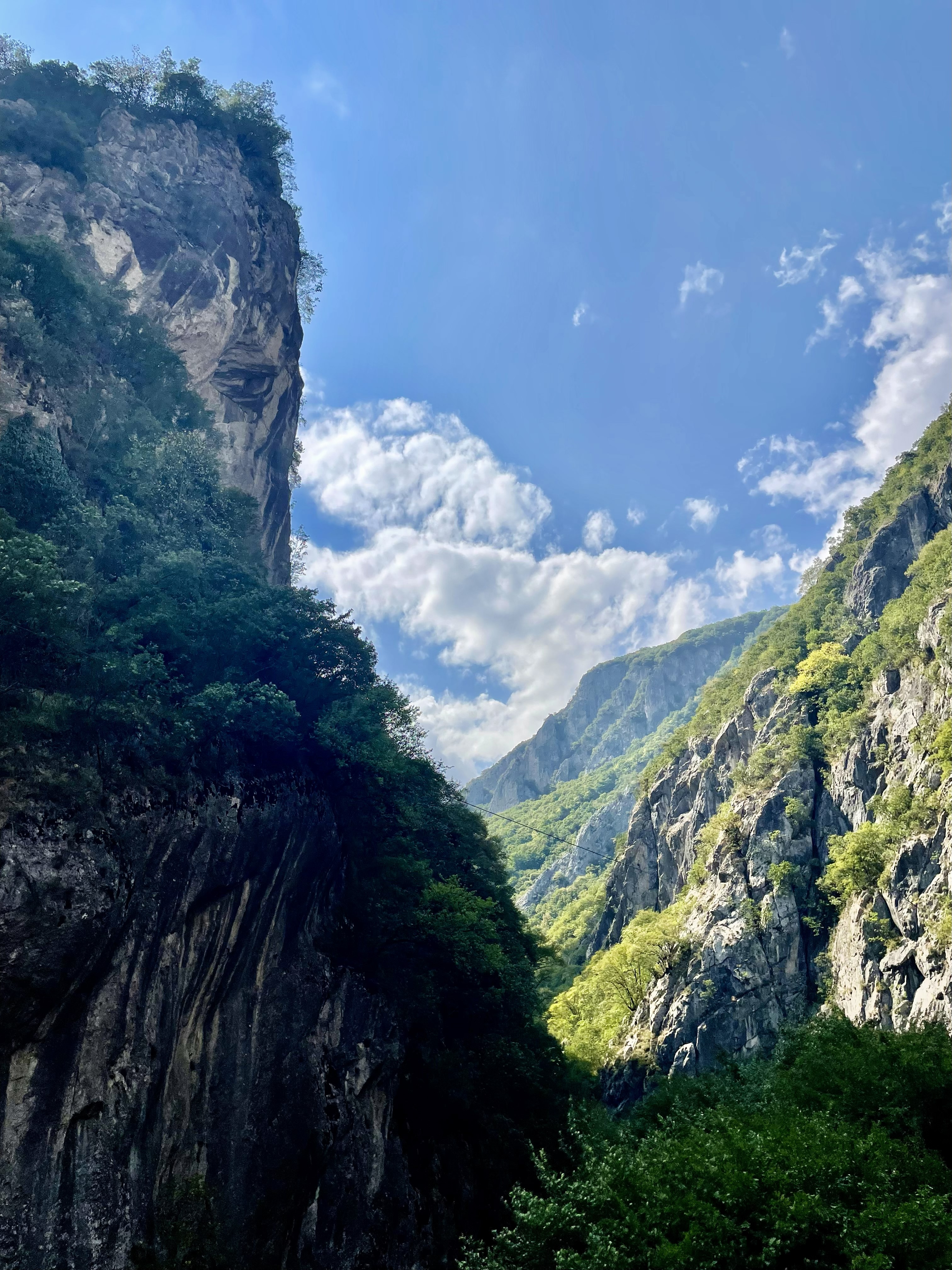
A glimpse of Rugova Canyon

After Peć, we continued up the road into the Rugova Canyon. Though we were both tired, it was an absolutely gorgeous day, and I wanted to see at least a few of the viewpoints. C, however, was ready for a nap in the car, so my stops were brief — just long enough to take in the view before moving on. As we’d encountered so often on this trip, the mountain road was narrow and winding, but this stretch added a few short tunnels carved straight through the rock. I drove only as far as the Hotel Panorama, about eight miles in, before turning back. The scale of the canyon was humbling — sheer cliffs, deep shadows, and a vastness that was beyond words.

We returned to our hotel in Peja completely knackered — we had packed a lot of sightseeing into one day. After resting for a few hours, I headed out alone at the golden hour while C stayed behind. That was fine; she had already shown far more interest in art, architecture, and history on this trip than I had expected, and I welcomed the chance for a quiet walk. I strolled down to the Peja Town Square, a broad pedestrian area with shops, hotels, and restaurants framed by interesting architecture. From there, I crossed the bridge by the old clock and followed the Lumbardhi Peja River until I reached the stone bridge, where I crossed again. I was hoping to find traces of the city’s older past — and did: Haxhi Zeka’s Kulla, Haxhi Bey’s Hammam, and another kulla nearby. The kullat, traditional stone tower houses found throughout the Balkans, are remarkable glimpses into Peja’s history. Still, I couldn’t help but feel the city could do more to showcase these pieces of its cultural heritage.

Left: Clock on Peja’s Town Square: Right: a kullat, or traditional stone residential tower-home in Peja

Our time in Peja had come to an end, and the next day we would return to Pristina to begin the final stretch of our journey through Kosovo. It had been a full few days — rich with history, beauty, and more than a few winding roads.

Balkans Bound, Part Five: Cetinje, Podgorica, & Ostrog Monastery

This is the fifth installment of my daughter’s and my trip to Kosovo, Albania, and Montenegro in August 2026.

C at the upper level at Ostrog Monastery

On the eighth day of our trip and our fifth day in Montenegro, C and I said farewell to Kotor. We were off to Cetinje, the country’s former capital. To get to Cetinje, I had two options: up and over Mt. Lovćen or around it. Having already had two drives through the serpentine road, I opted to go around!

Cetinje served as the royal capital of Montenegro from the 15th century and the capital of independent Montenegro from 1878 to 1914. Today, the city is still considered the seat of Montenegrin culture. It is on the UNESCO World Heritage Site tentative list for its “historic core.” With that sort of pedigree, I figured that Cetinje was a “must-see” when in Montenegro.

Left: The Court Church in Ćipur, the 1890 church in Citenje, inside which are interred several members of the Montenegrin royal family; Right: The Monastery of St. Peter

We started at the Court Church and made a circuit around the historic area. The church didn’t appear to be open, so we took in its exterior before continuing on. Our next stop was the Monastery of St. Peter, a Serbian Orthodox monastery founded in 1484. The building’s architecture was beautiful and striking, and I would have loved to go inside, but we weren’t dressed appropriately. Although I’d read that tourists in shorts might be given wraps to cover their legs, there was no one around to offer them or to admit visitors. The gate that seemed to be the entrance was closed, so we lingered for a moment to appreciate the monastery’s façade, then moved on.

As we entered town, we passed Biljarda Palace, the 19th-century residence of Prince-Bishop Petar II Petrović-Njegoš (of the Njegoš Mausoleum fame), now home to a museum dedicated to his life and work. Along Njegoš Street — a pedestrian-only road through the center — we saw many fine old buildings, including the former French Embassy. Some were crumbling with age, while others were clearly in the midst of restoration. Something about Cetinje felt off — it was too quiet, almost abandoned, and C and I just couldn’t muster much enthusiasm for exploring it.

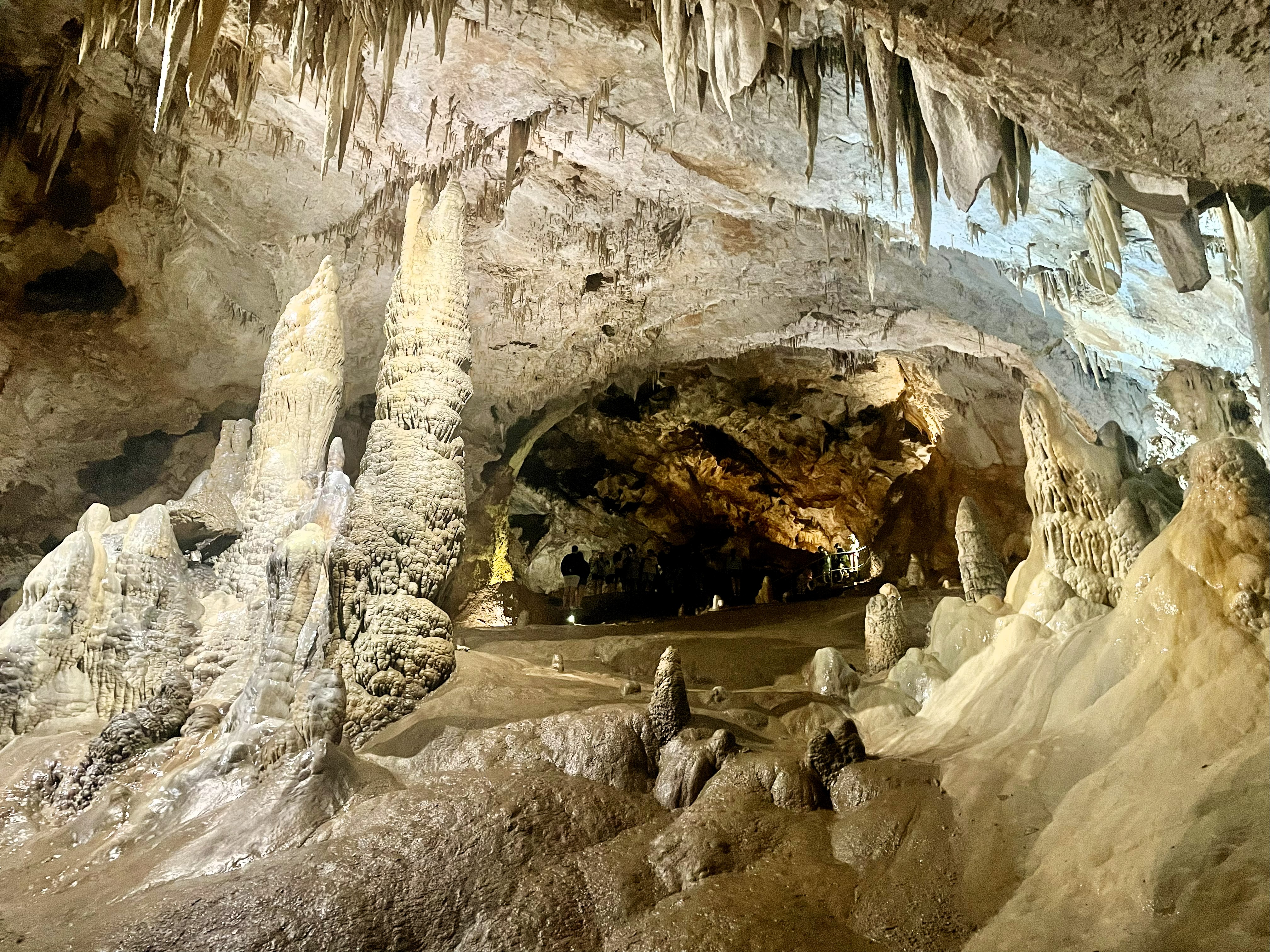
Inside Lipa Cave

From Cetinje, we continued just a short distance outside town to visit Lipa Cave — Montenegro’s first cave open to the public. Permanently opened in 2015, it’s one of the country’s largest caves and has quickly become a popular tourist attraction. I seem to have a thing for cave tours; I’ve visited Mammoth Cave, Wind Cave, Jewel Cave, Carlsbad Caverns, and Luray Caverns in the United States, along with several others around the world. Lipa Cave keeps a cool ambient temperature of about 45–55°F, so it’s definitely on the chilly side. At the car, C was wearing shorts and a T-shirt, and I insisted she put on something warmer. Being a teenager, she insisted she was “fine” and only grudgingly put on a sweatshirt. But when we reached the cave entrance, she quickly realized I hadn’t been kidding about how cold it would be! Our visit included a one-hour guided tour, which proved both fascinating and refreshingly cool. Even C expressed a lot of interest! Once back outside, we were grateful for the summer heat.

After exploring Lipa Cave, we continued on to Podgorica, Montenegro’s capital, which would be our base for the next two nights. After several busy days, we opted for something familiar and went to the Hard Rock Café for a late lunch — a bit of a travel tradition for C and me, as we’ve visited locations all over the world. Downtown Podgorica felt a little untended and quiet, though parking was surprisingly difficult. Lunch, unfortunately, was forgettable, and we spent the rest of the evening simply relaxing at our hotel.

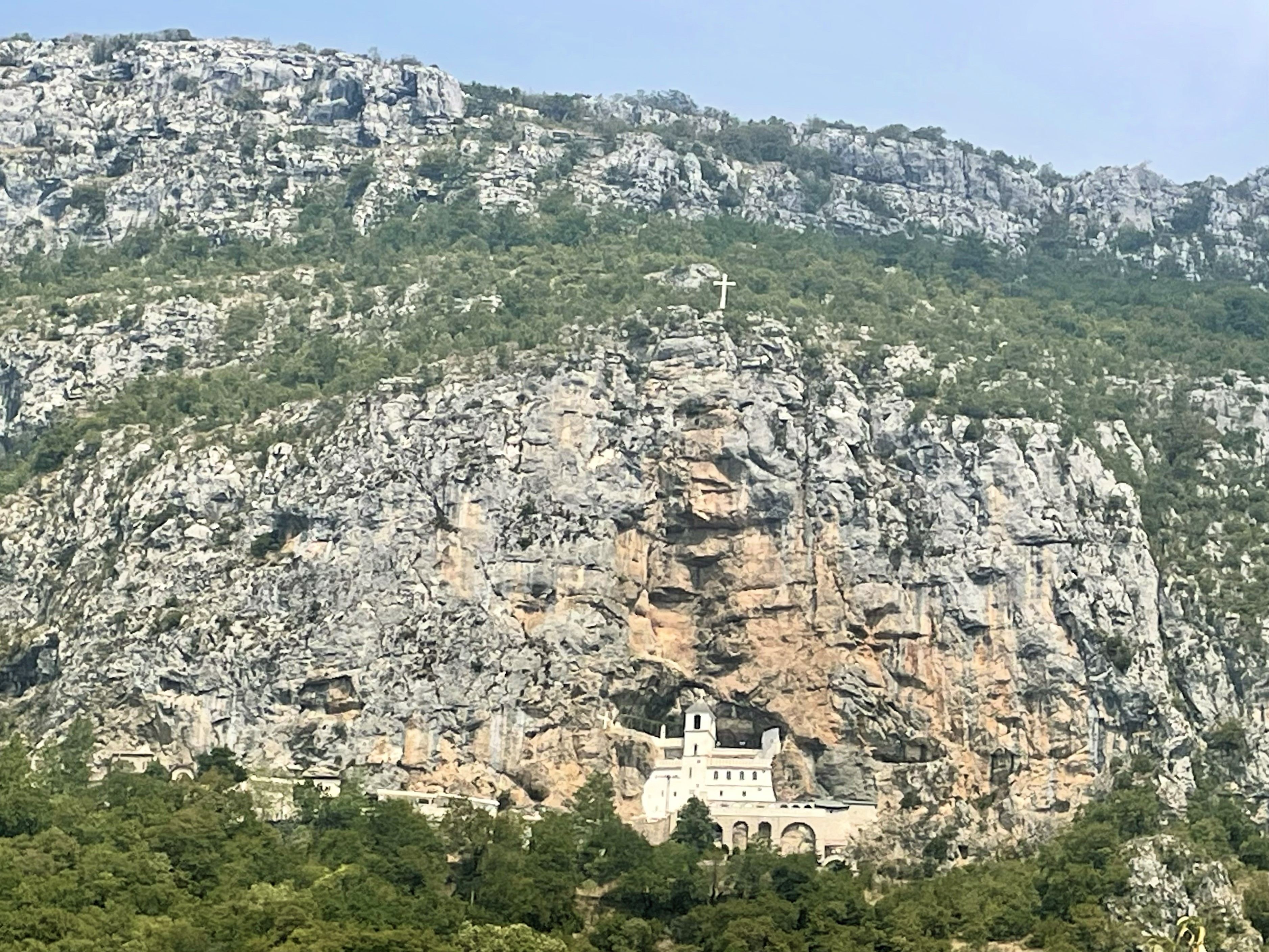
Ostrog Monastery from a view point just above the lower monastery demonstrating the near vertical limestone cliff of Ostroška Greda

The following day, our main sightseeing goal was Ostrog Monastery. Built in the 17th century, this Serbian Orthodox monastery is dramatically carved into a sheer, almost vertical cliff of solid rock. It’s not only the most important pilgrimage site in Montenegro but also one of the most revered in the entire Balkans.

Ostrog is about an hour’s drive northeast of Podgorica. For the first fifty minutes, everything was smooth sailing — easy roads and light traffic. Then, as we neared the lower monastery, about three kilometers below the upper one, traffic ground to a crawl. I wondered if we should have parked at the lower monastery and walked up. But by then, we’d passed the lot and were fully committed to the narrow, winding road — no turning back (literally). Ostrog sees about 100,000 visitors a year, and I’m fairly certain most of them showed up that same day. Traffic attendants were trying their best to direct the chaos while crowds of pilgrims and tourists hiked up from the lower parking areas. It took us nearly another hour just to find a spot. When we finally arrived at the upper monastery, we joined the long line to get inside — though, thankfully, it moved faster than the traffic. Once inside, it seemed we could spend as much or as little time as we wanted.

Sights of Ostrog Monastery

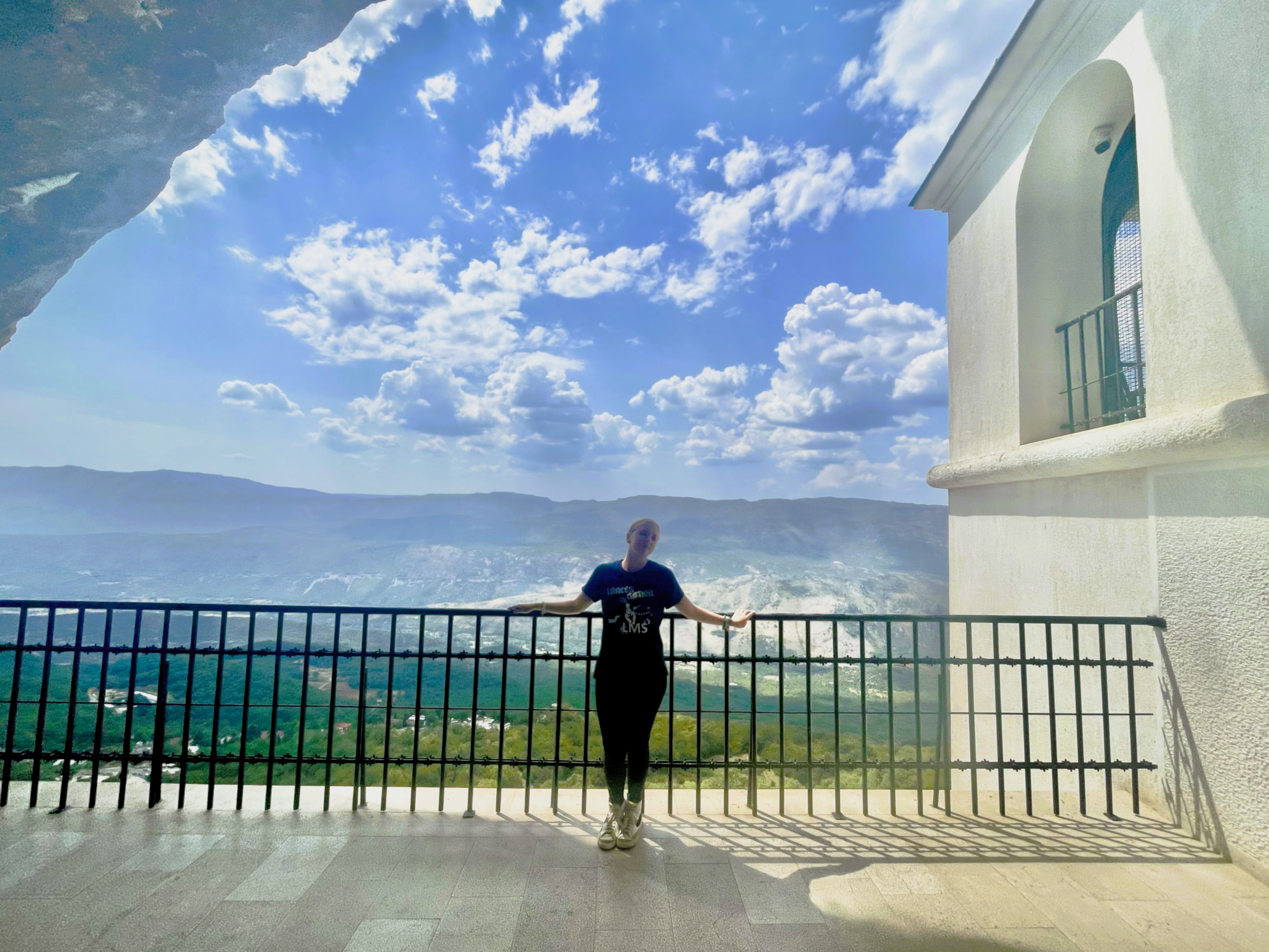
We spent about an hour at Ostrog. The monastery itself isn’t all that large — the upper section consists of two cave churches, a stairwell, and a terrace that opens onto breathtaking views of the Zeta Valley. The main church was damaged by fire in the early 20th century, but the cave churches and their frescoes survived and remain the site’s most historically and spiritually significant features. Beyond its religious importance and remarkable engineering, the sheer setting is unforgettable. Once again, we lucked out with perfect weather to take it all in. C, ever the good sport, joined the pilgrims in kissing the rocks, relics, and other sacred spots — but after a while, her enthusiasm began to fade. I started getting those unmistakable, withering teenage looks that signal it’s time to call it a day.

It turned out our timing was perfect. We made it back to the car and even managed two quick stops — one at a viewpoint and another at the lower monastery — before the skies opened in a torrential downpour. We got back to the hotel, then spent the rest of the afternoon and evening chilling.

Left: Graffiti art in Podgorica’s old town; Right: the Old Town Clock Tower, built in 1667.

The next morning, we went into Podgorica to explore the old town. Being a Monday, the city felt livelier — more traffic, more people, and completely full parking lots. I finally spotted a space, only to realize it was in a reserved lot, but after a little negotiation with the attendant, he agreed to let us stay for just an hour. With that, we set off on a rapid sightseeing tour. We headed for the old town — Stara Varoš (Стара Варош) — an Ottoman-era neighborhood that was once the heart of the capital between the 15th and 19th centuries. Much of it was destroyed during World War II, and perhaps a walking tour might have brought its history to life, but ours was at a sprint, and whatever traces remained were easy to miss. We made it back to the car just in time.

As we drove to Kosovo for the final days of our trip, I thought back on our time in Montenegro — full of history, dramatic scenery, challenging mountain roads, and a fair bit of adventure, not to mention the cats.

Balkans Bound, Part Four: Kotor & Surroundings

This is the fourth installment of my daughter’s and my trip to Kosovo, Albania, and Montenegro in August 2026.

Our Lady of the Rocks

On the sixth day of our trip and our third day in Montenegro, we took the car and drove about 30 minutes north along the Kotor Bay road to the small town of Perast. Although Perast was also Venetian, it was not enclosed by city walls like Kotor, Budva, or Sveti Stefan; instead, it was protected by nine defensive towers and a fortress. Also, unlike the other towns, Perast has not outgrown its historic location; it has no modern buildings and no roads through it. There are only the traditional stone houses and baroque palaces. And in its bay, the Church of Our Lady of the Rocks.

Since I’d read that parking in Perast fills up quickly during the peak summer season, I wanted us to get there early. Although we’d beaten jet lag from day one, we’d fallen into a routine of waking up around 8 AM and leisurely getting ready for a 9 AM start. As we approached Perast, we could see that several small lots were already full, and cars were parking alongside the roadway and walking further. But the Gods of Parking must have been shining down on me as we pulled into the lot closest to the town, the man at the entrance made eye contact with me and offered me his space IF I also purchased a ticket from him for the boat out to Our Lady of the Rocks. Done!

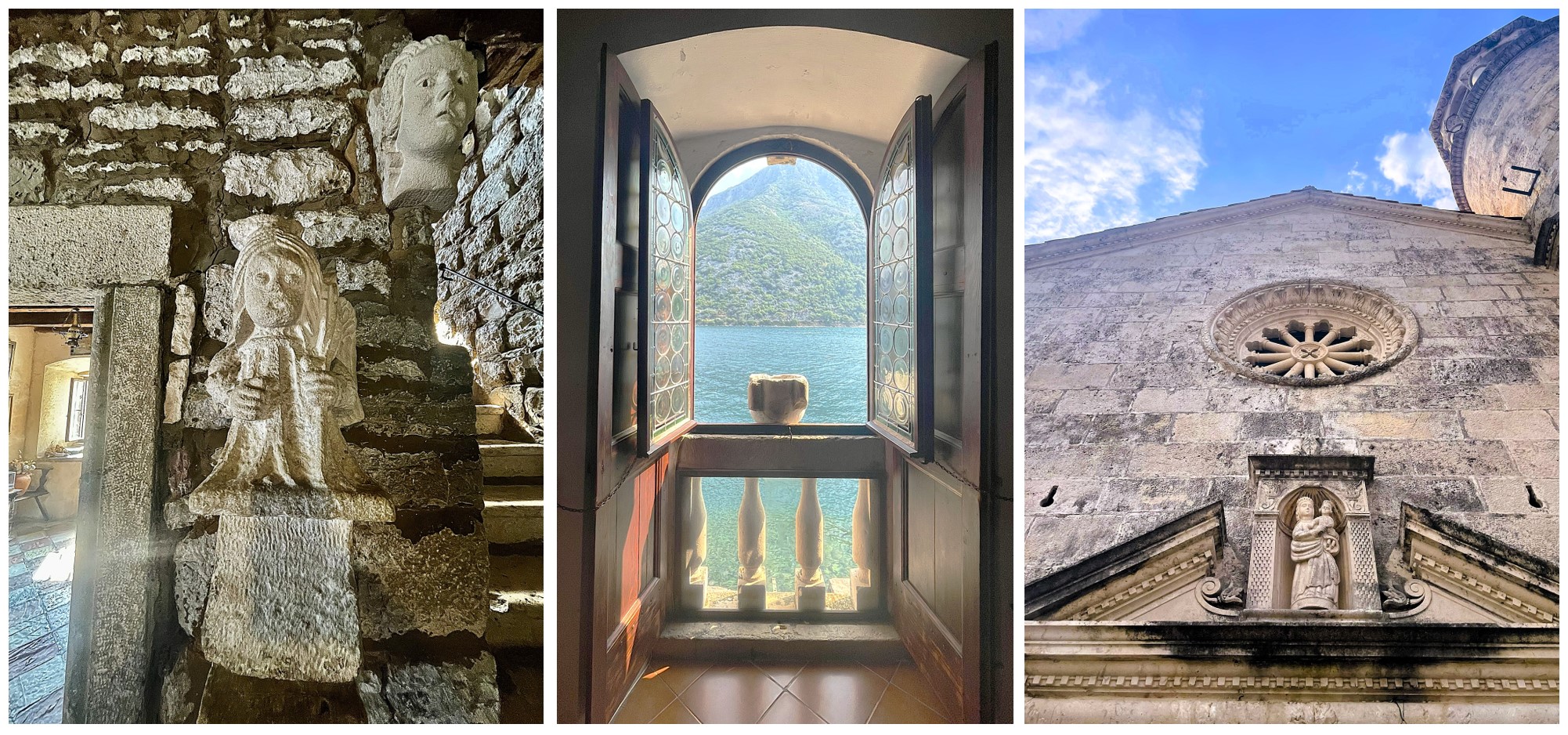
Some photos from our visit to Our Lady of the Rocks, Perast, Montenegro

The 17th-century church Our Lady of the Rocks stands on an artificial island that townspeople began creating around 1452 by dropping rocks and sinking old ships. A young man with impeccable English (so much so that I asked if he was North American) ferried us over to the island, giving us half an hour to explore before returning to pick us up.

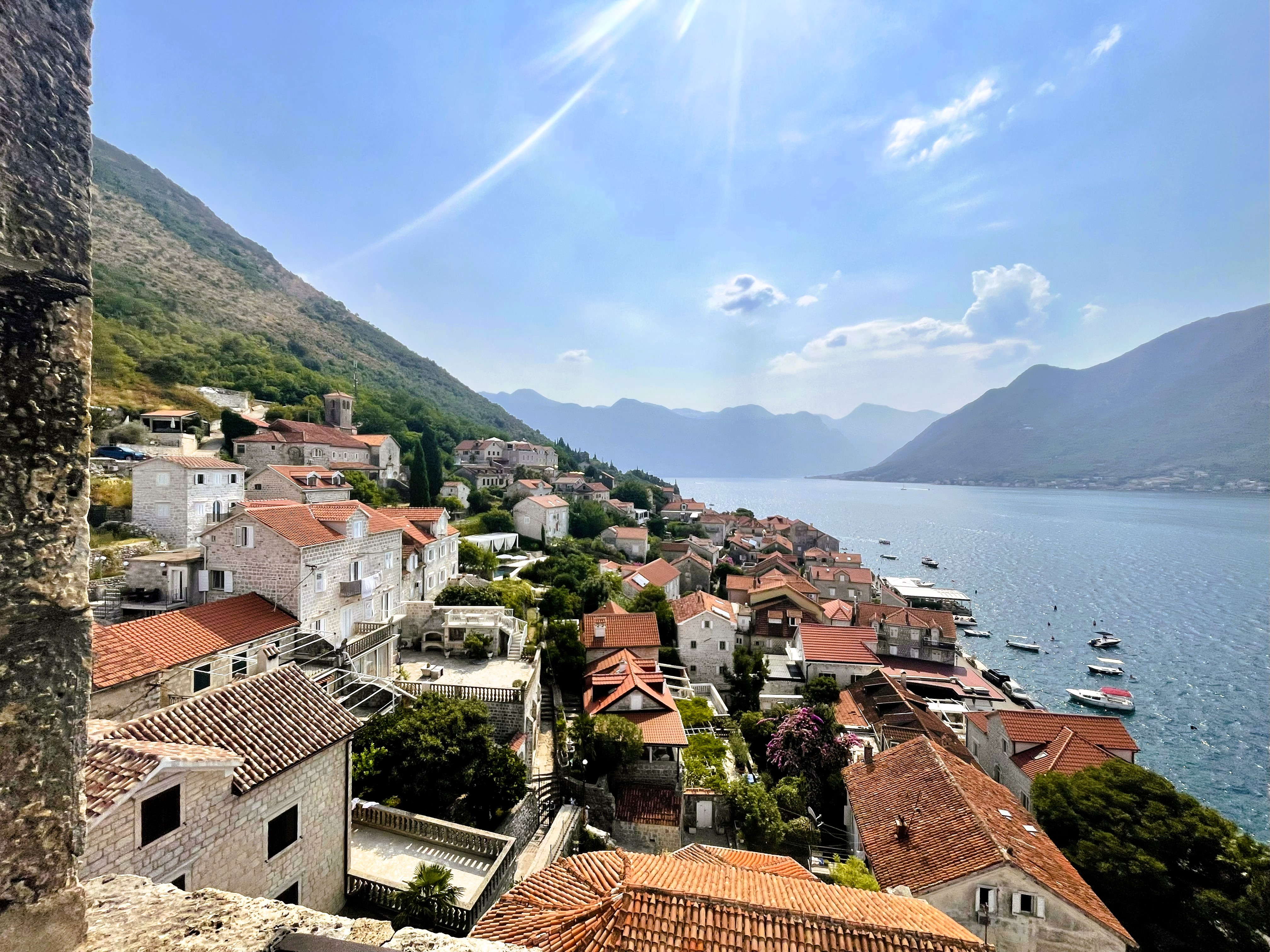
A view of Perast from the top of the church bell tower

We made the most of our time, making sure to circle the church to take in all its exterior details, and also joining a tour that led us through its beautiful interior. The island is small and doesn’t take much time to explore, but it was crowded, and the number of people allowed inside the church at any one time was limited. Had we been alone on the island, 30 minutes would probably have been fine, but on our visit, I felt a little rushed. But, it would have to do.

Back in Perast, we did a bit of sightseeing and climbed the very narrow stone steps to the top of the bell tower at the Church of St. Nicholas. I later learned that children under 15 aren’t supposed to climb, but no one asked about C’s age, nor did they say a word to us. I guess our one-euro payment was enough to overlook that little detail. We finished our walking tour with a bit of gelato, because why not have some for brunch when on vacation in Europe?

Our next stop was the Mausoleum of Njegoš. It was only about an hour’s drive from Kotor, but much of the route wound along a serpentine road climbing up Mt. Lovćen. I’ve done plenty of driving in all sorts of places, so I was mostly fine with the road, but it demanded a lot of concentration and patience with so many others making the same journey. We broke up the journey with lunch at a restaurant high up on the mountainside with a tremendous view of the Bay of Kotor.

Left: Screenshot just before we entered the serpentine road on Mt. Lovćen; Right: A view of the Bay of Kotor from along the road up Mt. Lovćen

After lunch, we continued our climb, navigating a few more dramatic twists and turns before the road finally leveled out near the top. We entered Lovćen National Park and followed the winding route on to the Mausoleum of Njegoš, perched atop Jezerski Peak — the second-highest of Mount Lovćen’s two summits — at 5,436 feet above sea level. The mausoleum honors Petar II Petrović-Njegoš, a 19th-century ruler and poet, who chose this peak for his resting place because of its sweeping views over the land he cherished.

We parked in the parking lot and took the 461 steps, most of which are located in a tunnel that goes through the mountain itself, up to the mausoleum. I was not prepared for what greeted us at the top—the solemn light granite structure with an entrance flanked by statues of two women in traditional Montenegrin dress and the breathtaking 360-degree views over Lovćen National Park. I can understand choosing such a spot as one’s final resting place. I felt contemplative and even blessed to be able to visit. I had almost given this place a pass.

The Mausoleum of Njegoš

Unfortunately, the quickest way back to Kotor was the same serpentine road we had taken up. The drive down felt both less stressful — because we knew what to expect — and more stressful, thanks to heavier traffic. Several times we had to pull as close as possible to one edge or the other to let another vehicle pass. At one point, we were caught in a logjam when several full-sized buses tried to navigate an especially narrow stretch. Thankfully, a few people got out of their cars to direct traffic — some drivers were asked to back up, others (including me) to inch along the cliffside — until there was finally enough room for the buses to squeeze through. Once back in Kotor, I breathed a sigh of relief. With plenty of excitement for the day, we picked up some groceries, made a meal of sandwiches and chips on our balcony, and had a quiet evening.

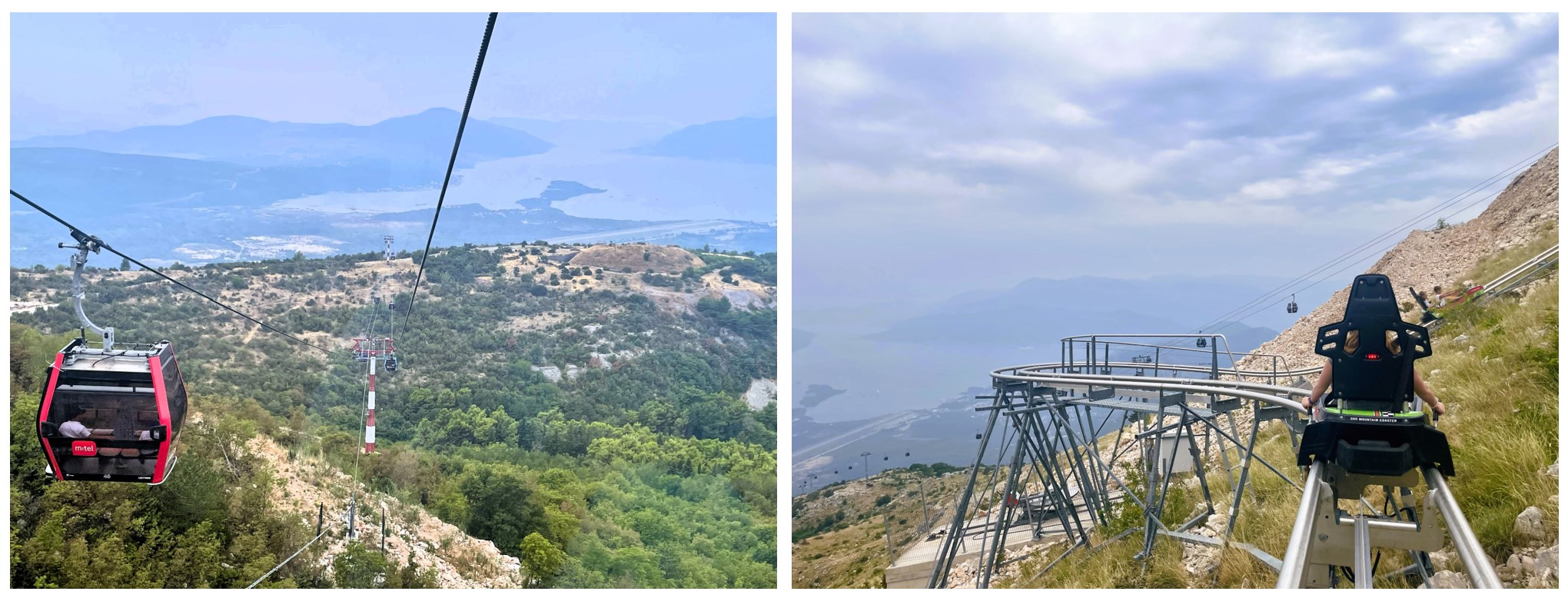
On our final day in the Kotor area, we started with a ride on the cable car, which climbs another part of Mount Lovćen. From the lower station, it travels 3,900 meters (about 12,795 feet) in just 11 minutes to reach the upper station, perched 1,316 meters (4,218 feet) above sea level. Along the way, the views are breathtaking — stretching across the mountains, over the Bay of Kotor toward the side near the airport, and almost all the way to the Adriatic Sea.

Left: Our view from the Kotor Cable Car as we near the top; Right: C just ahead of me on the Kotor Alpine Coaster with a dramatic view of the cable car and beyond

The cable car ride itself was pleasant enough, and the views were well worth it, even as the first clouds of our trip began to roll in. At the upper station, however, a new attraction awaited: the alpine coaster — a self-controlled mountain ride where riders regulate their own speed with a brake lever. C and I have ridden similar coasters in Jamaica (at Ocho Rios) and the Great Wall of China, both of which offered thrills. But the coaster in Kotor takes it up a notch, perched dramatically on the edge of a mountain. Though two people can ride together, C opted for her own car. As the car sped down the first hill and headed toward the edge, I really wondered what I was thinking! But we both loved it so much, we rode it two more times!

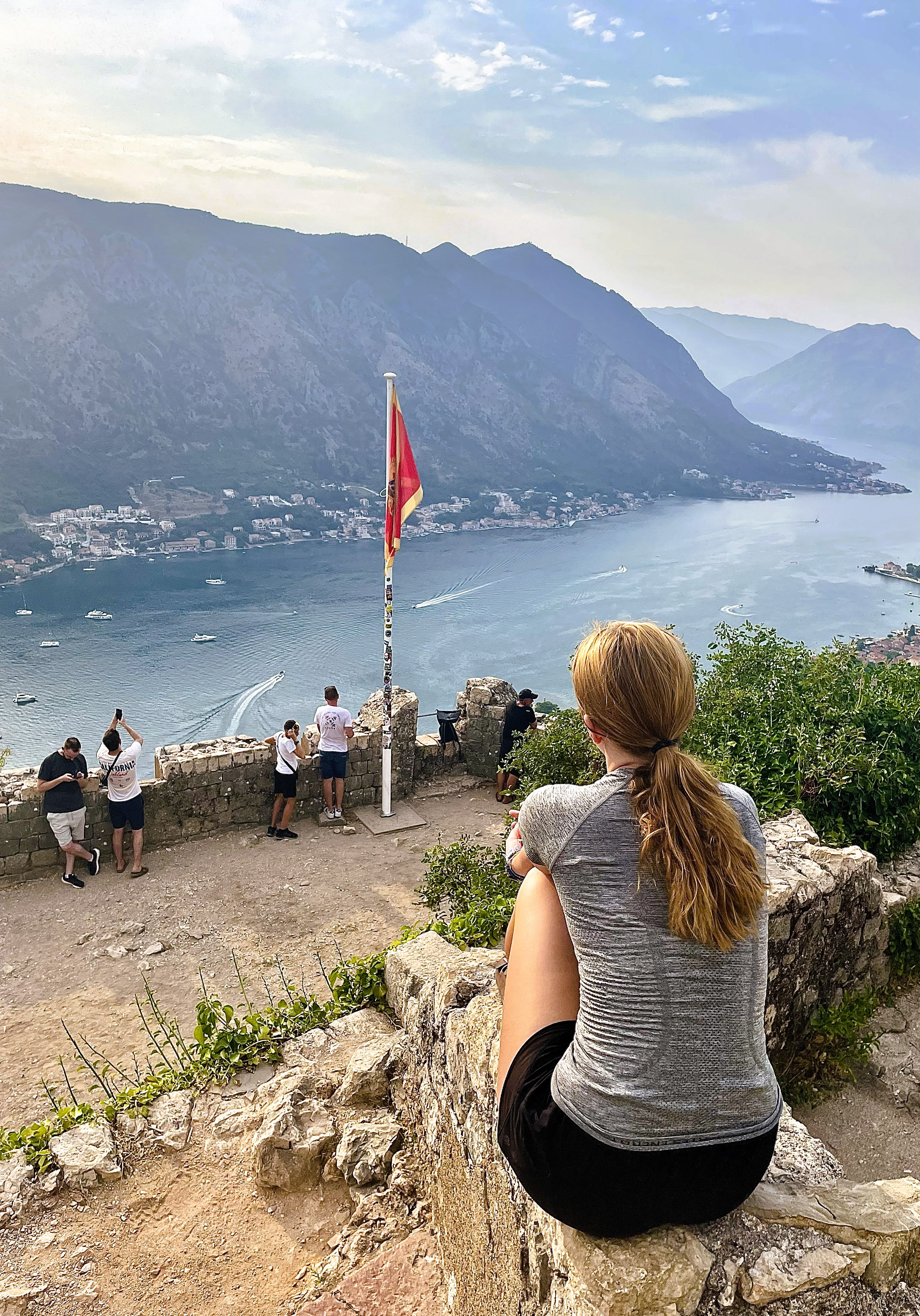
C surveys Kotor from St. John’s Fortress

Back in Kotor, we had one more thing to do: climb to the 6th-century St. John’s Fortress, which sits like a sentinel above the old Venetian city. Starting from the back of the old town, we paid the 8 Euro entrance fee and then followed a steep path along the fortifications that clung to the near-vertical slope of St. John’s Hill. It was not easy going; it was hot, we were a bit tired, and the steps were uneven or non-existent. As we climbed, C frequently asked if we could just stop or if I would leave her somewhere to wait, but then she would reluctantly press on. There were times when I, too, thought, maybe this point is good enough? But I really wanted to reach the top. The views along the way—and especially from the top at St. John’s Fortress—were amazing, and once at the fortress, C conceded that maybe it had been worth it.

Accomplished, we made our way back down, rewarding ourselves with some gelato in town before we headed back to the guest room. We needed to prepare for the next part of our journey.

Balkans Bound, Part Three: Arrival in Kotor

This is the third installment of my daughter’s and my trip to Kosovo, Albania, and Montenegro in August 2026.

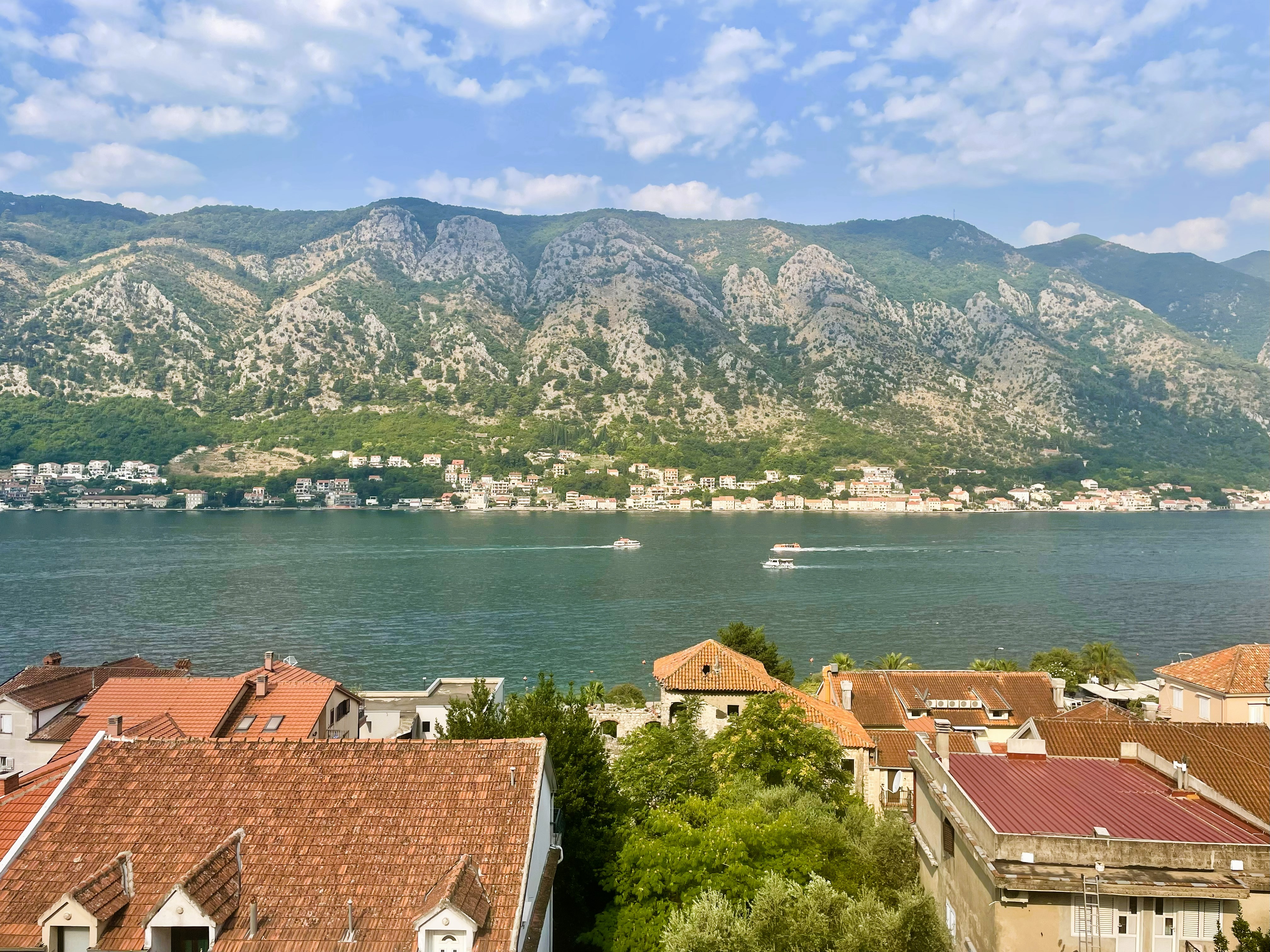
The view from our guest room in Kotor, Montenegro

The morning my daughter and I were departing Shkoder, Albania, for Kotor, Montenegro, I checked the route in my maps app and discovered the most direct route across the border was closed due to wildfires. The heat wave we had been experiencing had contributed to wildfires across southern Europe, including Montenegro. We would have to take another, longer route to get to Kotor. Instead of along the coast, the route that generated my whole plan to include our side trip to Albania, we would drive along the southern edge of Lake Shkodra and cross into Montenegro southwest of its capital. I opted not to drive through the capital and instead skirted the western edge of the lake, then take the only road that crossed the lake.

The drive to the border was uneventful, but once there, we faced a very long line of cars seeking to cross. Perhaps the traffic was due to this being the most popular crossing, or maybe it was caused by the other border being blocked by the fires; either way, it was tedious. At last, it was our turn, and I handed over our passports to the Montenegrin immigration official. He demanded to see the rental car papers, and I passed him the rental agreement. He stared at me, annoyed, and asked for additional car papers. I said I had not had to provide anything additional in Albania, and he gave me one of my most memorable quotes of the trip: “I don’t know about Albania, but in Montenegro, we have rules.” I explained that that was all I had, so he told me “Then, you will not be able to cross,” and asked me to pull over to the side.

Left: Screenshot of Google Maps route the day after we crossed; on the day of our drive that route was blocked by another fire at that border crossing; Right: Wildfires visible around Bar as we drive to the coast

There, I sat thinking for a minute, then I opened the glovebox, and found the car registration. I thought back to the eager car rental guy back in Kosovo, who had quickly shown me all of the car’s scratches, but when I has asked about crossing borders had said it would be “no problem” and failed to mention the all-important car registration. Sigh. I realized that the immigration official likely needed this, so I grabbed our passports, the registration card, and told C to wait in the car, and walked back to the official. He shook his head at my apparent stupidity and stamped us into the country.

View of the famed Sveti Stefan from the coastal road

We were now even further behind my hoped-for schedule. Things only got worse as we drove along narrow roads and encountered random traffic. I had hoped the drive across Lake Shkodra would allow for a quick photographic stop at Fort Lesendro, a fortress located on an island on the lake, which the road crossed, but there was no place to pull off. It passed in a blur. We drove over the mountains to meet the coastal road, and as we neared the coast caught sight of smoke plumes from wildfires on the hills around the popular town of Bar. Though this was a very time-consuming detour, I felt glad I had not chanced our original route.

We stopped briefly along the coastal road to photograph Sveti Stefan, a 15th-century Venetian fortified town located on a small island connected to the mainland by a narrow isthmus. It is so beautiful that photographs of this location are used for many a screensaver. However, the island is private and used as a luxury resort. I had considered driving up to a small church further up the mountainside for its views of Sveti Stefan, but we were already so far behind that our one quick stop would have to do.

Sights from Budva’s walled town

Our lunch stop was Budva, a larger Venetian walled town just a little further up the coast. My plan had been to arrive around 11 AM, but instead, we arrived three hours later, tired and hungry. Parking was a bit of a nightmare; I had read it was difficult in the height of summer, and headed for a mall parking lot that online had said was usually available. The lot was full, so I had to wait until a car departed before I could pull in and park.

Sunset in Kotor Bay our first evening

There were quite a lot of people in the walled town. Some of the narrow walkways were wall-to-wall tourists. The tiny beach in front had almost no square of sand unoccupied. Yet, the first few restaurants we tried were closed. It was quite hot. Bothered by the crowds and the heat, we decided on smoothies from a little hole-in-the-wall shop. Fortified, we toured the Citadel and the narrow streets. Had it been less crowded, it might have been nice to see some of Budva outside the walls, or maybe not. There were just far too many people and we could not feign longer interest. We wanted to get to Kotor.

Though only an hour north, there was again heavy traffic through the center of Kotor. And, when we arrived at our room for the next four days, the manager was not on site, though I had messaged upon our departure from Budva. Finally, he arrived (he had been at the beach) and showed us to our lovely flat on the top floor of his multi-story condo. With our last bit of energy, we made a quick stop trip to a nearby supermarket so we could have dinner in peace and quiet, on our balcony while we watched the sun set over Kotor Bay.

Left: A coin from the Cats Museum; Right: One of the super cute cats of Kotor

The next day, C and I set out to explore the UNESCO-listed old town of Kotor. Our first stop had to be the Cats Museum. The only other place I have visited a cat museum was in Kuching, Malaysia. Kuching means “cat” in Malay, and Kotor’s historical name under the Venetians was Cattaro. Though that does not mean “cat,” it seems the people of Kotor, who have taken to protecting the numerous street cats of the town, rather enjoy the play on words.

C in front of the 10th century Roman Catholic St. Tryphon Cathedral in Kotor’s old town

Kotor’s Cats Museum is small, just two small rooms and a reception/gift shop. Yet it is chock full of cat stuff – propaganda with cats, studio photography of persons with their cats, postcards, newspaper articles, currency, and so on, all featuring cats. Proceeds from the museum’s entrance fee and the sale of its souvenirs support the care and feeding of Kotor’s street cats. C and I loved the museum and finding Kotor’s cats throughout the town.

We had lunch outside in one of the many small squares of the walled town. Then C and I did a bit of sightseeing and window shopping. C had actually done some online sleuthing and informed me that shopping is a big thing to do in Kotor’s old city, and it would be key for us to take part. By the early afternoon, though, we were again tired by the heat and the long day of road travel the day before, so we returned to our guest room to rest.

In the late afternoon, I was ready to return to the old town, but C bowed out. We had been rather “go-go-go” for the past few days, and it was just the right day for her to take a break. I relished the time to just see things at my own pace, to go slowly and take photos of whatever I wanted without a teenager telling me her legs hurt or she was bored or asking “How much longer are we going to be here?” I love that she is now at an age to enjoy more of the history, but can also be left in the hotel to do her own thing when I wish to do mine.

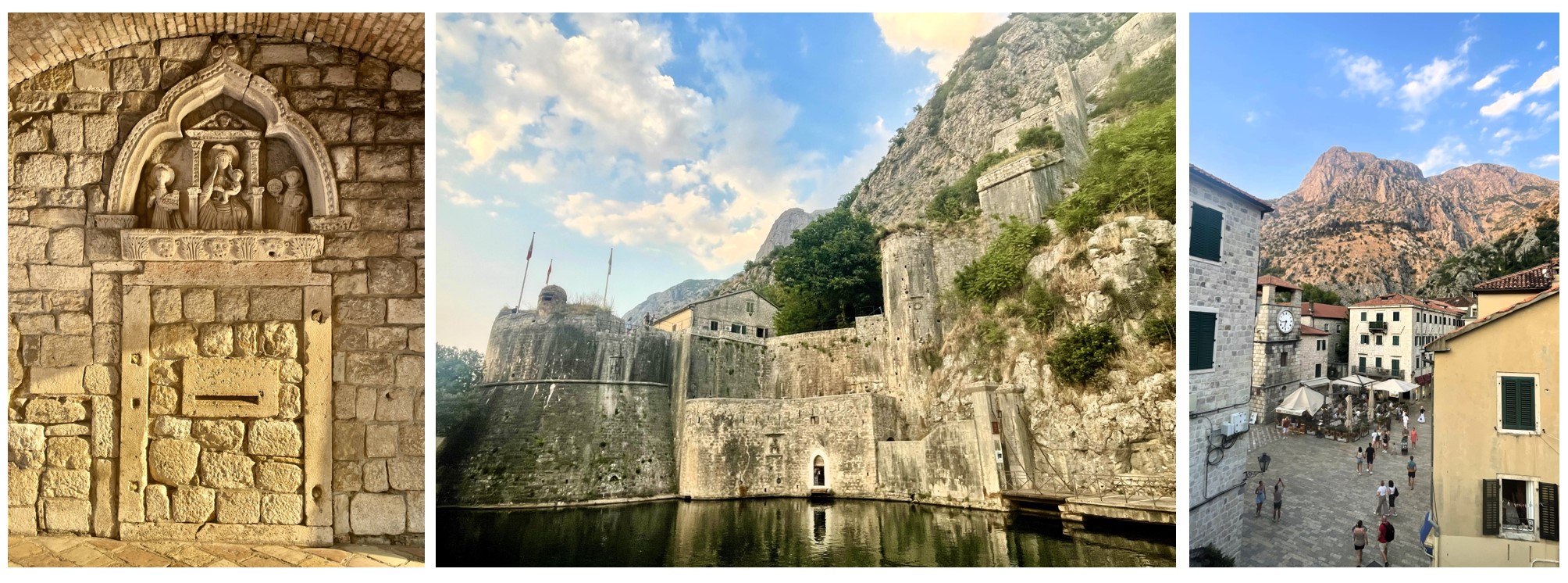
Left: The inside of the Sea Gate to the old town; Center: The Gurdic Bastion of the old town; Right: a view of part of the Square of the Arms and the Clock Tower from the top of the old town walls

I loved walled cities. I have visited many in my travels, from Avignon and Avila to San Juan, Xian, and Galle. Kotor is magnificent and I am grateful that I was able to spend a few hours exploring on my own. I could have certainly spent more time there. However, we had more to see and do in Montenegro.

Balkans Bound, Part Two: Northern Albania

This is the second installment of my daughter’s and my trip to Kosovo, Albania, and Montenegro in August 2026.

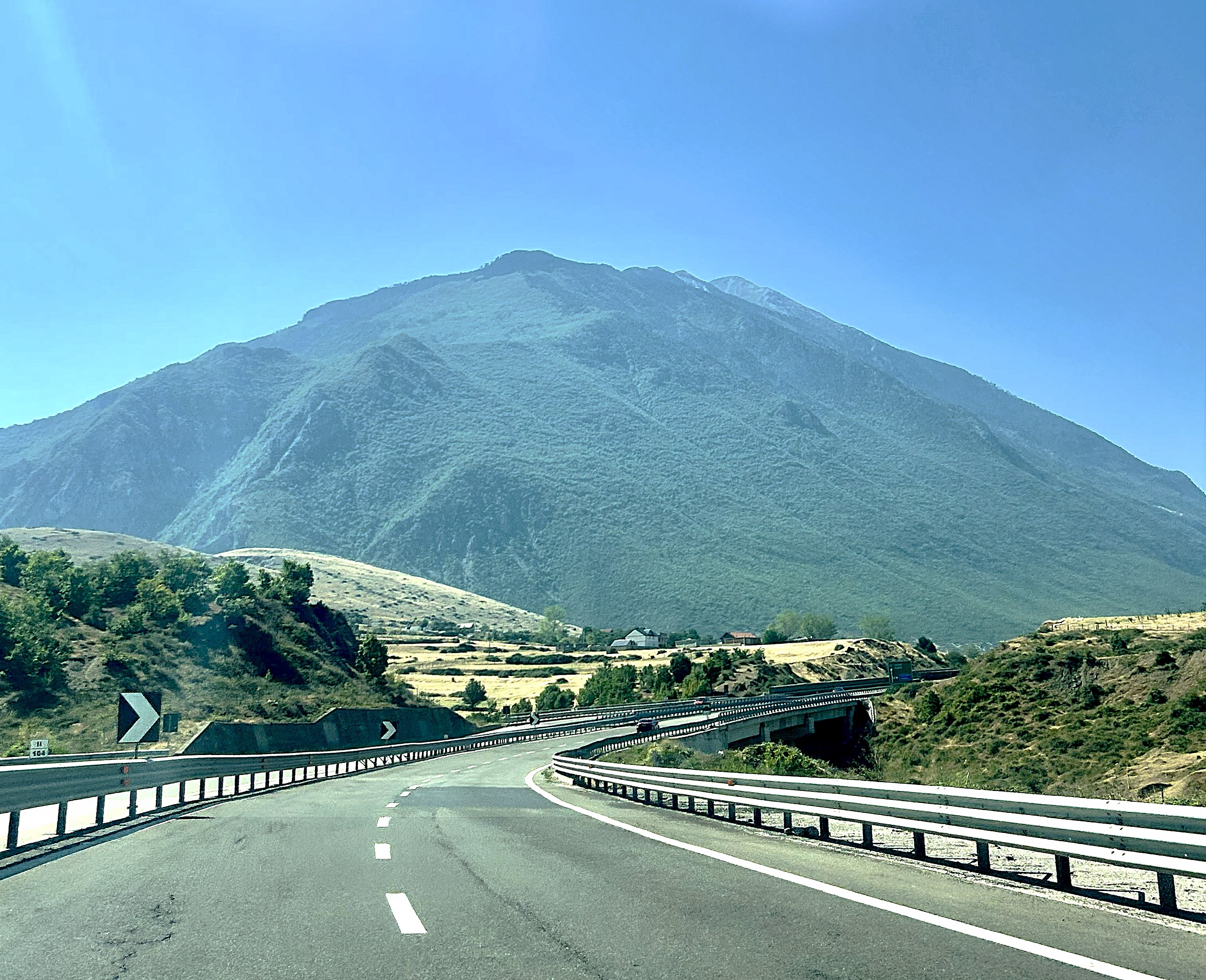
Along the road in northern Albania from Prizren, Kosovo

On the second day of our trip, C and I woke up in Prizren, Kosovo, ready to head out on the next part of our journey. When I was first planning our trip, I thought we would visit only Kosovo and Montenegro. Yet, as I looked at the map and the places I most wanted to visit, I realized it would make more sense for us to drive through northern Albania to get to coastal Montenegro from Kosovo. Otherwise, we would spend more time backtracking and driving over some of the same ground.

Back in 2000, I had planned a trip to Albania from Macedonia that had not gone quite right. Though I had then planned to visit Tirana and Durres, not northern Albania, and had instead ended up with a hilariously strange three hours in Sarande in the south, this still felt like righting a past travel wrong. C, always keen to add another country to her belt, was definitely up for it.

Sights along Shkodër’s main pedestrian thoroughfare in the city center

We first needed to fill up on gas before entering Albania and tackling the 2.5-hour drive. This led to a humorous stop at a petrol station just outside Prizren. With my non-existent Albanian and the attendant’s broken English, I managed to get the car filled up and the fuel paid for. Then we were on our way. The border with Albania is only a 20-minute drive from downtown Prizren, though I made it take longer due to finding an out-of-the-way petrol station and taking a wrong turn or two. I had no idea how long it might take at the border and was very surprised to find that it took no time at all. Neither the Kosovars nor Albanians paid our car any mind. Though I stopped at the window to hand over my passport, the three immigration agents were engaged in a conversation amongst themselves and waved me through without a glance. This was wildly different from the difficult time I had with Albanian immigration in 2000.

Our first hour in Albania went smoothly. The A1 Highway to the Kosovar border was wide and smooth. The views as we drove through the mountainous area were stunning. Then, I received a notification of a serious accident where the A1 met the road north, which would lead to delays of at least an hour. Having already departed Prizren later than expected and then losing time due to my fueling adventure, I was not eager to delay further. I turned off the A1, hoping the small roads would get me there. Oh, they did, but it still took a bloody long time.

One of the many striking photographs at the Marubi Museum that capture a snapshot of the ethnic, religious, cultural, costume, and trade history of the region; I especially loved this photo as my mom owned that exact style of Singer sewing machine

We rolled into Shkodër, Albania’s main northern city, around 1:30 in the afternoon. Unfortunately, it took about 30 more minutes to figure out the hotel parking. Google directions kept leading me down a very narrow back alley that turned into one way (the opposite direction) just before reaching the gated parking area. In the other direction, one had to drive a short way down a pedestrian-only road, then hope the bored parking attendant was in his little booth (he wasn’t at first) and then crawl behind him as he walked the 200 meters to the parking lot and unlocked it. Nerve-wracking!

We quickly checked in and headed out to a late lunch. After filling our bellies, we went for a bit of a sightseeing stroll. We felt like melting as we walked along the pedestrian street. It was 103 degrees out; a heat wave was sweeping southern Europe. We did not last long in the heat and decided to duck into the Marubi National Museum of Photography. It is a small but interesting display that marries the history of a family of Albanian photographers (the Marubbi), celebrates the art of photography, and displays a period of Albanian history captured in photographs.

We cut short our midday walk, defeated by the heat and the fatigue of having been in the car four hours that morning. When the temperature dropped a little at the golden hour of dusk, we stepped out again for another short stroll. Then we returned to our hotel, just across from the Ebe Beker Mosque, and rested up for the next day’s adventure.

On our second day in Albania, we woke up a little earlier so we could drive west, into the wonderfully-named Accursed Mountains to the picturesque hamlet of Theth. Having spent so many hours driving to Shkodër the day before, I was not overly thrilled to get back in the car again for another long drive. I had spent the night before researching other options, but nothing sounded anywhere near as appealing as Theth. So, Theth it was!

Along the road to Theth

I am so grateful that we elected to stick to our plan. The weather cooperated magnificently, and the drive delivered stunning vistas around nearly every turn. The road, though narrow and often capable of giving some drivers vertigo as it clung to mountainsides, was well-paved. I would, however, not want to make that journey in bad weather or at night. After two hours, we arrived in the hamlet at the heart of Theth National Park.
C in the Theth River, Albania

The small hamlet of Theth has a population of perhaps 300, though I cannot imagine many of them remaining in the isolated valley through the harsh winter when that winding road is impassable. Yet this stunning location draws some 5,000-10,000 tourists during the summer months.

We parked beside the very popular Pizzeria Jezerca, which fronted a small bathing beach and the Theth River. It seems that nearly all the visitors that day were at the Pizzeria. We had a great lunch and then went down to the river. Though the heat wave continued, the temperature was a few degrees cooler in Theth, maybe 95? But that river was ice cold! So cold it felt like pins prickling our skin. But oh, how beautiful the setting! And I even watched a striped snake swim nearby, slipping beneath the rocks.

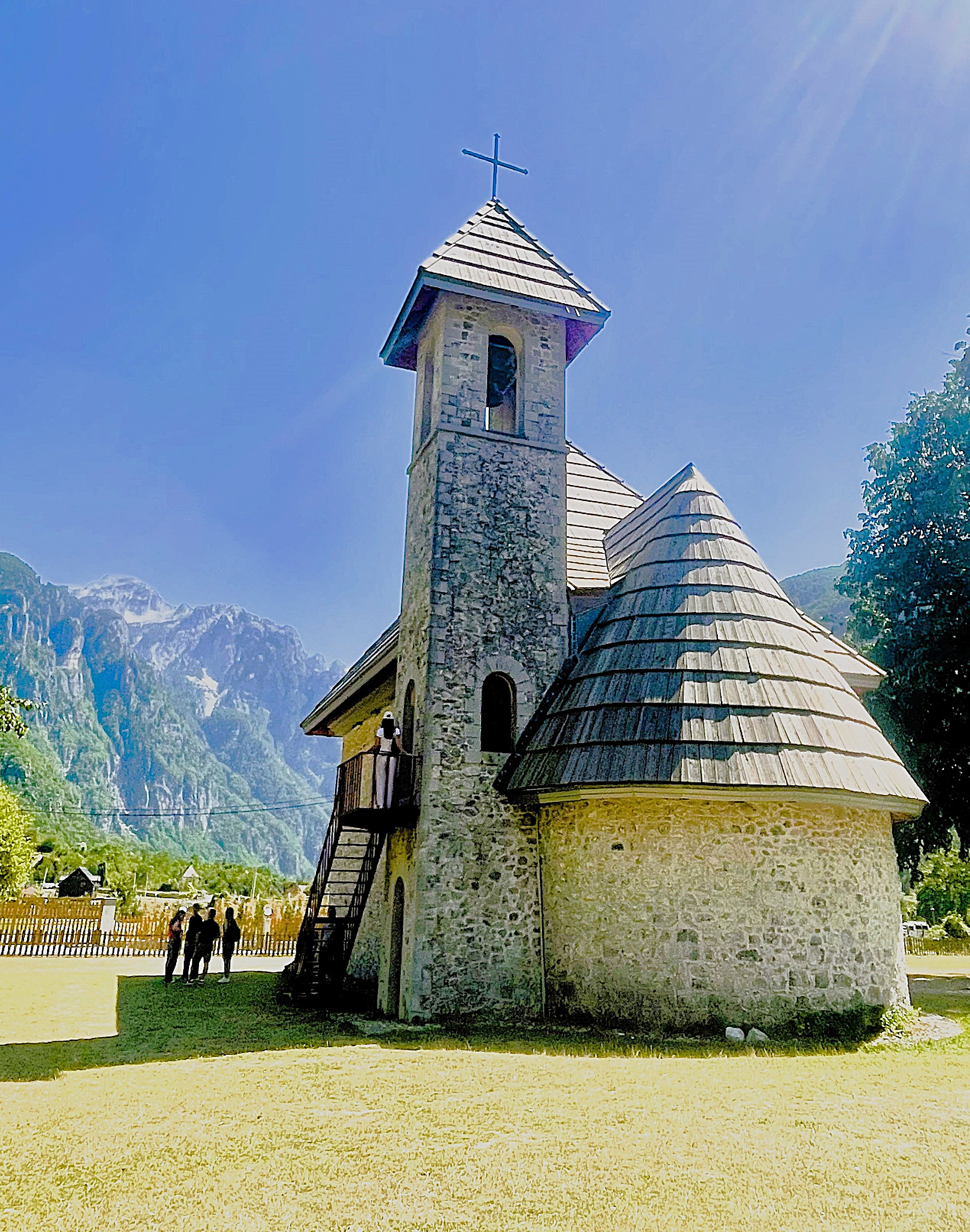
The stunningly simple Kisha e Thetit or Church of Theth

After our dip, we wandered down into the hamlet to visit its most famous landmark: the simple yet striking 1892 church. While charming in its own right as a piece of architecture, what truly sets it apart is its setting — nestled in a grassy, fenced-in field and surrounded by the towering Albanian Alps. We circled the church slowly, alternating between quietly taking it in and snapping photos.

I’m mindful that my teenager might only tolerate so much quiet admiration of historic buildings, but C seemed just as captivated as I was. After a decent pause, we continued on to the 400-year-old Reconciliation Tower — a stout, two-story stone structure once used to mediate blood feuds. Those accused in local conflicts were locked inside for protection, giving the community time to cool down and resolve tensions before resorting to violence.

By this time, the heat was again getting to us as we meandered our way back to the car. We had debated about doing the recently added zipline, but ultimately decided it made sense to begin the drive back. Although we had not really experienced any jet lag, I did not want fatigue—whether from jet lag, long driving, or the heat—to become an issue on that mountainous road. And, there was more for us to see!

The Mesi Bridge

Just outside Shkodër stands the Mesi Bridge, a stone relic of the Ottoman era built in 1770. It was designed to span the Kir River — though when we visited, the riverbed was bone-dry; there was not a trickle in sight. Yet even without water beneath it, the bridge remained an impressive and beautiful monument to Ottoman engineering. The Mesi Bridge is the longest Ottoman bridge in Albania, and one of the best-preserved in the entire region

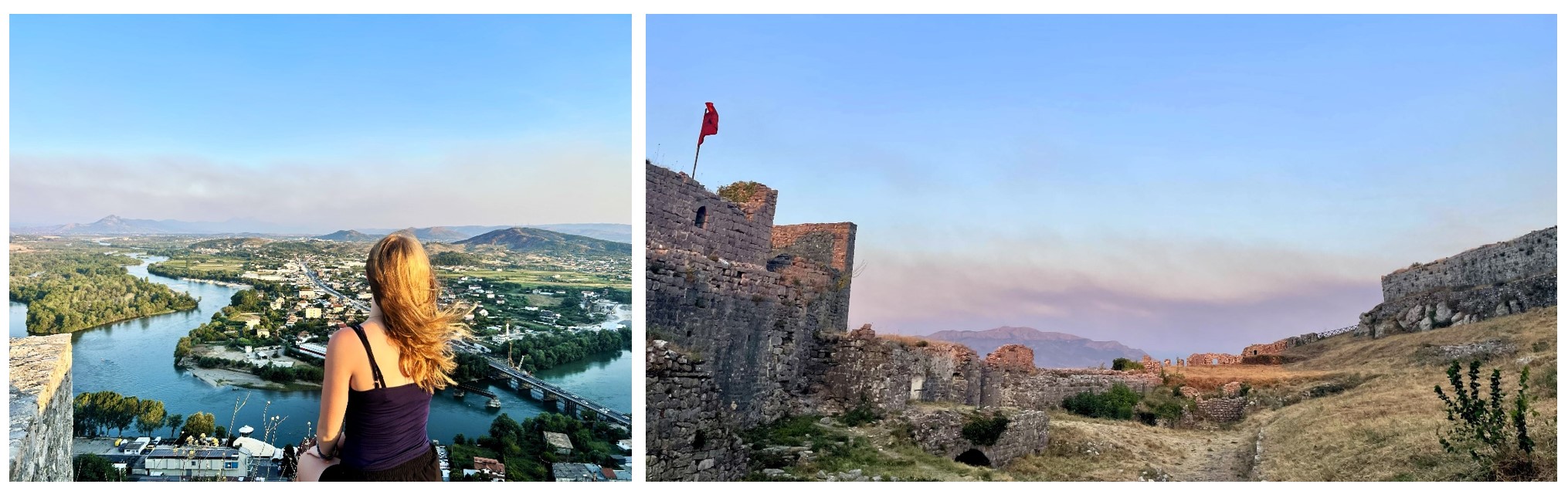
To wrap up our amazing day, we next headed to the ruins of Rozafa Castle. Located on a stony promontory outside Shkodër proper and overlooking the confluence of the Drin and Buna Rivers, the ruins of the largely Venetian stronghold (though also used by the Ottomans) are a popular place to take in the sunset.

We parked in a small lot in the front yard of an enterprising family who happened to live just across from the lower entrance. The man of the residence took time to criticize my parking, but it was in such an amusing way that I took it in stride. We then made our way up the steep stone driveway to the top entrance; I am so glad that we parked where we did, as the upper lot was small and most definitely full.

Left: C looks out from the Rozafa ruins; Right: Part of the Rozafa ruins at sunset

We easily spent an hour at the ruins. The area is quite extensive, and there were a surprising number of tour groups, yet except at a few very photogenic spots, it did not feel crowded.

I would have liked a little longer at Rozafa, but we had been on the go all day. It did not feel possible that we had done so much, seen so much in a day. Our stopover in Albania had been perfect, but it was time to head on to our next destination.

Balkans Bound, Part One: Planning, Arrival, and Prizren

The newest additions to my magnet collection

In August 2025, my 13-year-old daughter C and I embarked on an amazing two-week road trip through Kosovo, Albania, and Montenegro. Last fall, after our incredible trip to Japan, I began thinking about the next big summer trip. C asked if I would consider somewhere in the Balkans. With more than 40 countries under her belt and a love of geography, C wanted to both head back to Europe and also somewhere more off the beaten track. I had had several countries in the Balkans on my bucket list for a while, so it seemed perfect. I started to plan, and by early 2025, I had our flights, hotels, and itinerary all set.

Then the year started to go sideways. With everything going on in and around my life, I began to debate with myself whether a big summer vacation was still a good idea. I am incredibly grateful to my friends who talked me out of cancelling.

C at the airport before we started walking to our hotel

We flew into Pristina via Istanbul on an overnight flight. I again employed my long overnight flight strategy: go to bed early the night before so we’d start the trip rested, stay awake through the journey, and crash only after we arrived. It had worked surprisingly well for Tokyo — and, as luck would have it, it worked for this trip too. I slept for about an hour and C for two, and we touched down in Pristina wide awake and excited — 7 PM local time, 1 PM Washington, DC time.

I had reserved a hotel close to the airport. My brilliant plan was to stay at the hotel that evening, then return to the airport the next morning to pick up our rental car. On the map, the hotel looked close, only a 17-minute walk. We had walked from the airport to a hotel a few years before when we visited Lisbon, and I had walked from hotel to airport or vice versa in other places (I remember particularly in Bonaire and St. Kitts), so this seemed like a piece of cake. Unfortunately, the sidewalk stopped about 5 minutes out from the hotel, and we had roller bags that we then had to drag through a narrow strip of untended grass and weeds. While 10-year-old C had been game for the walk a few years ago, 13-year-old C was less than thrilled. But we both survived the ordeal, arriving at our hotel safe and sound and ready to finally get a good night’s sleep.

The 16th-century Old Stone Bridge in Prizren

The next morning, I walked back to the airport to collect our rental car only to discover that Budget does not have an office there — the Budget rental car office was right across the street from our hotel. Sigh. Just a lovely early morning stroll for me to and from the airport on a busy road. It seemed the guy sitting in the Budget office had been there for at least an hour just waiting for me, because as soon as I walked in, he spoke my name. Like something right out of a movie. He brought a little white Yaris around, showed me it had a few scratches and a long crack across the windshield, which he assured me was no problem. I signed the paperwork, and that was it. I hoped in, drove across the street to the hotel, where C and I checked out and loaded up the car. We were off. Our road trip had begun!

Beautiful wall mural in Prizren

We had only an hour drive to get to our first stop, Prizren. Kosovo’s second-largest city and its constitutionally mandated cultural capital, the area of modern-day Prizren has been inhabited since 2000 B.C. and has been a key city for the Dardanians, Romans, Serbians, and the Ottomans. As such, the small city is brimming in history.

After some trouble dealing with the difficult parking situation at our hotel located in the heart of the old city, a stone’s throw away from the Ottoman-era Old Stone Bridge that spans the Prizren river, we headed across the bridge for some sightseeing and lunch.

Following a lunch in Shadervan Square, we headed back across the river to the Archaeological Museum. The small museum is housed in a former 14th-century Turkish hammam. The museum was okay, but we were really there to climb up its watchtower so we could peek over into the neighboring plot at the church of Our Lady of Ljevis, one of the four Byzantine-Romanesque buildings that make up Kosovo’s UNESCO World Heritage-designated “Medieval Monuments in Kosovo.” I had read online that the Ljevis church was closed to the public for renovations and therefore the best way to see it was from the museum’s tower. Unfortunately, when I asked how to access the tower, the museum guide informed us it was closed for a special exhibit. So special, it seems, that guests to the museum could not access it, but only see the odd red light flashing from the top windows.

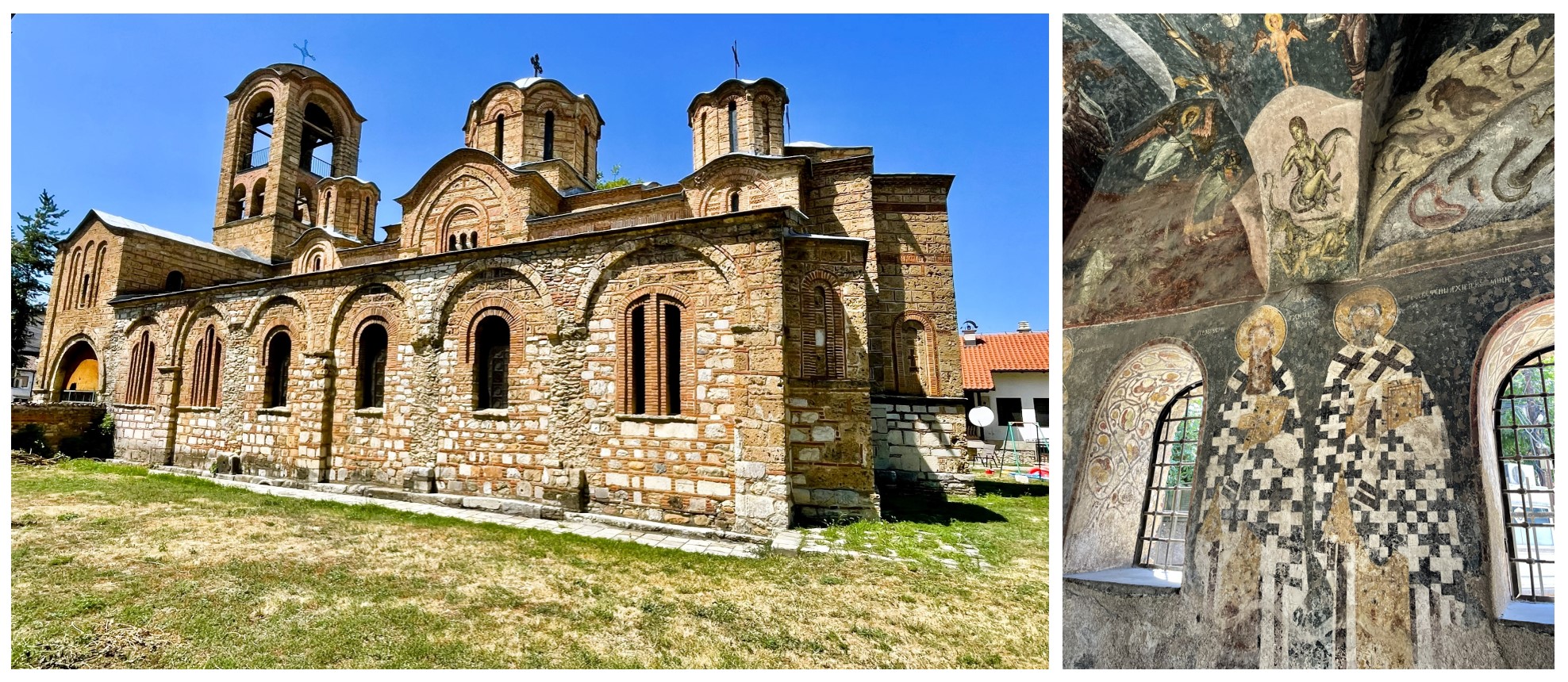
Our Lady of Ljevis

Once we exited the museum, I thought we would pop around the corner and look at the church from the gates. I managed a decent photo through the bars of the encircling fence. Then we walked around to the front to discover it was open to visitors, with a very knowledgeable guide on site. How lucky! Though the majority of the 14th-century frescos in the church, which were plastered over during the Ottoman period, have either yet to be uncovered or are perhaps too damaged to be so, restoration workers have been able to bring enough of them to light to demonstrate their significant artistic and cultural importance.

We headed back to Shadervan Square for ice cream, then, once fortified, we headed to Privren Fortress. Situated on a hill overlooking the city, the current fortress ruins date from the late Ottoman period. However, fortifications of some kind have sat in that location since the Roman era. There is no cable car or modern conveyance to get one up to the fortress, just a hard slog up the steep, uneven, paved pathway. Thankfully, it takes just 15 or 20 minutes to walk up from the Old Stone Bridge.

C at an entrance to Prizren Fortress overlooking the town

There is no entrance fee, no informational plaques, no guides. The location is amazing; from atop the walls, one has a commanding view of the town, river, and surrounding mountains. The fortress is a popular sunset spot for locals; however, we did not want to stay too long, and especially did not want to manage our way down the slippery stones in the waning light. Still, we enjoyed a good hour of the late afternoon light. We also did not know how much longer we might hold out against the likely jet lag.

My exquisite salad at the Sarajeva Steakhouse

We ended the day with an unforgettable dinner at a riverside restaurant, tucked beneath the 15th-century Sinan Pasha Mosque and looking out toward the graceful Old Stone Bridge. The evening was warm, touched by a gentle summer breeze, and we lingered over our meal as families and couples strolled across the bridge or paused in front of the mosque, bathed in golden-hour light. When the last rays of sun finally slipped away, we took one more slow walk along the river on the far side of the bridge. It was the perfect finish to our first day — so full and joyful that it already felt as though we’d been on holiday for days. We easily fell asleep so we would be well-rested for the next part of our adventure.