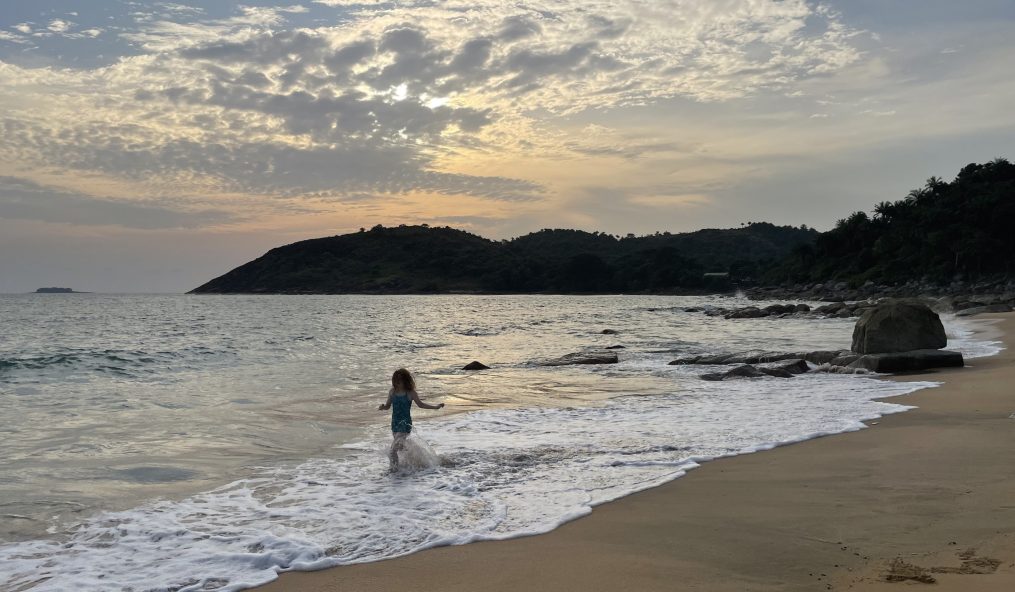

In August 2025, my 13-year-old daughter C and I embarked on an amazing two-week road trip through Kosovo, Albania, and Montenegro. Last fall, after our incredible trip to Japan, I began thinking about the next big summer trip. C asked if I would consider somewhere in the Balkans. With more than 40 countries under her belt and a love of geography, C wanted to both head back to Europe and also somewhere more off the beaten track. I had had several countries in the Balkans on my bucket list for a while, so it seemed perfect. I started to plan, and by early 2025, I had our flights, hotels, and itinerary all set.
Then the year started to go sideways. With everything going on in and around my life, I began to debate with myself whether a big summer vacation was still a good idea. I am incredibly grateful to my friends who talked me out of cancelling.
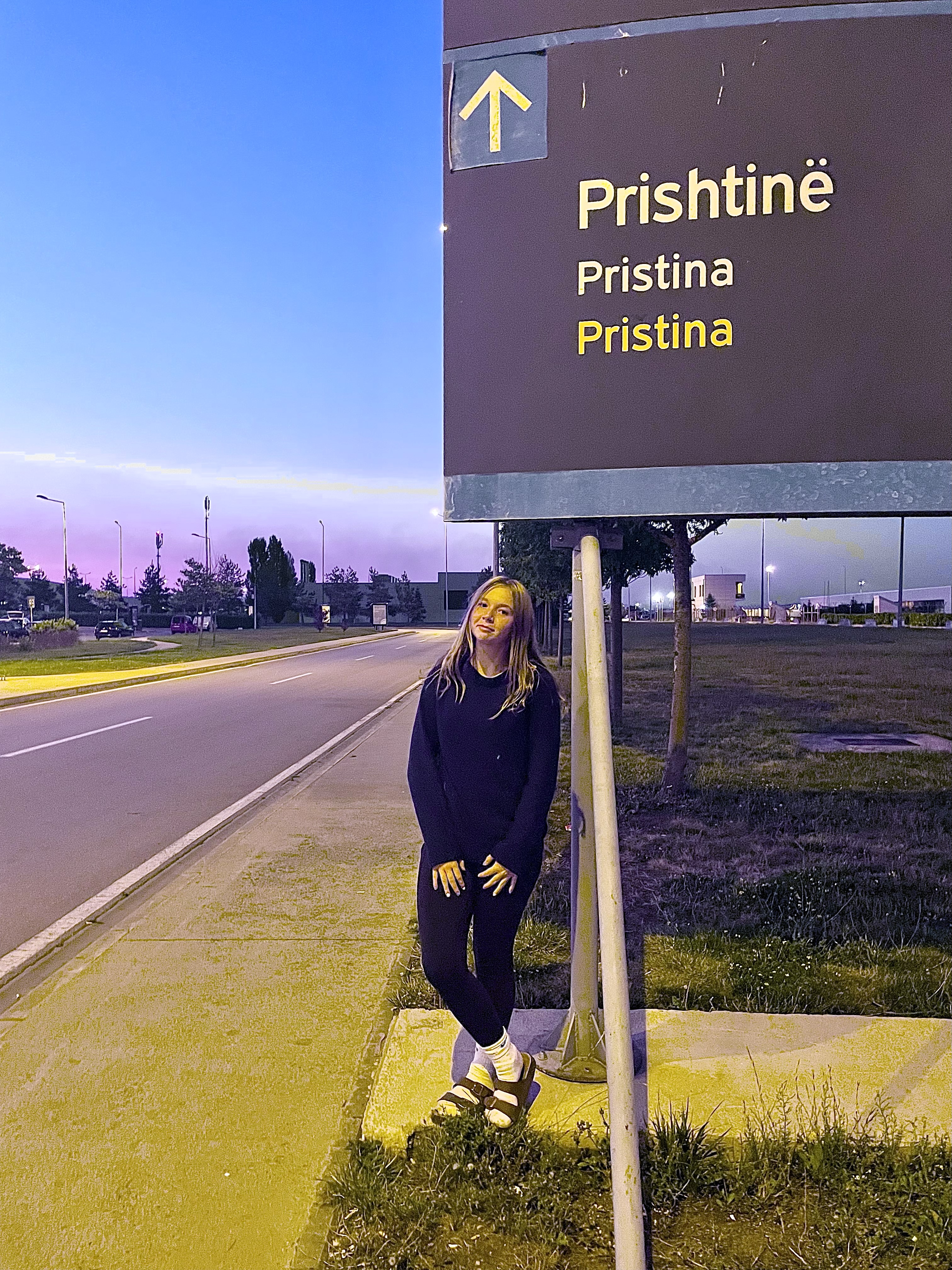
We flew into Pristina via Istanbul on an overnight flight. I again employed my long overnight flight strategy: go to bed early the night before so we’d start the trip rested, stay awake through the journey, and crash only after we arrived. It had worked surprisingly well for Tokyo — and, as luck would have it, it worked for this trip too. I slept for about an hour and C for two, and we touched down in Pristina wide awake and excited — 7 PM local time, 1 PM Washington, DC time.
I had reserved a hotel close to the airport. My brilliant plan was to stay at the hotel that evening, then return to the airport the next morning to pick up our rental car. On the map, the hotel looked close, only a 17-minute walk. We had walked from the airport to a hotel a few years before when we visited Lisbon, and I had walked from hotel to airport or vice versa in other places (I remember particularly in Bonaire and St. Kitts), so this seemed like a piece of cake. Unfortunately, the sidewalk stopped about 5 minutes out from the hotel, and we had roller bags that we then had to drag through a narrow strip of untended grass and weeds. While 10-year-old C had been game for the walk a few years ago, 13-year-old C was less than thrilled. But we both survived the ordeal, arriving at our hotel safe and sound and ready to finally get a good night’s sleep.

The next morning, I walked back to the airport to collect our rental car only to discover that Budget does not have an office there — the Budget rental car office was right across the street from our hotel. Sigh. Just a lovely early morning stroll for me to and from the airport on a busy road. It seemed the guy sitting in the Budget office had been there for at least an hour just waiting for me, because as soon as I walked in, he spoke my name. Like something right out of a movie. He brought a little white Yaris around, showed me it had a few scratches and a long crack across the windshield, which he assured me was no problem. I signed the paperwork, and that was it. I hoped in, drove across the street to the hotel, where C and I checked out and loaded up the car. We were off. Our road trip had begun!

We had only an hour drive to get to our first stop, Prizren. Kosovo’s second-largest city and its constitutionally mandated cultural capital, the area of modern-day Prizren has been inhabited since 2000 B.C. and has been a key city for the Dardanians, Romans, Serbians, and the Ottomans. As such, the small city is brimming in history.
After some trouble dealing with the difficult parking situation at our hotel located in the heart of the old city, a stone’s throw away from the Ottoman-era Old Stone Bridge that spans the Prizren river, we headed across the bridge for some sightseeing and lunch.
Following a lunch in Shadervan Square, we headed back across the river to the Archaeological Museum. The small museum is housed in a former 14th-century Turkish hammam. The museum was okay, but we were really there to climb up its watchtower so we could peek over into the neighboring plot at the church of Our Lady of Ljevis, one of the four Byzantine-Romanesque buildings that make up Kosovo’s UNESCO World Heritage-designated “Medieval Monuments in Kosovo.” I had read online that the Ljevis church was closed to the public for renovations and therefore the best way to see it was from the museum’s tower. Unfortunately, when I asked how to access the tower, the museum guide informed us it was closed for a special exhibit. So special, it seems, that guests to the museum could not access it, but only see the odd red light flashing from the top windows.
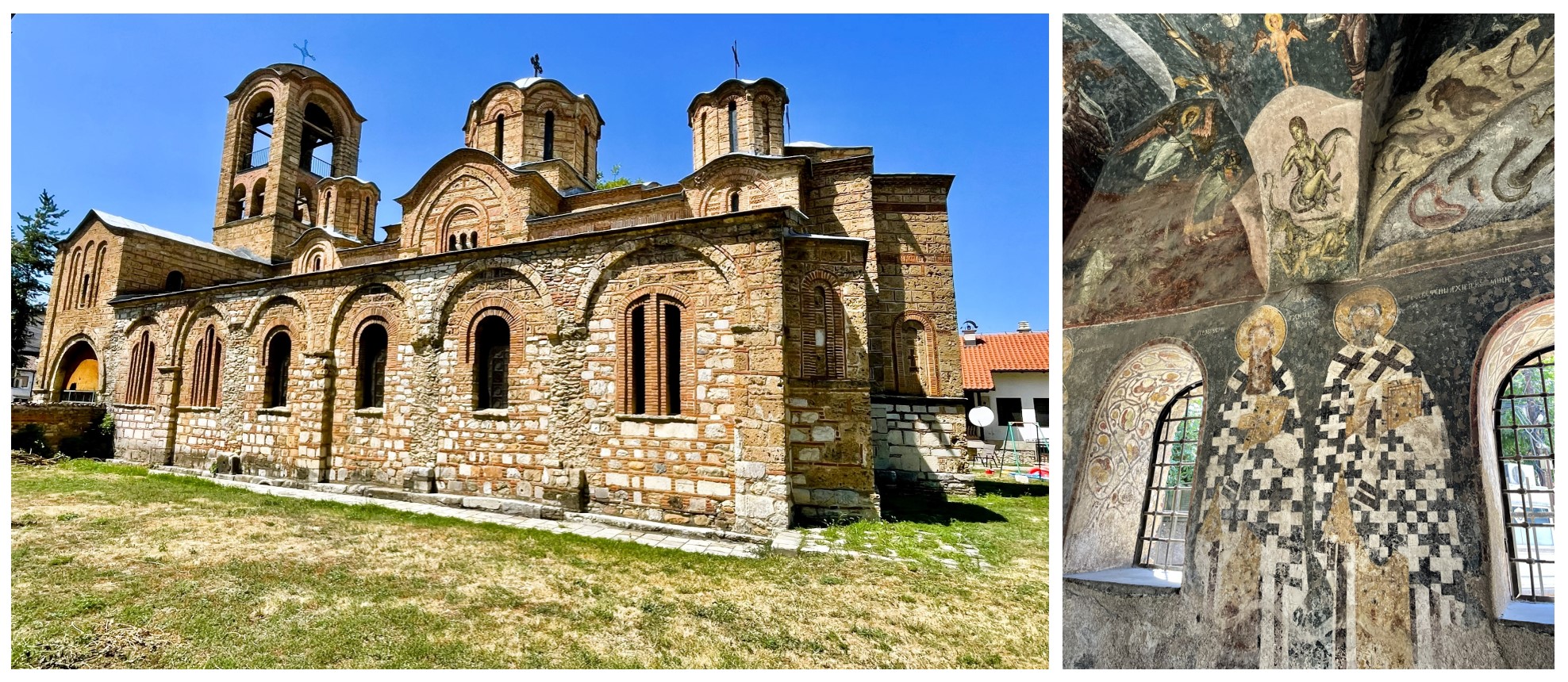
Once we exited the museum, I thought we would pop around the corner and look at the church from the gates. I managed a decent photo through the bars of the encircling fence. Then we walked around to the front to discover it was open to visitors, with a very knowledgeable guide on site. How lucky! Though the majority of the 14th-century frescos in the church, which were plastered over during the Ottoman period, have either yet to be uncovered or are perhaps too damaged to be so, restoration workers have been able to bring enough of them to light to demonstrate their significant artistic and cultural importance.
We headed back to Shadervan Square for ice cream, then, once fortified, we headed to Privren Fortress. Situated on a hill overlooking the city, the current fortress ruins date from the late Ottoman period. However, fortifications of some kind have sat in that location since the Roman era. There is no cable car or modern conveyance to get one up to the fortress, just a hard slog up the steep, uneven, paved pathway. Thankfully, it takes just 15 or 20 minutes to walk up from the Old Stone Bridge.

There is no entrance fee, no informational plaques, no guides. The location is amazing; from atop the walls, one has a commanding view of the town, river, and surrounding mountains. The fortress is a popular sunset spot for locals; however, we did not want to stay too long, and especially did not want to manage our way down the slippery stones in the waning light. Still, we enjoyed a good hour of the late afternoon light. We also did not know how much longer we might hold out against the likely jet lag.

We ended the day with an unforgettable dinner at a riverside restaurant, tucked beneath the 15th-century Sinan Pasha Mosque and looking out toward the graceful Old Stone Bridge. The evening was warm, touched by a gentle summer breeze, and we lingered over our meal as families and couples strolled across the bridge or paused in front of the mosque, bathed in golden-hour light. When the last rays of sun finally slipped away, we took one more slow walk along the river on the far side of the bridge. It was the perfect finish to our first day — so full and joyful that it already felt as though we’d been on holiday for days. We easily fell asleep so we would be well-rested for the next part of our adventure.
 The Wanderlust Diaries
Pingback: Balkans Bound, Part Six: Peja and the Monasteries of Dečani & Peć – The Wanderlust Diaries
Pingback: A Hard Year – The Wanderlust Diaries
Pingback: Cruising Away, December 2025 Winter Vacay: Part One – The Wanderlust Diaries