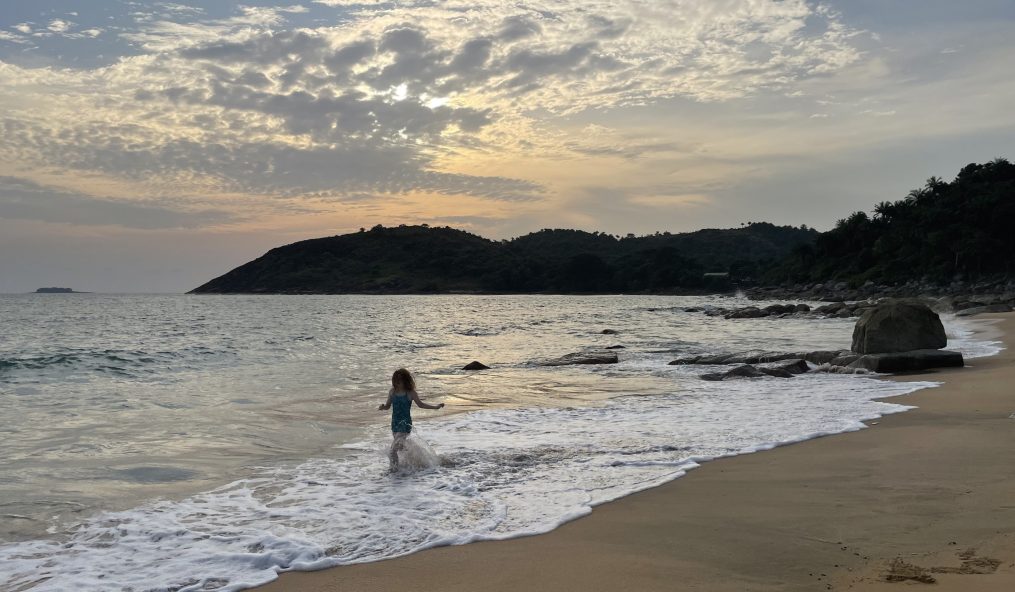
This is the third installment of my daughter’s and my trip to Kosovo, Albania, and Montenegro in August 2026.
The morning my daughter and I were departing Shkoder, Albania, for Kotor, Montenegro, I checked the route in my maps app and discovered the most direct route across the border was closed due to wildfires. The heat wave we had been experiencing had contributed to wildfires across southern Europe, including Montenegro. We would have to take another, longer route to get to Kotor. Instead of along the coast, the route that generated my whole plan to include our side trip to Albania, we would drive along the southern edge of Lake Shkodra and cross into Montenegro southwest of its capital. I opted not to drive through the capital and instead skirted the western edge of the lake, then take the only road that crossed the lake.
The drive to the border was uneventful, but once there, we faced a very long line of cars seeking to cross. Perhaps the traffic was due to this being the most popular crossing, or maybe it was caused by the other border being blocked by the fires; either way, it was tedious. At last, it was our turn, and I handed over our passports to the Montenegrin immigration official. He demanded to see the rental car papers, and I passed him the rental agreement. He stared at me, annoyed, and asked for additional car papers. I said I had not had to provide anything additional in Albania, and he gave me one of my most memorable quotes of the trip: “I don’t know about Albania, but in Montenegro, we have rules.” I explained that that was all I had, so he told me “Then, you will not be able to cross,” and asked me to pull over to the side.

There, I sat thinking for a minute, then I opened the glovebox, and found the car registration. I thought back to the eager car rental guy back in Kosovo, who had quickly shown me all of the car’s scratches, but when I has asked about crossing borders had said it would be “no problem” and failed to mention the all-important car registration. Sigh. I realized that the immigration official likely needed this, so I grabbed our passports, the registration card, and told C to wait in the car, and walked back to the official. He shook his head at my apparent stupidity and stamped us into the country.

We were now even further behind my hoped-for schedule. Things only got worse as we drove along narrow roads and encountered random traffic. I had hoped the drive across Lake Shkodra would allow for a quick photographic stop at Fort Lesendro, a fortress located on an island on the lake, which the road crossed, but there was no place to pull off. It passed in a blur. We drove over the mountains to meet the coastal road, and as we neared the coast caught sight of smoke plumes from wildfires on the hills around the popular town of Bar. Though this was a very time-consuming detour, I felt glad I had not chanced our original route.
We stopped briefly along the coastal road to photograph Sveti Stefan, a 15th-century Venetian fortified town located on a small island connected to the mainland by a narrow isthmus. It is so beautiful that photographs of this location are used for many a screensaver. However, the island is private and used as a luxury resort. I had considered driving up to a small church further up the mountainside for its views of Sveti Stefan, but we were already so far behind that our one quick stop would have to do.

Our lunch stop was Budva, a larger Venetian walled town just a little further up the coast. My plan had been to arrive around 11 AM, but instead, we arrived three hours later, tired and hungry. Parking was a bit of a nightmare; I had read it was difficult in the height of summer, and headed for a mall parking lot that online had said was usually available. The lot was full, so I had to wait until a car departed before I could pull in and park.

There were quite a lot of people in the walled town. Some of the narrow walkways were wall-to-wall tourists. The tiny beach in front had almost no square of sand unoccupied. Yet, the first few restaurants we tried were closed. It was quite hot. Bothered by the crowds and the heat, we decided on smoothies from a little hole-in-the-wall shop. Fortified, we toured the Citadel and the narrow streets. Had it been less crowded, it might have been nice to see some of Budva outside the walls, or maybe not. There were just far too many people and we could not feign longer interest. We wanted to get to Kotor.
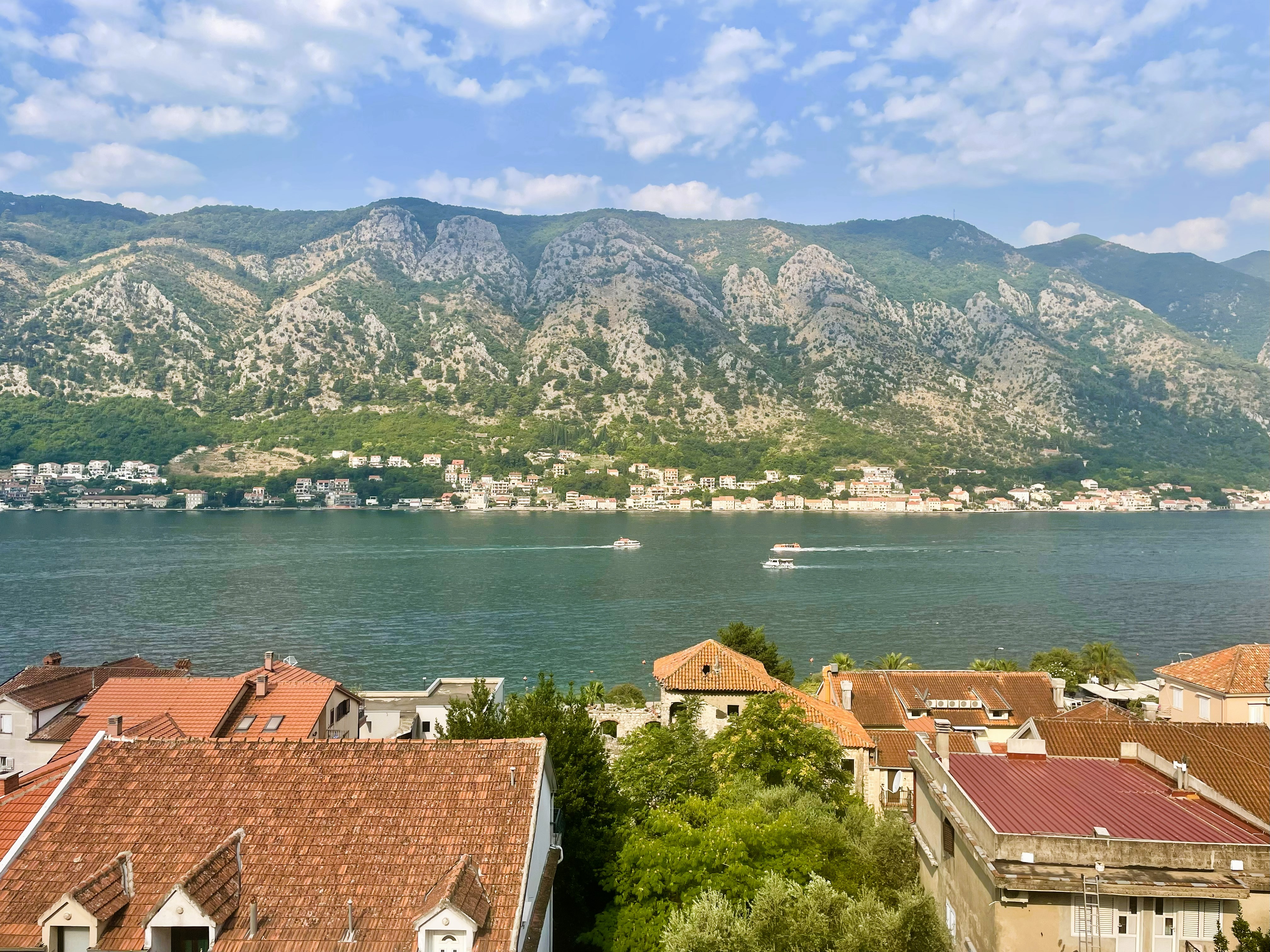
Though only an hour north, there was again heavy traffic through the center of Kotor. And, when we arrived at our room for the next four days, the manager was not on site, though I had messaged upon our departure from Budva. Finally, he arrived (he had been at the beach) and showed us to our lovely flat on the top floor of his multi-story condo. With our last bit of energy, we made a quick stop trip to a nearby supermarket so we could have dinner in peace and quiet, on our balcony while we watched the sun set over Kotor Bay.

The next day, C and I set out to explore the UNESCO-listed old town of Kotor. Our first stop had to be the Cats Museum. The only other place I have visited a cat museum was in Kuching, Malaysia. Kuching means “cat” in Malay, and Kotor’s historical name under the Venetians was Cattaro. Though that does not mean “cat,” it seems the people of Kotor, who have taken to protecting the numerous street cats of the town, rather enjoy the play on words.

Kotor’s Cats Museum is small, just two small rooms and a reception/gift shop. Yet it is chock full of cat stuff – propaganda with cats, studio photography of persons with their cats, postcards, newspaper articles, currency, and so on, all featuring cats. Proceeds from the museum’s entrance fee and the sale of its souvenirs support the care and feeding of Kotor’s street cats. C and I loved the museum and finding Kotor’s cats throughout the town.
We had lunch outside in one of the many small squares of the walled town. Then C and I did a bit of sightseeing and window shopping. C had actually done some online sleuthing and informed me that shopping is a big thing to do in Kotor’s old city, and it would be key for us to take part. By the early afternoon, though, we were again tired by the heat and the long day of road travel the day before, so we returned to our guest room to rest.
In the late afternoon, I was ready to return to the old town, but C bowed out. We had been rather “go-go-go” for the past few days, and it was just the right day for her to take a break. I relished the time to just see things at my own pace, to go slowly and take photos of whatever I wanted without a teenager telling me her legs hurt or she was bored or asking “How much longer are we going to be here?” I love that she is now at an age to enjoy more of the history, but can also be left in the hotel to do her own thing when I wish to do mine.
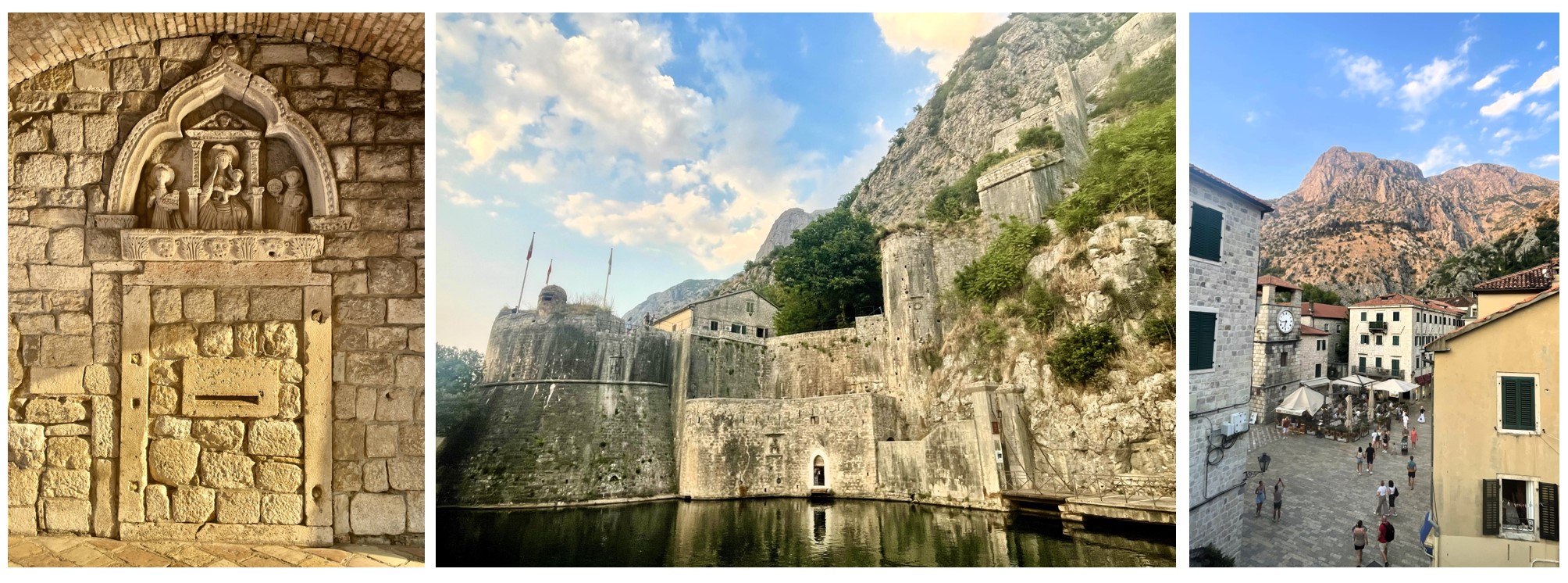
I loved walled cities. I have visited many in my travels, from Avignon and Avila to San Juan, Xian, and Galle. Kotor is magnificent and I am grateful that I was able to spend a few hours exploring on my own. I could have certainly spent more time there. However, we had more to see and do in Montenegro.
 The Wanderlust Diaries