The seventh and final installment of our summer 2023 European adventures.
From the Haut-Koenigsbourg Castle I drove to the little village of Riquewihr, which dates from the medieval period and is considered among the most beautiful villages of France.

The village is quite small, with a population around 1,000, though there were at least a few hundred other tourists milling about its car-free cobblestoned center. We come to see the beautiful Alsatian homes from the 15th to 18th centuries and the 13th century defensive gate. Having been spared terrible damage from the second World War, the village is a well-preserved representation of its medieval self.

It was 3 PM by the time I arrived and I was hoping for a nice restaurant meal with alfresco seating. Unfortunately, the village’s small size dictated its restaurant limitations; though there were still a good handful or so, many were closed for the period between lunch and dinner. The few open appeared to have much the same menus of heavy pork or duck sausages, veal head or kidney, Alsatian tarte flambees, and sauerkraut. Yet there were also shops of baked goods, preserves, sweets, and beer. Riquewihr items must be in demand as I saw them sold prominently in other locations around Alsace. The best of course, in my humble opinion, were the big German pretzels, with their brown, crispy, salty-crust and the light and soft insides. And as it started to rain again, I had the perfect meal of a delicious soft pretzel for 1 euro and a Diet Coke, standing under the eaves of a medieval house. My previously empty stomach and my traveler’s heart were deeply satisfied.
The rain let up again, enough for me to wander a bit more to see the 13th century Dolder tower, but the clouds opened up once again and soon enough the tourists, including myself, were huddling in the small passageway under the Tower or pressed back against the houses to get coverage from the narrow eaves. I made my way down the street, running from eave protected location to another, until I made it to the gelato shop. I had my dessert under the tarps of a small market and then ran for my car.

I drove the 30 minutes to Colmar, my next stop, where I would be staying the next two nights. I had a little trouble navigating to my central hotel given the many streets under some construction. Then parking too was problematic. There was only a small public parking lot on the one way street in front of the hotel that was full upon my arrival. I drove around the block (which was much trickier than it sounds) to try again. And again. The third time was not the charm. The hotel then arranged for me to park at a small garage nearby – maneuvering the car into that narrow single garage required a lot of focus on my part! I finished off my day with the best caprese salad I have every tasted in a small Italian restaurant.
I spent the whole of the following day touring the streets of Colmar on foot. I started just outside my lovely historic hotel in a house dating from 1565 directly on one of the canals of Colmar’s Little Venice. I made a booking for a canal tour for the early afternoon, then set off to explore.

I was in my element. One thing that I really love to do is to take a long wander through an attractive city, even better if its culture and history are strongly on display. Colmar had this in spades. Around every corner, indeed after every few steps in the old city center there was yet another delightful sight from flowers beds along the canal, the steeple of a lovely old church, an ornately painted house façade, a stork decoration. I just kept walking. After lunch I enjoyed the 30-minute canal boat tour, and then went right back to pounding the streets on my own two feet. I spent an hour in the Bartholdi Museum, dedicated to the life and works of August Bartholdi, the creator of the Statue of Liberty, located in his childhood home.
I really do not know quite how it happened, but when I think back now it seems incredible that I only spent one full day in Colmar. Like Strasbourg, I packed so much into that single day.

On the Thursday I departed Colmar and drove to another of the small beautiful medieval villages of Alsatian fame, Eguisheim. The area around the village is one of the oldest settlement areas in Alsace and the origins of the village date from the year 1257. It is a wonderful example of a typical medieval village of tight concentric circles around a square complete with a fountain, church, and enough space for a market.
When planning my trip, I had not done as much research as I might normally do. After all, my solo trip in Alsace was at the end of a pretty elaborate multi-week journey. I knew Eguisheim was a must see and I diligently added it to my itinerary, but it was rather like “set it and forget it” until I found myself parking outside the outer rim of the original village. I walked into one section of the outermost circle, and while it had a lovely old fountain and a few pretty buildings, it was not blowing me away. The sky was again overcast and I felt a bit tired. I looked up though and saw a large nest atop a nearby house and then to my astonished eyes, a stork stood up in it, then spread its wings, and flew.
I turned down a very narrow street, about the width of a car (though I certainly would not want to drive it). There was a funny little store dedicated entirely to mushrooms – edible goods and mushroom-inspired art and knick-knacks. The local government had cleverly set up little historic markers throughout the village for tourists to learn a little here and there about unique architectural or cultural quirks one might find. That circle opened up to a main street and I followed it to the village’s center square and here it really did blow me away. I spent about an hour exploring and then I had to bid farewell and drive on to Nancy, two hours away.

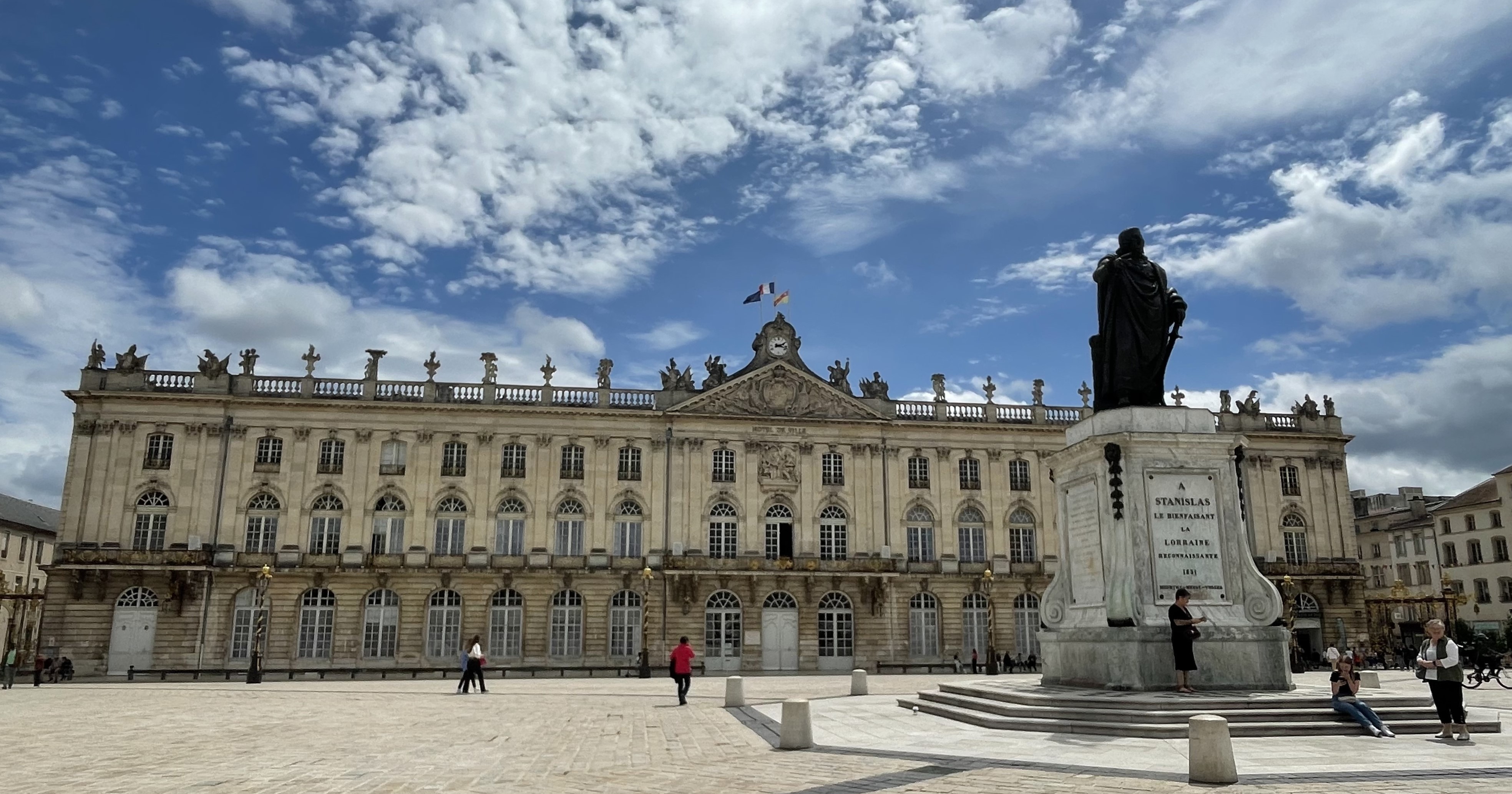
I arrived in Nancy, France just in time to enjoy a lovely alfresco lunch near the main square. Once again the stormy clouds had dispersed and the sky was blazing an almost unreal blue. After lunch I strolled around the 18th century Place Stanislas, conceived and inaugurated by Stanislaw Leszczynski, the last Duke of Lorraine, in 1755. The square is considered the most beautiful in France and is part of the UNESCO World Heritage Site designation for Nancy. It is bordered by elaborate gates and fountains and a triumphal arch, its golden buildings excellent examples of 18th century urban architecture. I thought I could sit there all day and just drink it in. But frankly, after all the go-go-go of the previous days and weeks, a full and content belly, and the strong sun, I just wanted to take a nap.
Unfortunately, when I woke up it was late afternoon and the grey clouds had rolled back in. I did take a walk again to the square and then to a nearby church and finally a supermarket to grab some food to eat in the hotel room. In every long trip there should be a day or two of lazing about, and I had not had that at all — so I made the time to just relax. I was also missing my kiddo.
I had to leave on Friday afternoon to make the 2 1/2 hour drive back to the Euro Space Center for the end of camp presentation, so I did not have much time. I needed to get myself into high gear and do another quick a la Amazing Race tour. As it was lightly raining again, I decided to jump on the little tourist train, which in 45 minutes would take me on a guided tour to all the main sights. That tour then told me exactly where I would want to go back on an additional speed walk tour – to see the Port de la Citadelle and the Port de la Craffe, restored gates of the 14th century defensive wall, into the Basilica of Saint Epvre of Nancy, along the Place de la Carriere (part of the UNESCO designation for Nancy), and then through the Parc de la Pepiniere, where among the trees and flowers is a statue by Rodin.

Nancy, too, was worth more time than I could give it, but I am glad I was able to see it in both sunshine and rain.
I drove the two and a half hours to the Euro Space Center through some rather heavy rains to arrive just in time to see the student end-of-camp rocket launch and the presentation of certificates. Last year the launch of the student-made rockets had been cancelled due to a heat wave and very dry conditions; this year they launched in a fine misty rain. All the kids reported having had a great time (though they all disliked the food). We all got the kids packed up, let them say their goodbyes, and hustled them off to the cars as we had a four-hour drive back to the Amsterdam airport. C once again rode with her cousins, so I had a bit more solo time on the road, which was just fine. Little did I know that I would get my second speeding ticket of all time on the highway outside of Rotterdam – I received my ticket, for driving 5 miles over the speed limit, when I returned home.
We had one more day in the Netherlands before returning to the States. Though it was once again overcast, we headed to the village of Zaanse Schans, just 10 miles north of Amsterdam. When I had started planning this part of our trip, I had hoped we could take a bicycle tour to the village as I had done when I visited in the late 1990s, because it was a place where we could see three quintessential symbols of the country: windmills, a cheese factory, and a wooden shoe factory. Unfortunately, the bicycle tours had a minimum age of 12, so C and her cousin AH were too young. But we worked out an easy enough way on the trains, which honestly allowed us to sightsee on our own timetable.

The sightseeing started off with us (and the hundreds of other tourists there) huddled under our umbrellas, but once again the gods of weather cleared the skies. Honestly, we had the most wonderful weather for the entirety of the three and a half weeks. Even when it rained, it always cleared up, in every location, for at least a few hours of glorious sunshine.
Thus, we spent several hours in Zaanse Schans, strolling past the windmills, learning about the process to make Edam and Gouda cheeses (and enjoying some samples), checking out the history and methods to make wooden shoes, touring inside one of the windmills, and enjoying hot chocolate and a delicious lunch. It was the perfect last day.
What an amazing trip! In the end, C visited a total of six countries, and I visited seven. We were able to meet up with our favorite travel buddies, CZ and Little CZ, and spend time with my sister and her family. We traveled by plane, train, bus, funicular, skylift, canal boat, cruise ship, subway, car, and on foot. C spent another week at the Euro Space Camp, this time with her cousins and where she made new friends – one of them is from, can you believe it?, Luxembourg!
It took a lot of work to plan and execute this trip – so many details and logistics! I loved it of course. I truly believe that planning a trip can be almost as fun as taking it, but I think the next trip will involve fewer moving parts! Maybe.


 The Wanderlust Diaries