Balkans Bound, Part One: Planning, Arrival, and Prizren

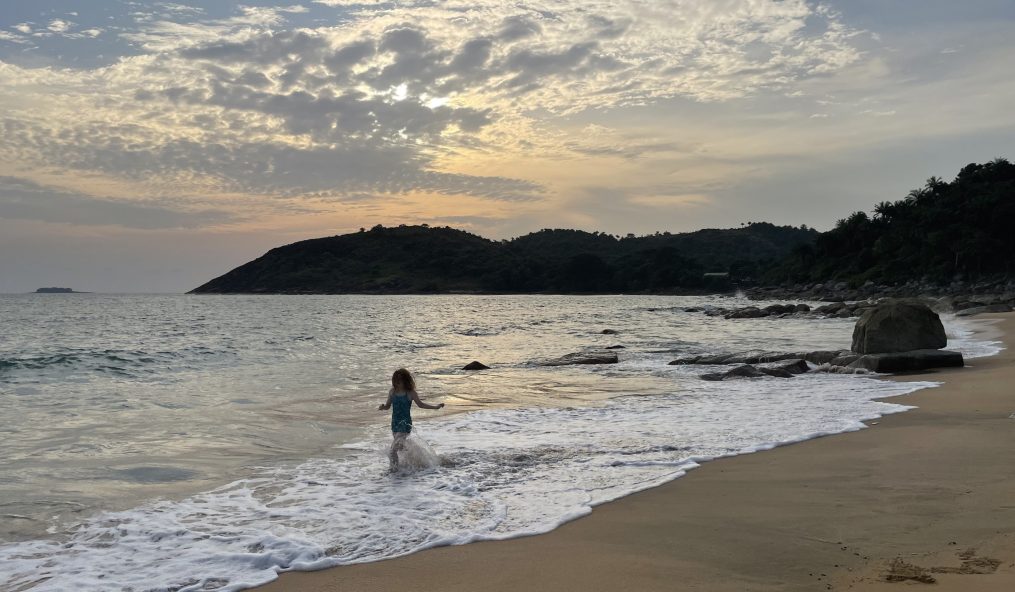
The newest additions to my magnet collection

In August 2025, my 13-year-old daughter C and I embarked on an amazing two-week road trip through Kosovo, Albania, and Montenegro. Last fall, after our incredible trip to Japan, I began thinking about the next big summer trip. C asked if I would consider somewhere in the Balkans. With more than 40 countries under her belt and a love of geography, C wanted to both head back to Europe and also somewhere more off the beaten track. I had had several countries in the Balkans on my bucket list for a while, so it seemed perfect. I started to plan, and by early 2025, I had our flights, hotels, and itinerary all set.

Then the year started to go sideways. With everything going on in and around my life, I began to debate with myself whether a big summer vacation was still a good idea. I am incredibly grateful to my friends who talked me out of cancelling.
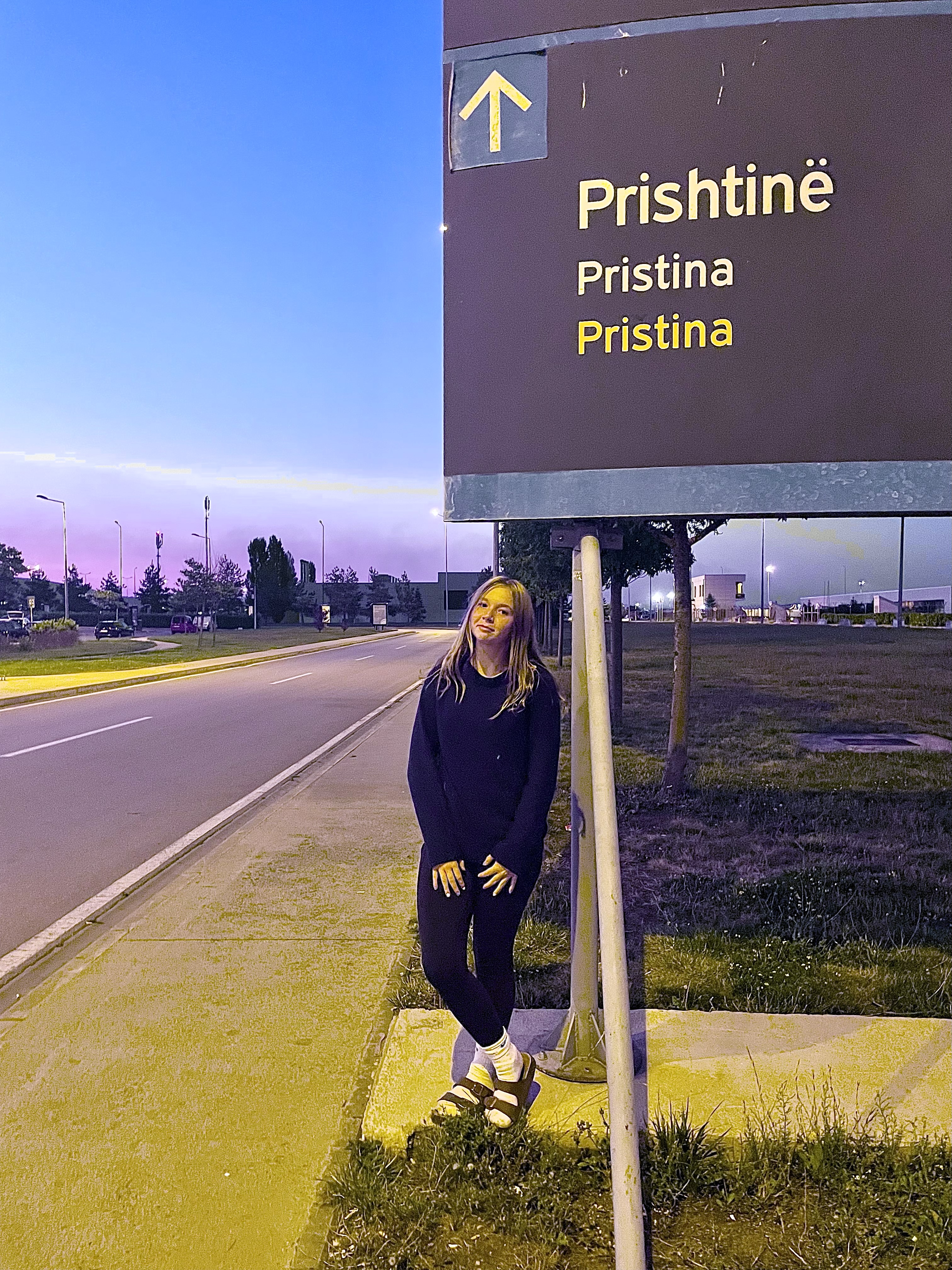
C at the airport before we started walking to our hotel

We flew into Pristina via Istanbul on an overnight flight. I again employed my long overnight flight strategy: go to bed early the night before so we’d start the trip rested, stay awake through the journey, and crash only after we arrived. It had worked surprisingly well for Tokyo — and, as luck would have it, it worked for this trip too. I slept for about an hour and C for two, and we touched down in Pristina wide awake and excited — 7 PM local time, 1 PM Washington, DC time.

I had reserved a hotel close to the airport. My brilliant plan was to stay at the hotel that evening, then return to the airport the next morning to pick up our rental car. On the map, the hotel looked close, only a 17-minute walk. We had walked from the airport to a hotel a few years before when we visited Lisbon, and I had walked from hotel to airport or vice versa in other places (I remember particularly in Bonaire and St. Kitts), so this seemed like a piece of cake. Unfortunately, the sidewalk stopped about 5 minutes out from the hotel, and we had roller bags that we then had to drag through a narrow strip of untended grass and weeds. While 10-year-old C had been game for the walk a few years ago, 13-year-old C was less than thrilled. But we both survived the ordeal, arriving at our hotel safe and sound and ready to finally get a good night’s sleep.

The 16th-century Old Stone Bridge in Prizren

The next morning, I walked back to the airport to collect our rental car only to discover that Budget does not have an office there — the Budget rental car office was right across the street from our hotel. Sigh. Just a lovely early morning stroll for me to and from the airport on a busy road. It seemed the guy sitting in the Budget office had been there for at least an hour just waiting for me, because as soon as I walked in, he spoke my name. Like something right out of a movie. He brought a little white Yaris around, showed me it had a few scratches and a long crack across the windshield, which he assured me was no problem. I signed the paperwork, and that was it. I hoped in, drove across the street to the hotel, where C and I checked out and loaded up the car. We were off. Our road trip had begun!

Beautiful wall mural in Prizren

We had only an hour drive to get to our first stop, Prizren. Kosovo’s second-largest city and its constitutionally mandated cultural capital, the area of modern-day Prizren has been inhabited since 2000 B.C. and has been a key city for the Dardanians, Romans, Serbians, and the Ottomans. As such, the small city is brimming in history.

After some trouble dealing with the difficult parking situation at our hotel located in the heart of the old city, a stone’s throw away from the Ottoman-era Old Stone Bridge that spans the Prizren river, we headed across the bridge for some sightseeing and lunch.

Following a lunch in Shadervan Square, we headed back across the river to the Archaeological Museum. The small museum is housed in a former 14th-century Turkish hammam. The museum was okay, but we were really there to climb up its watchtower so we could peek over into the neighboring plot at the church of Our Lady of Ljevis, one of the four Byzantine-Romanesque buildings that make up Kosovo’s UNESCO World Heritage-designated “Medieval Monuments in Kosovo.” I had read online that the Ljevis church was closed to the public for renovations and therefore the best way to see it was from the museum’s tower. Unfortunately, when I asked how to access the tower, the museum guide informed us it was closed for a special exhibit. So special, it seems, that guests to the museum could not access it, but only see the odd red light flashing from the top windows.
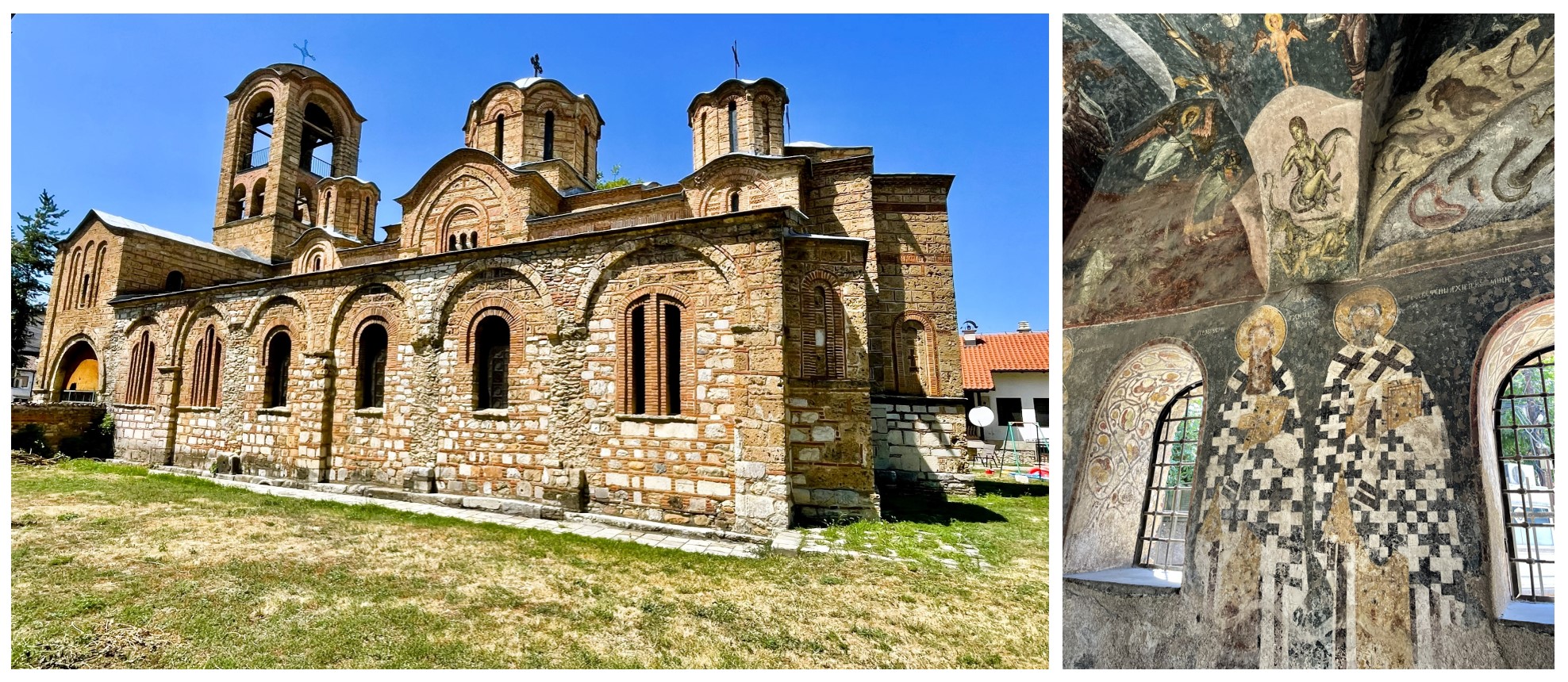
Our Lady of Ljevis

Once we exited the museum, I thought we would pop around the corner and look at the church from the gates. I managed a decent photo through the bars of the encircling fence. Then we walked around to the front to discover it was open to visitors, with a very knowledgeable guide on site. How lucky! Though the majority of the 14th-century frescos in the church, which were plastered over during the Ottoman period, have either yet to be uncovered or are perhaps too damaged to be so, restoration workers have been able to bring enough of them to light to demonstrate their significant artistic and cultural importance.

We headed back to Shadervan Square for ice cream, then, once fortified, we headed to Privren Fortress. Situated on a hill overlooking the city, the current fortress ruins date from the late Ottoman period. However, fortifications of some kind have sat in that location since the Roman era. There is no cable car or modern conveyance to get one up to the fortress, just a hard slog up the steep, uneven, paved pathway. Thankfully, it takes just 15 or 20 minutes to walk up from the Old Stone Bridge.

C at an entrance to Prizren Fortress overlooking the town

There is no entrance fee, no informational plaques, no guides. The location is amazing; from atop the walls, one has a commanding view of the town, river, and surrounding mountains. The fortress is a popular sunset spot for locals; however, we did not want to stay too long, and especially did not want to manage our way down the slippery stones in the waning light. Still, we enjoyed a good hour of the late afternoon light. We also did not know how much longer we might hold out against the likely jet lag.

My exquisite salad at the Sarajeva Steakhouse

We ended the day with an unforgettable dinner at a riverside restaurant, tucked beneath the 15th-century Sinan Pasha Mosque and looking out toward the graceful Old Stone Bridge. The evening was warm, touched by a gentle summer breeze, and we lingered over our meal as families and couples strolled across the bridge or paused in front of the mosque, bathed in golden-hour light. When the last rays of sun finally slipped away, we took one more slow walk along the river on the far side of the bridge. It was the perfect finish to our first day — so full and joyful that it already felt as though we’d been on holiday for days. We easily fell asleep so we would be well-rested for the next part of our adventure.
A Quick Getaway to Philly

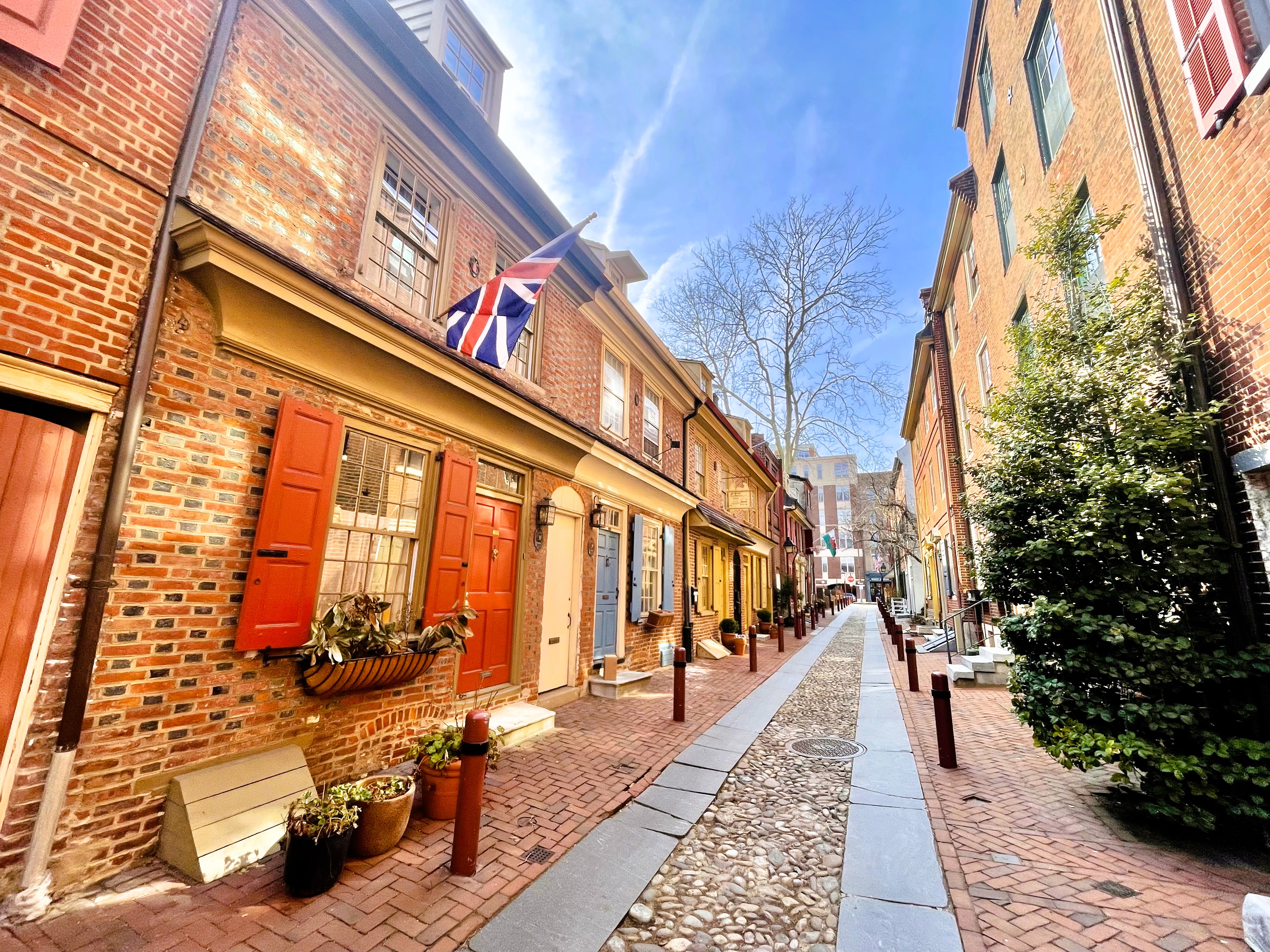
Elfreth’s Alley in Philadelphia, PA

C and I continue to make the most of my assignment to Washington, D.C. And, well, things have been more than a little, um, odd in Washington lately, which makes it more important that we make time to enjoy the positive aspects of the area and America.

In mid-March, C’s school had a random Friday off, so I decided we would have a short getaway to Philadelphia. I had only been to the City of Brotherly Love once, at least 15 years ago. I thought it would also be fun to invite one of C’s best friends, TO, on the trip. When I was a little younger than C is now, my best friend was a girl named Jennifer who lived up the street from me. Jennifer’s mom, Debbie, was also a single mom, but she invited me on several trips with her and Jennifer. We went to Ocean City once and another time to Gettysburg, Pennsylvania. My parents, maybe exhausted with four children and without much disposable income, rarely took us on trips other than to see family (and half the time our car would break down before we got out of town). Therefore, my trips with Jennifer and Debbie were really special for me. I wanted to pay that forward.

We had TO stay over the night before so we could have an early start on the three-hour drive. Half an hour into our journey, I stopped at a 7-11 and the girls stocked up on just the kind of stuff you might expect teenage girls would like to munch on while on a road trip. And I had the last hour in quiet once they crashed. I wanted them well rested for the busy day we would have ahead.

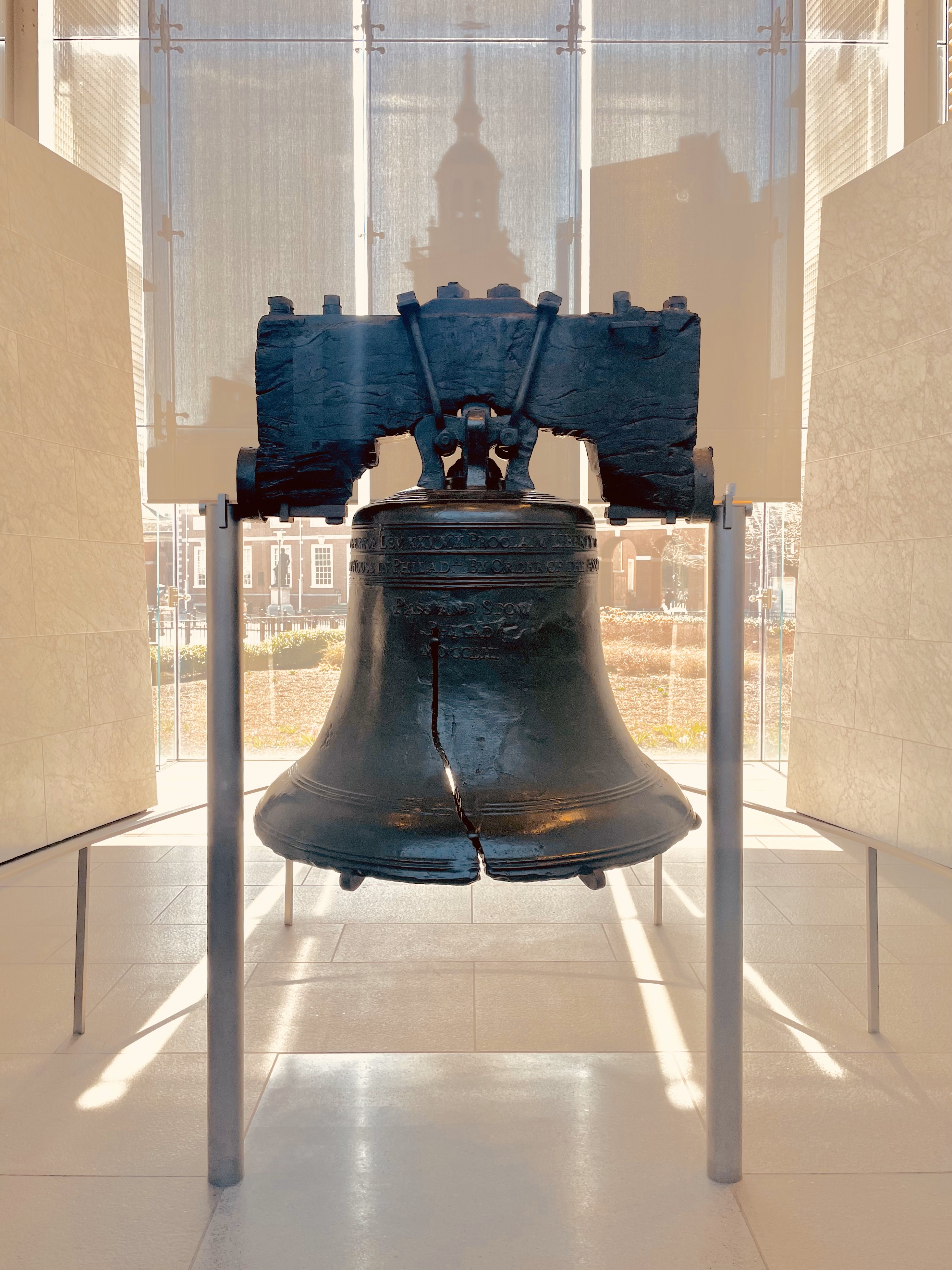
Sunlight hits the Liberty Bell with Independence Hall outside

After checking in early at our Penn’s Landing hotel, we headed to our first stop: the Philadelphia Mint. C is a member of Scouting America. Since she was working on her coin collecting merit badge, the U.S. Mint in Philadelphia, established April 2, 1792, seemed the perfect place to visit. Photography is not allowed inside the Mint, so we had to make do without. We enjoyed reading about the history of the Mint and the production of coinage in America but our favorite part was watching the thousands of quarters, dimes, nickels, and pennies move through the assembly line on the massive production floor. Though for C and TO, the gift shop came a close second.

After the Mint, we tried to visit Independence Hall, but I found out it was sold out for the day. I had not expected this on a random Friday in March! A National Park ranger informed me that a limited number of next-day tickets would go on sale at 5 PM, so I set an alarm and we headed to the Liberty Bell across the street. The first time I visited Philadelphia, it was a warm September day. I remember shuffling past the Liberty Bell in a long, slow-moving queue. This time? No line at all. It took less than ten minutes from entry to standing before one of our country’s most recognizable symbols of freedom. I think C and TO appreciated seeing in person something they had studied at school. Only they appreciated it for a fraction of the time I did.

The extraordinary Philadelphia Town Hall (from the outside)

I got those hungry teens some lunch, then we walked downtown to the beautiful Philadelphia Town Hall. Construction started on the ornate French Second Empire-style building in 1871, and when completed in 1894, it was the tallest habitable building in the world. With nearly 700 rooms, the Philadelphia Town Hall is the largest municipal building in the United States and one of the largest in the world. Today, it is listed as a National Historic Landmark and a National Historic Civil Engineering Landmark. This is exactly the kind of cool building I enjoy touring! But wouldn’t you know it, all tours were sold out that day. Foiled again.

Inside the Reading Terminal Market

On the way to our final planned stop for the day, we passed through the Reading Terminal Market, the indoor public market built under the elevated train shed of the former Reading Railroad Company (yes, the one from the Monopoly game). Here, I finally got C and TO’s attention with the sweet shop featuring popular American and imported candies. With their sweet teeth satisfied, the teens were ready to continue on with my sightseeing plan.

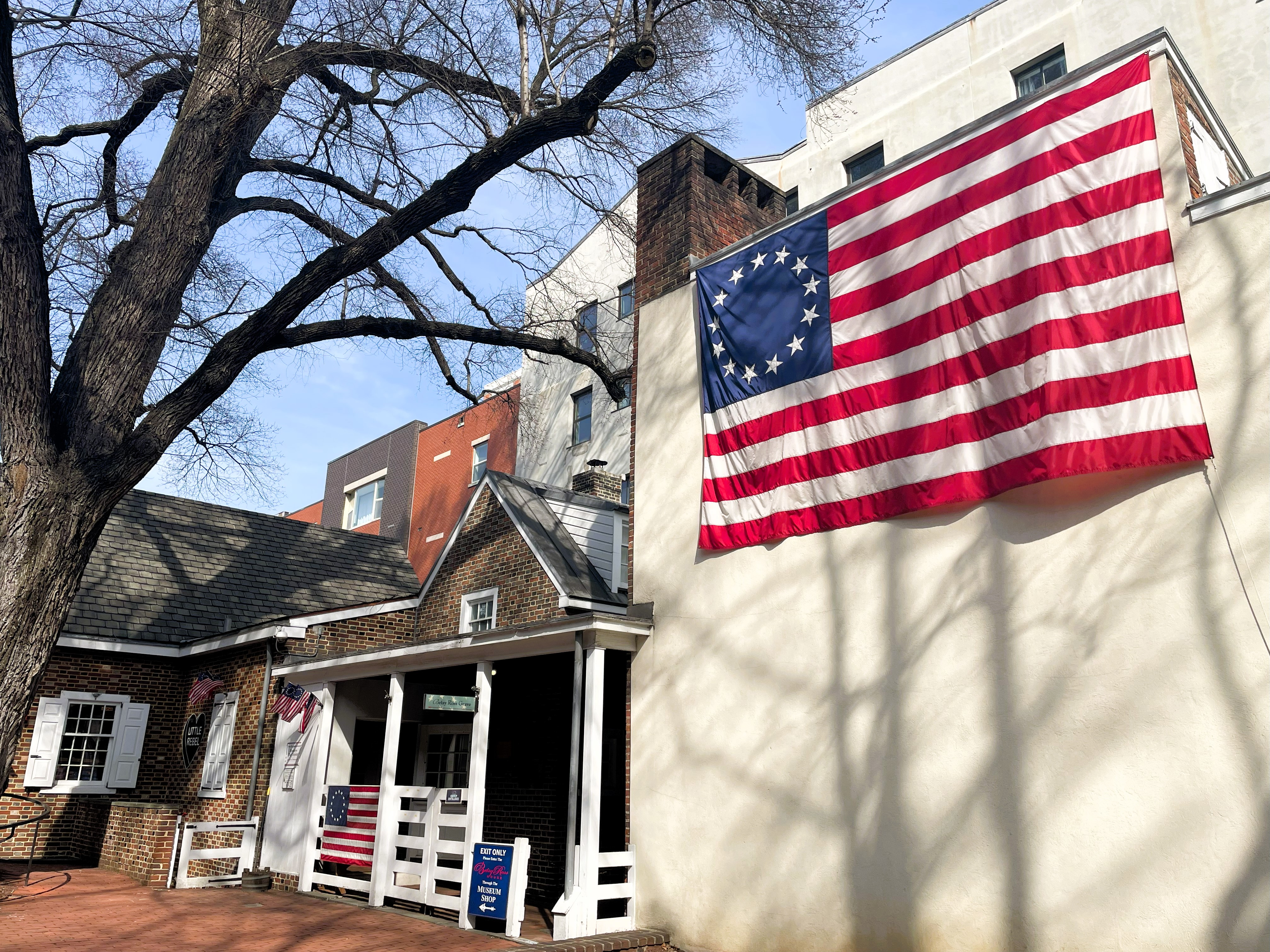
Widowed Betsy Ross purportedly rented two small rooms and a storefront for her upholstery shop in a building near the center of Philadelphia. A flag maker for many years, the Ross family history credits her with sewing the second official flag of the U.S. While direct evidence is thin, the legend of Betsy Ross is firmly rooted in American history, and I, for one, am pretty happy with a woman having such a place in the pantheon of historical figures associated with our democratic beginnings. It isn’t a big museum and the tour guides throughout are great; they kept C and TO interested and engaged. That is no mean feat with two teenage girls, especially ones who have already been dragged around to several historic sites for most of the day. Afterwards, we headed back to the hotel via the quaint, historic, and very photogenic Elfreth’s Alley, the oldest continuously inhabited residential street in America.

Betsy Ross was here (probably)

We rested a bit at the hotel before I made the girls join me at the riverfront at Penn’s Landing for a walk as the sun was setting. Then we went to the largest Wawa I have ever seen, where we all stocked up on foodstuffs for dinner. Back at the hotel, we ate and I watched television while the girls hid in the bathroom, chatting and making TikTok videos. And at 5 PM sharp, I logged on to the website and secured us tickets for Independence Hall for Saturday.

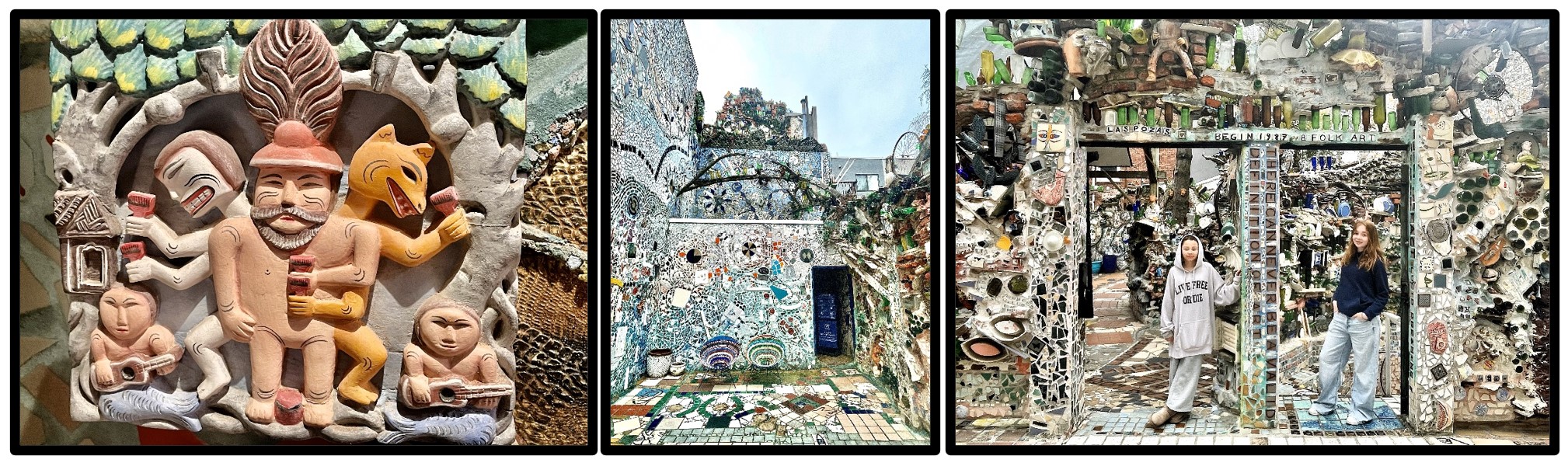
The next morning, I took the girls to an early morning guided tour of Philadelphia’s Magic Gardens, an extraordinary indoor/outdoor art space of mosaics created over decades by Isaiah Zagary combining handmade tiles, pieces of donated / cast-off household items from bottles to bicycle tires, and commissioned folk art from local, national, and international artists.

Scenes from the Magic Gardens

Honestly, I didn’t know if the girls would like it, but I wanted to include something on our itinerary other than historic sites. But they loved the Magic Gardens! They grabbed the scavenger hunt sheets provided by the museum, ditched the tour, and explored on their own.

I really enjoyed the tour. It was about 30 minutes long, providing us with information on the artist, his inspiration, process, role in the community, and legacy, along with plenty of time to meander where we liked, though in my opinion one needs at least twice the amount of time to really take in the details (well, if you are not visiting with teens). Unfortunately, the upper floors were closed to the public. I very much wanted to get up to the rooftop.

We then walked from the Magic Gardens to the old city for our Independence Hall tour. Luckily, we arrived early (as recommended online), and when other ticketed visitors did not arrive, we were able to join the tour scheduled 30 minutes before ours.

Scenes of Independence Hall

The tour is only 20 minutes long. The building is not large, and the tour visits just the two rooms on the ground floor. Though these are, perhaps, two of the most famous rooms in U.S. colonial history. C and TO were engaged in listening to and responding to questions from the guide; they are in civics this year. For me, the space, saturated as it is in our history to create a democratic nation, felt all the more weighty in the context of current political happenings. The words of our National Park Service guide, a bilingual, mixed heritage American from Puerto Rico, to our group, made up of visitors from around the country and the world, resonated with deeper meaning. I thanked each of the NPS guides for their service.

That was our quick trip to Philadelphia. Nowhere near enough time, but a fun and important trip that I hope will be something my daughter and her friend remember.

A Weekend Getaway to Melaka, February 2003

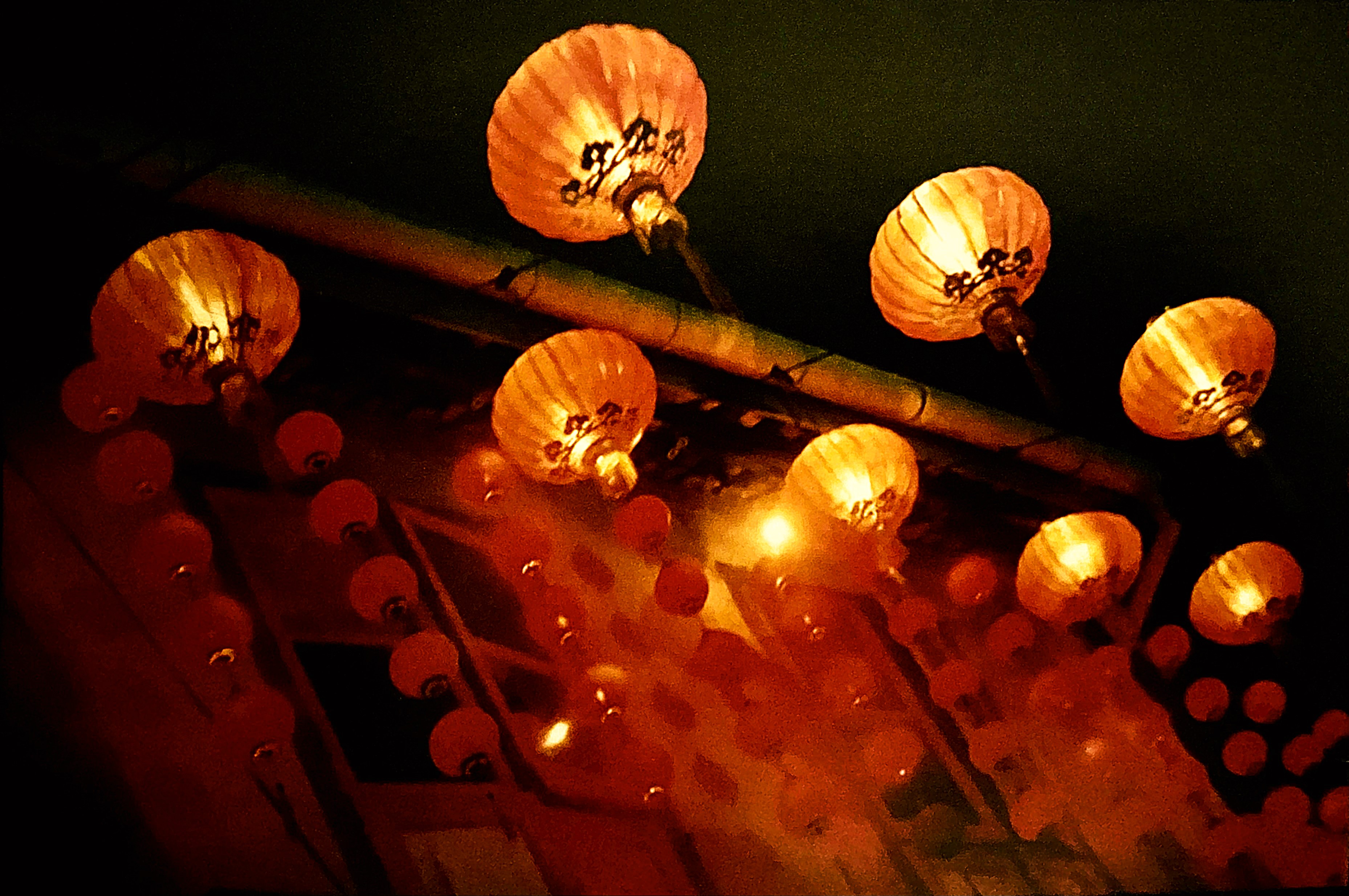
Lunar New Year’s decorations in the Chinese areas of Melaka

With current events being what they are, I thought this would be a good time to get into my way back machine and revisit a trip I took a long time ago. To go back to before I worked for the federal government, back before I was a mom, and before I grew old and my parents older. From July 2002 to July 2003, I lived in Singapore while pursuing a Master’s in Southeast Asian Studies. As Kismet would have it, a few months into my degree I discovered my high school friend CC was also in the country working at an advertising agency. CC and I decided to take a weekend and head up the Malaysian peninsula to Melaka together.

Melaka is but a quick, comfortable four-hour bus ride from central Singapore. I met CC early on a Saturday for the journey. All I remember is the bus was nice and CC and I talked the whole time. I know it must have been an easy trip as I do not recall anything special about it. I have been on very many types of transport around the world, and though it’s nice to have a straightforward trip, it’s the uncomfortable and weird journeys that make the best stories.

A traditional Straits Chinese shophouse building in Melaka

Melaka (spelled “Malacca” by the British) is quite possibly Malaysia’s most famous city outside of the capital. Owing to its strategic location halfway along the Strait of Malacca, a long-vital maritime route, and at the mouth of the Melaka River, Melaka has served as a crossroads, port, and home for many cultures over the centuries. In the 1400s it was the seat of a sultanate, from 1511-1641 a possession of the Portuguese, from 1641 to 1824 a Dutch holding, then ceded to the British until Malaysia’s independence in 1957. Chinese envoys and tradespeople made Melaka a key commercial stop and immigration destination. As I wrote in 2003: It is a fascinating little city with architectural representations of each of its colonial rulers and the Malay, Chinese, and Muslim influences of its past and present.  It seems like a place out of time, an almost European city plunked down in tropical Southeast Asia, with a Muslim Malay population with a heavily Chinese influence.

We stayed at the Eastern Heritage Guesthouse, an inexpensive lodging house in a traditional southern Chinese shophouse on Jalan Bukit Cina (China Hill Street) near the city center. Percentage Boy was the front desk clerk and jack of all trades at the Eastern Heritage Guesthouse. When we stopped in to inquire about a vacancy, we asked to see the room first.  We thought it was nice, but CC wanted a room with an attached bath, and the Eastern Heritage Guesthouse didn’t have any. We asked Percentage Boy if he knew of other places with similar prices and attached baths nearby. He assured us there were some, but mentioned that approximately 75% of visitors to his guesthouse decided to stay. After some discussion, we, too, came around to Percentage Boy’s persuasive nature. It was after all only 22 ringgit a night, which came out to 11 ringgit each or six and a half Singapore dollars each or four U.S. dollars each.  We were sold. 

The Peranakan-style necklace I bought; it’s still one of my favorites

Downstairs, as we entered our details in the guesthouse registry, I asked Percentage Boy if he spoke Malay, hoping to practice mine. He mentioned that he knew about 80% of Malay. I then asked about his Chinese. He responded that he spoke approximately 10% Chinese, about 90% English, 5% German, and 5% Italian. I tried not to roll my eyes. As CC and I exited, he provided us with a map and suggested we might be interested in the Laser Light show, as nearly 95% of his guests had reported enjoying it. However, the lady at the tourist information center informed us that the show was not running at the moment, although we discovered the next day that it had been. I wondered what percentage of visitors received the wrong information from Tourist Info Lady.

The Eastern Heritage Guesthouse, now permanently closed, sat about midway down a street of faded Chinese shophouses built in a style typical of the Straits Chinese. Downstairs the front of the building facing the street housed the family’s shop, while in the back and upstairs the family home. While living in Singapore, I visited the National Museum of Singapore during an exhibition on the Straits Chinese and was keen to see more of the culture.

Also known as Peranakan or Baba Nonya culture, the early southern Chinese who arrived on the Malay peninsula between the 14th and 17th centuries developed a unique amalgamation of Malay, Dutch, and Chinese culture. Their beautiful shophouses line many of the streets in Melaka; several have been turned into graceful hotels, interesting boutiques, and atmospheric restaurants. 

The Standhuys, or city hall, built by the Dutch in 1650

CC and I walked towards the historic center of Melaka to take in what is known as Red Dutch Square, an area characterized by 17th- and 18th-century Dutch buildings, including the Stadthuys or “city hall” (considered the oldest Dutch building in Asia) and the Dutch Anglican Christ Church (the oldest Protestant Church in Malaysia), and supplemented later by the British, who built the free school and the Queen Victoria fountain, and the Chinese, who built the clocktower. We next visited the ruins of the Portuguese Church of St. Paul, built between 1566 and 1590.

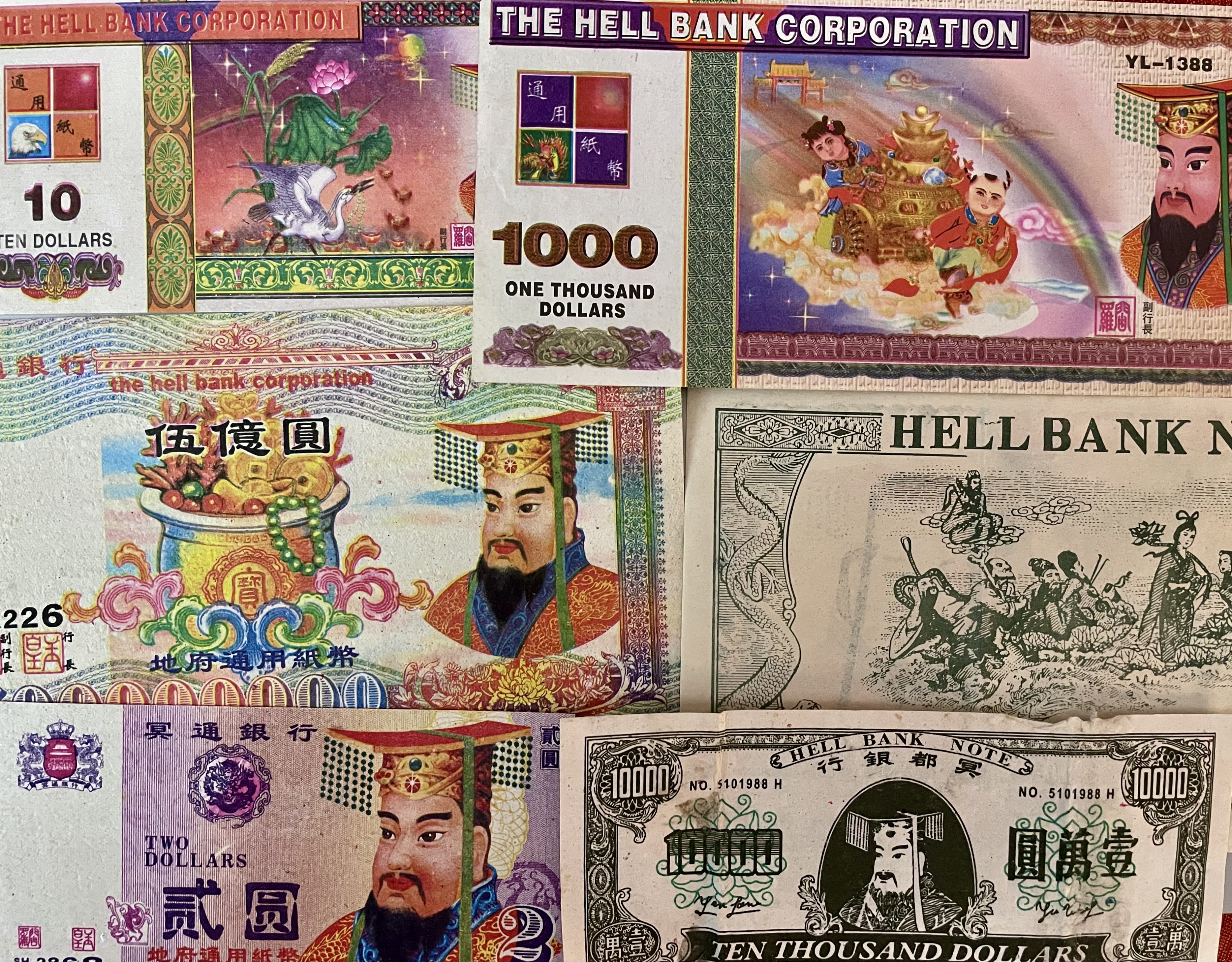
Some of the hell money I bought in Melaka

We poked about in shops, had a fantastic foot reflexology session, and gobbled up delicious wood-fired pizza in a refurbished shophouse. We also strolled through the Jonker Street Night Market, which was certainly lively, but lacked the jostling crowds we had experienced in Singapore.

While window shopping, I found a large stock of “hell money,” incense paper resembling various currencies, used in Chinese ancestral worship. By burning the currencies, people transfer funds from the living world to their deceased family members in the spirit world to ensure they will have sufficient funds in the afterlife to buy necessities and luxuries, pay bribes, or atone for their sins. Most hell money notes are high denominations. As a long-time currency collector, I had to buy some to add some to my collection.

The evocative ruins of the Portuguese Church of St. Paul

On our second and last day, Percentage Boy had one more opportunity to impress us with his statistical knowledge: At breakfast the next morning, Percentage Boy asked if we wanted toast with jam or eggs. We both ordered the egg, which seemed to confuse the boy as he noted that 75% of female guests ordered the toast and 90% of male guests ordered the eggs. We explained that we were hungry women. He seemed dubious.

Before we left Melaka we took a riverboat tour and met the talkative tour guide, whom I dubbed Loquacious Captain. We should have guessed something was up when his disembodied yet friendly voice welcomed us on board through the intercom with “Welcome. Welkommen. Selamat Datang. Huanying.”  This guy was full of character. He gave tons of information about the town of Melaka, the sights along the river, and just about everything else. Every monitor lizard we saw along the river had a name: Antonio Banderas, Sean Connery, Michael Douglas, Catherine Zeta-Jones, and Charlie. He spent much of the return journey saying goodbye to us…in as many languages as possible: “I would like to thank you on behalf of the tourist office of Melaka, myself, the boat captain, the crew, the Ministry of Tourism of Malaysia, the Prime Minister, and all the people of Malaysia– Thank You, Terima Kasih, Xie Xie, Arigato, Gracias, Merci, Danke Shon, Selamat Po, and for my friends from Russia Spaciba, to the Koreans Kamsahamnida, Shukriya to our Hindi friends, we want to thank all of you and to say Goodbye, So long, Farewell, Adios, Arrivederci, Ciao, Zaijian, Selamat jalan, Salaam, Adieu, G’day mates to those from Australia, Cheerios to our friends from Britain, Au revoir, Auf Wiedersehen, Aloha to the Hawaiians, Namaste, Sayonara, Do Svidanja to our Russian friends, thank you and goodbye, and as they say in Texas, you all come back now ya hear.”

I wish I had written more about and taken more photos of our trip to Melaka. It was a long time ago and a quick trip. Someday, I would love to return with my daughter. Five years after my visit Melaka, along with the Malaysian city of George Town, was designated a UNESCO World Heritage Site for its extraordinary blend of cultures and architectural styles. I hope the designation has led to funding and visitor interest in protecting this beautiful town. Though the faded, peeling paint jobs, broken shutters, and crumbling facades provided a certain atmosphere, future generations deserve to enjoy them too.