Balkans Bound, Part Seven: The Final Days in Pristina and Gračanica

This is the seventh and final installment of my daughter’s and my trip to Kosovo, Albania, and Montenegro in August 2026.

The Newborn Monument in Pristina, unveiled in the capital on February 17, 2008, when Kosovo declared independence

We left Peja and headed east toward Kosovo’s capital, Pristina — trading the mountains that had framed so much of our trip for rolling hills. Pristina sits in a flat valley, and at one point along the highway encircling the city, we caught a sweeping view of the entire capital spread out below us. It felt almost strange to see such a wide, open landscape after so many days of winding mountain roads.

We checked into our hotel in central Pristina. I had originally booked our final two nights near the airport but changed plans so we could spend a day exploring the city more easily. Once we settled into our room, we headed out for lunch nearby and then began a self-guided walking tour. Our first stop was the Newborn Monument, a large block-letter sculpture that celebrates Kosovo’s declaration of independence from Serbia on February 17, 2008. The monument changes its colors and design each year on that date, symbolizing the country’s evolving identity. Across the street, we visited the Heroines Monument, which depicts an Albanian woman formed from 20,145 metal pins — each representing the contributions and sacrifices of Albanian women during the 1989-1999 Kosovo War. The Newborn Monument felt celebratory and hopeful, while the Heroines Monument carried a quieter, somber weight. Facing one another, the two together formed a powerful message about the devastation of war and the hope that follows in its wake.

Left: C sits in the Newborn Monument; Right: the Heroines Monument

From there, we continued our walk along Mother Teresa Boulevard, a broad, pedestrian-only avenue lined with shops, cafés, and people out enjoying the day. We passed a statue of Mother Teresa herself — an important figure in Kosovo, as she was ethnic Albanian and is said to have found her spiritual calling in the small village of Letnica, in southern Kosovo. We followed the boulevard until we reached the Kosovo Parliament building, then crossed the street to the Çarshi Mosque. Built in 1389 to commemorate the Ottoman victory in the Battle of Kosovo, it is the oldest surviving building in Pristina. Behind it stands the National Museum of Kosovo, housed in an Austro-Hungarian building from 1889, though unfortunately it was closed for renovation during our visit.
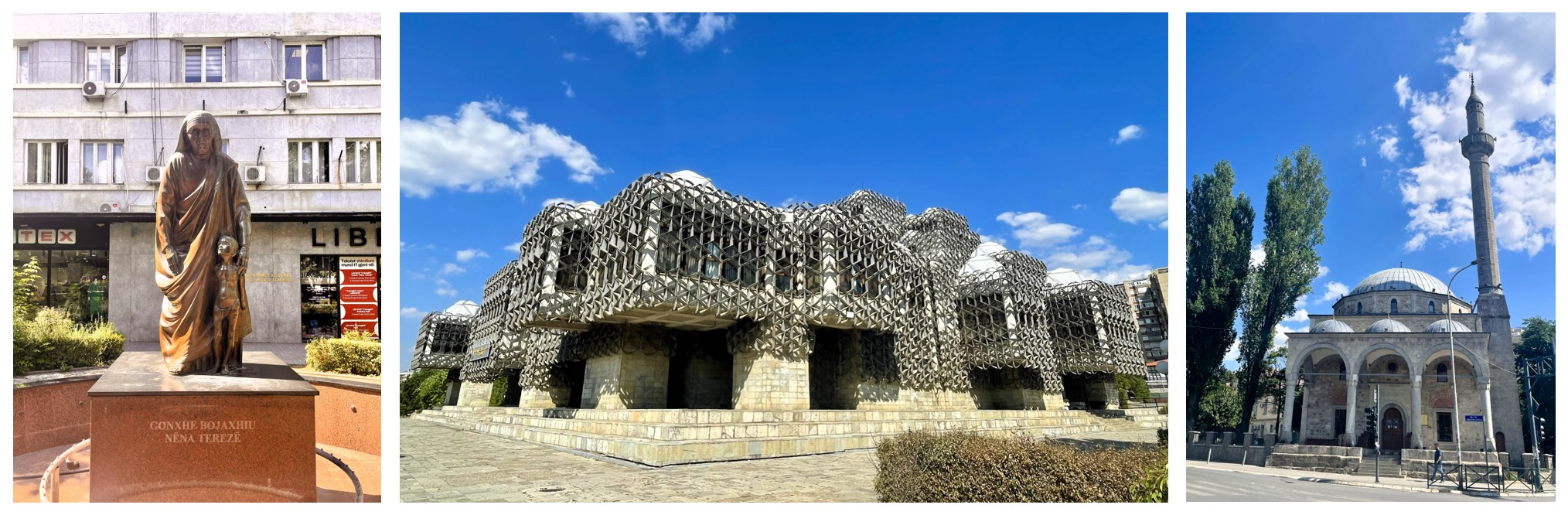
Sights of Pristina–Left: Statue of Mother Teresa in central Pristina; Center: the Brutalist/Futuristic beauty of the National Library of Kosovo; Right: the Çarshi Mosque, Pristina’s oldest building

We continued on to the campus of the University of Pristina to see the National Library, famous for its striking architecture — a brutalist design with a distinctive futuristic appearance. C, who has an interest in architecture and a surprising fondness for Brutalism (perhaps thanks to Washington, D.C.’s share of concrete buildings), had especially wanted to see it. Our final stop was the Cathedral of Saint Mother Teresa. Built between 2007 and 2017 and officially consecrated in 2017, it is the largest structure in Kosovo and the first cathedral built in the country since the 16th century.

In just a few hours of walking, I felt as though we had passed through centuries of Kosovo’s history — from Ottoman rule to war to hard-won independence. It was a beautiful day and a satisfying walk, but it carried a certain weight. While there isn’t an overwhelming amount to see in terms of traditional sightseeing, Pristina clearly has momentum. Construction cranes dotted the skyline, signs of an economic boom fueled in part by the Kosovar diaspora. The city felt youthful and hopeful. We spent the rest of the afternoon and evening resting up for our final day in the country.

Gračanica Monastery

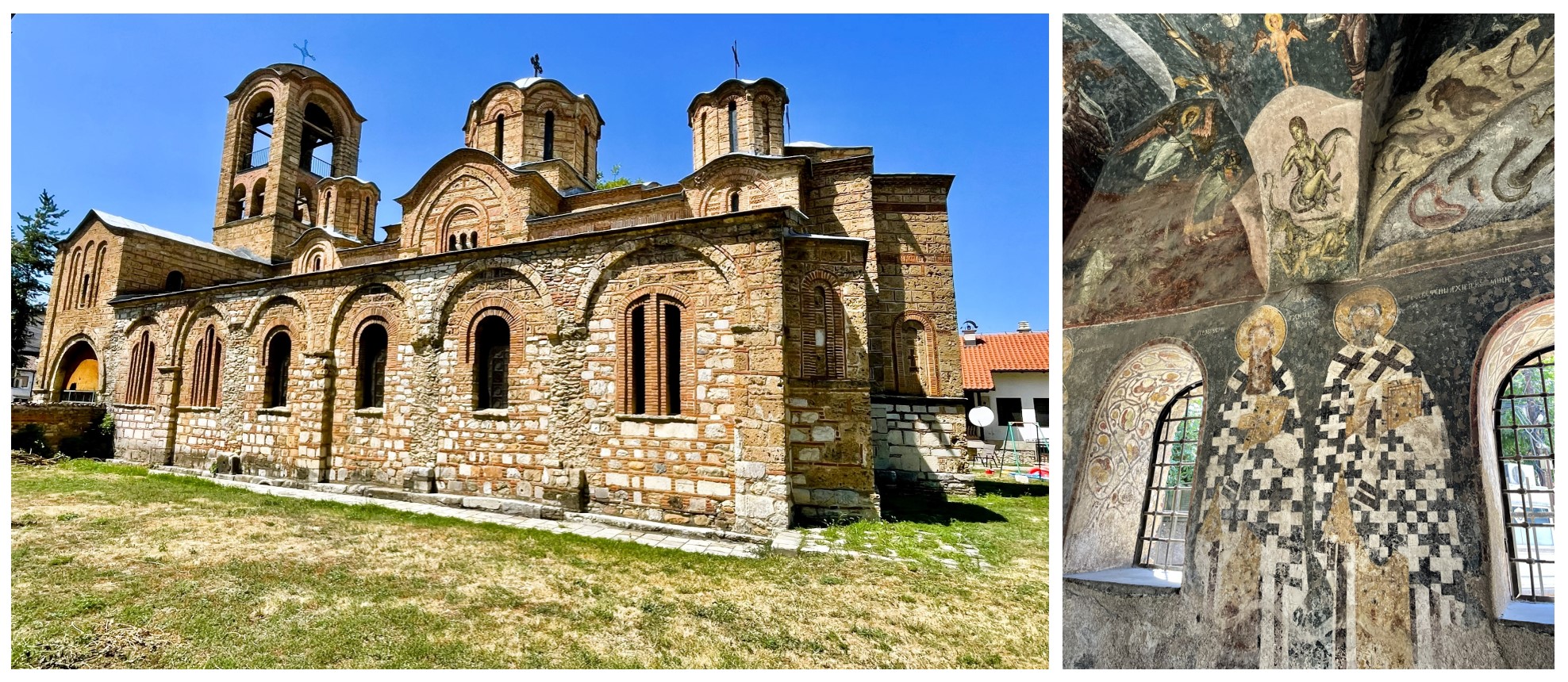
On our last day, we packed up the car for one final sightseeing drive, heading to the town of Gračanica, just five miles from Pristina. Our goal was the 14th-century Serbian Orthodox Gračanica Monastery — the fourth and final of the UNESCO-designated Medieval Monuments in Kosovo that we would visit. Like the others, the monastery centers on a stand-alone church within a walled complex, its interior lined with offices and living quarters. Inside, the church walls are covered with magnificent frescoes depicting scenes from the Bible — vivid, detailed, and deeply expressive. It was beautiful, though also the busiest of the four UNESCO sites we’d seen, and the strictest about what visitors could and could not do.

Outside the monastery, we took a short walk around town. One of the first things we noticed — or rather, C did, with her knack for recognizing flags — was the presence of Serbian flags and the use of the Serbian language. It was a noticeable change from what we had seen elsewhere: in Prizren and Peja, Albanian flags and symbols were everywhere, while in Pristina, we had seen a modest number of Kosovar flags. Here, the Serbian presence was unmistakable. A statue of the legendary Serbian knight Miloš Obilić stands prominently in the town center, and nearby is the Missing Monument, a somber memorial honoring the Serbs who were kidnapped or went missing during and after the Kosovo War.
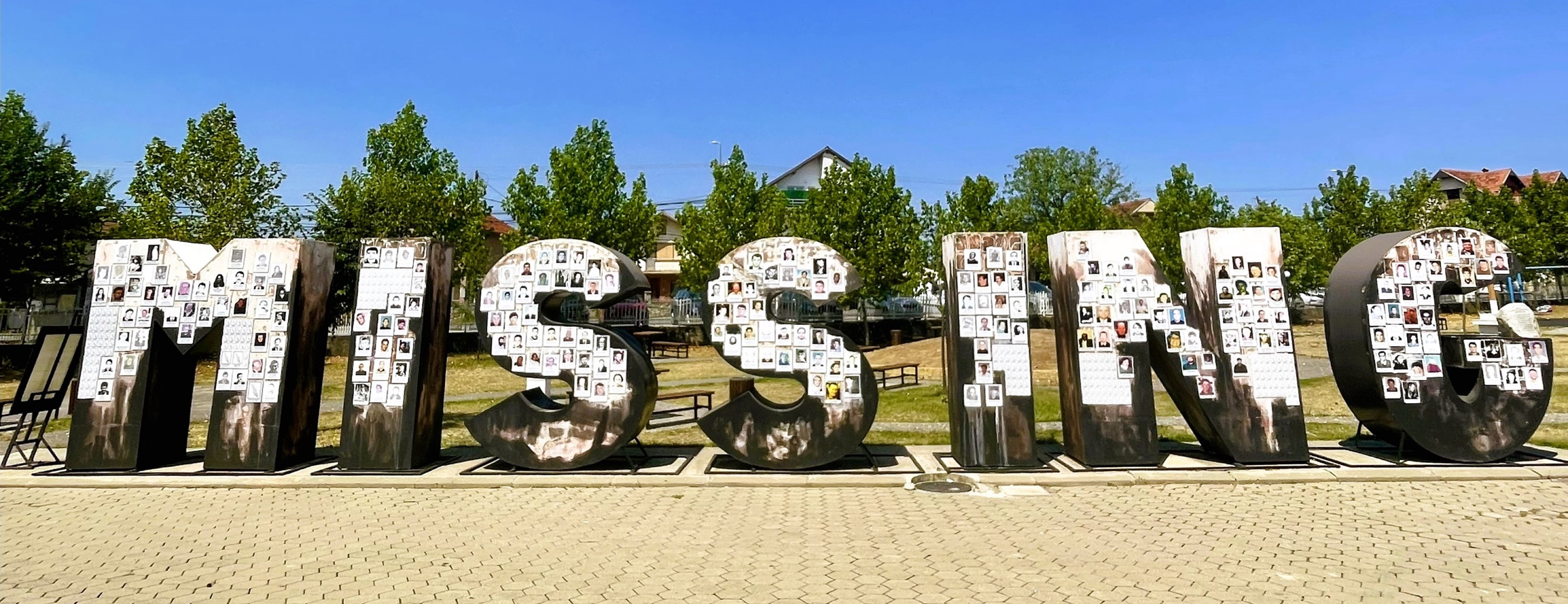
The Missing Monument in Gracanica

Even amid Kosovo’s visible economic growth and youthful optimism, reminders of the region’s divided past remain close at hand. I had thought I’d managed to keep politics at bay during our trip, but it was impossible to ignore the quiet signs everywhere — reminders of how deeply history, identity, and faith are still woven into daily life here, and how the past continues to shape the present.

For a change of pace — and to end our trip on a lighter note — we drove to the Bear Sanctuary Prishtina, a rescue center that provides care for brown bears once kept in captivity in Kosovo and Albania. The sanctuary is set on forested land by a lake, and the bears have large enclosures that give them room to roam and explore. It felt spacious and well-run, and as we followed the winding paths up and down the hillside, C and I got quite a workout. Watching the bears lounging and playing was a lovely way to close out our travels.
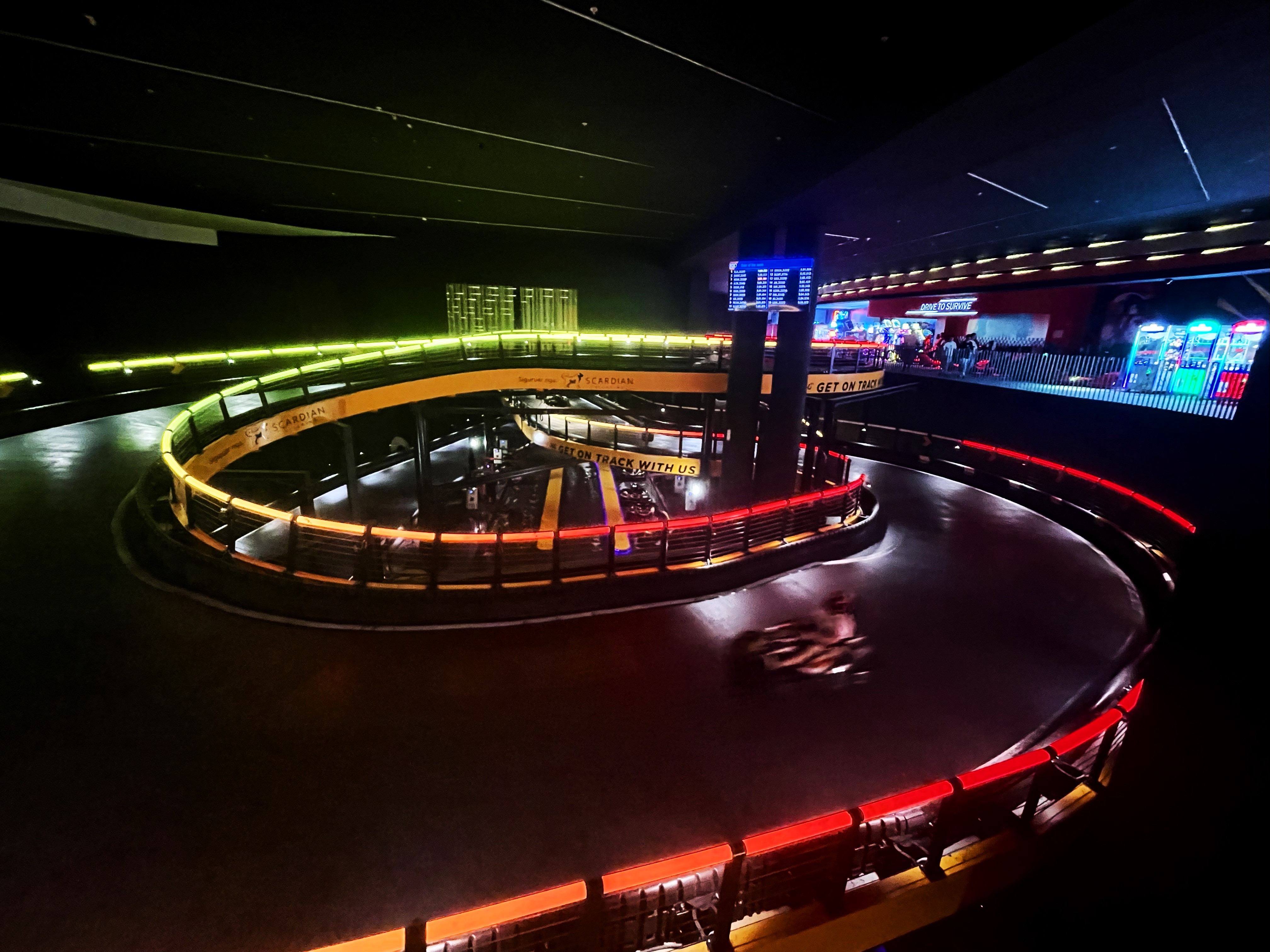
It was so fun go-karting on this track in the Pristina Mall!

I had one last surprise for C: for our final final activity of the vacation, we went to Prishtina Mall. At 1,233,140 square feet, it’s the largest shopping and entertainment center in southeastern Europe. We had lunch, did some window shopping, got gelato, and drove go-karts on a cool indoor track — yes, right inside the mall! It was the first time either of us had gone go-karting, and it was an absolute blast. Afterward, we drove to our hotel near the airport, returned the rental car, and spent our last night in Europe before the early morning flight that would begin our journey home.

Our two weeks in Kosovo, Albania, and Montenegro were everything I could have hoped for — full of adventure, discovery, and connection. We packed so much into those days, from mountain drives and monasteries to coastal towns and caves. More than anything, it was a memorable mother-daughter journey, one that I know neither of us will forget.
Balkans Bound, Part Six: Peja and the Monasteries of Dečani & Peć

This is the sixth installment of my daughter’s and my trip to Kosovo, Albania, and Montenegro in August 2026.

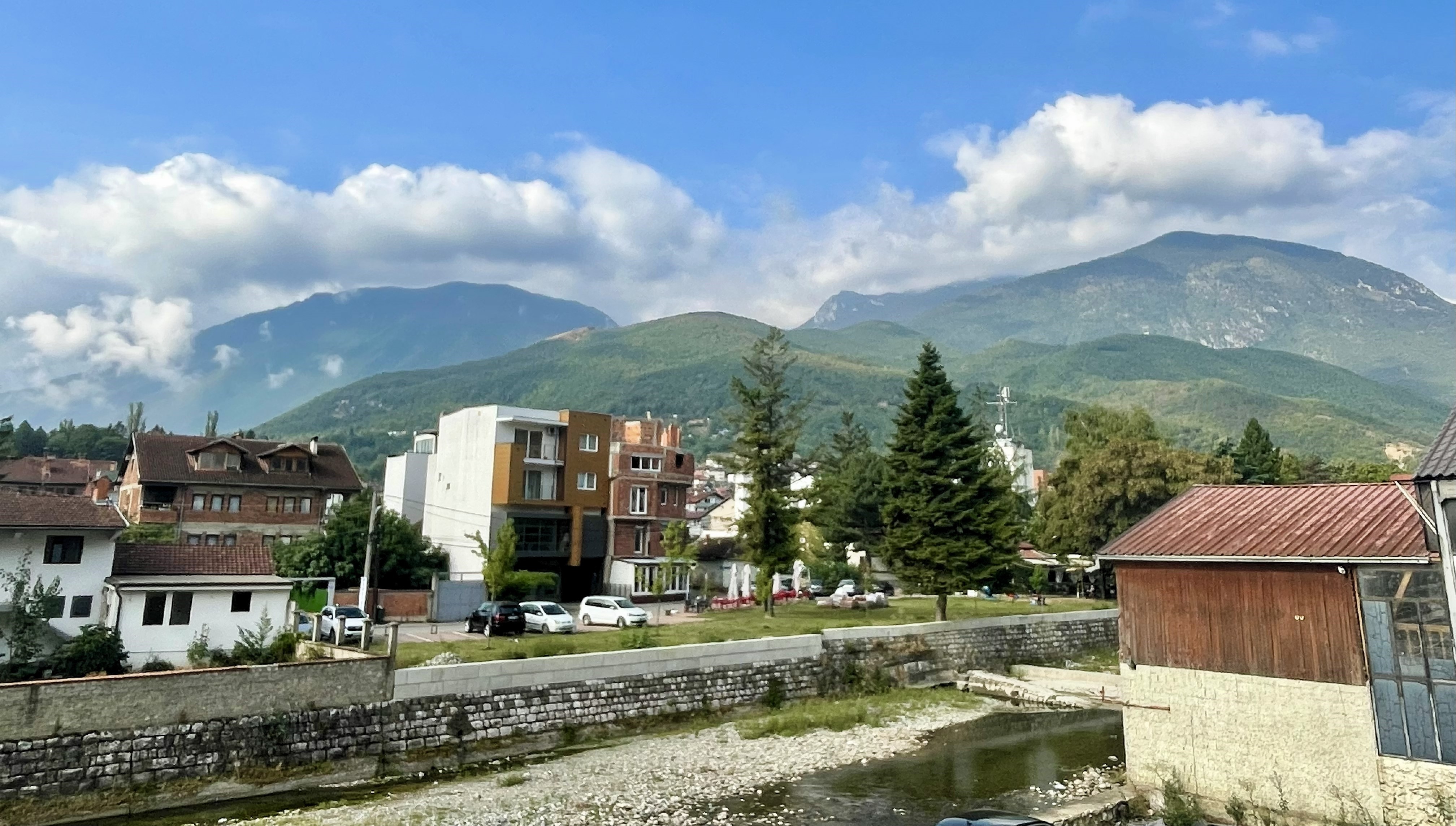
The view from our Peja hotel toward the Rugova Mountains

We left Podgorica on a smooth, straight highway, but about an hour later turned toward Kosovo and began to climb once more into the Accursed Mountains — the southernmost and highest subrange of the Dinaric Alps. The next ninety minutes took us along twisting mountain roads with sweeping vistas at every turn until we reached the Montenegrin border crossing. After the hiccups we’d faced entering Montenegro, I was grateful that this crossing went off without a hitch. Interestingly, the checkpoint wasn’t at the actual border; we still had about four miles to go before entering the narrow Kulla Pass, then another nine miles of serpentine road with breathtaking panoramic views before reaching Kosovar immigration.

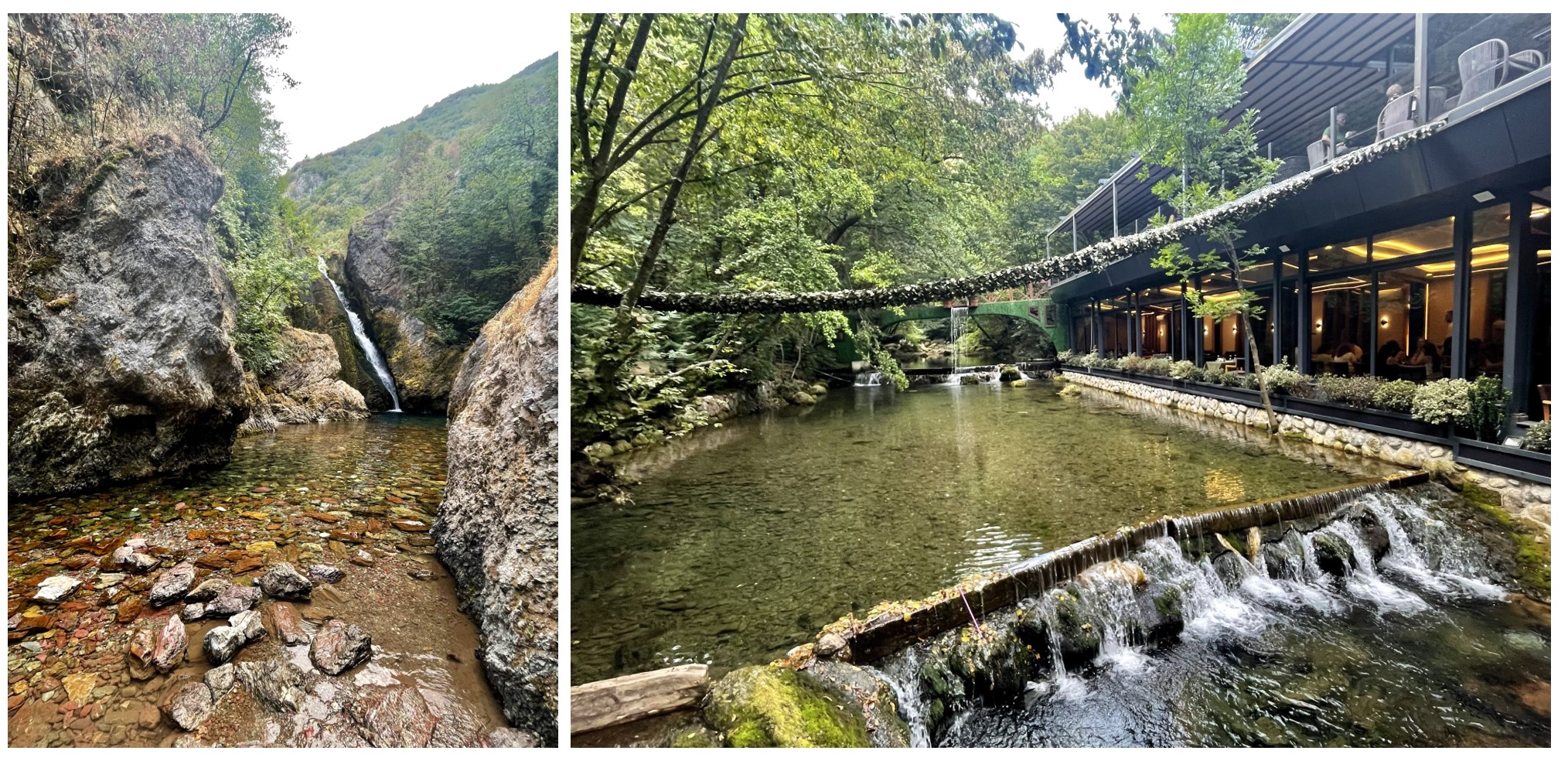
From the border, we descended toward Peja but stopped first at Ujëvara e Drinit Resort (Waterfall of the Drin Resort) for lunch and a view of the White Drin Waterfall. The resort was stunning — all dark wood and stone, blending well into the forest along the White Drin River. Despite it being a Monday, the resort was lively, full of families and friends enjoying a day out. I could not help but think that if I lived in Kosovo, this would be the perfect weekend getaway. After a lovely lunch, we took a short forest walk to the 75-foot waterfall. It may not have been the most spectacular waterfall I’ve seen, but it was undeniably pretty — and the forest setting was peaceful and restorative. From there, we continued on to Peja.

Left: A view of the White Drin Waterfall; Right: the White Drin as it flows past the restaurant at the Ujëvara e Drinit Resort

Arriving in Peja took longer than expected. It was still the summer holiday season, and many Kosovars living abroad were visiting their families. The roads were bumper-to-bumper, and Google Maps led me astray more than once. By the time we finally checked into our hotel, it was after 4 p.m. Though we were ready for an early evening after the long drive, we still took an hour to walk through the town.

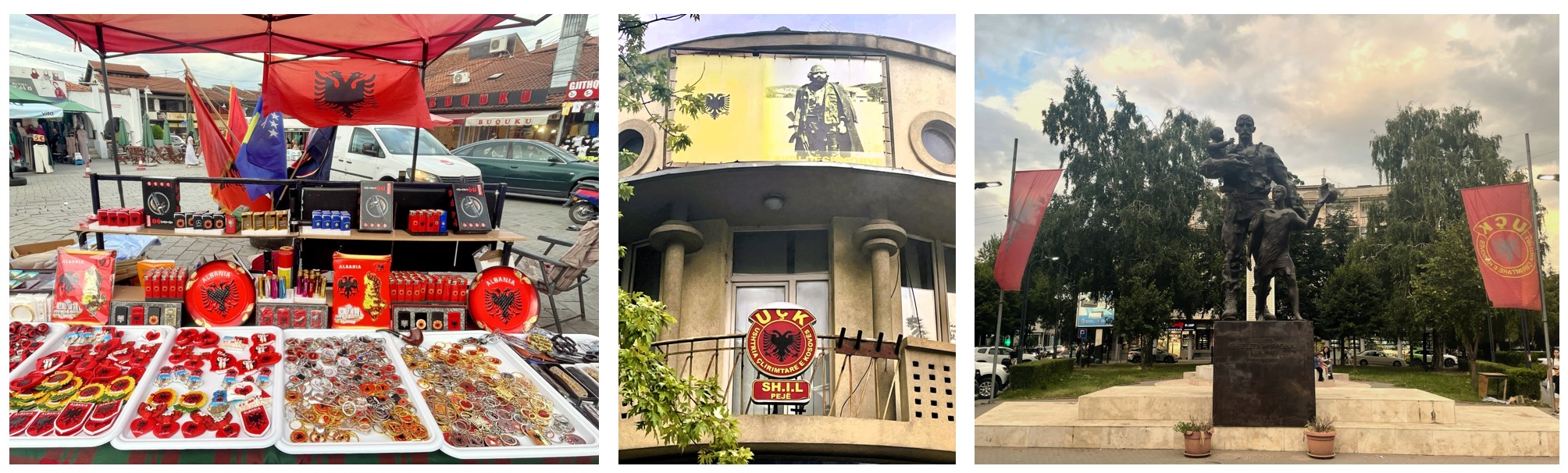
We walked a few blocks to the Peja Bazaar, which dates back to the Ottoman period and was once the center of trade in the city. The market was destroyed in 1999, during the Kosovo War, and rebuilt using the traditional style. Most of the shops weren’t aimed at tourists — they sold gold jewelry, carpets, furniture, clothing, toys, and other everyday goods. But one stall near the 15th-century Bajrakli Mosque at the market’s center stood out: it was filled entirely with Albanian paraphernalia, and I remembered back to when we were in Prizren.

When we were in Prizren, we saw many signs with the letters “UCK.” My daughter pointed one out and guessed it was supposed to be a bad word, missing a letter. After we kept seeing it — along with Albanian flags, placards on buildings, and other symbols — I decided to look it up. UÇK stands for Ushtria Çlirimtare e Kosovës, or the Kosovo Liberation Army. Curious, I asked a souvenir shop clerk if UÇK had become a political party, but he explained that it was disbanded in 1999. When I asked why, then, there were still so many signs and goods today, he said, “Because it is still important to Albanians and Albanian culture.” There were almost no Kosovar flags or souvenirs to be seen.

Reminders of war and Albanian ethnic identification in Peja

The following morning, C and I set off on another adventure — a visit to the Dečani Monastery, about ten miles south of Peja. Founded in the first half of the 14th century by Stefan Dečanski, King of Serbia, the monastery also serves as his mausoleum. It is one of four churches in Kosovo designated as UNESCO World Heritage Sites under the collective title Medieval Monuments of Kosovo, recognized for their blend of Byzantine and Romanesque styles and their remarkable wall frescoes. This was the second of those sites we visited, following Our Lady of Ljeviš in Prizren, and it is the largest medieval church in the Balkans.

I had not realized Dečani’s complicated history. Because Stefan Dečanski is such a significant figure in both Serbian history and the Serbian Orthodox Church, the monastery remains deeply important to Serbia today. Serbia placed the site under legal protection in 1947, but it now lies within Kosovo’s borders — though Serbia does not recognize Kosovar independence. To ensure the security of the site, the monastery has been under the protection of NATO’s Kosovo Force (KFOR) since 1999.

I, having not done my customary research, was, however, completely unaware of the above before setting out, and was taken aback when we reached a checkpoint on the road leading to the monastery. We passed through fine, but once at the site, we had to check in with KFOR soldiers, who asked for our passports, which, to my dismay, I had left behind. I could hardly believe how unprepared I was, and for a moment I thought we might have to drive all the way back to Peja to retrieve them. I offered my driver’s license instead and pleaded my case, and after a brief discussion with their command, the soldiers agreed to let us in.

Just a few photos of the extraordinary Decani monastery

The weather that day was perfect — bright, sunny, with a deep blue sky overhead. The church is enclosed within defensive walls that also contain administrative offices, dormitories, and a small hospital. Visitors are not permitted to enter any of those areas, only the church itself. The building is beautiful, constructed of pink and white marble that appears more white and golden in the sunlight. The doorframes and supraportes are intricately carved, each detail precise and deliberate.

Then we stepped inside — and I was not at all prepared for what awaited us. Every inch of wall and ceiling was covered in frescoes depicting scenes from Serbian history and Christian tradition. They were vibrant, detailed, and utterly stunning. Both C and I were transfixed, slowly wandering through the church with our heads tilted back.

The stunning Patriarchate of Peć

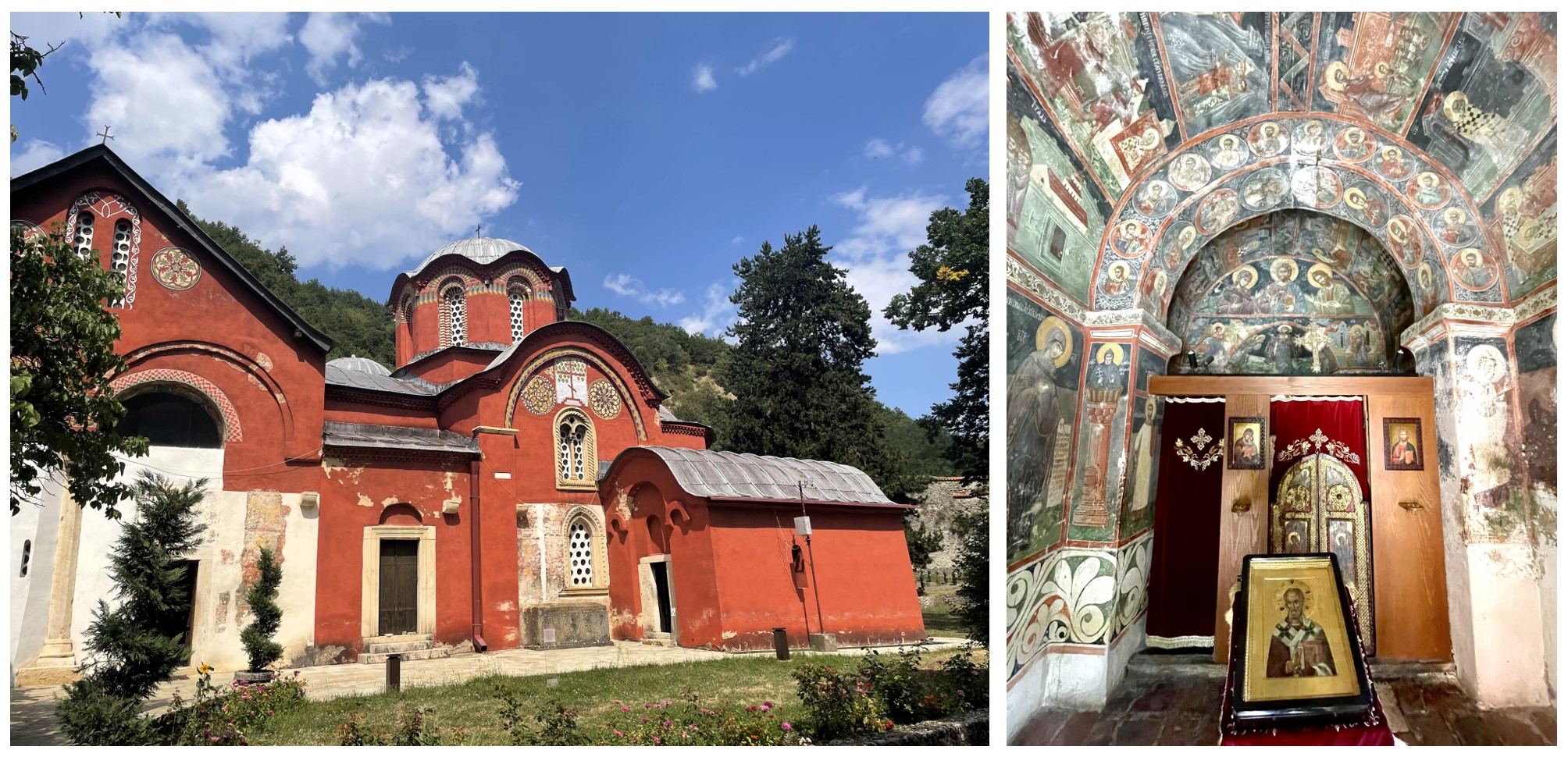
From Dečani, we headed back to Peja for lunch and to pick up our passports before continuing to the Patriarchate of Peć, another of the UNESCO-designated Medieval Monuments of Kosovo. The Peć monastery was guarded by police rather than KFOR, though passports were still required for entry. Unlike Dečani, Peć is set within a walled garden, and instead of marble, its 13th-century church has a bright red plaster exterior — the same color as when it was first built. There were also more visitors here; at Dečani, we had been two of only a handful, but Peć had at least a dozen, along with a few very watchful nuns. The frescoes, though less extensive than at Dečani, were just as beautiful. We enjoyed the visit, though by the end, we had certainly had our fill of ecclesiastical art for the day.

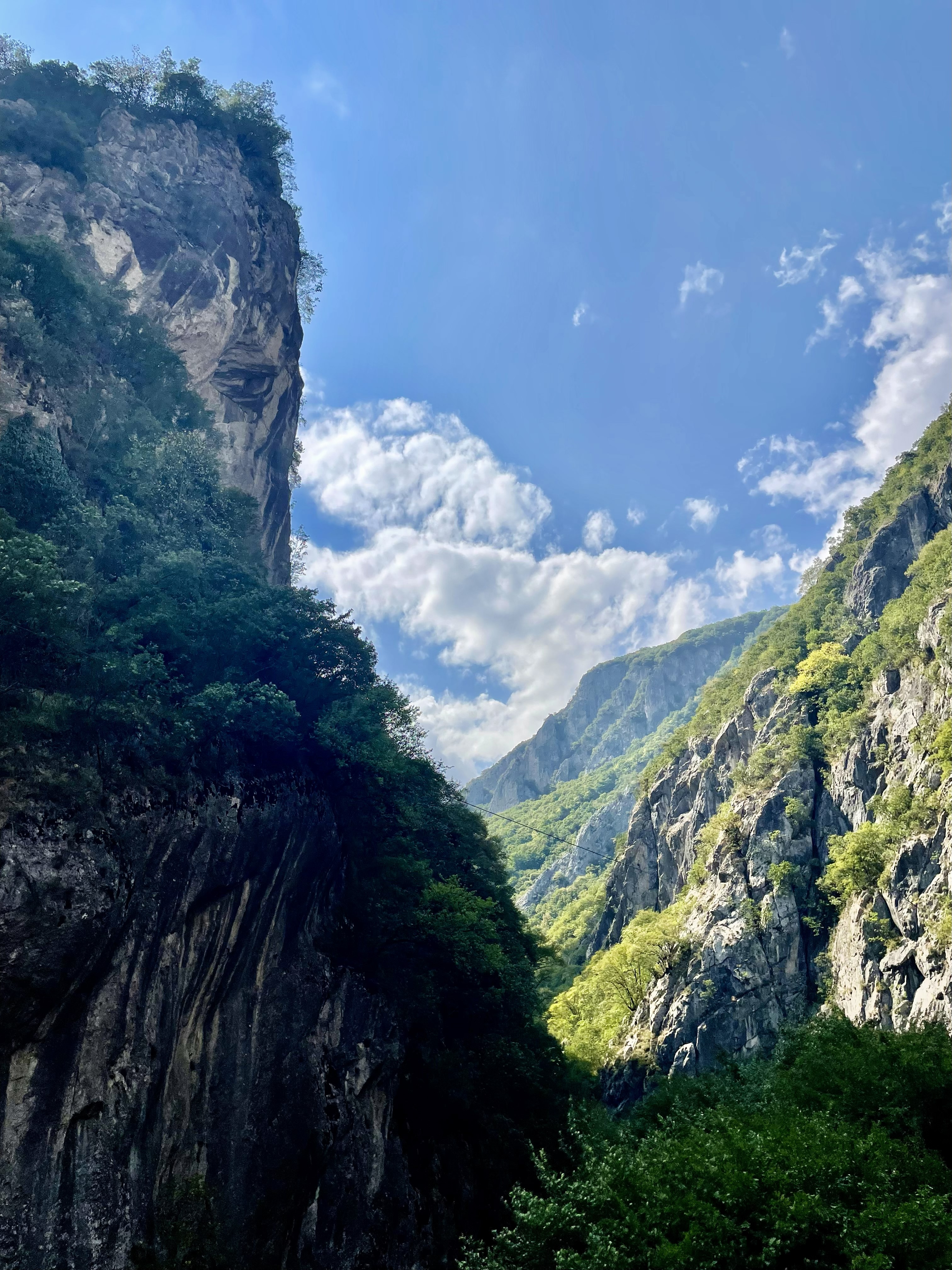
A glimpse of Rugova Canyon

After Peć, we continued up the road into the Rugova Canyon. Though we were both tired, it was an absolutely gorgeous day, and I wanted to see at least a few of the viewpoints. C, however, was ready for a nap in the car, so my stops were brief — just long enough to take in the view before moving on. As we’d encountered so often on this trip, the mountain road was narrow and winding, but this stretch added a few short tunnels carved straight through the rock. I drove only as far as the Hotel Panorama, about eight miles in, before turning back. The scale of the canyon was humbling — sheer cliffs, deep shadows, and a vastness that was beyond words.

We returned to our hotel in Peja completely knackered — we had packed a lot of sightseeing into one day. After resting for a few hours, I headed out alone at the golden hour while C stayed behind. That was fine; she had already shown far more interest in art, architecture, and history on this trip than I had expected, and I welcomed the chance for a quiet walk. I strolled down to the Peja Town Square, a broad pedestrian area with shops, hotels, and restaurants framed by interesting architecture. From there, I crossed the bridge by the old clock and followed the Lumbardhi Peja River until I reached the stone bridge, where I crossed again. I was hoping to find traces of the city’s older past — and did: Haxhi Zeka’s Kulla, Haxhi Bey’s Hammam, and another kulla nearby. The kullat, traditional stone tower houses found throughout the Balkans, are remarkable glimpses into Peja’s history. Still, I couldn’t help but feel the city could do more to showcase these pieces of its cultural heritage.

Left: Clock on Peja’s Town Square: Right: a kullat, or traditional stone residential tower-home in Peja

Our time in Peja had come to an end, and the next day we would return to Pristina to begin the final stretch of our journey through Kosovo. It had been a full few days — rich with history, beauty, and more than a few winding roads.

Balkans Bound, Part One: Planning, Arrival, and Prizren

The newest additions to my magnet collection

In August 2025, my 13-year-old daughter C and I embarked on an amazing two-week road trip through Kosovo, Albania, and Montenegro. Last fall, after our incredible trip to Japan, I began thinking about the next big summer trip. C asked if I would consider somewhere in the Balkans. With more than 40 countries under her belt and a love of geography, C wanted to both head back to Europe and also somewhere more off the beaten track. I had had several countries in the Balkans on my bucket list for a while, so it seemed perfect. I started to plan, and by early 2025, I had our flights, hotels, and itinerary all set.

Then the year started to go sideways. With everything going on in and around my life, I began to debate with myself whether a big summer vacation was still a good idea. I am incredibly grateful to my friends who talked me out of cancelling.

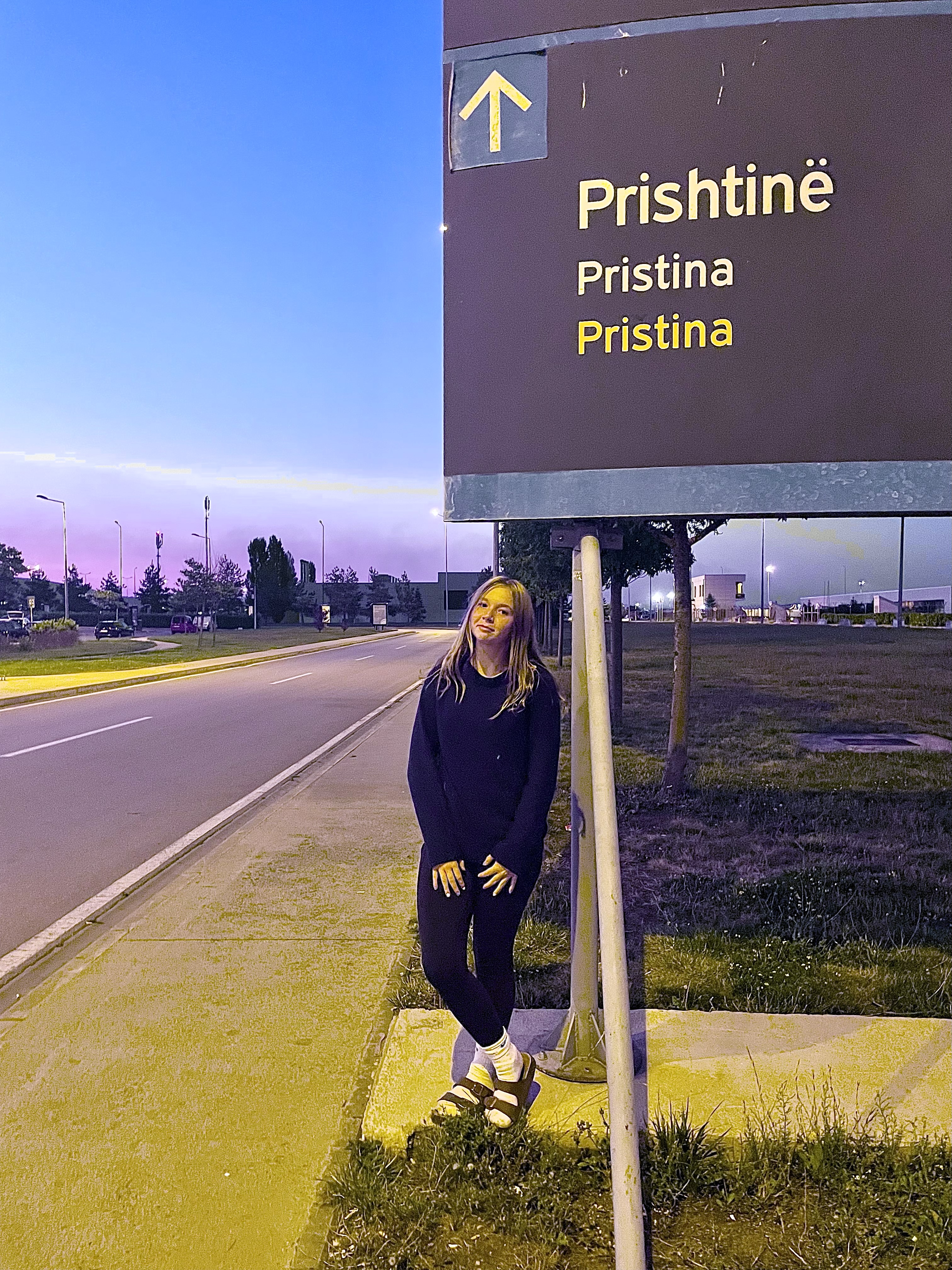
C at the airport before we started walking to our hotel

We flew into Pristina via Istanbul on an overnight flight. I again employed my long overnight flight strategy: go to bed early the night before so we’d start the trip rested, stay awake through the journey, and crash only after we arrived. It had worked surprisingly well for Tokyo — and, as luck would have it, it worked for this trip too. I slept for about an hour and C for two, and we touched down in Pristina wide awake and excited — 7 PM local time, 1 PM Washington, DC time.

I had reserved a hotel close to the airport. My brilliant plan was to stay at the hotel that evening, then return to the airport the next morning to pick up our rental car. On the map, the hotel looked close, only a 17-minute walk. We had walked from the airport to a hotel a few years before when we visited Lisbon, and I had walked from hotel to airport or vice versa in other places (I remember particularly in Bonaire and St. Kitts), so this seemed like a piece of cake. Unfortunately, the sidewalk stopped about 5 minutes out from the hotel, and we had roller bags that we then had to drag through a narrow strip of untended grass and weeds. While 10-year-old C had been game for the walk a few years ago, 13-year-old C was less than thrilled. But we both survived the ordeal, arriving at our hotel safe and sound and ready to finally get a good night’s sleep.

The 16th-century Old Stone Bridge in Prizren

The next morning, I walked back to the airport to collect our rental car only to discover that Budget does not have an office there — the Budget rental car office was right across the street from our hotel. Sigh. Just a lovely early morning stroll for me to and from the airport on a busy road. It seemed the guy sitting in the Budget office had been there for at least an hour just waiting for me, because as soon as I walked in, he spoke my name. Like something right out of a movie. He brought a little white Yaris around, showed me it had a few scratches and a long crack across the windshield, which he assured me was no problem. I signed the paperwork, and that was it. I hoped in, drove across the street to the hotel, where C and I checked out and loaded up the car. We were off. Our road trip had begun!

Beautiful wall mural in Prizren

We had only an hour drive to get to our first stop, Prizren. Kosovo’s second-largest city and its constitutionally mandated cultural capital, the area of modern-day Prizren has been inhabited since 2000 B.C. and has been a key city for the Dardanians, Romans, Serbians, and the Ottomans. As such, the small city is brimming in history.

After some trouble dealing with the difficult parking situation at our hotel located in the heart of the old city, a stone’s throw away from the Ottoman-era Old Stone Bridge that spans the Prizren river, we headed across the bridge for some sightseeing and lunch.

Following a lunch in Shadervan Square, we headed back across the river to the Archaeological Museum. The small museum is housed in a former 14th-century Turkish hammam. The museum was okay, but we were really there to climb up its watchtower so we could peek over into the neighboring plot at the church of Our Lady of Ljevis, one of the four Byzantine-Romanesque buildings that make up Kosovo’s UNESCO World Heritage-designated “Medieval Monuments in Kosovo.” I had read online that the Ljevis church was closed to the public for renovations and therefore the best way to see it was from the museum’s tower. Unfortunately, when I asked how to access the tower, the museum guide informed us it was closed for a special exhibit. So special, it seems, that guests to the museum could not access it, but only see the odd red light flashing from the top windows.

Our Lady of Ljevis

Once we exited the museum, I thought we would pop around the corner and look at the church from the gates. I managed a decent photo through the bars of the encircling fence. Then we walked around to the front to discover it was open to visitors, with a very knowledgeable guide on site. How lucky! Though the majority of the 14th-century frescos in the church, which were plastered over during the Ottoman period, have either yet to be uncovered or are perhaps too damaged to be so, restoration workers have been able to bring enough of them to light to demonstrate their significant artistic and cultural importance.

We headed back to Shadervan Square for ice cream, then, once fortified, we headed to Privren Fortress. Situated on a hill overlooking the city, the current fortress ruins date from the late Ottoman period. However, fortifications of some kind have sat in that location since the Roman era. There is no cable car or modern conveyance to get one up to the fortress, just a hard slog up the steep, uneven, paved pathway. Thankfully, it takes just 15 or 20 minutes to walk up from the Old Stone Bridge.

C at an entrance to Prizren Fortress overlooking the town

There is no entrance fee, no informational plaques, no guides. The location is amazing; from atop the walls, one has a commanding view of the town, river, and surrounding mountains. The fortress is a popular sunset spot for locals; however, we did not want to stay too long, and especially did not want to manage our way down the slippery stones in the waning light. Still, we enjoyed a good hour of the late afternoon light. We also did not know how much longer we might hold out against the likely jet lag.

My exquisite salad at the Sarajeva Steakhouse

We ended the day with an unforgettable dinner at a riverside restaurant, tucked beneath the 15th-century Sinan Pasha Mosque and looking out toward the graceful Old Stone Bridge. The evening was warm, touched by a gentle summer breeze, and we lingered over our meal as families and couples strolled across the bridge or paused in front of the mosque, bathed in golden-hour light. When the last rays of sun finally slipped away, we took one more slow walk along the river on the far side of the bridge. It was the perfect finish to our first day — so full and joyful that it already felt as though we’d been on holiday for days. We easily fell asleep so we would be well-rested for the next part of our adventure.