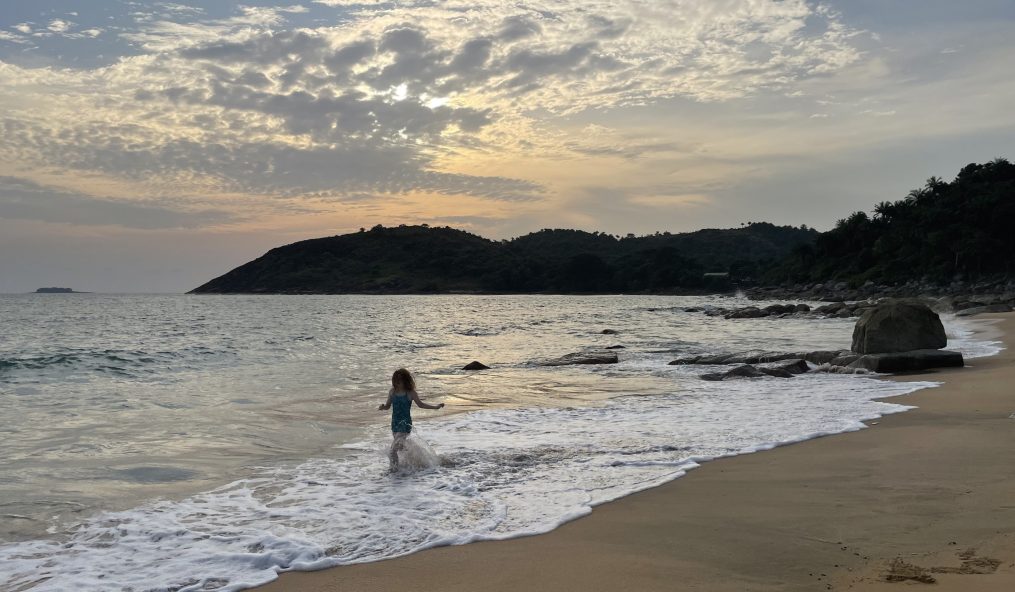
This is the fifth installment of my daughter’s and my trip to Kosovo, Albania, and Montenegro in August 2026.
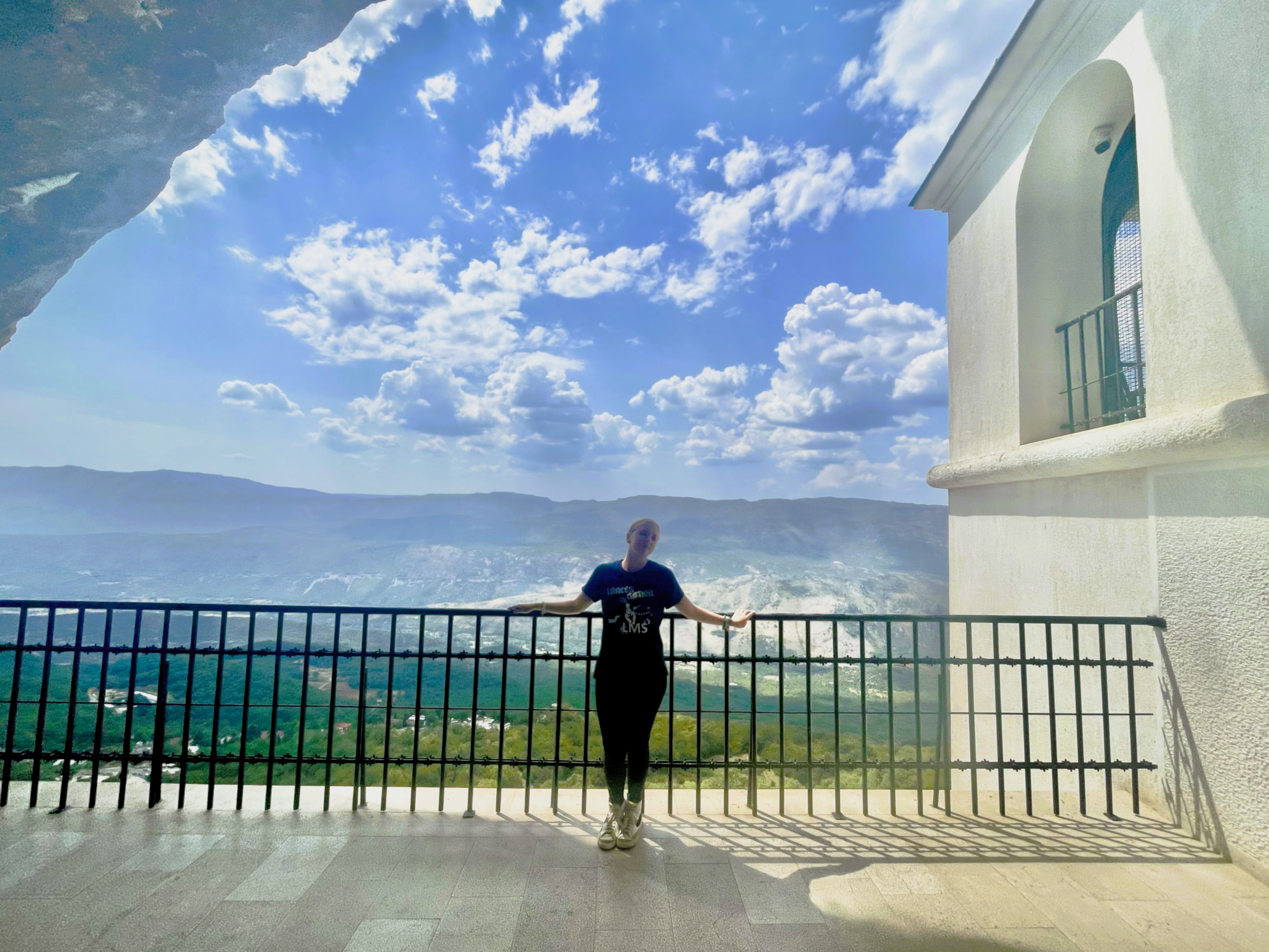
On the eighth day of our trip and our fifth day in Montenegro, C and I said farewell to Kotor. We were off to Cetinje, the country’s former capital. To get to Cetinje, I had two options: up and over Mt. Lovćen or around it. Having already had two drives through the serpentine road, I opted to go around!
Cetinje served as the royal capital of Montenegro from the 15th century and the capital of independent Montenegro from 1878 to 1914. Today, the city is still considered the seat of Montenegrin culture. It is on the UNESCO World Heritage Site tentative list for its “historic core.” With that sort of pedigree, I figured that Cetinje was a “must-see” when in Montenegro.

We started at the Court Church and made a circuit around the historic area. The church didn’t appear to be open, so we took in its exterior before continuing on. Our next stop was the Monastery of St. Peter, a Serbian Orthodox monastery founded in 1484. The building’s architecture was beautiful and striking, and I would have loved to go inside, but we weren’t dressed appropriately. Although I’d read that tourists in shorts might be given wraps to cover their legs, there was no one around to offer them or to admit visitors. The gate that seemed to be the entrance was closed, so we lingered for a moment to appreciate the monastery’s façade, then moved on.
As we entered town, we passed Biljarda Palace, the 19th-century residence of Prince-Bishop Petar II Petrović-Njegoš (of the Njegoš Mausoleum fame), now home to a museum dedicated to his life and work. Along Njegoš Street — a pedestrian-only road through the center — we saw many fine old buildings, including the former French Embassy. Some were crumbling with age, while others were clearly in the midst of restoration. Something about Cetinje felt off — it was too quiet, almost abandoned, and C and I just couldn’t muster much enthusiasm for exploring it.
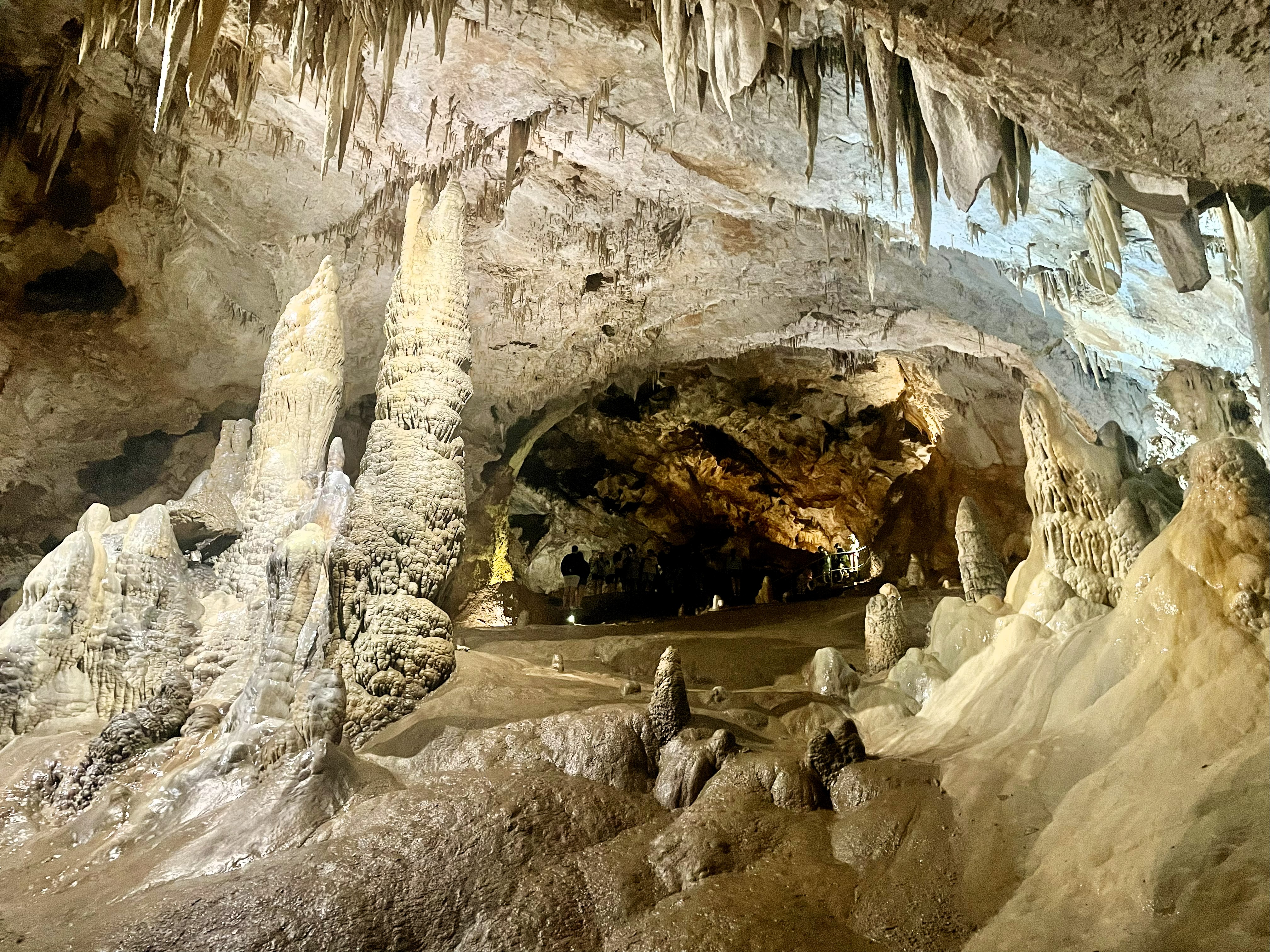
From Cetinje, we continued just a short distance outside town to visit Lipa Cave — Montenegro’s first cave open to the public. Permanently opened in 2015, it’s one of the country’s largest caves and has quickly become a popular tourist attraction. I seem to have a thing for cave tours; I’ve visited Mammoth Cave, Wind Cave, Jewel Cave, Carlsbad Caverns, and Luray Caverns in the United States, along with several others around the world. Lipa Cave keeps a cool ambient temperature of about 45–55°F, so it’s definitely on the chilly side. At the car, C was wearing shorts and a T-shirt, and I insisted she put on something warmer. Being a teenager, she insisted she was “fine” and only grudgingly put on a sweatshirt. But when we reached the cave entrance, she quickly realized I hadn’t been kidding about how cold it would be! Our visit included a one-hour guided tour, which proved both fascinating and refreshingly cool. Even C expressed a lot of interest! Once back outside, we were grateful for the summer heat.
After exploring Lipa Cave, we continued on to Podgorica, Montenegro’s capital, which would be our base for the next two nights. After several busy days, we opted for something familiar and went to the Hard Rock Café for a late lunch — a bit of a travel tradition for C and me, as we’ve visited locations all over the world. Downtown Podgorica felt a little untended and quiet, though parking was surprisingly difficult. Lunch, unfortunately, was forgettable, and we spent the rest of the evening simply relaxing at our hotel.
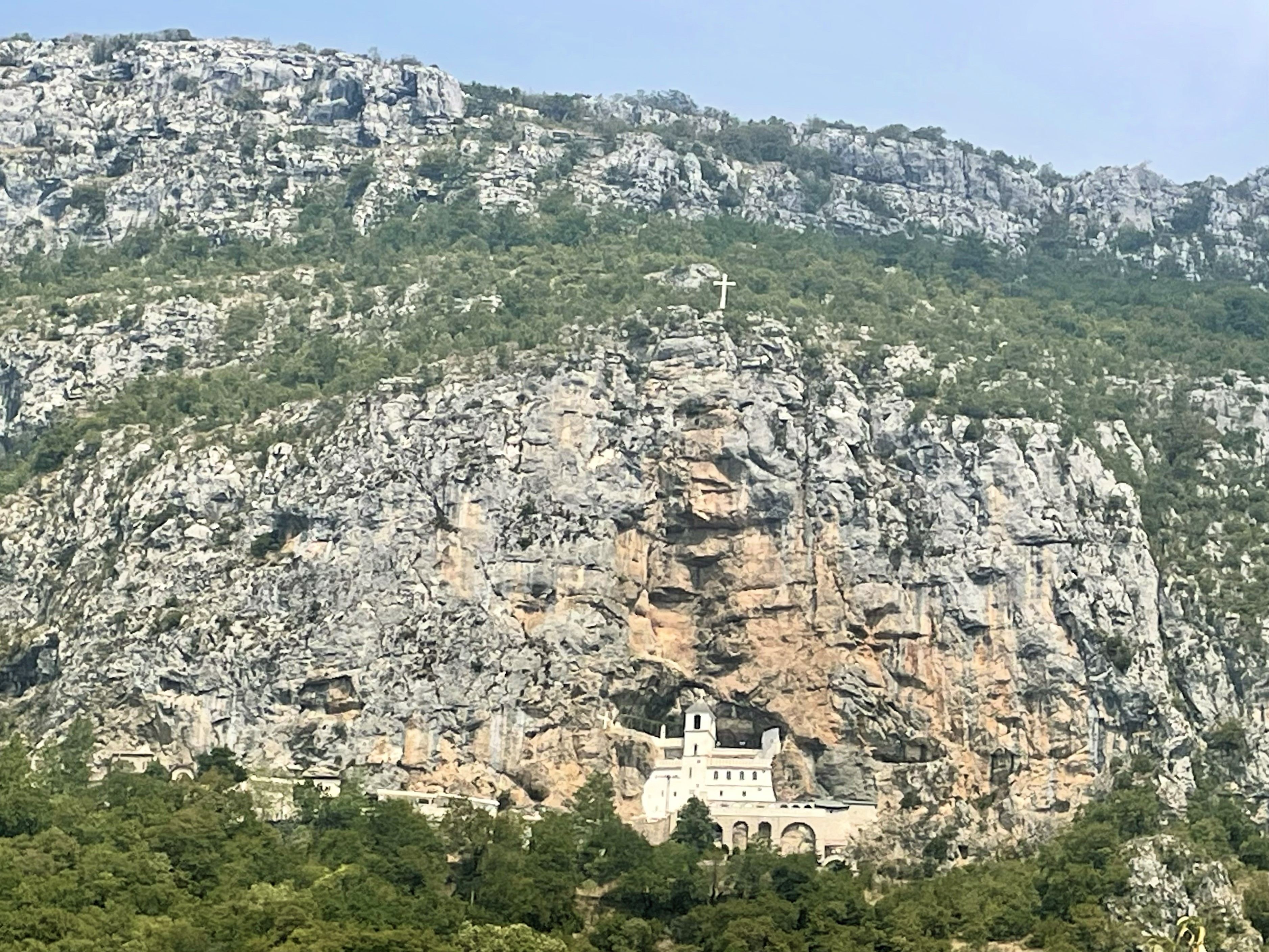
The following day, our main sightseeing goal was Ostrog Monastery. Built in the 17th century, this Serbian Orthodox monastery is dramatically carved into a sheer, almost vertical cliff of solid rock. It’s not only the most important pilgrimage site in Montenegro but also one of the most revered in the entire Balkans.
Ostrog is about an hour’s drive northeast of Podgorica. For the first fifty minutes, everything was smooth sailing — easy roads and light traffic. Then, as we neared the lower monastery, about three kilometers below the upper one, traffic ground to a crawl. I wondered if we should have parked at the lower monastery and walked up. But by then, we’d passed the lot and were fully committed to the narrow, winding road — no turning back (literally). Ostrog sees about 100,000 visitors a year, and I’m fairly certain most of them showed up that same day. Traffic attendants were trying their best to direct the chaos while crowds of pilgrims and tourists hiked up from the lower parking areas. It took us nearly another hour just to find a spot. When we finally arrived at the upper monastery, we joined the long line to get inside — though, thankfully, it moved faster than the traffic. Once inside, it seemed we could spend as much or as little time as we wanted.

We spent about an hour at Ostrog. The monastery itself isn’t all that large — the upper section consists of two cave churches, a stairwell, and a terrace that opens onto breathtaking views of the Zeta Valley. The main church was damaged by fire in the early 20th century, but the cave churches and their frescoes survived and remain the site’s most historically and spiritually significant features. Beyond its religious importance and remarkable engineering, the sheer setting is unforgettable. Once again, we lucked out with perfect weather to take it all in. C, ever the good sport, joined the pilgrims in kissing the rocks, relics, and other sacred spots — but after a while, her enthusiasm began to fade. I started getting those unmistakable, withering teenage looks that signal it’s time to call it a day.
It turned out our timing was perfect. We made it back to the car and even managed two quick stops — one at a viewpoint and another at the lower monastery — before the skies opened in a torrential downpour. We got back to the hotel, then spent the rest of the afternoon and evening chilling.

The next morning, we went into Podgorica to explore the old town. Being a Monday, the city felt livelier — more traffic, more people, and completely full parking lots. I finally spotted a space, only to realize it was in a reserved lot, but after a little negotiation with the attendant, he agreed to let us stay for just an hour. With that, we set off on a rapid sightseeing tour. We headed for the old town — Stara Varoš (Стара Варош) — an Ottoman-era neighborhood that was once the heart of the capital between the 15th and 19th centuries. Much of it was destroyed during World War II, and perhaps a walking tour might have brought its history to life, but ours was at a sprint, and whatever traces remained were easy to miss. We made it back to the car just in time.
As we drove to Kosovo for the final days of our trip, I thought back on our time in Montenegro — full of history, dramatic scenery, challenging mountain roads, and a fair bit of adventure, not to mention the cats.
 The Wanderlust Diaries