Balkans Bound, Part Five: Cetinje, Podgorica, & Ostrog Monastery

This is the fifth installment of my daughter’s and my trip to Kosovo, Albania, and Montenegro in August 2026.
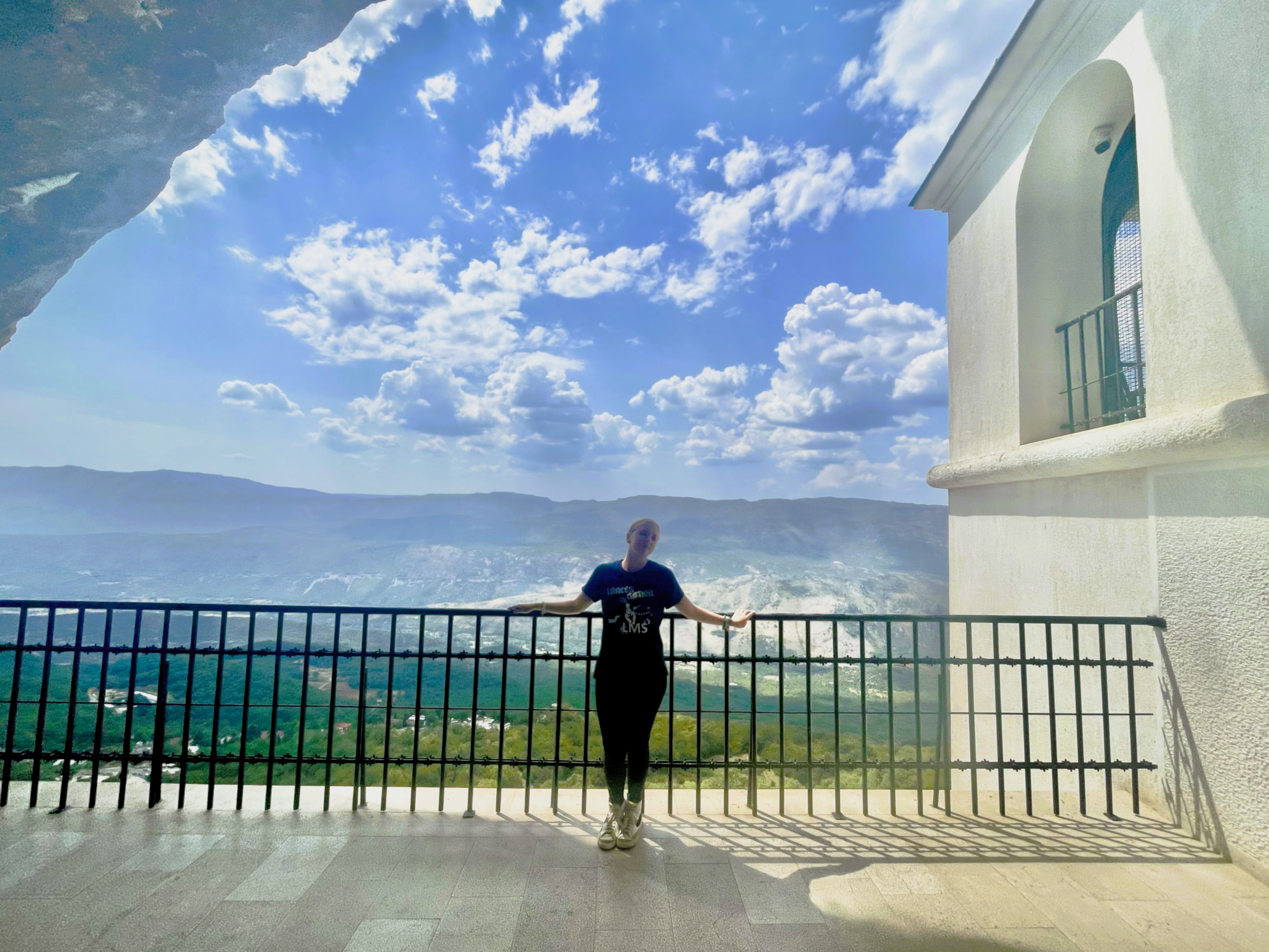
C at the upper level at Ostrog Monastery

On the eighth day of our trip and our fifth day in Montenegro, C and I said farewell to Kotor. We were off to Cetinje, the country’s former capital. To get to Cetinje, I had two options: up and over Mt. Lovćen or around it. Having already had two drives through the serpentine road, I opted to go around!

Cetinje served as the royal capital of Montenegro from the 15th century and the capital of independent Montenegro from 1878 to 1914. Today, the city is still considered the seat of Montenegrin culture. It is on the UNESCO World Heritage Site tentative list for its “historic core.” With that sort of pedigree, I figured that Cetinje was a “must-see” when in Montenegro.

Left: The Court Church in Ćipur, the 1890 church in Citenje, inside which are interred several members of the Montenegrin royal family; Right: The Monastery of St. Peter

We started at the Court Church and made a circuit around the historic area. The church didn’t appear to be open, so we took in its exterior before continuing on. Our next stop was the Monastery of St. Peter, a Serbian Orthodox monastery founded in 1484. The building’s architecture was beautiful and striking, and I would have loved to go inside, but we weren’t dressed appropriately. Although I’d read that tourists in shorts might be given wraps to cover their legs, there was no one around to offer them or to admit visitors. The gate that seemed to be the entrance was closed, so we lingered for a moment to appreciate the monastery’s façade, then moved on.

As we entered town, we passed Biljarda Palace, the 19th-century residence of Prince-Bishop Petar II Petrović-Njegoš (of the Njegoš Mausoleum fame), now home to a museum dedicated to his life and work. Along Njegoš Street — a pedestrian-only road through the center — we saw many fine old buildings, including the former French Embassy. Some were crumbling with age, while others were clearly in the midst of restoration. Something about Cetinje felt off — it was too quiet, almost abandoned, and C and I just couldn’t muster much enthusiasm for exploring it.
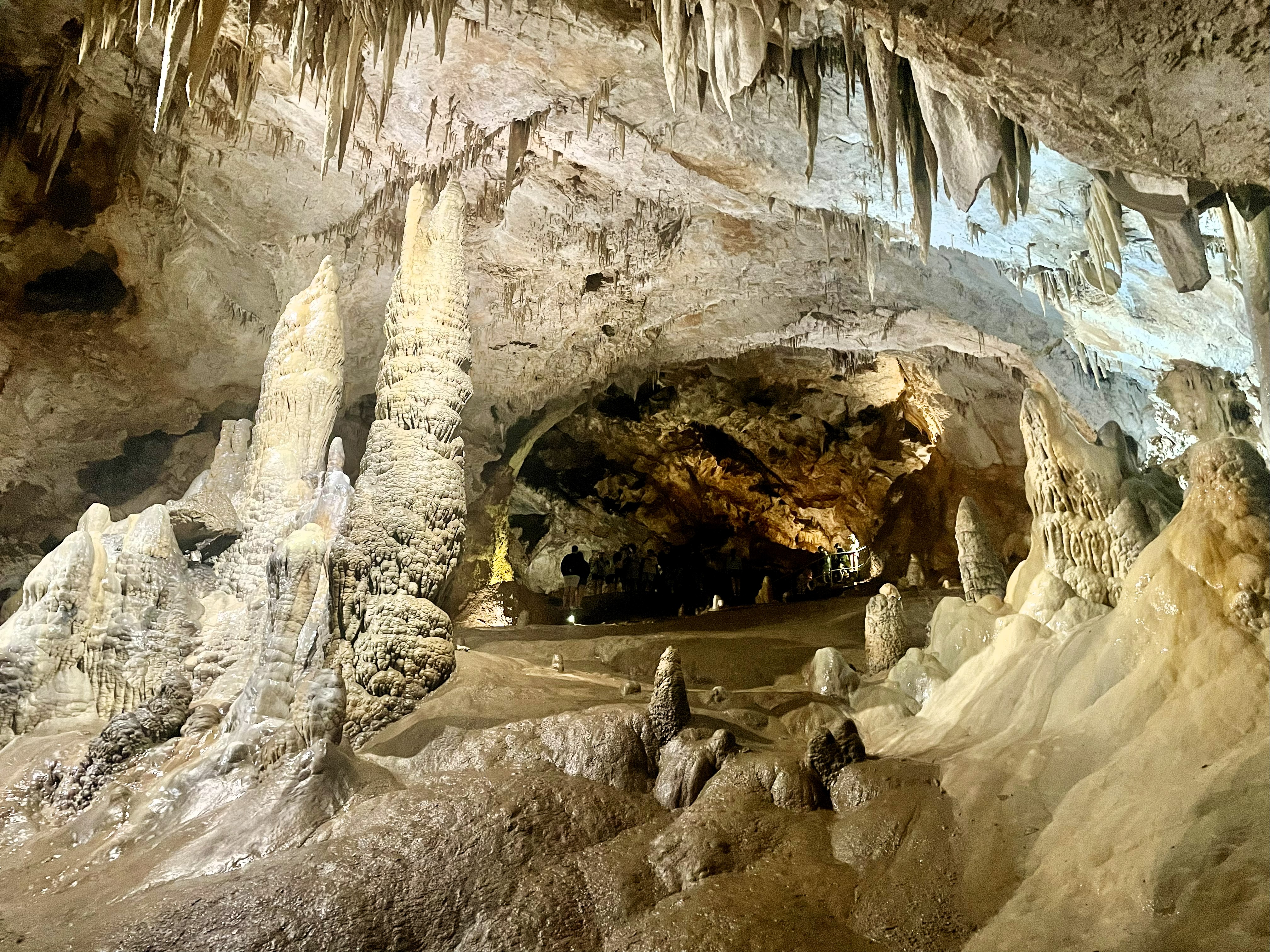
Inside Lipa Cave

From Cetinje, we continued just a short distance outside town to visit Lipa Cave — Montenegro’s first cave open to the public. Permanently opened in 2015, it’s one of the country’s largest caves and has quickly become a popular tourist attraction. I seem to have a thing for cave tours; I’ve visited Mammoth Cave, Wind Cave, Jewel Cave, Carlsbad Caverns, and Luray Caverns in the United States, along with several others around the world. Lipa Cave keeps a cool ambient temperature of about 45–55°F, so it’s definitely on the chilly side. At the car, C was wearing shorts and a T-shirt, and I insisted she put on something warmer. Being a teenager, she insisted she was “fine” and only grudgingly put on a sweatshirt. But when we reached the cave entrance, she quickly realized I hadn’t been kidding about how cold it would be! Our visit included a one-hour guided tour, which proved both fascinating and refreshingly cool. Even C expressed a lot of interest! Once back outside, we were grateful for the summer heat.

After exploring Lipa Cave, we continued on to Podgorica, Montenegro’s capital, which would be our base for the next two nights. After several busy days, we opted for something familiar and went to the Hard Rock Café for a late lunch — a bit of a travel tradition for C and me, as we’ve visited locations all over the world. Downtown Podgorica felt a little untended and quiet, though parking was surprisingly difficult. Lunch, unfortunately, was forgettable, and we spent the rest of the evening simply relaxing at our hotel.
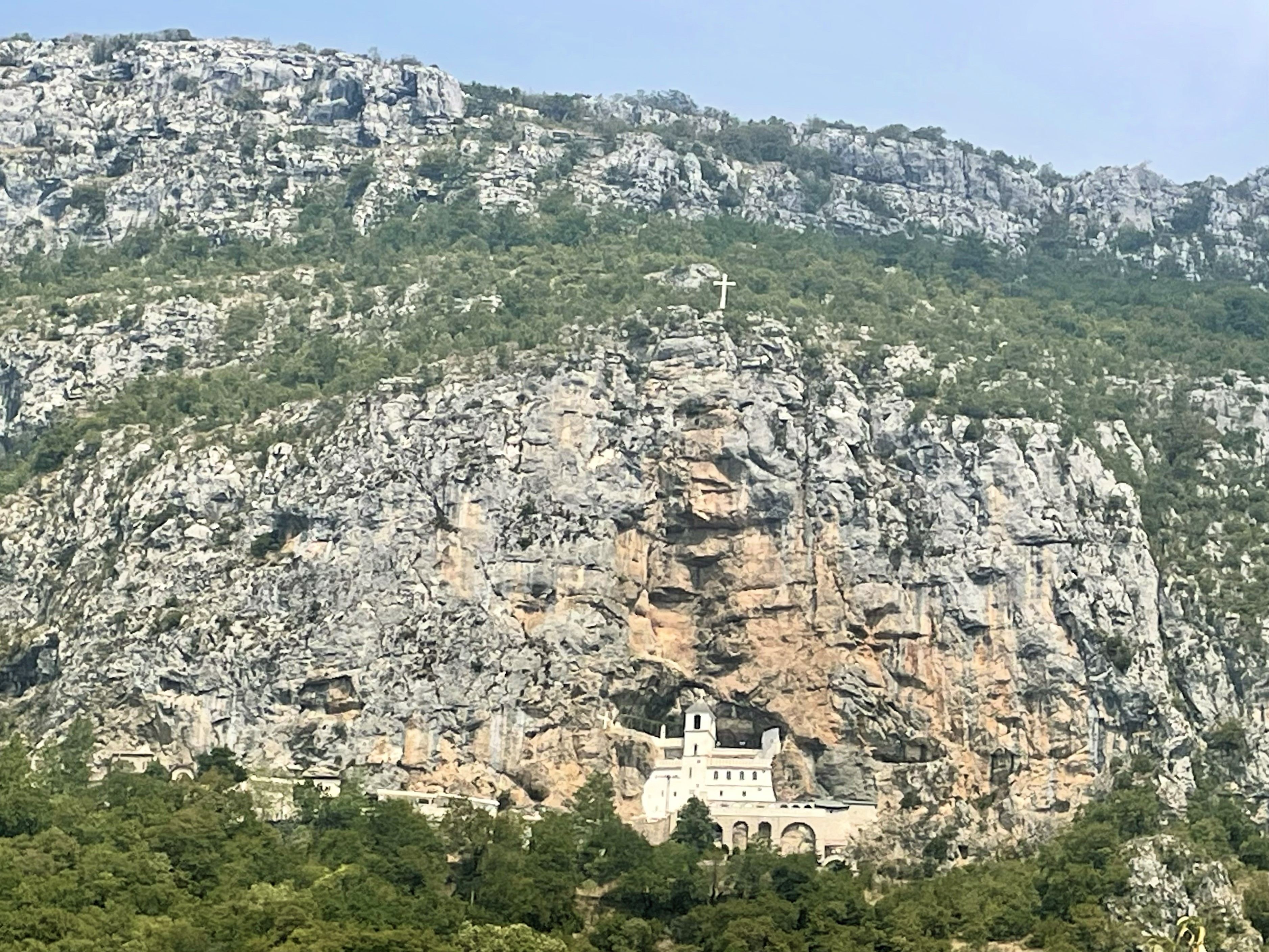
Ostrog Monastery from a view point just above the lower monastery demonstrating the near vertical limestone cliff of Ostroška Greda

The following day, our main sightseeing goal was Ostrog Monastery. Built in the 17th century, this Serbian Orthodox monastery is dramatically carved into a sheer, almost vertical cliff of solid rock. It’s not only the most important pilgrimage site in Montenegro but also one of the most revered in the entire Balkans.

Ostrog is about an hour’s drive northeast of Podgorica. For the first fifty minutes, everything was smooth sailing — easy roads and light traffic. Then, as we neared the lower monastery, about three kilometers below the upper one, traffic ground to a crawl. I wondered if we should have parked at the lower monastery and walked up. But by then, we’d passed the lot and were fully committed to the narrow, winding road — no turning back (literally). Ostrog sees about 100,000 visitors a year, and I’m fairly certain most of them showed up that same day. Traffic attendants were trying their best to direct the chaos while crowds of pilgrims and tourists hiked up from the lower parking areas. It took us nearly another hour just to find a spot. When we finally arrived at the upper monastery, we joined the long line to get inside — though, thankfully, it moved faster than the traffic. Once inside, it seemed we could spend as much or as little time as we wanted.

Sights of Ostrog Monastery

We spent about an hour at Ostrog. The monastery itself isn’t all that large — the upper section consists of two cave churches, a stairwell, and a terrace that opens onto breathtaking views of the Zeta Valley. The main church was damaged by fire in the early 20th century, but the cave churches and their frescoes survived and remain the site’s most historically and spiritually significant features. Beyond its religious importance and remarkable engineering, the sheer setting is unforgettable. Once again, we lucked out with perfect weather to take it all in. C, ever the good sport, joined the pilgrims in kissing the rocks, relics, and other sacred spots — but after a while, her enthusiasm began to fade. I started getting those unmistakable, withering teenage looks that signal it’s time to call it a day.

It turned out our timing was perfect. We made it back to the car and even managed two quick stops — one at a viewpoint and another at the lower monastery — before the skies opened in a torrential downpour. We got back to the hotel, then spent the rest of the afternoon and evening chilling.

Left: Graffiti art in Podgorica’s old town; Right: the Old Town Clock Tower, built in 1667.

The next morning, we went into Podgorica to explore the old town. Being a Monday, the city felt livelier — more traffic, more people, and completely full parking lots. I finally spotted a space, only to realize it was in a reserved lot, but after a little negotiation with the attendant, he agreed to let us stay for just an hour. With that, we set off on a rapid sightseeing tour. We headed for the old town — Stara Varoš (Стара Варош) — an Ottoman-era neighborhood that was once the heart of the capital between the 15th and 19th centuries. Much of it was destroyed during World War II, and perhaps a walking tour might have brought its history to life, but ours was at a sprint, and whatever traces remained were easy to miss. We made it back to the car just in time.

As we drove to Kosovo for the final days of our trip, I thought back on our time in Montenegro — full of history, dramatic scenery, challenging mountain roads, and a fair bit of adventure, not to mention the cats.

Balkans Bound, Part Four: Kotor & Surroundings

This is the fourth installment of my daughter’s and my trip to Kosovo, Albania, and Montenegro in August 2026.

Our Lady of the Rocks

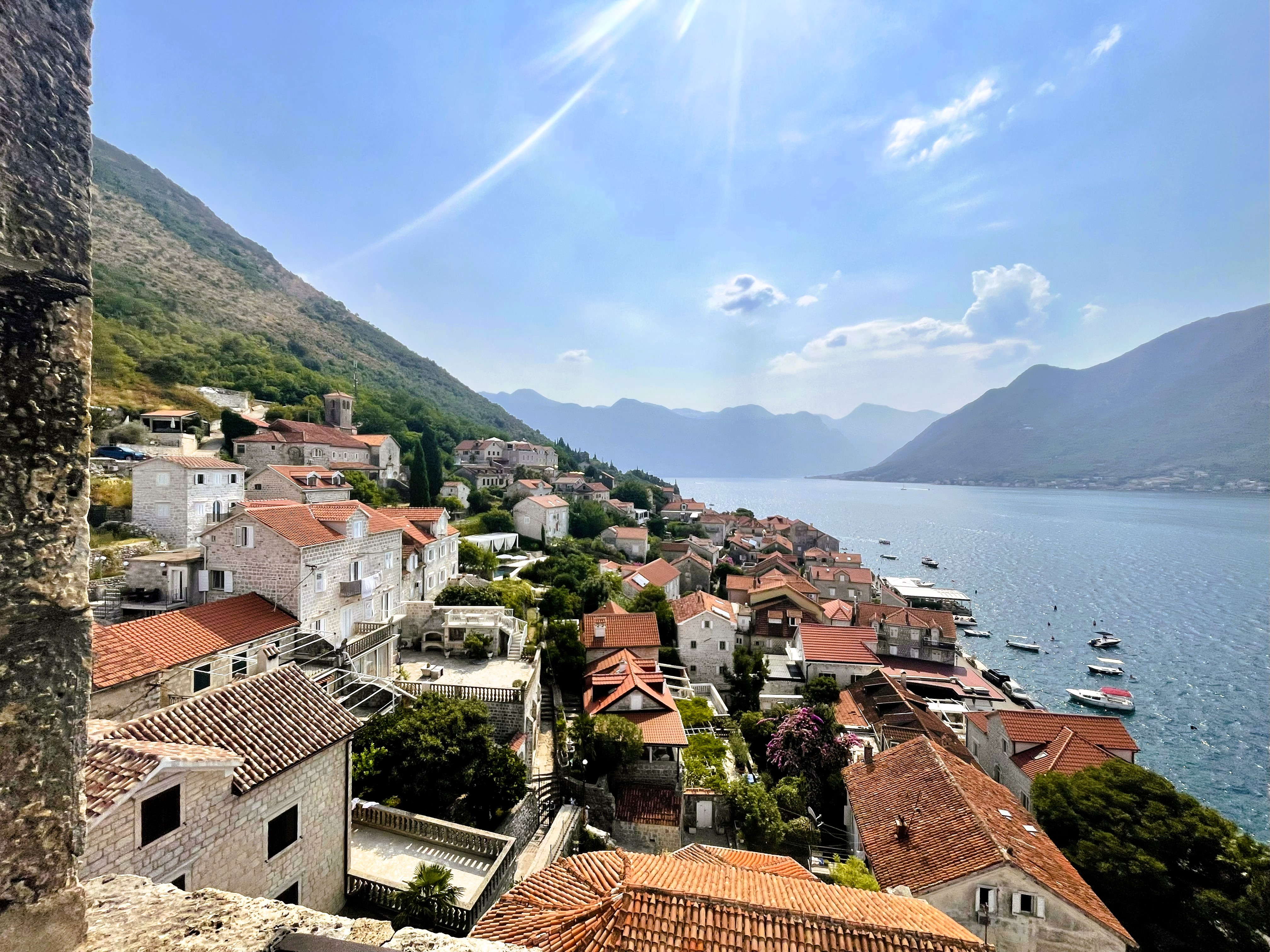
On the sixth day of our trip and our third day in Montenegro, we took the car and drove about 30 minutes north along the Kotor Bay road to the small town of Perast. Although Perast was also Venetian, it was not enclosed by city walls like Kotor, Budva, or Sveti Stefan; instead, it was protected by nine defensive towers and a fortress. Also, unlike the other towns, Perast has not outgrown its historic location; it has no modern buildings and no roads through it. There are only the traditional stone houses and baroque palaces. And in its bay, the Church of Our Lady of the Rocks.

Since I’d read that parking in Perast fills up quickly during the peak summer season, I wanted us to get there early. Although we’d beaten jet lag from day one, we’d fallen into a routine of waking up around 8 AM and leisurely getting ready for a 9 AM start. As we approached Perast, we could see that several small lots were already full, and cars were parking alongside the roadway and walking further. But the Gods of Parking must have been shining down on me as we pulled into the lot closest to the town, the man at the entrance made eye contact with me and offered me his space IF I also purchased a ticket from him for the boat out to Our Lady of the Rocks. Done!

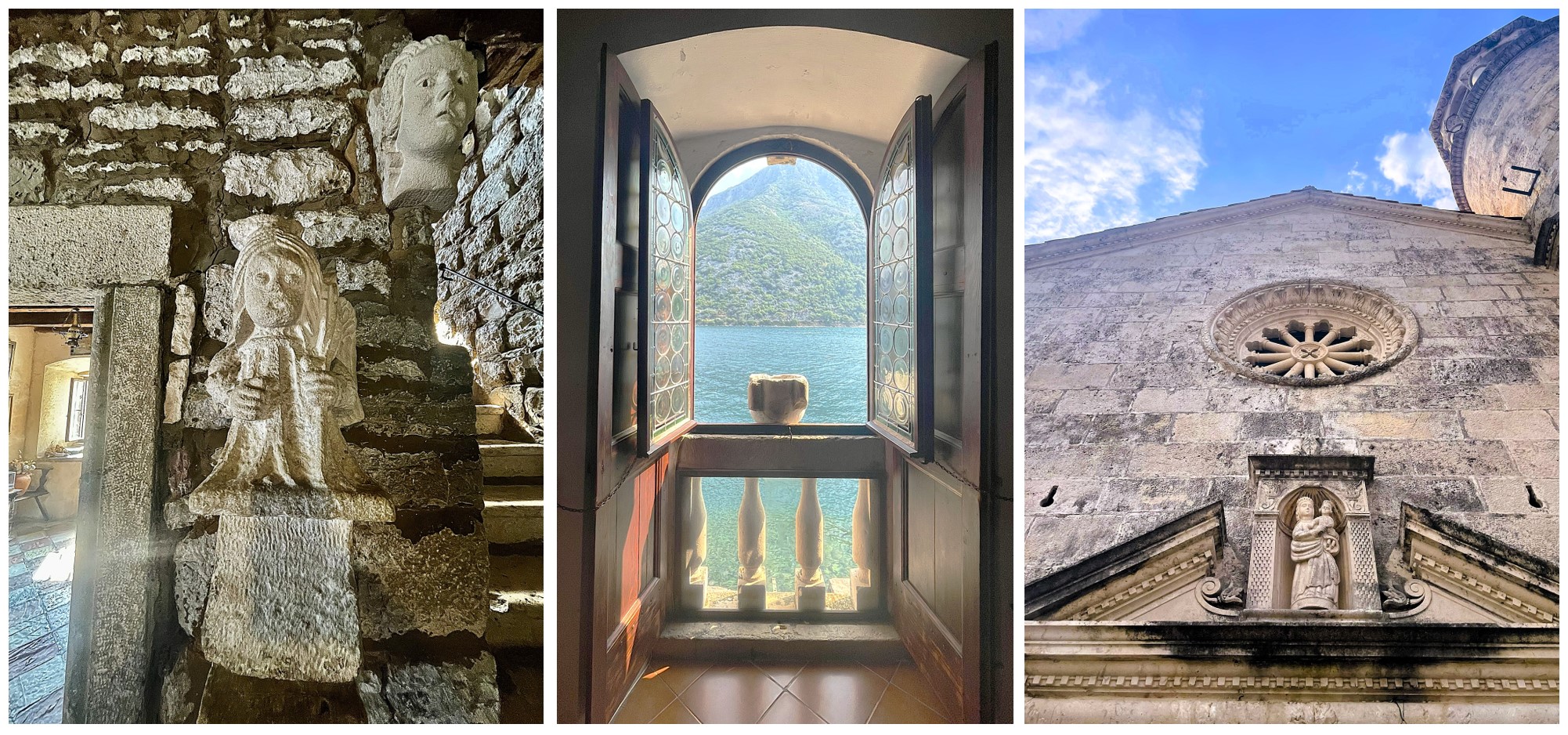
Some photos from our visit to Our Lady of the Rocks, Perast, Montenegro

The 17th-century church Our Lady of the Rocks stands on an artificial island that townspeople began creating around 1452 by dropping rocks and sinking old ships. A young man with impeccable English (so much so that I asked if he was North American) ferried us over to the island, giving us half an hour to explore before returning to pick us up.

A view of Perast from the top of the church bell tower

We made the most of our time, making sure to circle the church to take in all its exterior details, and also joining a tour that led us through its beautiful interior. The island is small and doesn’t take much time to explore, but it was crowded, and the number of people allowed inside the church at any one time was limited. Had we been alone on the island, 30 minutes would probably have been fine, but on our visit, I felt a little rushed. But, it would have to do.

Back in Perast, we did a bit of sightseeing and climbed the very narrow stone steps to the top of the bell tower at the Church of St. Nicholas. I later learned that children under 15 aren’t supposed to climb, but no one asked about C’s age, nor did they say a word to us. I guess our one-euro payment was enough to overlook that little detail. We finished our walking tour with a bit of gelato, because why not have some for brunch when on vacation in Europe?

Our next stop was the Mausoleum of Njegoš. It was only about an hour’s drive from Kotor, but much of the route wound along a serpentine road climbing up Mt. Lovćen. I’ve done plenty of driving in all sorts of places, so I was mostly fine with the road, but it demanded a lot of concentration and patience with so many others making the same journey. We broke up the journey with lunch at a restaurant high up on the mountainside with a tremendous view of the Bay of Kotor.

Left: Screenshot just before we entered the serpentine road on Mt. Lovćen; Right: A view of the Bay of Kotor from along the road up Mt. Lovćen

After lunch, we continued our climb, navigating a few more dramatic twists and turns before the road finally leveled out near the top. We entered Lovćen National Park and followed the winding route on to the Mausoleum of Njegoš, perched atop Jezerski Peak — the second-highest of Mount Lovćen’s two summits — at 5,436 feet above sea level. The mausoleum honors Petar II Petrović-Njegoš, a 19th-century ruler and poet, who chose this peak for his resting place because of its sweeping views over the land he cherished.

We parked in the parking lot and took the 461 steps, most of which are located in a tunnel that goes through the mountain itself, up to the mausoleum. I was not prepared for what greeted us at the top—the solemn light granite structure with an entrance flanked by statues of two women in traditional Montenegrin dress and the breathtaking 360-degree views over Lovćen National Park. I can understand choosing such a spot as one’s final resting place. I felt contemplative and even blessed to be able to visit. I had almost given this place a pass.

The Mausoleum of Njegoš

Unfortunately, the quickest way back to Kotor was the same serpentine road we had taken up. The drive down felt both less stressful — because we knew what to expect — and more stressful, thanks to heavier traffic. Several times we had to pull as close as possible to one edge or the other to let another vehicle pass. At one point, we were caught in a logjam when several full-sized buses tried to navigate an especially narrow stretch. Thankfully, a few people got out of their cars to direct traffic — some drivers were asked to back up, others (including me) to inch along the cliffside — until there was finally enough room for the buses to squeeze through. Once back in Kotor, I breathed a sigh of relief. With plenty of excitement for the day, we picked up some groceries, made a meal of sandwiches and chips on our balcony, and had a quiet evening.

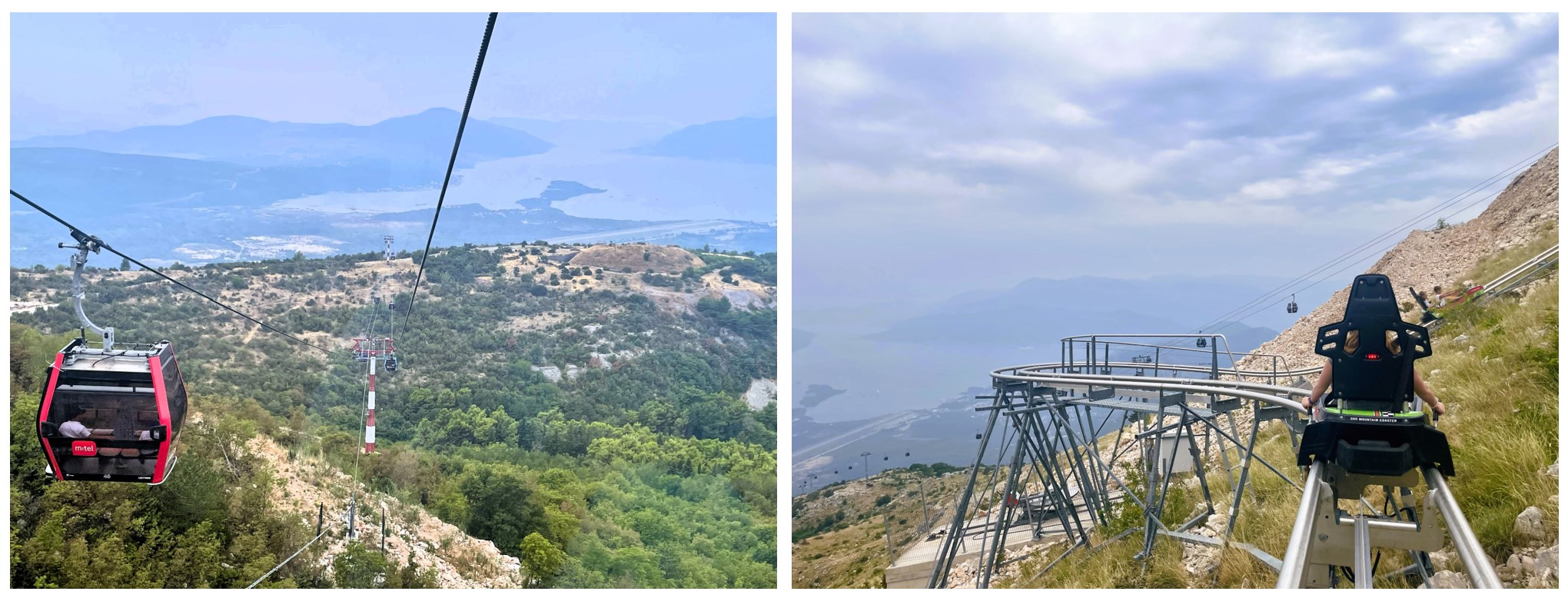
On our final day in the Kotor area, we started with a ride on the cable car, which climbs another part of Mount Lovćen. From the lower station, it travels 3,900 meters (about 12,795 feet) in just 11 minutes to reach the upper station, perched 1,316 meters (4,218 feet) above sea level. Along the way, the views are breathtaking — stretching across the mountains, over the Bay of Kotor toward the side near the airport, and almost all the way to the Adriatic Sea.

Left: Our view from the Kotor Cable Car as we near the top; Right: C just ahead of me on the Kotor Alpine Coaster with a dramatic view of the cable car and beyond

The cable car ride itself was pleasant enough, and the views were well worth it, even as the first clouds of our trip began to roll in. At the upper station, however, a new attraction awaited: the alpine coaster — a self-controlled mountain ride where riders regulate their own speed with a brake lever. C and I have ridden similar coasters in Jamaica (at Ocho Rios) and the Great Wall of China, both of which offered thrills. But the coaster in Kotor takes it up a notch, perched dramatically on the edge of a mountain. Though two people can ride together, C opted for her own car. As the car sped down the first hill and headed toward the edge, I really wondered what I was thinking! But we both loved it so much, we rode it two more times!

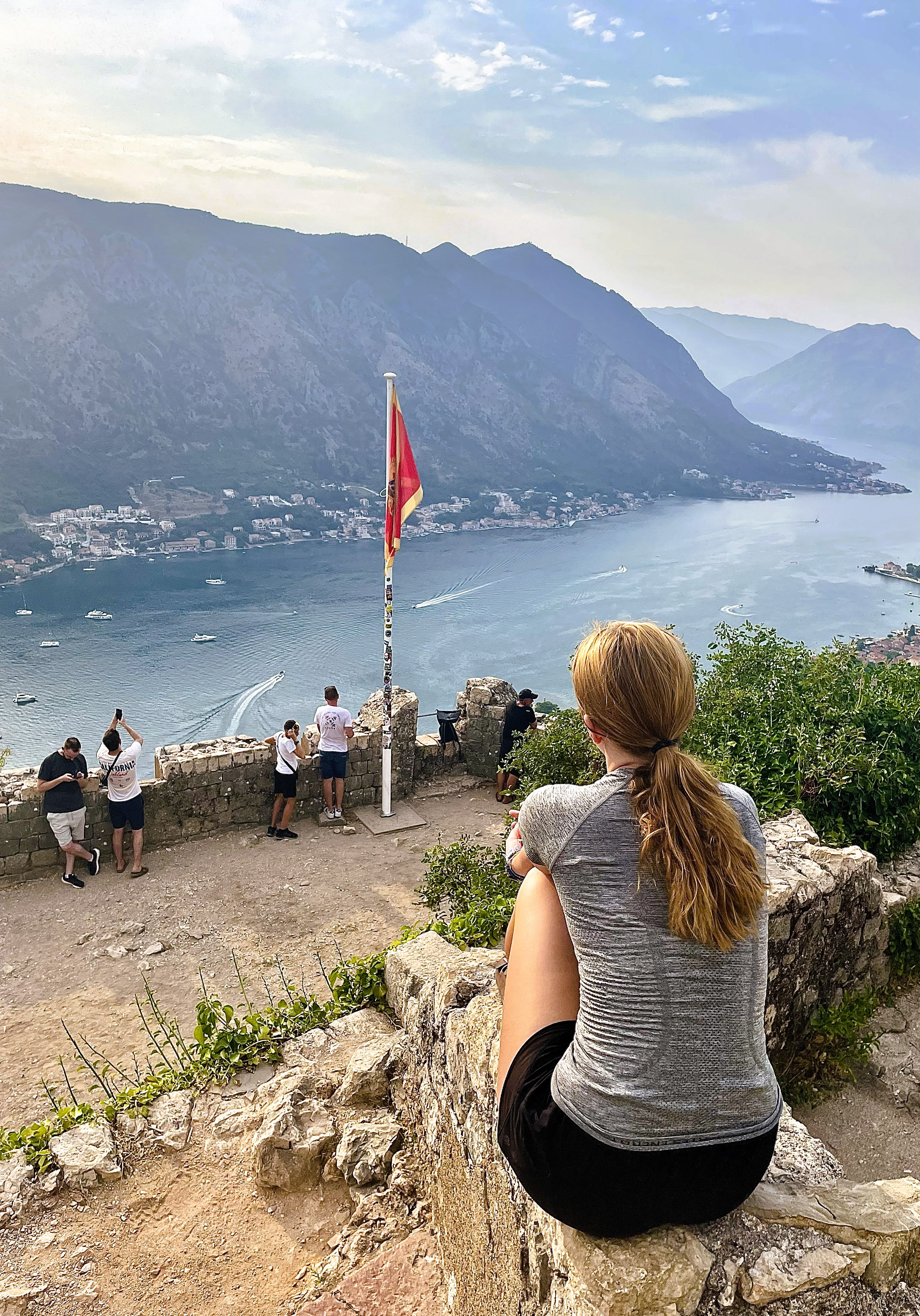
C surveys Kotor from St. John’s Fortress

Back in Kotor, we had one more thing to do: climb to the 6th-century St. John’s Fortress, which sits like a sentinel above the old Venetian city. Starting from the back of the old town, we paid the 8 Euro entrance fee and then followed a steep path along the fortifications that clung to the near-vertical slope of St. John’s Hill. It was not easy going; it was hot, we were a bit tired, and the steps were uneven or non-existent. As we climbed, C frequently asked if we could just stop or if I would leave her somewhere to wait, but then she would reluctantly press on. There were times when I, too, thought, maybe this point is good enough? But I really wanted to reach the top. The views along the way—and especially from the top at St. John’s Fortress—were amazing, and once at the fortress, C conceded that maybe it had been worth it.

Accomplished, we made our way back down, rewarding ourselves with some gelato in town before we headed back to the guest room. We needed to prepare for the next part of our journey.

Balkans Bound, Part Three: Arrival in Kotor

This is the third installment of my daughter’s and my trip to Kosovo, Albania, and Montenegro in August 2026.

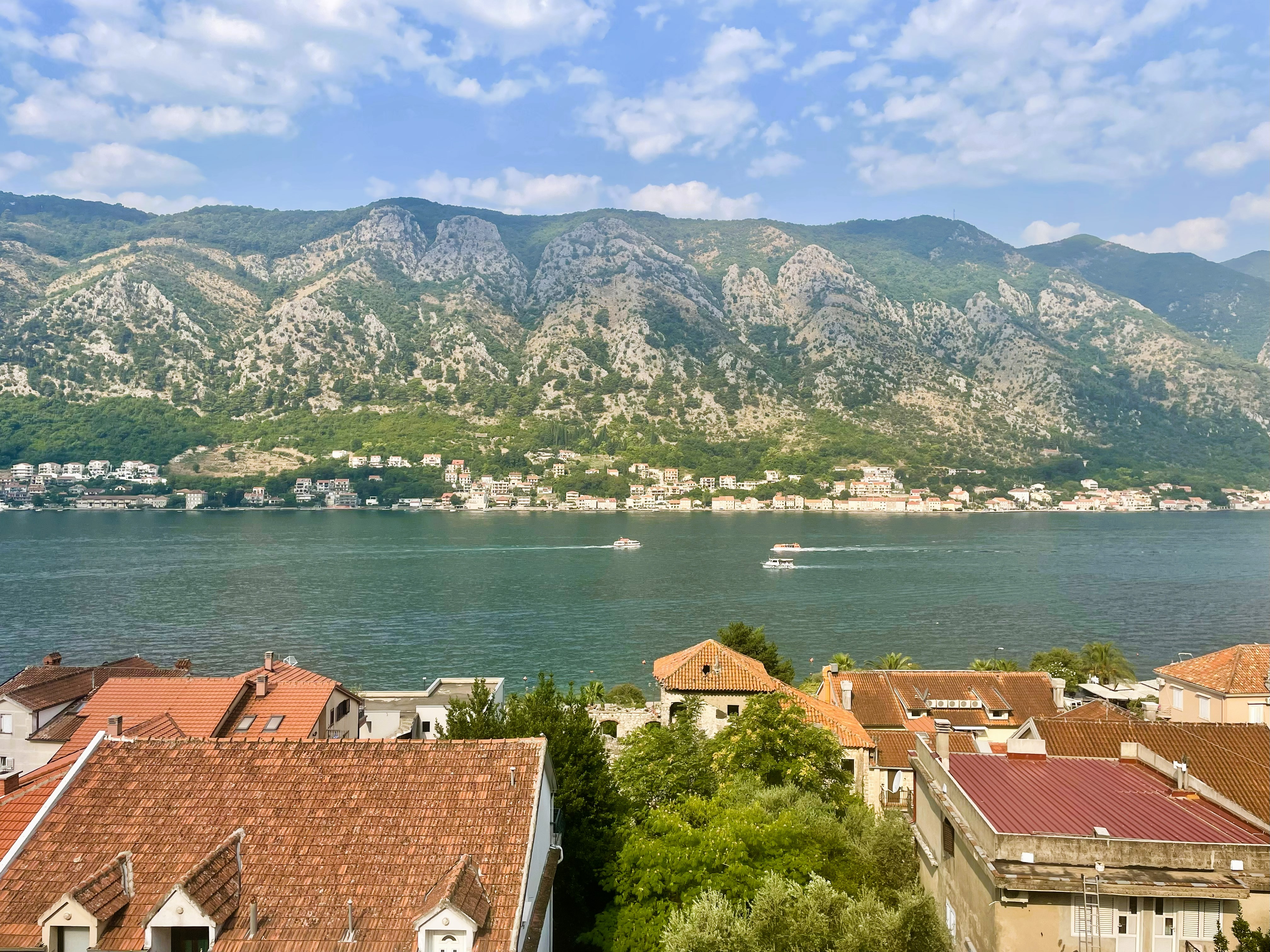
The view from our guest room in Kotor, Montenegro

The morning my daughter and I were departing Shkoder, Albania, for Kotor, Montenegro, I checked the route in my maps app and discovered the most direct route across the border was closed due to wildfires. The heat wave we had been experiencing had contributed to wildfires across southern Europe, including Montenegro. We would have to take another, longer route to get to Kotor. Instead of along the coast, the route that generated my whole plan to include our side trip to Albania, we would drive along the southern edge of Lake Shkodra and cross into Montenegro southwest of its capital. I opted not to drive through the capital and instead skirted the western edge of the lake, then take the only road that crossed the lake.

The drive to the border was uneventful, but once there, we faced a very long line of cars seeking to cross. Perhaps the traffic was due to this being the most popular crossing, or maybe it was caused by the other border being blocked by the fires; either way, it was tedious. At last, it was our turn, and I handed over our passports to the Montenegrin immigration official. He demanded to see the rental car papers, and I passed him the rental agreement. He stared at me, annoyed, and asked for additional car papers. I said I had not had to provide anything additional in Albania, and he gave me one of my most memorable quotes of the trip: “I don’t know about Albania, but in Montenegro, we have rules.” I explained that that was all I had, so he told me “Then, you will not be able to cross,” and asked me to pull over to the side.

Left: Screenshot of Google Maps route the day after we crossed; on the day of our drive that route was blocked by another fire at that border crossing; Right: Wildfires visible around Bar as we drive to the coast

There, I sat thinking for a minute, then I opened the glovebox, and found the car registration. I thought back to the eager car rental guy back in Kosovo, who had quickly shown me all of the car’s scratches, but when I has asked about crossing borders had said it would be “no problem” and failed to mention the all-important car registration. Sigh. I realized that the immigration official likely needed this, so I grabbed our passports, the registration card, and told C to wait in the car, and walked back to the official. He shook his head at my apparent stupidity and stamped us into the country.

View of the famed Sveti Stefan from the coastal road

We were now even further behind my hoped-for schedule. Things only got worse as we drove along narrow roads and encountered random traffic. I had hoped the drive across Lake Shkodra would allow for a quick photographic stop at Fort Lesendro, a fortress located on an island on the lake, which the road crossed, but there was no place to pull off. It passed in a blur. We drove over the mountains to meet the coastal road, and as we neared the coast caught sight of smoke plumes from wildfires on the hills around the popular town of Bar. Though this was a very time-consuming detour, I felt glad I had not chanced our original route.

We stopped briefly along the coastal road to photograph Sveti Stefan, a 15th-century Venetian fortified town located on a small island connected to the mainland by a narrow isthmus. It is so beautiful that photographs of this location are used for many a screensaver. However, the island is private and used as a luxury resort. I had considered driving up to a small church further up the mountainside for its views of Sveti Stefan, but we were already so far behind that our one quick stop would have to do.

Sights from Budva’s walled town

Our lunch stop was Budva, a larger Venetian walled town just a little further up the coast. My plan had been to arrive around 11 AM, but instead, we arrived three hours later, tired and hungry. Parking was a bit of a nightmare; I had read it was difficult in the height of summer, and headed for a mall parking lot that online had said was usually available. The lot was full, so I had to wait until a car departed before I could pull in and park.

Sunset in Kotor Bay our first evening

There were quite a lot of people in the walled town. Some of the narrow walkways were wall-to-wall tourists. The tiny beach in front had almost no square of sand unoccupied. Yet, the first few restaurants we tried were closed. It was quite hot. Bothered by the crowds and the heat, we decided on smoothies from a little hole-in-the-wall shop. Fortified, we toured the Citadel and the narrow streets. Had it been less crowded, it might have been nice to see some of Budva outside the walls, or maybe not. There were just far too many people and we could not feign longer interest. We wanted to get to Kotor.

Though only an hour north, there was again heavy traffic through the center of Kotor. And, when we arrived at our room for the next four days, the manager was not on site, though I had messaged upon our departure from Budva. Finally, he arrived (he had been at the beach) and showed us to our lovely flat on the top floor of his multi-story condo. With our last bit of energy, we made a quick stop trip to a nearby supermarket so we could have dinner in peace and quiet, on our balcony while we watched the sun set over Kotor Bay.

Left: A coin from the Cats Museum; Right: One of the super cute cats of Kotor

The next day, C and I set out to explore the UNESCO-listed old town of Kotor. Our first stop had to be the Cats Museum. The only other place I have visited a cat museum was in Kuching, Malaysia. Kuching means “cat” in Malay, and Kotor’s historical name under the Venetians was Cattaro. Though that does not mean “cat,” it seems the people of Kotor, who have taken to protecting the numerous street cats of the town, rather enjoy the play on words.

C in front of the 10th century Roman Catholic St. Tryphon Cathedral in Kotor’s old town

Kotor’s Cats Museum is small, just two small rooms and a reception/gift shop. Yet it is chock full of cat stuff – propaganda with cats, studio photography of persons with their cats, postcards, newspaper articles, currency, and so on, all featuring cats. Proceeds from the museum’s entrance fee and the sale of its souvenirs support the care and feeding of Kotor’s street cats. C and I loved the museum and finding Kotor’s cats throughout the town.

We had lunch outside in one of the many small squares of the walled town. Then C and I did a bit of sightseeing and window shopping. C had actually done some online sleuthing and informed me that shopping is a big thing to do in Kotor’s old city, and it would be key for us to take part. By the early afternoon, though, we were again tired by the heat and the long day of road travel the day before, so we returned to our guest room to rest.

In the late afternoon, I was ready to return to the old town, but C bowed out. We had been rather “go-go-go” for the past few days, and it was just the right day for her to take a break. I relished the time to just see things at my own pace, to go slowly and take photos of whatever I wanted without a teenager telling me her legs hurt or she was bored or asking “How much longer are we going to be here?” I love that she is now at an age to enjoy more of the history, but can also be left in the hotel to do her own thing when I wish to do mine.

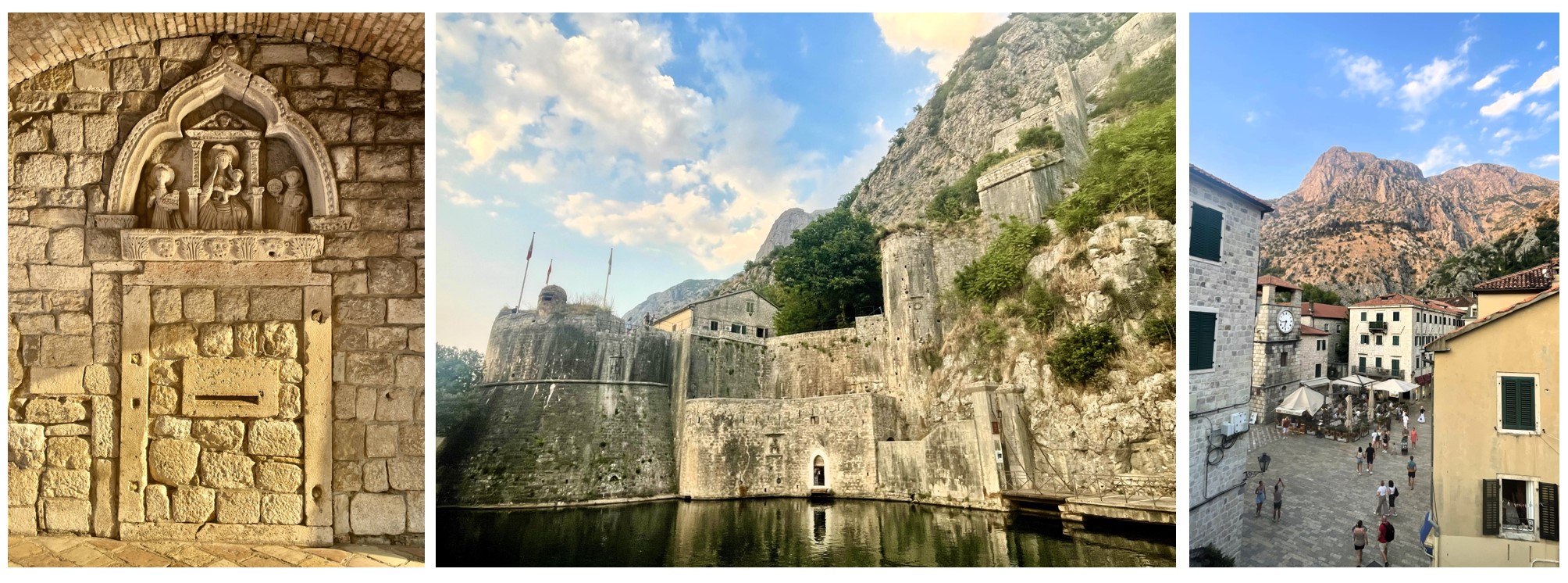
Left: The inside of the Sea Gate to the old town; Center: The Gurdic Bastion of the old town; Right: a view of part of the Square of the Arms and the Clock Tower from the top of the old town walls

I loved walled cities. I have visited many in my travels, from Avignon and Avila to San Juan, Xian, and Galle. Kotor is magnificent and I am grateful that I was able to spend a few hours exploring on my own. I could have certainly spent more time there. However, we had more to see and do in Montenegro.