A Quick Getaway to Philly

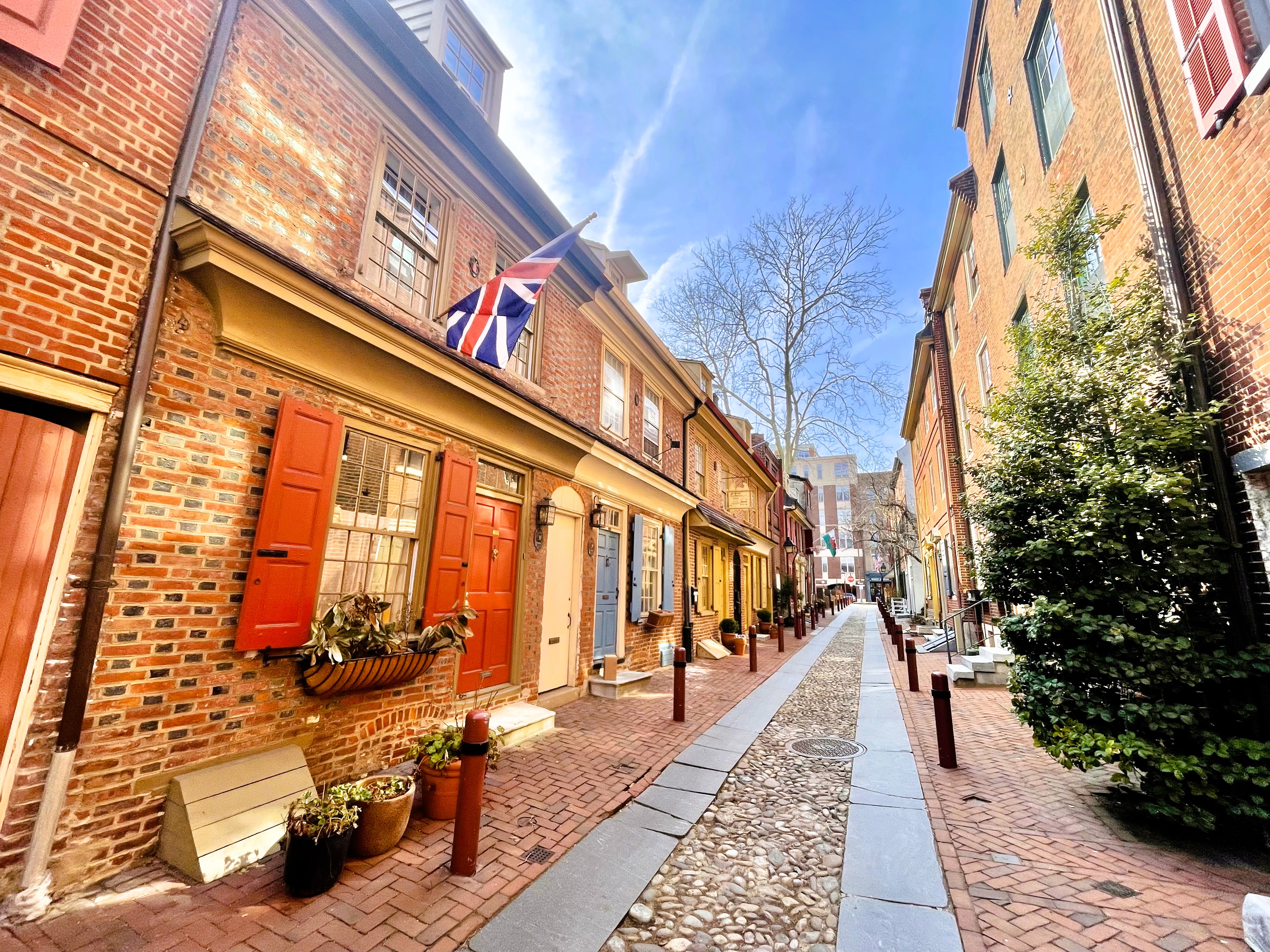
Elfreth’s Alley in Philadelphia, PA

C and I continue to make the most of my assignment to Washington, D.C. And, well, things have been more than a little, um, odd in Washington lately, which makes it more important that we make time to enjoy the positive aspects of the area and America.

In mid-March, C’s school had a random Friday off, so I decided we would have a short getaway to Philadelphia. I had only been to the City of Brotherly Love once, at least 15 years ago. I thought it would also be fun to invite one of C’s best friends, TO, on the trip. When I was a little younger than C is now, my best friend was a girl named Jennifer who lived up the street from me. Jennifer’s mom, Debbie, was also a single mom, but she invited me on several trips with her and Jennifer. We went to Ocean City once and another time to Gettysburg, Pennsylvania. My parents, maybe exhausted with four children and without much disposable income, rarely took us on trips other than to see family (and half the time our car would break down before we got out of town). Therefore, my trips with Jennifer and Debbie were really special for me. I wanted to pay that forward.

We had TO stay over the night before so we could have an early start on the three-hour drive. Half an hour into our journey, I stopped at a 7-11 and the girls stocked up on just the kind of stuff you might expect teenage girls would like to munch on while on a road trip. And I had the last hour in quiet once they crashed. I wanted them well rested for the busy day we would have ahead.
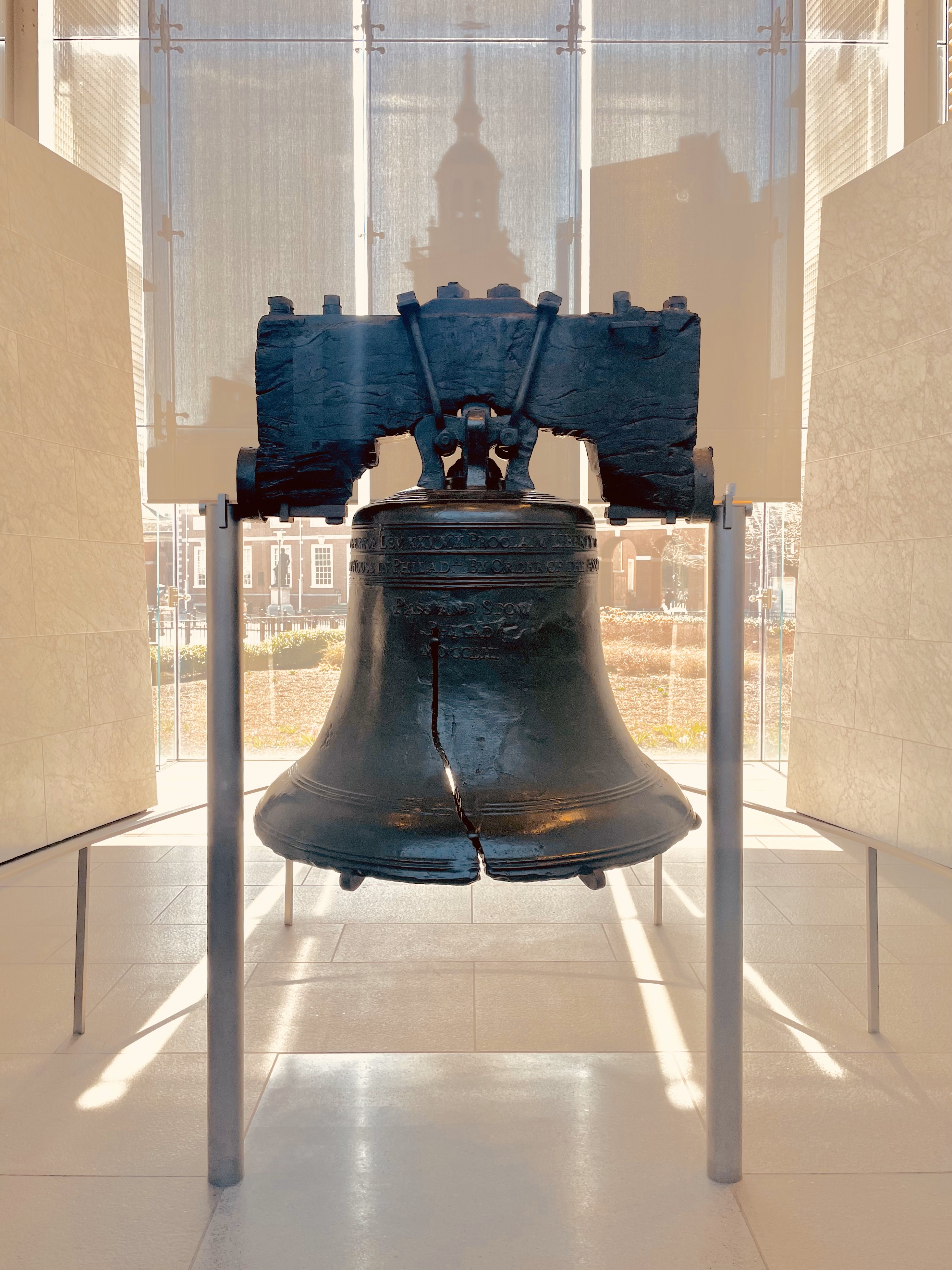
Sunlight hits the Liberty Bell with Independence Hall outside

After checking in early at our Penn’s Landing hotel, we headed to our first stop: the Philadelphia Mint. C is a member of Scouting America. Since she was working on her coin collecting merit badge, the U.S. Mint in Philadelphia, established April 2, 1792, seemed the perfect place to visit. Photography is not allowed inside the Mint, so we had to make do without. We enjoyed reading about the history of the Mint and the production of coinage in America but our favorite part was watching the thousands of quarters, dimes, nickels, and pennies move through the assembly line on the massive production floor. Though for C and TO, the gift shop came a close second.

After the Mint, we tried to visit Independence Hall, but I found out it was sold out for the day. I had not expected this on a random Friday in March! A National Park ranger informed me that a limited number of next-day tickets would go on sale at 5 PM, so I set an alarm and we headed to the Liberty Bell across the street. The first time I visited Philadelphia, it was a warm September day. I remember shuffling past the Liberty Bell in a long, slow-moving queue. This time? No line at all. It took less than ten minutes from entry to standing before one of our country’s most recognizable symbols of freedom. I think C and TO appreciated seeing in person something they had studied at school. Only they appreciated it for a fraction of the time I did.

The extraordinary Philadelphia Town Hall (from the outside)

I got those hungry teens some lunch, then we walked downtown to the beautiful Philadelphia Town Hall. Construction started on the ornate French Second Empire-style building in 1871, and when completed in 1894, it was the tallest habitable building in the world. With nearly 700 rooms, the Philadelphia Town Hall is the largest municipal building in the United States and one of the largest in the world. Today, it is listed as a National Historic Landmark and a National Historic Civil Engineering Landmark. This is exactly the kind of cool building I enjoy touring! But wouldn’t you know it, all tours were sold out that day. Foiled again.

Inside the Reading Terminal Market

On the way to our final planned stop for the day, we passed through the Reading Terminal Market, the indoor public market built under the elevated train shed of the former Reading Railroad Company (yes, the one from the Monopoly game). Here, I finally got C and TO’s attention with the sweet shop featuring popular American and imported candies. With their sweet teeth satisfied, the teens were ready to continue on with my sightseeing plan.

Widowed Betsy Ross purportedly rented two small rooms and a storefront for her upholstery shop in a building near the center of Philadelphia. A flag maker for many years, the Ross family history credits her with sewing the second official flag of the U.S. While direct evidence is thin, the legend of Betsy Ross is firmly rooted in American history, and I, for one, am pretty happy with a woman having such a place in the pantheon of historical figures associated with our democratic beginnings. It isn’t a big museum and the tour guides throughout are great; they kept C and TO interested and engaged. That is no mean feat with two teenage girls, especially ones who have already been dragged around to several historic sites for most of the day. Afterwards, we headed back to the hotel via the quaint, historic, and very photogenic Elfreth’s Alley, the oldest continuously inhabited residential street in America.
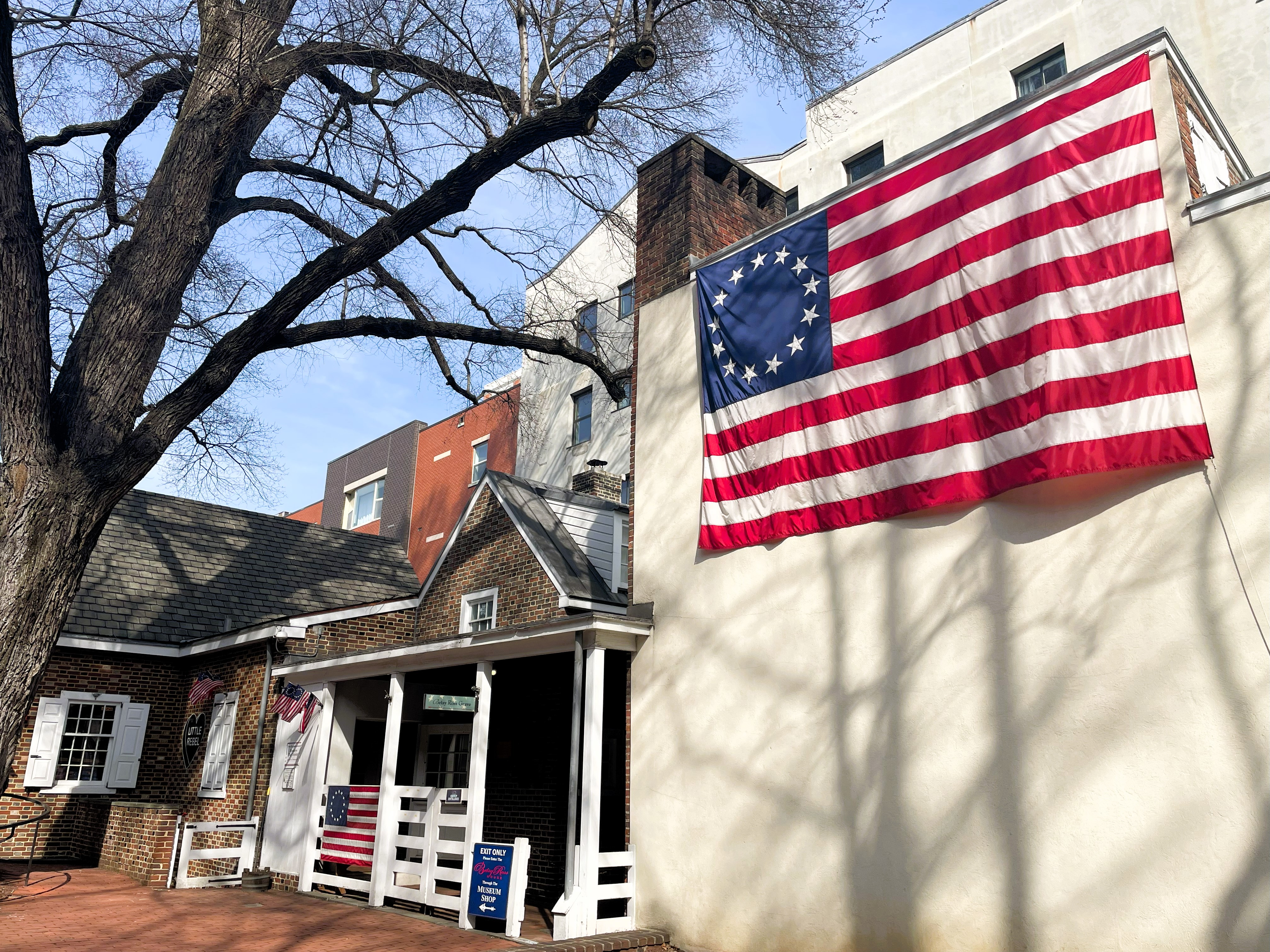
Betsy Ross was here (probably)

We rested a bit at the hotel before I made the girls join me at the riverfront at Penn’s Landing for a walk as the sun was setting. Then we went to the largest Wawa I have ever seen, where we all stocked up on foodstuffs for dinner. Back at the hotel, we ate and I watched television while the girls hid in the bathroom, chatting and making TikTok videos. And at 5 PM sharp, I logged on to the website and secured us tickets for Independence Hall for Saturday.

The next morning, I took the girls to an early morning guided tour of Philadelphia’s Magic Gardens, an extraordinary indoor/outdoor art space of mosaics created over decades by Isaiah Zagary combining handmade tiles, pieces of donated / cast-off household items from bottles to bicycle tires, and commissioned folk art from local, national, and international artists.
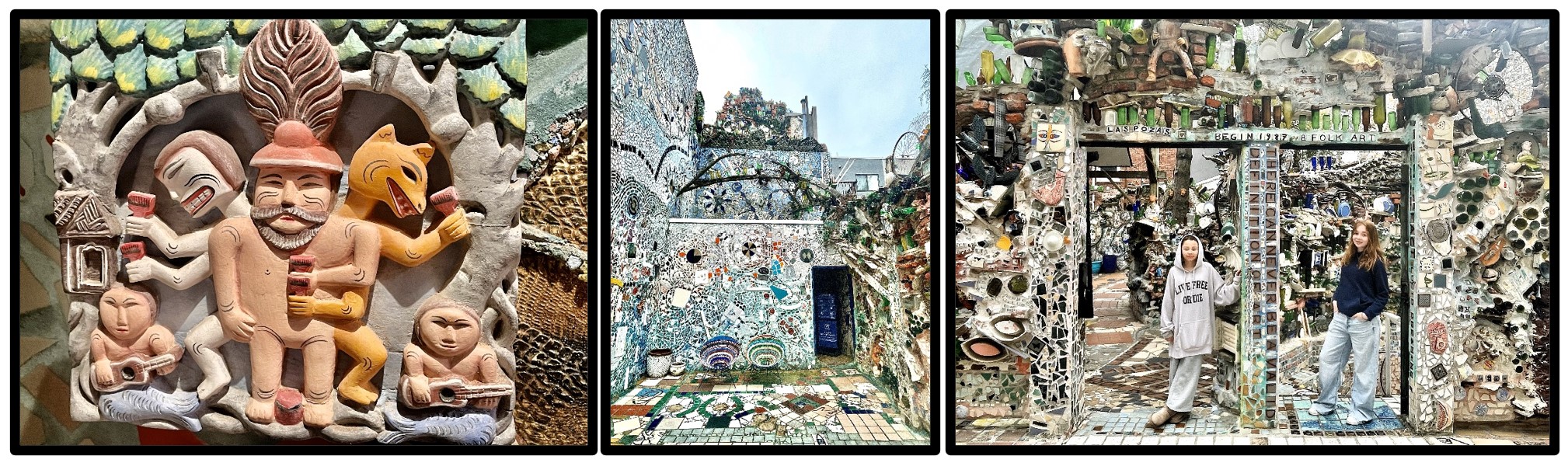
Scenes from the Magic Gardens

Honestly, I didn’t know if the girls would like it, but I wanted to include something on our itinerary other than historic sites. But they loved the Magic Gardens! They grabbed the scavenger hunt sheets provided by the museum, ditched the tour, and explored on their own.

I really enjoyed the tour. It was about 30 minutes long, providing us with information on the artist, his inspiration, process, role in the community, and legacy, along with plenty of time to meander where we liked, though in my opinion one needs at least twice the amount of time to really take in the details (well, if you are not visiting with teens). Unfortunately, the upper floors were closed to the public. I very much wanted to get up to the rooftop.

We then walked from the Magic Gardens to the old city for our Independence Hall tour. Luckily, we arrived early (as recommended online), and when other ticketed visitors did not arrive, we were able to join the tour scheduled 30 minutes before ours.

Scenes of Independence Hall

The tour is only 20 minutes long. The building is not large, and the tour visits just the two rooms on the ground floor. Though these are, perhaps, two of the most famous rooms in U.S. colonial history. C and TO were engaged in listening to and responding to questions from the guide; they are in civics this year. For me, the space, saturated as it is in our history to create a democratic nation, felt all the more weighty in the context of current political happenings. The words of our National Park Service guide, a bilingual, mixed heritage American from Puerto Rico, to our group, made up of visitors from around the country and the world, resonated with deeper meaning. I thanked each of the NPS guides for their service.

That was our quick trip to Philadelphia. Nowhere near enough time, but a fun and important trip that I hope will be something my daughter and her friend remember.

Lancaster County, PA Getaway – Again!

C on the historic Chiques River Covered Bridge

Last fall, I bought tickets for an event in Lancaster, Pennsylvania. My daughter C and I had really enjoyed our previous visit to the town, and we looked forward to another trip there. Washington, D.C. has also recently been saturated in tension and uncertainty, so I needed to get out of town for a weekend.

We headed out of town on a Friday afternoon just after C came home from school. Friday afternoon driving out of D.C. can be a struggle, and so soon after the Return-to-Office order for federal employees meant the 2 1/2 hour drive took about an hour longer. But no worries, our first destination in town was Sushi Heaven, an all-you-can-eat Japanese restaurant we fell in love with during our last visit. After stuffing ourselves, we headed to our hotel.

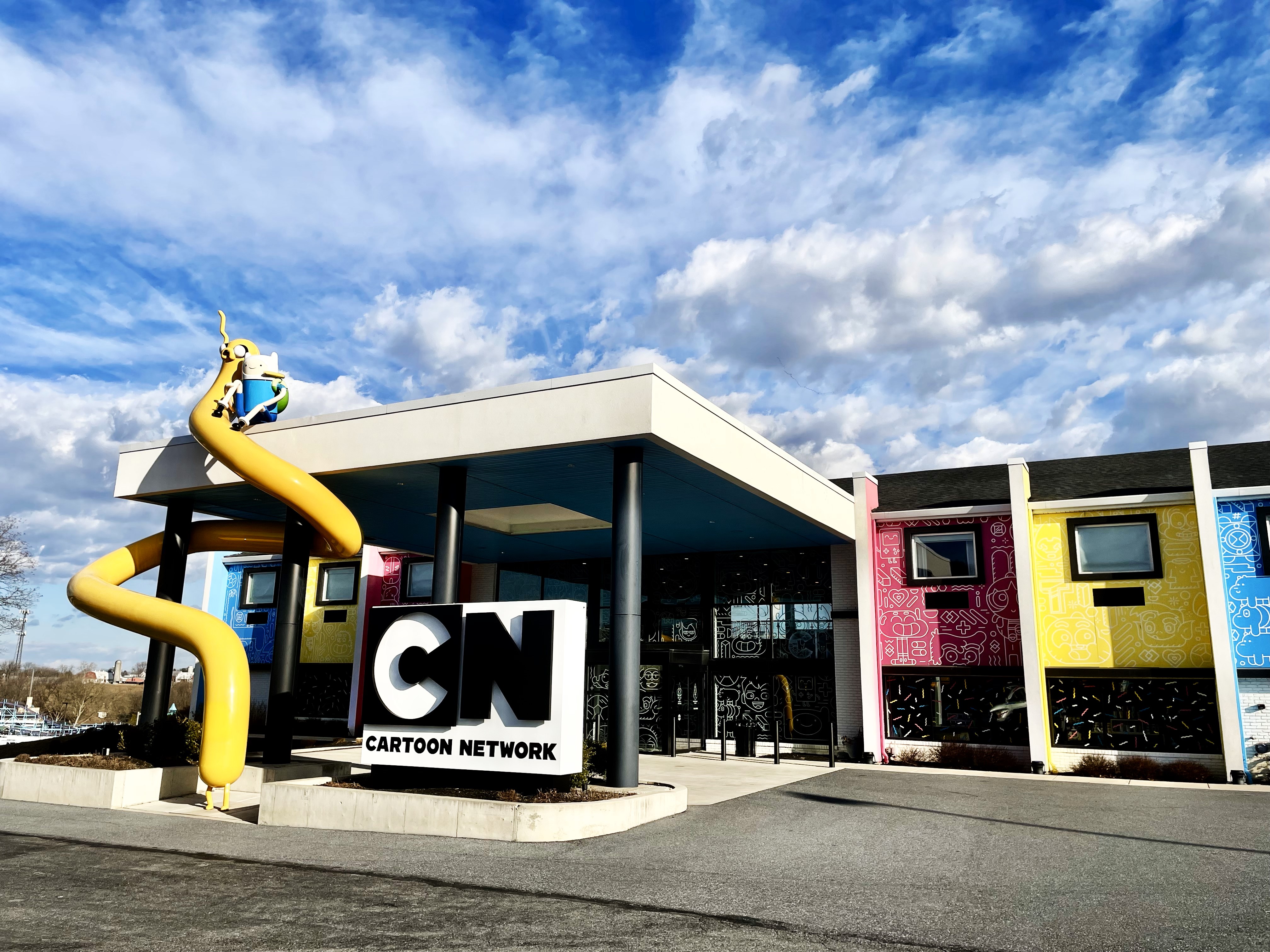
The Cartoon Network Hotel in Lancaster

On our last visit we stayed at the super cute Red Caboose Motel in Ronks, PA. Looking for something else unique, I reserved a room at the world’s only Cartoon Network Hotel. While I am a bit too old for Cartoon Network, and C is largely over it, we are familiar with it, and we love a unique place! Also, the hotel is well-located on one of the main drags in Lancaster, with easy access to everything we wanted to see and do. I wanted a Powerpuff Girls room, but they had all been reserved, so we had to make do with Jake the Dog from Adventure Time. No problem. The room was cute, the beds comfortable, and we had a good night.

On Saturday morning, after a much-needed lie-in, we headed to the town of Lititz for a 10:30 AM tour at the Julius Sturgis Pretzel Bakery. On our tour, C and I had the opportunity to roll out some dough, twist our own pretzels, and learn about the history of Sturgis Pretzels. Founded in 1861, the bakery is the site of the oldest commercial pretzel factory housed in one of Lititz’s original buildings, which was built in 1784. Now, pretzels have been around a really long time. Reportedly, an Italian monk invented them in 610 AD, but those were the soft pretzels now generally associated with Germany. But the hard pretzel popular in the U.S. was invented by Julius Sturgis in 1860. The baker he worked for thought they wouldn’t sell, so Julius bought his own place, and, as they say, the rest is history.

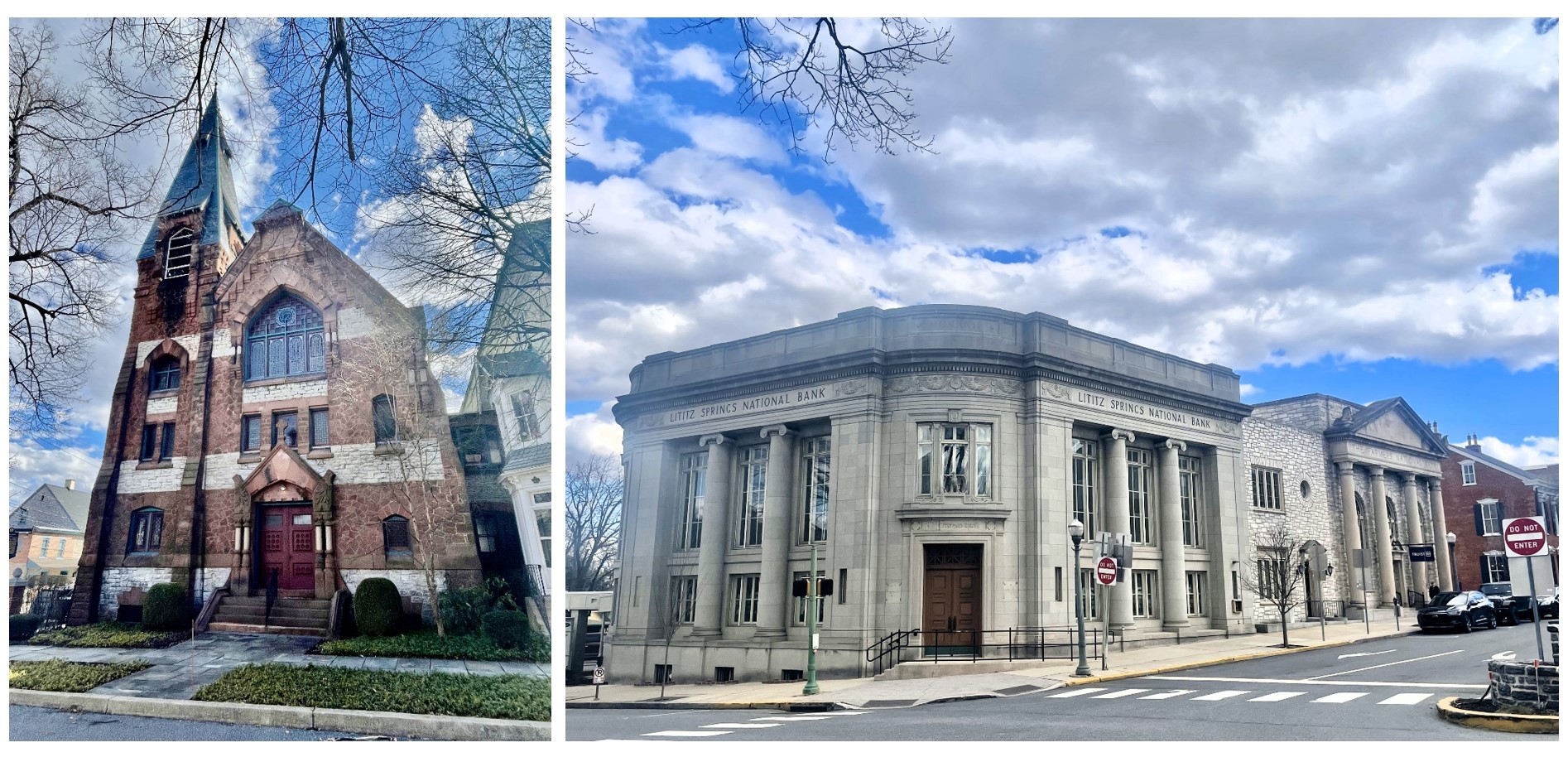
Following the Sturgis bakery, we took a brief walk around the lovely historic town of Lititz. Members of the Moravian church from Bohemia founded Lititz in 1756, and for much of the first 100 years of its history, only congregation members could own homes in the town. Over the years, buildings of many architectural styles (48!), from colonial and federal to Victorian and Beaux Arts and everything in between. I would have liked more time to explore but C is a bit less enthralled with historic buildings and architecture than I am, it was chilly with a bitter wind that made walking unpleasant, and we we were getting hungry and had lunch plans.

Lititz Architecture ranges from the Linden Hall School for Girls (left), the oldest girls’ boarding school in the U.S. and the Beaux Arts-style Lititz Springs National Bank (right)

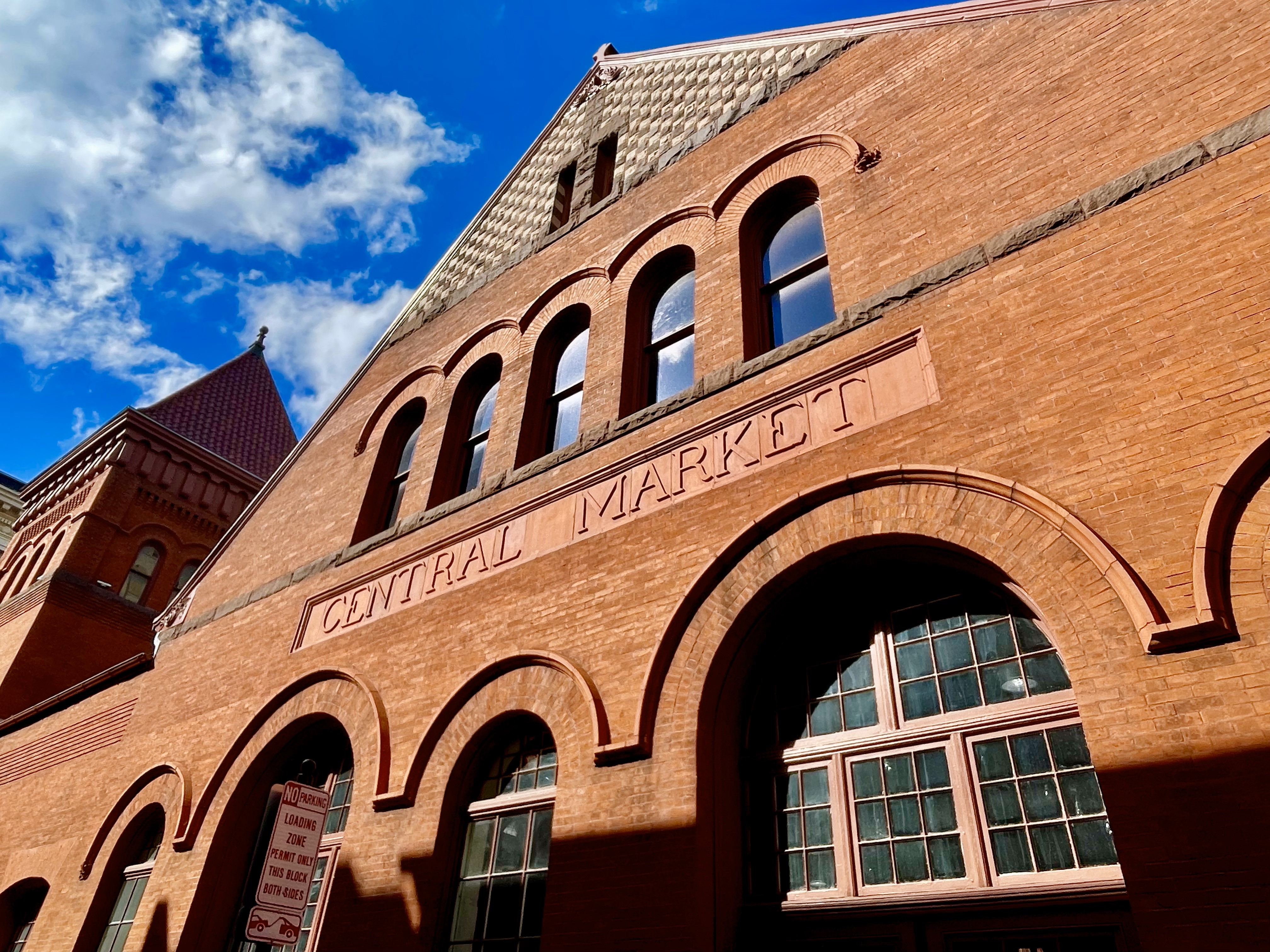
C and I made a beeline back to Lancaster and its Central Market (the continuously operated public market in America) for lunch. C may not care that much about the historic importance of the market, but she enjoyed the food there enough to personally request we return for some more goodies. We wandered past the stalls doing some “window” shopping before getting sandwiches and a whoopie pie, then nabbed a few seats at one of the few tables on the ground floor. Here we could munch on our food and people watch – where cheerleaders just out of a local competition mingled amongst locals and visitors buying from stalls with fresh fruits, vegetables, cheeses, and meat from Mennonite and Amish farms or grabbing Thai, West African, Spanish, Caribbean, Scandinavian, or Middle Eastern bites. Then, it was back to the hotel for a little rest before the evening’s event.

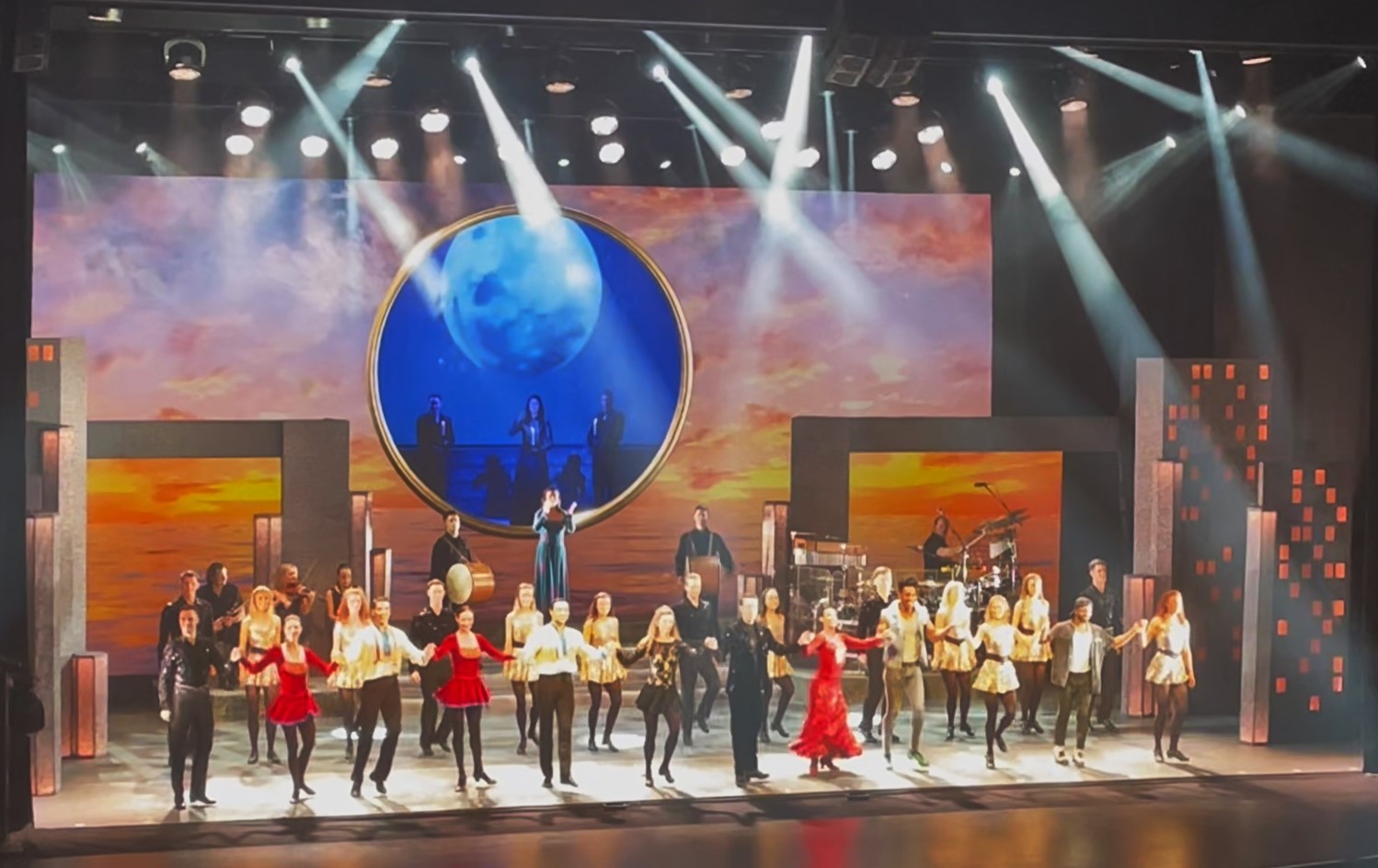
I built our Lancaster return trip entirely around seeing Riverdance, the Irish dance phenomenon, at the American Musical Theater (AMT). I do not remember when I first saw Riverdance, but it was in the Washington, D.C. area some 20 years ago, and I absolutely loved it. When C and I visited Busch Gardens in Williamsburg, I took her to see the Irish dancing show, and she insisted we see it again on our next visit. I knew she would love Riverdance, so I had to get tickets when I heard they were touring again. Lancaster and its unique AMT seemed the perfect place to see it. The performance was everything I remembered and more; C loved it! I’ll certainly keep the AMT in mind for future shows.

On the last day of our Lancaster County getaway, we drove first to one of the county’s many famous covered bridges so I could do a photoshoot of C. It was chilly and C was grouchy (she is nearly every time I pull out the fancy camera) so we spent only 20 minutes. Our next and final stop was the Turkey Hill Experience in Columbia, PA. I opted for both the interactive experience and the taste lab. For the former, we laughed our way through creating and naming our own ice cream flavor, designing its box, and making a commercial. We also locked ourselves into a mock (but still cold) ice cream freezer and taste-tested several of Turkey Hills’ beverages (for free!). In the taste lab, we were able to create our own ice cream using a very delicious vanilla base and choosing between some 18 flavorings, maybe 20 dry toppings, and some 10 liquid mixes. I went with a birthday cake flavor, topped with peanut butter cups and cookie morsels. I stopped there. With the flavoring, that is! I wish I could have used more self-control when it came to eating!

We packed a whole lot into our second visit to Lancaster County! It really was just what we needed for a mother-daughter getaway.

2024 Camp Pick-Up Weekend: Cumberland, National Memorials, and a Groundhog Town

When I picked up my daughter from her overnight summer camp in Pennsylvania last year, I had driven through or near some sights that called to me to visit. This year I decided to make a weekend trip out of it.

I drove a little over two hours northwest of Washington, DC to the historic town of Cumberland, Maryland. Established in 1787 at the confluence of the Potomac River and Wills Creek and at the base of the Appalachian Mountains, the town has been at the heart of American history. Here, in the late 1750’s young army colonel George Washington led General Braddock’s operations in the French and Indian War and he returned in 1794 to review troops preparing to quell the Whisky Rebellion. Cumberland also gained fame in the 1800s as a transportation hub with the National Road (now US 40) began construction there in 1811 and in 1850 the Chesapeake and Ohio (C&O) Canal between Cumberland and Washington, D.C. opened.

History like that is my jam.

I picked the centrally-located (and historic!) Cumberland Inn and Spa as my base. I wanted to just park the car and then walk all over the historic district. I headed first a few streets up to the Gordon-Roberts House, once home to a prominent lawyer, statesman, and President of the C&O Canal. Unfortunately, the door was locked and I saw no one about. I tried knocking and called their phone number and left a message, but it seemed I had already struck out in the Queen City.

George Washington’s headquarters in Cumberland, MD

No worries, it was lunch time. So, I made my way down the street, passing the tiny building that served as Washington’s headquarters, and headed across the river. Baltimore Street is the main artery here and is flanked by beautiful buildings from Cumberland’s heyday. And the street completely torn up for a major renovation project that will turn it pedestrian only. It will be wonderful when it is completed, but wished my timing had been better. Still, I found a nice place for lunch and made the most of it. I did have wonderful weather!

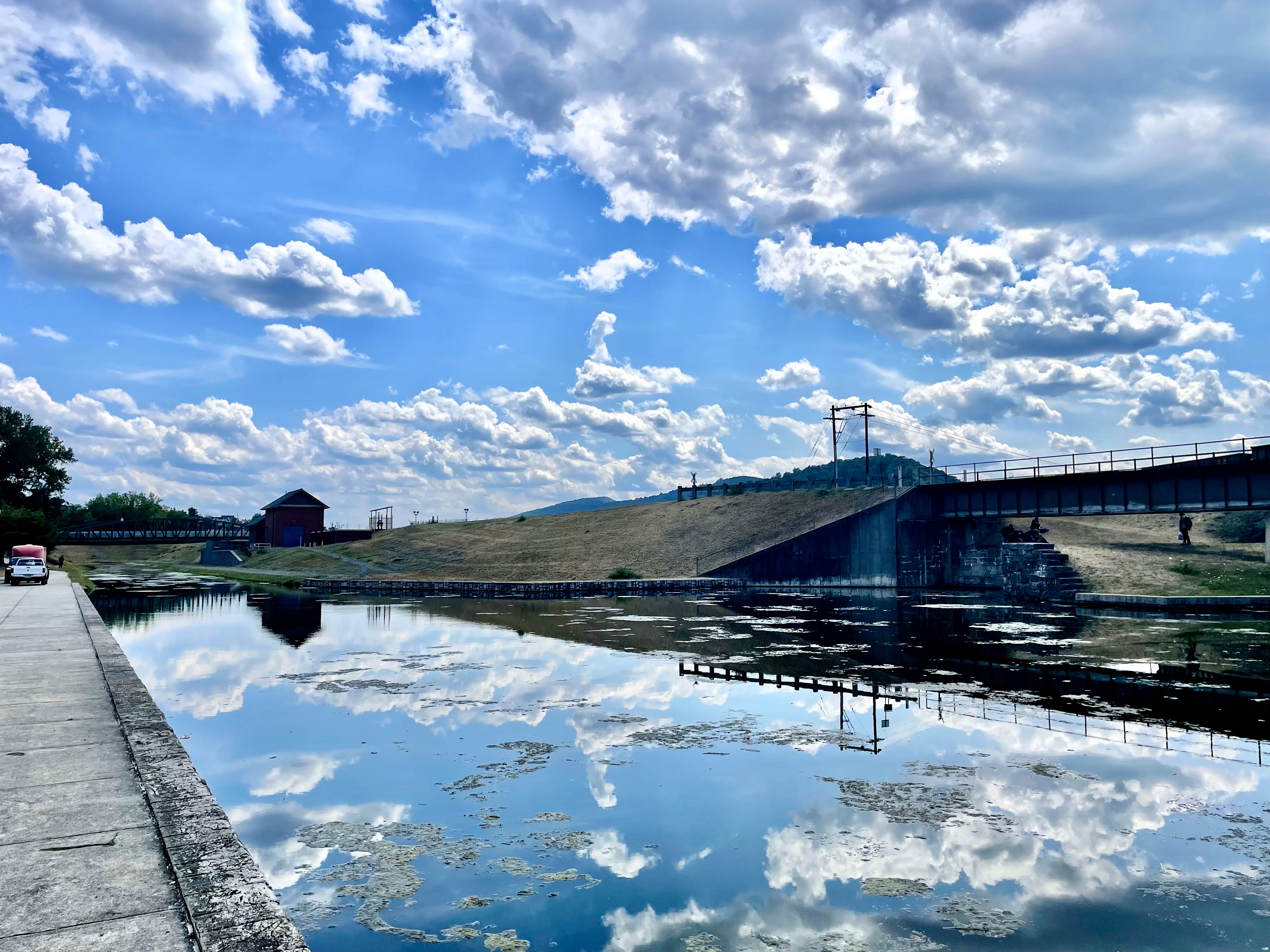
After lunch, I visited Cumberland Station, built in 1913, from where still operates scenic steam and diesel train rides. I walked over to Mile 0, the terminus, of the 184.5 mile C&O canal; its towpath a popular multi-day ride for cycling enthusiasts. I will be honest here: the canal waters were a bit stagnant, some rubbish was floating in it; across the way some unhoused individuals crouched beneath a bridge, likely welcome shade from the strong, hot sun, and a festival featuring a death-metal band was in full swing (though the music was pretty good, it was not quite the soundtrack I expected). Yet, the sky was a blazing blue generously sprinkled with cumulus clouds and with just the right angle, the scene was perfect.

Mile 0 of the C&O Canal begins (or ends) in Cumberland

In the National Park visitor’s center I chatted with a young AmeriCorps volunteer eager to learn about how to parlay his education and experience into a career at the State Department. I was grateful my daughter was not with me; she is not a fan when I get too friendly and chatty with strangers. She would also have disliked my talking with the lovely volunteer docent at the Allegany Museum. Housed in two floors of a former 1930s courthouse and post office, it is packed full with interesting information, mostly on the architecture, industry, and transportation history of the region.

I left just before the 5 PM closing and planned only to walkabout the area looking at the architecture when my phone rang. A young woman asked if I had called earlier that day to visit the Gordon-Roberts House and told me that unfortunately they have few tours and it would be closed for a special event on Saturday. Well, I figured, that’s that. But then she said, “Well, I am here now doing preparations for the event…If you are nearby, I can give you a quick 15 minute spiel and then let you self-tour.”

The impressive Second Empire style Gordon-Roberts House

And that is how I ended up with an after hours tour at the house. I really could hardly believe my luck and the woman’s generosity. She gave me more than 15 minutes of her time and really did let me wander around on my own through the ground floor, second floor, and basement (the third floor is closed to the public – but I still took a peek). I found the house interesting – six bedrooms on the second floor alone! And a dumbwaiter! And a pre-electric single person elevator! – but by far the best part of the experience was that I got to tour it in the manner I did. I spent another hour or so of the long summer evening wandering past the churches, the Masonic Temple, and other architectural gems before calling it a night.

The LaVale Toll Gate house dating from 1835

On Saturday morning I set off for Somerset County, Pennsylvania along US40. At the Allegany Museum, I had learned that Maryland’s first (and last) toll house still stands just a few miles outside of Cumberland. It was on the way—just a slower, more picturesque way—so how could I resist?

The LaVale Toll Gate stands forlorn on the side of US40. Next door there was a Goodyear tire shop and across the street a gas station, both of which seemed rather fitting to me for a place where travelers have had to stop their journey for nearly 200 years. It was not open, there were no other cars in the parking lot and no other visitors while I was there, yet, I am glad it is still there for the odd traveler and history enthusiast.

The Barronvale Covered Bridge, built 1830

An hour later, I had a teary-eyed C and her belongings in the car. She had had a wonderful two weeks at camp and was thrilled to see me (imagine it!) but also sad to leave her new friends. I knew immediately what would cheer her up! A visit to an old covered bridge! Somerset County is full of them (ten in total) and I had pre-programmed directions to one of them as we headed to our next destination. I should have known better though (and really I did) because once at the bridge C opted to stay in the car (“I can see it from here.”). My free-wheeling, teenager-free part of the trip was over.

I drove east about 30 minutes to a field just outside Shanksville, PA, where on September 11, 2001, the brave passengers and crew of United Flight 93, learning their plane was part of a terrorist act, forced the hijackers to crash the plane, killing them all but saving hundreds, if not thousands, more.

Flight 93 National Memorial: view of the flight path from the Visitor’s Center (left), the Tower of Voices (center), and memorial wreaths at the far end of the Memorial Plaza

We started off with a walk down from the visitor’s center that passes the flight path, impact site, and wall of names. The weather was nice, warm, with clouds that threatened rain but held off; the field dotted with wild flowers. It felt both fitting and incongruous as a final resting place of such an act of terror. C was far more focused on a school issue than the site and I tried to refocus her attention on the importance of the location. We moved on to the Visitor’s Center and it was here, with the television footage of the planes flying into the towers, the photographs of the passengers and crew, and recordings of some of their final goodbyes that left us both weeping. We completed our visit at the Tower of Voices, a ninety-three foot tall structure of wind chimes that plays 40 tones representing the voices of the 40 passengers at their final resting place.

Our next stop, after a quick lunch stop: the Johnstown Flood National Memorial. Along the way, I thought, though certainly educational, perhaps two national disaster memorials in one day might not have been my brightest idea?

The valley that once was Lake Conemaugh

The Visitor’s Center sits on a hill overlooking a valley, what what was once the two mile long, one mile wide, and 60-feet deep Lake Conemaugh, before on May 31, 1889, the earthen dam holding it burst releasing 20 million tons of water downriver at 40 miles per hour, wiping out the town of Johnstown and killing over 2200 people within an hour. Reading that sentence is sobering enough. Looking at the photographs and reading or listening to first hand accounts of survivors was more so. But the 35-minute movie “Black Friday” shown at the Visitor’s Center? Wow. It is seriously a downer. It so vividly describes the horror and the fatalities that it comes with a PG rating with a recommendation that small children do not attend. I began to worry a bit about C. When she was six, she sobbed through her school viewing of a movie on the Pacific garbage patch, and when she was seven she cried out loudly “No! Stop!” when colonists attacked Native Americans at the production of “The Lost Colony” at Roanoke Island, NC and then bawling yelled “Mom! Why would you bring me here?” But thankfully at 12 1/2 she could handle this particular film though I found myself cringing several times.

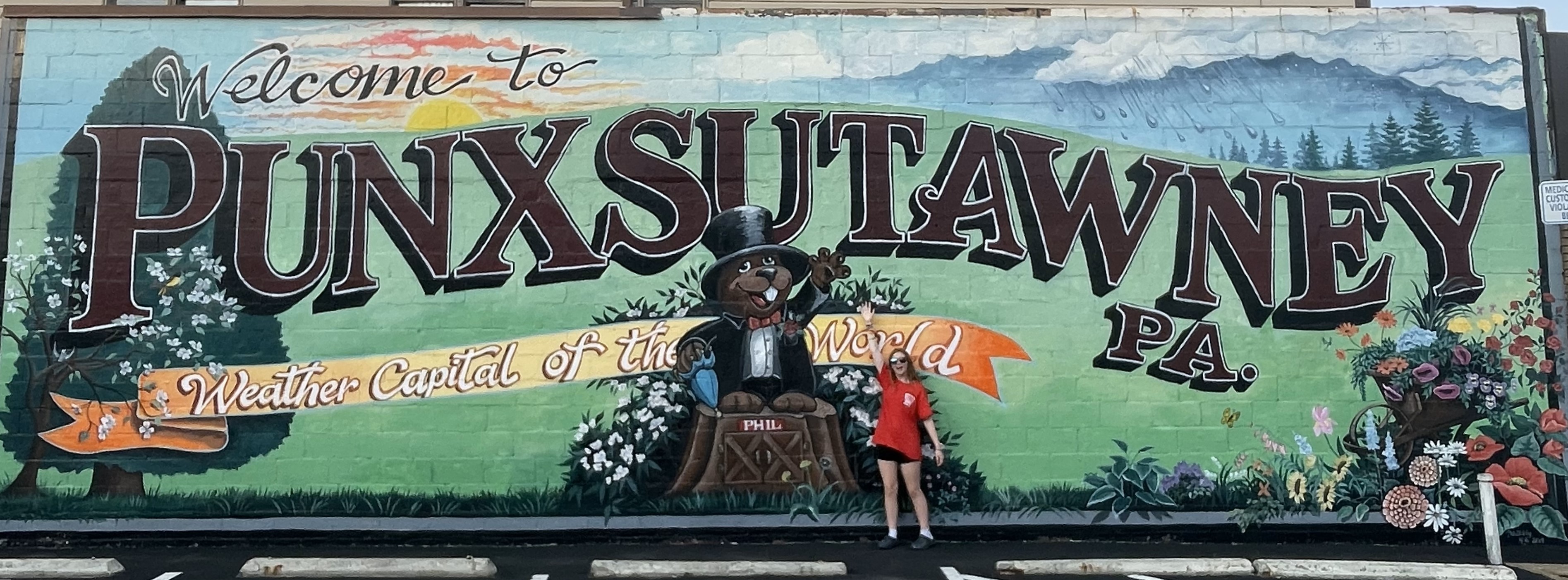
To round out our day and bring the mood up, I turned north to Punxsutawney, Pennsylvania, “the weather capital of the world,” and home to the famous spring forecaster Punxsutawney Phil. Although the movie “Groundhog Day” (one of my personal favorites), was actually filmed in Illinois (yeah, really), I did find us a lovely B&B just on the main town square that was close enough for me. We were just a hop, skip, and a jump from Phil’s Burrow, the home of Punxsutawney Phil, his spouse Phyllis, and their kit. After visiting Phil, whom C declared as adorable before asking if she could have a pet groundhog, we went for a nice evening walk in search of the Phantastic Phils, the six foot tall fiberglass groundhog statues placed around town.

One of the 40-something Phantastic Phils and C hamming it up at Gobbler’s Knob

On Sunday morning, C and I made the pilgrimage to Gobbler’s Knob where each on Groundhog’s Day since 1887, Punxsutawney Phil, “Seer of Seers, Sage of Sages, Prognosticator of Prognosticators and Weather Prophet Extraordinary,” is coaxed from a tree stump and held up before the eager crowds then makes his prediction of the coming Spring. I doubt we will ever make it for an actual Groundhog’s Day (accommodation books out years in advance and one has to wake up in the dead of night in the middle of winter; me I am not a fan of the cold or middle of the night galivanting), so this would have to do. We chased down the locations of a few more Phantastic Phils and then it was time to go. C’s dad picked her up for a week in New York and I headed home.

I don’t know why it continues to amaze me how restorative even a few days away can be, but throw in beautiful weather, lovely drives, and historical, natural, and cultural sites, and it can truly be perfect.

A Weekend Getaway in Lancaster, PA

One of the good things about being in the U.S. now are the many opportunities for wonderful weekend getaways. And though my 11-year old is extremely well traveled internationally, she has far less experience in our home country. It is important to me that she has the opportunity to see sights around the U.S. that also introduce her to the variety of cultures, history, people and places that our nation offers.

For the Veteran’s Day weekend, I decided C and I would visit Lancaster, Pennsylvania. I have vague memories of visiting the area when I was a child, perhaps 8 or 9 years old, with a friend and her mom, also a single mother. But other than having spent a day there, I had no other recollections. With good weather and a fair amount of trees still in their autumnal leaf glory, Lancaster seemed a great place to get away from our every day.

A delicious assortment of macarons at Bistro Barberet

Our first stop in Lancaster was the Bistro Barberet, an authentic French restaurant and bakery owned and operated by an award winning French chef located in the historic downtown area. C loves French pastries and desserts and insisted she needed some bona fide macarons a.s.a.p. She left with the macarons, which must have passed muster as she ate every one of them (I got none).

Next we headed to the Lancaster Central Market. Founded in 1730 as part of the town’s original design, the market is the longest continuously operating public market in the country. It’s 60-some vendors offer a little bit of the old – from fresh local produce, homemade canned and dried goods, and family-owned meat, seafood, and poultry options – to the new, including Puerto Rican, Thai, and West African foods. Once inside, C immediately made a beeline for the West African stall as she identified the flags of Guinea and Liberia on the stall at once. Though we had not really immersed ourselves into the local food scene in Conakry, the flag was a pleasant reminder of both our personal journey and the international connections around us. C really loved the market. She tried the local favorites like soft pretzels and whoopie pies, and declared the market a wonder that she wished were closer to us.

Hankering for something a bit more substantial for lunch, we headed up the street to Brooklyn Pizza Grill & Pasta. It was a little chilly and overcast with a slight drizzle outside, but the wafting smell of fresh baked pizza, the heat from the ovens, and the cheery greetings from the staff were very welcoming. There are only a few tables, so we perched on bar stools at the small table in the window as we chowed down on delicious hot and greasy New York style pizza as upbeat salsa tunes encircled us. Fantastic!

That afternoon we had bookings for the Amish House & Farm tour. For some reason, I thought the tour meeting spot would be just nearby, and when I learned I had a 25-minute drive we made a hasty retreat over. I was a little surprised to find an 1805 farmhouse in a Target-anchored shopping center, but we ended up having a wonderful tour. We started with a 90-minute bus tour through the surrounding countryside accompanied by commentary from the guide on the history and culture of the Amish. We made three stops at Amish businesses along the way. At the first we never even got inside the store as the small petting zoo with adorable goats, the soft pretzel stand, and the large bin of free pumpkins kept C and I plenty busy during the 15-minute break. The second stop was a small single-family run housefront store with handmade goods, many made by the family’s children. At the third, we spent nearly the entire time in the barn as C and several other children from the tour oohed, aahed, and cooed over a little of adorable havapoo puppies for sale. Back at the farmhouse, we had the opportunity for a further 30 minute tour of a mostly typical Amish home. Though I think the puppies were C’s favorite (ok, maybe mine too), the tour was very educational for us both.

Our “room” at the Red Caboose Motel at Paradise Station in Ronks, PA

We were to also have a self-guided tour of the adjacent farm, but with the recent time with daylight savings, the farm was far too dark to check out when we finished the house tour. We drove on to our hotel–the delightful Red Caboose Motel in Ronks, PA, where we would spend the next two nights in a renovated train caboose. We loved our room at once – it was cleverly converted and very cosy. C had her choice of 4 bunk beds but chose instead to squeeze in with me in the double; though she often asserts her independence, I think she might have been intimidated by her first stay in what essentially looked like a train yard. Dinner (and the following morning’s breakfast) was hearty portions of Americana in the Casey Jones’ restaurant where patrons sit in two train dining cars.

It is perhaps impossible to capture the pure joy of experiencing this view first hand – the crunch of frost covered grass beneath one’s feet, the evaporating chill still tingling the nose, and the calls of the boys to their horses in the fields

When we woke up the next morning there was frost and a fine mist hovering over the ground. Though chilly and in the upper 30s (Fahrenheit), the sun and sky were bright and clear. Before breakfast, I grabbed my good camera and did a perambulation around the property. The view across the fields was absolutely stunning. I do love our neighborhood in northern Virginia, but though the residential streets are tree-lined and there are plenty of parks, it cannot compare to the beauty of open land. I do not think I am designed for country living, but I sure do enjoy taking time to drink it in.

Wheatland on a lovely autumn day

After breakfast, C and I headed to Wheatland, the preserved home of the 15th President of the U.S. James Buchanan. Buchanan, thus far the only bachelor president and the only one from Pennsylvania (though some are now divided on that President Joseph Biden was born and lived the first decade of his life in the state before his family relocated to Delaware), was a controversial figure who, though an accomplished statesman, is probably most remembered (when he is remembered) for presiding over the succession of the southern states and the start of the Civil War, which began just six weeks after he left office.

It was a very good tour. C, who has often seemed bored by house tours, was well-engaged by the former 5th grade art teacher turned tour guide. We were also a small group of six; in addition to C and I there were two 20-something male history buffs and, as luck would have it, a just-retired Foreign Service couple. What are the odds? There were a few things that struck me as rather extraordinary about the tour: 1. the 20-minute introductory film makes no bones about the controversy surrounding the man and 2. that so much of the furniture and decor were not only original to the house and family but that we were free to move around (though not touch) the rooms. In nearly every home of a person of such historic value, the rooms are cordoned off in some way, with either carpet runners you must stay on or by stanchions or plastic barriers that allow guests only too close.

We crisscrossed the county again, grabbed lunch at a small mom & pop taqueria, and then headed to the Strasburg railroad where we boarded a luxury lounge car for a leisurely 45-minute out-and-back ride on the country’s oldest continuously operating steam train. C’s pre-teen tendencies were beginning to show as she grumpily dropped into her velvet armchair; though the fun of an historic train ride did not perk her up, an iced tea and a M&M brownie did the trick and soon enough she conceded it was sort of interesting. I enjoyed the ride, though would have liked it more had it been a wee bit longer. It felt that as soon as we got going it was time to turn back and then it was over.

After the train ride, we drove along the back country roads visiting a few of Lancaster’s covered bridges. I had not realized at first that there would be so many such bridges as they are often more associated with New England, but there are at least 20 of them in the county. We passed by four of them, but it was the Kurtz Mill Bridge, dating from 1876, that provided the best opportunity to really see a covered bridge due to its location in the county’s central park.

C leaps at the Kurtz Mill Covered Bridge

On Sunday morning, I took one last stroll around the Red Caboose Motel grounds, listening for the clip-clopping of the Amish carriages on their way to a friend’s or neighbor’s home. C and I then packed up and made one final stop in Lancaster, so I could take a photo of the Lancaster County Prison, which the mid-18th century town leaders decided should be built like an English castle. Just another unique feature of Lancaster, I suppose.

I was reluctant to depart and head home; it was a great weekend away.