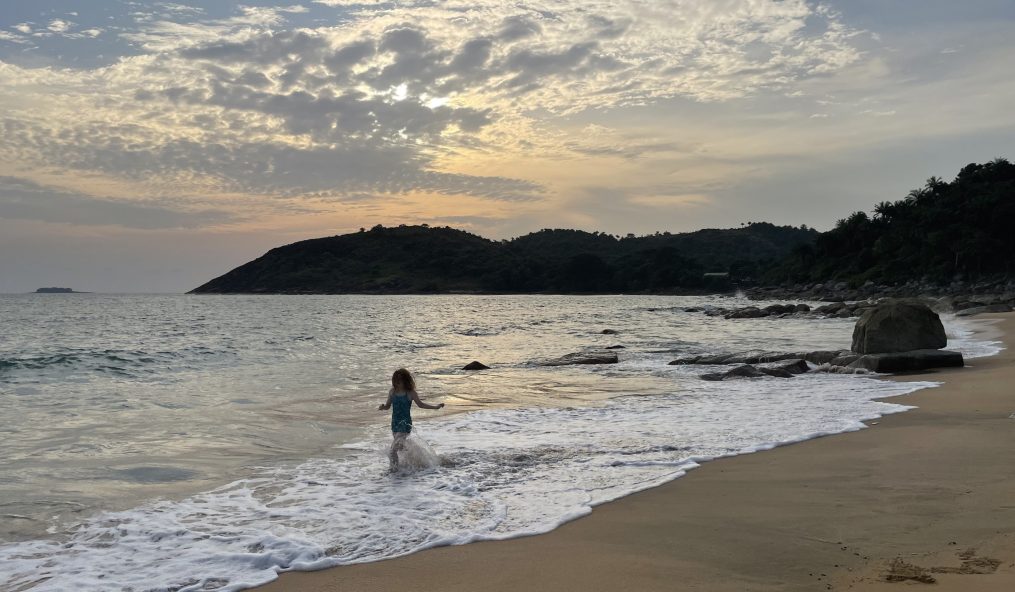

After our Southern Caribbean cruise, we ended up back in San Juan, Puerto Rico. I planned for us to spend three days in Puerto Rico taking in some sights.
On the first morning, we took a taxi from the cruise terminal to our hotel in Condado Beach, left our luggage, and headed out for a walking tour of Santurce, the largest and most populous neighborhood in San Juan, and a place with a long history of diverse immigration and cultural expression. I had read an article online about the murals of Santurce and was determined to see them. (I have a bit of a thing for murals, graffiti, and painted signs such as those we saw in Brussels, Luxembourg, Lisbon, Kenya, Malawi, and even Guinea.)
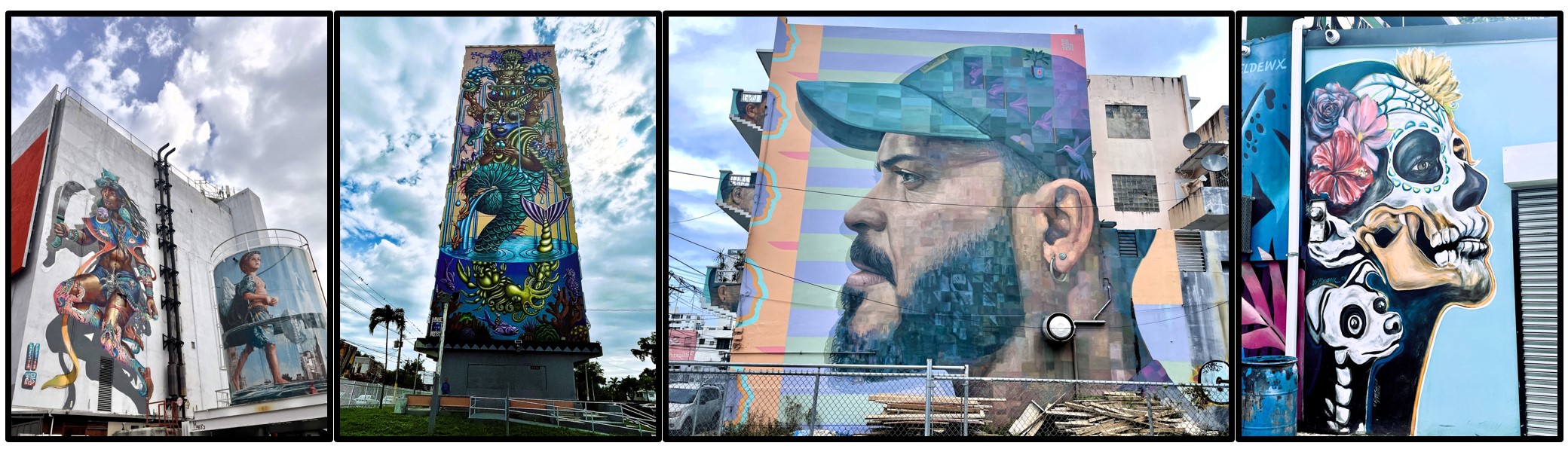
From our hotel, we walked about 30 minutes to Calle Loiza, which the article indicated was the center of the street art renaissance in Santurce. We crossed up and down streets and tried asking some locals, but I could not find the ones I was specifically on the hunt for. We did see many fantastic examples of street art, but none of those I saw in the article. It was more than a little frustrating as there seemed to be no information I could find online that would map out where to find these beautiful murals, some of which were painted by well-known international artists. Even those who lived in San Juan or in Santurce could not tell me where certain artworks I found online could be located. One of our hotel clerks told me Santurce was too large a place and the murals spread out. In an area of Santurce, where I had read that not only was there a large concentration of murals, but also a burgeoning restaurant scene, C and I found instead an atmosphere of neglect. It was Saturday late morning, and I had expected to see many people out and about, lounging in outdoor seating at some of these cafes I had read about, where I thought we might have lunch. Instead, we ran into only a few other people. An old man seemed confused when we asked him about murals, as if he did not realize we were even in San Juan. A drunk, stumbling about, who yelled something at us. The cafes listed in the article were closed, at least one permanently. After an hour of walking through Santurce, hot and a little confused, we returned to the hotel.

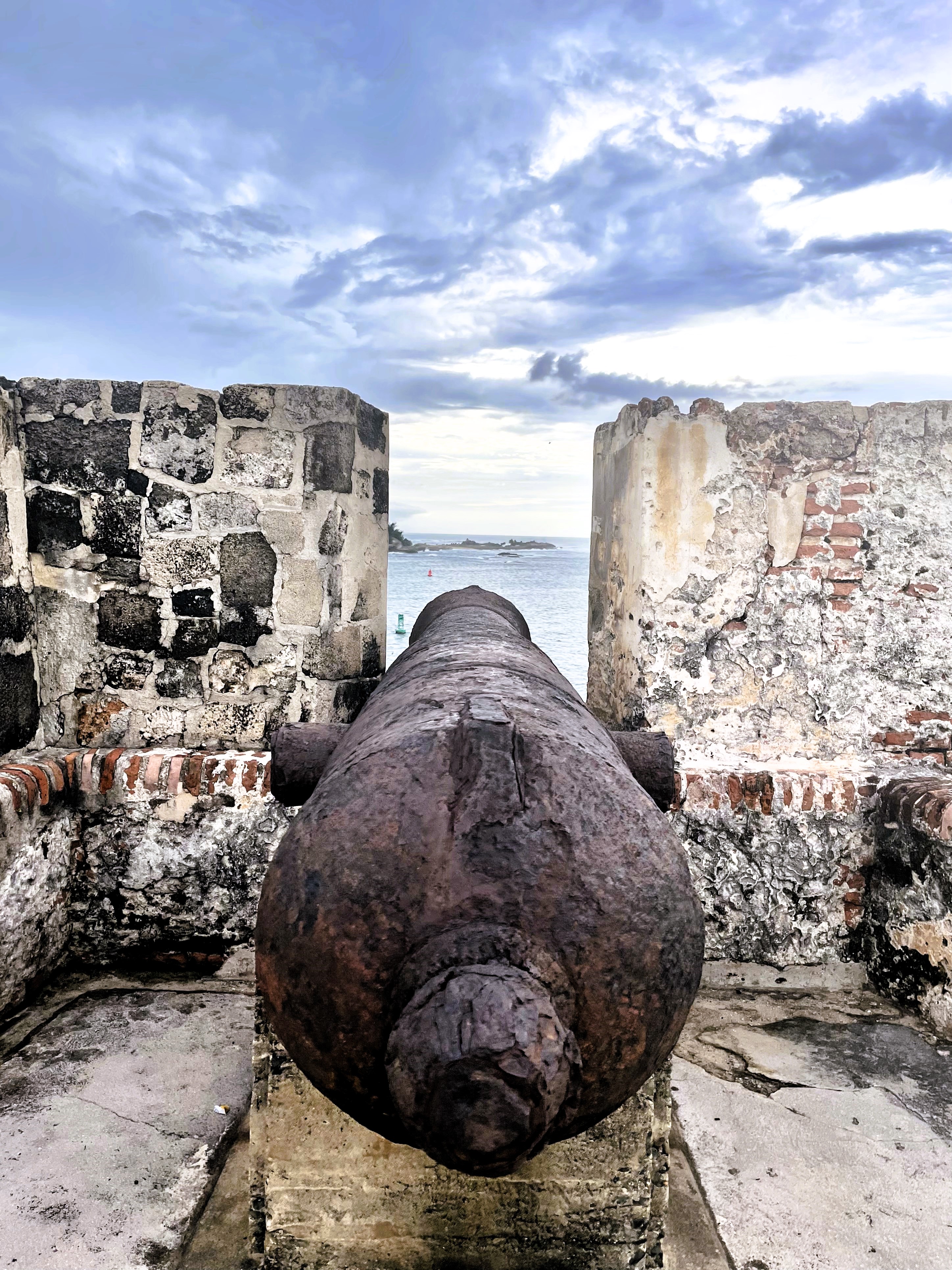
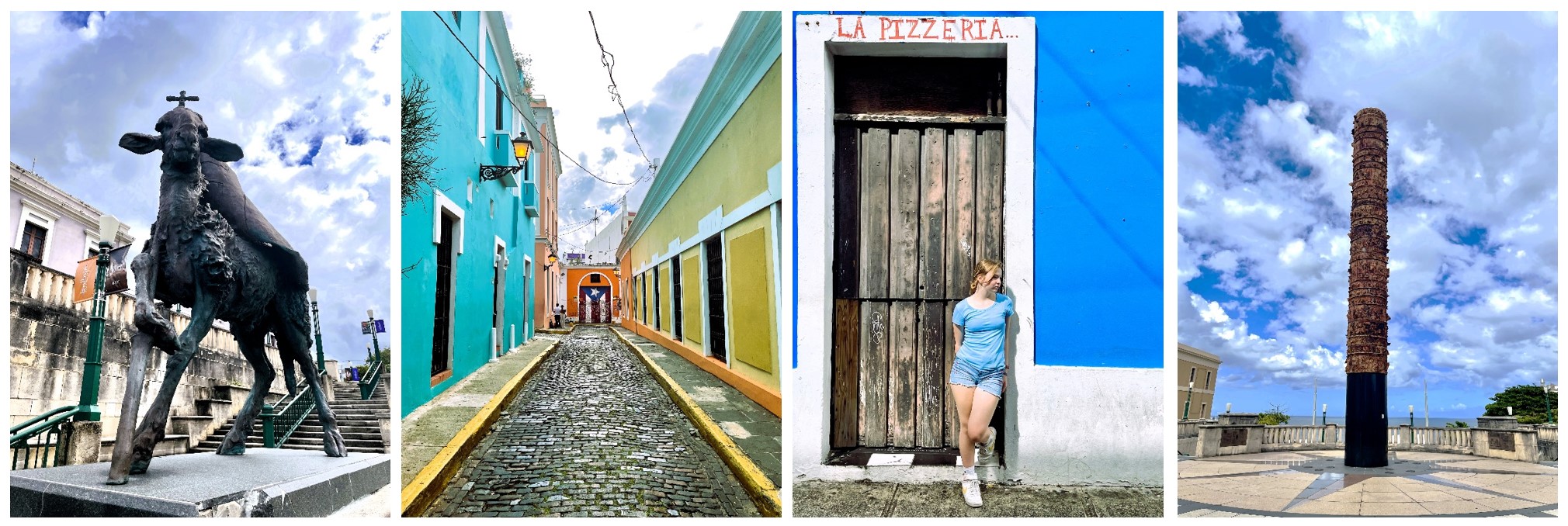
We grabbed another Uber and returned to Old San Juan for lunch in a popular location. The place was packed and it took nearly an hour to get our food; we did not finish until about 2 PM. I was trying hard not to be frustrated by the hiccups. I was determined to show C more of Old San Juan, so we headed to the Puerta de San Juan, the main gate to the walled city built around 1635, during the Spanish colonial period. We took a leisurely stroll along the Paseo del Morro, the pedestrian pathway wedged between the waters of the Bay of San Juan and beneath the walls of the Castillo San Felipe de Morro.
We meandered along. A large feral cat colony lived alongside the water, and dozens were asleep beneath the bushes, among the rocks, in the grass, and on the path, much to my daughter’s delight. Iguanas lay on ledges in the rocks beneath the higher Castillo walls; their location likely keeping them out of the way of the cats.
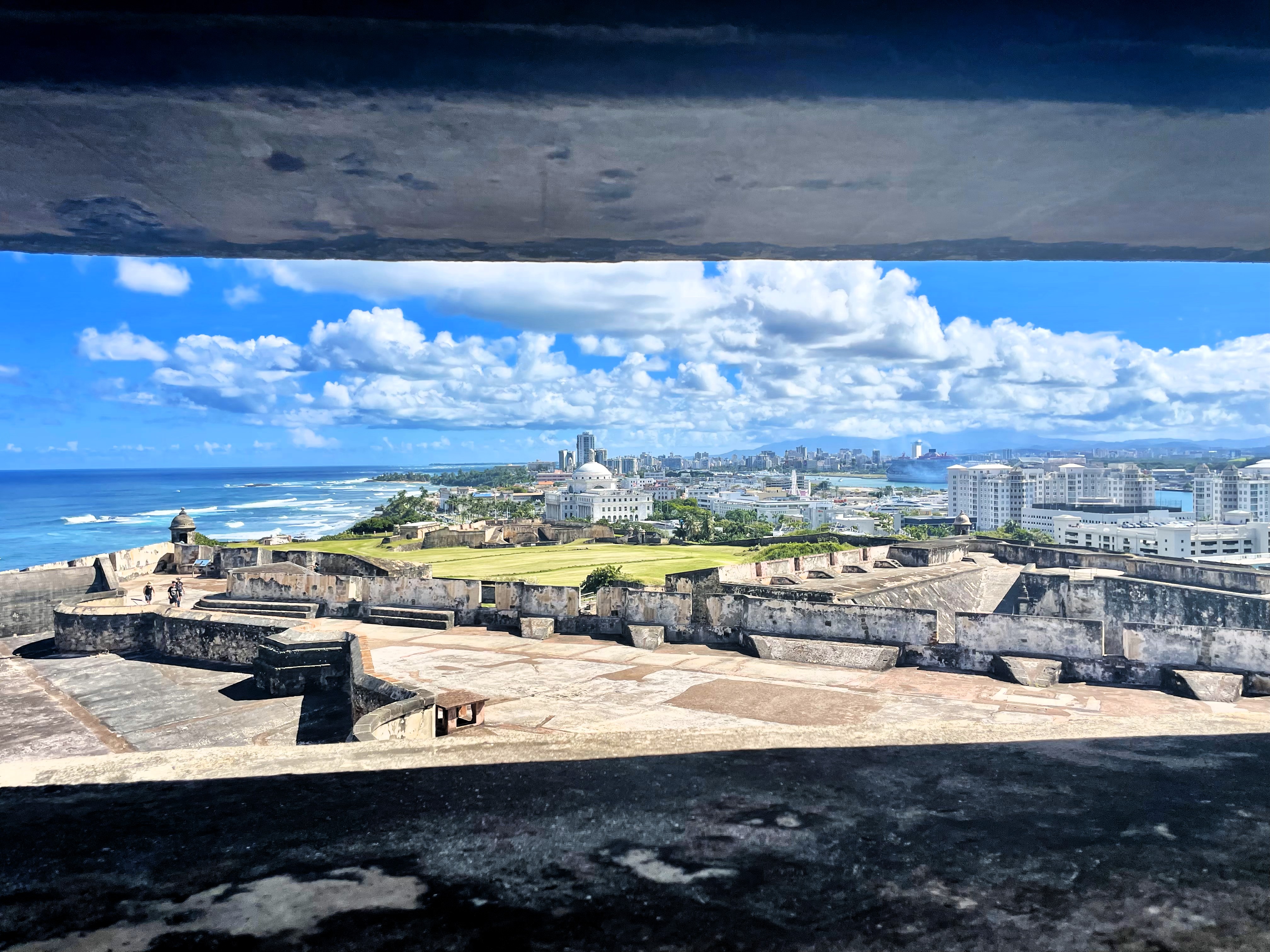
I looked at my watch and discovered it was after 4 PM and the Castillo would close at 5, so we needed to hurry up to see it. It took us another 15 minutes to climb up to a Castillo entrance, leaving us about 40 minutes to race through one of the most iconic fortifications in the Americas. It was not our first high-speed tour on the trip, so by this time, we were getting pretty good at it. We quickly explored all three levels right up until we were being ushered out by park rangers. We walked out the front of the Castillo, across the expanse of lawn where kids were flying kites, families, friends, and dogs were enjoying the last rays of sunlight. We passed the Santa Maria Magdalena de Pazzis Cemetery, where the dead have an amazing fabulous panoramic view of the ocean and the fort. I remembered I had wanted to walk through it, but now time would likely not permit.
On Sunday morning, on our second day in Puerto Rico, C and I picked up a rental car in Condado Beach and headed south into the interior. Our destination: the Toro Verde Adventure Park in Orocovis, about an hour southwest of San Juan. We were here to ride the Monster, the longest zipline in North America and among the top 10 longest ziplines in the world.

C and I like to have a bit of adventure, not only in where we travel but also in what we do when traveling. For instance in London, we slid down the world’s longest tunnel slide, and in Amsterdam took a ride on Europe’s highest swing. We were supposed to take on the highest zipline in Norway when we visited Bergen, but C got sick. (I will admit I was also quite nervous about it!). I thought C and I were up for taking on the Monster that, at 1.57 miles (2.5 kilometers) long and reaching speeds up to 95 miles per hour, is not for the faint-hearted.
We stepped inside the store, paid for our go on the Monster, and then went around the side to get fitted into our gear. Unlike most ziplines where you sit upright, to ride the Monster you lie down so one wears a helmet and a long rubber-like apron, similar to what you might see a butcher wear. Fitted out, we shuffled over to the stairs that took us up a rise and then ascended the stories-high metal tower. With only five or six people in front of us, we did not have long to wait. C and I wanted to zip down side-by-side, but only one zipline was in operation. I decided to go first.
I had to step up to the platform and get into a plank position while the operator pulled the apron down full so it became more like a hammock cocooning my front and I was attached to the zipline in two locations. I had to put my arms behind me so my hands could grasp a handle around the back of my knees; the operator instructed me to keep holding on, with my arms tight to my side. Only at the end, I was told, should I release and put my arms out to the side. She swung me out part way from the platform and let go.
It was exhilarating! I must have been going really fast but as I looked down across the green valley, some 1200 feet below, it sort of felt that I was moving in slow motion. The foliage below was dense; I flew over a river. It was breathtaking. I could not stop smiling. But it was over in a minute. I waited for C to make her flight across the valley, then we had another shorter zipline to do before arriving at the truck that would take us back to the top. My verdict of the Monster? I would do it again!
After our zipline experience, we headed south through the mountains to Ponce; founded in 1692, it is Puerto Rico’s second-largest city. The road was windy, but the weather was fantastic and I enjoyed the freedom of being behind the wheel. It took about 75 minutes to arrive at the Plaza las Delicias, the main square. Except it turns out I headed to the Plaza las Delicias in Salinas, not Ponce, adding an extra 30-minute drive to our destination. Sigh. We had lunch in the Ponce suburbs and then parked near the Plaza for our sightseeing.
When I visited Puerto Rico in 2003, I wanted to visit Ponce but there were no rental cars available on the island, leaving me confined to San Juan. So, this time around, I aimed to rectify that. But a lot had happened since 2003. Most recently, Hurricane Maria in September 2017, two major earthquakes in January and May 2020, Hurricane Fiona in September 2022, and the COVID-19 pandemic led to physical and economic damage in Puerto Rico, but Ponce was hit particularly hard.

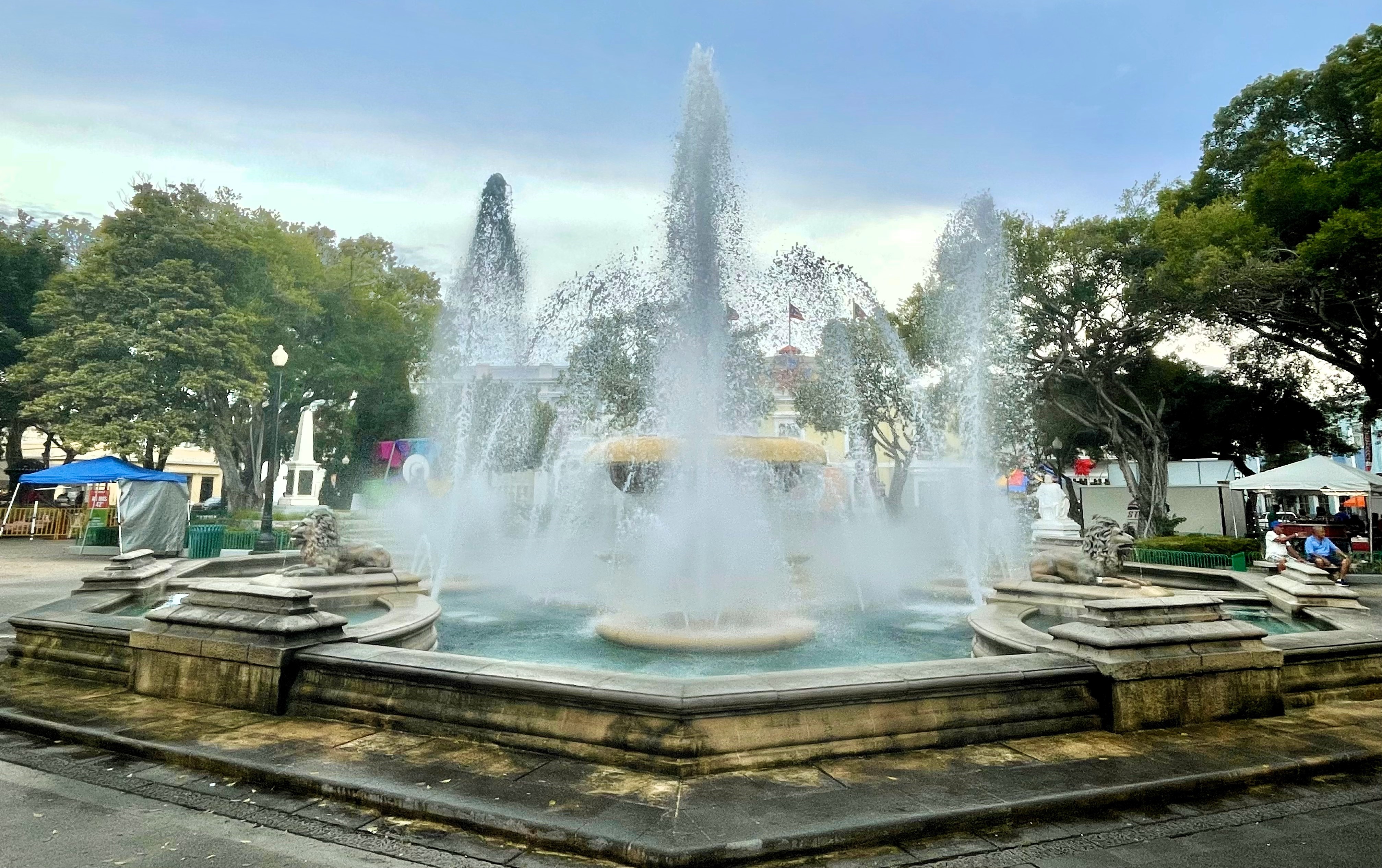
I parked a few blocks away from the Plaza las Delicias, at the heart of the city’s Historic Zone, and we began exploring. The plaza is beautiful. It is dominated by the Cathedral of Our Lady of Guadalupe to the west, the Parque de Bombas (the extraordinarily bold black and red striped building that was once a fire station and is now a museum) to the east, the Fuente de los Leones to the south, and a small park with statuary to the north. While not crowded, there were a good many people taking advantage of the good weather and festive spirit of the main plaza. Off from the plaza though, despite the stand-out buildings, largely in colorful Ponce Creole style (a mix of Spanish Creole and Neoclassical architecture), the air shifted perceptively. Buildings were weather-beaten, cracked, partially boarded up, and/or abandoned. While still lovely, they were hauntingly so, with an atmosphere of loss and neglect. My heart felt heavy and a little sad.

After exploring more of the historic area on foot, I learned that a housing area with an interesting history was nearby, so we returned to the car and drove over. On January 25, 1899, a fire threatened the munitions depot and some local firefighters extinguished the flames. Hailed as heroes, the city gave them free housing, and, for some 50 years, another firefighter and his family were rewarded with a free home on Calle 25 de Enero (January 25th Street). Once we had visited the area, it was time to drive back to San Juan.
For our third and final day in Puerto Rico, C and I headed to El Yunque National Forest, the only tropical rainforest in the U.S. national forest system.
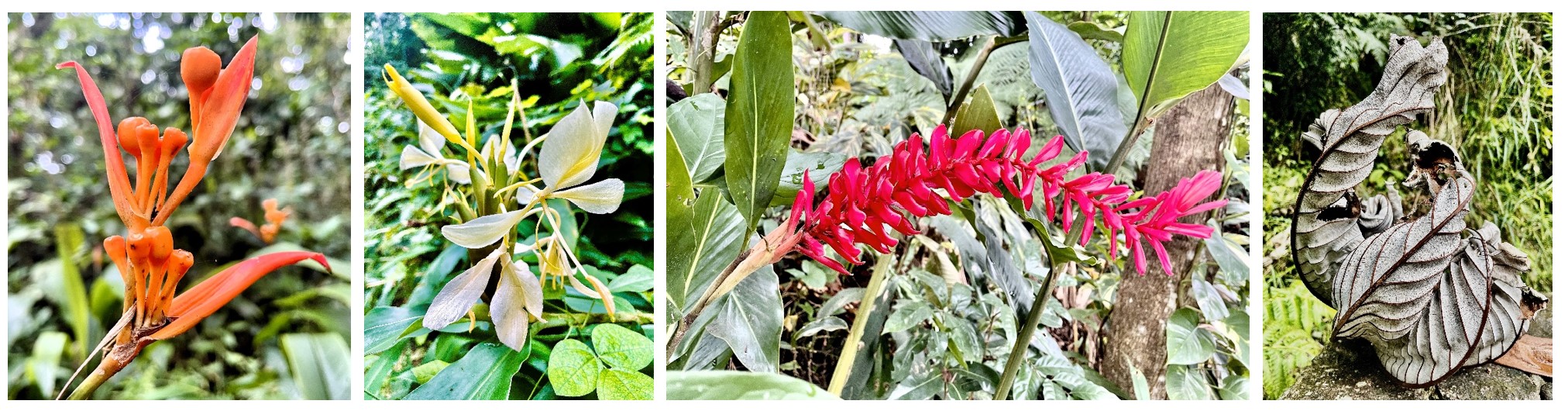
I visited El Yunque during my 2003 trip to Puerto Rico. I took a group tour from San Juan. I remember that it was raining rather hard and that most of the group, including myself, bought cheap plastic parkas in a shop before beginning our guided hike. Also, during our walk we came across a waterfall where a couple had shed their clothes and were, um, making the most of their not-so-private time in the pool by the falls.
This time it was C and I and we had our own wheels, which gave us more freedom. We stopped first at the visitor’s center, where we picked up the guide pamphlet, learned a bit about the park, and took a short trail walk. Though the trail started just steps away from the parking lot, we spent the whole trail pleasantly alone.
We then drove into the park. I hoped to stop at La Coca Waterfall, located just near the road, but the area was congested, with cars parked on the roadside for some distance. So, on we went. Our first stop would be the Baño de Oro. The Civilian Conservation Corps built the bathing area in the 1930s in pits previously excavated by Spanish gold seekers; it is now a National Historic Property. We could only walk up a short set of stone stairs to the pool and on a path halfway around; trails that headed further into the forest were closed for renovations. Many trails in El Yunque remain closed for repair after the 2017 hurricane.
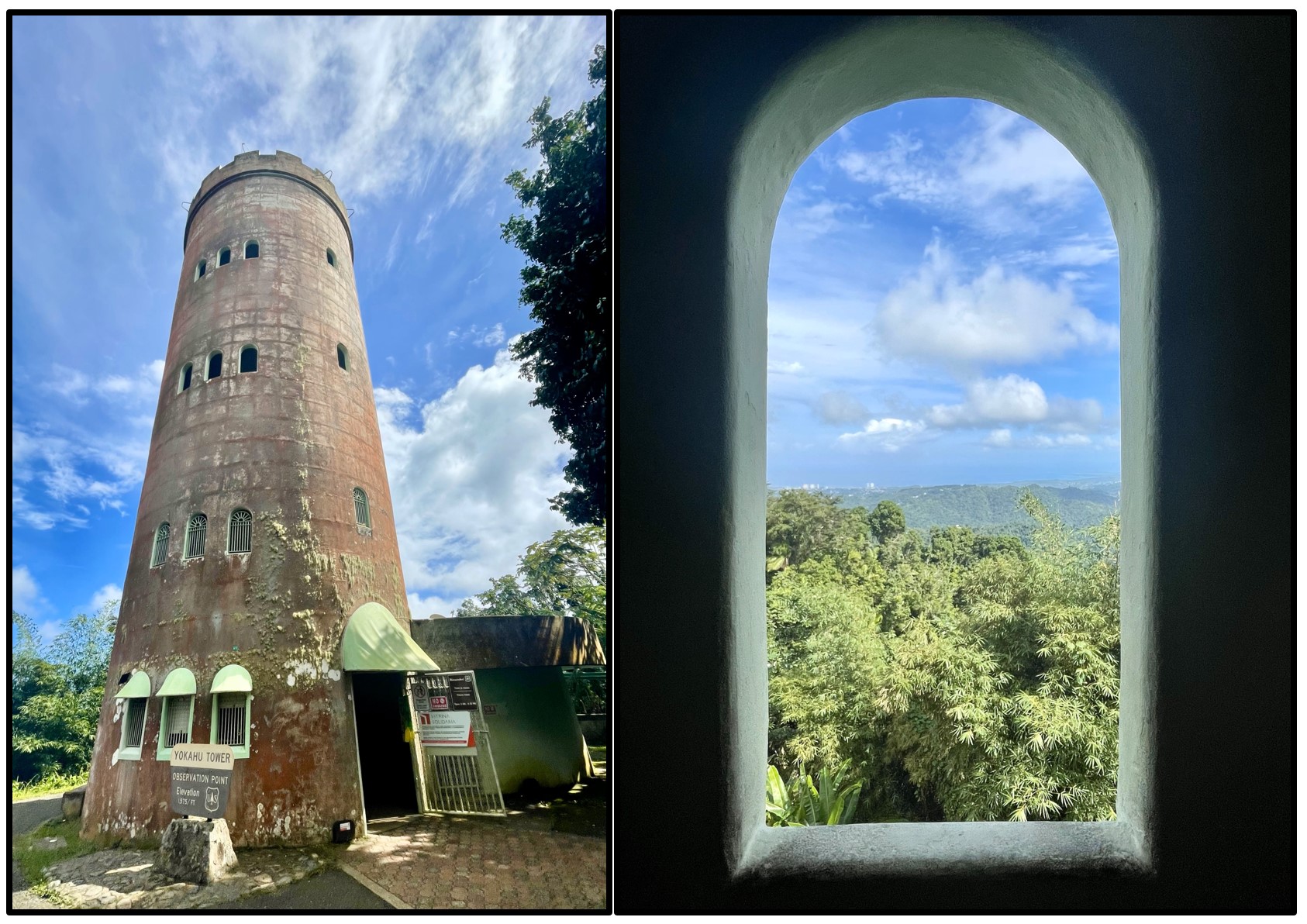
We made it back to the car before the rains began. This on-again-off-again rain would stay with us for the rest of our visit, but I was fine with it for the breaks of bright sunshine we still had a chance to enjoy. I drove us to the top of the accessible road, and then we turned around. We stopped at the Rainforest Cafe for lunch, stopped for a panoramic view, and climbed the Yokahu Tower.
I took the scenic route back to San Juan and returned the rental car. C and I spent the rest of the afternoon relaxing and soaking in the last bit of the warmth of the tropics before returning to chilly Washington, D.C. It was a wonderful way to wrap up our visit to Puerto Rico and our winter vacation.



 The Wanderlust Diaries