My daughter C and I were up around 5 AM on our second full day in Tokyo. Early, yes, but still far better than I expected so early in a trip half way around the world. I made sure C had some breakfast goodies from a nearby convenience store and I took an early morning of walk over to Tokyo Tower. I returned in good time and we met CZ and Little CZ at the Roppongi metro station where we hopped on a train to the Sumida district.

We were heading there to take part in a lunch with sumo wrestlers at the Yokozuna Tonkatsu restaurant. The Sumida district is famous for sumo wrestling. Japan’s first sumo tournament was held here in 1768 and the stadium there continues to host three of the six Grand Sumo tournaments held each year. Many professional sumo wrestlers live and train in the area as well.
We had a little over an hour to kill before our lunch and wrestling show began at 11:00, so we walked up to the Kokugikan stadium, where the grand sumo tournaments take place. I was on the hunt for the sumo wrestler statues I had heard dotted the area. I wish I could say the walk was pleasant, but the temperature was quite warm and Sumida district exuded an almost-deserted feel on a Saturday morning, a sharp contrast from the hustle and bustle of Roppongi. The biggest bit of excitement was when I finally found the statues and when two young, but of course very large, sumo wrestlers came into a convenience store where we were buying drinks. Their presence caused a bit of a stir, not only with us but also the Japanese patrons, but they were not particularly friendly.
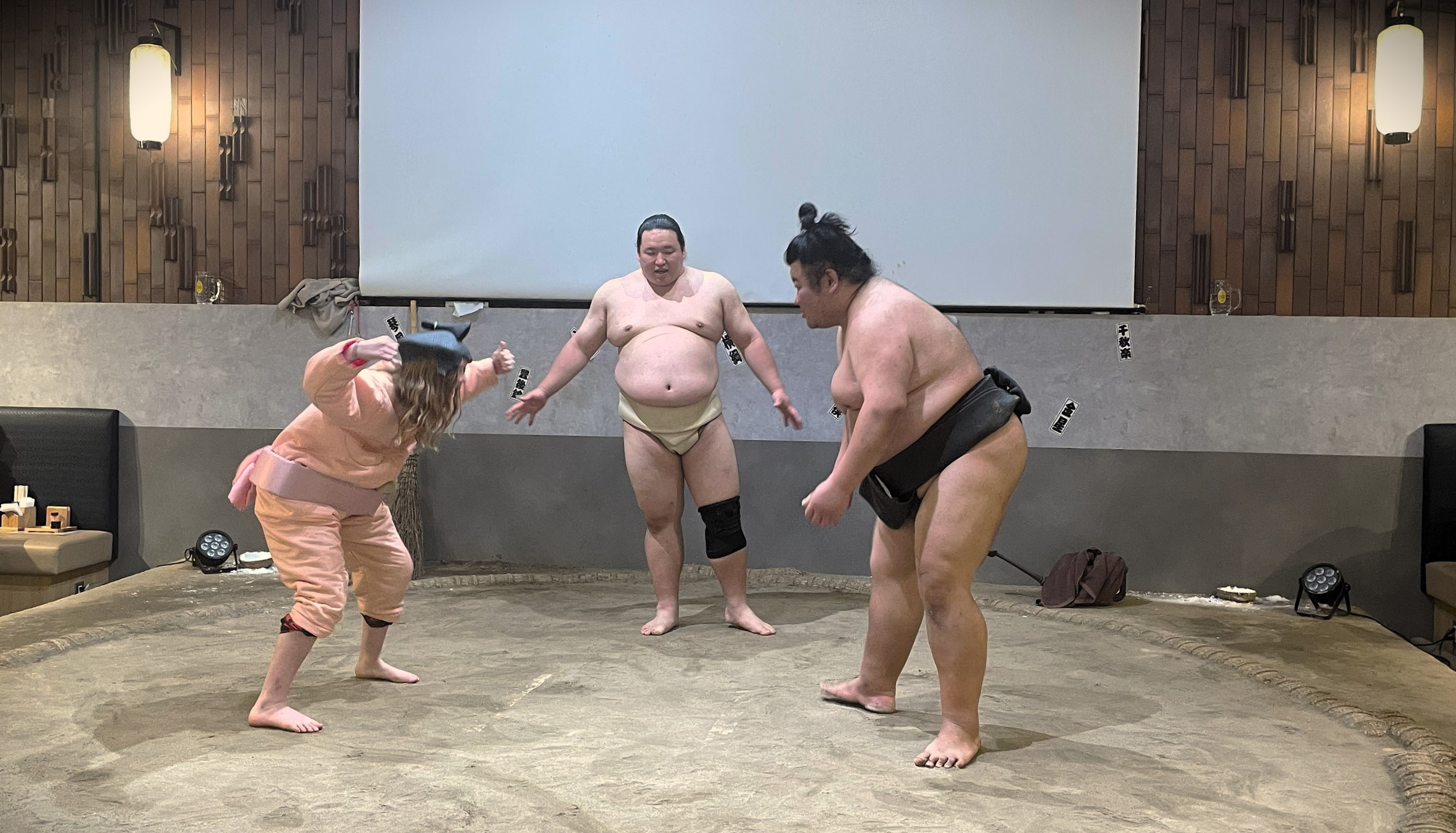
We arrived just in time for our sumo lunch. The food, a traditional tonkatsu or breaded fried pork cutlet, rice, and miso soup, was not particularly to our liking, but the fact that it is often served to sumo wrestlers and at this restaurant the meal is cooked by retired sumo wrestlers made it more special. However, it was the after lunch entertainment we were here for. During lunch, the restaurant showed a short film on sumo and then brought out two of their retired professional wrestlers to explain the key rules and procedures of the sport and give live demonstrations. Then, we the lunch-goers, had the opportunity to don hilarious suits and step into the ring. My hand shot up first, much to the amusement of my daughter and Little CZ. Following my triumphant (and silly) attempt, they also agreed to get into the ring. All in all, it was great fun.

We stopped next at the museum dedicated to Sumida Hokusai, the Edo-era ukiyo-e or woodblock print artist whose work “The Great Wave off Kanagawa” is one of the most recognizable paintings in the world. Hokusai was born in and lived the majority of his 90 years in the district that now takes his name. We spent about an hour here. Though both C and Little CZ were familiar with the famous Great Wave painting and found some interest in the comic-like woodblock prints of Hokusai and a few of the interactive displays, the museum involved far more reading and staring in wonder at art works than a 10 and 12 year old were prepared to give, especially with so much more to see in do in Tokyo awaiting them. Truth be told, the museum exhibits use up only two floors of the building and CZ and I were also ready to move on to more sightseeing.
The original plan had been for C and I to return to our hotel after the museum; I had been quite sure that by that time we would either be succumbing to jet lag or dangerously close to doing so. Yet again, surprisingly, we were not. With the Sunday weather forecast including rain, we decided to join CZ and Little CZ on a jaunt to preview some of Harajuku’s culture ahead of our planned visit the next day.

We made a beeline to the most famous part of Harajuku, Takeshita Street, where we would find many of the wild, wonderful, and wacky parts of Japanese youth culture. C desperately wanted to check out the fashion stores and quickly disappeared into one, but we dragged her out soon enough to have some snacks. First up were some of Harajuku’s famous crepes that have been filling up customers on Takeshita Street since the 1970s. Unlike French crepes, the Japanese crepes are thinner, crispier, stuffed full of goodies like fresh fruit, whipped cream, syrup, and ice cream, and wrapped up like cones so they can be eaten on the go. Oh my were they good. We followed up the sweet with the savory, chowing down on some breaded rainbow cheese, which was just okay.

We then spent a good hour in one of the ubiquitous toy capsule stores spending coins like there was no tomorrow. CZ and I found it nearly as addictive as the kids! Then we meandered over to Meiji Jingu, one of the most important Shinto shrines in Tokyo. It is an oasis of green forest in the middle of the world’s most populous city; there are over 100,000 trees of some 230 varieties planted over 170 acres. I wanted some space, tranquility, and more muted colors after the crowded, color explosion of Harajuku. We spent maybe 20 minutes there, but after so many hours of walking, we opted to call it a day. I thought we might get back to Meiji again the following day, but alas, we did not.
It was rainy on Sunday morning. I had forgotten that June was Japan’s wettest month and in all the travel planning had failed to check this key bit of information. Having already covered some of Harajuku the day before though, we had the flexibility for a later start. Off we all went to Shibuya on the bus. We were already getting a good handle on Tokyo’s massive public transportation network and felt, rightly I think, pretty proud of it.

We first stopped at the famous statue of Hachiko, a real dog who waited faithfully each day outside of Shibuya Station even many years after his owner died. It is a beautiful story of loyalty and unconditional love that has made Hachiko one of the most famous dogs in the world, nearly 90 years after he passed away. We then made our way across to the Shibuya Scramble, the famous spot where seven roads converge and traffic lights signal for all pedestrians to cross at the same time. Though there are several vantage points to watch the crossing, we chose the Starbucks. The price of admission to the viewing windows was a green tea latte for myself and a cookie for C.

We leisurely made our way on foot back to Harajuku by way of another lost hour in a toy capsule store and a lovely ramen and tea lunch at a small mom and pop shop. Once again on Takeshita Street, we had a little time for window shopping and people gawking, before arriving at Harry’s Harajuku Terrace for our 2 PM appointment with the hedgehogs, chinchillas, and otters of this animal cafe.
There are many, many, MANY animal cafes to choose from in Tokyo. Initially, C had really wanted to visit a dog cafe with Shiba Inus, but we realized that was far too vanilla a choice from the options available. Should we see owls? Snakes? Fennec Foxes? As we were planning, I sent CZ a message of this particular cafe in Harajuku and within minutes of sending it she called. She didn’t even say hello, only “OTTERS!” And thus our decision was made. Though the hedgehogs were very cute, C and I had had our fair of experience with wild hedgehogs in Malawi, so they were not all that new for us. The chinchillas were adorable, but Harry’s limited the interaction with them. The otters were indeed the stars of the day. In our special interaction period with them (for an extra fee) they could not have given a fig about us; they just wanted their treats and we were merely in the way. But it was still a great experience.

After Harry’s, CZ and Little CZ broke off for their own fun while I took my daughter C to the Purikura booths. “Purikura” is short for purinto kurabu (or “print club”), which are very popular photo booths where one can make all sorts of stylized photos. This is *not* the US version of the four poses, four printed photos booths. This is so, SO much more. Purikura had been a big activity when I lived in Japan in the late 1990s. Then though, you or you and a friend or a group of friends would have your photo printed on a variety of backgrounds to make mini stickers to share. Now, I found the photos and editing options are incredibly advanced. We struggled to figure out the process with the Japanese instructions, but C still had a fun time with it.

Then we were off to meet my friend Koki, who had been my big’s big in my college’s co-ed service fraternity. Since college, Koki and I had met only one other time, around 1998, when I spent two weeks in Tokyo attempting to learn Japanese. Yet, I recognized him immediately. The three of us had dinner at Niku no Mori, a very small traditional counter service restaurant specializing in the very popular Japanese hamburger steak. It is more like an American meatloaf, usually cooked with onion, egg, and panko crumbs, and served over rice. Niku no Mori offered it also with a grilled miso coated slab of cream cheese.
I really enjoyed catching up with Koki over dinner and then he walked with us along Takeshita Street while C did a little Japan-style thrifting. We said goodnight to Koki at the train station and C and I returned to the hotel.
Day 3 in the books and still no real jet lag to speak of…
 The Wanderlust Diaries