Balkans Bound, Part Four: Kotor & Surroundings

This is the fourth installment of my daughter’s and my trip to Kosovo, Albania, and Montenegro in August 2026.

Our Lady of the Rocks

On the sixth day of our trip and our third day in Montenegro, we took the car and drove about 30 minutes north along the Kotor Bay road to the small town of Perast. Although Perast was also Venetian, it was not enclosed by city walls like Kotor, Budva, or Sveti Stefan; instead, it was protected by nine defensive towers and a fortress. Also, unlike the other towns, Perast has not outgrown its historic location; it has no modern buildings and no roads through it. There are only the traditional stone houses and baroque palaces. And in its bay, the Church of Our Lady of the Rocks.

Since I’d read that parking in Perast fills up quickly during the peak summer season, I wanted us to get there early. Although we’d beaten jet lag from day one, we’d fallen into a routine of waking up around 8 AM and leisurely getting ready for a 9 AM start. As we approached Perast, we could see that several small lots were already full, and cars were parking alongside the roadway and walking further. But the Gods of Parking must have been shining down on me as we pulled into the lot closest to the town, the man at the entrance made eye contact with me and offered me his space IF I also purchased a ticket from him for the boat out to Our Lady of the Rocks. Done!

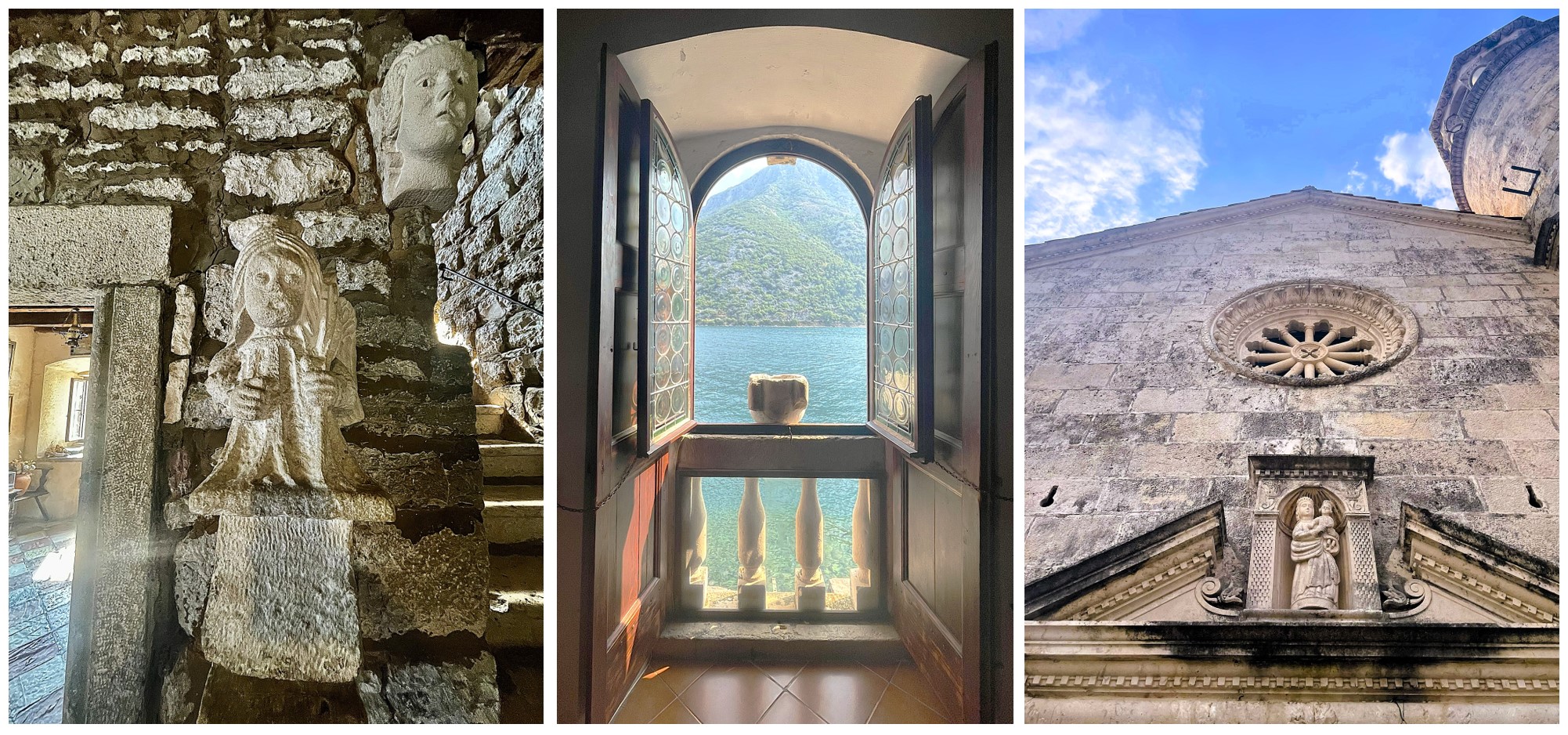
Some photos from our visit to Our Lady of the Rocks, Perast, Montenegro

The 17th-century church Our Lady of the Rocks stands on an artificial island that townspeople began creating around 1452 by dropping rocks and sinking old ships. A young man with impeccable English (so much so that I asked if he was North American) ferried us over to the island, giving us half an hour to explore before returning to pick us up.

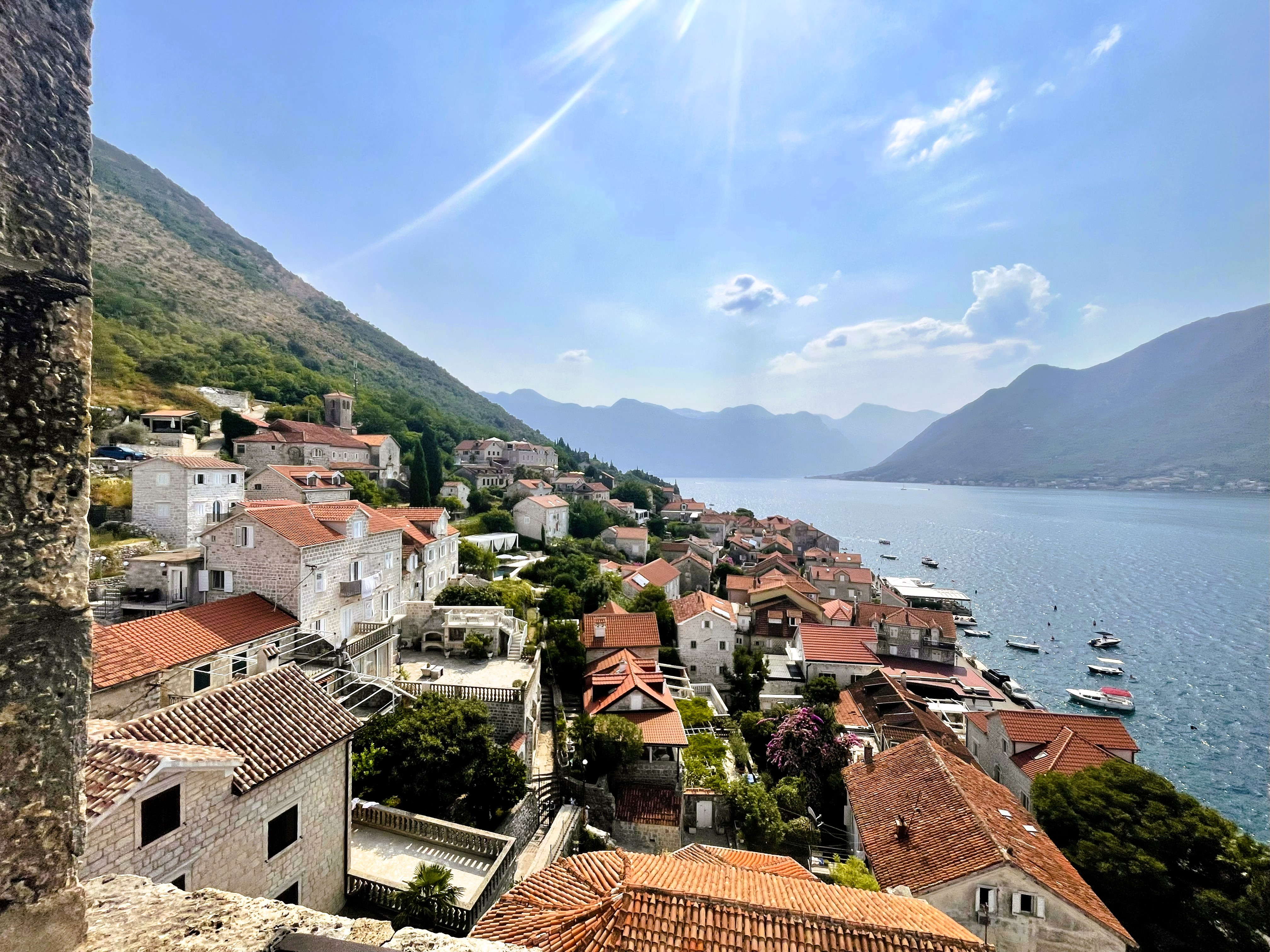
A view of Perast from the top of the church bell tower

We made the most of our time, making sure to circle the church to take in all its exterior details, and also joining a tour that led us through its beautiful interior. The island is small and doesn’t take much time to explore, but it was crowded, and the number of people allowed inside the church at any one time was limited. Had we been alone on the island, 30 minutes would probably have been fine, but on our visit, I felt a little rushed. But, it would have to do.

Back in Perast, we did a bit of sightseeing and climbed the very narrow stone steps to the top of the bell tower at the Church of St. Nicholas. I later learned that children under 15 aren’t supposed to climb, but no one asked about C’s age, nor did they say a word to us. I guess our one-euro payment was enough to overlook that little detail. We finished our walking tour with a bit of gelato, because why not have some for brunch when on vacation in Europe?

Our next stop was the Mausoleum of Njegoš. It was only about an hour’s drive from Kotor, but much of the route wound along a serpentine road climbing up Mt. Lovćen. I’ve done plenty of driving in all sorts of places, so I was mostly fine with the road, but it demanded a lot of concentration and patience with so many others making the same journey. We broke up the journey with lunch at a restaurant high up on the mountainside with a tremendous view of the Bay of Kotor.

Left: Screenshot just before we entered the serpentine road on Mt. Lovćen; Right: A view of the Bay of Kotor from along the road up Mt. Lovćen

After lunch, we continued our climb, navigating a few more dramatic twists and turns before the road finally leveled out near the top. We entered Lovćen National Park and followed the winding route on to the Mausoleum of Njegoš, perched atop Jezerski Peak — the second-highest of Mount Lovćen’s two summits — at 5,436 feet above sea level. The mausoleum honors Petar II Petrović-Njegoš, a 19th-century ruler and poet, who chose this peak for his resting place because of its sweeping views over the land he cherished.

We parked in the parking lot and took the 461 steps, most of which are located in a tunnel that goes through the mountain itself, up to the mausoleum. I was not prepared for what greeted us at the top—the solemn light granite structure with an entrance flanked by statues of two women in traditional Montenegrin dress and the breathtaking 360-degree views over Lovćen National Park. I can understand choosing such a spot as one’s final resting place. I felt contemplative and even blessed to be able to visit. I had almost given this place a pass.

The Mausoleum of Njegoš

Unfortunately, the quickest way back to Kotor was the same serpentine road we had taken up. The drive down felt both less stressful — because we knew what to expect — and more stressful, thanks to heavier traffic. Several times we had to pull as close as possible to one edge or the other to let another vehicle pass. At one point, we were caught in a logjam when several full-sized buses tried to navigate an especially narrow stretch. Thankfully, a few people got out of their cars to direct traffic — some drivers were asked to back up, others (including me) to inch along the cliffside — until there was finally enough room for the buses to squeeze through. Once back in Kotor, I breathed a sigh of relief. With plenty of excitement for the day, we picked up some groceries, made a meal of sandwiches and chips on our balcony, and had a quiet evening.
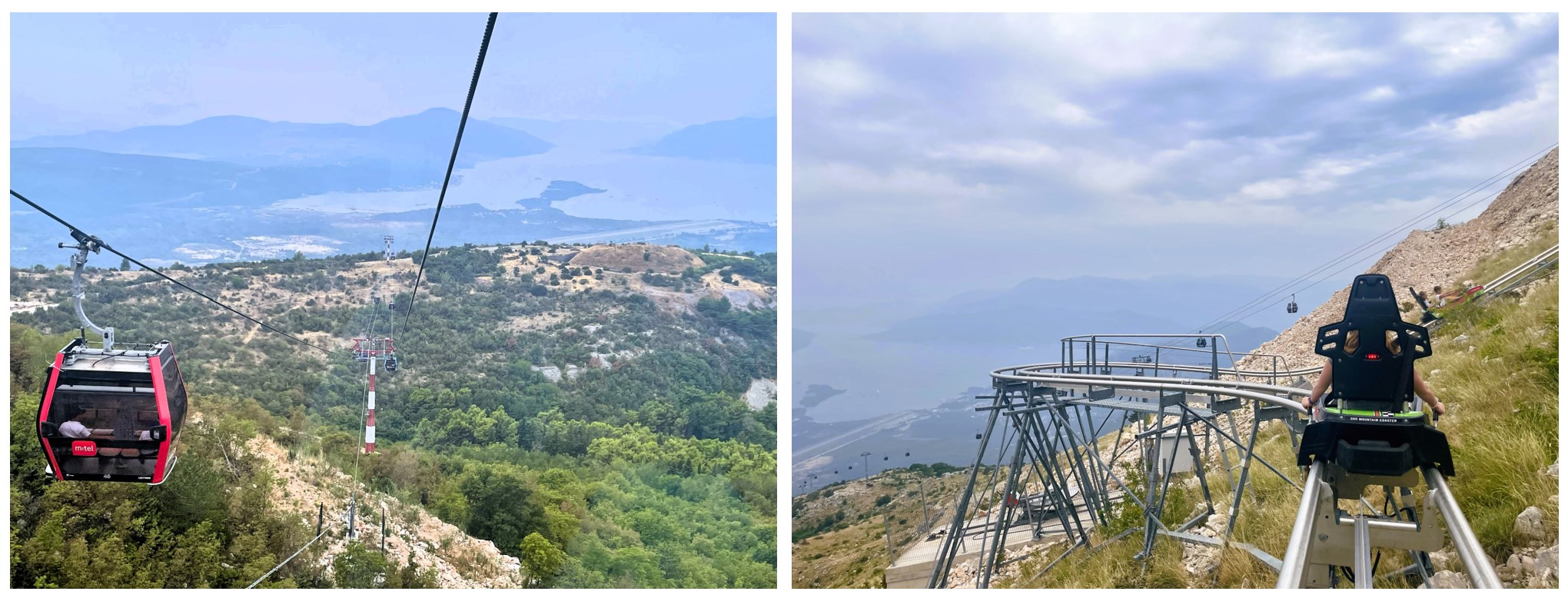
On our final day in the Kotor area, we started with a ride on the cable car, which climbs another part of Mount Lovćen. From the lower station, it travels 3,900 meters (about 12,795 feet) in just 11 minutes to reach the upper station, perched 1,316 meters (4,218 feet) above sea level. Along the way, the views are breathtaking — stretching across the mountains, over the Bay of Kotor toward the side near the airport, and almost all the way to the Adriatic Sea.

Left: Our view from the Kotor Cable Car as we near the top; Right: C just ahead of me on the Kotor Alpine Coaster with a dramatic view of the cable car and beyond

The cable car ride itself was pleasant enough, and the views were well worth it, even as the first clouds of our trip began to roll in. At the upper station, however, a new attraction awaited: the alpine coaster — a self-controlled mountain ride where riders regulate their own speed with a brake lever. C and I have ridden similar coasters in Jamaica (at Ocho Rios) and the Great Wall of China, both of which offered thrills. But the coaster in Kotor takes it up a notch, perched dramatically on the edge of a mountain. Though two people can ride together, C opted for her own car. As the car sped down the first hill and headed toward the edge, I really wondered what I was thinking! But we both loved it so much, we rode it two more times!

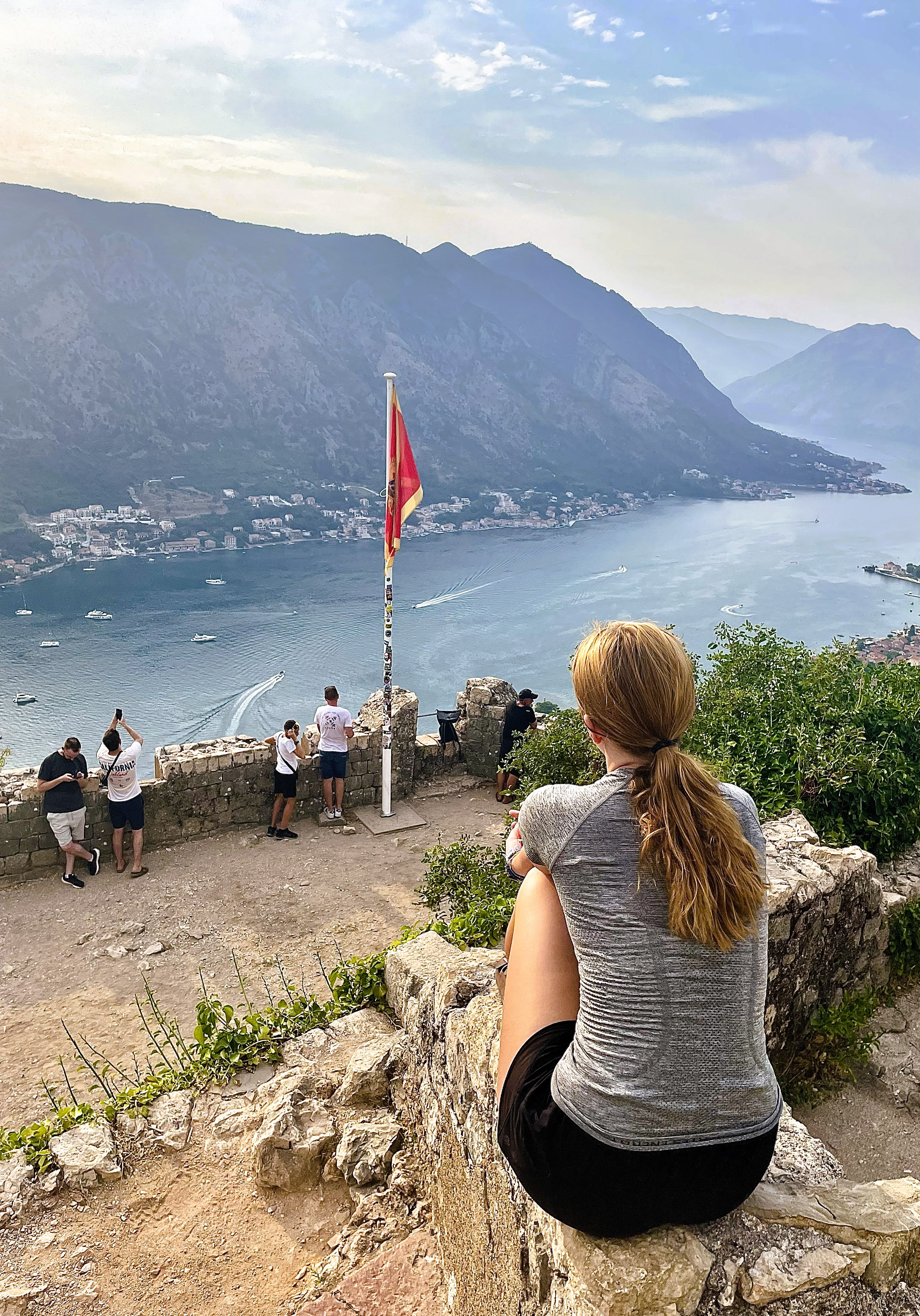
C surveys Kotor from St. John’s Fortress

Back in Kotor, we had one more thing to do: climb to the 6th-century St. John’s Fortress, which sits like a sentinel above the old Venetian city. Starting from the back of the old town, we paid the 8 Euro entrance fee and then followed a steep path along the fortifications that clung to the near-vertical slope of St. John’s Hill. It was not easy going; it was hot, we were a bit tired, and the steps were uneven or non-existent. As we climbed, C frequently asked if we could just stop or if I would leave her somewhere to wait, but then she would reluctantly press on. There were times when I, too, thought, maybe this point is good enough? But I really wanted to reach the top. The views along the way—and especially from the top at St. John’s Fortress—were amazing, and once at the fortress, C conceded that maybe it had been worth it.

Accomplished, we made our way back down, rewarding ourselves with some gelato in town before we headed back to the guest room. We needed to prepare for the next part of our journey.

Balkans Bound, Part Three: Arrival in Kotor

This is the third installment of my daughter’s and my trip to Kosovo, Albania, and Montenegro in August 2026.

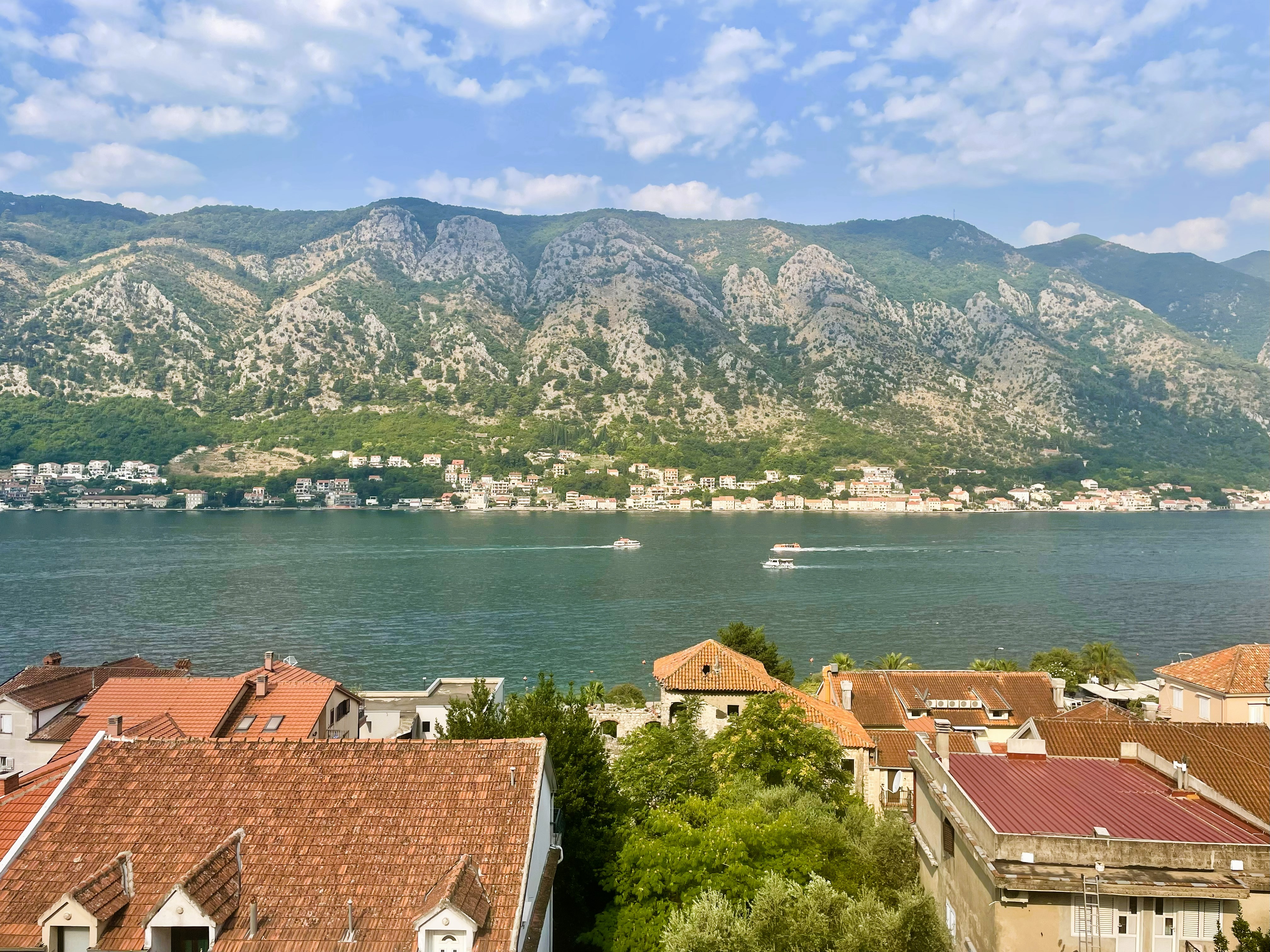
The view from our guest room in Kotor, Montenegro

The morning my daughter and I were departing Shkoder, Albania, for Kotor, Montenegro, I checked the route in my maps app and discovered the most direct route across the border was closed due to wildfires. The heat wave we had been experiencing had contributed to wildfires across southern Europe, including Montenegro. We would have to take another, longer route to get to Kotor. Instead of along the coast, the route that generated my whole plan to include our side trip to Albania, we would drive along the southern edge of Lake Shkodra and cross into Montenegro southwest of its capital. I opted not to drive through the capital and instead skirted the western edge of the lake, then take the only road that crossed the lake.

The drive to the border was uneventful, but once there, we faced a very long line of cars seeking to cross. Perhaps the traffic was due to this being the most popular crossing, or maybe it was caused by the other border being blocked by the fires; either way, it was tedious. At last, it was our turn, and I handed over our passports to the Montenegrin immigration official. He demanded to see the rental car papers, and I passed him the rental agreement. He stared at me, annoyed, and asked for additional car papers. I said I had not had to provide anything additional in Albania, and he gave me one of my most memorable quotes of the trip: “I don’t know about Albania, but in Montenegro, we have rules.” I explained that that was all I had, so he told me “Then, you will not be able to cross,” and asked me to pull over to the side.

Left: Screenshot of Google Maps route the day after we crossed; on the day of our drive that route was blocked by another fire at that border crossing; Right: Wildfires visible around Bar as we drive to the coast

There, I sat thinking for a minute, then I opened the glovebox, and found the car registration. I thought back to the eager car rental guy back in Kosovo, who had quickly shown me all of the car’s scratches, but when I has asked about crossing borders had said it would be “no problem” and failed to mention the all-important car registration. Sigh. I realized that the immigration official likely needed this, so I grabbed our passports, the registration card, and told C to wait in the car, and walked back to the official. He shook his head at my apparent stupidity and stamped us into the country.

View of the famed Sveti Stefan from the coastal road

We were now even further behind my hoped-for schedule. Things only got worse as we drove along narrow roads and encountered random traffic. I had hoped the drive across Lake Shkodra would allow for a quick photographic stop at Fort Lesendro, a fortress located on an island on the lake, which the road crossed, but there was no place to pull off. It passed in a blur. We drove over the mountains to meet the coastal road, and as we neared the coast caught sight of smoke plumes from wildfires on the hills around the popular town of Bar. Though this was a very time-consuming detour, I felt glad I had not chanced our original route.

We stopped briefly along the coastal road to photograph Sveti Stefan, a 15th-century Venetian fortified town located on a small island connected to the mainland by a narrow isthmus. It is so beautiful that photographs of this location are used for many a screensaver. However, the island is private and used as a luxury resort. I had considered driving up to a small church further up the mountainside for its views of Sveti Stefan, but we were already so far behind that our one quick stop would have to do.

Sights from Budva’s walled town

Our lunch stop was Budva, a larger Venetian walled town just a little further up the coast. My plan had been to arrive around 11 AM, but instead, we arrived three hours later, tired and hungry. Parking was a bit of a nightmare; I had read it was difficult in the height of summer, and headed for a mall parking lot that online had said was usually available. The lot was full, so I had to wait until a car departed before I could pull in and park.

Sunset in Kotor Bay our first evening

There were quite a lot of people in the walled town. Some of the narrow walkways were wall-to-wall tourists. The tiny beach in front had almost no square of sand unoccupied. Yet, the first few restaurants we tried were closed. It was quite hot. Bothered by the crowds and the heat, we decided on smoothies from a little hole-in-the-wall shop. Fortified, we toured the Citadel and the narrow streets. Had it been less crowded, it might have been nice to see some of Budva outside the walls, or maybe not. There were just far too many people and we could not feign longer interest. We wanted to get to Kotor.

Though only an hour north, there was again heavy traffic through the center of Kotor. And, when we arrived at our room for the next four days, the manager was not on site, though I had messaged upon our departure from Budva. Finally, he arrived (he had been at the beach) and showed us to our lovely flat on the top floor of his multi-story condo. With our last bit of energy, we made a quick stop trip to a nearby supermarket so we could have dinner in peace and quiet, on our balcony while we watched the sun set over Kotor Bay.

Left: A coin from the Cats Museum; Right: One of the super cute cats of Kotor

The next day, C and I set out to explore the UNESCO-listed old town of Kotor. Our first stop had to be the Cats Museum. The only other place I have visited a cat museum was in Kuching, Malaysia. Kuching means “cat” in Malay, and Kotor’s historical name under the Venetians was Cattaro. Though that does not mean “cat,” it seems the people of Kotor, who have taken to protecting the numerous street cats of the town, rather enjoy the play on words.

C in front of the 10th century Roman Catholic St. Tryphon Cathedral in Kotor’s old town

Kotor’s Cats Museum is small, just two small rooms and a reception/gift shop. Yet it is chock full of cat stuff – propaganda with cats, studio photography of persons with their cats, postcards, newspaper articles, currency, and so on, all featuring cats. Proceeds from the museum’s entrance fee and the sale of its souvenirs support the care and feeding of Kotor’s street cats. C and I loved the museum and finding Kotor’s cats throughout the town.

We had lunch outside in one of the many small squares of the walled town. Then C and I did a bit of sightseeing and window shopping. C had actually done some online sleuthing and informed me that shopping is a big thing to do in Kotor’s old city, and it would be key for us to take part. By the early afternoon, though, we were again tired by the heat and the long day of road travel the day before, so we returned to our guest room to rest.

In the late afternoon, I was ready to return to the old town, but C bowed out. We had been rather “go-go-go” for the past few days, and it was just the right day for her to take a break. I relished the time to just see things at my own pace, to go slowly and take photos of whatever I wanted without a teenager telling me her legs hurt or she was bored or asking “How much longer are we going to be here?” I love that she is now at an age to enjoy more of the history, but can also be left in the hotel to do her own thing when I wish to do mine.

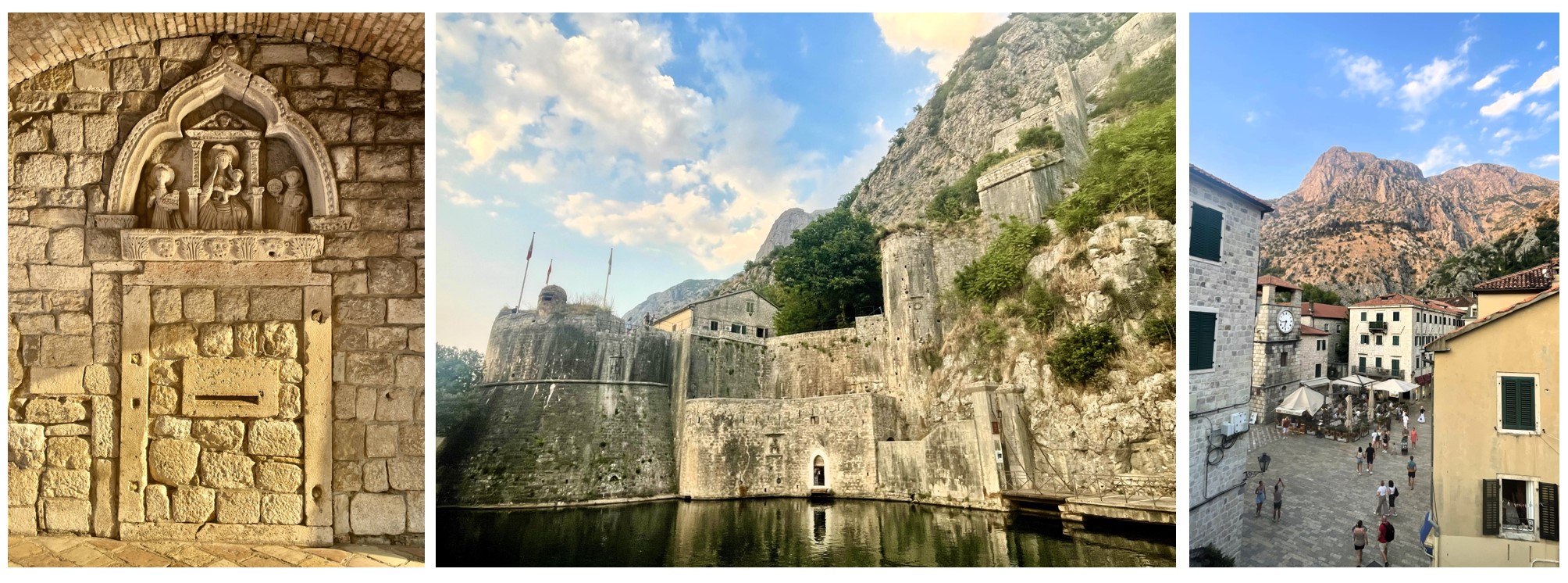
Left: The inside of the Sea Gate to the old town; Center: The Gurdic Bastion of the old town; Right: a view of part of the Square of the Arms and the Clock Tower from the top of the old town walls

I loved walled cities. I have visited many in my travels, from Avignon and Avila to San Juan, Xian, and Galle. Kotor is magnificent and I am grateful that I was able to spend a few hours exploring on my own. I could have certainly spent more time there. However, we had more to see and do in Montenegro.

Balkans Bound, Part Two: Northern Albania

This is the second installment of my daughter’s and my trip to Kosovo, Albania, and Montenegro in August 2026.

Along the road in northern Albania from Prizren, Kosovo

On the second day of our trip, C and I woke up in Prizren, Kosovo, ready to head out on the next part of our journey. When I was first planning our trip, I thought we would visit only Kosovo and Montenegro. Yet, as I looked at the map and the places I most wanted to visit, I realized it would make more sense for us to drive through northern Albania to get to coastal Montenegro from Kosovo. Otherwise, we would spend more time backtracking and driving over some of the same ground.

Back in 2000, I had planned a trip to Albania from Macedonia that had not gone quite right. Though I had then planned to visit Tirana and Durres, not northern Albania, and had instead ended up with a hilariously strange three hours in Sarande in the south, this still felt like righting a past travel wrong. C, always keen to add another country to her belt, was definitely up for it.

Sights along Shkodër’s main pedestrian thoroughfare in the city center

We first needed to fill up on gas before entering Albania and tackling the 2.5-hour drive. This led to a humorous stop at a petrol station just outside Prizren. With my non-existent Albanian and the attendant’s broken English, I managed to get the car filled up and the fuel paid for. Then we were on our way. The border with Albania is only a 20-minute drive from downtown Prizren, though I made it take longer due to finding an out-of-the-way petrol station and taking a wrong turn or two. I had no idea how long it might take at the border and was very surprised to find that it took no time at all. Neither the Kosovars nor Albanians paid our car any mind. Though I stopped at the window to hand over my passport, the three immigration agents were engaged in a conversation amongst themselves and waved me through without a glance. This was wildly different from the difficult time I had with Albanian immigration in 2000.

Our first hour in Albania went smoothly. The A1 Highway to the Kosovar border was wide and smooth. The views as we drove through the mountainous area were stunning. Then, I received a notification of a serious accident where the A1 met the road north, which would lead to delays of at least an hour. Having already departed Prizren later than expected and then losing time due to my fueling adventure, I was not eager to delay further. I turned off the A1, hoping the small roads would get me there. Oh, they did, but it still took a bloody long time.

One of the many striking photographs at the Marubi Museum that capture a snapshot of the ethnic, religious, cultural, costume, and trade history of the region; I especially loved this photo as my mom owned that exact style of Singer sewing machine

We rolled into Shkodër, Albania’s main northern city, around 1:30 in the afternoon. Unfortunately, it took about 30 more minutes to figure out the hotel parking. Google directions kept leading me down a very narrow back alley that turned into one way (the opposite direction) just before reaching the gated parking area. In the other direction, one had to drive a short way down a pedestrian-only road, then hope the bored parking attendant was in his little booth (he wasn’t at first) and then crawl behind him as he walked the 200 meters to the parking lot and unlocked it. Nerve-wracking!

We quickly checked in and headed out to a late lunch. After filling our bellies, we went for a bit of a sightseeing stroll. We felt like melting as we walked along the pedestrian street. It was 103 degrees out; a heat wave was sweeping southern Europe. We did not last long in the heat and decided to duck into the Marubi National Museum of Photography. It is a small but interesting display that marries the history of a family of Albanian photographers (the Marubbi), celebrates the art of photography, and displays a period of Albanian history captured in photographs.

We cut short our midday walk, defeated by the heat and the fatigue of having been in the car four hours that morning. When the temperature dropped a little at the golden hour of dusk, we stepped out again for another short stroll. Then we returned to our hotel, just across from the Ebe Beker Mosque, and rested up for the next day’s adventure.

On our second day in Albania, we woke up a little earlier so we could drive west, into the wonderfully-named Accursed Mountains to the picturesque hamlet of Theth. Having spent so many hours driving to Shkodër the day before, I was not overly thrilled to get back in the car again for another long drive. I had spent the night before researching other options, but nothing sounded anywhere near as appealing as Theth. So, Theth it was!

Along the road to Theth

I am so grateful that we elected to stick to our plan. The weather cooperated magnificently, and the drive delivered stunning vistas around nearly every turn. The road, though narrow and often capable of giving some drivers vertigo as it clung to mountainsides, was well-paved. I would, however, not want to make that journey in bad weather or at night. After two hours, we arrived in the hamlet at the heart of Theth National Park.

C in the Theth River, Albania

The small hamlet of Theth has a population of perhaps 300, though I cannot imagine many of them remaining in the isolated valley through the harsh winter when that winding road is impassable. Yet this stunning location draws some 5,000-10,000 tourists during the summer months.

We parked beside the very popular Pizzeria Jezerca, which fronted a small bathing beach and the Theth River. It seems that nearly all the visitors that day were at the Pizzeria. We had a great lunch and then went down to the river. Though the heat wave continued, the temperature was a few degrees cooler in Theth, maybe 95? But that river was ice cold! So cold it felt like pins prickling our skin. But oh, how beautiful the setting! And I even watched a striped snake swim nearby, slipping beneath the rocks.

The stunningly simple Kisha e Thetit or Church of Theth

After our dip, we wandered down into the hamlet to visit its most famous landmark: the simple yet striking 1892 church. While charming in its own right as a piece of architecture, what truly sets it apart is its setting — nestled in a grassy, fenced-in field and surrounded by the towering Albanian Alps. We circled the church slowly, alternating between quietly taking it in and snapping photos.

I’m mindful that my teenager might only tolerate so much quiet admiration of historic buildings, but C seemed just as captivated as I was. After a decent pause, we continued on to the 400-year-old Reconciliation Tower — a stout, two-story stone structure once used to mediate blood feuds. Those accused in local conflicts were locked inside for protection, giving the community time to cool down and resolve tensions before resorting to violence.

By this time, the heat was again getting to us as we meandered our way back to the car. We had debated about doing the recently added zipline, but ultimately decided it made sense to begin the drive back. Although we had not really experienced any jet lag, I did not want fatigue—whether from jet lag, long driving, or the heat—to become an issue on that mountainous road. And, there was more for us to see!

The Mesi Bridge

Just outside Shkodër stands the Mesi Bridge, a stone relic of the Ottoman era built in 1770. It was designed to span the Kir River — though when we visited, the riverbed was bone-dry; there was not a trickle in sight. Yet even without water beneath it, the bridge remained an impressive and beautiful monument to Ottoman engineering. The Mesi Bridge is the longest Ottoman bridge in Albania, and one of the best-preserved in the entire region

To wrap up our amazing day, we next headed to the ruins of Rozafa Castle. Located on a stony promontory outside Shkodër proper and overlooking the confluence of the Drin and Buna Rivers, the ruins of the largely Venetian stronghold (though also used by the Ottomans) are a popular place to take in the sunset.

We parked in a small lot in the front yard of an enterprising family who happened to live just across from the lower entrance. The man of the residence took time to criticize my parking, but it was in such an amusing way that I took it in stride. We then made our way up the steep stone driveway to the top entrance; I am so glad that we parked where we did, as the upper lot was small and most definitely full.

Left: C looks out from the Rozafa ruins; Right: Part of the Rozafa ruins at sunset

We easily spent an hour at the ruins. The area is quite extensive, and there were a surprising number of tour groups, yet except at a few very photogenic spots, it did not feel crowded.

I would have liked a little longer at Rozafa, but we had been on the go all day. It did not feel possible that we had done so much, seen so much in a day. Our stopover in Albania had been perfect, but it was time to head on to our next destination.

Balkans Bound, Part One: Planning, Arrival, and Prizren

The newest additions to my magnet collection

In August 2025, my 13-year-old daughter C and I embarked on an amazing two-week road trip through Kosovo, Albania, and Montenegro. Last fall, after our incredible trip to Japan, I began thinking about the next big summer trip. C asked if I would consider somewhere in the Balkans. With more than 40 countries under her belt and a love of geography, C wanted to both head back to Europe and also somewhere more off the beaten track. I had had several countries in the Balkans on my bucket list for a while, so it seemed perfect. I started to plan, and by early 2025, I had our flights, hotels, and itinerary all set.

Then the year started to go sideways. With everything going on in and around my life, I began to debate with myself whether a big summer vacation was still a good idea. I am incredibly grateful to my friends who talked me out of cancelling.

C at the airport before we started walking to our hotel

We flew into Pristina via Istanbul on an overnight flight. I again employed my long overnight flight strategy: go to bed early the night before so we’d start the trip rested, stay awake through the journey, and crash only after we arrived. It had worked surprisingly well for Tokyo — and, as luck would have it, it worked for this trip too. I slept for about an hour and C for two, and we touched down in Pristina wide awake and excited — 7 PM local time, 1 PM Washington, DC time.

I had reserved a hotel close to the airport. My brilliant plan was to stay at the hotel that evening, then return to the airport the next morning to pick up our rental car. On the map, the hotel looked close, only a 17-minute walk. We had walked from the airport to a hotel a few years before when we visited Lisbon, and I had walked from hotel to airport or vice versa in other places (I remember particularly in Bonaire and St. Kitts), so this seemed like a piece of cake. Unfortunately, the sidewalk stopped about 5 minutes out from the hotel, and we had roller bags that we then had to drag through a narrow strip of untended grass and weeds. While 10-year-old C had been game for the walk a few years ago, 13-year-old C was less than thrilled. But we both survived the ordeal, arriving at our hotel safe and sound and ready to finally get a good night’s sleep.

The 16th-century Old Stone Bridge in Prizren

The next morning, I walked back to the airport to collect our rental car only to discover that Budget does not have an office there — the Budget rental car office was right across the street from our hotel. Sigh. Just a lovely early morning stroll for me to and from the airport on a busy road. It seemed the guy sitting in the Budget office had been there for at least an hour just waiting for me, because as soon as I walked in, he spoke my name. Like something right out of a movie. He brought a little white Yaris around, showed me it had a few scratches and a long crack across the windshield, which he assured me was no problem. I signed the paperwork, and that was it. I hoped in, drove across the street to the hotel, where C and I checked out and loaded up the car. We were off. Our road trip had begun!

Beautiful wall mural in Prizren

We had only an hour drive to get to our first stop, Prizren. Kosovo’s second-largest city and its constitutionally mandated cultural capital, the area of modern-day Prizren has been inhabited since 2000 B.C. and has been a key city for the Dardanians, Romans, Serbians, and the Ottomans. As such, the small city is brimming in history.

After some trouble dealing with the difficult parking situation at our hotel located in the heart of the old city, a stone’s throw away from the Ottoman-era Old Stone Bridge that spans the Prizren river, we headed across the bridge for some sightseeing and lunch.

Following a lunch in Shadervan Square, we headed back across the river to the Archaeological Museum. The small museum is housed in a former 14th-century Turkish hammam. The museum was okay, but we were really there to climb up its watchtower so we could peek over into the neighboring plot at the church of Our Lady of Ljevis, one of the four Byzantine-Romanesque buildings that make up Kosovo’s UNESCO World Heritage-designated “Medieval Monuments in Kosovo.” I had read online that the Ljevis church was closed to the public for renovations and therefore the best way to see it was from the museum’s tower. Unfortunately, when I asked how to access the tower, the museum guide informed us it was closed for a special exhibit. So special, it seems, that guests to the museum could not access it, but only see the odd red light flashing from the top windows.

Our Lady of Ljevis

Once we exited the museum, I thought we would pop around the corner and look at the church from the gates. I managed a decent photo through the bars of the encircling fence. Then we walked around to the front to discover it was open to visitors, with a very knowledgeable guide on site. How lucky! Though the majority of the 14th-century frescos in the church, which were plastered over during the Ottoman period, have either yet to be uncovered or are perhaps too damaged to be so, restoration workers have been able to bring enough of them to light to demonstrate their significant artistic and cultural importance.

We headed back to Shadervan Square for ice cream, then, once fortified, we headed to Privren Fortress. Situated on a hill overlooking the city, the current fortress ruins date from the late Ottoman period. However, fortifications of some kind have sat in that location since the Roman era. There is no cable car or modern conveyance to get one up to the fortress, just a hard slog up the steep, uneven, paved pathway. Thankfully, it takes just 15 or 20 minutes to walk up from the Old Stone Bridge.

C at an entrance to Prizren Fortress overlooking the town

There is no entrance fee, no informational plaques, no guides. The location is amazing; from atop the walls, one has a commanding view of the town, river, and surrounding mountains. The fortress is a popular sunset spot for locals; however, we did not want to stay too long, and especially did not want to manage our way down the slippery stones in the waning light. Still, we enjoyed a good hour of the late afternoon light. We also did not know how much longer we might hold out against the likely jet lag.

My exquisite salad at the Sarajeva Steakhouse

We ended the day with an unforgettable dinner at a riverside restaurant, tucked beneath the 15th-century Sinan Pasha Mosque and looking out toward the graceful Old Stone Bridge. The evening was warm, touched by a gentle summer breeze, and we lingered over our meal as families and couples strolled across the bridge or paused in front of the mosque, bathed in golden-hour light. When the last rays of sun finally slipped away, we took one more slow walk along the river on the far side of the bridge. It was the perfect finish to our first day — so full and joyful that it already felt as though we’d been on holiday for days. We easily fell asleep so we would be well-rested for the next part of our adventure.

In and Around DC: Activities Summer 2025

Double rainbow over Nationals Stadium in June

I’ve always loved summer — the warm weather, the long days, the feeling of freedom. While my own long breaks are behind me, having a daughter in secondary school still brings a welcome shift in pace each year. This summer feels especially meaningful, as I’ll be bidding for my next assignment soon, and it could be our last full one in the U.S. for some time, so I was determined to make the most of it.

C sparkles on the ice during her June Ice Show performance

We kicked off the summer with an unexpected event: an ice show. Last year, my daughter began figure skating lessons and quickly advanced through the Learn to Skate levels. By spring, she had progressed enough to participate in the seasonal performance — a proud milestone for both of us.

Much of her early childhood was spent overseas, in places where extracurricular opportunities were limited. Even during our year back in the U.S. for my French training, pandemic-related restrictions curtailed many activities. So, this felt like the first time she could truly take advantage of the wealth of options available in Northern Virginia — a region teeming with opportunities beyond the usual suspects like soccer, ballet, and Scouts. Here, she could explore Irish dancing, field hockey, archery, fencing, or, of course, ice skating.

Though I grew up in this area, I never knew anyone who skated. So when C chose an ice skating party for her birthday in January 2024, I was stunned to learn that eight of the twelve kids she invited had at least a year of skating experience. It struck me how much had changed — and how fortunate she was to grow up in a place where these experiences were within reach.

Watching her glide across the ice during the two-day show, I couldn’t help but feel overwhelmed with pride.

My sister greets guests to the Great Gatsby’s big party at Dodona Manor

We followed up my daughter’s performance by attending another of my sister’s. Over the past two and a half years, we have had the opportunity to see her in several stage productions. Last fall, she participated in an interactive performative experience of Dracula at the historic Dodona Manor in Leesburg. This year, she played Catherine in a Great Gatsby experience, also at the manor. It was fun to wander the grounds, watching short scenes and interacting with the characters.

To satisfy our sports-watching appetites, we were invited to a Washington Spirit game by my daughter’s friend and family. Although the Spirit lost, it was an exciting match that kept us on our toes. Then we caught not one, not two, but three Washington Nationals games through the summer – one each in June, July, and August. We had our first-ever rain-postponed game in June, which delivered an amazing double rainbow over the stadium. We brought friends to the July game that ended in a spectacular win for the Nationals and evening fireworks. The Grateful Dead-themed August game ended in another loss, but we left with fun souvenir shirts. Win or lose, my daughter and I enjoy an evening at Nationals Park.

C readies for her first 5K

In mid-June, I invited my friend JK1 (who I served with in Ciudad Juarez and visited in Thailand and Zimbabwe) to see British comedian Sarah Millican at DAR Constitution Hall. We had enjoyed a holiday lights display with JK1 and her family the previous fall at Meadowlark Botanical Gardens, but their time in DC had grown short as JK1 wrapped up her language training and they moved to Laos. I had discovered the award-winning raunchy and hilariously funny Millican about two years before; as soon as I learned she would be touring in the U.S., I bought two tickets. A great deal had happened between my purchase of the tickets in early fall 2024 and the show in June 2025; with the administration’s military parade in the capital the day after, concerns arose that the show could not go on as planned. Thankfully, Millican’s team was in touch with the powers that be and her performance was given the go ahead. JK1 and I had dinner downtown beforehand, and then laughed and laughed through the show. How I had needed that!

On July 4th, C and I ran together in a local 5K. It was C’s first and my first in a long, long time. Back when I started this blog (11 years ago now!), I used to run regularly, but I had stopped when we moved to Malawi in 2017. C had asked me recently to show her my race tees and medals and asked that we run a race together. I suggested a fall run, but she wanted something much sooner. Against my better judgment, I signed us up for one only a few weeks ago. Unsurprisingly, we were slow. But we did far better than expected, and we had a good time.

C then headed off for two weeks of camp in Pennsylvania while I held down the fort with Ramen the Cat. The day after C returned, we headed to the Kenilworth Aquatic Gardens to attend the annual Lotus and Water Lily Festival. The park, located in the northeastern corner of Washington, D.C., was originally planted with water lilies from Maine by a Civil War veteran in the 1880s. He and then his daughter commercialized the venture when the lilies thrived in the marshy environment. In 1938, the government of Washington, D.C. bought the land to establish a park, and in 1976, the National Park Service took over its administration and started the yearly festival.

A snapshot of the beauty of the lilies and water lotus at Kenilworth Aquatic Gardens

The festival takes place each July during peak bloom. The weather was hot and humid, and the park crowded with flower enthusiasts. There are many activities available over the course of the three days from painting classes and yoga, but C and I stuck to what the majority of visitors appeared to be doing: soaking in the atmosphere and taking photographs. We spent nearly two hours there.

At the end of July, C and I made our way to the National Theater to see the Broadway production of Harry Potter and the Cursed Child. I’ve been enchanted by the Harry Potter universe since 2000, when a fellow traveler at a youth hostel in Vienna, Austria, passed along her copy of the first book before she flew home.

When we arrived to take our seats in the balcony, we were surprised with an upgrade — something that had never happened to me before in any theater. Our new spots were in the left orchestra section, barely 30 feet from center stage. Part theatrical drama, part sleight-of-hand spectacle, the performance was nothing short of mesmerizing, leaving us and the entire audience spellbound.

Before heading out on our summer vacation, C and I got in a bit of volunteer work at a local farm. Nearly two years ago, my daughter joined an all-girls Scouting America (formerly the Boy Scouts) troop. This past summer she worked on the Eagle-required Citizenship in Community merit badge. As part of the badge, she needed to volunteer at least eight hours with a charitable organization that supports the community. C chose to volunteer with the Arlington Food Assistance Center. For six of her eight hours, we went to JK Community Farm in Purcellville, Virginia on two Saturdays to pick fresh vegetables. I figured if C were going to do it, I should too.

Just some of the bounty we picked at JK Community Farm

It was hard work! We pulled and cut weeds, and harvested eggplant, cucumbers, yellow melons, tomatoes, and a variety of peppers — including bell, banana, and jalapeño. On the first Saturday, the temperature soared into the upper 80s under a relentless, beating sun. I sweated profusely, and my back ached for most of the following week — to the point where I wasn’t sure I could make it through a second Saturday. Nevertheless, we were there, and my sister and her two kids joined us. However, it was a great experience for us all, to see the kind of work that goes into growing and harvesting our food, and the importance of generosity and assistance to those in one’s community who need a helping hand.

It was another magnificent summer in Northern Virginia. It was not quite over as we had two weeks holiday overseas yet to come, but I think we once again made the most of our time posted to Washington, D.C.

In and Around DC: Activities Spring 2025

Plentiful in a northern Virginia spring, the Dogwood is both the state tree and flower of Virginia. Once my favorite flower, until I traveled and discovered the frangipani.

Another Spring in Washington, D.C. It is now our third consecutive year, and thus the longest I have lived continuously in the U.S. since August 2003 to January 2007. Although during that time I lived in four separate locations around the country (California, Hawaii, Maryland, and Washington, D.C.). I am not accustomed to staying in one place. I will be honest, I am developing some rather itchy feet.

I have to keep reminding myself that any travel, even local, is travel, and my daughter C and I can have adventures anywhere. These past several months have been hard, both personally and professionally, but I have tried to keep in mind that such times make it all the more important to find joy wherever you can.

We kicked off Spring with an early-season game of the Washington Nationals. The longer we stay in Washington, the bigger the baseball fans we become, and the more we associate the arrival of warmer weather with an afternoon or evening at the ballpark.

Checking out a Washington Spirit game at Audi Field

Continuing our streak of attending professional sports events, we went to our first Washington Spirit match in May. The same college friend who took us to a Capitals game last fall is also a Spirit season ticket holder. He and his wife couldn’t make one of the matches and were kind enough to offer their tickets to C and me. We were able to enjoy premium seating with free food and drinks throughout the match and seats close to the goal line. It was an exciting game, though the Spirit lost. The whole atmosphere of a Spirit match is infectious; we will definitely make attending more Spirit games a priority!

Not only did my sister perform in the show—she also designed this advertisement.

Also in May, we drove out to Purcellville to watch my sister perform in another local theater production. Being back in the U.S. has had many benefits, and getting to see her pursue this new passion has been a true highlight. This time, she played Miss Scarlett in Clue—one of my all-time favorite movies and my daughter’s favorite board game. I have a fear of public speaking, and my single attempt to try out for an improv group in college was a resounding failure, so it never ceases to amaze me that my sister does this so well.

In May, we also visited the Washington Monument. I grew up just outside of Washington, D.C., and have lived in the area several times as an adult, but I had never been inside the iconic memorial in our nation’s capital. In my defense, it has been closed to the public several times: about six months after 9/11, for over two years after the July 2011 earthquake, about three years between 2016-2019 for security upgrades and repairs, and at least six months during the COVID pandemic. With it currently open, I was determined that C and I would see it while we are living here. However, ever time I tried to secure the free tickets, they were snapped up as soon as they were released online. Unwilling to wait any longer, I booked through Viator. $25 each seemed a small price to pay to finally check this off my list.

Left: Bronze plaque found in the Washington Monument vestibule featuring George Washington and freemasonry symbols; Right: A view of the Tidal Basin from the Monument’s observation deck

In 1833, a society began collecting funds to build a monument to the country’s first president, George Washington. This would be the nation’s second monument to President Washington; last year I visited the first monument in Boonsboro, Maryland, built in 1827. Construction on the Washington Monument began in 1848; when it was completed in 1884, it was the tallest building in the world at 555 feet, 5-1/8 inches.

We lucked out with the weather during our visit to the Washington Monument. May turned out to be a chilly and rainy month, leading me to dub it “Mayvember,” but we had warm and sunny weather, despite a strong wind. It was, frankly, perfect for the incredible views from the observation deck at 500 feet.

Left: The Military Women’s Memorial; Right: A sentinel marches in front of the Tomb of the Unknown Soldier

Later in May, C and I visited Arlington National Cemetery. Despite all my years living in and around Washington, D.C., I can only recall visiting once before—around 2006—and even then, I only toured Arlington House. I very much wanted my daughter to see this extraordinary place; I thought this was especially important before more information highlighting certain heroes might be removed. In March, during a process reportedly conducted to comply with a presidential executive order, some material about black, Hispanic, and female veterans was removed from the cemetery’s website. Given the incredible history of the cemetery–built on land seized from the family of Confederate General Robert E Lee and his wife, Mary Custis, the great-granddaughter of the nation’s revered first president, George Washington, and located in southern confederate territory but on the doorstep of the northern capital — it is the final resting place for some 430,000 American soldiers from all walks of life.

For a Scout merit badge requirement, C was in charge of our visit and she made sure that we saw the highlights: the Military Women’s Monument, the eternal flame, Arlington House, and the changing of the guard ceremony at the Tomb of the Unknown Soldier.

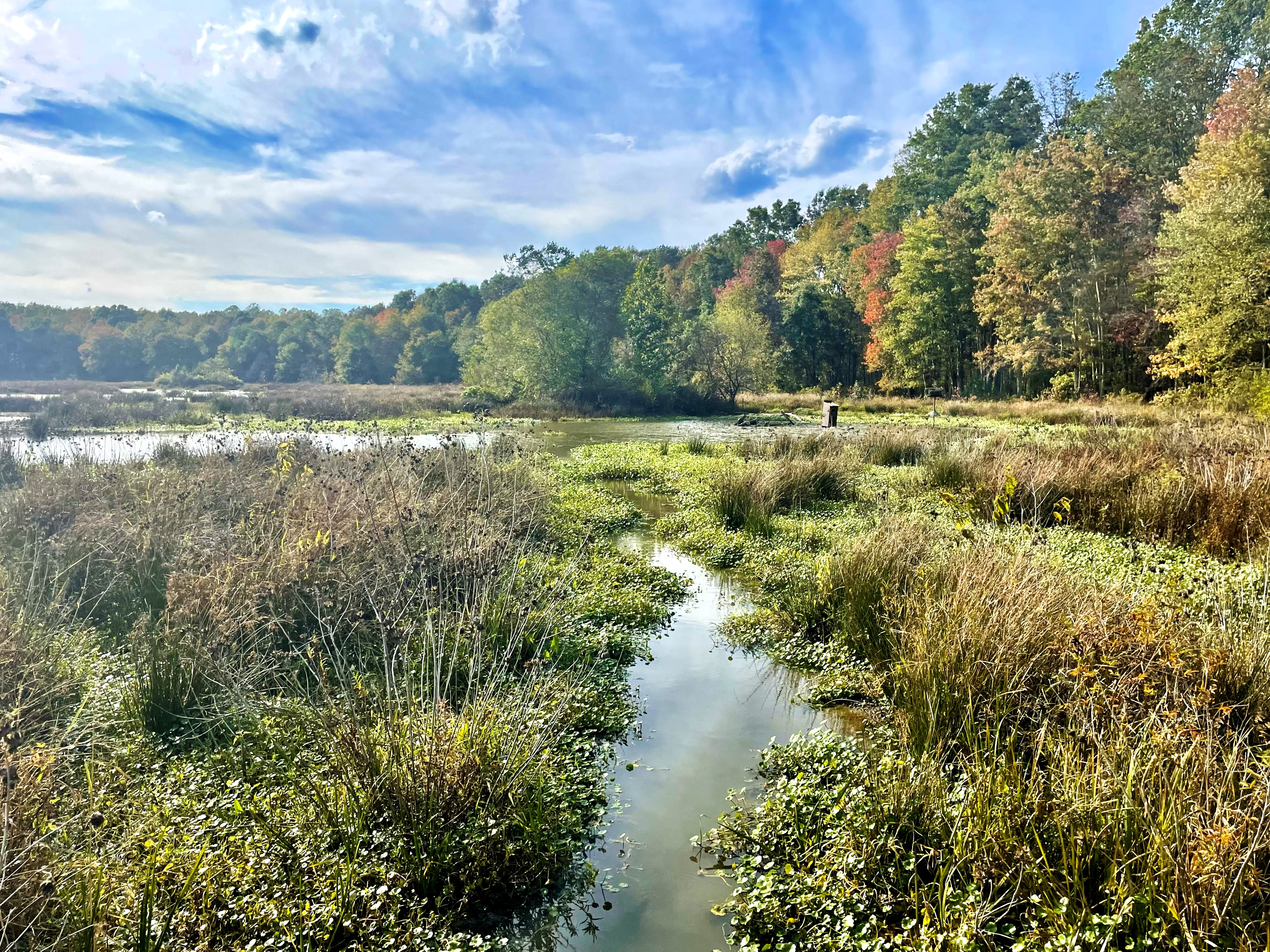
The incredible expanse of Elizabeth Hartwell National Wildlife Refuge

C and I wrapped up our Spring 2025 activities with some short nature walks at the Elizabeth National Wildlife Refuge in Lorton, Virginia. The refuge, established in 1969, was the first federal reserve created expressly to protect the bald eagle. At the time of its establishment, bald eagles were on the national endangered list with only a few breeding pairs in the area. Today, in a large part due to the Refuge, the Chesapeake Bay area, particularly around Mason Neck, is the home of the densest breeding population of the majestic birds outside of Alaska.

We brought binoculars on our walk and were lucky to observe several bald eagles flying and fishing in the area over the Potomac River. I found it so extraordinary that just 40 minutes outside the urban environment of our nation’s capital is so much protected land.

Once again, my daughter C and I made the most of our time posted to visit and experience the wonderful places and activities on offer in the Washington, D.C. area. We are incredibly lucky to live here.

A Mini Spring Break in North Carolina

Sunset on Sand Dollar Island

Spring Break. I do love that term and the possible adventures it opens up. For the past two years, my daughter C and I have opted to spend her Spring Break in the Caribbean, first in Grand Cayman and then in Roatan. However, this year, we stayed closer to home.

From the beginning, this year has thrown me some personal and professional challenges, so I did not have either the time or the energy to plan a big getaway. In addition, I had already taken some time off work to manage those personal challenges and did not want to be away for long in case I was needed. Still, I very much wanted and needed a break.

I opted to take only two days off, during which C and I drove south to the beautiful town of New Bern, North Carolina, to visit our long-time friends and travel companions CZ and Little CZ. The aim was simply to spend time with people who mean a lot to us and to be away from home because the whole “change of scenery” idea really does work for me.

At Latham-Whitehurst Nature Park

Another perk of this trip was the drive. Like many Americans, I do love driving and the excitement of a road trip. In many of my overseas postings, road trips are often limited, so while posted in the U.S., I want to take advantage of this option. Also, to be honest, I am currently quite annoyed by plane travel. I do not yet know if this is only a temporary irritation or something more permanent.

On the Wednesday night of the Easter week, C and I packed up the car to join the rush hour commuters heading south on I-95. I do not even remember the traffic; we really did not care. We were in the car, on our way to see friends, and singing our favorite songs at the top of our lungs. We stayed in a hotel just outside Rocky Mount, NC, for the evening. I could have pushed on to New Bern that evening, but the stress of the first few months of 2025 had worn me out. The journey, even staying the night in a nondescript, but clean and comfortable, hotel off the highway, was a big part of the break. Well-rested the following morning (more rested than I had been in months), we made the last two hours to CZ’s house the following morning.

Our first day was low-key. We arrived a bit before lunch and settled in. CZ and I began to catch up. Then, we all headed out to Sara’s, a restaurant serving up hearty portions of Italian and American comfort foods. It was a lovely, warm day and we sat outside. CZ and I did some more catching up. Afterwards, we drove just a short way down the road to the Latham-Whitehurst Nature Park, where we strolled and talked along wooded paths and boardwalks. Then back to the house for more talking. I am sure C and Little CZ were catching up as well; we weren’t worried about them. They have spent so many trips together over the years, they are almost like siblings.

For our second day, we decided to spend the day visiting Edenton. CZ said it had long been on her list of places to visit, and I am a huge fan of historic towns.

Left: The Cupola House, a Georgian-style home built in 1758.
Right: A 1905 bronze teapot commemorating the 1774 political protest organized by Penelope Barker—one of the first organized acts of female political action in American history.

Just outside of town, we stopped at the Edenton National Fish Hatchery. This might seem like an odd stop, but when I visited South Dakota in 2014, I also visited a fish hatchery. That one was established by none other than the famous Seth Bullock of Deadwood fame. The fish hatchery in Edenton also has a rich history, having been established in 1898. There is a small aquarium on the premises, and one can take a self-guided walk among the hatchery ponds. Unfortunately, several of the ponds were drained and we couldn’t see the fish in those that were filled. Though CZ and I tried to make it fun, the kids were bored fairly quickly. I admit is was no where near as interesting as the one in North Dakota.

The 1898 Roanoke River Lighthouse on the Edenton waterfront

The town of Edenton, however, is a different story altogether. We visited the welcome center and then took an hour-long trolley tour to learn about Edenton. Our trolley guide was a chatty woman, retired from nursing, who had grown up in the town. Though new to guiding, she knew her stuff. She filled us in on both the town’s and her family’s history.

Founded on Albemarle Sound in 1712—making it the second-oldest town in the state—Edenton served as the second colonial capital of the Province of North Carolina from 1722 to 1743. Often hailed as the prettiest small town in North Carolina, Edenton may be small, but it is rich in history, with nearly every street featuring multiple sites listed on the National Register of Historic Places. The 1782 home of Penelope Barker, the organizer of the 1774 Edenton Tea party, serves as Edenton’s Welcome Center. The 1776 Chowan County Courthouse, a beautiful example of public Georgian architecture, is the oldest courthouse still in use in the state. Lane House, the oldest house in North Carolina, is found in Edenton.

At the Herringbone restaurant, which is located in a 19th century herring icehouse

After the tour, we took a stroll up the main street to do a bit of window shopping. Fronted with coffee and dessert shops, restaurants, cute boutiques, and Bryum’s Hardware Store (owned by the family of our trolley guide), which has been a town staple since 1912, the compact street offers more than most towns of comparable size. We all had a nice time on the walk; each one of us bought ourselves a little something. Afterwards, we ordered dinner from the Herringbone (our guide said it is the most popular dining establishment in Edenton), and ate outside with a view of the sun setting on the waterfront. We loved our visit to Edenton!

For our final day in North Carolina, we chose another waterfront destination—the historic town of Beaufort. Established in 1713, it is the fourth-oldest town in the state and is known for its rich maritime (and pirate) history. On our previous visit with our friends, we explored the North Carolina Maritime Museum, took a silly tour aboard a replica pirate ship, and spent time at Shackelford Banks enjoying the beach and spotting wild horses. This time, we came for a late lunch before catching a ferry out to Sand Dollar Island.

Sand Dollar Island is a barrier island in the Beaufort Channel. It not really an island, but instead a sandbar, which is only accessible at low tide. And it has the highest concentrations of sand dollars (flat burrowing sea urchins) in North Carolina.

Sand dollars at Sand Dollar Island

To get there, we took a 30-minute ferry ride. Along the way, a pod of curious dolphins treated us to a bit of excitement. I doubt I could ever tire of spotting dolphins. The ferry “docked,” or rather rolled up to the sandbar, and we disembarked for our two-hour visit. Already after 5 PM and the tide on the rise, we had maybe a soccer pitch’s length and a maximum of fifty feet in width of sand to explore. The water around Sand Dollar Island was only a few inches deep so one could “wade” out a few dozen feet and still have the water only up to one’s ankles, giving the impression that visitors were walking on water. Though nearly everyone was bent over double in search of sand dollars.

Being the last boat of the day, there were not many left to be found. Visitors are warned to leave the living sand dollars, though we could pick them up and hold them to feel their tiny velvety spines, like hair, tickling the palm of your hand. C and I had never before found or held a sand dollar, so this was a very special experience. Especially walking on a sandbar at sunset as warm waters lap over your feet.

Sand Dollar Island disappearing beneath high tide as we depart

I will admit feeling just a tinge of worry as the sun set, the wind kicked up, and the water rose, and the return ferry was not yet in sight. But soon enough, we could see the ferry puttering towards us on the horizon. As we pulled away, Sand Dollar Island was certainly thinner than when we had arrived, and would surely be completely engulfed by the sea at high tide.

We drove back to CZ’s house, giving my oldest friend and I another hour to while away in conversation. C and I started our drive back home that evening, stopping again to spend one more night away from home, extending that different scenery feeling just a little longer. Then we were back home on Easter morning.

In and Around DC: Activities Winter 2024-2025

The frozen Potomac River from Riverbend Park in Great Falls, VA in January

I am continuing to write of my daughter C’s and my activities and adventures while make the most of our domestic posting to Washington, D.C. Lately, I have found it a bit harder to write about what we have been up to here in the United States. While I rarely discuss politics in this blog, I feel I must acknowledge the impact recent political shifts have had on myself and how they color the way many of us experience places and travel. The activities in this post start at the end of December, before the change in the government, and end in March, a few months into the new administration. Through it all, I continue to place great importance on meaningful experiences—time for my daughter and I to be together: to be entertained, to witness great performances, to explore historical sites, and to simply have fun.

Winter is my least favorite season of the year. I often plan a getaway to a warm (or warmer) destination around the holidays, and otherwise just plan to get through the chilly days. This year, I wanted to be a bit more intentional with indoor or seasonally appropriate activities that would make it pass a bit more pleasantly.

We started our winter activity extravaganza just after our return from our winter cruise with tickets to see the award-winning Broadway production of the Life of Pi at the Kennedy Center. I read the book some 20 years before and it had such a strong effect on me I recall where I was when I read it: in Hanoi during a trip to attend a conference. I had the book with me when I went out for an evening dinner and happened to sit near a table of U.S. diplomats. As luck would have it, my daughter C had selected the book from a pile of freebies at the end of sixth grade. I knew we would both enjoy the Tony award winning play with it’s power story by actors interacting with amazing puppets. I managed to get us second-row seats and it truly was a great night out.

At the very end of December, I booked us a tour of the U.S. Capitol and the Library of Congress. C has joined an all-girls BSA Scout troop here in northern Virginia and one of the requirements for the Eagle-required Citizenship in the Nation merit badge is to visit one’s state capitol or the U.S. Capitol. I had not toured the Capitol for at least 20 years and loved the idea of visiting again with C.

No matter the weather, the U.S. Capitol building is historically and architecturally phenomenal

All visitors to the U.S. Capitol are whisked through the public areas of the building with quick precision. There is a 13-minute introductory film and then each group is taken to the crypt, the rotunda, and statuary hall. Sadly, the public tours do not visit either the Senate or House galleries or climb up into the dome. I was surprised by the crowds on the last Saturday of the year. The rooms are so visually rich, I wanted more time to drink it in, but we had only so much time in any given spot before we had to move along.

The extraordinary architectural beauty of the Library of Congress

After the Capitol tour, our guides led us along the underground passageway to the Library of Congress. I had only visited the building once before; while working at the Defense Department, I went to the reading room in search of one particular book or article. How I could possibly have forgotten the astonishing grandeur of the library, I shall never know. But, my goodness, the Library is a feast for the eyes and a bibliophile’s dream. Again, the tour just scratched the surface. Unlike the U.S. Capitol, a visit to the Library is self-guided. C and I enjoyed the information, delivered with a comedic touch, of our guide, but I surely could have spent at least another hour languidly exploring the rooms. C, perhaps not, but she did like the Library portion of the tour better.

For our January outing, we lucked out with an absolutely glorious winter’s day to head to the Building Museum in downtown Washington, D.C. Like so many other places on my list of places to drag my daughter to, I last visited the Building Museum some 20 years before. One of the best parts of the museum is its location, housed in the gorgeous former headquarters of the U.S. Pension Bureau. Its distinctive red brick exterior is very attractive, but it is really the interior, with its Great Hall complete with eight massive Corinthian columns, that sets the museum apart.

The stunning interior and exterior of the Building Museum

The museum educates the public on the impact of architecture, planning, and design on our everyday lives and how it can transform communities. When C asked me where we were headed, she expressed skepticism that the visit would be of any interest to her. However, she loved the Great Hall and the exhibits. The “Mini Memories” exhibit featuring souvenir buildings from around the world was right up her alley. She familiar with many of the knickknacks such as the Empire State Building in NY, the Oriental Pearl Tower in Shanghai, Big Ben in London, or the Burj Khalifa in Dubai, all of which she had visited. She really enjoyed the Brick City exhibit celebrating iconic architecture from around the world made with LEGO Bricks. And surprisingly, she also found the exhibit on Brutalism interesting, as one can find many buildings from that unfortunate period in architecture around D.C.

C made a Philadelphia Eagles player out of LEGOs and that evening we took part in one of the most Americana of winter activities: watching the Superbowl.

The performers allowed photos during their second encore

In February, C and I returned to the Kennedy Center to see an exquisite performance by the National Ballet of China. The company reimagined The Nutcracker, keeping the beloved original score but giving it a fresh twist for Chinese New Year. Every scene was infused with rich cultural elements—from dancers wearing zodiac animal masks to a graceful crane dance, and striking costumes inspired by blue-and-white porcelain and decorative fans. Once again, I managed to score seats close to the stage, which let us fully immerse ourselves in the performance. I was not quite sure how C felt about it all, until she leapt to her feet to applaud at curtain call. (Sadly, this will be our last visit to the Kennedy Center until it is less politicized).

Nosebleed seats still give one a great view of the action on the court!

To close out our winter season adventures, we went to our first professional basketball game, cheering on the Washington Wizards as they took on the Orlando Magic. While the Wizards did not appear interested in playing defense and only found their rhythm late in the final quarter, we had a really great time. The two and a half hours flew by as we were engaged and entertained from start to finish. I have a feeling this won’t be our last live basketball game!

Winter has never been my favorite season, and, between the shifting political climate and some personal challenges, this one was harder than most—between the shifting political climate and some personal challenges. But making sure C and I carved out space for fun and good memories made all the difference. From memorable performances to D.C. highlights, we found a great mix of things to keep us busy. And now, with spring (and warmer weather) finally settling in, I’m looking forward to lighter days—both in season and in spirit.

A Quick Getaway to Philly

Elfreth’s Alley in Philadelphia, PA

C and I continue to make the most of my assignment to Washington, D.C. And, well, things have been more than a little, um, odd in Washington lately, which makes it more important that we make time to enjoy the positive aspects of the area and America.

In mid-March, C’s school had a random Friday off, so I decided we would have a short getaway to Philadelphia. I had only been to the City of Brotherly Love once, at least 15 years ago. I thought it would also be fun to invite one of C’s best friends, TO, on the trip. When I was a little younger than C is now, my best friend was a girl named Jennifer who lived up the street from me. Jennifer’s mom, Debbie, was also a single mom, but she invited me on several trips with her and Jennifer. We went to Ocean City once and another time to Gettysburg, Pennsylvania. My parents, maybe exhausted with four children and without much disposable income, rarely took us on trips other than to see family (and half the time our car would break down before we got out of town). Therefore, my trips with Jennifer and Debbie were really special for me. I wanted to pay that forward.

We had TO stay over the night before so we could have an early start on the three-hour drive. Half an hour into our journey, I stopped at a 7-11 and the girls stocked up on just the kind of stuff you might expect teenage girls would like to munch on while on a road trip. And I had the last hour in quiet once they crashed. I wanted them well rested for the busy day we would have ahead.

Sunlight hits the Liberty Bell with Independence Hall outside

After checking in early at our Penn’s Landing hotel, we headed to our first stop: the Philadelphia Mint. C is a member of Scouting America. Since she was working on her coin collecting merit badge, the U.S. Mint in Philadelphia, established April 2, 1792, seemed the perfect place to visit. Photography is not allowed inside the Mint, so we had to make do without. We enjoyed reading about the history of the Mint and the production of coinage in America but our favorite part was watching the thousands of quarters, dimes, nickels, and pennies move through the assembly line on the massive production floor. Though for C and TO, the gift shop came a close second.

After the Mint, we tried to visit Independence Hall, but I found out it was sold out for the day. I had not expected this on a random Friday in March! A National Park ranger informed me that a limited number of next-day tickets would go on sale at 5 PM, so I set an alarm and we headed to the Liberty Bell across the street. The first time I visited Philadelphia, it was a warm September day. I remember shuffling past the Liberty Bell in a long, slow-moving queue. This time? No line at all. It took less than ten minutes from entry to standing before one of our country’s most recognizable symbols of freedom. I think C and TO appreciated seeing in person something they had studied at school. Only they appreciated it for a fraction of the time I did.

The extraordinary Philadelphia Town Hall (from the outside)

I got those hungry teens some lunch, then we walked downtown to the beautiful Philadelphia Town Hall. Construction started on the ornate French Second Empire-style building in 1871, and when completed in 1894, it was the tallest habitable building in the world. With nearly 700 rooms, the Philadelphia Town Hall is the largest municipal building in the United States and one of the largest in the world. Today, it is listed as a National Historic Landmark and a National Historic Civil Engineering Landmark. This is exactly the kind of cool building I enjoy touring! But wouldn’t you know it, all tours were sold out that day. Foiled again.

Inside the Reading Terminal Market

On the way to our final planned stop for the day, we passed through the Reading Terminal Market, the indoor public market built under the elevated train shed of the former Reading Railroad Company (yes, the one from the Monopoly game). Here, I finally got C and TO’s attention with the sweet shop featuring popular American and imported candies. With their sweet teeth satisfied, the teens were ready to continue on with my sightseeing plan.

Widowed Betsy Ross purportedly rented two small rooms and a storefront for her upholstery shop in a building near the center of Philadelphia. A flag maker for many years, the Ross family history credits her with sewing the second official flag of the U.S. While direct evidence is thin, the legend of Betsy Ross is firmly rooted in American history, and I, for one, am pretty happy with a woman having such a place in the pantheon of historical figures associated with our democratic beginnings. It isn’t a big museum and the tour guides throughout are great; they kept C and TO interested and engaged. That is no mean feat with two teenage girls, especially ones who have already been dragged around to several historic sites for most of the day. Afterwards, we headed back to the hotel via the quaint, historic, and very photogenic Elfreth’s Alley, the oldest continuously inhabited residential street in America.

Betsy Ross was here (probably)

We rested a bit at the hotel before I made the girls join me at the riverfront at Penn’s Landing for a walk as the sun was setting. Then we went to the largest Wawa I have ever seen, where we all stocked up on foodstuffs for dinner. Back at the hotel, we ate and I watched television while the girls hid in the bathroom, chatting and making TikTok videos. And at 5 PM sharp, I logged on to the website and secured us tickets for Independence Hall for Saturday.

The next morning, I took the girls to an early morning guided tour of Philadelphia’s Magic Gardens, an extraordinary indoor/outdoor art space of mosaics created over decades by Isaiah Zagary combining handmade tiles, pieces of donated / cast-off household items from bottles to bicycle tires, and commissioned folk art from local, national, and international artists.

Scenes from the Magic Gardens

Honestly, I didn’t know if the girls would like it, but I wanted to include something on our itinerary other than historic sites. But they loved the Magic Gardens! They grabbed the scavenger hunt sheets provided by the museum, ditched the tour, and explored on their own.

I really enjoyed the tour. It was about 30 minutes long, providing us with information on the artist, his inspiration, process, role in the community, and legacy, along with plenty of time to meander where we liked, though in my opinion one needs at least twice the amount of time to really take in the details (well, if you are not visiting with teens). Unfortunately, the upper floors were closed to the public. I very much wanted to get up to the rooftop.

We then walked from the Magic Gardens to the old city for our Independence Hall tour. Luckily, we arrived early (as recommended online), and when other ticketed visitors did not arrive, we were able to join the tour scheduled 30 minutes before ours.

Scenes of Independence Hall

The tour is only 20 minutes long. The building is not large, and the tour visits just the two rooms on the ground floor. Though these are, perhaps, two of the most famous rooms in U.S. colonial history. C and TO were engaged in listening to and responding to questions from the guide; they are in civics this year. For me, the space, saturated as it is in our history to create a democratic nation, felt all the more weighty in the context of current political happenings. The words of our National Park Service guide, a bilingual, mixed heritage American from Puerto Rico, to our group, made up of visitors from around the country and the world, resonated with deeper meaning. I thanked each of the NPS guides for their service.

That was our quick trip to Philadelphia. Nowhere near enough time, but a fun and important trip that I hope will be something my daughter and her friend remember.

Lancaster County, PA Getaway – Again!

C on the historic Chiques River Covered Bridge

Last fall, I bought tickets for an event in Lancaster, Pennsylvania. My daughter C and I had really enjoyed our previous visit to the town, and we looked forward to another trip there. Washington, D.C. has also recently been saturated in tension and uncertainty, so I needed to get out of town for a weekend.

We headed out of town on a Friday afternoon just after C came home from school. Friday afternoon driving out of D.C. can be a struggle, and so soon after the Return-to-Office order for federal employees meant the 2 1/2 hour drive took about an hour longer. But no worries, our first destination in town was Sushi Heaven, an all-you-can-eat Japanese restaurant we fell in love with during our last visit. After stuffing ourselves, we headed to our hotel.

The Cartoon Network Hotel in Lancaster

On our last visit we stayed at the super cute Red Caboose Motel in Ronks, PA. Looking for something else unique, I reserved a room at the world’s only Cartoon Network Hotel. While I am a bit too old for Cartoon Network, and C is largely over it, we are familiar with it, and we love a unique place! Also, the hotel is well-located on one of the main drags in Lancaster, with easy access to everything we wanted to see and do. I wanted a Powerpuff Girls room, but they had all been reserved, so we had to make do with Jake the Dog from Adventure Time. No problem. The room was cute, the beds comfortable, and we had a good night.

On Saturday morning, after a much-needed lie-in, we headed to the town of Lititz for a 10:30 AM tour at the Julius Sturgis Pretzel Bakery. On our tour, C and I had the opportunity to roll out some dough, twist our own pretzels, and learn about the history of Sturgis Pretzels. Founded in 1861, the bakery is the site of the oldest commercial pretzel factory housed in one of Lititz’s original buildings, which was built in 1784. Now, pretzels have been around a really long time. Reportedly, an Italian monk invented them in 610 AD, but those were the soft pretzels now generally associated with Germany. But the hard pretzel popular in the U.S. was invented by Julius Sturgis in 1860. The baker he worked for thought they wouldn’t sell, so Julius bought his own place, and, as they say, the rest is history.

Following the Sturgis bakery, we took a brief walk around the lovely historic town of Lititz. Members of the Moravian church from Bohemia founded Lititz in 1756, and for much of the first 100 years of its history, only congregation members could own homes in the town. Over the years, buildings of many architectural styles (48!), from colonial and federal to Victorian and Beaux Arts and everything in between. I would have liked more time to explore but C is a bit less enthralled with historic buildings and architecture than I am, it was chilly with a bitter wind that made walking unpleasant, and we we were getting hungry and had lunch plans.

Lititz Architecture ranges from the Linden Hall School for Girls (left), the oldest girls’ boarding school in the U.S. and the Beaux Arts-style Lititz Springs National Bank (right)

C and I made a beeline back to Lancaster and its Central Market (the continuously operated public market in America) for lunch. C may not care that much about the historic importance of the market, but she enjoyed the food there enough to personally request we return for some more goodies. We wandered past the stalls doing some “window” shopping before getting sandwiches and a whoopie pie, then nabbed a few seats at one of the few tables on the ground floor. Here we could munch on our food and people watch – where cheerleaders just out of a local competition mingled amongst locals and visitors buying from stalls with fresh fruits, vegetables, cheeses, and meat from Mennonite and Amish farms or grabbing Thai, West African, Spanish, Caribbean, Scandinavian, or Middle Eastern bites. Then, it was back to the hotel for a little rest before the evening’s event.

I built our Lancaster return trip entirely around seeing Riverdance, the Irish dance phenomenon, at the American Musical Theater (AMT). I do not remember when I first saw Riverdance, but it was in the Washington, D.C. area some 20 years ago, and I absolutely loved it. When C and I visited Busch Gardens in Williamsburg, I took her to see the Irish dancing show, and she insisted we see it again on our next visit. I knew she would love Riverdance, so I had to get tickets when I heard they were touring again. Lancaster and its unique AMT seemed the perfect place to see it. The performance was everything I remembered and more; C loved it! I’ll certainly keep the AMT in mind for future shows.

On the last day of our Lancaster County getaway, we drove first to one of the county’s many famous covered bridges so I could do a photoshoot of C. It was chilly and C was grouchy (she is nearly every time I pull out the fancy camera) so we spent only 20 minutes. Our next and final stop was the Turkey Hill Experience in Columbia, PA. I opted for both the interactive experience and the taste lab. For the former, we laughed our way through creating and naming our own ice cream flavor, designing its box, and making a commercial. We also locked ourselves into a mock (but still cold) ice cream freezer and taste-tested several of Turkey Hills’ beverages (for free!). In the taste lab, we were able to create our own ice cream using a very delicious vanilla base and choosing between some 18 flavorings, maybe 20 dry toppings, and some 10 liquid mixes. I went with a birthday cake flavor, topped with peanut butter cups and cookie morsels. I stopped there. With the flavoring, that is! I wish I could have used more self-control when it came to eating!

We packed a whole lot into our second visit to Lancaster County! It really was just what we needed for a mother-daughter getaway.