Palau – Islands on the Edge (2011) Part One

[As part of my blog I am posting stories from my past travels.  These are edited, augmented, versions of email stories I sent to friends and families, or in some cases meant to send but were never completed.  They are at times supplemented with information from my diaries and/or memories.  This trip to Palau was one of my last before I started carrying a baby on board and joined the Foreign Service.  It was a trip in which I pushed up against my comfort zone (swimming in the ocean with a twist), bent to convention (signing up for lots of tours – because the nature of the islands make it nearly impossible to get to places on your own unless you have your own boat – and realized what things I might be too old for (like running after Taylor Swift in the Manila Airport during transit–I did not do it in case you were wondering. I only thought about it.]

19. placid Palauan waters

The incredibly stunning and calm waters of Palau

“The Caroline group includes, besides coral islands, five mountainous islands of basaltic formation, beautiful and fertile with rivers and springs…They look very picturesque as you approach them, with the white shining sands of the beach in the foreground dotted with their queer-looking canoes; then the cocoanut [sp]palms, lifting their tufted feathery heads seventy or eighty feet in the air, the long drooping leaves of the pandanus trees, and the dark, shining foliage of the bread-fruit, while beneath all one can here and there catch glimpses of thatched huts of the natives.  With a closer inspection, however, the beauty vanishes, and the barrenness and isolation of the island are realized.  The heat is intense, and there are heavy languor and lifelessness in the air, which is heavy with the odors of decaying vegetation and the rancid copra, as well as the odor which seems inseparable from heathenism…To establish protectorates over any of these groups must be purely philanthropic work—a laying up of treasure in heaven for there will certainly be none to lay up on earth.” —Harper’s Weekly, November, 20 1900

Palau.  A string of small sun-kissed islands in the Western Pacific Ocean.  Who wouldn’t want to visit?  Certainly not the author of this Harper’s Weekly article over 100 years ago!!  Funny, how our visions of far-flung tropical islands (and heathenism) have changed.   I suppose if more than just a few die-hard divers, WWII history buffs, and Asian honeymooners knew the place existed (and I am none of the above), I expect many people would like to make their way there.   Yet these days even many guidebooks seems to have given up on Palau.  Perhaps a decade and a half ago I had myself a Lonely Planet guidebook to Micronesia.  I was going to visit Guam and had visions of myself soon after somehow making my way to these other difficult to reach islands.  That did not happen.   But it must not only have happened to me because Lonely Planet no longer makes a guide book to Micronesia.

4. sunset at hotel

Sunset view from my hotel

I had a number of reasons to visit Palau.  I love visiting different countries and cultures.  But I do have a particular interest in the South Pacific after spending 6 months in Hawaii as a visiting fellow and then visiting the Cook Islands and Samoa in 2004.  I am not quite sure when Palau came on my radar – but it was sometime after 2004, just 10 years after Palau’s independence from the United States, after 47 years in trusteeship status.  Just a few years ago I started thinking I would really like to visit Palau, but it seems a long way from anywhere.  Unlike Hawaii, which, although it is the world’s most remote island chain in the sense of distance,  is connected to many places by daily flights, Palau has but a few flights a week, some only by charter, from Manila, Guam, Tokyo, Seoul, and Taipei.  Although it is perhaps closest to Indonesia (they share a maritime border!) there are no air connections between the two countries.

I love that Palau is home to the longest river and second largest island in Micronesia.  And amazingly enough there are bridges between several of the main islands!  I find this extraordinary in the Pacific.  Also the famed Rock Islands, featured in multi-years of my National Geographic Islands calendars, are here.

Another interesting tidbit about Palau is that in 2009 the country offered asylum to the 20 Uyghurs held at Guantanamo.  Eight took them up on the offer (and on my first day a guide took me by the apartment where they all supposedly reside.  According to the guide, they are all “very nice”.)  Several months later the US offered Palau something along the lines of $240 million in long-term assistance and in September 2010 the first permanent U.S. Ambassador to Palau started work.  Previously, the US Ambassador to the Philippines also covered Palau.

Palau is different.  Most flights arrive in the darkness.  Mine landed right on schedule at 2:05 am.   Despite that, I noticed something was off as soon as I got into the car to take me to my hotel.  My driver got into the right side of the car, but we also drove on the right side of the road…  Uh, what?  When I asked him why he was driving on the wrong side of the road he said he was not.  So I asked him why his steering wheel was not on the other side of the car.  Turns out, a majority of the vehicles in Palau are from Japan.  i.e. for the Japanese market.  Though the traffic patterns of Palau are those of the US.  I found this confusing because well, the Philippines is perhaps Palau’s closest neighbor (though parts of Indonesia might be just as close, there are no direct flight connections) and they manage to have their steering wheels and their lane directions matched up.  But this is just one of Palau’s many idiosyncrasies.

17. german consulate

Clothing store downstairs and the German Consulate upstairs.  Old school representation in Palau

Like when I went into a souvenir shop and looked at the postcards.  First, the selection was really limited.  But then I noticed that some of the cards were not even of Palau!  I noticed three cards were of Yap, Micronesia.  Okay, I guess that is relatively close by, but it is a different country, the Federated States of Micronesia.  And then I noticed a card that showed an aerial view of a village.  I picked it up to look at it closer – and thought there was far too much land visible for it to be of any island in Palau or Micronesia.  And, wait, the houses looked European.   What?  I turned it over and the card information was not in English, but I noticed the words C. Krumlov.  Oh my goodness.  I have been to Cesky Krumlov.  It is in the Czech Republic!  Why in the world would they sell a postcard of the Czech Republic in Palau?

I had only a few things planned for my first day.  Buy sunblock, get my watch battery replaced (it died the day before I flew to Palau), arrange a few tours, and take a walking tour of Koror.  The live-in-manager of the hotel, Maisa, drove me down to the main shopping center in Koror around 10 am.  (well, at 10:15 am she told me she wanted to leave at 10 am! – but hey, I got a free lift to town).   I browsed through the supermarket to check out what was available, had my watch batter replaced (check) and bought the sunblock (check).  Then I decided to talk a walk around town.  Funny, but that morning as I looked out from the hotel balcony, to see swaying palms and the crystalline sea, I thought, “I could live here”.  After about 10 minutes of walking in the blazing heat, along the main road lined with nondescript buildings, I thought, “there is no way I could live here.”

Koror reminded me of Suva, Fiji, and even parts of Hawaii.  Blessed with beautiful blue skies, warm trade winds, palm trees, and stunning vistas across clear aquamarine seas – but cursed with ugly, functional concrete block architecture.  Maybe it is a result of so many WWII battles being fought in the Pacific that so many of the buildings resemble bunkers? Tall, often colorfully painted, bunkers.

I had a delicious lunch at an Indian restaurant staffed by Filipinos before calling Maisa to come and pick me up.   She let me know that she had arranged a river tour for me that afternoon and they would be picking me up in about 40 minutes.  I was thrilled.

The River Tour was great!  First, on the way there, the self-employed Polish couple from Chicago with whom I shared a pick-up service regaled me with their hilarious tales of tourism in Palau.  When asked how long they would stay in Palau they said 2 months – but so far it was three weeks and they wryly said they were not sure how much longer they would stay.  They said that Palau is odd because it thrives on tourism and yet is not very helpful to tourists.  There are few, if any, maps available.  Many tourist sites have no signage.  For example, they told me how they tried 3 times to visit the Crocodile Farm.  The first 2 times they went it was closed.  So, on the third try they called the place at 8:30 am to ask their opening hours and were told until 11 am that day.  But when they showed up an hour later it was locked up tight!  So they parked the car, scaled the fence, and took a look around themselves!  They also told me when they arrived and the immigration officer asked them how long they were staying, he laughed and asked them “what are you going to do here for that long?”  They loved my story of the postcards!

9.

I am quite sure I would never grow tired of seeing tropical flowers

Once at the river boat tour site we had an opportunity to hold a juvenile fruit bat and a baby crocodile.  I think fruit bats are cute.  I really do!  Their faces look like puppy dogs.  It is just when they spread their leathery wings and reach out with their clawed toes that things start to get a bit scary.  Still, I held him as he pawed my shirt, then licked and nipped my hand.  Until the nipping got a bit too hard.  However, better than the little crocodile, which I dropped as soon as he started to squirm…

So, yes, there are crocodiles in Palau!  I was rather surprised myself.  As part of preparing myself for snorkeling in Palau, I googled “sharks in Palau” and came across some articles about the crocodiles, which some divers seemed a little concerned about.  I know I certainly became concerned as well.  I get that the Philippines and Indonesia and Papua New Guinea and the Solomon Islands have crocodiles – they have some fairly large islands – but the little islands of Palau, a minimum of 400 kilometers from anywhere?  However, an online search of the worldwide habitat of saltwater crocodiles revealed that they were in fact in Palau.  Though there has not been an attack, at least a fatal attack, on a human being since the 60s.  That attack turned the Palauans against the crocodiles, nearly wiping out the island population.

While meandering down the river we saw only one crocodile.  On the way down river, we saw him sunning himself on the bank, on the way back he swam up to the boat.  Otherwise there was little to see along the river – a few birds and fruit bats, but mostly lush green vegetation on either side.  It was quite relaxing.  The tour was supposed to last around an hour, but I think our guide took at least twice as long.  Time seemed unimportant.  There was no hurry.

Back at the hotel, the owner told me that she would be going to the supermarket at 6 pm and I could join her.  I told her it was already 6:10 pm.  That’s Palauan time.  Her friend ended up taking me at 7:30!

Kathmandu 2002: Part Two

I should have known better.  I went to the same restaurant.  Again I had the same plans for the following day:  to visit the Buddhist Boudhanath Stupa and the Hindu Pashupatinath temple.  Clearly I was tempting fate.

Well, I have certainly learned a very valuable lesson, and that is DO NOT eat a second time in a restaurant from which the first time you received food poisoning.  I thought perhaps to give the New Orleans Cafe another go.  It might have been a coincidence to become sick after one meal, but twice?  I woke up about 1:30 in the morning and dragged myself to the bathroom.  Despite my illness I did notice that my two handsome neighbors were playing, of all things, the Greatest Hits of Whitney Houston!  So while ridding myself of my dinner I could enjoy the Greatest Love of All and the theme song to the Bodyguard.  What a strange place is Nepal!

6

Buddha’s eyes watching from Boudhanath

The day after my visit to the “Poison Café,” I could barely get myself up.  But I managed to eat a few pieces of fruit and have some tea before heading out to Boudhanath and Pashupatinath, the most famous of Nepal’s Hindu and Buddhist temples.  Boudhanath is apparently the second largest Buddhist stupa in the world.  It is also home to a large Tibetan community in Nepal.  All around were monks of all ages in their red robes and women with their traditional garb with colorful aprons, some carrying their wooden beads.  I walked up onto the stupa and looked around at this amazing little Buddhist village.  It was very charming.  I even saw people walking their dogs, when I thought in general dogs were not pets, but just street animals.  A sign on the stupa tells visitors in English to not do immoral things while there, such as smoking, gambling, spitting and the like, while all around me I saw people doing these exact things.  Several young novice months, maybe 6 to 12 years of age, stood around a gambling area, placing their bets.  And I saw many people smoking, some quite young.  And spitting, of course!  The sound of the throat clearing and the spit is as common as car horns!  I walked around the stupa about three times, soaking in the atmosphere and decided to then try my luck walking to the Hindu temple, which I had been told was about 30 minutes on foot.

I headed off in the direction of Pashupatinath along a gravel and dirt path between two store facades.  Immediately I was transported into the real life of Nepali people, away from the tourists.  The first scene I came upon was a group of boys throwing stones at another boy.  Without thinking I intervened, telling the offending stone throwers “No!”  They hesitated and slyly threw a few more stones for good measure.  I then came upon also three people washing in a stone bath outside, though they were all wearing saris, and a woman bathing in an area outside her house. There were lots of children playing.  Along one side of the road a bus stood broken down, though for how long it had been there, who knows, and three men stood talking conspiratorially behind it.  On the other side, three young women stood gossiping with each other.  Perhaps they, the men and the women, actually wanted to talk with each other.  It reminded me a bit of a scene I had seen on the first day as I walked to Kathmandu Durbar Square.  One one side of the street a young man sat on the stoop of a store smiling shyly.  On the other side of the street, a lovely young woman in an all red sari stood, brazenly flirting with the man.  It was enchanting to watch.

7

Nepalese children

Further along the path I saw a boy hitting some cows hard with a stick.  I thought here was a boy who had not learned that cows are sacred in Nepal!  I took a picture.  This did not make the boy shy; he only hit the cows harder.  As I walked, I would come to a fork in the road and would just ask someone “Pashupatinath?” and I would be pointed in the right direction.  A few children yelled hello to me, but for the most part I seemed to pass by unnoticed.  This was such a relief after the constant “Hello friend,” “Tiger Balm, cheap for you madam,” “Where are you going? Rickshaw?” and “Come inside, just looking, very cheap” calls in Thamel.  Also the interesting proposal I received of “Tour? Sightseeing? Marriage? Madam” from a rickshaw driver.  Tempting, but no. 

I began to grow tired and feel sick.  My legs began to feel like lead, my stomach to hurt, and my head to pound.  Just at that time by my side appeared a Nepali man who spoke English and told me the temple was not farther.  Thank goodness!  Although a 30 minute walk would usually be a piece of cake for me, this one was beginning to feel it would never end.  The man asked me questions along the way, and showed me the path to the temple and the way inside.  I knew I was earning myself a “guide” but I did not have the energy to tell him to go away.

Those who are not Hindu cannot enter the temple grounds proper but only the area alongside the river and up to the cemetery.  I paid the entrance fee and he led me inside, immediately to the right of the ticket booth we went to the riverside where the cremations are performed.  I looked over the side of a wall and there lay a body almost burned and another wrapped in white cloth being prepared for cremation.  My guide points out to me a hand on the pyre.  “Can you see it?” he asks.  “No,” I say, “and I am not sure I want to…ah there it is.”  My stomach churned.  “Can you see the foot?” my eager guide asks.  “I need to sit down,” I say.  That the smoke in my face is coming off the burning pyre and the ashes as well are from this just burned body, is too much for meI sit down and my head spins and my stomach leaps about.  I tell my guide I think I need to go.  “No, no, I have more to show you.”  I tell my guide that I am going to call it a day.  I pay him some money and catch a motor-rickshaw back to town.  I feel every bump in the road and I slide further and further into the depths of the rickshaw clutching my stomach and moaningThen the rickshaw breaks down.  A policeman watches the driver tinkering with the engine but does not offer to help, while I slump in the back holding my head and wondering at it all.  After perhaps 10 minutes the driver gets us going again and we bump our way back to Thamel and my hotel.  I dragged myself up to my room for a long nap. 

8

Cremation at Pashupatinath

The following day I woke up quite late, about half past eleven.  I was still tired.  I think the air of the Kathmandu valley quite tires me out.  I have to use my asthma inhaler quite frequently and I feel lightheaded at times.  I was not too worried about getting up late, I am here after all to relax, and I had been sick the day before.  I was just worried about being sick still.  I decided I would return to Pashupatinath.  It took me a couple hours to get going and I did not arrive at the temple until about 4 pmAgain a guide joined me almost immediately and though I tried to shake him, he hung on tight.  But he was very informative and I was glad I had him to tell me about the temple.  I saw a cremation on the commoner side of the river.  Though actually on the same side of the river as those for the rich, in government positions, or in the royal family, the cremations for the commoners are separated from the others by a bridge.  For each caste there is a separate platform.  On the commoner side there are four platforms for the four castes.  On the other side were three platforms, one for rich and high government positions, one for, I believe, the sons and daughters of royalty, perhaps for the queen as well, and one for the king. 

My guide told me what a sad time it was last year when so many members of the royal family, who had been murdered in the palace, were cremated.  That royal homicide occurred just weeks after I last left Nepal, and things have become even more difficult for the struggling country. I was not the only spectator; there were many more, most Nepali.  How strange I thought to watch a funeral.  But I thought this in Bali too.  I sat and watched a Newari cremation ceremony until the sky grew very dark and the first fire was lit under the pyre.  Beforehand each member of the family and friends had gone down to the holy river (which flows to the Ganges in India) to dip their hands in and to carry a handful of water to the lips of the deceased.  At last the eldest son dressed all in white and being supported by another man, walked three times around the pyre and then placed the first flame beneath the head of the deceased.  He then fled to the back of the crowd wailing; his loud cries could be heard across the river. It was very sad and very strange for me to be sitting across the river from this rite of passage.  When I said this to my guide, he told me not to worry for this is human life, part of the cycle of life. 

That evening I enjoyed a nice dinner in a cafe overlooking one of the main thoroughfares of Thamel.  Enjoying Mexican food, writing in my journal and reading for my exams (yes I did in fact study) it was hard to reconcile the life on the street below, the shops, loud music, strands of blinking lights and people preparing for or returning from a trek or others selling their wares, with the end of life I had just witnessed, but there it was – the cycle of life.

11

Riding in style – Kathmandu public buses.  See the goats?

The next day I had plans to go to Bhaktapur, the UNESCO World Heritage city about 18 kilometers from Kathmandu.  Last year my friends and I had decided to skip it because we were too angered by the entrance fee.  The fee is 750 rupees (or $10) for foreigners and 50 rupees (.75) for citizens of SAARC countries or China. This time however I was prepared to payThis time I would not take a taxi.  I was determined not to take the easy traveler’s way.  I had hoped to take the bus there, and the trolley car back, but was disappointed to learn the decrepit trolley had finally seen its last days.  I walked down to the City Bus Park in Kathmandu and asked the first police officer I saw to help me find the bus to Bhaktapur.  He kindly helped me find one.  I was delighted because it looked to be about a century old!!  Well actually it looked as though it was rather newly made, welded together from other century old buses, pieces of wood and carpet, which with grinding gears and horrible exhaust belched its way down the highway.

10

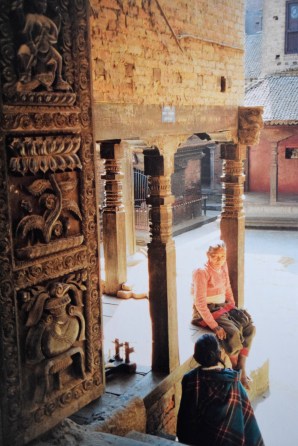
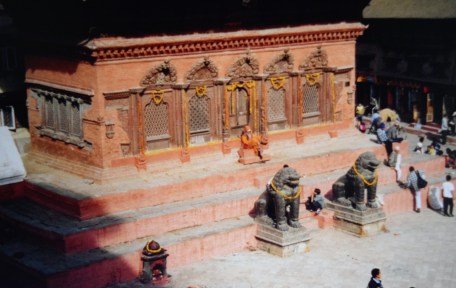
Beautiful carved door opens to a courtyard in Bhaktapur

The 18 kilometer trip to Bhaktapur took about 45 minutes.  I arrived though in good spirits right outside one of the city gates.  Who needs to take a 300 rupee taxi ride when they can take an 8 rupee bus ride?  My first glimpse of Bhaktapur, just inside the entrance, was disappointing. It looked shabby and the houses in disrepair.  But on my left a courtyard opened up, with an old woman sitting on a wooden parapet and weaving on an old loom.  Beside her a young girl stood, just in the doorway to this courtyard.  Inside women were threshing rice and the yellow grain littered the ground beside Hindu temples.  Ah, this is Bhaktapur!  From the courtyard I hurried up the street to see more of the city’s treasures and came upon a square I mistakenly took to be Bhaktapur’s Durbar Square.  It was wide and open with some big temples and a totem like pole in off center.  A lovely tea shop set up right into an old building with beautiful windows, porticos and balconies to my right.  I thought I would come back there for lunch, but I did not.  As it was still too early to eat, I headed off down a side street.  I saw two boys rolling thin rubber tires with sticks; they spun their tires quickly up another side street and away. 

9

Hanging out in Bhaktapur

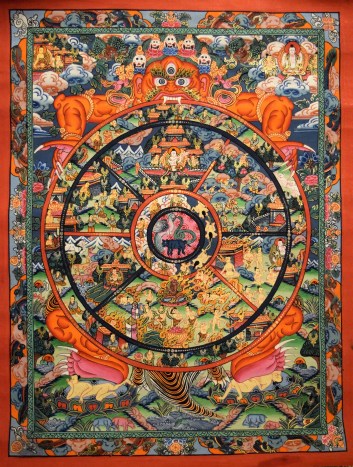
Off I went down another street and I came upon the true Durbar Square.  It was truly beautiful.  There were some temples there which seemed like those I had seen in Lopburi, Thailand or Angkor in Cambodia.  Along the steps were parades of animals.  Once again I acquired a guide, though this one, a student, said he wanted no payment, only a chance to practice his English.  He told me his name was Dave.  Dave gave me a wonderful tour around Bhaktapur, telling me many wonderful things about the city I would never have known on my own.  And he told me about himself. Seventeen, he just taken his high school exit exams and is waiting to go to university.  We had cokes in a cafe overlooking the Durbar Square.  We had a nice conversation and I watched the school kids just let out of school scatter across the square.  I also bought a Thangka painting, painted by my young guide.  It was not expensive and it will help him to go to school.  Dave brought me out another of the gates to another bus park and I hopped aboard a smaller bus back to Kathmandu.  This time I had to stand the whole trip.  It was fine.

Tomorrow is my last day in Nepal.  Then I fly back to Bangkok for an evening and back to Singapore the following day.  Back to the exams.

The trip must have worked.  I scored very well on my exams.  Quite well in fact.  When I graduated I received a gold medal for achieving the highest score in my program that year.

13

My Thangka painting by Dave


Kathmandu 2002: Part One

1

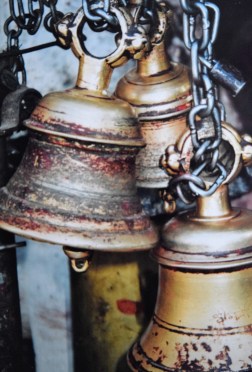
One of my favorite pictures from the trip: Temple bells.

As part of my blog I am adding edited excerpts of stories I wrote on/of past travels.  I have been thinking a lot on the person I was before I joined the Foreign Service.  The person I was before I became a mother.  My by-the-seat-of-my-pants travels, the ones without hotel reservations, the ones where I carried everything in a single mid-sized backpack, the ones where I stayed not in hotels but in shared dorms or cheap guestrooms, sometimes with shared facilities, sometimes without hot water.  The trips where I would walk for hours instead of taking a taxi or tuk-tuk or rickshaw that I thought cost too much.  The trips on which I might wear the same pair of pants or shirt for days.  I sometimes really miss those footloose and fancy free vacations.

Still I am, and was, a planner.  I poured over maps and guide books, train time tables and bus schedules.  Once on the road things could change.  If I arrived somewhere and I did not like it, I could leave a day earlier, even that afternoon, off to somewhere else.  If I liked a place a lot I would stay longer.  But I still had a very good idea of what I would find in any given place.  I was prepared.  Yet my 2002 trip to Nepal is the least planned of all my trips (except maybe that time I went to Albania).   I always wondered if I could be one of those people to show up at an airport and simply buy a ticket and fly to anywhere same day.  This is the closest I have come.

2

Look at those snazzy hiking pants!  One of my first acts in Kathmandu was to buy two pairs.

I was a graduate student in Singapore and we all had one week off between classes and our exams.  I wanted to get away, out of the country.  I decided to fly to Thailand.  Inside my bags I had my class notebooks.  My plan was to sightsee during the day and then study for my exams in restaurants and in my guestroom in the evenings.

After a day in Bangkok listening to the thumping sample CDs competing with the bars and restaurants on Khao San Road, I knew Bangkok was not the place I wanted to be.  The day before, I had met a Japanese rafting instructor who was on his way to Katmandu.  I had been considering going to Brunei, but who goes to Brunei for a week?  So I went to one of the Khao San Road travel agents and instead of asking about a ticket to Brunei I asked about Kathmandu. A day later I was on the plane.

Now about 30 minutes before landing at the Kathmandu airport I am wondering if this trip was a good idea.  For one thing, I have no guide book.  For another, I have no cool weather clothes with me.  The pilots just announced the weather is in the 70s.  I look around the plane to see the majority of people dressed in khaki pants, long sleeved shirts with pullovers or jackets and hiking boots. I look down at my own knee length skirt, a short sleeved shirt and sandals.  I have one jacket in my checked luggage.  The flight attendants hand out the customs forms.  One question asks me to declare how much currency I am bringing into the country.    I realize I have about US$50, (US$30 is to cover the cost of the visa on arrival) and 50 Singapore dollars. I cannot recall if Kathmandu has ATM machines. Thailand has them on every street corner so it had not occurred to me.  Until now.

4

I sought calm and inspiration in Durbar Square.  I am not sure who I liked more: the uber cool Sadhu chillin’ out at the temple, or the young man just below him staring up in rapt attention

But it was enough.  I bought some pants, found a place to stay, and have managed. It turns out there are two ATMs in Katmandu, although I was in a bit of a panic when I went to the first outside of the Kathmandu Guest House and found it out of order.  However the owner of the Thamel guesthouse where I found a small, quiet room on the third floor with a wooden desk perfect for studying and a window that looks out on a busy pedestrian street, told me not to worry and to just pay him the following day once I located the other ATM (which thankfully worked because it turns out that the banks are closed for two or three or four days for a holiday). 

I am so glad to be here in Nepal.  I love the atmosphere.  I am a bit envious of all the people I see heading off or returning from treks.  There is the excitement of starting something so amazing and the uncertainty of whether one will be able to complete the trek.  Then for the returnees there is the joy of accomplishment, of having the smiles and pain and blisters and stories about the journey.  I spent some time last night with some women about to head off on a two week trek to Everest Base Camp, and how much I longed to bunk my exams and head off to the hills.  I think they would have made lovely companions.  But as spontaneous as I can be on travel, I usually remain practical. No, this trip is just for a week.

3

Festive colors for Diwali and the Newali New Year

I feel lucky to have come to Nepal at this time even though I had not planned on this trip.  It is a week of celebrations.  First, it is Diwali.  The streets are full of lights.  Candles and carpets of yellow flowers lie at the entrances to many shops.  Groups of children are caroling from door to door for tika, a blessing and a small amounts of money.  Tomorrow the boys will receive tika from their sisters. They give a small present to the sister, who will then give them some small amount of money.

Today Kathmandu Durbar Square was full of holiday makers buying fruits, flower garlands, and new clothes for the occasion.  The last time I was in Kathmandu, although there were certainly people in the Square it was more of an oasis from the crowded narrow streets, but today the Square rivaled the streets in energy and raucous noise.  It was rather wonderful. On the way to the square I was blessed by a Sadhu, who planted a tika on my forehead, put some flowers in my hair and doused me with holy water.  I returned the favor with a “donation.”

 It is also the Newari New Yea.  At first I was a little confused.  New Year?  I thought it was New Year the last time I visited Nepal, in April 2001.  And it was.  Then it was the Baishakh New Year 2058.  Now instead it is turning 1132.  What luck to always turn up during such celebrations.

Because I have been to Kathmandu before and am a little familiar with the

5

I felt pretty blessed to receive “tika” from this happy fella

streets and restaurants, I can sit and study in a cafe enjoying a cup of Nepali tea or in a Kashmiri’s shop having lemon tea, do a little studying, but still enjoy a different atmosphere..  It feels just right.  I hope I feel the same after a week (or even tomorrow because I tempted fate by having dinner in the same restaurant that A&P had our last dinner together the last time I was in Kathmandu, and the following day I was extremely ill.  I sat at the table beside the previous table.  I think I even had the same surly waiter!  But it was a delicious meal then, and it was tonight too.)

I am growing a bit tired. Although it is just 8:45 Nepali time, it is 11 pm Singaporean time (Nepal doesn’t like to have the same time as India, so it is 2 hours and 15 minutes different from Singapore).  It’s time to head back to my hotel and sleep.  I want to get up early tomorrow and head out sightseeing.

Namaste & Happy New Year

SARS in Singapore (2003) Part Two

Between July 2002 and July 2003 I lived in Singapore while studying for my graduate degree at the National University.  For three of those months, from 1 March to 30 May, Singapore life was altered with the arrival of Severe Acute Respiratory Syndrome or SARS.  During that period of time 238 people fell ill with SARS and 33 people died.  The small country reacted quickly with numerous restrictions and regulations affecting most aspects of social life. 

This is the second of two posts cobbled together from emails I sent out to family and friends during this time.  The strain of living under the conditions imposed to stop the spread of the illness began to take their toll on me.  I began to feel depressed.  I will admit I sought some counseling. At the same time SARS not only brought me closer to my Singaporean friends but also made me think about the consequences of SARS in a more political context.  The ways in which the Singaporean government could react quickly were both positive and negative.  And I got a little political.  When my friends and I, along with all the other international graduate students in our building, were unceremoniously notified on a weekend that we would have to vacate our apartments earlier than expected, we contacted the media.  I served as a student representative from our building in meeting with university officials and I was interviewed on television.  We still had to move out but I spent my last six weeks living with friends in an even better apartment.  When the government announced the plan to require all international students to pay a deposit before they left the country to pay for their possible quarantine upon return, my friends and I contacted our relevant embassies to express our dissatisfaction.  The government soon backtracked and it was never instituted.  The below was written before I started to work for the US government and as such represent only my thoughts at the time and not those of the USG or any department or agency of the US government. 

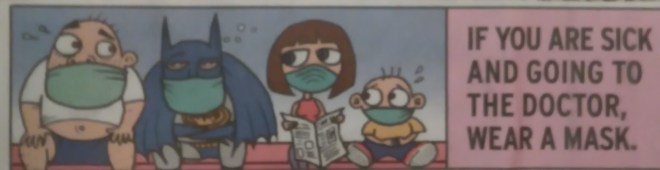
7. Batman mask SARS comic

Another Straits Times front page SARS comic

May 6, 2003

If you think that subject “SARS: The Show Goes On” sounds silly or tasteless I will have you know it is the title of yet another SARS-related television show launched here.  The following night you can tune into another show entitled SARS: A Courage Within.

Now not only do we have to report each day for our temperature check and receive our stamp, but if we fail to do so we are charged 50 Singaporean dollars a day.  On a Saturday afternoon – when we could not complain until Monday – an announcement was placed in our elevators notifying all students we had to vacate our apartments by June 16 because they will be doing a massive cleaning and all the incoming students will have a ten day mandatory home stay. (Sounds like a fancy name for QUARANTINE!)

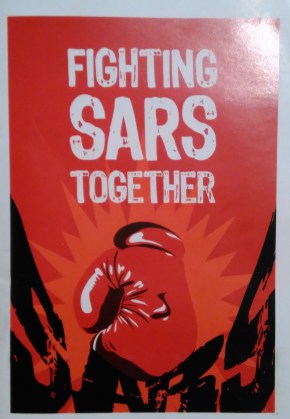
8. Fight SARS together brochure

A cover of a what-to-do in the event of SARS brochure

At the bowling alley my friends and I had our temperatures checked, and once declared normal, issued with a sticker allowing us entry.

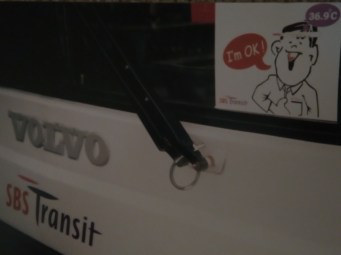
I have seen the workers at the Deli France wearing their “I am fever FREE!” stickers and the “I’m OK!” sign in the windows of the Singapore buses, to report the temps of the drivers.

Now I am, though not completely officially, a person with a Masters degree.  I thought I would feel happier but because of SARS and the government and university policies my friends are scattering to the winds all the more sooner.

Things are just not as I expected them to be now.  I had plans.  To travel to Malaysia with friends, or to hop over to Batam or Bintan (nearby Indonesian islands, one I fondly remember as the Island of a Million Mosquitoes).  But life has a funny way of throwing up the most unexpected things.  I am itching to travel.  I had planned on a glorious month long trip to China, but that is a definite no-go.  Yesterday downtown I saw three western backpackers alight from a bus near Orchard Road.  Each was wearing their very own mask.

May 22, 20039. cover mouth when sneeze comic

Though the World Health Organization has declared Singapore “safe” in the battle for SARS, the Singapore government continues its relentless political and media campaign. Though today’s Straits Times declares Singapore need not be on the defensive against allegations that it is “exporting” SARS, the government seems intent on pointing its own fingers at the importation of the disease. If ever there was a global non-traditional security issue, SARS is it.   It is literally testing the invisible boundaries between countries and the ability for countries to work together on such an issue. Singapore may have won the battle so far in containing the disease, but I do not know if it would win popularity contests for its diplomacy.  Just a few days ago the Singapore government announced that ALL foreign students in the country would have to re-apply for their student passes and come up with a S$1000 deposit when leaving the country FOR ANY DESTINATION to cover possible medical expenses upon return.  This is clear discrimination against foreign students in the country, as Singaporean students are free to go on their trips abroad without such a deposit, although they are just as likely to contract SARS as anyone else.  I have already sent my letters of protest to the US Embassy and Singapore Ministry of Education after phoning the Ministry of Health. Of course for SARS affected countries there are special measures, but Singapore seems to so easily forget that it is itself a SARS-affected country, and that viruses do not recognize invisible lines drawn on maps, nor the nationalities of its victims.

10. I'm OK SARS note on bus

It’s alright to ride this bus because this driver is OK

I find it so intriguing, this focus on SARS, equating it with war and battle.  I noted that once SARS hit Singapore the front page headers of the Straits Times simply changed from “War in Iraq” to “War on SARS.”  Every day in the paper, the front page begins with a cartoon related to SARS.

Yesterday I heard on the radio that a new television channel has been launched, the SARS channel.  I am not making it up.  They say on this channel one can “see all the SARS programs you missed.” Oh, what a teaser!  Makes you want to tune in right now.  Once I move to my new digs with friends (for just a month) I just may try to tune in, out of curiosity and my new found fascination with the media’s role in policy.  The radio and television ads plead with Singaporeans to be vigilant.  One ad proclaimed that such a war required vigilance, that one mistake, one “selfishness,” could cost the country greatly.  There is even a terribly annoying television commercial in which two “friends” badger a third friend about hygiene practices. It starts with the woman saying she is going to wash her hands, and the idiot friend asks her “why?”  She and her male partner begin a barrage of DOs and DONTs for their third friend, such as “you should always wash your hands after you use the toilet” and “always cover your mouth and nose when you cough or sneeze” and “don’t spit on the floor” and “if you feel unwell see a doctor but don’t ‘Doctor hop.'”

Singapore’s most well-known comedian Phua Chu Kang released a song called SAR-vivor.  There is a video.  It is basically a public service announcement about washing your hands and delaying travel to SARS-affected countries packaged into a dreadfully silly rap.  (This is not a joke.  You can Google it.)

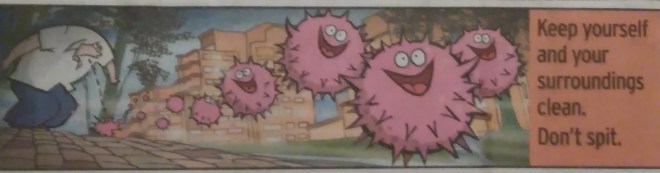
What gets me is that Singapore has been declared SARS “safe” and the regulations and admonishments just keep coming.  So far eleven people have been arrested for spitting. (One such criminal claimed “something flew into my mouth and my instinct was to spit” but the judge would have none of that and he was fined S$300).

11. dont discriminate SARS quarantine comicSingapore is doing its best to recover from the economic consequences of both the Iraq War and SARS.  The government has launched a campaign “Step Out! Singapore” to encourage Singaporeans to get out and have fun, “live life as usual,” yet while being socially responsible (i.e. not spreading SARS).   I am tired of campaigns.
As far as “living life as usual,” we all have to adapt to what is now usual.

Yesterday I found myself taking my temperature while at the copy machine at the library. Although the mandatory in-person temperature checks at the apartment complex have come to an end, we must now register our temperatures on-line every day.  One problem with this, which I pointed out to the Dean of the Office of Student Affairs, is that we have no internet connection in our housing complex.  It is perplexing that international graduate students in one of the world’s most connected countries are housed in a building with no Internet or air-conditioning…but I digress.  Therefore, we are supposed to go to the campus every day, twice a day, and log our temperatures.  Never mind that the computer labs now close at 5 PM each day and they were not open last Thursday, which was a national holiday, and last Friday I could not access the SARS daily temperature declaration website.

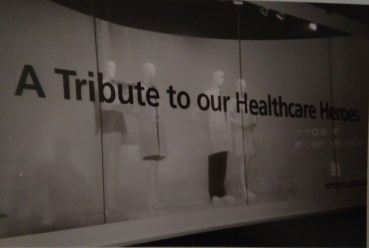
12. A tribute to healthcare workers window display

After the WHO declared SARS safe the fancy stores on Orchard Road used window displays to celebrate and recognize the sacrifices

So, yesterday.  I went to the school library. Before entering one must have their temperature checked and identification cards swiped.  This is reportedly so in the event of a spontaneous SARS outbreak, all persons who were present at the time can be contacted.  I submitted myself for the requisite check. I registered a temperature of 37.5, which is the cut-off point, and had to wait five minutes to have my temperature taken again.  I will note that this is Singapore, located close to the equator, with a year round average temperature of 80 degrees Fahrenheit with 80% humidity.  The entrance to the library is located on the fifth floor and I had just climbed five flights of stairs. I certainly felt warm.  My second temperature check registered at 37.6.  The young woman taking my temperature sounded panicked. “No, no way!  Sorry.  Zhe ge ren you 37.6.  Wo yinggai zuo shenme? (This person has 37.6 degrees, what should I do?)”  I thought, “Maybe I should not have walked past the hospital which looked like a scene out of the movie “Outbreak” because now I might have SARS and I cannot get into the library.”  Luckily, third time was the charm; I was released and allowed to enter the library.  Thereafter I found myself photocopying with thermometer in mouth.

But things did eventually return to normal of course.  The temperature checks and other SARS related measures slowed and then ceased.  The Singaporean government announced that the Great Singapore Sale would happen, a bit delayed but as part of normalizing.  Tourists returned.  My roommates and I moved out of the University apartments to our own place.  I did my six week internship and then left for travel – not China, but Turkey and Denmark instead. 

SARS in Singapore (2003) Part One

Between July 2002 and July 2003 I lived in Singapore while studying for my graduate degree at the National University.  For three of those months, from 1 March to 30 May, Singaporean life was altered with the arrival of Severe Acute Respiratory Syndrome or SARS.  During that period of time, 238 people fell ill with SARS and 33 people died.  The small country reacted quickly with numerous restrictions and regulations affecting most aspects of social life.  It was a strange time to be in Singapore.  The following is edited from emails I sent to friends and family while living through this period.  It is my take on my experience only.

1

One of the SARS related comics from the Straits Times

April 14, 2003

 If one rides the subway or buses or goes out, there is a feeling that many Singaporeans are restricting their movements around town.  Subway stations on Friday or Saturday nights are almost deserted.

There has not yet been a case of the disease on my campus, and the school is doing a lot to see that it does not, although many other schools in the country have already been closed.  Fewer people eat at the canteens and all the silverware and plates have been switched to disposable plastic.  All the water fountains have been shut down.  The university administration divided the campus into five zones.  We received a Presidential circular requesting we restrict our movements between zones.

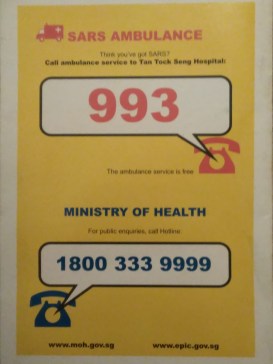
2. SARS ambulance brochure

A special SARS ambulance with is own number was established

The exam schedule is also going to be adjusted so that students can undergo a health check before entering the exam rooms.  Students will be sat further apart and there will be fewer students in each room.  We have known our exam dates since the semester began and now we are in limbo, awaiting news as to whether our exam dates will remain the same or be pushed back.

The other day there was a bit of a scare.  One of my roommates and I had just finished our last class and were feeling really good.  We joined classmates for a lovely late dinner.  We felt relaxed in a way we had not for weeks.  While at the restaurant, we received calls that two people from our apartment complex had been taken away in ambulances, possible SARS cases. We were told not to take the elevator for fear of exposure.  Previously I had not given much thought to my own safety in regards to SARS.  Cases are going up in Singapore, but I spend little time in places other than my apartment and the study room at school, but this, this was where we lived.  It turned out the students had food poisoning and all is well, but for an hour or so it was scary.  SARS became real.

Much of the papers in Singapore are dominated by two stories: SARS and the war in Iraq.  Though the war receives more notice in the paper, it is SARS that has people here jumpy.  My roommate and I went to a party last evening and needed to get off at the subway station closest to the hospital where many of the SARS cases are quarantined.  We were warned not to go.  We went anyway.  People want to avoid movie theatres, clubs, restaurants, basically most public places.  I just don’t know how dangerous could it be?

3. fever and weight SARS comic

SARS comic humor.  Keeping it light.  Unrelenting but light.

Last evening on the bus my roommate and I saw an advertisement for a new weekly television program called Living With SARS.  No joke.  I can see it is quite a shrewd move on the part of the government to calm the fears of citizens and help businesses being affected by the illness.  But something rang so….uh…Singaporean about having such a show.

I do not know how plans will turn out for the summer.  I had wanted to intern for six weeks and then travel.  But I had planned on traveling for a month in China but with SARS that seems very unlikely.  Right now even people who travel to Singapore are quarantined for ten days when they go back to their countries.  It is hard to say how long these measures will be in place.  Two more patients with SARS died yesterday in Singapore.  It is not quite an epidemic, but it is very serious.

April 28, 2003

There are already more precautions and more new things to report about SARS in Singapore.  I am not sure what to make of it, but the paranoia is growing. I am glad I do not have a television as I might be locked up in my apartment afraid to go out.

4. SARS foldout poster

A “Fight SARS” poster – I collected one in all four languages

Last night I had the opportunity to watch television for about an hour on a friend’s computer, and we tuned in just in time to catch the beginning of the new show Living With SARS.  We promptly changed the channel.  We know what living with SARS is like. All over the campus are signs about SARS; all the water fountains are shut down for “maintenance,” and every time one signs into the campus intranet via Outlook we get a dose of SARS with notifications telling us to wash our hands, not to hang out with any SARS affected people, not to do this and not to do that.  Today there was a list of places that if anyone has visited in the past few weeks one was supposed to monitor their fever every two hours.

By email we also received an exam update, which listed the number of people who went through the exams and how many had to go to the isolation room and how many went to the hospital.  I know it is supposed to make us feel better, but in reality, I am not all that sure it does.

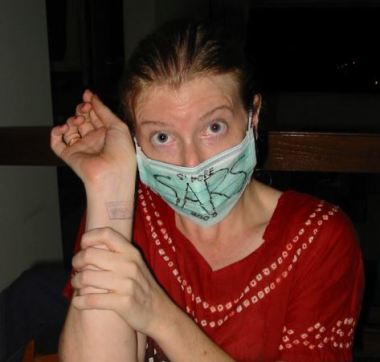
Beginning tomorrow there will be daily checks at the dormitory apartment building where I live.  We have been issued thermometers.  Every morning the residents of our complex, all 350+ of us, are supposed to line up to have our temperatures taken.  Should we be “cleared” we will receive a stamp – HEALTH SCREENING NUS – on our wrists, which is good for the whole day.  The following day we go through the whole thing again.  This will go on every day until the end of May when the policy will be reviewed.  And the stamp colors are changed each day so that we cannot cheat and use the stamp from the day before.  (I want my next one on my forehead!)  Those who fail to turn up for these checks face disciplinary action.

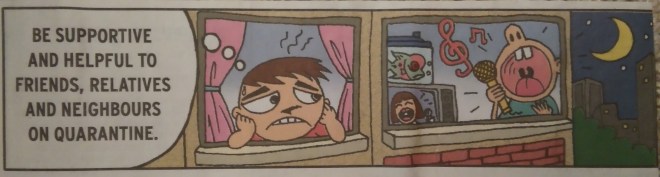
5. support friends in quarantine comic

A few days ago I was a bit hungry and wanted something different than the usual fare, and it being a Sunday the school canteens were closed.  A friend drove me to the National University Hospital, which has a Deli France.  The scene which met me as I stepped out of the car and up to the entrance was straight out of some movie.  The people were dressed all in plastic with hats and gloves and face masks.  I explained I just wanted to get a sandwich and they said I just needed to go through this small procedure before I could enter the hospital.  I was given a clipboard with a form to fill out (have you been to Hong Kong, Hanoi, Toronto? In the past few weeks have you been around a SARS victim?), and then they took my temperature, issued me a sticker badge only for the Food Court and ATM and my very own mask.  Then properly masked I headed off to get my sandwich.  I was not so nervous until I saw those hospital workers decked out like that.  I will not be getting any more sandwiches from the hospital for some time to come.  It felt very odd because just a week before the SARS outbreak my best friends and I had enjoyed a lovely lunch there.

The other day I stepped into the university bookstore and already there were two books on sale about SARS.  I went to our local supermarket yesterday and there were very few fruits and almost no veggies. I didn’t make the connection until a roommate reminded me that the Pasir Panjang market closed down because a worker there came down with SARS.  The market, a major supplier of produce in Singapore was shut down. 7-11 is selling SARS kits for S$19.90 which includes masks, gloves, vitamins, and related items.

6. Me in SARS mask 2003 close up

Look, I got my stamp, so I’m good to go.

A few quarantined individuals broke their quarantine so now things are even more stringent.  In a special congressional session the government is going to pass a law that allows people who break quarantine to be fined.  Quarantined individuals who refuse to answer their phones will have to wear electronic tracking bands.

The final thing is this screening at Changi airport and at the causeways connecting Singapore and Malaysia.  Now they have infrared temp screening for all passengers/arrivals/departures in Singapore.  The authorities are looking into putting these machines in other places.

These are certainly strange times in Singapore.


Sick, Abroad

I am writing this post from the comfort, or, er, sometimes discomfort, of my Medevac (Medical Evacuation) to Washington, DC. This post however is NOT about my Medevac.

Someday, I might be able to write about this, after I have put some distance between myself and this whole crazy, stressful, yet, I hope and believe, ultimately positive experience.

To keep my mind off the current situation my mind has turned to some of my past experiences when I have found myself a bit more than just under the weather while overseas. The pre-Foreign Service, pre-Medevacs times.

There have been those days when I just did not feel right. You know those days, they happen to everyone. But when you are traveling or living solo in a foreign country those days may feel all the more bewildering and lonely.

So there was that time I had my appendix out in Japan.

In January 2000, a few days after returning to my teaching job after a lovely Christmas and New Year’s getaway to Australia, I came down with an excruciating stomach pain. It started an hour or so after eating, the pain building by the hour. Eventually, convinced I had a terrible bout with food poisoning, I called my Japanese friend Tomomi who called the local ambulance to collect me.

I lived in the small town of Kogushi, which in Japanese means “little stick,” (which I found rather appropriate) located on the famous San-In coastline of Yamaguchi prefecture. I was half way through my third and final year of teaching English at the local high school. I not only taught at the school up the street but once a week, on Thursdays, at another high school in the next county over, and alternating on Tuesdays a school for the deaf located about 45 minutes away, and the local hospital school. The hospital school was adjacent to the small county hospital, and this is where the ambulance took me.

Tomomi, a student in my three times a month adult class, who had become a close friend, however met me at the hospital to assist. Though I had thought it to be a very bad case of food poisoning it turned out to be appendicitis; I was scheduled for emergency surgery the following morning.

I learned a lot from my time in Japanese hospital. I quickly learned the Japanese words for IV, pain, nurse, doctor, and all manner of hospital-ese. I have forgotten them all except for “appendix.” Pronounced “moe-cho” I thought it sounded like “mo-jo” and I like to say I had my mo-jo removed in Japan. I also learned how amazing a health care system can work. The ambulance, albeit in a small town, arrived quickly, and was also free. My whole bill came to about $800. This included the operation, my two days in a private room, and four days in a shared room, everything. As an employee through the Japanese Ministry of Education, I was enrolled in the Japanese national health care system. Because my bill was less than $1000 I had to pay upfront, and then seek for reimbursement. To do so I filled out two pages, front and back, of simple paperwork – my name, address, date and type of illness, the procedures, the hospital information, and then the information of my post office savings account. Within ONE WEEK the entire amount was reimbursed directly into my account. I am still in awe of this efficiency all these years later.

Then there was that time (or rather the two times) I came down with food poisoning in Nepal.

On my next to last day in the country my two travel companions, A&P, and myself decided to celebrate with dinner at a recommended Western-food restaurant. P and I ordered the same delicious chicken dish. It was scrumptious. Then the next morning, around 6 am, my stomach cramped up. Bad. It was race to the restroom time. Again and again. Thankfully I had one of those wonderful backpacker rooms with the tiny bathrooms, which allows one to uh, excuse me, well, you might know where I am going with this. (If you have been a sick backpacker abroad with one of those closet sized rooms then I am sure you and I are on the same page).

After hours of this I walked, or rather crawled, up a flight or two to A&P’s room to discover that P too had had a disagreement with dinner. I had planned for a final day of sightseeing before heading to the airport the following day, but the most I did was walk really, really slowly to a place where I could buy beverages to keep me alive curled up in my room. A&P stayed on another few days and A took P to the doctor who confirmed food poisoning.

That was in the Spring of 2001. Fast forward to Fall 2002 and I find myself back in Kathmandu for a week. I planned to finally take the trip out to UNESCO World Heritage Site Boudhanath Stupa and then Pashupatinath, Nepal’s most important Hindu temple. These were the same sites I had missed the previous visit and to celebrate my plan I went to the same restaurant and also had the chicken. Was it really so shocking that in the middle of the night, around 1 am, I woke up with a familiar and unfortunate feeling? I tempted fate and it came back and bit me.

Yet I was determined. Though up most of the night with my, uh, issues, I dragged my weak, dehydrated self out to Boudhanath and then for extra measure walked the 2+ kilometer walk to Pashupatinath. The walk revived me some and my initial impressions of the temple were positive; it was colorful and the cultural importance and the comings and goings fascinating. However, then the smoke from the funeral pyres started to get to me, my stomach reminded me of its’ earlier malcontent, and I unfortunately caught site of a body part in a pyre alongside the river and I knew I had to get out of there.

I suppose getting food poisoning twice by the same restaurant in Kathmandu trumped the time I came down with a terrible bout of stomach issues following a cooking class in Thailand. I did not know whether to blame the green papaya or chicken from the wet market or my preparation of said items.

And then there was the time I came down with the mumps as an adult…

Yes, you read that right. And yes I did in fact receive the MMR vaccination as a child.

After I returned from that second bought of Nepalese food poisoning, I had a weeks of finals in Singapore, and then I flew to Bangkok to begin approximately seven weeks of backpacking in Thailand, Laos, and Burma for winter vacation (oh, I miss graduate school). In Bangkok my jaw started to ache, in a way it had never ached before. The following morning before I flew to Chiang Rai I had a lump on my jaw and felt queasy. By the time the plane landed I could hardly stand and my jaw had swollen even more. I made it to a guesthouse, checked in, got my pack to my room, and then stumbled down to the front desk area to ask if there were a clinic nearby. When I explained I could not walk to one even 500 meters away, a man in the lobby jumped to his feet and declared he would take me on his motorbike. He not only took me to the clinic, but he also waited with me and during my appointment, took me to the pharmacy, and then back to the guesthouse. When I tried to offer him payment he stated he was a Thai policeman and that is job was to help people. Awesome.

The doctor had told me that I had “mume.”which seemed a mysterious illness indeed. I put on a hoodie to cover my misshapen face and then secreted out to an Internet café where I used one of those online medical sites to input my symptoms and voila – mumps. I made sure to purchase a fair amount of beverages so that once again I could sequester myself to my room. I also bought a packet of pumpkin seeds – one of my favorite backpacker snacks – and after eating maybe three of them that caused my jaw to throb for hours afterward I was very, very sorry.

I read my Paul Theroux book and played many, many hands of solitaire with the deck of cards I used to always carry in my pack. After a week I felt well enough to move on – to the Thailand/Laos border to continue my trip, including a two day slow boat down the Mekong River.

Besides these rather unforgettable experiences I have had a few other opportunities to experience medical care overseas – I had my first sigmoidscopy in Tunisia, an emergency doctor visit in Singapore when my fever spiked and my hotel implemented their SARS protocol (I was SARS-free), my first pregnancy ultrasound in Jakarta, and a fun emergency room trip in Tasmania the night before a half marathon.

Thinking over all of these experiences reminded me that while I did feel pretty awful at the time, I did recover. And I shall recover from this too (the procedure was successful and I am on the mend). And maybe someday I will be able to write about it.

I Love You Backpacking Long Time – Part Twelve Vietnam, the Finale

A few days before departing Kathmandu A&P asked me what destination I had planned next. Somewhere in Southeast Asia, but I really was not sure. They were heading next to Vietnam and asked if I had no other plans, would I want to join them? I had worried that I had become a bit of a third wheel – but they liked me, they really liked me. I agreed.

DSCF0791

Vietnam snake wine – not for the faint-hearted (and not for me either!)

I flew out of Kathmandu a few days before them so that I could secure my Vietnamese visa and flights from a Khao San Road travel shop. So I did not learn that P had visited an American clinic in Kathmandu and learned she was suffering from both dysentery and food poisoning – and I likely had had the same – until after we met up in Bangkok for our flight to Ho Chi Minh.

Welcome to Vietnam! My friends A&P and I hung back at bit at the airport a bit hesitant to throw ourselves into the throng of people waiting to whisk us off. One guy in particular was persuasive so we went with him. We get to his cab and it’s not a cab. It’s his private car. Oh well, his price sounds reasonable so we put our things in the trunk. He purposely leaves the trunk open as he strides to the front door. We don’t like that – what if we stop at an intersection and someone opens the trunk and makes off with our bags – so we shut the trunk. Oops – the driver just realized his key broke off in the trunk lock. He cannot open the car doors or the trunk; we cannot get our bags out of the trunk. The guy sends a friend on a mission – he returns with superglue to try to glue the key back together…and amazingly it works. We switch to a real taxi, the friend of the first guy. We ask him if it is the same price. He doesn’t answer. He switches on the meter. We ask him again. No answer. Alright. We arrive and the meter says 48,000 dong. We pay 48,000 dong and he is upset we do not pay double. Why use the meter then? And suddenly the guy speaks English. We grab our bags and walk away. We are already tired and we have only been in the country about an hour.

DSCF0774

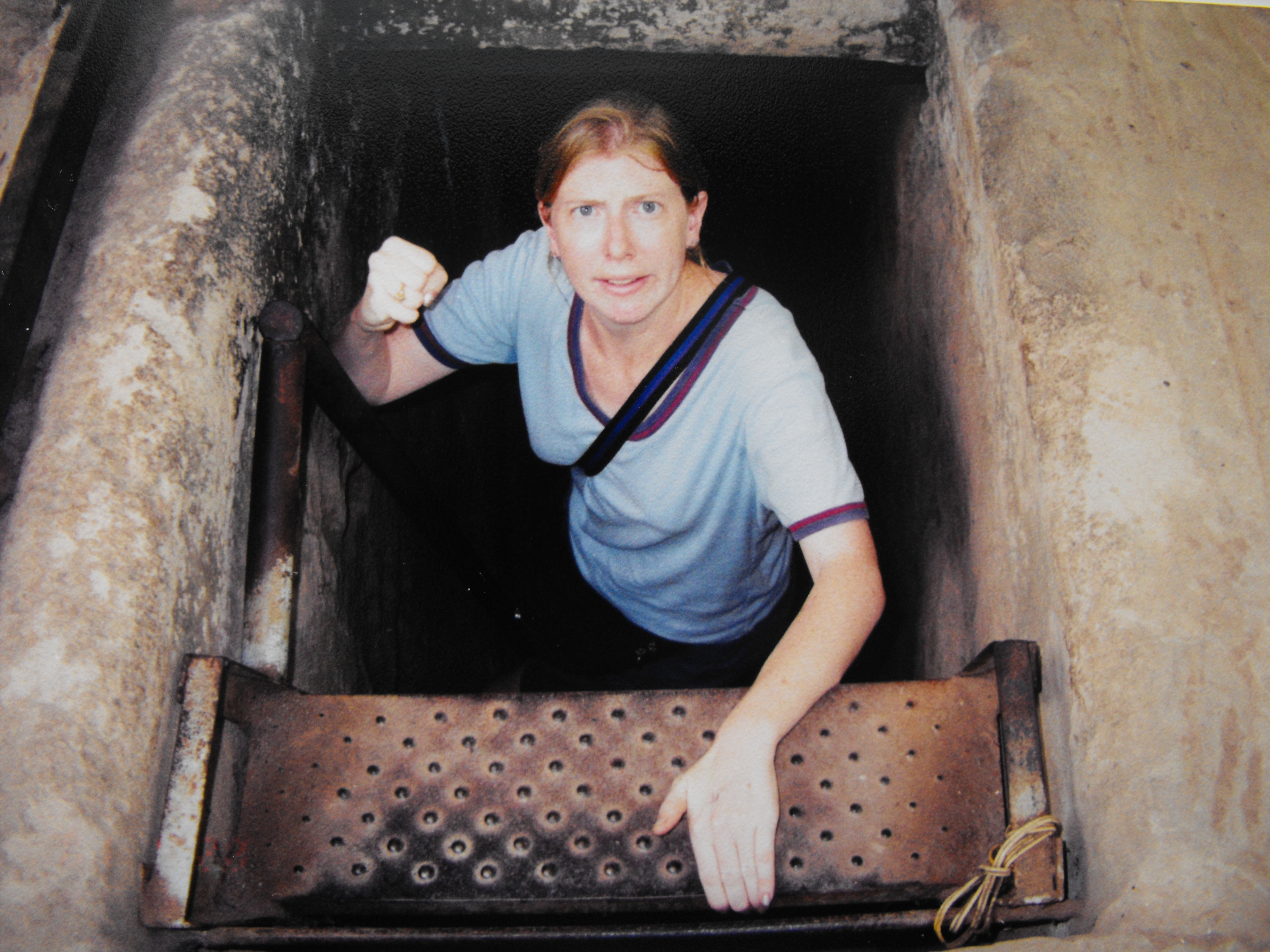
I try to get into the spirit of things at the Cu Chi tunnels

Our first full day is an adventure, but not for the lighthearted. We take a tour to the Cu Chi tunnels, where the Viet Cong dug some 250 kilometers of underground tunnels. We watch an old movie about the brave Cu Chi people killing Americans and winning “American Killer Awards.” We get to walk (or rather stoop) our way through the tunnels and see some innovative torturous traps build by the Cu Chi people. The tunnels are only about 40 centimeters wide and 80 centimeters high, but also join to meeting rooms, kitchens, sleeping rooms and such, as well as consisting of three levels. It is an amazing display of what people can endure to fight for what they believe in. It is also very sobering. The weapons they fashioned from recycled American weapons were clever and terrifying. Then we arrive at a shooting range where tourists can shoot a couple of rounds of an AK-47 or an M-16 or some handguns for just $1 a bullet! I decline this amazing opportunity and put some tissue in my ears. On our way back we visit the War Crimes Museum, now renamed something like the War Remnants Museum.

We had wanted to leave the following day north to Nha Trang but the bus that day was full, so we instead took that day to rest. We had also heard that people get hassled on the beach in Nha Trang so we first headed to the quiet beach town of Mui Ne for two days to rest up. At Mui Ne we stayed in tents on the beach and it was indeed quiet. Just sand and surf and a few backpacker areas.

DSCF0786

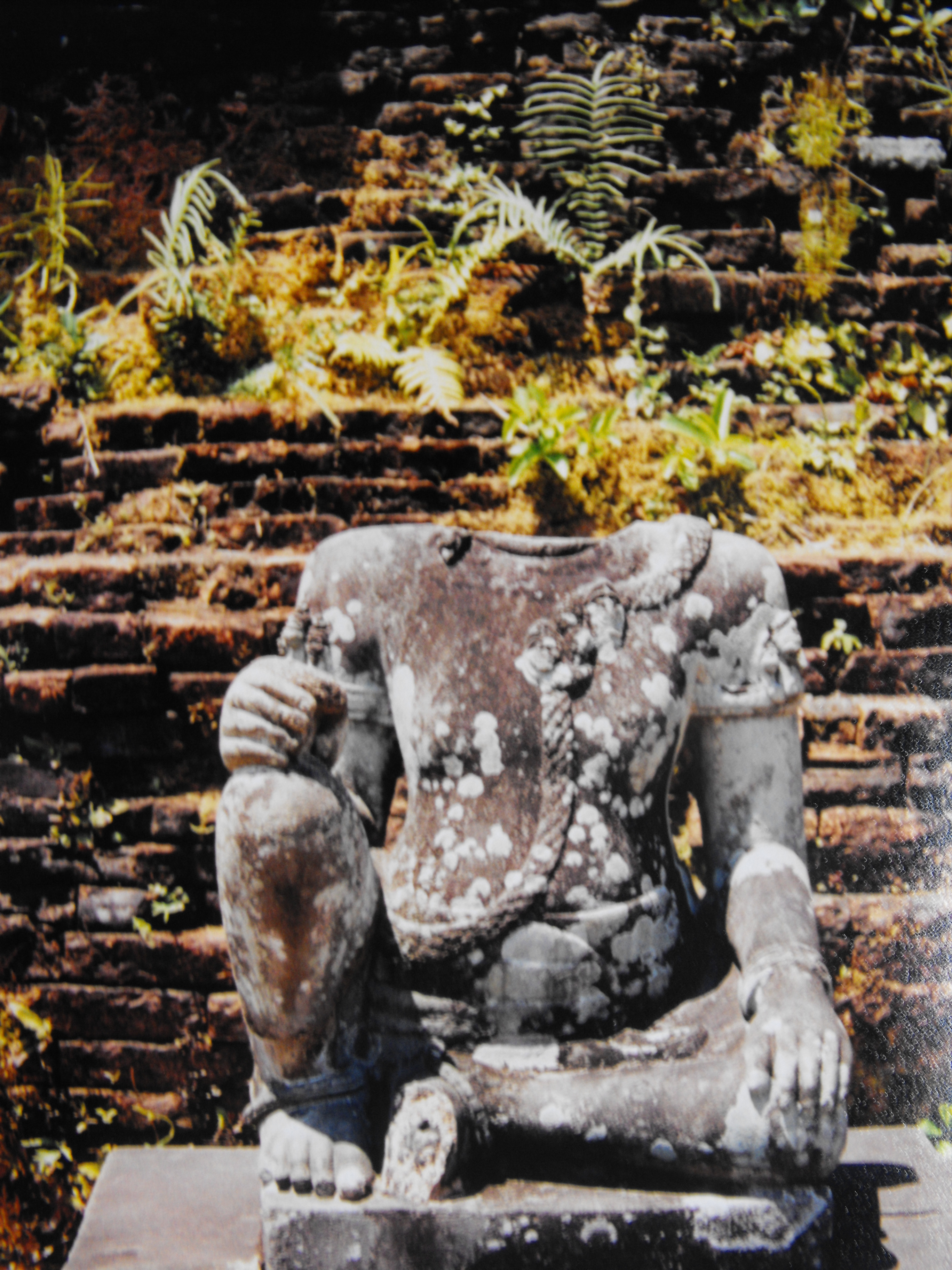
A statue at the Cham ruins, My Son. Yeah, that is the name of the temple complex, I’m not saying “my son.” Nope, I’m not.

Nha Trang was crowded. The touts were out in force. It was near impossible to relax on the beach without being pestered. I refused to take the much touted all-day backpacker boat trip. Given that I have very fair skin, do not eat sea food, a healthy fear of the ocean, and have a low tolerance for stupidity, I could not stand the thought of spending hours on a boat, likely burning to a crisp, with a bunch of boozed foreigners, swimming in the ocean and then being “treated” to a seafood lunch. Instead P and I both had traditional Vietnamese dresses made and we all visited the Cham ruins and the Ba Ho Waterfalls.

The waterfalls were cool – both the scenery and the water – but the problem of unwelcome requests, even demands, for money took away from the enjoyment.  A boy started carrying P’s bag at the waterfall. He just appeared out of nowhere and we surmised he was our guide included in the entrance fee. I started to wonder whether he was going to ask for money but seeing as hour our guild for the day tolerated him, I thought maybe it was okay. But when we arrived back at the entrance the boy demanded 10,000 dong from each of us, although he had carried only one of our bags. As usual it seems a good time cannot be had without the locals asking for some money, often for nothing to do with us. And everyone is in on it from little children to seniors.

DSCF0777

At the Ba Ho waterfalls – and the amazing part is that I leaped in from the ground above. Sometimes I am rather badass.

I completely understand the desire for everyone to try to make some money, not only to make ends meet but to provide extra for their families. I tried very hard to keep this in perspective, but there are times when too much of it day after day can wear down even the most generous of travelers. In retrospect, I read these complaints in my diary and recall some of them with the trigger to memory, but for the most part I forgot these annoyances and remember mostly that I enjoyed Vietnam immensely.

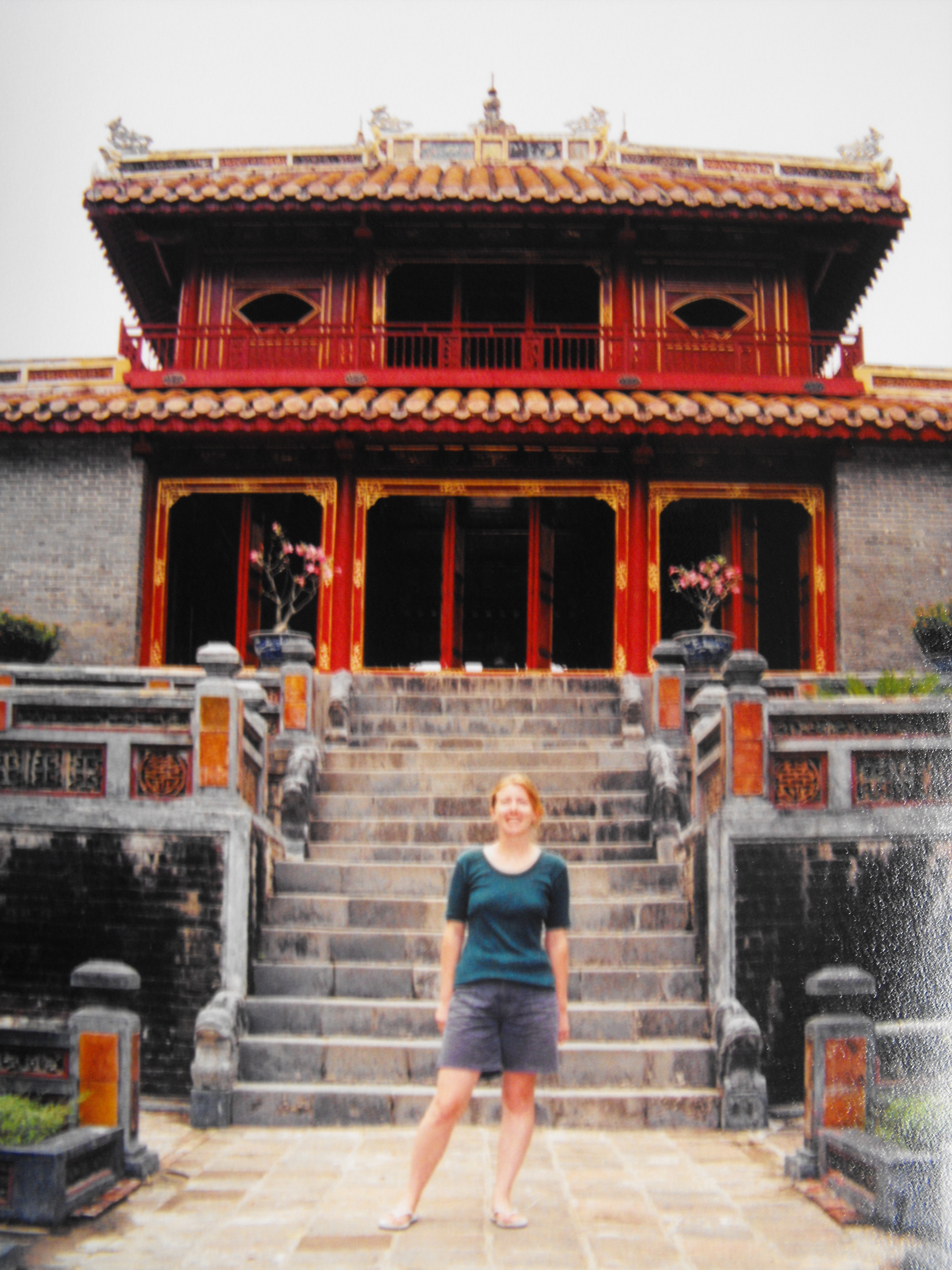
A&P and I parted ways for a few days as they had a week longer in Vietnam than I did. I headed from Nha Trang to Danang of China Beach fame, then the lovely and quiet Hoi An with its unique Japanese covered bridge and on to historic Hue. There I took a tour on the Perfume River visiting three royal tombs of the Nguyen Dynasty, a temple, and Thien Mu pagoda.
Next I took an overnight bus from Hue to Hanoi. We departed at 7 pm and it was to take us some 14 hours to get to Hanoi, or so the brochure said. I wondered about our two drivers, it seemed only one was a driver and the other one had the job of keeping the driver awake as he seemed too young to have a license. That should have given me pause, and well it did, but not enough to get off the bus.

At some point in the night, around 4 am we were all jolted awake with some pretty loud thumbs and crashes, some screeching breaks, and finally our bus falling into a large ditch in the middle of the road. It would seem there was a road block of sorts set up for repairing the road, but the driver (and his assistant) were a little too tired and/or the road too dark to see the several “road closed” signs and we crashed through several barriers before landing in the two to three foot hole. We were lucky no one was seriously injured!

DSCF0790

At a temple somewhere in Vietnam.

We all climbed out of the bus to survey the damage but it was pitch-black, middle of the night, and little could be seen. As luck would have it a small road side restaurant happened to be just across the street from our accident site – and even at that early hour was open. It was simple, coffee and tea, very basic bathroom facilities, and once 6 am came around they offered simple Vietnamese breakfasts that involved French bread, eggs, rice, and the like. During our forced rest stop, the driver, assistant, and some random locals worked to free the bus. It took several hours and it was probably 8 am before we were back on the road again. However, the driver must have been keen to make up time and he barreled down the roads, emboldened by daylight and coffee. I was exhausted but a little afraid to fall asleep. Just as I was doing so the driver plowed right into a dog on the road. There was no hesitation, no reduction in speed; he did not swerve at all. I just wanted off that bus.

Once in Hanoi I booked a three day, two night trip into Halong Bay. This was a fairly big deal for me as I knew I would be trapped on a boat with some party-types for some period of time but it seemed the best way to get out to the bay.

Yesterday before the five hour trek through Cat Ba National Park we stopped at a cave which had been transformed into a base of operations for the Viet Minh. The cave was built into a bunker with the help of the Chinese from 1960 to 1964. Inside the cave we had a local guide, a man who had served in the war. He sang us a military song and demonstrated how he took out enemy planes by shooting his arm up and down toward the ceiling while making blast noises. I realized though that he is a veteran of war just like any other veteran; he is probably pretty happy retelling his stories of valor and excitement to foreigners.

What I recall most of the Halong Bay adventure was the giant black and white mosquitoes I referred to as Zebras who buzzed and bit relentlessly during the hot and sweaty five hour hike. I also remember that the swim in the bay was nowhere near as bad as I had anticipated and I got in and swam despite my fear. I thankfully forgot how much travel time the whole thing took – at least a four hour drive from Hanoi to Halong City and then a four hour boat ride from Halong City to Cat Ba island.

DSCF0815

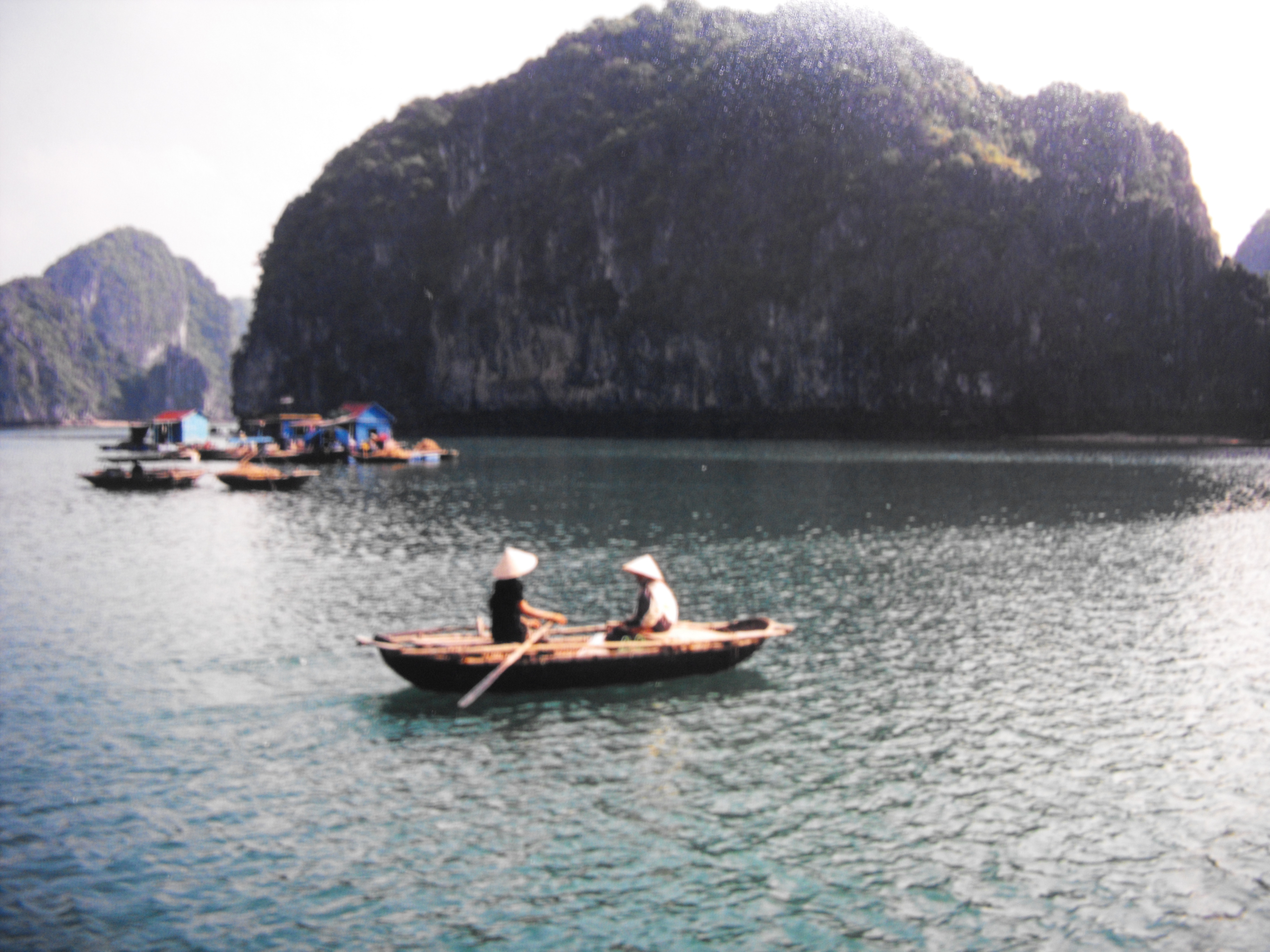
Cruising in the beautiful Halong Bay

Back in Hanoi I reunited with A&P – we rendezvoused to visit the mausoleum of Ho Chin Minh and to see a show of the traditional Vietnamese art form of water puppets. We saw Uncle Ho and the Puppets and decided should we ever form a band that this would be an excellent name. It was kind of creepy to see Uncle Ho because he has been dead for 30 years, but it looks like he is just taking a nap. The puppets were enchanting and really unique.

We also visited the Ho Chi Minh museum, Quan Thanh temple, and the Temple of Literature.

And then it was time to depart; it was not only the end of my three weeks in Vietnam but it ended my eleven months of travel from Finland through the Baltics, then Eastern and Central Europe, the Balkans, to North Africa and finally to Asia. So many border crossings and currencies and cultures. Planes, trains, boats, buses, motorbikes, tuk-tuks, cyclos, camels, horses and elephants, and lots of walking long distances on my own two feet. I was swindled and threatened; I was the subject of a lot of male harassment; I was attacked by dogs; I developed a lifelong intestinal condition; I had food poisoning. I also made friends, heard some incredible stories, saw amazing sunrises and sunsets, visited places of extraordinary history and/or beauty, fell in love, and pushed myself physically and mentally on a remarkable journey of a lifetime.

I did return to Bali for two more weeks to collect my things, do some final shopping, and make some promises I could not keep, then it came time to head to Monterey, California to begin graduate school and start the next chapter.

DSCF0523

With my trusty backpack

I Love You Backpacking Long Time – Part Eleven Nepal

Nepal was so different. It was an enlightening breath of fresh air and exciting and just a tad crazy.

DSCF0724

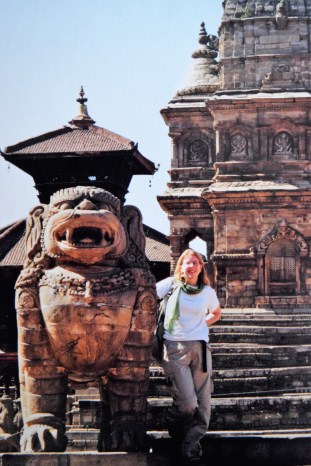
Kathmandu’s Durbar Square

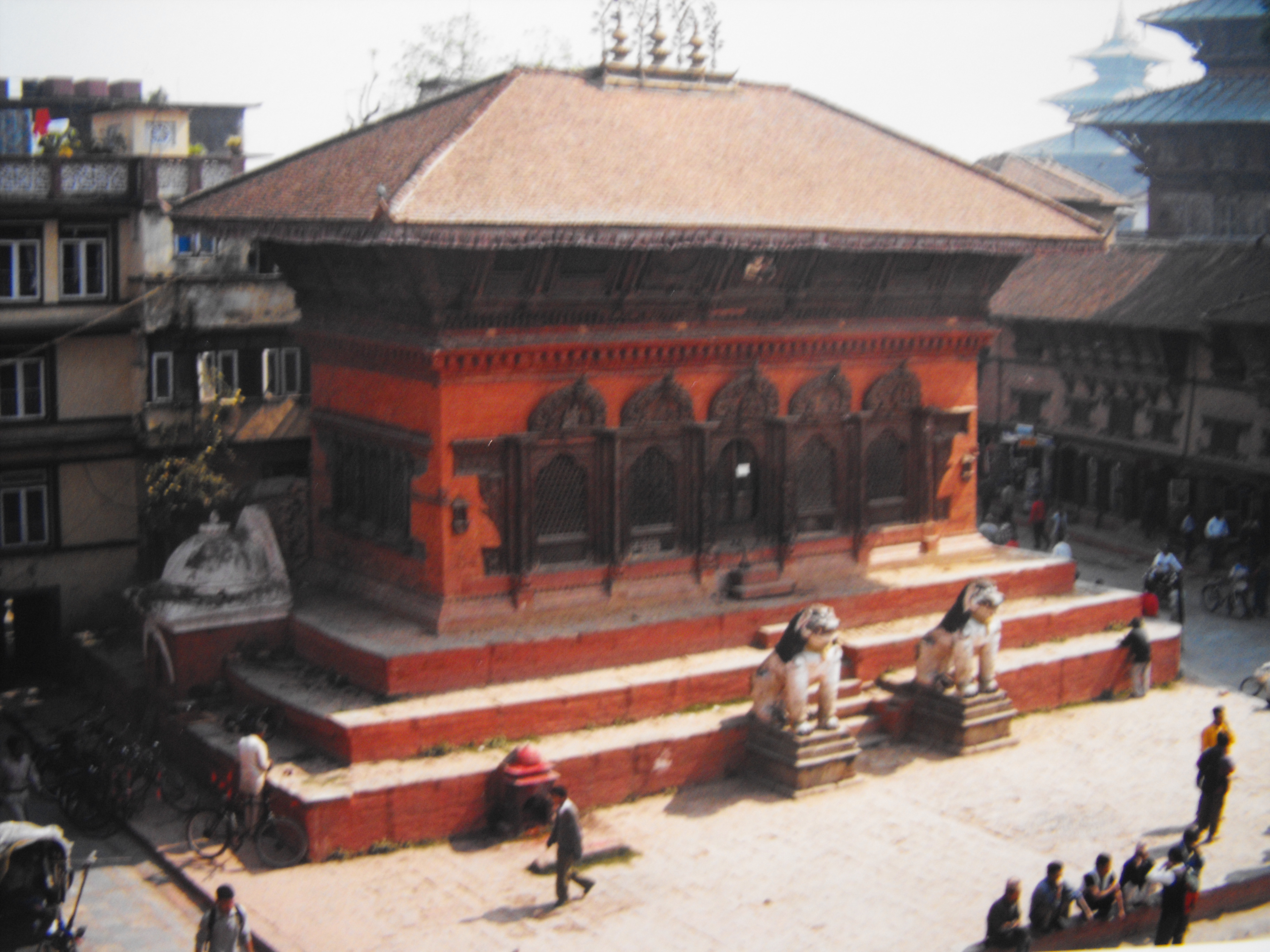
My first days in Kathmandu were interesting to say the least. I stayed in Thamel, the tourist mecca section of town, in a simple guesthouse. I loved wandering the streets heading down to Durbar Square. I stopped at small flower markets at traffic circles (none of which were actual circles, more like traffic triangles where narrow roads come to meeting point), watched Nepalese Sadhus, waited outside the temple of the Living Goddess for her appearance, and just soaked it in. I visited the temple of Swayambhunath, taking in the prayer flags, monks, and prayer wheels, and the UNESCO World Heritage Site city of Bhaktapur, with its astonishing temples and palaces (I took a rickety old bus missing several floor boards to the city; it was awesome).

DSCF0731

Happy in the rickshaw before setting out, before the driver cursed me and my family.

In my first few days in the country the Maoists, who at the time were becoming quite a problem for the government, staged a strike in the capital. Most stores closed up, pulling down corrugated metal doors at their storefronts to prevent break-ins and looting. As I had heard most buses and cars were also to be off the road I hired a bicycle rickshaw driver to take me to Patan, another of the UNESCO World Heritage Site cities of the Kathmandu Valley. It was only 5 kilometers away and the rickshaw driver agreed – he had taken me to Swayambhunath the day before. The trip to Patan and back was fine. It was after he dropped me at a hostel in Thamel and it came time for payment that things went horribly wrong. I know we fixed price beforehand but upon returning he wanted more than we had agreed on. I said no. He refused to take the money. He spit on me. Cursed me. Cursed me and my family and our next generations. He wished me dead. Even though I was not actually staying at the Hotel Backpackers Inn, I hid in their lobby/lounge area as they had armed guards. From the parking lot entrance the rickshaw driver screamed obscenities at me for at least 20 minutes.

That sure was interesting.

I took a public bus to Chitwan, where I headed to the National Park. It was a pretty awful ride. It seemed to take forever although we took turns or precipitous cliffs with breakneck speed and had to stop for awhile as a large boulder the size of a rickshaw had rolled onto the middle of the road. It was exhilarating!

I had an awesome time at Chitwan!

DSCF0741

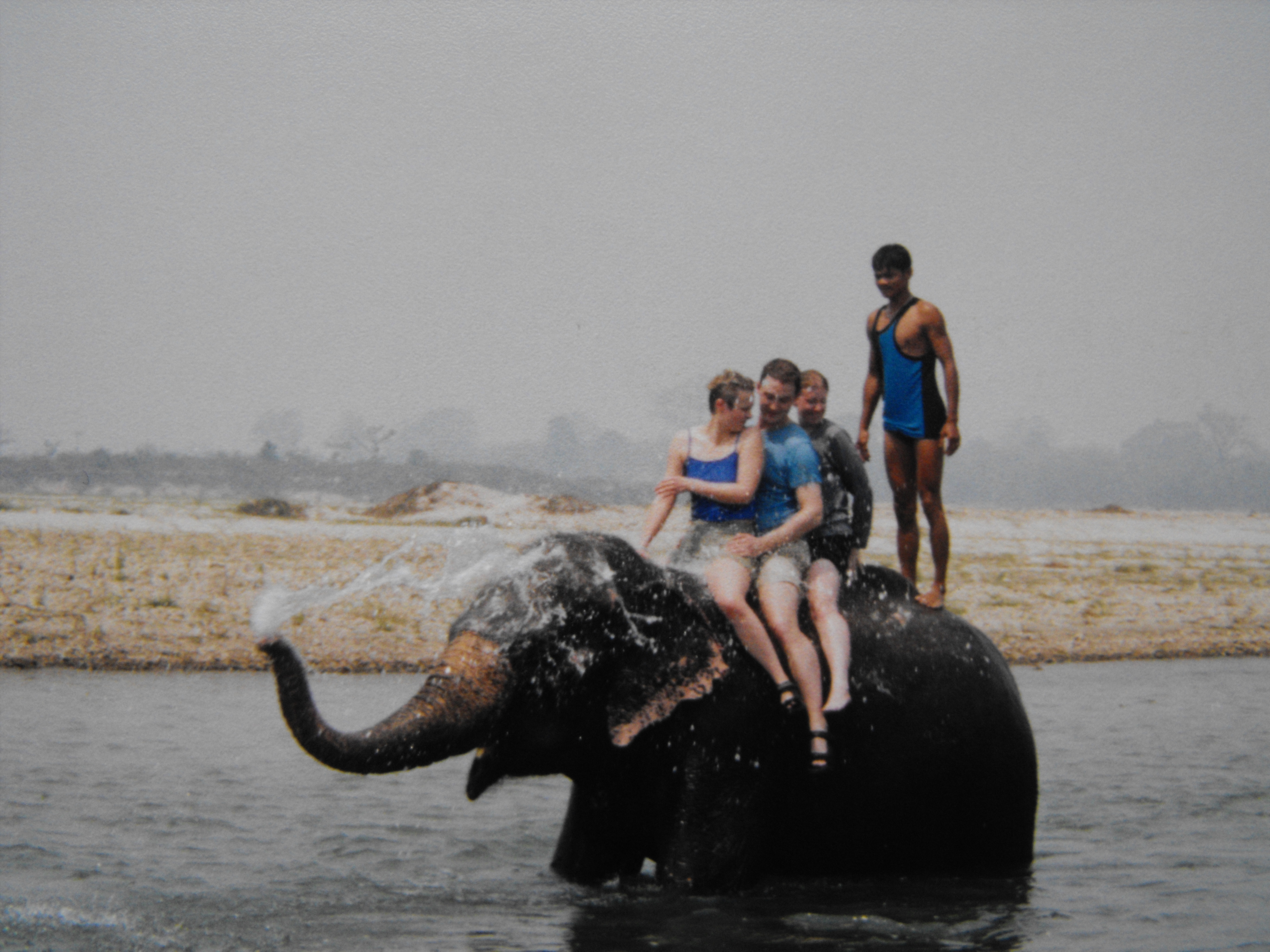
A&P and I having a “bath” courtesy of this cute elephant.

Yesterday was very eventful. After breakfast we had a canoe ride for about an hour, followed by a three hour jungle walk. The guidebook had said these were not very safe. One of the hotel staff had informed us that just ten days before a Nepali tourist had been killed by a rhinoceros and that usually 1 to 2 people are killed annually. This was not comforting news. After getting out of the canoe the guide briefed us on evasive techniques were we to encounter any of the parks three dangerous animals: sloth bear, rhino, or tiger. [I still remember these techniques: if you see a bear, make noise. If you see a rhino, climb a tree or run in a zigzag. If you see a tiger, pray.]

We walked with two guides, one at the front and one at the rear, armed only with four-foot long sturdy sticks. The first animal we came across was a four foot long gharial crocodile sunning itself on a sandy area in the middle of a stream. Then we came upon many piles of rhino dung, some of it fresh. I wanted to see if I could climb a tree and found myself a rather poor climber…I saw myself likely being trampled by a rhino as a result.

DSCF0745

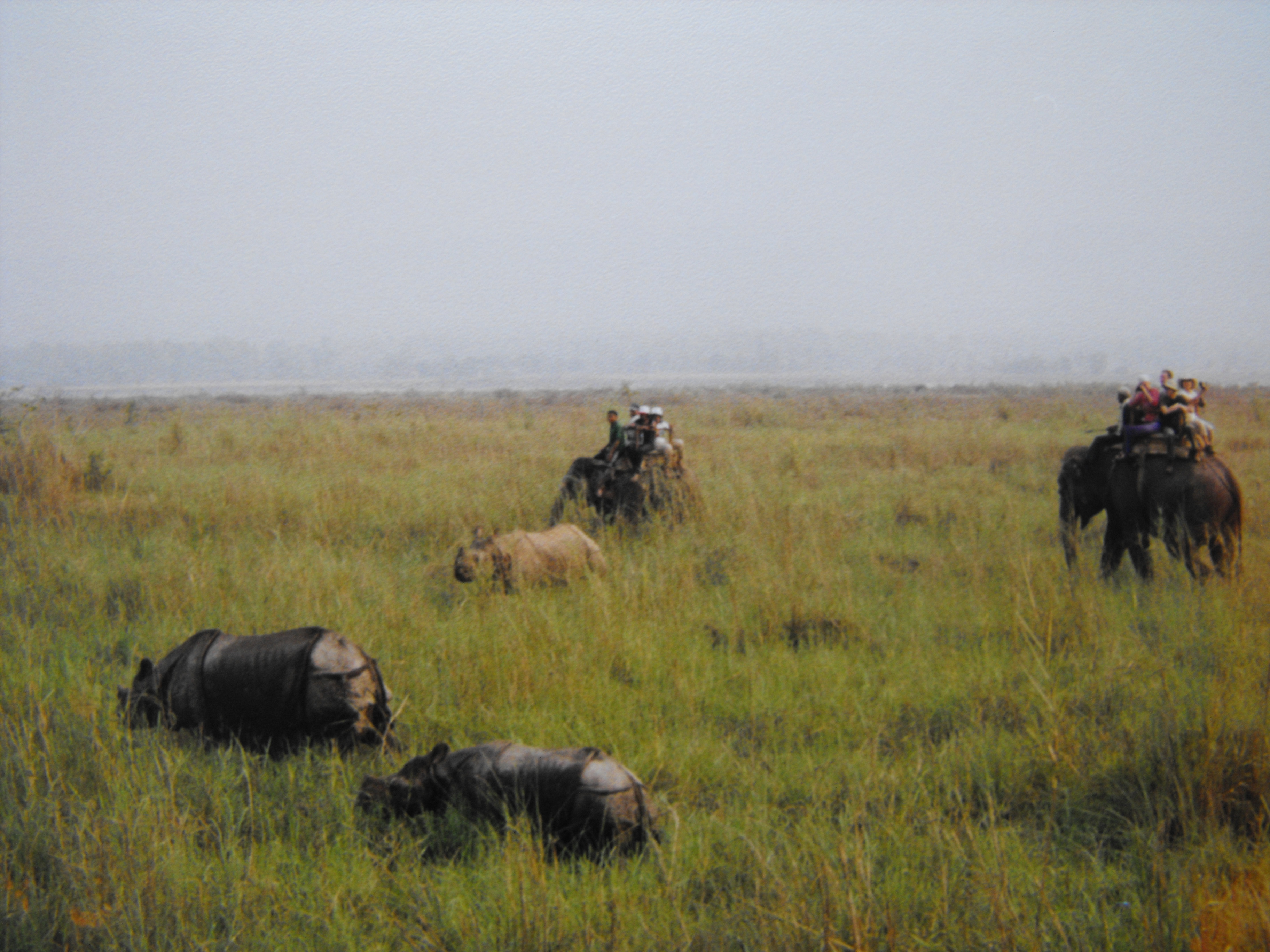
I am sure this was totally safe, teetering atop elephants among rhinos.

Rhinos were spotted and so up into the trees [I had to have someone boost me up]. After ten minutes they trotted off and we climbed down and continued our walk. Only five minutes later we were running through the brush to see four rhinos together, just over 50 meters away (and few good climbing trees in sight.) It was very exciting. We saw no more rhinos but we did see monkeys and heard what might have been a bear quite close to us. After lunch we began a five hour jeep safari. On this trip we saw one bear, 12 rhinos, several crocodiles, wild pigs, wild chickens, deer, a monkey and a wild cat.

It was here I met British-Finnish couple A&P, with whom I would travel the next five weeks with. This morning a British couple and I went to the elephant breeding center by bicycle. Later we paid extra for an elephant bath. We also took an elephant safari ride together for a few hours. The elephant ride was a bit bruising and slow in parts, but we saw many rhinos up close and even saw two fighting.

DSCF0750

Pokhara town center type of entertainment

We next headed to Pokhara, a lovely little town that serves as a base for trekking trips into the Annapurna Mountains. Here I met Tsering, a Tibetan refugee woman, in the center of town selling jewelry. I bought several pieces from her and got to talking. The following day A&P and I took a taxi out to the Tibetan refugee village several kilometers outside Pokhara to visit Tsering at home. She gave us a tour of the village and welcomed us into her home with many cups of yak milk tea (delicious!) and stories of her family. I stayed in touch with Tsering for many years, sending clothing for her five girls and exchanging letters and the occasional email.

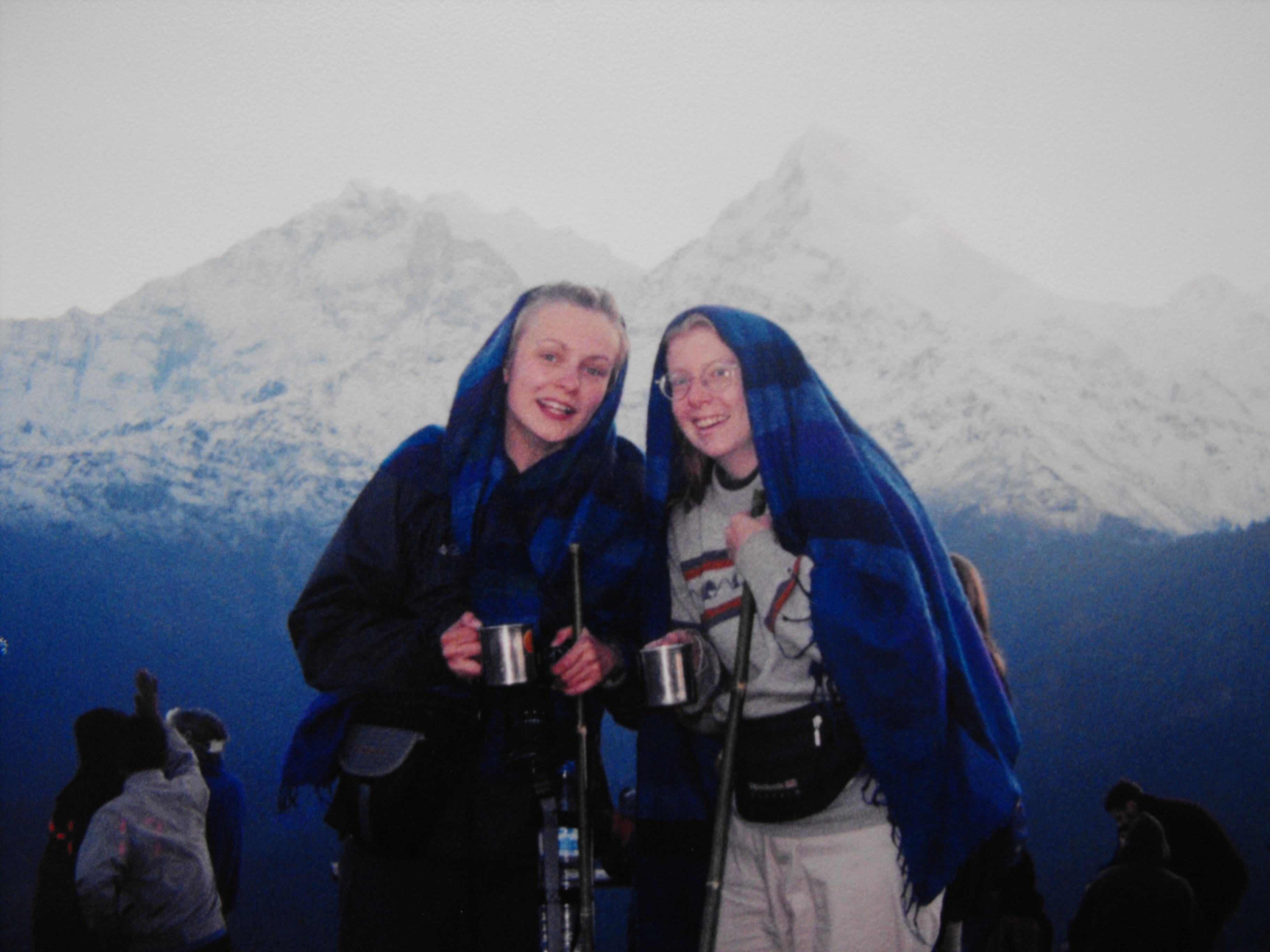
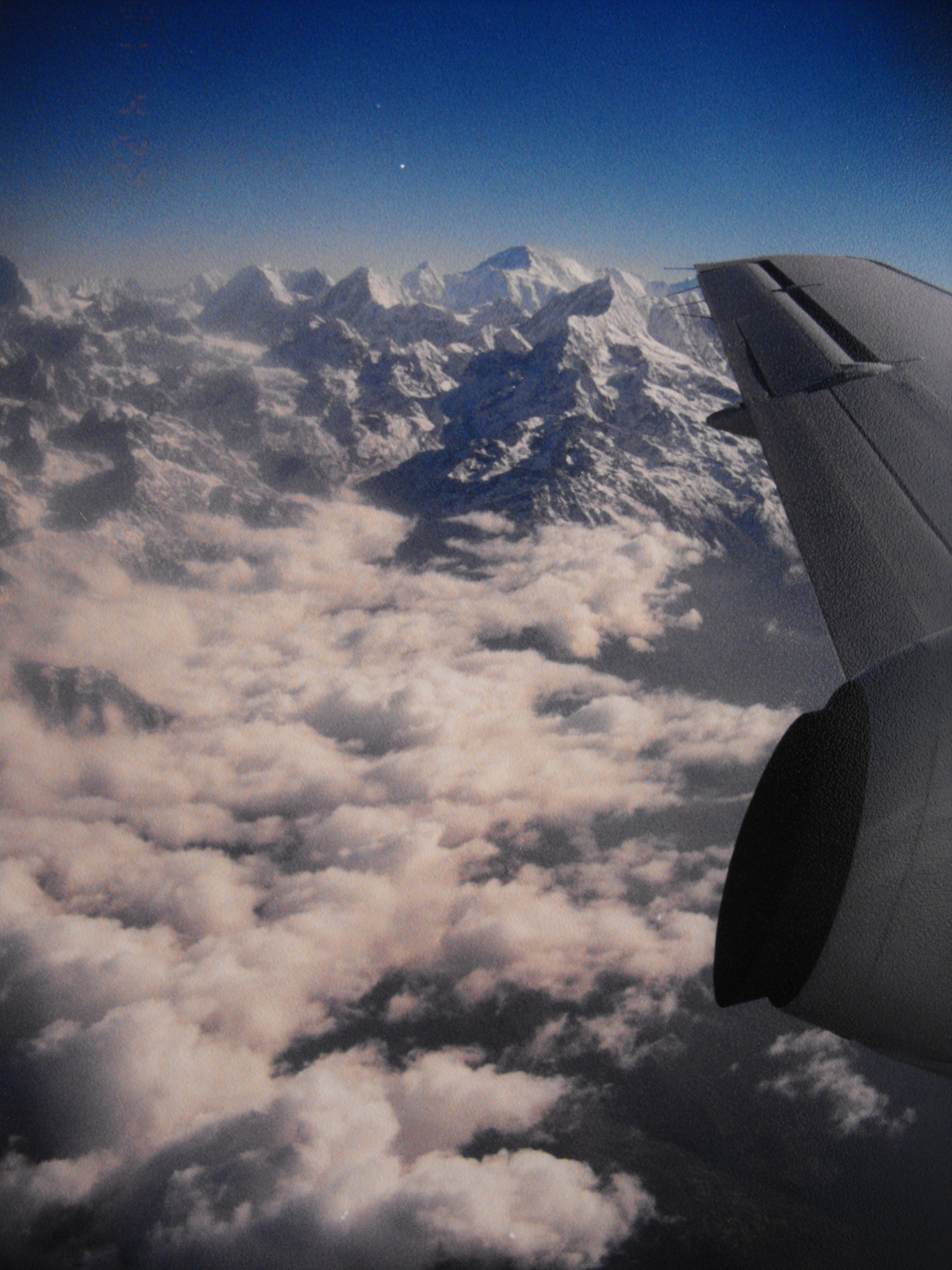
A&P and I signed up for a four night, five day teahouse trek. From the first day in Nepal I had seen trekkers and I had wanted to do one but as a solo traveler did not see it as something realistic. But after meeting A&P they too revealed they wanted to do a trek but not just on their own. We joined forces and had an incredible, and at times tedious and exhausting and dangerous, time.

DSCF0755

The views are totally worth the hike

Day One. April 14 2001. We left on our trek the first day of the Nepali New Year 2058. It seemed a nice way to start off the New Year. Our guide Ram and our porter Bhim, met us at our hotel with a taxi at 7 am. With five of us it was pretty crowded and the one hour drive to Naya Pl was not the most comfortable. But we were beginning our trek and we were excited. We walked from Naya Pul to Birethani for breakfast and the beginning of our trek. Ram told us the first day would be about six hours and pretty hard as it is all uphill. We did pretty well though making it to Ghandrung in four and a half hours even with rain for the last hour. I was absolutely thrilled with the first day because my legs held up and we made great time. I was all smiles. We played a few games of billiards at a local place, had dinner, and went to bed around 8:30 pm.

DSCF0756

That’s me, the hiker of the Annapurnas

Day Two. We were up around 6 am to see the sun rise and the peaks were absolutely stunning. The walk that day was short (three hours) and pleasant, through a wooded area. But we arrived before noon, thankfully before the rain, and had almost nothing to do for hours. The stop, Tadapani, consisted of a few lodges and restaurants and Tibetans selling handicrafts. It was cold and both P and I bought Tibetan shawls [I still have mine!] It was a long day and I would have preferred a little more walking to have something to do.

Day Three. From Tadapani to Ghorapani was about a six hour walk and we did not shave any time off this day. It was a lot of up, up, up and we were tired. It was on this day that Ram the guide asked me if I wanted to be his girlfriend. I told him sorry, but no. He had been peppering me with questions about a boyfriend and dating situations in the west from day one. Before we had started our trek he had helped me set my departure date with Thai Airways and he was trying to convince me to stay longer in Pokhara where he could show me around. I wish it had never happened.

We made it to Ghorapani, at around 2800 meters, with six hours of walking and one hour for a lunch break and rest. We made it just before the rain and hail started. Ghorapani is quite charming, with most buildings painted a bright blue with gorgeous views of the Annapurna mountain range. It’s big drawl, and the reason we had chosen this trek, is its proximity to Poon Hill. At 3200 meters one can see at least fifteen peaks of the beautiful Annapurnas.

DSCF0762

P and I atop Poon Hill with some hot cocoa and wearing every bit of clothing we had with us.

Day Four. We all woke up at a quarter to five in the morning to walk up Poon Hill in time for the sunrise. A was not able to make it up because of some scary drops [he is scared of heights] but P and I made it with Ram. It was a 40 minute climb up. We stayed at the top for about an hour, then the 40 minute climb down, breakfast, and then we set off for Tatopani.

Earlier in the trip Ram suggested that we might be interested in extending our trek one day to add in Tatopani where there are hot springs instead of heading down to Tirkedunga. He said it was an easier route and that it would be easier for A as it would be a lot less steep.

Ram was not much of a guide for the first part, usually going ahead of us or still trying to chat me up. If we got ahead of A&P and I wanted to stop and wait he would tell me they would just catch up. So when I walked more with them Ram seemed to lose interest in us all. This bothered us a bit but I was secretly happy for the time away from him. We made it to Sikha in three hours and stopped an hour for lunch. The trail then had been mostly easy, wide undulating roads. But about an hour later, just after Ghara, an archway opened into a steep cliff face. I was ahead of the others and just knew A would hate it. It was not at all what we had been promised.

DSCF0768

On the bridge that would lead to Tatopani. I am sure this is totally safe.

I was happy to be away from Ram and could feel the excitement of being on my own. I could have waited but I thought it was not far from Tatopani and decided to make a go of it. There was a lone girl and her porter a little way ahead but I had soon overtaken them. I started to feel apprehensive about being on my own as I still could not see the others and in fact did not see any other trekkers. The wind was picking up and a storm coming so I decided to go on. I knew the bridge across the river was not far and Tatopani was to be 30 minutes beyond. I signed in at the police checkpoint and crossed the bridge. I began to worry I was not going the right way but I asked locals and they all pointed in the same direction. I arrived at Tatopani at 3:45 pm, seven hours after we had set off. I waited at the first café for the others who arrived about 50 minutes later.

Day Five. We were off to another late start this day. It was 8:45 am by the time we left and it was already raining. Ram told us that once we crossed the bridges and the police checkpoint, the walking was easy along wide roads and without drop offs. That was not true, and the rain only made the narrow, muddy trails (often only 2 feet wide) worse. A was terrified and P was angry. I too was tired. I did not like being lied to and wanted to distance myself as much as possible from Ram. He had told us it was a five to six hour walk to Galeswor and then another two to three to Beni. His plan was for us to stay in Galeswor another night and then on to Beni where we would catch a bus or cab to Pokhara.

After walking several hours [a hard, miserable slog through thick muddy trails] we asked Ram if it were possible to push on through to Beni and be back to Pokhara that night but Ram said it was impossible. It took us nine hours to reach Galeswor. We had resigned ourselves to another night so we just sat down, took off our shoes, and rested. However at dinner two Canadian women told us it was only another 30 minutes on to Beni. That night I was curled up in bed reading when there was a knock on the door. It was Ram and he wanted to sleep in my room. He said the guide room “smelled funny” but I said no. What a creep!

DSCF0769

The pathway on our final long day. Just a small traffic jam. Notice the narrow ledge. I am sure this was totally safe too.

Day Six. After breakfast we made the walk to Beni in a 50 minute leisurely pace. We waited 30 minutes for a taxi and then had a rough three and a half hour journey back to Pokhara.

The trek was amazing. Absolutely. It was a challenge but the stunning views and backdrop were worth the temporary physical pain. But it was marred by the incompetence, lies and harassment on the part of the trek guide. After returning to Pokhara we learned the company was likely only registered to sell treks but not to actually lead them. Sitting in the office of another trek company, we noticed their comprehensive trek board that listed the names, passport numbers, and citizenship of their trekkers, the guide posted with them, the trek and approximate days. Our trek company had nothing of the sort. When we went to complain to the company they met us only with stares and recriminations. An hour or so after leaving the office we stepped in to another company to book our flights to Kathmandu and on a hunch I requested to re-confirm my flight on to Bangkok and learned that someone had called on my behalf had cancelled my flight. The only other person who had that flight information was the person who had helped me book it in the first place – the trek guide Ram!

Back in Kathmandu we took a one hour scenic flight including a view of Mt. Everest. On our next to last evening we all went to dinner together and the next day I woke up sick as a dog. I could barely move but I dragged myself up to A&P’s room to learn that P too was incredible ill. I spent my last day curled up in a fetus position on the narrow, thin mattress of my cheap guesthouse room.

DSCF0772

The view from the scenic flight. One of these peaks might be Mt. Everest.

Even departing Nepal turned out to be an adventure as my inbound plane was temporarily diverted to Calcutta when Maoists set fire to the one and only runway. Thai Airways put all the passengers on the bus and took us to a nice buffet lunch while the fire was put out and we departed four hours late.

Whew.  Nepal was almost enough adventure for a lifetime.  Almost.

I Love You Backpacking Long Time – Part Ten Still in Bali

I haven’t had a hot shower in over a month. I wear flip flops every single day. I wake up when the roosters start crowing. I have mango or papaya or pineapple or water apples or mangosteens or rambutans or some other exotic fruit every day (though durian, soursops, and snake fruit are not to my liking). I feel fairly busy every day although the next day I couldn’t tell you what I did. It is quite lovely.

Cnv0280

A stack of Balinese offerings. I made a whole bunch of these one day. Not great for the allergies, but a great way to feel like one of the women.

The bus dropped me off at Lovina Beach, in the village of Kalibukbuk, a suburb of the town of Singaraja, in the regency of Buleleng, Northern Bali on Christmas Eve. There I met a cute guy and decided to stay a bit longer than a few days. After some more days I moved my departing flight back a week. A week later I moved it back even further, checked out of my guesthouse and moved in with the cute guy and his extended family. It was my Eat, Pray, Love move before there was an Eat, Pray, Love.

When I say his extended family, I really mean just about everyone. He lived in a fairly traditional multi-family compound home. The entrance to the home was to the north, towards the beach. As you enter the gate in the center is an open courtyard. To the right of the courtyard there are three rooms. The first is a roofed area, walled on three sides and completely open on the fourth. It is an all-purpose room, there are simple wood benches, and there is a loom. Later, after I have been here some time, I sat with a group of women here to make hundreds of Balinese flower offerings. The second and third rooms are kitchens. I learn later that it is this way because the cute guy’s mother does not get along with one of her daughter’s in law and they refuse to use the same kitchen.

To the south at the back of the courtyard were two bathrooms. They were two large rooms each with a concrete floor, a squatting toilet, and a large cistern with buckets to use to wash or to flush the toilets.

I have to take a deep breath before I throw a bucket full of cold water on me. Usually a few buckets later and I feel quite nice, but I can never quite get over the shock of that first bucketful. And the toilet paper, or rather the lack of it, is rather a mystery to me. No one else uses it but how they accomplish this feat without soaking themselves is beyond me. I can observe the eating with hands (or rather hand, only the right) and sort of copy it and get some of the food within the range of my mouth. But I cannot exactly observe the mysterious toilet paper-less feats. So every week I buy myself another roll or two and continue to look somewhat like an idiot clutching my paper as I make my way to the bathroom.

DSCF0714

Seemed like a good reason to stop traveling for awhile…

The left of the courtyard had the living quarters. The southwest portion housed cute guy’s third oldest brother, his pregnant wife, and their two daughters. From their section, the next room was that for cute guy’s parents. The was then a long open hallway where the family gathered for watching television and eating sitting on the floor; it wrapped around with more hallway and two additional bedrooms, one for cute guy’s second oldest brother, his wife, and their daughter, and then cute guy’s room.

Cute guy is named Kadek. Though I usually try not to give away names, because of Balinese naming convention, this actually gives away little. Names in Bali. You can call me Putu. If I were born in Bali that would be my name as I am the first born. In Bali children are named by their birth order and then given another name. If you are first born then you are called Putu or Wayan. If you are the second child you are Kadek or Made. The third is Komang or Gede. The fourth is Kutut. If you are the fifth child, then you are Putu or Wayan again. And so on. The names are for males and females. Kadek is named so because he is the sixth child, but he also has a nickname. However while in school he was called Made because there were already enough Kadeks to go around. His second name is Partama, but until the age of 5 it was something else, until his uncle said it was a stupid name and it was changed. There are no family names. The second name, the given name, is also chosen depending on caste, but it is changing was some children have foreign names. Some people are called by their birth order name, some by their second name, and some by a completely different nickname.

DSCF0691

Heading to the temple with the family.

It was amazing to live with this family. I learned a lot about Balinese culture and incredibly was welcomed by and became woven into the lives of the family.

Kadek’s third oldest brother’s wife gave birth to their third child while I lived there. One morning they roared off on the motorcycle to the hospital and a few hours they roared back with a newborn.

Nearly every day for four months I watched Kadek’s second sister-in-law Ngah, from the village of Tenganan famous for its double ikat weaving, sit at her simple wood loom, pumping her legs and snaking her arms in an elaborate and fluid dance until she produced a beautiful piece of finished purple cloth with gold threads. When she, with her sister in law, came to my room to offer me the piece at the family and friends price, I readily accepted it. I felt I belonged.

It took a little time for the children to warm to me, but soon I felt like part of the family. Bodoh tai tunglep, which translates from Balinese to “you are as ugly as chicken shit” is a fond taunt of little children. All the children from three and up regularly call themselves and their friends UACS (ugly as chicken shit). It is a sign of my acceptance by the children that they now fondly call me the same. It is very touching and often brings a tear to my eye to be called ugly as chicken shit, have the child smack me, and run away giggling. Progress it is!

DSCF0718

At the community temple wearing the beautifully woven skirt from Ngah.

In my time in northern Bali I had the opportunity to attend a wedding ceremony, a cremation, a tooth filing ceremony, a child’s naming ceremony, and a Balinese wayang kulit (shadow puppet) performance as part of a wedding reception. I also was able to attend important festivals in the Balinese calendar.

Bali is gearing up for the big festival of Galungan, when the deified ancestors return to the family temple and must be entertained with food. This week the family has been busy. Sunday was the day to prepare the bananas. Monday was the day to prepare the caked of rice and today is the day to kill the pig. Ah, nothing like a good animal sacrifice. Okay to be truthful I am not all that comfortable with the animal sacrifice. It unnerves me to hear the squeals of pigs or squawks of chickens in their death throes. It is more unnerving to step outside and see a just roasted pig on a spit leaning up against the kitchen door or to have a chicken with its throat cut trying to make its last getaway throw itself at my feet.

So the deified ancestors are coming and will be around to party for about three days. Three being an auspicious number for the Balinese, as it is for many Asians. I will probably borrow some temple dress from Kadek’s sister-in-law again. Although the last time I was tempted to stuff the top with toilet paper as my bust is a bit smaller than the average Balinese woman’s.

I also experienced the Balinese New Year. This Saturday is New Year’s Eve and Sunday welcomes the New Year 1923. Yesterday there was a procession from the family temple to the community temple and then finally to the beach (or lake in other parts of Bali) to cleanse in preparation for the New Year. I was in my traditional temple clothing, my handmade sarong from Kadek’s sister-in-law. Today people are generally getting the house ready and heading to their home villages if they have not already. Tomorrow there will be a festival of giant monster effigies called Ogoh-ogoh. They were built in competition between villages. They will be paraded through the streets and then burned. Then on Sunday people stay home to welcome the first day of the new year. Traditionally people do not eat, drink, work, smoke, or go outside the home compound, although generally the guidelines are not so strict anymore. Eating and drinking will be practiced in many homes and some people, probably me included, will sneak out for a little while just to see what it is like out on the streets with no one else about. Happy New Year 1923.

Cnv0290

An amazing demonstration of a village-made Ogoh-ogoh

It was not all festivals and celebrations of life events. Many of the days there was little to do; it rained every single day in February. But I went on walks, several dolphin sighting trips with snorkeling, I learned to play pool pretty well as that was one of the few pastimes in the local bars and I memorized all the songs to the Red Hot Chili Peppers’ Californication because it was the primary soundtrack and go-to playlist for the bars and bands in the area.

Ultimately it did not work out between Kadek and I, though I am very grateful for the time I was able to spend with him and his family and the people I met in Lovina. However, it was time to stop putting off the final legs of my around the world journey.

I Love You Backpacking Long Time – Part Nine Indonesia

Bali is absolutely wonderful! I feel rejuvenated as I haven’t felt in some time…

I would like to write that I was full of bliss and excitement when I landed in Bali, Indonesia but instead I was tired and confused. My journal is not full of the observations of the sights and experiences of Bali but rather pages and pages of troubled personal scribbling. The upside though is reading through it I do not remember the angst but I do still remember, even so many years later, my days in Bali. Perhaps because this was my first trip there and the island and Indonesia would become such a large part of my life later on.

DSCF1861

Sunset on Kuta Beach, Bali

I found a room at a cheap guesthouse on Jalan Karthika Plaza, not far from Kuta Beach. I was determined to relax and take my time in Bali and I proved it right away. Just minutes after checking in I walked into the guesthouse dining area, where each morning they would serve a lovely breakfast of watermelon and buttered toast or a banana jaffle, I found a pet fruit bat. I had never thought myself a fan of bats but then I had never before seen a fruit bat up close and it turns out they are really cute. This one was tame and enjoyed being fed fruit and resembled a tiny German shepherd with wings and clawed hands.

Before I could walk five minutes away from the guesthouse two enterprising young women accosted me and insisted I get a manicure and pedicure right there on the street. They had their own plastic stool for me to sit on and small array of nail polish colors. I consented and some thirty minutes later I had one of the worst painted nail jobs ever but by two of the friendliest girls; I felt only amused.

Not ten minutes later down the road I stopped to watch a performance of sorts with several men and women in traditional dress and clearly under some kind of trance dance in front of a temple located in the middle of a traffic circle. I stopped and watched for awhile as I had no particular schedule.

A few blocks away in a small shopping center very close to the beach I was able to turn away two women who wanted to braid my hair Bo Derek style. I had to draw the line somewhere and I knew I would probably not rock that look. Not long afterwards though it did not take too much convincing for me to agree to a massage on the beach.

DSCF1820

Balinese dance is alive and enchanting

Initially, as in that first day when I was accepting of all things Bali and drinking it all in, the street side/beach side touts were amusing and dare I say refreshing. Yes I did want my nails done. Yes I did want to sign up for a tour. Yes I would like to eat in your restaurant. Yes I would like a massage. As the days wore on however this constant barrage of requests became really, really annoying. You could be quietly sleeping on the beach, face down or arm thrown over your eyes, listening to the sounds of the waves and conversation and laughter when someone would shake you out of your reverie and you would open your eyes to find someone who was offering to sell you a massage, or a sarong, or board shorts, or fake Baby-G watches. You could not walk down the street without someone trying to get your attention. The calls for “transport? Transport?” from men sitting on the curbs, their long black pants rolled up to their calves, shirts rolled up to expose their bellies, as they make a gesture like turning a steering wheel is what I remember as one of the biggest banes of Bali.

I signed up for tours. I visited Goa Gajah cave and temple with a stop to see a traditional Barong dance on the way. It was my first time to see the Barong and it launched a great interest in Balinese dance. I was joined on the tour by a German father and daughter, whom I am still in touch. I also went on the sunset tours to the beautiful Tanah Lot, a coastal temple that becomes inaccessible at high tide, and Uluwatu, which sits precariously on a high cliff in the far south and where as the sun set I watched my first Kecak dance. And completely unlike me, I joined three male backpackers from the guesthouse to dance my cares away at a local night club.

DSCF0665

Because every funeral should have it’s own t-shirts.

A Perama shuttle bus took me from Kuta to the central Balinese town of Ubud. Still crowded with tourists it had a completely different vibe from the Spring Break party-like Kuta. It was rice paddies and artists, handicrafts and dance.

I loved Ubud. I stayed another five days just there. During the day I strolled the streets, visiting the Monkey Forest full of the cheeky aggressive fellows who will rob you blind of food and water or dining on some of the best backpacker fare in Southeast Asia. I attended a cremation ceremony after the motorcycle taxi guy who transported me from the Perama shuttle station to my guesthouse showed up one day and invited me. Why not? I had never been to a cremation. I visited the Tegalalang rice terraces, a waterfall, and the Gunung Kawi temple. And every single night I purchased a 25 rupiah ticket (about US$2.50) to watch traditional Balinese dances at the Ubud palace. I saw Barong and Kris dance again (it’s a crowd favorite), the Kecak dance (different venue from the cliffs of Uluwatu), the Legong dance, the frog dance (tari kelod), and the entrancing butterfly dance (tari kupu), my absolute favorite.

I am having a pretty good time here and am in no hurry to leave. Tonight I went to see my third performance of Balinese dance. They have all been great. I also attended a cremation ceremony today. A guy I met at the bus station showed up on my porch today and told me about it. I was immediately excited over the prospect of seeing a real ceremony, then though for a second…hey, this is a cremation, a funeral of someone I do not know.

But there were hundreds of people there; easily there were 50 men carrying the platform on which sat the Papier-mâché bull inside which lies the body of the deceased. The pallbearers turn this way and that and around as the body is transported from the home of the deceased to the cremation site so that the spirit will be unable to find its way home again. At the site vendors sold ice cream and other snacks.

DSCF0674

Yogyakarta street signs offer life advice (a “gang” is a small side street in bahasa)

From Ubud I traveled to the coastal town of Sanur to catch a bus to Java.

I made it to Java! There was some doubt yesterday as to whether I might get here today. The day before I had been thrilled to get my bus ticket, it had been so easy, too easy. The bus was to pick me up at my Sanur hotel and drop me off in Malang – still a seven hour drive from Yogyakarta, but at least getting me off Bali and on to Java. It also had air-con and reclining seats. The cost was 85,000 rupiah. The pick-up time was to be 5:10 pm. Around 5:30 I was beginning to worry and called the office. They said there was some problem with the air conditioning and they would be along shortly. At 6 pm I called again and was told 30 minutes more. At 6:45 they said 15 minutes. At 7:10 they said the bus had to leave before 8 pm. I negotiated a 15% discount. At 8:45 pm I marched up to the office because phoning them seemed to do nothing to spur them to action. Around 9:10 me and my bags were ensconced aboard the bus and heading for Denpasar.

I thought we would pick up the five other people at the station, but we picked up each person at their homes, usually at the end of a one lane, unpaved road, so that I, in the back of the bus was tossed around like a beach ball. Supposedly this bus adventure included dinner to be served around 1 am when we first crossed into Java. We rolled off the ferry from Bali at 4 am. At 6 am we arrived somewhere and the driver told us to have our dinner, er, breakfast. We arrived in Malang at 10:30 am, though we were supposed to arrive around 5 am.

I stayed two days in Malang staying in the house of a sister of a woman I met randomly while in Sanur. I felt a bit weird about it at first but the family was extremely kind. On the evening of the second day I took a night bus to Yogya.

DSCF0672

My first visit to the amazing Borubodur

Yogyakarta. I loved this place too. I had no idea at the time that I would return time and time again to Bali and to Yogya. As any good backpacker would do I visited the Sultan’s palace in the city and the 9th century Mahayana Buddhist Temple of Borobudur, the world’s largest such Buddhist monument, and the 10th century hindu temple of Prambanan, both UNESCO World Heritage Sites. Both are also breathtaking. One evening in a hot un-air-conditioned school room, sitting on hard folded wooden chairs with only two other tourists, I watched an old chain-smoking puppet master perform a traditional shadow puppet play. On another evening I watched a Javanese-style performance of the Ramayana ballet.

Then it was time to head back to Bali on a two day bus “tour” that stopped at the smoking volcano of Mt. Bromo along the way. What I remember most though was not the volcano or landscape but the hot and uncomfortably long ride in the bus, the too early wake-up call to head to the volcano that came after already being awakened by the call-to-prayer from a scratchy megaphone rigged to the mosque directly across from the hotel, and the unexpected morning chill before the sunrise.

Mt. Bromo was incredible but we had only four hours there and many, many more hours on the bus. The bus was supposed to be air-conditioned and it was not. The driver and his bus were filthy. I was wearing white Taekwondo pants and at the end of the trip they were grey. Gas was leaking into the bus which smelled bad and was surely dangerous. The man at the hotel was a jerk. I would like to have spent a whole day or two at the volcano instead of arriving at 8 pm and waking up at 3 am to see the sunrise and leaving again by 8 am. Mt Bromo is still an active volcano, which right now is showing quite a bit of activity – it was smoking and yet we still climbed right up to the crater and peered in.

DSCF0685

A smoking Mt. Bromo

After again crossing the Bali Strait by ferry I could not stand the thought of staying in that filthy shuttle any longer than necessary. So, instead of continuing south to Kuta I disembarked at the first stop in Bali, Lovina Beach. And there I stayed and stayed. To be continued…