 Americans’ love affair with the car is no secret. In reality, Western Europeans have more cars per person than Americans, but Americans drive their cars for just about anything – short trips, long trips, and everything in between. And when Americans go on long trips, they might be just as likely to pack up the car as to get on a plane. Americans (in general) love a good road trip.
Although I have spent a good portion of my adult life (between September 1995 and September 2011) without owning a car, I still very much appreciate a good drive. In my Foreign Service career, I have not done much driving at Post. In Ciudad Juarez, we could only drive in a limited area around the city and into the United States, and I did not own a vehicle in Shanghai. Malawi has been an “interesting” opportunity to get back on the road.
Most of my driving life in Malawi is within a small area, maybe five square miles, if that. It’s a seven-minute drive from my home to the Embassy and most other trips are to and from friends’ homes and a few supermarkets and restaurants. But every so often we get out of town, and with nearly two years under my belt in Malawi, I have taken a road trip or two or ten. And driving here is unlike any other place I have driven.

Some Malawian roads I have driven
Malawi may be one of the most densely populated countries in Africa, but when on the road between cities and towns, it can feel as if you are in the middle of nowhere. Its not just the lack of population — there can certainly be those times when it seems there is no one else around — but even when there are villages it is just those villages, a cluster of small homes, probably the majority just a single room. They might be mud or brick with thatch or corrugated iron roofs, but except in the larger trading centers, the homes, maybe a school, is it. You will not see road lights or electricity poles. There are few if any road signs. You will only rarely see billboards by the side of the road — only as you might approach a major center. Playing “I spy” is a futile exercise.
There will be no fast-food restaurants if any restaurants at all. Few stores. Even petrol stations are in short supply. On the 4+ hour drive on the M1, the country’s main artery linking the capital Lilongwe with the business capital of Blantyre, there are perhaps only two or three places to stop for gas. You should always fill up when you can, because there may not be another opportunity for some distance. The same goes for restrooms.
 The paved roads, even the main ones, are predominantly two lanes, one in each direction. Maybe there will be a painted center line, maybe not. Maybe there will be a shoulder, though usually not. Most often the sides of the road are jagged, as though a large monster that eats asphalt has bitten huge chunks off the edges. There are many potholes. Near villages, there will be cyclists, and it seems almost a given that as your car approaches they will begin to weave haphazardly, adding an extra challenge to an already difficult drive. There are also often goats or cattle alongside the road — the cattle are usually accompanied by children or young men, the goats are often unattended and maybe a wee bit suicidal, or at least not phased by traffic at all. However, if you hit someone’s livestock, be prepared to pay up.
The speed limit is generally 80-90 kph (50-55 mph) on the roads outside urban/market areas and 50 kph (30 mph) within. Yet, in my experience, you either get those who drive a maddening 20 kph below or a scary 20-30 kph above. It’s the excessive speeds which are particularly worrying — according to the World Health Organization, sub-Saharan Africa has some of the highest rates of vehicle accident fatalities per 100,000 people in the world, and Malawi ranks as one of the higher among southern African countries.

License and registration, please
To force people to at least occasionally slow down, the police set up roadblocks. The Malawi police are basically a static force; they are hampered by their shoestring budget and a limited number of vehicles. Thus they are not hiding around bends or behind trees in their police cars or motorcycles ready for the hot pursuit of lawbreakers. Instead, they set up roadblocks, some quite rudimentary, to at least temporarily halt travel and conduct vehicle inspections. My diplomatic-plated car is rarely stopped, and on the very few occasions it’s happened, I have been waved through quickly. Not that I am doing anything wrong mind you. I drive the speed limit, my tires are in good shape, I have a license and insurance, and I carry the required-by-law equipment. I have a feeling I might be in the minority.

Safety First!
On any given day you will likely encounter some creative interpretation of traffic regulations. There are no official taxis and buses are few and far between (largely cross border routes); the primary means of travel for the commuter is on foot, bicycle (including bicycle taxis), or the ubiquitous mini-buses, which can be used for intracity or intercity transportation. These small vans are notorious for being overcrowded with people and packages, in poor condition, often with inadequate tires or brakes, and often driven at excessive speeds. Besides the mini-buses, Malawians come up with some resourceful methods to transport goods and people via the roads. If I weren’t so concerned about how their ingenuity impacts my ability to safely get from Point A to Point B, I would be pretty impressed. But I have also read enough articles about, and even come across, what happens when vehicles drive too fast on Malawian roads.

Uh-oh!
I remember something a friend once said about driving here — how much it takes out of you because you cannot ever really relax. This is not the place where you can put the car on cruise control and zone out. One has to keep on one’s toes, as you never know what will be around the next bend. Maybe there is a disabled vehicle, cordoned off not with the required-by-law warning triangles but leafy branches. Or a police checkpoint. Or perhaps there might be a bunch of uniform-clad school children lollygagging on the road’s edge. Or a bunch of goats. You might come across someone selling dried fish or gunny sacks of illegal charcoal. Or perhaps someone selling roasted field mice on a stick — a popular delicacy during the dry cool season. Or you might run across masked young men or boys dressed in makeshift costumes of torn clothes, strips of fabric, burlap sacks, and straw, heading to a performance. These are the Gule Wamkulu, or ritual spiritual dancers of the Chewa tribe, the dance inscribed as a UNESCO Intangible Cultural Heritage. Or maybe you come around a curve to face a stunning vista. Driving in Malawi is not for the faint-hearted, but it sure does keep things interesting.

Furry fried field mice anyone? Or maybe hang with Gule Wamkulu spirits?

 We dropped them in the center of Otjiwarongo and then headed southwest. This road too was paved and in good shape, but I had miscalculated the distance and it took us an hour longer than expected. As we approached the coast the green scrubs gave way to desert, and a fog descended, the clouds swallowing up the blue sky.


 There was so much more to do in Swakopmund I was reluctant to leave, but we were heading south-east, back inland, to the Namib-Naukluft Desert, the oldest desert in the world.
 Miles and miles of sandy gravel — stunning vistas but with few, if any, signs of civilization. No houses, no gas stations, and almost no other cars. It was exhilarating and also a wee bit scary. This is where I was especially worried that I would blow a tire, run out of gas (although I had filled up before leaving Walvis Bay), or have some other car trouble, like run into an oryx that suddenly jumped out in front of me. I had a long, long time to think, to daydream, and also come up with crazy stranded by the side of the road scenarios. There were enough cars that should something happen someone would likely be along in about an hour, and we had plenty of water, but not something I wanted to experience with C on vacation (or ever).
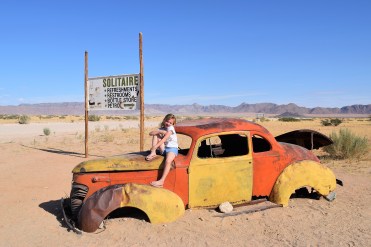 At long last we arrived at the town of Solitaire. Well, town might be a bit of a stretch. Solitaire is a gas station, bakery, lodge, cafe, general store, and mechanics at a t-junction, the only stop between the coast at Walvis Bay and the dunes at Sossusvlei. The population is probably less than 100 souls. The sandy yard around the settlement is littered with colorful and photogenic old rusting cars. We stayed at the Solitaire Desert Farm seven kilometers away, down a sandy track towards some rocky red hills, that at sunset burned crimson. The evening was still, with the exception of what I guess were jackals yipping playfully somewhere near our lodge.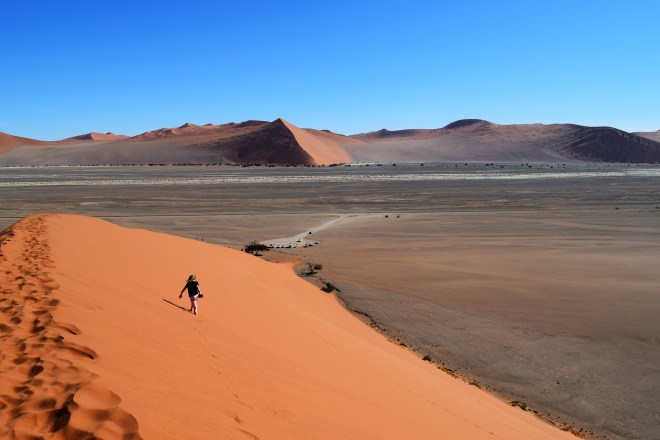


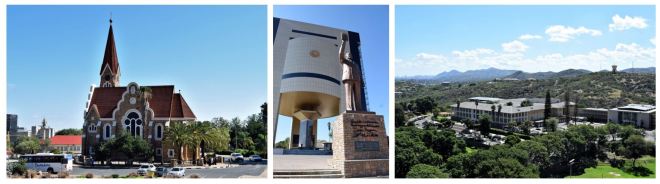
 We then crossed the street to the Parliament building, built orginally as the headquarters for the German colonial administrative offices, and its gardens. We then headed a short way up the road, at the corner of Robert Mugabe Avenue and Fidel Castro Street, to the Independence Memorial Museum. The building is jarring. Modern, yes, but also leaning on eyesore. No surprise then that it was built by a North Korean firm in the socialist-realist style. The bronze statue of Namibia’s first President was also made by North Korea. Behind the museum we ended the tour in the currently closed Alte Feste, once the headquarters of the imperial German military, in front of which stands the Genocide statue (also gifted by North Korea) representing the brutal extermination and punishment of Herero and Namaqua people during the 1904-1907 Namibia-German war, and how the indigenous people of Namibia overcame repression. We left the tour there and headed to the museum, which while informative, most certainly had that same socialist-realist vibe. We swung by the kudu statue and then headed back to the hotel.
 The following day it was time to begin our Namibia road trip. Now, back in Malawi, having finished the Namibian vacation, knowing we survived the drives is so different from before it began. Back when I was planning the trip I thought most about doing the driving. I wanted the freedom driving ourselves would bring. C and I have gone on a few day group bus trips. They have been convenient and sometimes fun. But there have been those, like the one to the Cape of Good Hope, where we were too much at the mercy of other tourists who had their own agenda at the expense of everyone else. I did not want to do that for a whole trip. Yet I am a single parent, who has limited (my diplomatic way of saying non-existent) car repair skills, traveling with a 7-year old long distances in a country I have never been to. I have traveled to many places, I am intrepid, but honestly, the driving had me a tad worried.
 Heading north from Windhoek toward Etosha National Park though, I had nothing to worry about. It was a long four hour drive but on the most beautifully tarred road. There was not much to see along the way, a few times we saw warthogs and baboons, but mostly miles and miles of green shrubs, every once in awhile a town that we could drive through in minutes.