New York City Visit on a Long Weekend

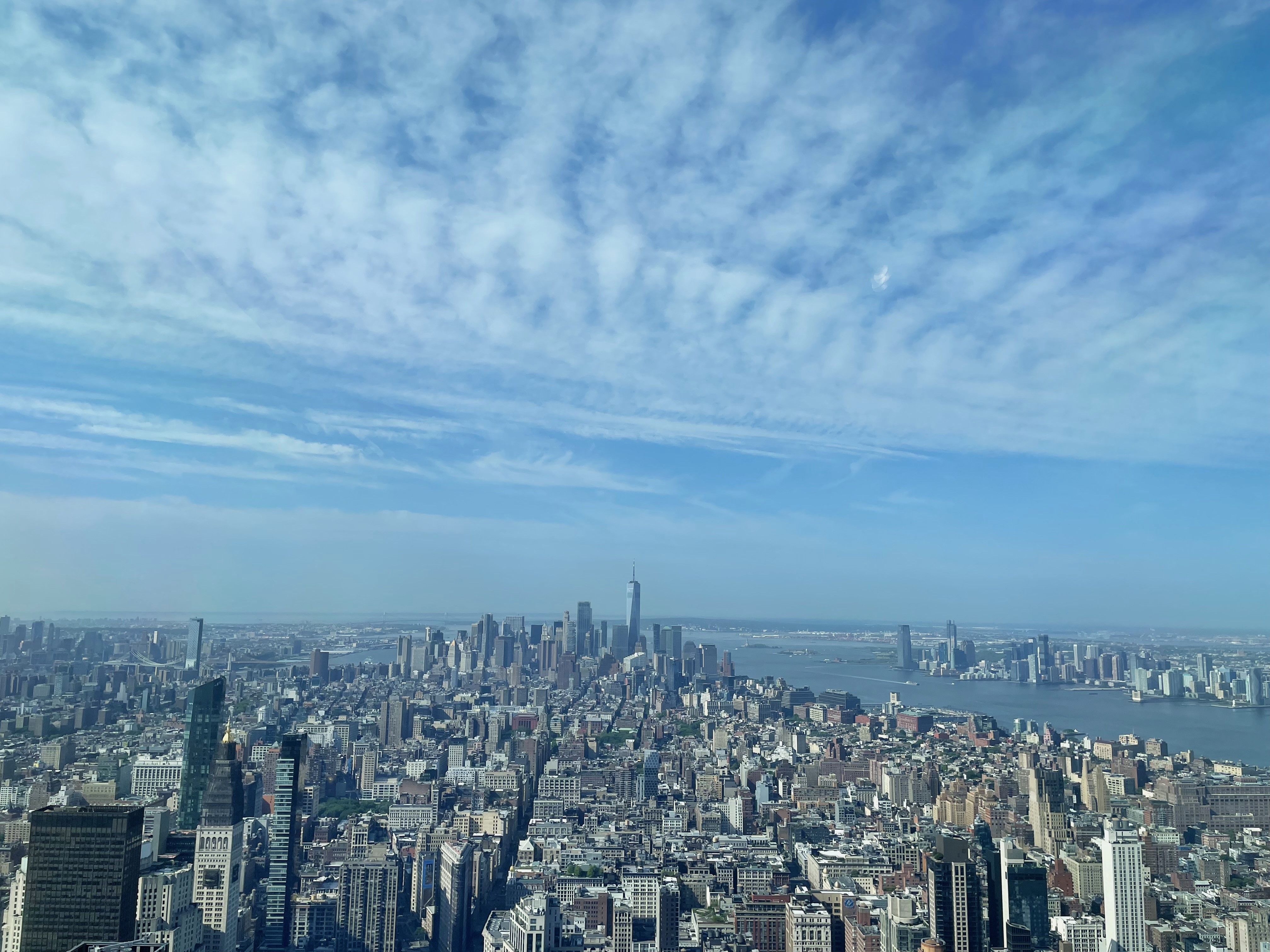
View from the 80th floor of the Empire State Building

I have long wanted to go to New York.

Well, what I mean is I have long wanted to spend more than a day in the Big Apple. Throughout my life, I have visited the city three times, but each time for only a day. In high school, probably my junior year, our class took a trip from the Northern Virginia area to New York City. We left around 6:30 AM and returned at 10:30 PM. I do not remember much from the trip — we went to Wall Street to see the New York Stock Exchange, we visited the FAO Schwartz toy store (the movie Big had come out the year before), and we sat on the floor of the Trump Tower lobby and were scolded by guards. In college, I went home one Thanksgiving with my roommate to Connecticut, and the Friday after the holiday we took the train into the city. We visited the Macy’s flagship store and goofed around at the Museum of Modern Art. Later, when I started working in Washington, DC, after graduate school, I took the train up for the day to visit that former roommate who was spending the summer in the city. I visited the Tenement Museum and we walked around Central Park.

In addition to wanting to spend enough time in New York City to require a hotel stay, I wanted to bring C to see it too. Initially, I had hoped our 2021 Home Leave would include as much as a week in the city, but with COVID-19 still going strong, it was not feasible. NYC restrictions on the unvaccinated (which included kids like C) kept it off our list and as French training grew in intensity in the Spring of 2022, I did not feel I could getaway for a whole weekend.

I knew as soon as we were back in the Washington, DC area that we were going to take a trip to New York for Memorial Day weekend. After reviewing all the planes, trains, and automobile options, I decided the easiest and most economical would be to take one of the bus companies that ply the DC to NYC route.

We had a view of the Empire State Building from our hotel room!

Early on the Saturday, we took the Vamoose bus from Rosslyn, Virginia to New York City. It was a good, comfortable trip. C said she was excited to see the view from the bus on the way; she was not quite blown away by the Jersey Turnpike as she had hoped, but once we began to approach the city and the Lincoln Tunnel, she perked up.

We excitedly disembarked from the bus at Penn Station; only a ten minute walk from our hotel. Unfortunately, within five minutes of our arrival, at the first corner, while waiting for the crosswalk, we witnessed one man assaulting another man. We heard yelling, then a bottle breaking, and a man ran to the street, blood running down his face, before he turned and ran down 7th Avenue. It was pretty shocking, though being New York, there were crowds of people standing around with little to no reaction. But I turned to C to find tears in her eyes and she told me, “Mom, I want to go home.”

Oh man, that was hard. For all the places we have been, all the unfamiliar, exciting, unpredictable, and even dicey situations we have been in, sometimes one does not expect it at “home.” C has had limited experience in the U.S. and most of it has been on vacation. Not that I want her to experience the negative! It is only that she has not been exposed to it so much until recently. I hugged her and asked if maybe we could just get to the hotel and see how we felt from there. She agreed.

We walked the seven and a half blocks to our hotel. It was too early to check in, so we stored our bags, and I took C to the Hard Rock Cafe for lunch to cheer her up. We have been into eating at Hard Rocks over the past year – in DC, Lisbon, Grand Cayman, and now New York. C and I enjoyed our favorites and then we were ready for the next part of our New York adventure.

We headed over to the New Amsterdam Theater on West 42nd Street, stopping at the Hard Rock Cafe gift shop (C loves her Hard Rock Cafe t-shirts) and MINISO (C also loves her Japanese cute stuff). C and I were catching the matinee of Disney’s Aladdin on Broadway!

I had originally planned for us to see Chicago as it is one of C’s favorite movies and she knows all the songs. But I had heard the current New York production, though the longest running Broadway show, has little in the way of set and costume glamour. C and I also really know Aladdin and it seemed a natural second choice. I knew it would really have the Broadway pizzazz. And boy did it deliver! Disney changed up some of the storyline for the stage and added in a few extra songs and the singing, set, and costumes were fantastic. C and I both loved it!

After the show and a quick meal and rest at the hotel, we headed to Nintendo New York at Rockefeller Plaza. C had long wanted to visit this iconic store, the only one outside of Japan. She loves Nintendo and Pokémon and the Nintendo New York store has a Pokémon section with plush characters not available anywhere else for retail in the U.S. The place was packed, with a roped line for the cashier register as if we were at an amusement park. C had been saving up her allowance for just such an occasion and she did not leave that store empty handed.

On Sunday morning, our second day, we headed to Madame Tussauds. This stop had not been on my original agenda, but the location is just a few doors down from the New Amsterdam Theater, and C had asked me what it was. After I explained it was a famous wax museum with wax replicas of celebrities with some 20 locations around the world, she begged me to go. With all my travels, I had never actually been to a Madame Tussauds, and though London is supposed to have the largest, the New York location is probably considered the best, so it seemed a fitting place for us to both visit for the first time. I imagine the place can get pretty packed, but we arrived very soon after opening and the crowds were not bad. I am not sure I could go out of my way to visit another Madame Tussauds, but C and I had a fun time.

C and I then walked the 17 blocks from Madame Tussauds to Central Park. We grabbed some lunch and then walked an additional 18 blocks through the park to the American Museum of Natural History. Another of C’s favorite movies is Night at the Museum. We have been to the Smithsonian National Museum of Natural History in Washington, DC multiple times, but we had long planned to visit the one in New York, featured in the original Night at the Museum movie. C and I were a little disappointed to learn that we could not find the Theodore Roosevelt statue at the museum (there is still a seated one though we could not locate it; the famous one in front of the museum was removed in January 2022 as it was culturally insensitive); we would also find no Sacagawea, no Genghis Khan, no small display of American cowboys or Romans or Pompeii. But we did find the Moai head from Easter Island, the capuchin monkey, the blue whale, and Rexy. And so many other amazing displays. We spent over three hours at the museum and just scratched the surface of all it had to offer.

The Theodore Roosevelt Rotunda at the American Museum of Natural History

Having already more than met our step count for the day, C and I braved the New York subway to return to 42nd Street. With the ability to pay for up to four riders with a single credit card direct at the turnstile (no need to buy physical tickets!) we managed quite nicely.

I have to admit that even with all my travel all over the world, I was a bit nervous to ride the New York City subway! That assault we witnessed upon arrival had also rattled me. Come on, I told myself, you have been on plenty of public transportation options in countries all over and in plenty I did not speak the language. Just to make sure I understood the ease of paying for the subway, I approached a guard at the museum to ask him. “Yeah, sure, you can totally ride the subway!” he said jovially. “Yep, just scan your card twice at the turnstile and make sure you wait until it turns green.” But then his voice dropped an octave and turned serious, “But be careful. Have your daughter go through first. Stay close to one another. Do not let anyone else get close too close to you. Keep a tight grip on all your belongings,” he added with an air of danger. And then he smiled, “You will be fine! Have a great night.” I was not sure how to feel. I felt both buoyed and wary. We only had to go three stops! I pumped myself up. And we did it.

Before heading back to the hotel we stopped at one more New York megastore (It’s Sugar – another of C’s favorites) for C to indulge in some more retail therapy.

On our final morning in New York, we headed over to the Empire State Building for a visit to the exhibits on the first floor and then views on the 80th, 86th, and 102nd floors. We truly lucked out with our timing. Only the day before, I purchased our tickets for the first available visit at 9 AM. We arrived maybe ten minutes early, but we were let in anyway. There was no line and we whizzed past all the stanchions setup for when there are crowds.
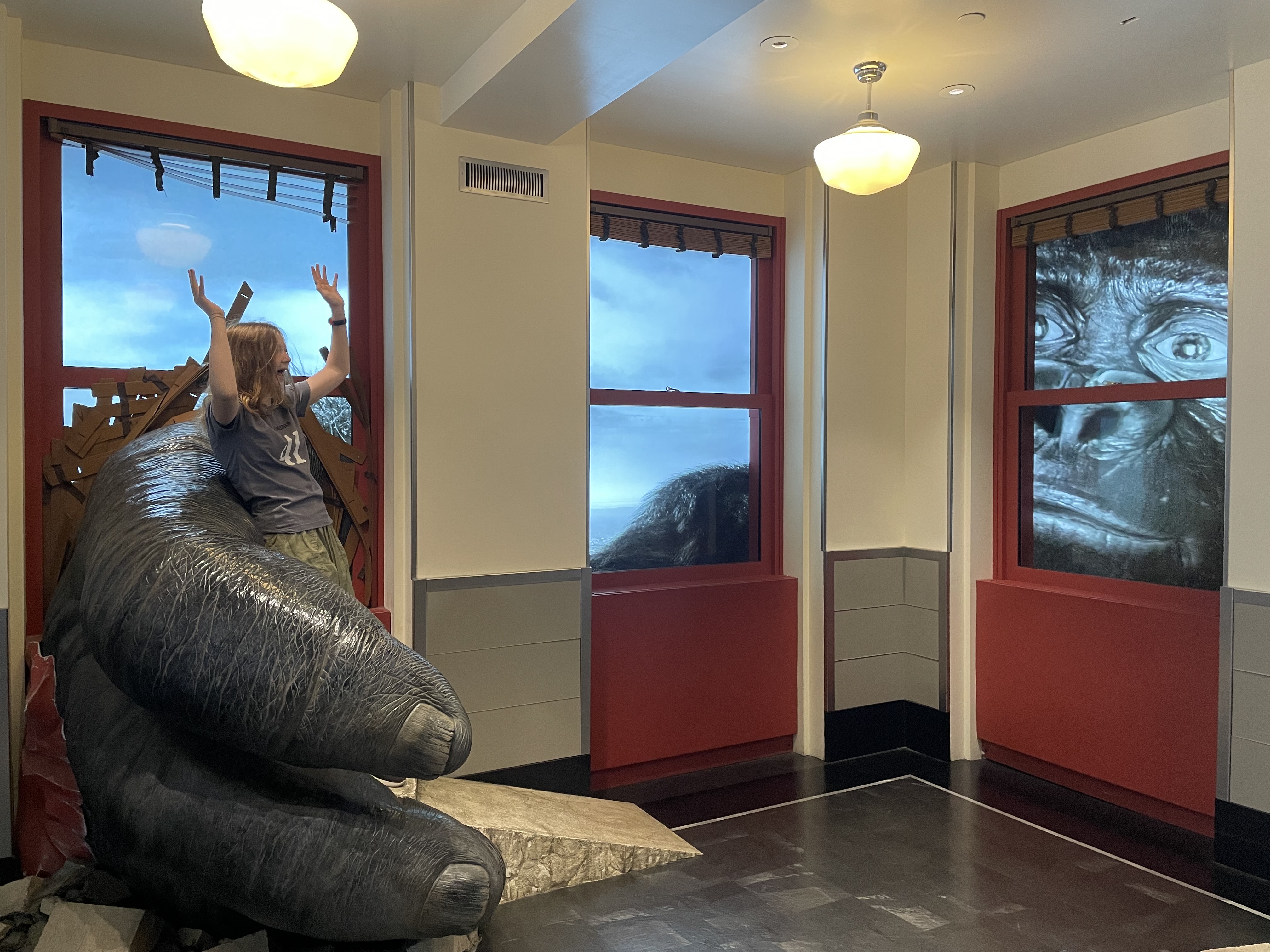
C gets “carried away” at the Empire State Building

The exhibits on the history and national and international cultural phenomenon of the building are amazing. So many movies, television shows, and advertisements have featured the world-famous iconic building. I could have taken C to Top of the Rock or the One World Observatory, but I had to go with the Empire State. Though it has not been the tallest building since 1970 (it is still the 54th tallest), it is by far the most famous building in the world.

I think C really enjoyed the exhibition and the views from the enclosed 80th floor, but once we went out on the 86th floor outdoor viewing platform, she was less enthused with the height. She does not remember that I took her to the Burj Khalifa (the world’s tallest building) when she was just 14 months old. She does not remember so well staying at the Intercontinental Hotel Nanjing in a room on the 77th floor of the Zifeng Tower (the 25th tallest building in the world), or staying in a hotel room on the 66th floor of the Jin Mao Tower (the 37th tallest building in the world) while visiting the top of the Shanghai Tower (the second tallest building in the world). Heck, we have lived on the 19th floor (in Shanghai) and the 23rd floor (in Guinea), and again on the 19th floor (Virginia). I have been taking C to tall buildings all her life.

We not only had little in the way of crowds, but we also had gorgeous weather, at least for the views from inside. Outside on the 86th floor platform, it was very windy. I did not want to rush, but I will admit that my legs too feel a bit wobbly when I look out from a high height. We walked the whole way around, took some photos, and then I gave in to C’s entreaties to get inside to safety! I got a good ole preteen death laser stare when I said we had one more elevator to board to the 102nd floor. I expect C was afraid that I was next going to make her hang on the side of the building. Luckily, the top observation floor is all enclosed, though its floor to ceiling windows can still give one the willies when standing too close to them. C perked up again though with the views of all of Manhattan and beyond. It was truly spectacular.

It was time then to pack up and take the bus back to Virginia. We packed a lot into our little weekend though the Big Apple has far too much to see in such a short time. Despite the rough start, C declared it fantastic, giving the Aladdin show and New York City shopping two thumbs up for her favorite things about the trip. I think I will be able to convince her to go back.

Spring Break on Grand Cayman: Part Two

Memorial plaque and viewpoint at the site of the famous 1794 Wreck of the Ten Sails

On our fourth day in Grand Cayman, we opted to make a trip to the capital of this island nation, Georgetown. Again, we caught the first hotel shuttle of the day to make the 15-minute drive. We stopped first at the cruise ship terminal to drop off an older couple who were trying to catch their cruise after missing its initial departure in Florida. We could easily have walked from there to the museum, our first stop, but the driver insisted on taking us all the way.

As cities of the world go, Georgetown is not particularly large, but its population of 35,000 makes it the largest capital of the United Kingdom’s 14 British Overseas Territories. I love that the town was initially called Hogsties, named for all the pigs kept in the vicinity! The bay is still called Hog Sty Bay.

We stopped first at the Cayman Islands National Museum. Though quite small, it is chock full of information and uses some really nice multi-media presentations. The museum is housed in the oldest public building in the Caymans, dating from the 1830s.

After visiting the museum, we took a stroll around the town. A few cruise ships were in port and the main streets fronting the harbor were busy with cruise ship passengers clogging the souvenir shops. A few blocks back and it was just a quiet Wednesday afternoon in a small island capital. We passed the House of Parliament, the library, the 1919 Peace Memorial and the Clock Tower constructed in 1937 in memory of King George V, and Heroes Square. It was not a long walk, but it was enough to drum up an appetite for our lunch at the Hard Rock Cafe, which surprisingly was not too busy. After lunch, we called the hotel shuttle for pick-up and spent the rest of the day lazing around the hotel.

On Thursday, I rented a car. I just did not want to keep relying on the hotel shuttle that only operated from 10 AM to 5 PM on the hour or the island bus. or the pricey taxis. We needed some wheels! Unfortunately, we did have to get another taxi to the airport to pick up the rental, but we would drop at the airport when we departed. I had opted for the smallest, most economical car but was pretty excited when we upgraded to a mini jeep! The perfect car to tool around the island.

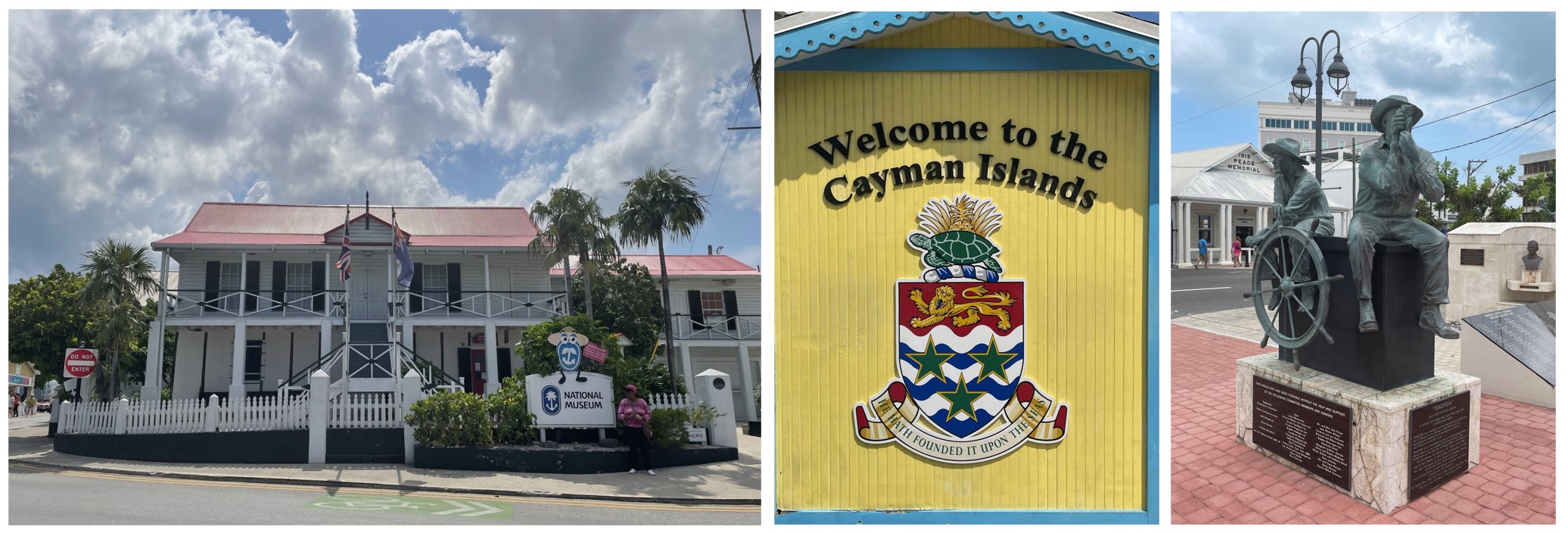
The Cayman Islands National Museum, the sign welcoming tourists at the port, and a fun sculpture at Heroes Square

We first drove over to the far east end of the island to visit the Cayman Parrot Sanctuary. It is an approximately 45-minute drive, but more like an hour or hour and 15 minutes when you are completely unfamiliar with the roads and tend to go around one too many times at the traffic circles. (not saying that was me, just saying that *could* happen to some people). Frankly, the driving was fine with a few little wrinkles. For example, on the one road that resembled a highway, the East-West Arterial Road, the posted speed limit was 40. Given that we were in a British territory and driving on the left, I assumed the posted speed limit was in kilometers. Certainly, the speedometer in the car used kilometers. But 40 kilometers an hour is just 25 miles an hour and seemed extremely slow for a two-lane each way highway. This was really puzzling me until I saw that there were a few places near the posted speed limits where there were those digital “Your Speed” signs and it was reading in miles per hour!

The Cayman Parrot is the only native parrot to the Cayman Islands and their national bird. C had got it in her head recently that she wanted a parrot and was thrilled to learn she could visit with the birds during our Grand Cayman vacation. The Cayman Parrot Sanctuary has much more than parrots. We were able to go into an enclosure and feed some parrots, parakeets, and cockatiels; then to another enclosure to pet some sweet little guinea pigs, held a small snake, and pet the resident agouti.

The beautiful historic house at Pedro St. James

After the parrot center, we drove back towards town stopping briefly at the site overlooking the reef where ten British sailing ships wrecked centuries before. It’s the most famous wreck of the Caymans and Queen Elizabeth II dedicated a memorial to remembrance in 1994 when she visited.

When then traveled on to the historic site of Pedro St. James. On arrival we were informed that there was a large cruise ship group arriving in about 20 minutes so we would have to wait for them to view the 4-D introductory presentation. C and I cruised the grounds a little before returning to join the group for the presentation. Afterward, knowing that the group would be tramping through the home together, we had lunch at the on-site cafe. We had also opted for the self-tour of the house as the guided tour was about 90 minutes long! The house is interesting, and I would have loved to have heard more on the architecture and history, but it is not a big home, and I did not think C would hold out that long (or I for that matter).

After lunch we then had the “castle” all to ourselves. Though it was not large by today’s standards, it would have dwarfed nearly all other buildings on the island. If I remember correctly, the first floor was the food storage and preparation areas while the second and third floors were the living spaces. The most extraordinary part of the home was the wide wrap-around verandas which created additional living space with an additional room in each corner and light-filled, ventilated walkways between that could be used for extra seating or office space or whatever. The house is the oldest surviving stone structure in the Caymans and is known as the birthplace of Cayman democracy as it was here at the “castle” where in 1831 a decision was made to form the territory’s first parliament and in 1835 an envoy from the Governor of Jamaica read the proclamation ending slavery in the British Empire. It was well worth a visit.

A fiery sunrise

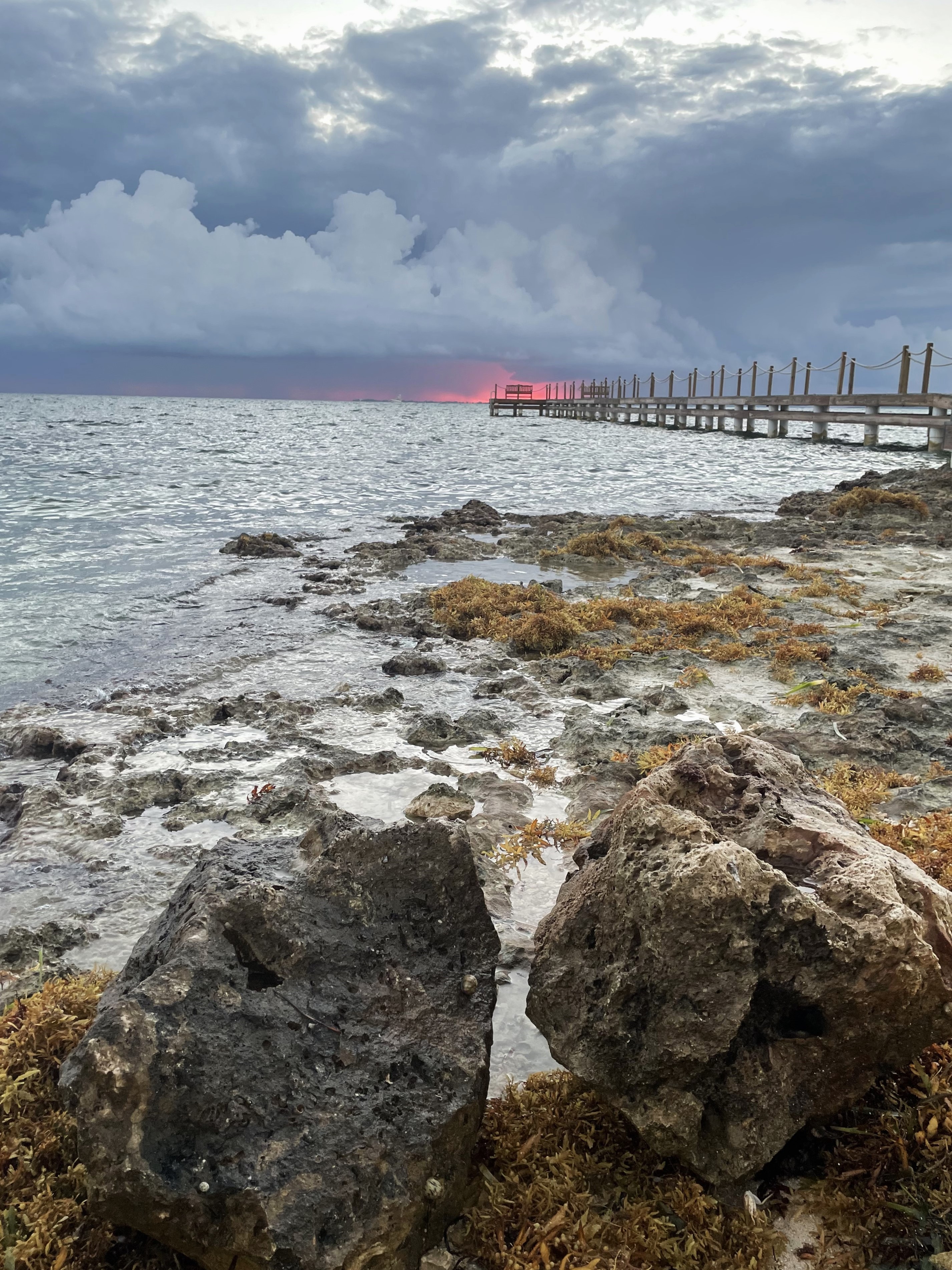
On Friday, our sixth day, the weather had turned. It was still very warm of course, but it had grown cloudy and windy. I was glad we had joined the Stingray City tour early in the week as the wind made the sea a bit choppier. I woke up early to catch the sunrise and walked out to the hotel’s little beach. It did not look promising with all the clouds, but just when it looked like there would be no sunrise at all, a ball of red light began to glow at the base of the clouds. With the cloud cover, the light did not have much room to grow, but though small, it was dramatic.

It was Good Friday, which turns out to be quite a big holiday in the Caymans. I had not realized the strength of the Christian belief such that places that are open nearly all year round are closed only on Christmas Day and Good Friday. While looking around for someplace that would be open, one site noted that they had live music six days a week and would do so seven if Cayman law were amended to allow it! Normally, I am quite thorough in my research of vacation destinations, but I did not anticipate this. I found that a lot of entertainment and restaurant venues would be closed on Good Friday, limiting our options. But in the end, we just wanted to hang out and I wanted to drive.

We first made our way back to Hell as C wanted to check out the gift shop. Imagine our disappointment that though the sign for Hell indicated it was open daily, it was in fact closed on Good Friday. (There is a lot to unpack there, but I will leave that to the reader to do so). From there we headed to the Dolphin Center, just across from the Cayman Turtle Center. Though we did not intend to book any dolphin experience, a fellow tourist had mentioned there was an observation area that we could enter for free. We spent about an hour watching the dolphins as they swam and jumped either on their own or in their interactions with the paying guests.

For lunch, we stopped at a delicious Mexican place in town that was luckily open on the holiday. Then we drove the hour or so to Starfish Point at the tip of the landmass on the right side of North Sound. I had hoped the drive would reveal beautiful ocean or other views but frankly, it was a bit on the boring side. Initially, we passed through the same towns we had the day before and it was largely shopping centers and residential homes. There seemed little in the way of beaches on the less populated, eastern part of the island. As we cut up Frank Sound Road, the only road the cuts north/south in the east, the few houses quickly gave way to dry scrubland. Even along the northern road to Rum and Starfish points I found few spots worthy of a stop.

Once we arrived in the vicinity of Starfish Point, we saw where a good chunk of the local population was spending their Good Friday. I had never thought of Easter as a party kind of holiday, much less Good Friday. But it seems in the Caymans that it very much can be. Camping over the Easter weekend is a Cayman tradition and the popular beaches, like Starfish Point, are covered over with pop-up tents with friends and families eating and drinking, cooking and talking, and swimming. We made our way over to Starfish Point, hoping we might see some starfish in the shallow waters, but there were far too many people and boats (including a BBQ boat selling food to those not cooking themselves). No one stopped us from wading in the water, but no one interacted with us either. C and I were the odds one out. We were not local, we did not know people, it was not our holiday. We got ice cream at the very busy Kaibo restaurant nearby before we headed back.

Flora at the Queen Elizabeth II Botanic Park

On Saturday, our last full day on Grand Cayman, we headed back over to the East End to visit the Queen Elizabeth II Botanic Park. We arrived soon after the opening – I wanted us to be there before the free Easter festivities for local kids commenced. After days of clouds, the morning was hot and humid. In many areas of the park, one could walk beneath a canopy of plants but between individual gardens the path lay directly in the sun. There were a few other visitors but we had little interaction and it was almost like having the park to ourselves. Visiting the park was also a chance to see the endangered blue iguanas, only found on the island of Grand Cayman. We were able to see some roaming around the park but also in the conservation center on the property.

That evening we had one final activity – a tour that would include a visit to Bioluminescent Bay. I had read that it was not advised to swim in the bay given the type of algae involved can be harmful to humans and humans can be harmful back. But we were still up to seeing the phenomenon. Our boat left the dock about an hour before sunset so that we could watch the sun sink as we motored from the inlet near Governor’s Creek across the North Sound, returning again to Starfish Point. The Easter revelers were in rare form with music from the campers on shore and that from several party boats competing. C and I stayed on the boat chatting with some other tourists (who as incredible luck would have it live only a few blocks from us in Virginia!) while most of our boat’s occupants jumped into the shallow waters. It did not take long for many of them to rush back onto the boat for some treatment for jellyfish stings! I am not sure what our tour guides were using as luckily C and I had no need, but there were at least eight on our boat that needed treatment.

Sunset from the jellyfish bar

Ironically, our next stop was the Jellyfish Bar – where our tour guides tried to lure us off the boat into the one-foot-deep waters to learn about jellies and hold them. After a good third of our boat had just experienced some stings, it was a little bit of a hard sell, but the guides explained this interesting fact: jellies cannot sting the palm of the hand or the sole of our foot. The guide scooped up a jellyfish and deposited it into the palm of our hands. Both C and I even gave it a try and lo and behold it was true. Though afterwards it is key to use the sand to “wash” our hands to remove any of the minuscule barbs the jellyfish may have left behind to ensure we do not transfer them to other parts of our body where it will in fact hurt.

After our educational jellyfish stop, the sun had set and night had fully come, we motored into Bioluminescent Bay for those who would participate. From the boat, C and I could see some of the glow, but it was not nearly as impressive as we thought it might be. Maybe it would have been better in the water, but I was happy to just stay on the boat to see the sunset, enjoy the oohs and aahs from our fellow travelers, and the cooler air as we headed back in at the end of the trip. It was a great way to end the trip.

All in all, it was a good vacation for C and me; we had just the right amount of activity, including a once-in-a-lifetime stingray experience, and lazing about. I was so proud of C for getting out of her comfort zone — kissing a stingray, holding a snake, holding a jellyfish, riding a scooter, and her willingness to snorkel her second and third times ever after a not great first experience several years before. After the challenging previous months, we needed some wins and we found them in Grand Cayman.

Spring Break on Grand Cayman: Part One

Three months after our early return to the United States from Guinea, my daughter had her Spring Break. We had had such a topsy-turvy few months with our unexpected return, then two months in temporary housing, and then a move to a more permanent place, that I really wanted us to have a nice mother-daughter getaway. We had to cancel our original R&R trip from Guinea in December since we were leaving and we had only had the quick trip to Maf Village and Sierra Leone, which while a fun little adventure with friends, was not the same as the initial two-week vacation I had planned.

Finding ourselves back in Virginia during winter after always-hot West Africa, I longed to be warm again. The Caribbean seemed a good choice. But where in the Caribbean? I wanted someplace where a week would allow us to see most, if not all, we wanted to see and maybe even allow for some real downtime. After checking out a few places, I settled on Grand Cayman.

Grand Cayman is not my usual sort of place. Do not get me wrong. I absolutely love sunshine, beaches of soft, pretty sand, palm trees, and glistening clear water. I just cannot do it all day long under the noonday sun. I also like to enjoy it in peace and quiet without 10,000 other people on holiday all around me. In Cayman, C and I found a good compromise.

Then just a week before this trip our shipment of 3,500 pounds of Household Effects (HHE) had been delivered to our new apartment – an overwhelming activity at any time – and I had learned that an acquaintance of mine – a fellow single mom diplomat – had passed away. I was very much in need of a getaway.

We had extraordinary weather on the flight down – A view of the Florida Keys from the air

We had an early flight and the three hours to Grand Cayman went quickly. Although I had planned to sleep, the gorgeous weather and views kept me awake and glancing out the window regularly.

Although we arrived on Grand Cayman just after 10 AM in the morning, I did not have all that much planned for this first day. We took a taxi from the airport to the Holiday Inn Resort, our hotel for the week. The hotel is in the same general area as the famous Seven Mile Beach, but on the opposite side of the island. Though only 1.5 miles as the crow flies from Seven Mile Beach it is located across a highway, along a windy road past a golf course and a growing residential area. It’s an odd place to put a hotel, but I had enough points for a free week, so I could not really complain. (But I did, just a wee bit)

Not a bad view from our hotel room

The upside is that the hotel runs a complimentary shuttle from the hotel to Seven Mile Beach, Camana Bay, and the Cayman capital of Georgetown. The downside is the shuttle did not operate on Sundays.

We had lunch at the hotel restaurant and then took a taxi down to Seven Mile Beach near the Westin Hotel. The back of the hotel was hopping. There were people everywhere around the pool, at the majority of tables at the beachfront cafe and chairs around the bar, and spilling onto the beach to and into the water. It seemed this was the place to be. C noted all the kids frolicking nearby and turned her best pre-teen glare on me and petulantly asked me why we were not staying there. (Hint: The $800-a-night price tag was part of it) C jumped into the water. I took off my shoes and walked through the surf. It was really beautiful. But it did not take long for the searing bright sun and crescendo of the crowds to get to us. After an hour we sat down for a cold beverage and a snack at the restaurant and C conceded that the Westin was maybe not all that.

I did not want to get another expensive taxi back; I had planned for us to enjoy the late afternoon weather for a walk, but just as we got started we came across several electric scooters. C had never been on one, but it seemed a good enough time to try, especially given the winding road alongside the golf course had very little traffic. It took some time to get back and ended up costing twice as much as a taxi! But we had a fun time and a low-key first day.

On our second day, we had a lazy morning before catching the 10 AM hotel shuttle (the first of the day) to the main strip where we caught a bus heading to the northern end of the island where we could visit the Cayman Island Turtle Center. For such a developed island, the bus system is fairly regular and inexpensive; it cost 2 Cayman Islands dollars (about US$2.50), which was a far cry from the CI$30 (US$36) for the short taxi ride from the hotel to Seven Mile Beach the day before. The buses are like large mini buses similar to a small tourist bus. Ours dropped us off right in front of the Turtle Center in no time.

At the Cayman Turtle Center

I had heard some mixed reviews on the Turtle Center. The Center is one of the top tourist spots in the Caymans though there are some that are concerned its conservation activities do not go far enough as they do farm some of the turtles for local meat and shell products. It is tricky, but if they did not do that then perhaps those who wanted those items would seek alternative ways to source the turtles if they could not buy them from the Center? The Caymans have a long history with turtles. When Christopher Columbus came across the uninhabited Caymans in 1503, he named them Las Tortugas (The Turtles) for the overabundance of turtles in the islands’ waters. Harvesting turtles was a mainstay of the economy for at least a hundred years and when the Islands became a self-governing territory in 1959, the turtle became a prominent part of their flag. I could see both sides.

C and I had a great day at the Turtle Center. They had an informative talk at the predator tank where they had a few nurse sharks, tarpon, barracuda, jacks, and other predatory fish. C also enjoyed hand-feeding some birds in the aviary. And then we had the great pleasure of snorkeling in the lagoon with the turtles.

This was only the second time she had ever snorkeled! And the first time had been in Lake Malawi with an ill-fitting mask when she was about 6 years old. But she snorkeled like a champ.

After turtle snorkeling, spending some time in the Center’s swimming pool, and then lunch, we decided to walk over to Hell.

Oh, the jokes are almost endless.

We found it – Hell on Earth is inland on a beautiful Caribbean Island.

But Hell is an actual place on Grand Cayman about a 15-minute walk from the Turtle Center. Walking allowed us to stop and take a photo at the crossroads to Hell Road. Indeed, the road to Hell is paved and yes, I was leading my 11-year-old there.

Hell is just a geological formation of black limestone in standing water. Though online it is described as “sinister,” it really is not. I would not want to be walking through it (one is not allowed) and it was hot, but it was more lovely than eerie. With our backs to the kitschy souvenir shop with its dress-up devil costumes and “Postcards from Hell,” the abandoned night club and Hell Post Office, and only the rock formations, birds, fish, and trees against the startling blue sky, we could have been far from civilization. I certainly would not plan a whole trip around a visit to Hell, but quick-ish stop is worth it. Mostly, as apparently, the Caymans and tourists alike say, so we can say we have been to Hell and back.
It was hot and we were not really looking forward to trekking back to the Turtle Center or onward to find the closest bus stop, but the only other visitors to Hell at the time, three jovial ladies from upstate New York with some challenges to driving on the left, offered us a lift back to Seven Mile Beach and in the end even took us straight back to the hotel.

Boats gather at the Stingray City sandbar; C gets a pat on the back from a friendly stingray.

The activity for Tuesday, our third day on Grand Cayman, was a visit to the island’s number one tourist attraction, the famous Stingray City. Stingray City is a shallow sandbar located in North Sound, a bowl-shaped lagoon cupped between Grand Cayman’s narrow peninsula to the west and the bulkier body of the island to the east and capped by a barrier reef, where stingrays have been gathering for years, reportedly first for fishermen’s catch and now for tourists’ handouts. In the clear three feet of water, tourists can stand as southern stingrays swim around and sometimes right up to them. I read that boats are limited per day and by the number of squid goodies that can be given. For the tasty squid, stingrays will eat from your hand, let you give them a kiss, and offer you a brief slap on the back.

C had initially been a little worried about getting in with these sea creatures, but once our boat pulled up and set anchor, she was ready to jump in. Though I had chosen a trip earlier in the day hoping there might be fewer visitors given that many cruise ship passengers would likely take the midday tour, it was rather crowded with several more boats pulling up just after us. Though it would probably have been a different, and possibly more magical experience without every Tom, Dick, and Harry vacationing in the Grand Cayman on Spring Break, our tour guides made sure that everyone who wanted a stingray interaction got one. It really was a unique experience that C and I will likely not forget.

Sunset at our hotel

Following Stingray City, the boat then headed to a reef for some snorkeling. C and I opted to wear floatation devices for safety, and I am glad we did so. First off, I wear some rather thick prescription lenses and when snorkeling with a tour company’s equipment, I do not see all that well. Second, this was only C’s third snorkeling experience and the first in the ocean. And finally, the wind was beginning to pick up and the seas were very choppy. While we heard others from our boat exclaiming about seeing a stingray, a lobster, and a barracuda, C and I just saw some fish and the reef. And that was perfectly fine for this particular day. After being pushed around by the waves for 15 minutes, we were more than ready to get back in the boat. Though we almost got aboard the wrong one! That is what happens when one is partially blind and so many look-alike boats are all gathered in one place.

We spent another low-key evening at the hotel attempting to order food from the Cayman Island’s version of Uber Eats. It was fine, really. It was a great start to the week. This is exactly what I wanted – a few fun things to do while also lots of lying around doing little to nothing.
Introducing Our New Diplo-cat, Ramen

My daughter and I may have departed Guinea earlier than planned, but we have brought a little something from the country with us – our new Diplocat, Ramen Noodle.

We lost one of our diplo-kitties, Tikus, when in Malawi, and I had promised my daughter that she could get a kitten though noted, given the challenges of moving with pets, it would be best to wait until after our arrival in Guinea before we found our newest furry family member. Our Guinea kitty.

Before arriving in Conakry, I had heard there were quite a few feral kittens at the Kakimbo residences where we would live. I figured once we got a bit settled we could pick out one of those kitties. Turned out they were super feral little beasts that were nearly impossible to catch. On several occasions I found myself running around the parking garage trying to capture one. It did not seem like it was going to work out.

At a Country Team meeting where I was the new person and did not really know what to say I blurted out I was looking for a cat for my daughter if anyone had any leads. Lo and behold the Peace Corps Director announced that if I am looking for cats, she has cats. A whole bunch of them running around her front yard. Though she fed them, she isn’t really a fan of cats, but is concerned for their welfare when she would depart in two months. It sounded like a plan.

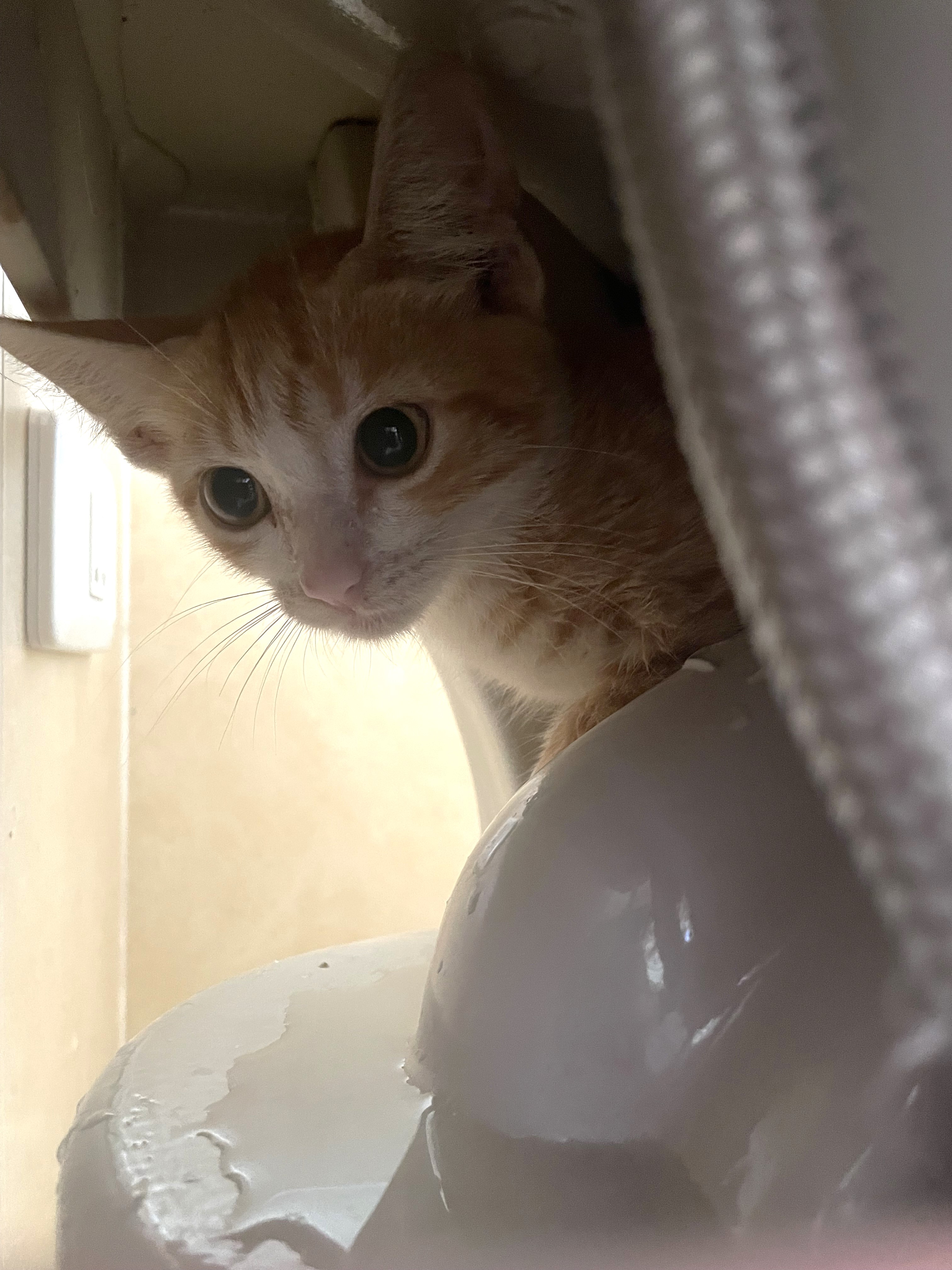
Thankfully after about a month with us Ramen was too large to hide inside the area in the back of the toilet

Therefore on July 11th, a Monday holiday in Guinea, I celebrated by taking one of my very first (rather terrifying) drives over to the Peace Corps Director’s house to capture our new kitten. We had initially planned to grab one of the older cats but the Peace Corps Director thought maybe it would be better to adopt a younger one. And just then this little orange tabby streaked in front of us and C knew that was the cat for her. With a pillow case and a can of tuna and five people we managed to corral that ball of fluff into our carrier and we took him home. We dubbed him Ramen and guesstimated his birthday to be April 1.

At home I placed the unzipped carrier in one of the bathrooms, set out a little food and a litter box, and then closed the door. Just to get him acclimated. When I looked in 20 minutes later, he was gone. He was not in the carrier. He wasn’t in the bathtub. He wasn’t in the under the sink cabinet even though I found a hole where he might have accessed it. I looked and looked in all the same completely obvious places where he obviously was not. I began to think I had imagined the whole thing – the drive down the narrow streets, the catching the kitten, everything. But then after a few hours, Ramen the kitten crawled out of a hidey hole in the back of the commode!

So here is something else about Conakry. Before I bid on the assignment I watched a Post bidding video – a recruitment video of sorts. One thing that was most definitely highlighted were the number of pets in the Embassy community — and I distinctly remember something along the lines of what a great Post Conakry is for pets. Well, uh, that might have been a slight exaggeration.

I heard there were basically two vets for the expat community – one who spoke English and one who spoke only French. I went with the former, a lovely, good-natured man who I think was doing the best he could with what he had available. But it sure did make for some interesting times.

Dr. K prepares to neuter Ramen in my living room – just another foreign service experience

I needed to get Ramen fixed so I called on Dr. K to perform the procedure. One nice thing for Conakry is the vets make house calls, even on the weekends. Dr. K arrived at my apartment with his scrubs on and carrying his vet bag on a Saturday morning. We would be conducting the procedure on the coffee table in my living room. Yes, you read that correctly. A veterinarian would be conducting a minor surgical operation in front of my television set. I brought out my tie-dyed towel from Jamaica to make it extra special…

I had not realized that I would be serving as the vet assistant. I held Ramen as the vet injected the anesthesia. I did not have a great grip and he bucked as the needle went in — probably a good thing as I learned later the vet was more than a little generous with dosing. I assisted as the vet shaved the area and also made the incisions. This was not how I had initially seen my day going. Dr. K wrapped things up with some sutures, handed me a prescription for some painkillers, and headed out.

There was no cone of shame. I wish I had known that Dr. K had very little supplies as I would have ordered one from the States and waited for its delivery before the procedure. The lack of that cone became problematic. But that came later.

I headed out to get the meds at the pharmacy, then I came home to monitor Ramen. He was loopy, like really loopy, for a what seemed a really long time. But then again normally, in the places I have been where my pets have had surgery (the U.S., Indonesia, Malawi), you drop off your pet in the morning and the veterinary staff will monitor the animal for several hours until you can pick them up in the afternoon. I would say usually I do not see my pet until 6-8 hours after the procedure. It was quite strange to see him so groggy, his eyes unfocused, his third eyelid visible.

Mealtimes started to get a little weird with Ramen around

Over the next few days Ramen seemed very off. I kept trying to give the medication as prescribed, but the pills seemed large for a 5 pound cat. I conducted a little Google sleuthing and discovered that the vet had prescribed Ramen 150 mg of doxycycline each day. I had felt bad that the pharmacy had only had 100 mg pills. Yet, it turned out the typical dosage is 2 milligrams of doxycycline per pound of body weight – or only 10 mg for a five pound cat! The vet had prescribed 15 times that dosage! Once I discovered this, three days in, I stopped giving the medication altogether. He got his energy back, but developed a weird cough. A week later he ripped out his stiches and one incision site looked bad. Online I learned that usually stiches are not even necessary for neutering. I was beginning to worry he was not going to recover from what should have been a fairly straightforward procedure.

Luckily he did.

I also had Dr. K given him his first rabies shot and microchip. Dr. K told me he had no microchips so I would have to order one and he would inject it. I bought a pack of two off Amazon. After the insertion I gave the extra one to Dr. K and he was ecstatic. He thanked me profusely. He said it was one of the best gifts he had ever been given. I wish I had ordered a ten pack.

Ramen grew on us quickly. He is the mushiest cat I have ever had. Most nights he slept draped across my daughter or curled up near her head. A couple times a week I was the lucky one to have him join me for a snooze. He was (and still is!) naughty as well. He refuses to use the cardboard cat scratchers and he and his claws kept me in terror of his ripping up the faux leather sofas in our Conakry apartment or the carpet in our Virginia housing. We have showered him with cat towers with sisal fiber joints that he does at least sometimes scratch, and I have acquired a spray water bottle for when he invariably attempts another scratch location.

He is a rather extraordinary cat. We taught him to play fetch with some small bouncy balls and now when he wants to play he will jump up to the bed or the sofa carrying one of the balls or even one of his mouse toys.

Ramen looks forward to more travels as a diplo-cat

He is also so, so good. As a young, energetic cat who gets a serious case of the zoomies twice a day I had no idea how he might respond to being cooped up in his carrier for the duration of our flight from Guinea to the United States upon our departure. Because the EU put new guidelines in place in early 2022 that require all transiting pets to meet EU pet import requirements, we could not fly through Europe. (The guidelines require a titer test for all pets coming from “countries of concern” for rabies. The test necessitates at least a three month lead time. Both the blood draw and laboratory testing for the titer would be difficult, if not impossible, in Guinea.) Therefore, we had to fly through Addis Ababa – an eight hour flight and a one hour stop in Abidjan – going in the opposite direction first. Then the 17 hour flight from Addis to Washington, DC via Dublin. All told our two cats – Kucing and Ramen – spent about 34 hours in the carriers going door to door. Ramen made not a peep.

And now we are back in the U.S. Well C, Kucing, and I are back. This is Ramen’s first time here. We lived first in temporary housing for 2 months and then moved into more permanent housing, meaning within the first year of his life Ramen has lived in four locations: Peace Corps Director’s yard, our home in Guinea, our temporary quarters in Virginia, and now our apartment in Virginia. He has a long way to go to catch up with Kucing, who has lived in six countries at a total of 14 addresses, but he is well on his way to being a proper Diplo-cat.

P.S. It turned out that the rabies and distemper shots Ramen got in Guinea were for dogs. We found out at his first vet check-up in the US. This could explain his interest in playing fetch….

The Fast(ish) and the Furious: Driving in Conakry

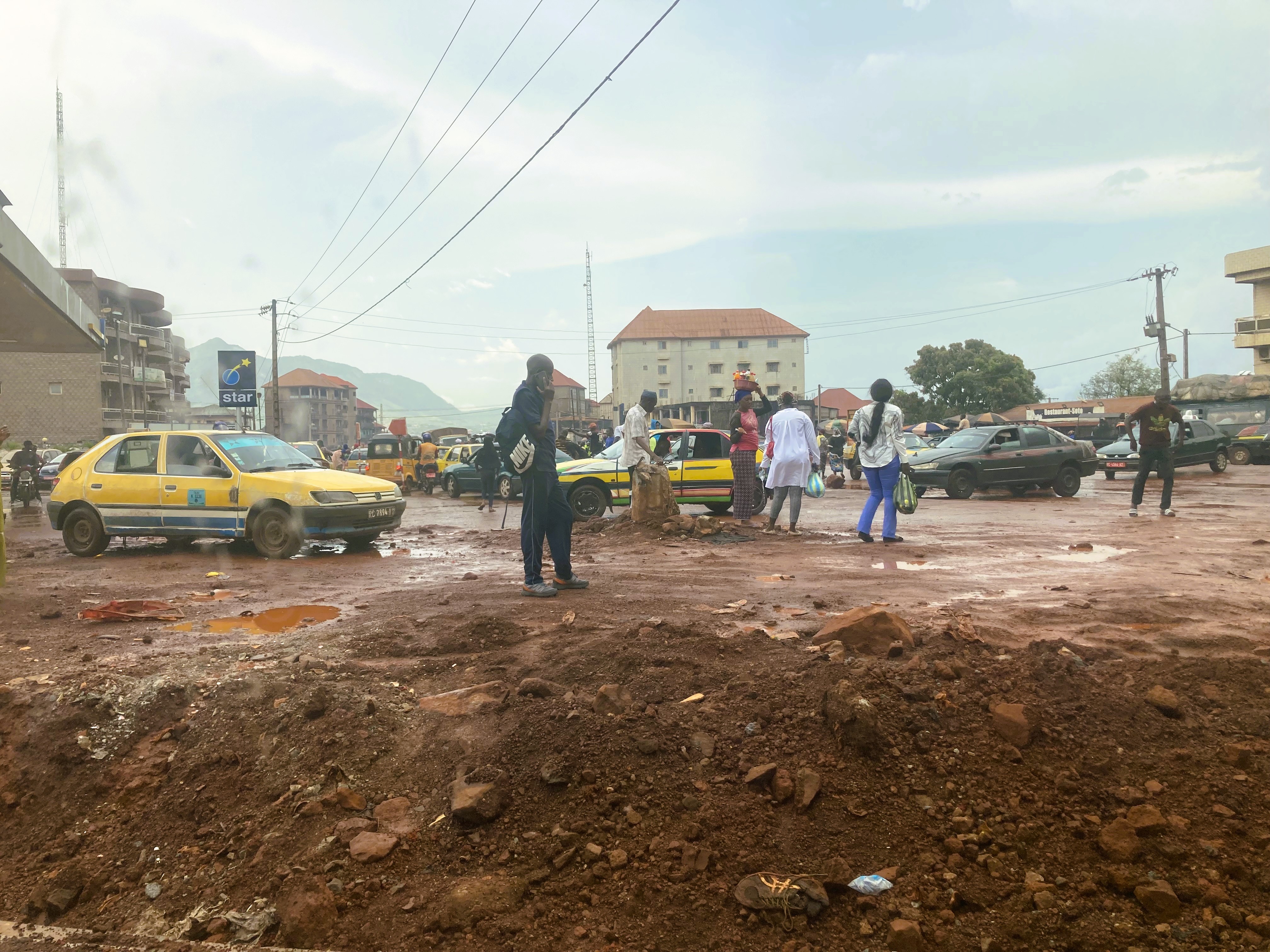
A typical Conakry traffic situation with cars going every which way however they want. I am just trying to go straight out of a roundabout…

I used to think traffic in Malawi was, hmmmm, how do I say? Interesting? My daughter learned all the bad words from sitting in the back seat while I drove around Lilongwe. Traffic in Malawi, my friends, was nothing compared to Conakry. I laugh now thinking back to it. How did I think Lilongwe was challenging? I have certainly been in locations where there was similarly interesting traffic – Hanoi, Delhi, Mombasa come to mind – but I was not a driver in those locations. Conakry really tested me. The State Department’s required Foreign Affairs/Counter Threat (FACT) course, lovingly referred to as “Crash and Bang” for its defensive driving and shooting components (though over the years the weapons familiarization portion has gradually been reduced), really came in handy in Conakry.

Conakry has more roads in general and wider, two-lane roads than Lilongwe. But Conakry is also more chaotic. There are more vehicles: more large trucks, more taxis (there really were not taxis in Lilongwe, but in Conakry, there are a plethora of these distinctive sedans painted in the red, yellow, and green colors of the Guinean flag), and motorcycles. So. Many. Motorcycles.

Just a wee road obstacle. Do not worry about this five-foot deep ditch on the side of the road with no barriers that can swallow your car. Not a problem….

Any city might struggle with the volume of vehicles in Conakry. But a city with poor infrastructure, where most two-lane roads have no lane markings, no shoulders, no crosswalks, no sidewalks, few traffic lights, and all kinds of obstructions on the road, really struggles with this. Add in drivers that seem to do whatever they want… If you want to stop suddenly in the middle of the road to let out or pick up passengers or just wait, go right ahead. Too tired to go up to the next roundabout to turn around? Just drive down the road against traffic, no problem! Basically, too many vehicles, haphazard traffic conditions, and a lack of road etiquette spell very challenging driving conditions.

I am sure accidents like this, right outside my residence, happen frequently. I am just surprised I have not seen more of them.

For instance, when I depart out of my residential compound when there is significant traffic (a very regular occurrence) there are guards who stop traffic to let us out. Though the guard may stop one lane of traffic, inevitably the car behind that one, or the one behind the second one, immediately decides this is BS waiting and pulls around the stopped vehicle. The guard usually then stops this car, but back in the line, someone else has decided they don’t want to wait in lane one or lane two and then tries to go around both cars. This road is about four lanes wide. Well, it would be if there were any lane markings, which there are not. But at times cars will build up to four across in one direction as each person tries to get ahead of everyone else. This then, naturally, causes difficulties for the traffic going in the other direction. On very bad days this can lead to a standstill. I called one of my colleagues once who informed me she had been sitting in her car “one minute from the Embassy” for approximately 30 minutes, barely inching forward. On another day my colleague and I were heading to the grand opening of an event, and it took us one hour to move three kilometers. Something that should have taken five minutes. When we finally reached the end, we could see no reason for the backup. It was just one of those special Conakry traffic days. (Luckily though things often start late in Conakry, and we were mostly on time)

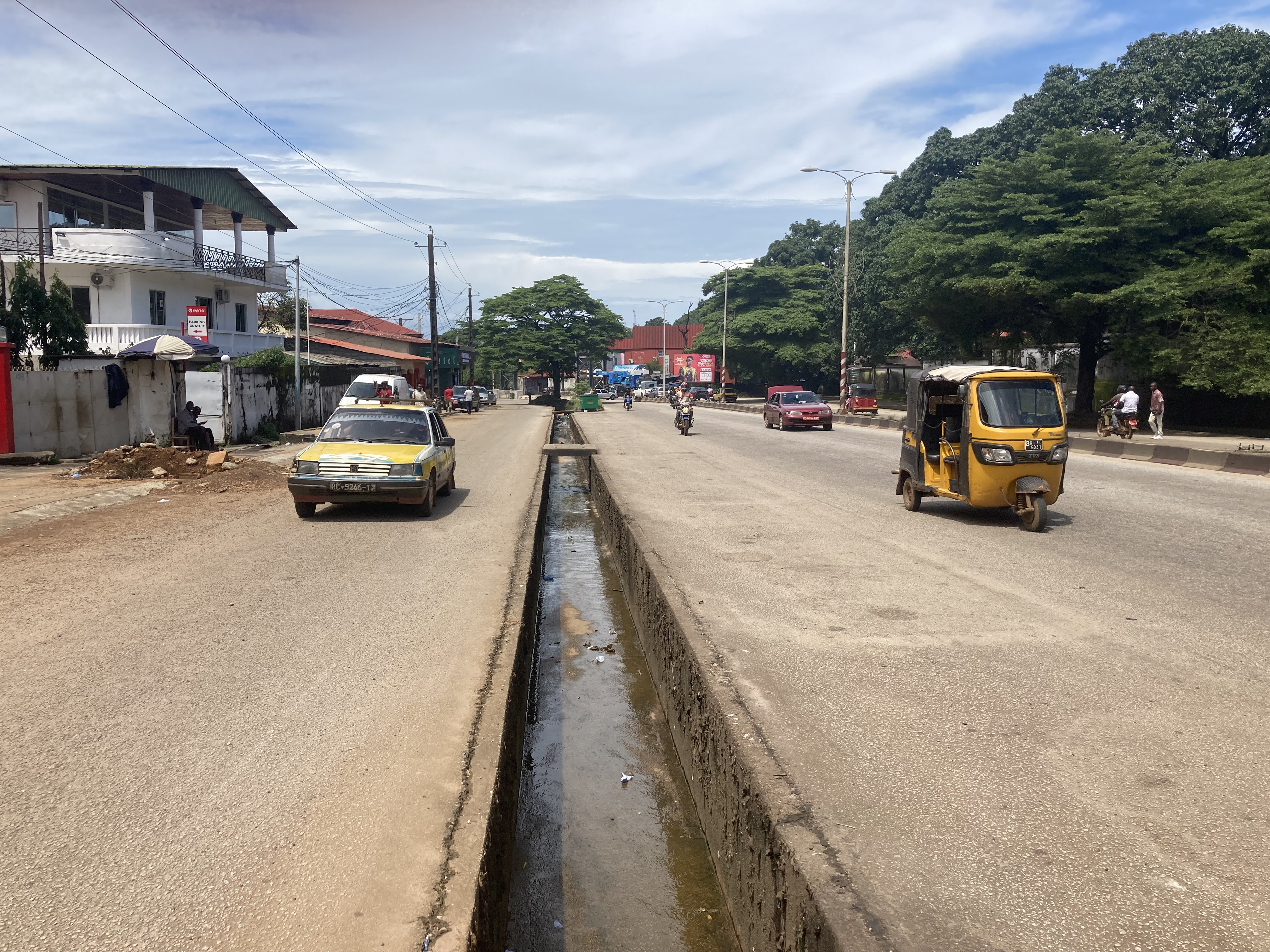
Photo of a Conakry road. You might think I took this photo from the side of the road, but you would be wrong. I am in a vehicle, also on the road.

In the U.S., some drivers facing a similar predicament, might just drive on to the shoulder and skirt around those blocking the lane. Except there are often no shoulders. Or the auxiliary lane is cut off from the rest of the road by a two foot wide, five foot deep cement ditch with zero protective barriers to stop a car from driving into them. There are some areas where the road is paved between the two to allow drivers to get onto that side road, but you may end up driving for awhile before you can get back on. These ditches are so deep that informal mechanics use these to conduct under carriage work – having a car carefully use a paved crossing to maneuver their car so that tires are on either side of the drainage ditch and the mechanic gets into the ditch to work on the underside of the car.

I guess one positive of Conakry traffic is it is hard to get up any real speed. With so many cars jostling for space on the road, pedestrians darting across at any location, speed bumps, dips, and random obstacles on the road, when most accidents occur they are generally scrapes and fender benders. When my daughter and I were returning from tennis at her school one day, we got caught in a traffic jam that turned the 6.6 kilometer (4.1 mile), 15 minute drive into an over an hour ordeal. Inching along and jockeying to keep ahead of cars and motorbikes that take any hesitation as a sign of weakness and an opportunity to pull ahead, it was maddening. Due to some road construction we were diverted onto a makeshift road, though one better than 90% of the roads in Conakry. Although the state of the road was good, there were simply too many cars on it trying to get out a narrow opening to another road. A driver in a taxi next to my car decided that he was going to forge ahead and cut me off. Instead he scraped against my car and got stuck. Traffic police, who I had not noticed at all before, suddenly appeared and tried to get the driver to back up. That only led to more scraping against my vehicle. The police tried to get me to back up, but I was completely hemmed in by the taxi and a horde of motorcyclists right on my bumper. I had a few inches to my right alongside a barrier and the police directed me to slightly turn that way. This gave the taxi the chance to get off my bumper and he sped away. The police pushed in my bumper and gave me the thumbs up sign. And here is the amazing bit: I didn’t yell. I didn’t say one bad word. I just returned the thumbs up sign and drove home. It was all just so inevitable.

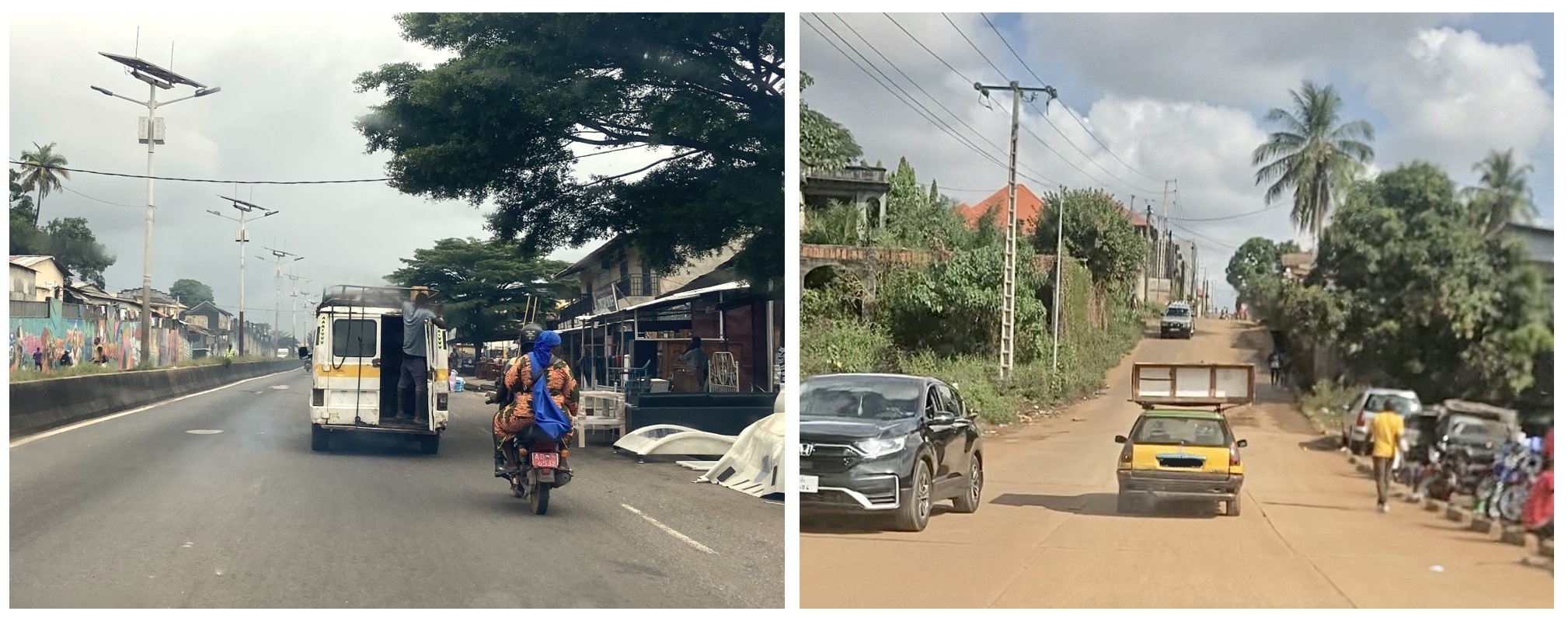
Creative driving in Conakry. On the left: the guy hanging outside the back of the truck and furniture for sale placed directly on the roadside; on the right: I have to get this large ungainly wooden thing home so I will just strap it to the top of my taxi.

There is a lot of creativity to driving in Conakry. I have got to hand it to some folks for their ingenuity, but some things just are just downright dangerous. See the guy hanging out the back of the panel van? I cannot say he is the only person I have seen doing this. And the large piece of furniture strapped haphazardly to the top of that taxi? Yawn, so commonplace. And I 100% know that these kinds of innovative means of transporting goods and people is not, by any stretch of the imagination, limited to Guinea. There just seems an extra layer of hutzpah added here. For example, when I lived in Indonesia in 2007, I watched a father place his slightly sized son, maybe 10 years old?, on the back of a motorcycle holding on to newly bought large television set, still in its box, and then motor off. I feared for the kid who could barely wrap his skinny arms around the box. One speed bump would surely knock him backwards as his little bum sat on the very back of the seat and he was not anchored to his father in any way, just holding on to the unwieldy box. However, one day in Conakry, at a particularly messed up under-construction intersection, I saw a motorcycle swerve between my car and the one in front of us. The passenger, a middle aged woman wearing a bright orange patterned west African style dress, perched on the back of the bike clutching a large unboxed television. As another car roared into the fray, trying to maneuver in front of me, the motorcycle swerved again and the woman nearly lost her balance on the bike and her grip on the television. As she grabbed for the television she let forth a string of curses aimed at the car, gesticulating angrily with her head and a few fingers of one hand. Hutzpah.

For some reason the city has opted to start construction on many of the roads in Conakry all at the same time. This is not just my complaint, I have heard it from expats and Guineans alike. No doubt the roads could use a facelift, it just does not make much sense to do it all at the same time, that only contributes more to the gridlock. Much of the construction is on the main roads forcing drivers to take to the side streets, which are often in worse shape. Side roads are often unpaved. They are generally more narrow and are hemmed in by pedestrians, businesses or homes, pop-up markets, and random piles of stuff. The stuff could be mud, garbage, construction materials (not for roads, but for buildings), whatever. There are often more speed bumps (or what is left of speed bumps), more potholes (some that could swallow up cars), just more life and obstacles in general.

On my first drives in Conakry, the GPS led me down a side street that may have once been two lanes but was at the time in the throes of a busy market with hundreds of hawkers and customers milling around and motorcycles zipping everywhere they wanted. It had easily become a single lane. The road ended in a T-junction that I needed to turn on to, except the majority of the end of the road was blocked by a three to four foot pile of garbage. Motorcycles were easily getting by, but for me to squeeze through I needed half my car to go up and over. This was my introduction to Conakry driving. Wowsers.

Some roads are just dirt, but not just dirt. They are rocky strewn hills. Seriously, I think the Guinean government could make a pretty penny having Ford and Chevy film their tough truck commercials making their way down Conakry side streets.

Burning tire barricade ahead means a protest is starting

In addition to just the every day fun on Conakry roads and the construction, there are also the protests that can throw a spanner in the works of a commute. On many protest day we had advance warning and telework was an option. With protests often happening in and around the Bambeto traffic circle, I had a bird’s eye view of the demonstrators and police doing their delicate dance of throwing rocks then running and the thumbs and smoke plumes of tear gas or the cracks of firearms. But sometimes protests are a bit more spontaneous. Driving home twice from my daughter’s school, myself and all my fellow drivers heading in a certain direction were confronted by the sight, smell, and burning taste of black smoke from a burning tire barricade blocking our way to Bambeto. I watched as vehicle after vehicle made u-turns (often in the middle of the street without looking, thanks guys!), but I actually needed to continue forward to get into my residential complex. The route is also the most direct to the airport and to one of Conakry’s major thoroughfares, the Rue Le Prince.

My daughter and I did make it home but many others were stranded in massive traffic jams. Three people from the Embassy were stuck in traffic for SIX hours. Two people missed their flights out of the country.

Every drive in Conakry is an adventure. Getting behind the wheel is not for the faint of heart. But you know what? I am so glad that I did it. I found there were many expats who opted not to drive at all. And I throw no shade, none, I get it. I just did not want to be at the mercy of the Embassy motorpool schedule or needing to hire some driver. I am not afraid to drive in Conakry. There were some white knuckle moments for sure. I was often annoyed. But there were also days I found a great sense of satisfaction for getting myself from Point A to Point B by driving my own car. I can say that sometimes I even enjoyed myself.

Maf Village and Sierra Leone

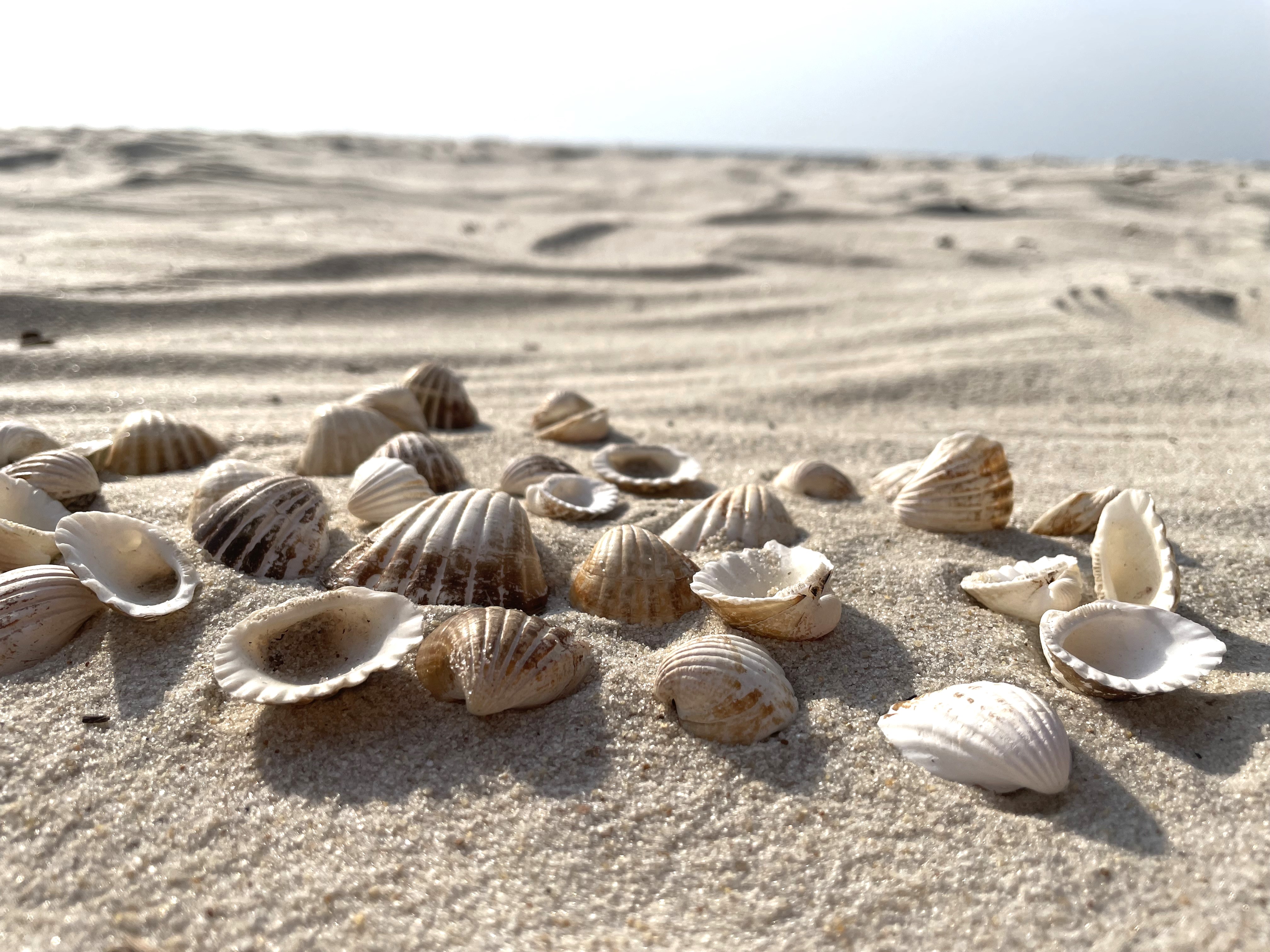
Shells galore on Tokeh Beach, Sierra Leone

When I had to cancel my previously scheduled two-week Christmas-time R&R (for reasons which will be revealed in the not so distant future), I wondered if I would have any getaway at all at the end of the year. I had a bunch of use or lose leave (we can only carry over a set amount of leave in a given year to the next and any that is over that is forfeited if not used or donated by the end of the year) and a hankering to spend it somewhere other than my apartment. I played with ideas of traveling to Senegal or Cote d’Ivoire for a week but frankly, I did not think I was up for that level of planning and time away. As luck would have it, friends of ours in Conakry asked if we were up to join them for a trip to Maf Village and on to Tokeh Beach in Sierra Leone for a few days. It was just what C and I needed. Some time with friends, a chance to see a bit more of Guinea and venture into a neighboring country, but without a big investment in time. Driving across borders in West Africa. Oh boy, an adventure!

Early on December 19 we met up to begin our caravan. Maf Village is in Maferiyah, Guinea, just over 50 kilometers (30 miles) southwest of Conakry. As all distances in Guinea are, this too is misleading. One might think that drive would take no more than an hour given some stop and go traffic in the capital. Unfortunately, one would be quite wrong. It took about three hours to drive that distance.

Light of sunrise at Maf Village

The problem is mostly Conakry, which as far as traffic and roads go is rather a mess. And that, my friend, is a major understatement. Yet truth be told, I hardly remember the first hour getting out of Conakry, probably as I was so excited about the prospect of this getaway, and perhaps, I am getting used to the madness? We took the N1 (National Road 1) from the heart of Conakry until it met the N4 just outside of Coyah, in the Kindia Region. Here there is major construction underway that one day will likely make this drive more pleasant but for the time being only made the road more narrow, crowded, and chaotic.

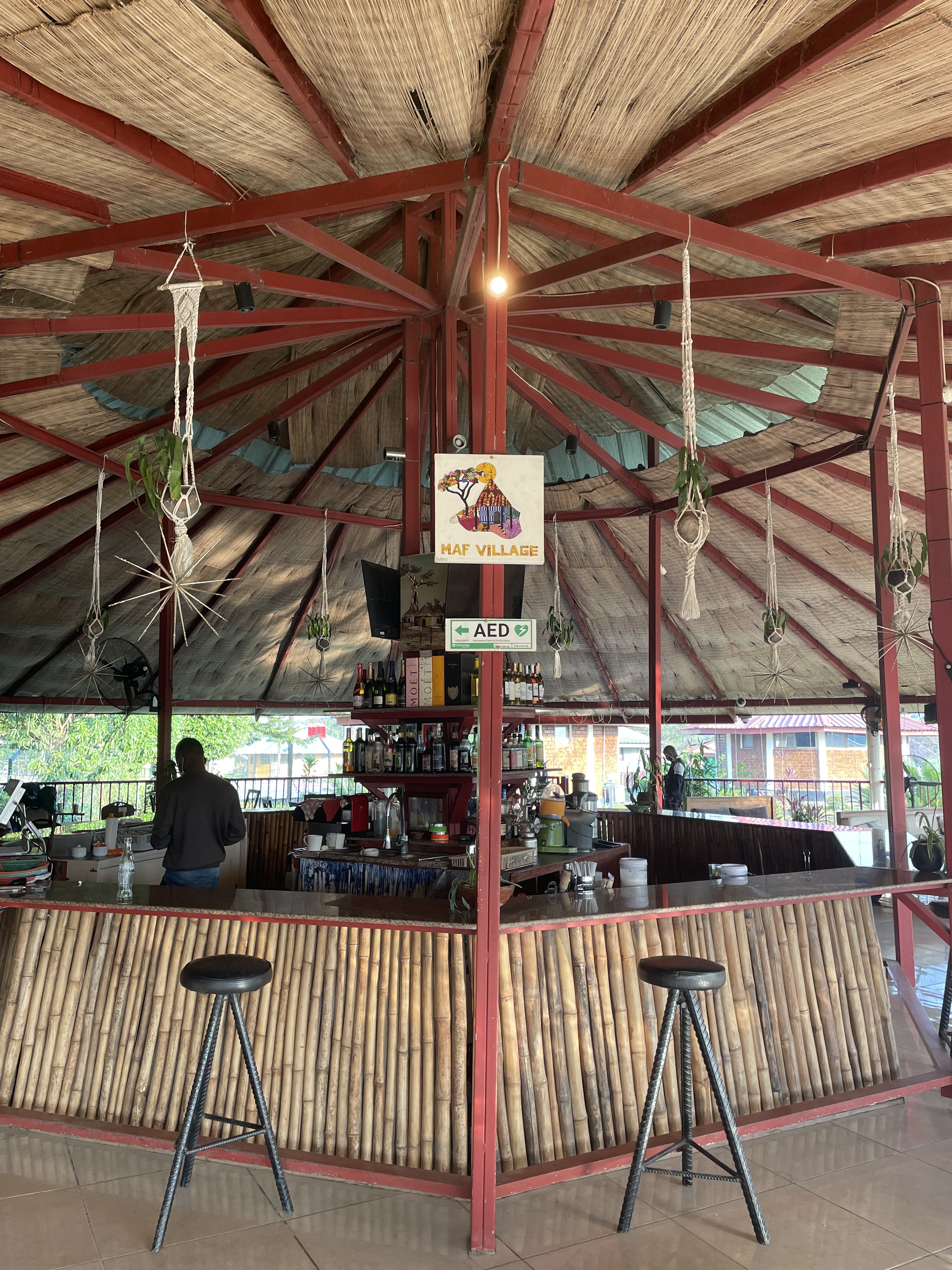
The Maf Village bar where we watched the World Cup final

I lost sight of my friend’s car, and the GPS told me to make a left that I should not have, right there smack in the middle of the chaos zone where motorcycles, taxis, passenger cars, semis, construction vehicles, and pedestrians vied for right of way in an unmarked dirt zone that served as the temporary alternative roadway. Luckily my friends called me to tell me of my error right away, but it would prove difficult to turn around in that area. Except I summoned my inner Guinean Driver and turned around where I wanted and got back on track quickly.

Once we turned on to the N4 it was as if we had been transported to another country. The road is paved; there are painted lanes and shoulders, and a glaring lack of potholes. What wizardry was this? The last bit of our drive to Maf Village went by quickly.

Maf Village is a lodging and activity location. This is where schools have field trips. There is the swimming pool and guided hikes but also horseback riding, a game room, an obstacle course, Guinea’s only bowling alley, exotic animals such as a monkey, ostriches, peacocks, and some baby crocodiles, and a large garden where they grow a significant amount of their own food.

In many places, Maf Village might not be all that, but in Guinea, it is the bee’s knees. It offers a respite from the hustle and bustle of the capital.

We only had one night at Maf Village. We enjoyed some lunch and then the kids swam in the pool and I had a pedicure at the newly opened (and nicely air-conditioned) spa. Then we all gathered in the bar area to watch the World Cup finals. We were rooting for Argentina and it sure was an exciting match. It was really great to be with friends and a few others yelling at a tv and cheering.

Following the game we took a walking tour of the property to see where they raise animals and grow crops and for some reason have a pair of ostriches. We then had dinner and the kids played ping pong afterwards.

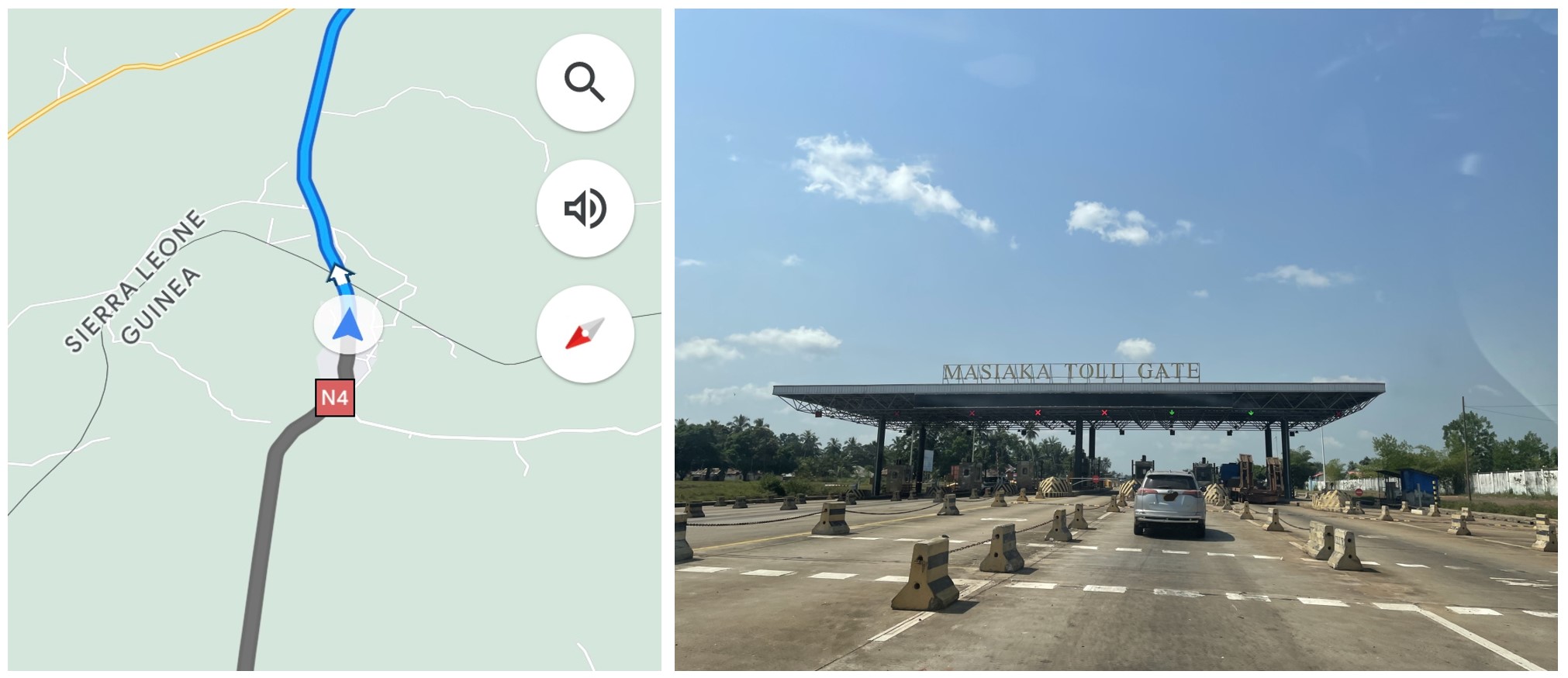
Approaching the Guinean-Sierra Leone border and, are you kidding me, Sierra Leone has toll plazas?

The next morning, I enjoyed the sounds of songbirds in the early morning light with a hint of a plateau in the distance through the Harmattan haze. It had been a long time since I had heard birds like that, since perhaps my wonderful yard in Malawi. We have an amazing view from our apartment in Conakry, but we have no yard, I rarely hear birdsong. I hear the train, the call to prayer, cars and trucks honking on the road, heavy machinery from the nearby construction site, and dance parties from below, but not birds and insects. I closed my eyes and listened. I had a good ten minutes before the spluttering of a motorcycle sliced through.

We had breakfast, packed up, and started our drive to the border with Sierra Leone. I have to tell you I was pretty excited, giddy even. I tried to think of the last time I had driven across an international border. Sure, I had this past summer from Belgium to Luxembourg and back, but driving across EU borders is not the same. Then there was when I served in Ciudad Juarez, Mexico, and crossed back and forth the border to and from the U.S. But not the same as self-driving across a border in West Africa.

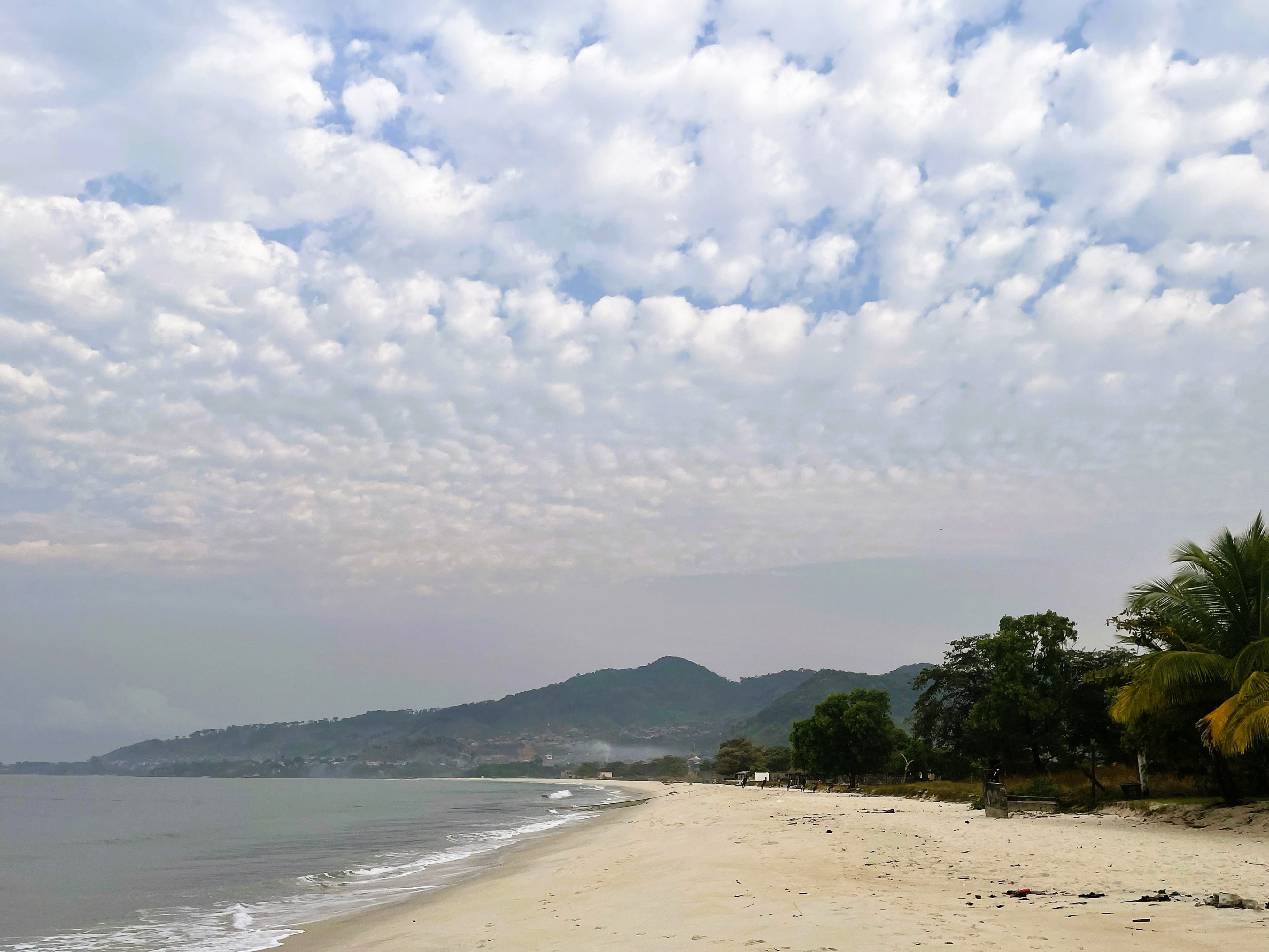
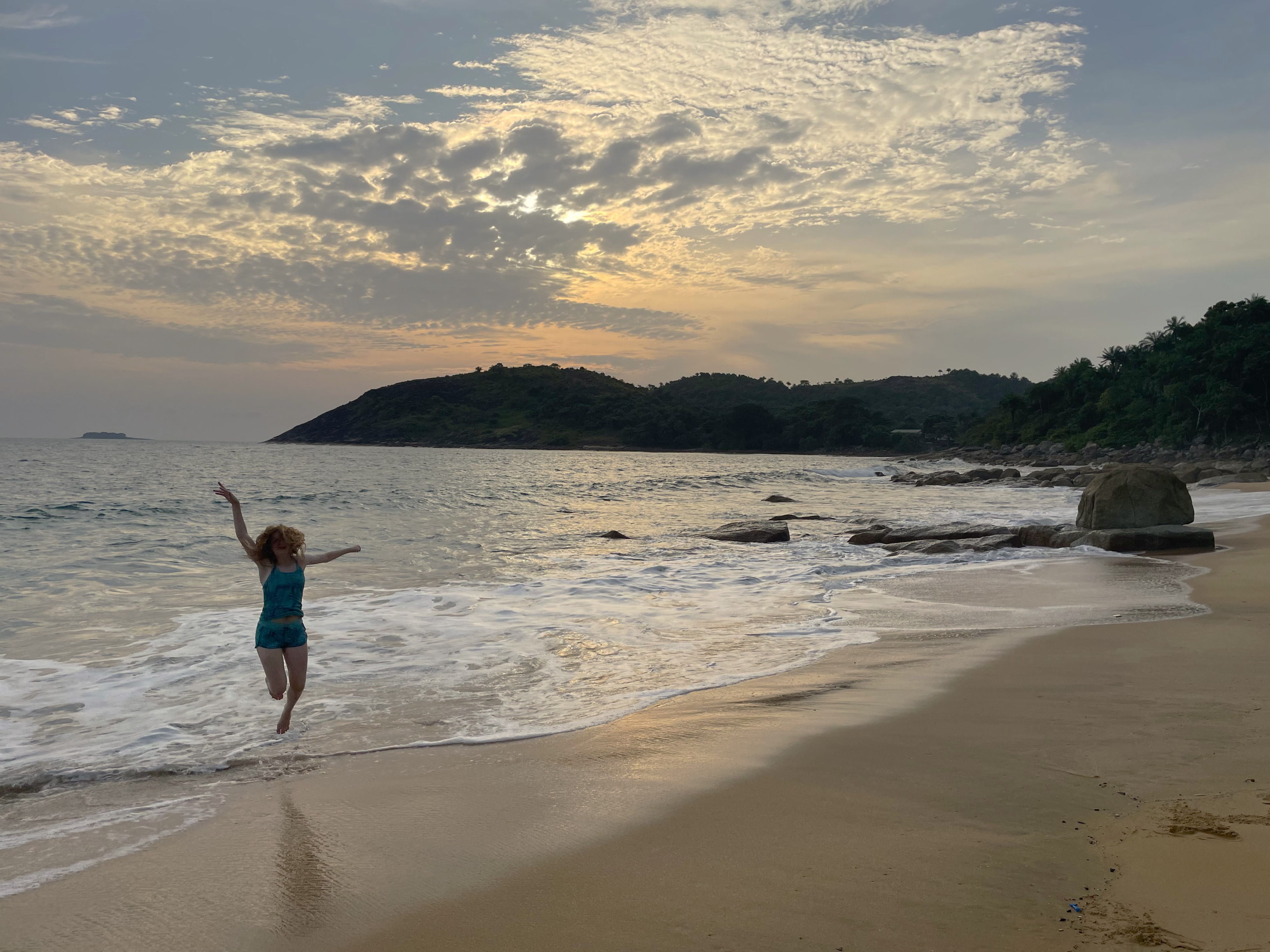
Tokeh Beach looking toward Freetown

The border was a little confusing. Makeshift rope barriers guarded by a single guy are all that keeps one from just driving across without going through immigration (well, and the threat of being caught). Signage in the building could leave most wanting, but as there were no lines to speak of and we stood out, we were quickly met by people wishing to help us. But we needed to ascertain if those people were official or not. A man who looked a bit dodgy but did have a badge on around his neck that he flashed at us, led us through the door marked “Do not enter. Officials only” and into an office where we all sat down in front of a desk. There sat a man with a computer, passport scanner, and camera. Seemed official enough as he scanned our passports one by one, asked us a few questions, typed up some information, then stamped us out of Guinea. I could not recall having ever sat down at immigration before.

We went back out to our cars. The guy lowered the rope to let us drive through to the other side where we parked and did the same thing on the Sierra Leone side. Once again, we were approached by a person who did not appear to be official but turned out to be. She also led us past the windows and into her office. Here though there were no computers or scanners, just two large ledger books. One was labeled in large capital letters in black permanent marker “Non-Citizens Incoming” and the other “Non-Citizens Outgoing.” I was surprised by the technology available on the Guinean side that the Sierra Leones did not have. After getting our Sierra Leone entry stamp we then had to have our “lassez passer” documentation for our vehicles checked. Then we were free and clear to continue to Tokeh Beach.

The road from the border nearly all the way to Tokeh Beach, about an hour outside of Freetown, was amazing. Paved, lane makings, shoulders, and mostly pot-hole free. We drove through two toll plazas where we paid 4 Leones (less than a quarter) to continue.

Finding Tokeh Beach Resort took a little extra effort as we got close the map lost its accuracy. But a wrong turn and some discussion with a local had us following said person as he lead us on a motorcycle taxi. Our initial reaction to Tokeh Beach Resort was not great. After the long drive and the fancy website, we had been expecting more, but it turned out a to be a very nice place to stay.

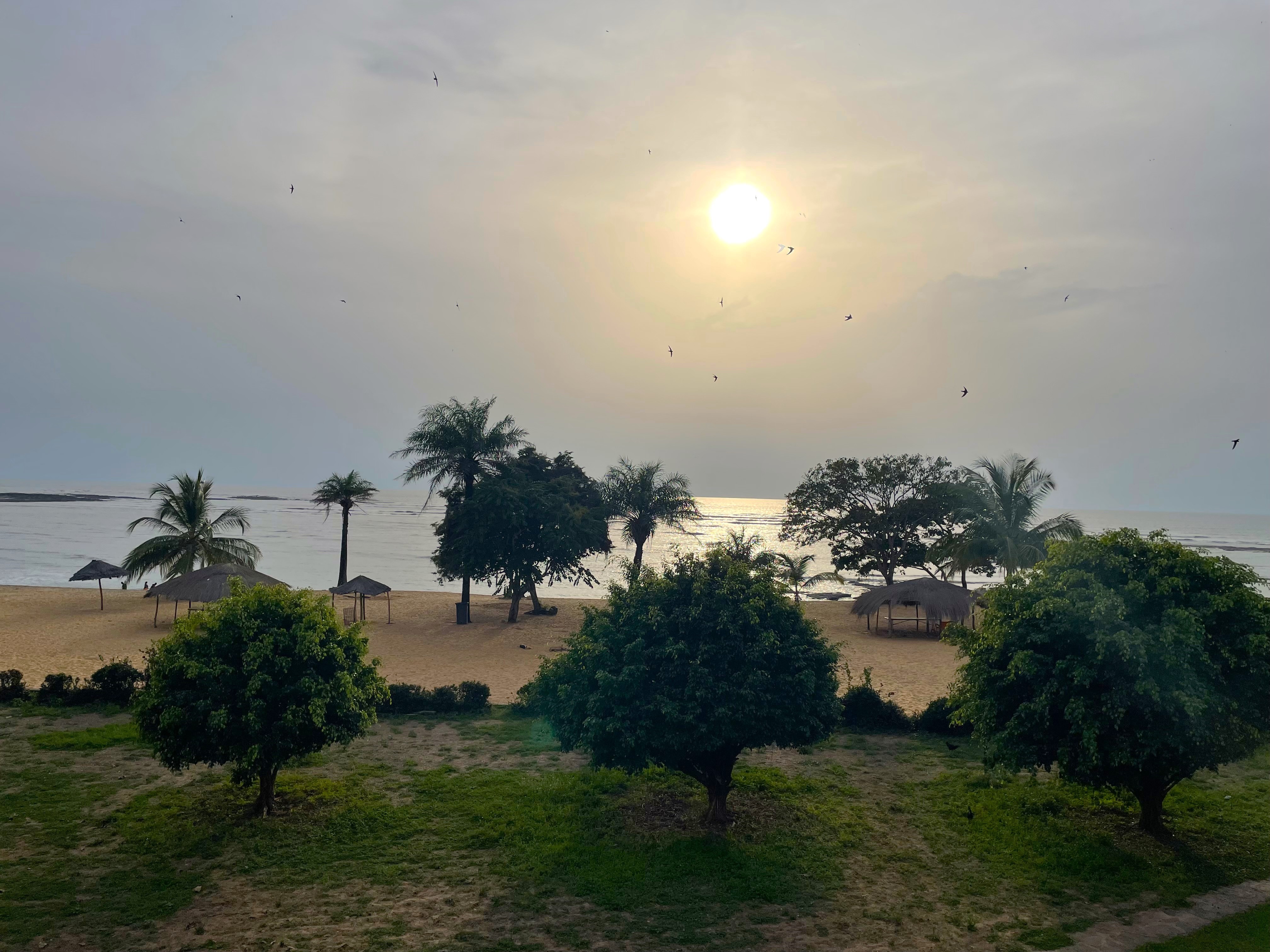
Sunset and sunrise at Tokeh Beach

There is another place to stay on Tokeh Beach ironically named The Place and it is really a nice-looking place, but it is popular and noisy. Tokeh Beach Sands on the other hand is quiet. I am a fan of quiet. We enjoyed the food, had great company, and just soaked in the sound of the waves on the powdery white sand beach. The sand is so fine that it squeaks as you walk across it. The pool turned out to be in the sister Tokeh Beach Palms about a 10-minute walk down the beach. No worries, the kids played in the surf for hours on end. I read. I wrote in my journal. I walked on the beach. I watched the kids and the waves. I thought about driving the hour to the chimpanzee sanctuary but then thought better of it. I didn’t want to go anywhere. I was already where I wanted to be.

The electricity is only on at the resort from 6:30 PM to 7:30 AM. You do not really need it otherwise. Sure, the bathroom was poorly lit/had no window so using the restroom or taking a shower during the day may involve some fumbling about in the dark or finding a large katydid on the faucet as you turn it on (as my daughter C found out. Great lungs for shrieking that one. C, not the katydid), but otherwise we were fine. The power overnight let us run the A/C so we could sleep and charge our devices.

This might not be a great commentary on the 2021 dream…or is it? A dream destroyed or a dream battered but hanging on? Hmmmmm… I just loved the composition.

After two glorious days of doing nearly nothing by the water, it was time for us to pack up and make the drive back to Conakry. Though this time we would do the reverse, thus going from good roads, to great roads, and then crappy roads the closer we got to the Guinean capital, the 48 hours of white sand and ocean waves must have done the trick because despite, the seven hours it took us to get home, I still felt content when we got there. Neither the long drive nor the tedious border crossing nor the stop-and-go crowded mania of the Coyah-to-Conakry interchange construction brought me down. Not even the special gift I got from Sierra Leone — a bizarre allergic reaction to a likely mosquito bite that left six inches of my left forearm swollen and super itchy — dampened my spirit. (Though once in Conakry I drove straight to the Embassy Health Unit to have that forearm thingy looked at and acquire some topical Benadryl). The adventure was worth it.

Mini Guinea Getaways: Soumba Falls

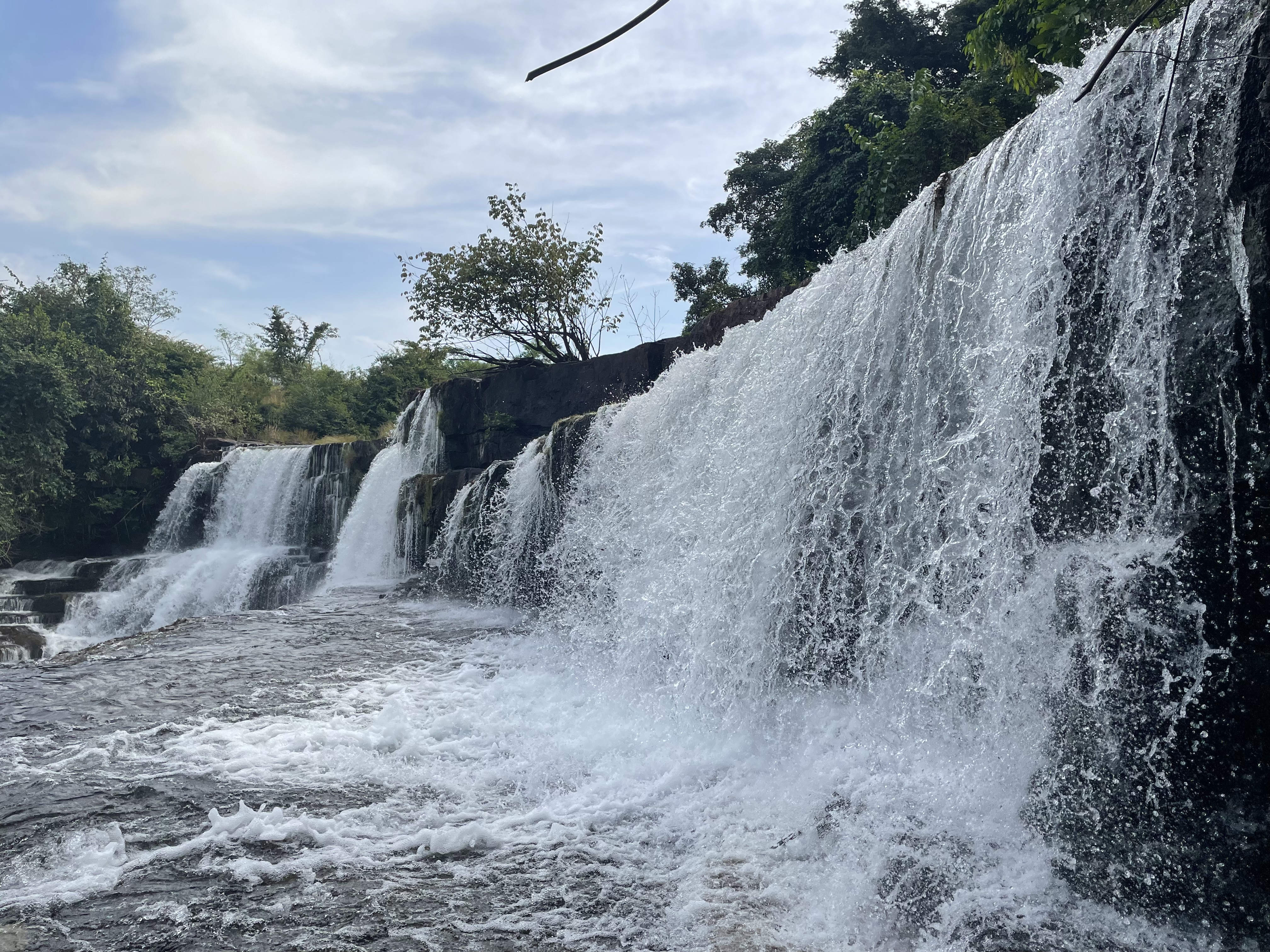
Close up of Soumba Falls at high volume

In my efforts to finally get out and about in Guinea, I was pleased to learn that our Community Liaison Office (the “CLO” – a catchall office that provides welcome information for newcomers, puts together holiday events, and organizes tours and gatherings) was organizing an Embassy outing to Soumba Falls in November. I knew there were not a lot of tourist sites in Guinea long before arriving (and many that do exist require a lot more creativity and resourcefulness to get to), but Soumba was in all the Embassy information – Post video and welcome letter – so the CLO trip was both fortuitous and expected.

As the rainy season had just ended the falls would be flowing well. I had heard that months after the rains, the falls would be little more than a trickle. This was the time to go.

A gorgeous sunrise as we leave our residence spells a good start to the day

We were to meet at the U.S. Embassy at 7 AM to travel to board the buses that would take us to the Les Cascades de Soumba. Originally, I thought we would all drive in a caravan, and though I do generally enjoy driving, I was a little apprehensive about making this one so I was quite happy to hear about the buses.

The falls are located just under 50 kilometers (30 miles) from the U.S. Embassy in Conakry though drive times vary considerably depending on traffic. It should be an hour drive at most, but online the quotes on TripAdvisor range from an hour and 30 minutes to “less than two hours.” The CLO had estimated a two hour drive with us all arriving around 9 AM. Unfortunately, it took THREE HOURS that Saturday morning! Sigh. Oh, Guinea.

A cemetery along the way with an amusing sign. Though it turns out that most cemeteries in Guinea have this saying “Nous Etions Comme Vous, Vous Serez Comme Nous!” (“We once were like you, you will be like us!”)

At first, it did not seem so long as people chatted away with one another or snoozed. And we could also look out at the sights along the road. Most of the time it was just to see the muddy roads, the crush of cars and trucks vying for dominance on the streets, and unattractive, poorly built buildings fronting the road. The cement of the structures coated in Guinean dust, and the clothing of many of the people on the street having been washed repeatedly in less than clean water, well, everything just takes on the same monochromatic reddish dirt color. Still, on occasion, there are surprises such as the cemetery sign above and the Donald Trump School (Le Groupe Scolaire de Donald Trump), of which I am quite sorry I did not get a photo.

At long last the buses limped into the parking area of Soumba Falls and we all gladly stumbled out of the buses.

We had a choice of two possible hikes in the area. One, that the CLO had organized last year, was just an out-and-back along the same road we had driven in on, with some side excursions alongside the river. Frankly, it did not seem all that appealing to walk along the dirt track we had just journeyed along on wheels even with the promise of a view or two of flowing water, so everyone hiking opted to take the other, unknown, route.

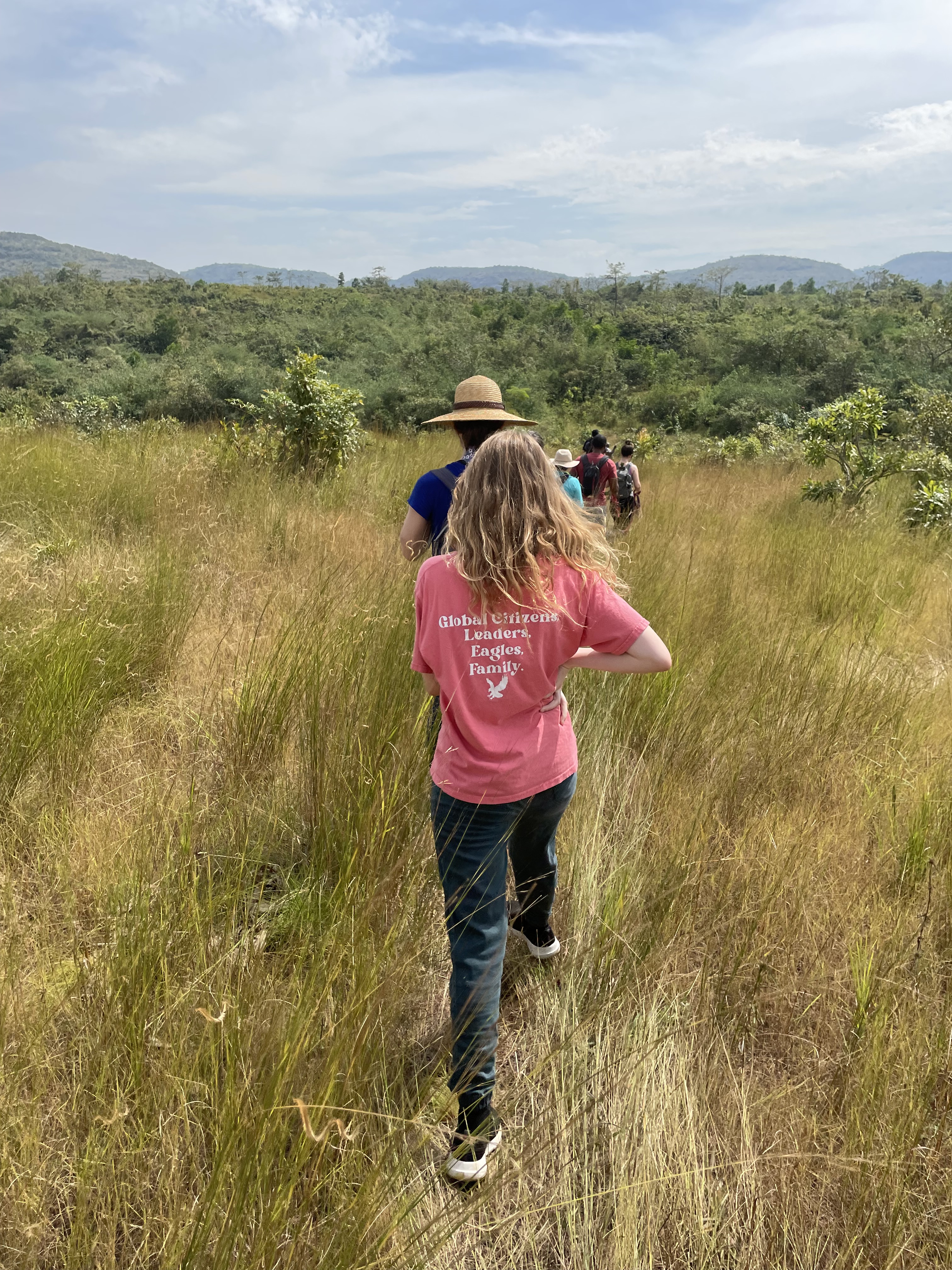
C hiking through the tall grass at Soumba Falls

I would love to write that the hike was a-ma-zing, but it wasn’t. It was okay. The colors of the tall grass were almost wheat-like against the taller green shrubs and the deep green of distant hills and a bright blue sky. Ok, so there were some highlights. But it was really warm, the grass high and scratchy, the trail almost imperceptible that it deserved to be in air quotes (“trail”), and there were several areas where plants with large thorns had to be held back for us to pass, but we still ended up with cuts on our legs and arms and small burrs on our shoes.

The “trail” did not really lead anywhere, just out to an overgrown area near a stagnant part of the upper river where crocodiles were languidly lying in wait beneath the surface. Or so we were told as barely any of us could get a good look at the water through the deep foliage. The two guides led us back the same way, which given the lack of sights the first time through did not give us all something to look forward to. Or rather the guides tried to lead us back the way we came, but they got a little lost at first, taking us first a shortcut that turned out to end in a barbed fence we could not cross, so we had to backtrack. Therefore, I have to air quote our “guides” and the “shortcut” as well.

The “guides” had told us the trek would take an hour. I should have air quoted the “hour” as well, though I didn’t believe them from the get-go. At least ninety minutes after we set out (though I think it was longer) we arrived back at the falls sweaty and grateful for a chance to cool off in the water.

The CLO had pre-ordered everyone’s lunch from the restaurant (well, I mean “restaurant” – it was more a giant smoke grill) that overlooks the falls. Unfortunately, at noon the food (either beef, chicken, or fish – we did not get more details than that) was nowhere close to being done. I cannot say for sure the cooks had even begun. I suspect not.

As everyone who had been in Guinea for at least a month knew that it was unlikely we would be seeing our food orders in the near term, we opted to swim before lunch. Good call.

My daughter, her friends, and their mom ran to get changed into their suits and slipped into the shallow pool at the end closest the “restaurant.” Just above there was a natural water slide created by the gushing falls and some smooth rocks. We counseled our kids to swim quickly to the side after the slide as the strong current and a bit of an undertow had the potential to sweep them quickly into a roped-off area. Apparently, there used to be signs warning of some potential death should one pass the rope line, whether by water or crocodiles or other was not all clear. However, though I went in search of the sign for photographic purposes, it had fallen and been shoved deep into the crook of a tree from which I could not yank it out. So much for a warning. Or a fun photo.

But we knew to stay away from the rope line. We also knew there were other possible risks — our health professionals had warned us all to avoid swimming in the falls due to the possibility of contracting Bilharzia, otherwise known as Schistosomiasis, from parasitic worms that live in snails that hang out in contaminated freshwater around Africa. Generally, these beasties are found in stagnant water though our medical practitioners warned that there is potential even in fast-flowing waters. We crossed our fingers and toes and put positive vibes out into the universe and then took our chances. Hopefully, we were lucky.

Wide view of Soumba Falls in its gushing glory

Around two in the afternoon to the “restaurant” began handing out some of the pre-ordered meals. Perhaps they had not anticipated such a large group in addition to some other visitors? How that might be the case since we had called ahead and it was a gorgeous and hot weekend at the beginning of the dry season, I fail to understand, but it was what it was and one has to learn to temper expectations in Guinea. By the time everyone had eaten we were well past our expected departure time, but what was there to be done for it? Luckily, I guess, the return drive took only two and a half hours. Ha! Still over what it should have been but it felt short given what it could have been.

All in all, I am glad we went when we did. The waters were high and fast and the falls resplendent in their gushing glory. The waters were cool and refreshing. The grilled chicken and chips were not bad. We were experiencing it as a group, with friends, and as much as I like to do independent travel, I did not want to be negotiating that drive or the meal on my own. I was grateful to have someone else handling those details.

Mini Guinea Getaways: Boffa

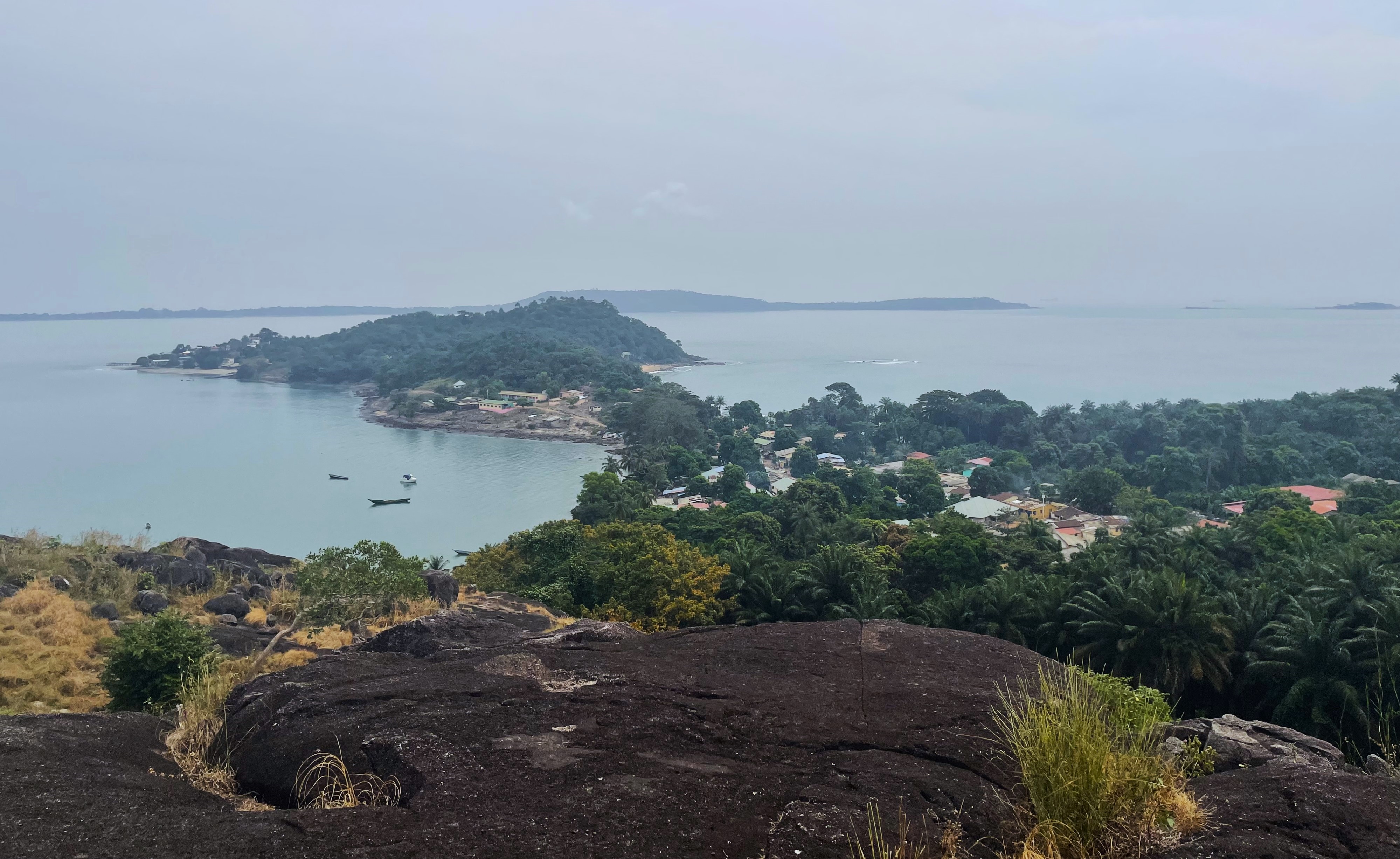
Bel Air Beach, Guinea

After spending our first four months in Guinea during the very wet rainy season, it was high time to get out of Conakry when November and the dry season rolled around.

My first opportunity to travel beyond the capital’s borders was in early November when a program officer came out from Washington to visit some sites where his bureau had funded programming. As the supervisor of his program assistant at the Embassy, I would get to visit all the sites and attend all the meetings as well.

As part of the trip, we would be visiting two national police academies. One is in Dubreka, about an hour outside of Conakry (on a good traffic day, which I suspect are few and far between) and the other in Boffa, about 140 kilometers north of Conakry, which according to Google takes only three hours from Conakry except I have not found Google driving estimates here to be particularly accurate.

On the road to Boffa

Given that, in reality it takes quite a bit longer to get to these locations, we would need to overnight near the academy in Boffa and stay at one of the few, if only, places in the area: the Hotel Bel Air, located another hour past Boffa, on the coast. I had read somewhere that this was a great hotel on Guinea’s best beach and had hoped to visit while in Guinea. As I was not so keen on a long drive, going there for work then would give me a chance to check it out.

After our visit to the academy in Dubreka, our driver headed north to Boffa. Road conditions in Guinea are not great, but the further we drove from Conakry, the better the roads seemed to get. They were narrow, no shoulders, few lines, but far fewer potholes in the countryside. Similar to Malawi, the roads zipped through the middle of small villages with little to set them back from the traffic.

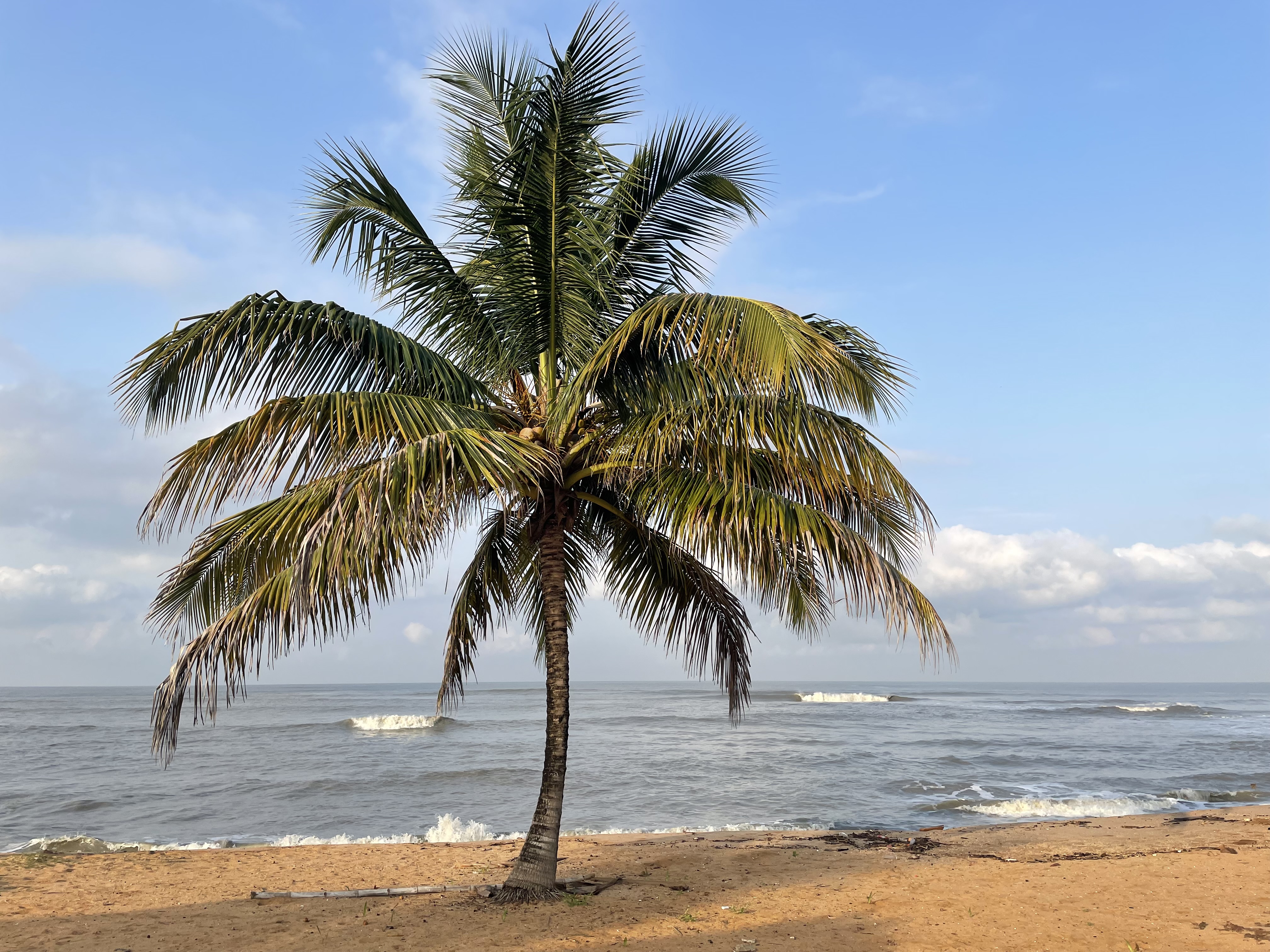
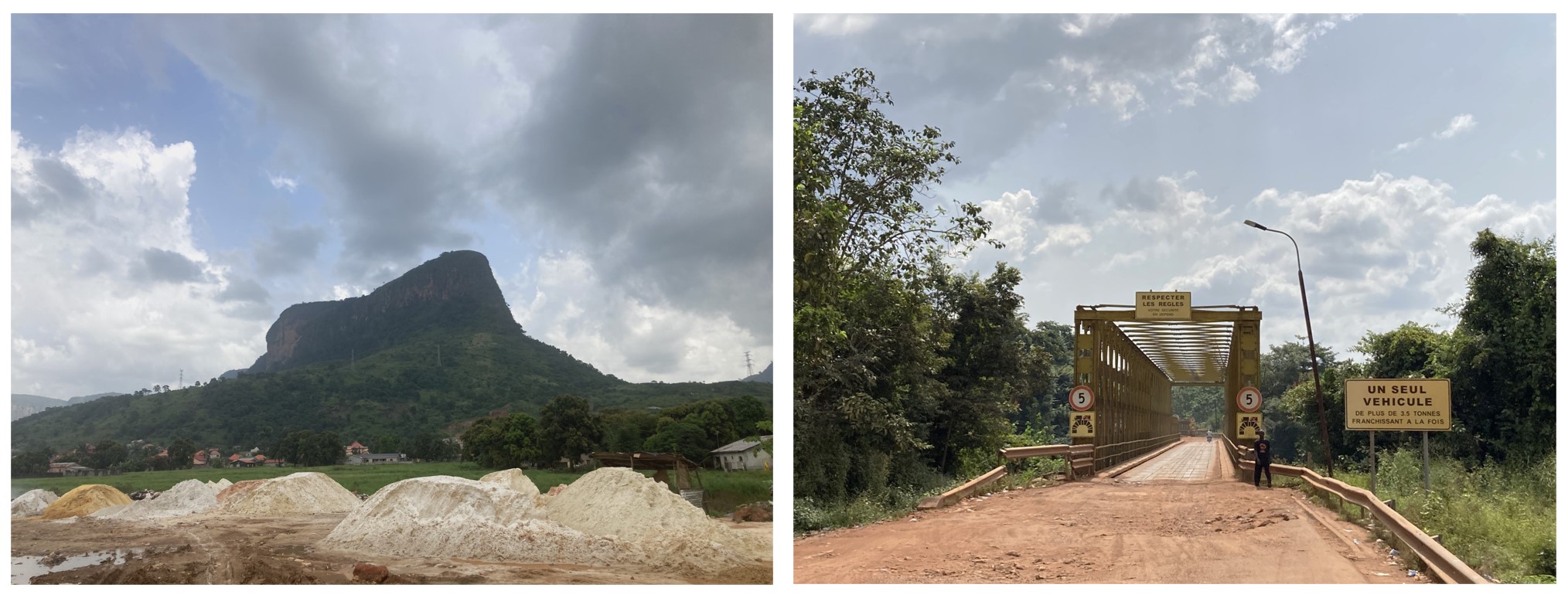
On a few occasions there was some dramatic and beautiful scenery, sometimes though you had to look beyond the immediate vicinity to see it. In the photo above with the craggy rock jutting out of a green hill, I was standing in a truck stop. It wasn’t much, just about a dozen long-haul semis parked in a muddy layby while their drivers took a break. My shoes were sinking in the muck and the drivers appeared amused at either my taking a photo of anything or that I was there at all. But with just the right angle and some cropping, you would not really know.

My new friend Carlsberg on Bel Air Beach

I do not remember too much of the drive to Bel Air as we had a lot of camaraderie in the car. I recall lots of green though. Sometimes the woody green of dense trees alongside the road, sometimes the emerald green of grass and palms by a river, and sometimes the chartreuse of towering grass framing the road. And the one-car bridge. I was pretty impressed with it. Malawi didn’t have any bridges that were quite so solid. After three hours or so of driving we arrived at what seemed like it might have once been the Hotel Bel Air, though now long past its glory.

We drove around a circular drive to the entrance. Not a single other vehicle was in the parking lot. The large lobby was deserted. Not a person in sight. No one came out from the reception desk even after we called “hello” multiple times. The lobby had large windows that let in the afternoon light, but it was clear the electricity was off as the corners of the high ceiling were dark. We walked down a large hallway that seemed eerily sterile and abandoned. We stepped out on to a back patio facing the Atlantic. Only stagnant water about a foot deep lay at the bottom of the pool. Behind us the building façade was stripped to the concrete, with the second-floor rooms missing not only their balconies but their whole back wall. So, yeah, things were not looking too promising.

But a man, who introduced himself as the manager, appeared from the standalone bar located a short walk from the patio. The Embassy program assistant said we had a booking but expressed reservations about the hotel and our being able to procure dinner. The manager assured us it would be no problem.

Not creepy at all….

He asked us to follow him to our rooms. We ascended a staircase and walked down a darkened hallway. The ceiling was removed to expose pipes, wooden crossbeams, wires and, the nests of what I later determined were swifts. The Shining anyone? The manager told us that only two of the rooms had a hot shower mechanism but that all the air conditioning units would work once the power came on in a few hours. The hotel only runs electricity from 6 PM at night to 8 AM the next morning. We were glad to hear it. Though I was once a backpacker who stayed in many a simple, unairconditioned room in steamy tropical locales and managed, I have grown very soft.

After getting ourselves settled, we meet the manager back at the patio to pre-order our dinner. We have a choice of chicken, beef, or fish. It’s like being on an airplane as there is no indication of how these options will be prepared or with what. Because I am just a tad picky with my chicken, I ask if any of the chicken available is breast meat. The manager says no, they do not have that. This is not the first time this has happened here but I wonder, as a chicken streaks across the beach in front of me, where do all the chicken breasts go if no place has them on offer? No matter, with low expectations I picked the beef.

While placing our dinner orders in the bar area, a small pack of very hopeful pups came to stand near us. I do not know what came over me — maybe just trying to find some joy in this somewhat odd place? — but I named two of them Carlsberg and Jameson. When I decided to take a walk along the beach, C and J trotted after me, tongues lolling. I just did a bit of walking and a bit of sitting and meditating as the waves rolled in. Then I returned to the room to do a bit of reading. Although my room was supposedly one of the ones with hot water, I could not figure it out for the life of me, so I enjoyed the first cool water bucket shower I have had in some time. It was actually refreshing and made me think of all the times I had done that before, mostly in Southeast Asia.

Around 7 PM, I met my two companions for dinner on the patio. Though warm, there was a lovely breeze, and we could hear the waves and the rustling of wind through the palms. We had views of a starry sky and the dark empty swimming pool. Carlsberg and Jameson stood vigil nearby. My beef arrived and it was remarkably good. My companions enjoyed their fish and chicken. This weird, mostly abandoned place had turned out some nice meals and service. I called my daughter, who was staying over with friends. She was none too happy with me for having left her while I went on this adventure. She told me she wished she were there and to describe the hotel. I had to tell her, laughing, that she was not missing anything. She thought Carlsberg and Jameson were cute though and that all things considered she would rather have been able to come with me.

The beach at the Hotel Bel Air in late afternoon

Retiring to my room I was happy to see the electricity was on and the air conditioning working well. The mosquito net hung limply from the ceiling with no frame, so I just wrapped it around me. Though the air conditioning unit was somewhat noisy it was more of a white noise and I could still hear the waves outside. I fell asleep.

I could not believe how well I slept. I am not a great sleeper, often prone to insomnia, and the tour in Guinea had thus far been more stressful than not. Imagine my surprise when one of my best nights of slumber would be at this hollowed-out hotel.

I opened the balcony doors and stepped out. The droning of the overworked air conditioner that had left a puddle over most of the balcony could not drown out the sounds of the sea and the dozens of swifts conducting aerial tricks over the beach. I love the view from my sky-high apartment in Conakry, but I missed the sounds of birds that I could hear every morning from my screened-in porch in Malawi. Bel Air was the first time I had heard this many birds in Guinea. I did not rush down to breakfast. I wanted to drink in the dulcet sounds, and store them, so I could recall them and feel calm later, when back in the chaos of Conakry.

The view from my balcony – of swifts, beach, and sea

We had a full day ahead of us. A visit to the national police academy in Boffa and then the long drive back to Conakry. The visit went very well and though long the drive was doable with such great companions. We laughed how no matter what in the future we would remember this trip together, we will always have the Hotel Bel Air. As much as C had wanted to join me, I knew this was not a trip I would have liked to do with her. I am grateful though I had this opportunity to see at least a small part of Guinea outside the capital.

Roume Island Adventure

The Los Islands just off of Conakry & the pirogue that whisked us away on an adventure

For Thanksgiving, another Embassy family (the D’s) invited C and I to join them for an overnight stay on the Ile de Roume or Roume Island. As a family of two that spends a lot of time overseas, we are not particularly traditional when it comes to the holiday and we had no other plans, so we welcomed the chance to spend time with friends while getting out of the city.

Roume Island (sometimes spelled Room) is the smallest of the three main islands of the Iles de Los archipelago, located just a few kilometers from Guinea’s capital. Conakry was initially established on the island of Tombo, one of the Ile de Los that is now connected to the Kaloum peninsula by a causeway. There is some interesting history to the islands. Their names are derived from early Portuguese navigators who called them Ilhas des Idolos (Islands of the Idols). The British controlled the islands from 1818 to 1904, when they were ceded to the French.

Roume Island dead ahead

On Thursday morning, we followed the D family’s car to Le Petit Bateau marina in Kaloum. We were to take a boat to Roume at 10 AM, but we were clearly already on island time or Guinea time or perhaps Guinea Island Time, as we did not begin the 45 minute boat ride until 11:30. We landed on Roume at a quarter past noon, jumping into the calf high water to wade on to the shore and then walking five minutes across the narrowest part of the island to the Hotel Le Sogue.

Here we had basic bungalows perched on the hillside. C and I shared a room with both a single and double bed, though only the larger of the two had a mosquito net above it. We had a well-water fed shower where we could get a good trickle going, after they turned on the pump. Once the hotel managers turned on the electricity, we were able to use it for a single bulb in the bathroom, a small bedside lamp, an outlet to charge my phone, and an electric fan. The room reminded me of my backpacking days. Simple, but more than sufficient for one night at the beach.

Knowing it might take awhile to get lunch, we ordered just after our arrival. The menu, presented on a chalkboard, had 7 or 8 choices, but all but one included seafood, which C and I do not eat. No surprise of course given our location! Lucky for us they also had chicken. While waiting, the kids changed into their suits and went to play on the beach and in the surf. I went to sit on my balcony where I could read and listen to the waves. My fellow parents divided themselves between the beach and the restaurant veranda.

A view of our bungalows at the Hotel Le Sogue

I do not want to oversell the Hotel Le Sogue, its beach, or Roume Island. I have stayed at nicer places on nicer islands, including in Africa, such as the Blue Zebra or Mumbo Island in Malawi. Unfortunately, there was a fair amount of trash on the side of the island where we landed, both on the land and in the water, though the beach in front of the Hotel Le Sogue was clearly taken care of well. Yet as I sat on my porch looking out at beautiful palms and the wide expanse of sand and listened to the rhythmic rolling of the waves and the sounds of our kids laughing, I felt quite content.

We did not get lunch until 2:30 PM. No worries as by that time we were on island time too. We dined on our fish or chicken with chips and salad on tables in a sandy clearing surrounded by palms.

After lunch the kids and one parent headed back to the waves. I was pretty impressed that my very fair skinned daughter stayed out as long as she did in the water. I was even more impressed that we applied sunscreen in sufficient quantities that she did not get a sunburn.

I did not get in the water, choosing instead to spend some more time on my balcony reading or just walking along the beach. Truth be told, I am not exactly sure what kept be occupied from the time after lunch until dinner. There was no phone service or internet on the Le Sogue side of the island, so we were not connected. That though was the beauty. There is not a load of things to do in Conakry, but it is loud, crowded, chaotic. There is little to do on Ile de Roume, but it was an entirely different kind of little to do.

C jumps for joy on Ile de Roume

In the evening, after dark, we had our dinner together in the open-air restaurant. Easy conversation and laughs among friends. Unfortunately, the lights attracted insects, in particular, blister beetles. I have since read that the blister beetle is common in North America, but I had never heard of them until arriving in Guinea. Just a few weeks ago our Health Unit warned employees that the blister beetle season was upon us. Blister beetles secret a burning chemical when threatened or squeezed so we were warned to make sure not to indiscriminately slap at an insect but to brush it off, just in case it might be a blister beetle.

After a whole host of blister beetles made their appearance, we started to lose interest in remaining in the dining room. When one landed on my daughter’s hair, she screamed and cried, and that was it — time to retire to the rooms even though it was only a little after eight in the evening. I read some by the weak, flickering light in the room, then C and I went to sleep, sharing the one double bed so we could both cocoon ourselves in the mosquito net that hung limply from the ceiling (there was no mosquito net frame). However, I had trouble falling asleep as I kept imagining blister beetles crawling on me, sensing a sting. (Fun fact: I have since learned that the blisters and skin rash from a blister beetle’s secretion takes 24 to 48 hours to form. Guess what? We did get blister beetled! Ouch!)

Roume Village Life: A painter puts the finishing touches on a mural; a village boy shows off his coup leader cum president t-shirt; get your goods at the Obama Shop Room

The next day, after a lazy morning drinking in the mesmerizing rocking of the waves and chowing down on a breakfast of omelets and fresh fruit, myself, C, AD and her son AD2 opted to take a guided hike through the village and up one of the island’s hills for a view of the neighboring Tamara Island. We were well prepared for two days on a beach with our shorts and flip flops, but ill-prepared for any sort of hiking beyond a stroll. And by “we” I mean mostly me. I mean, we were all dressed more or less the same, but it was I who struggled the most.

We started with a short three minute walk to the other side of the island where the boat had landed, then we skirted past the other hotel, then along a rocky, but easy, trail to the village. For a small island a little more than 4 square miles, the village appeared remarkably well appointed with a good number of houses, shops, a school, a community center, and plenty of goats and chickens.

The view of Roume Island from the top of the hill.

Through the village we went and on the other side we tramped through a makeshift trash heap in a clearing and then began to ascend the hill. We followed a slight trail through the underbrush under palm trees. Already quite warm, the sweat began pouring down my face, trickling down my arms and legs. It did not take long for my t-shirt to become soaked through and my flip flops slick. As we passed the tree line and started up on boulders, I fell further and further behind. Although my flip flops had a good grip on the bottom, my feet were so slick with sweat that I could barely keep them on, especially when trying to climb on rocks. One of our guides, a young 20-something with a stutter, stayed with me the whole time, offering his hand to pull me up rock after rock and eventually offering me his flip flops, which were too large but less slippery.

At last we reached the top. I had honestly started to think I might not make it and it was very humbling. In all it had only taken 30 minutes, but it had felt longer. We spent some time enjoying the view and then began our climb down. I gave up on shoes entirely, having a much better purchase on the rocks in my bare feet, until we reached the grassland. We were all happy to arrive back at the Le Sogue hotel at noon, to either wash ourselves in water from a bucket filled the night before or jump into the sea.

By noon, our lunch should have been ready or nearing ready as we had ordered after breakfast because it had taken so long the day before. However, we were told around 1 PM that lunch was not being prepared as the boat bringing the supplies from the mainland had broken down. All they had were french fries, so that is what everyone had. Though originally the hotel scheduled our return boat at 4 PM, we asked to leave an hour earlier given that without lunch we would want to get back to Conakry sooner.

Though we were ready at 3 PM, the hotel staff only began to take our belongings to the boat at 3:30 and there we sat for on the small beach for an hour as first two men bailed out water from the boat and then until our last mystery guest arrived. We started our journey at 4:30 PM.

About 30 minutes into our journey, when we were halfway between Kassa Island and Conakry, the motor stopped. Initially, I thought it might be a joke, like the boat guys were having a bit of fun with us given the boat with our food from the mainland had also broken down. They were not. The motor had died. It seemed they had used the same boat and motor as the one that had stalled earlier in the day. We made the usual jokes about swimming to shore or flagging down a passing fisherman. It was very amusing at first. After 20 minutes it was a little less so as it was now after 5 PM and the sun was beginning its descent. The boat guys assured us they had called for assistance, that someone was on their way, but it was unclear when that person, if someone had even been called, would arrive.

The boat guys try to restart the motor as the sun sets.

My friend messaged the Embassy’s security officer just to let him know that we were adrift in Sangareya Bay. Not that he could do anything, but it felt good letting someone know. At least we had cell and data service so I could tell all my friends and family hundreds, if not thousands, of miles away that I was stranded on a boat in West Africa. The boat guys dropped anchor to keep us from floating further away and they kept trying to rope start the motor. It would sometimes start, almost catch, and then die away. After forty minutes (with no rescue boat in sight) the finally caught and we pulled up anchor and headed toward shore. We let the security officer we were on our way again.

We made it a few more minutes, just inside the harbor, when we broke down again. It took only 10 minutes to get it started again this time and it was at this point the rescue speed boat zipped up. As we were moving, the rescue boat just circled around us and left. Seriously, it left! If I were the driver of the rescue boat I might have hung around, followed the boat with the problematic motor until they got back to port. I guess that is not how things roll in Guinea. No surprise then when we broke down again.

Luckily our rescue boat was not too far away. We figured we would need to transfer to the smaller boat and he would zip us back, probably in two shifts. But no, instead he towed us. Somehow it worked and we made it back before sunset. We were all still in pretty good spirits, but I think that would have changed had we still been out on the water after dark. Our kids were gifted with a great story to wow their classmates with for years to come.

This should have been the end of the story. I wish it were. But we still had to drive home. I had never driven in the city after dark. Driving in Conakry is challenging even on days with little traffic and in bright daylight. Most roads have no lane markings. Most have potholes. More present conditions more like off roading, more dirt and mud than asphalt. Most motorcyclists, of which there are many, obey no laws.

Just after we got off the boat they were, improbably (at least to me), loading it with supplies and taking on more passengers.

Our planned route out from the port area was blocked. Apparently, after 6 PM the normally two way road becomes one way, and not the way we wanted to go. We were stopped for more than 10 minutes unable to move or turn around with a steady stream of semis driving towards us, inching past us. At last someone did a little traffic directing and we were able to turn around and try again as we bumped down several side streets until we reached the N1. Traffic was bumper to bumper and aggressive, as usual, and in the melee I lost track of our friends.

I though at first to follow the N1 down to the roundabout near the airport and then the T2 which would take us directly back to our apartment. Except the government is doing a massive construction project at the Bambeto traffic circle right by our apartment and I was not sure of the way anymore. I turned off the N1 and the GPS led me along dark, narrow, bumpy side streets. Had it been daylight I could have been in a Toyota RAV4 or Goodyear tire commercial demonstrating my all-terrain driving prowess. Motorcycles circled us like sharks, dodging and weaving in all directions.

At last we made it to Rue de Prince. I was not sure my next move as it also led to Bambeto Circle or what was left of it. I followed some rogue cars to the circle, an active construction site, and slowly squeezed my way down a makeshift path between the construction pit and shops while surrounded by motorcycles. It is absolutely amazing we were not hit by any of them. But to get back to my apartment I had to take a newly built detour road and as I turned to enter the one way road, a cement mixer roared out, going the wrong way, and stopped just inches from my car. Its grill was all I could see out of my windshield, it was that close. And I lost it. I leaned on my horn for what seemed like a minute yelling “Aaaaarrrrrrrreeeeeetttttt!!” Why French came to me at this moment when so often I am at a loss for French vocabulary, I do not know, but it seemed appropriate. The truck stopped. I was able to inch around it and then made the last short drive home inching along with more traffic. By this point my daughter is sobbing and I am cursing. It took us two hours to drive home a distance of 13 kilometers (8 miles).

Guinea sure knows how to deliver. I am well on my way to a gold medal in the Guinea Experiences Games. Get doused with blister beetle acid? Check. Get stranded on a boat off shore? Check. Narrowly miss getting pulverized by a truck driving the wrong way? Check. I never know what Guinea has in store for us next.

A Big Birthday in Lisbon: Part Two

At Cabo de Roca, the end of Europe

This is the second of two posts about my birthday trip from Guinea to Portugal.

Thankfully, the day after my action-packed, wee bit frustrating birthday my daughter recovered from her stomach bug. We were leaving beach town Cascais for the heart of Lisbon. Before doing so, we caught another Uber (the message here is that Uber is very, very convenient in and around Lisbon) to Cabo de Roca, the windswept rocky coast that is the westernmost point of the European continent. A few years ago, C and I had visited the southern most point-ish place in Africa (because many brochures say the Cape of Good Hope is it, when its actually Cape Agulhas; we were close), so it seemed fitting. I was not quite prepared for the height of the cliffs and the cold air sweeping off the Atlantic, but the glimpses we were afforded when the clouds shifted were breathtaking.

We headed back to our hotel then to grab our luggage and then went straight to our central Lisbon hotel. I did not have big plans as I thought we should keep things more low key after all the sights from the day before. We simply walked from our hotel near the Edward VII Park to Commerce Square, about 30 minutes direct. But we meandered and took photos, passing Restauradores Square and Rossio Square, along the pedestrian shopping street through the Augusta Street archway, crossing Commerce Square, and ending at the Cais de Colonas, the stone pillars that mark a historic pier where arrivals on the Tagus River would alight in old Lisbon (Queen Elizabeth II arrived in Lisbon this way in 1957).

Fountain and theater on Rossio Square

We headed back to our hotel then to grab our luggage and then went straight to our central Lisbon hotel. I did not have big plans as I thought we should keep things more low key after all the sights from the day before. We simply walked from our hotel near the Edward VII Park to Commerce Square, about 30 minutes direct. But we meandered and took photos, passing Restauradores Square and Rossio Square, along the pedestrian shopping street through the Augusta Street archway, crossing Commerce Square, and ending at the Cais de Colonas, the stone pillars that mark a historic pier where arrivals on the Tagus River would alight in old Lisbon (Queen Elizabeth II arrived in Lisbon this way in 1957). We purchased a 48-hour Lisbon card at the Tourist Information center on Commerce Square and then retraced our steps back to the hotel for an early evening in.

Belem Tower

The next day we were to be up bright and early so we could use our Lisbon Card for free transportation to and included entry to the two UNESCO World Heritage Sites of Belem. Although both sites do not open until 10 AM, as many sites in Lisbon have a later start than most Americans are used to, I still was unsuccessful in my plan. We just got started a bit late, then got on the bus going in the wrong direction, and the bus took longer to wind its way to Belem. By the time we arrived it was 10:30 AM and there was already a significant line outside the Jeronimos Monastery. The Lisbon Card advertised a “fast track” entrance to the monastery but the two guys manning the ticket purchase area had themselves a hearty laugh at my expense when I asked about it. Thinking back to that line at Pena Palace, I just could not bring myself to join the queue.

Monument to the Discoveries

I made the executive decision to skip it for the day and instead head over to Belem Tower. I figured that there might be a similar line there as well, and then I would have to do some hard thinking about what we were going to do that day. Imagine my surprise when we approached the iconic 16th century fortification, that there was no line at all. None. I began to wonder if it were closed given it was a public holiday (Republic Day). But it was open. I could not believe out luck. Unfortunately, it didn’t exactly last as the stairwell to the tower’s top terrace, hailed online as the crown of any visit, was closed for no discernible reason. I found no explanation at the site itself or online. Still, it was another beautiful day and we were visiting one of Portugal’s most recognizable historic buildings.

As it was close by, we then walked over to the Monument to the Discoveries, a massive sculpture commemorating the Portuguese Age of Discovery with figures of Henry the Navigator and Vasca de Gama and 32 other Portuguese explorers along the river where many of their vessels set out on their journeys.

The Madre de Deus Convent at the National Tile Museum

We hopped on the 15E tram to head back down to Commerce Square where we did the 20-minute Virtual Reality experience at the Lisbon Story Center. With that it feels like you are flying over the key locations of Lisbon, Sintra, and Cascais, which was pretty fun since we had just visited nearly all of those sites recently. We got lunch and then rounded out our day with a visit to the National Tile Museum. The glazed ceramic tiles, or azulejos, can be found all over Portugal, in and on public buildings and private homes. The National Tile Museum incorporates the 16th century Madre de Deus Convent. It’s church is an extravagant display of carved exotic wood, golden framed paintings, and exquisite tile work. It is overwhelming and stunning. When we lucky the chapel was open during our visit.

The following day we headed first to the monastery. This time leaving earlier, on the correct bus, and arriving thirty minutes before the 10 AM opening. It was a completely different scene — we were one of the first in line and though there were a good number of people milling around, there was not the two long lines to get into the monastery’s cloister and the adjacent Church of Santa Maria. Instead of two guys laughing at my asking about the Lisbon Card’s “fast” line, we were actually let in to the cloisters at 9:45. I do not know if this happens regularly or not, but it wonderful to be some of the first people inside for the day.

The cloisters of the Jeronimos Monastery

The cloisters are breathtaking. There is zero doubt as to why UNESCO declared the monastery and the Tower of Belem as world heritage sites. The stone craftsmanship, the attention to detail, the architecture… I have run out of superlatives for this post. We saw so many beautiful sites on our trip but the cloisters were hands down my favorite. We also visited the Church of Santa Maria, which includes the tomb of the Portuguese explorer Vasco da Gama.

We once again headed back to Commerce Square, stopping briefly to check out the Pasteis de Belem, which has been making Lisbon’s famous pastel de nata, an egg custard tart, since 1837. I had planned for us to give this Portuguese dessert delicacy a try there at the shop, but the lines out the door and down the block had made me change my mind. The tart was ubiquitous in and around Lisbon. Each of our hotels had them out for breakfast. Many restaurants had them on the menu. Pastry shops around town sold them. So we did have one and it was flaky and creamy and so, so good. But it was probably not the original, and that’s okay.

Back at Commerce Square we went into the Lisbon Story Center, an interactive museum where visitors follow a set route through the museum with a headset that told the history of the city. Though some displays were a little campy, overall it was really well done.

Some views from our walks including the Santa Justa Lift (center)

Then we walked. And walked. And walked. Lisbon is a city built on hills and walking can be challenging but also rewarding with something beautiful on every block. We walked a lot during our trip in Portugal and it felt wonderful. I have always loved walking and it really hits me how much so when we are at a Post where we are unable to walk much. Conakry is one of those places. With few to no sidewalks, few shoulders and often deep ditches next to the road, and high vehicle traffic that will take as much road space as possible, we do not walk. I am grateful my 10-year old is usually up for walking during our holidays as I am.

Because of the hills, Lisbon has also built quite a few public transportation options to include the metro, trams (or trolleys), tram-like funiculars, and even one elevator – the Santa Justa Lift, inaugurated in 1901. With a strong desire to get around on our own two feet we did not use much of the transport — the bus and trolley a few times, and the lift, which is also a tourist attraction.

I had debated about taking a day trip from Lisbon to Obidos or Evora, both of which I had visited 20 years before and unlike Lisbon I actually remember some of. However, every time I looked at the train or tour options, I did not feel strongly about going. Honestly, the move and settling phase of Guinea has been challenging and tiring and I did not want my vacation to be more of the same. There was plenty to keep us happy and occupied right in Lisbon.

With that in mind I booked us a two hour tuk-tuk tour of the city’s street art. We had already seen (or planned to still see) most of the historic sights on foot or by Uber, so I wanted to do something a little different. And after we had seen the comic art murals of Brussels, I loved the idea of seeing something similar in Lisbon.

Some of my favorite Lisbon murals

It was a great tour on yet another beautiful, warm day. We saw mostly painted murals but there were also tiles, stenciled art, and stylized graffiti. The tour included getting us to some neighborhoods and viewpoints that we would not have likely gotten to on foot. I also loved that our guide was a former investment banker who after some 25 years of the grind retired and now motors tourists around in eco-friendly tuk-tuks. If it were not for Lisbon’s narrow streets and tricky parking situations, I might have put in an application.

After some lunch we then headed up to the Castelo de Sao Jorge, a mid-11th century Moorish fortification that overlooks Lisbon’s oldest neighborhoods. In the park, that affords gorgeous views toward the sea, peacocks roam. C and I were flagging some. We were gung-ho about walking, but we had done quite a lot and we might have also been getting a wee bit tired of castles (it is possible!). But we enjoyed the visit and the ice cream that helped give us strength to walk back down the hill and back to our hotel.

Our final day in Lisbon, we visited yet one more palace, the 18th century Queluz National Palace, which took us briefly back into the Sintra district. C and I had been looking online at the top castles and palaces in the world and one listed Queluz. It did not seem wrong to miss out it when it was so close. To my untrained eye it seemed similarly decorated as the Pena Palace but with larger rooms, less furnishings, and far fewer tourists. The highlights for me were the extraordinarily tiled canal, the Don Quixote room where a former Portuguese king had both been born and died, and the fountain of Neptune.

Queluz Palace

There was no use denying though that we had exceeded our palace viewing threshold. In fact, as incredulous as it seemed, I was beginning to miss our Conakry apartment, our cats, the joy of a quiet weekend with no pressure to get out and sightsee.

We made one last stop at the 18th century Aqueducto des Aguas Livres, part of the Museum of Water that showcases the fascinating efforts to bring drinking water to the city. We walked along the top of the aqueduct about a kilometer out and back and then once again walked back to our hotel with a stop for lunch.

C enjoyed seeing another part of Europe and declared that she liked Lisbon even more than Brussels. She even said that perhaps she would like to retire there. Though at 10, it might be a wee bit premature for her to be contemplating retirement. I am so glad I chose to spend my special birthday in and around Lisbon. As a backpacker 20 years ago I had not given nearly enough time to the city, and I feel this trip rectified that mistake.