Malawi: Two Year Anniversary

Two years in one place.  Its something to celebrate.  Not that I haven’t spent two years in other places; I have.  Japan. Jakarta.  Juarez.  Shanghai.  But this is the first time, in a long time, in which I am staying on past the two years or am not in the midst of those final months of packing up and preparing to leave to the next location.  We have two more years ahead of us in Malawi.

It seems a little hard to believe that a little over two years ago I was sitting at the table – the same exact table I had had in Jakarta, in Juarez, – in an unfurnished, characterless dining room around three in the morning, jet lagged, wondering what in the world had possessed me to bid on a job in Malawi.

Here I was in a new country, on a new continent, in a new position I had not yet done before.  In all the other places I had lived — with the exception of the small town of Kogushi in Western Japan – I was in a large city.  From my home I could get around on my own from day one, on foot or by taxi or other public transport.  The first few weeks in Malawi I felt very isolated.

Yet here we are two years later and it is very much our home.  Those early lonely days feel so long ago.  C loves her school.  When we arrived she was just starting kindergarten.  Two years later and she has graduated lower primary and begun upper primary.  This is not a distinction we have in the U.S. school system; it seems particular to the International Baccalaureate program taught in many international schools around the world.  This year as an older primary student she has a longer school day and eats lunch at school.  While C really doesn’t know any different, I know how incredibly lucky she is to attend a school like Bishop Mackenzie.  She has five classes a day Monday through Thursday and three classes plus assembly on Fridays.  Physical Education class is offered twice a week; once the weather warms, one of those will be swimming.  She also has French, drama, library, art, and music once a week, just built into the curriculum.  I not only am glad that C will have the opportunity to spend two more years at a school, but that it is this school.

IMG_3208

Our chickens enjoy some freedom in the garden

Our yard continues to be a wonderful sanctuary.  We continue to grow fruits (bananas, avocados, lemons) and vegetables (onions, carrots, cabbage, lettuce, tomatoes, sweet potatoes, cauliflower, and, new this year, edamame).

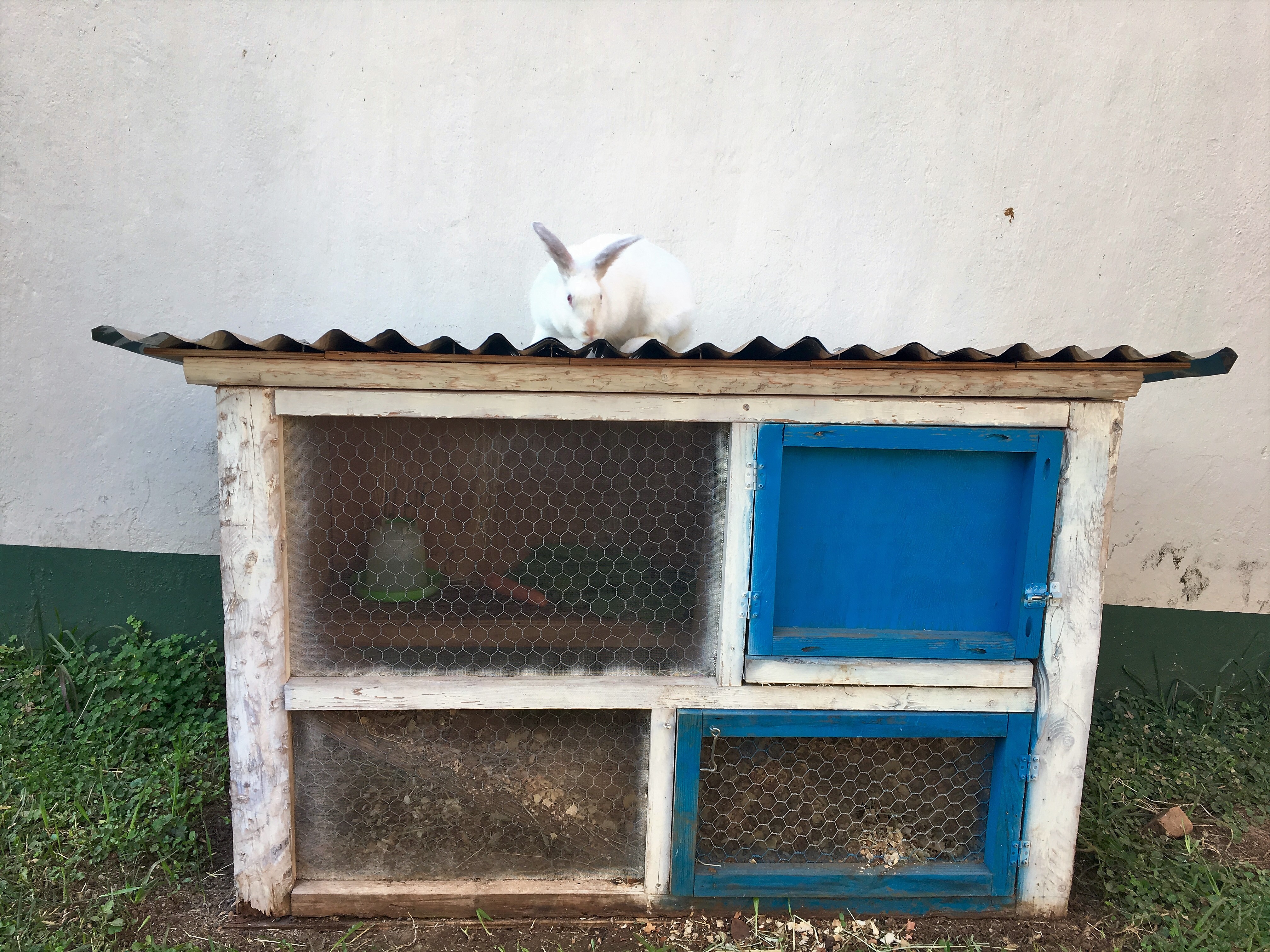
One of my favorite things to do is to get up on a lazy Saturday morning and head into the yard for the chores.  I first open the chicken hutch to let them out into the pen.  Then I collect the fresh eggs and bring them into the kitchen, where I will grab the key for the garage off the key hook.  Once in the garage I scoop out the chicken feed for the day.  It’s really cute to see how our chickens – Carmen, Can, Lou, and Leash – rush to me as I bring in their food, sometimes arching their backs for a pet.  Some Saturdays or Sundays I give them free reign in the whole yard – if we haven’t recently planted any new crops.  The gardner, a really cheerful and good natured guy named Stephen, does not take kindly to the chickens rooting up the newly planted shoots.  After squaring away the chickens I head over to the rabbit pen where our bunny Sarah, spends most of her time.  (The pen was built by our former Regional Security Officer from blueprints I found online and with wood from the crates that had shipped my Household Effects and Consumables.  Recycling and Embassy goodwill)  I check Sarah’s water and make sure she has enough food.  If she is not pissed at me I will give her a few nice scratches on her forehead and cheeks.  If she is mad, she retreats to the far end of the lower level, under the run, where it is near impossible to get her out.

IMG_E3110

Uh-oh.  Sarah the bunny may make a great escape.

Back inside I get my morning Coke Light (I don’t drink coffee) and sit on our konde (screened in porch) to enjoy some bird song and meditation.  Night or day there is birdsong in the yard.  I do not recall any place I have lived where I could hear so many birds.  The musical cacophany is truly magical.

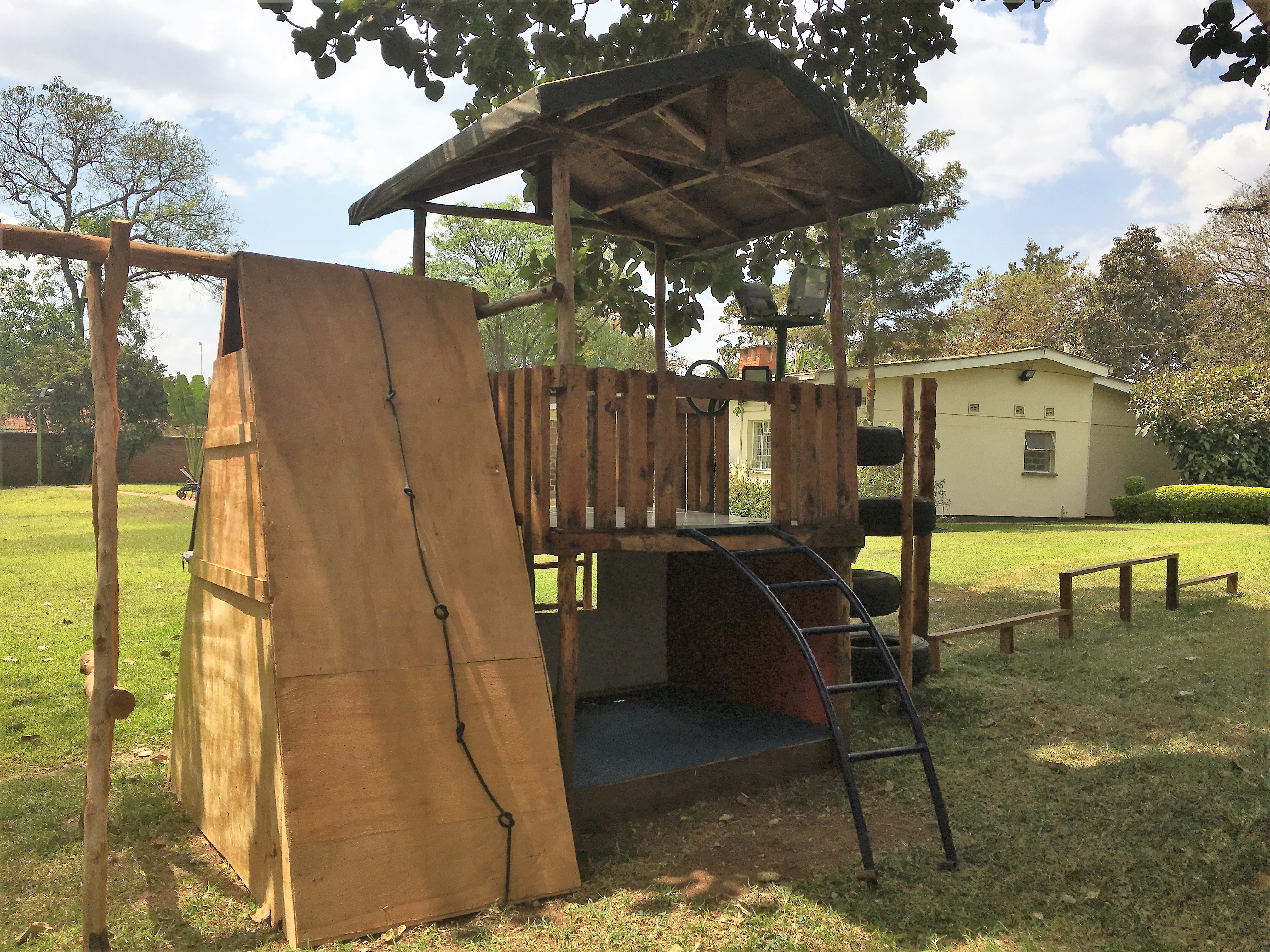
To celebrate two years in Malawi I decided to upgrade our background playground.  When we were first to arrive, I had arranged for the previous occupants of our assigned house to leave behind their custom made playground.  Things did not work out quite as expected as just days before our arrival our housing assignment was changed due to necessary security upgrades, so I had to pay someone to dig up, take apart, move, and reassemble the playground at our house.  But when we first arrived C was 5 1/2 years old.  Now she is 7 1/2 and the small slide, mini wall climb, sandbox, regular swing and tire swing were not quite age appropriate, so I hired the carpenter who had moved the playground two years before to execute a custom designed upgrade.

playground before and after

The Playground: Before and After

We now have three swings – a regular swing, a disk swing, and a trapeze and rings bar, a much taller rock climbing wall, a rope climb, a tire tower, long-leveled balance beam, a fort, and a curved metal climbing ladder.   The sandbox is now gone, replaced with a wooden floor and walls, and together with the inside of the climbing wall, creates a fort.  It’s a pretty awesome upgrade if I do say so myself, and C had better use it (or else!).

IMG_3151

The backside of our (awesome) upgraded playground

As part of my playground upgrade I found myself in communication with a guy, by the name of Cobra, who welds metal playground equipment.  C and stopped one day at a dirt field, where several different pieces of playground equipment lay strewn about.  There we met Cobra, apparently his real name (perhaps not so unusual here – I have met/heard of Malawians named Gift, Blessings, Lonely, Voice, Loveness, Poverty, and James Bond), and I got his WhatsApp number.  After I worked out what I wanted I sent him a photo and instructions.  Within days he had completed it.  I could have bought it on Amazon and had it shipped to Malawi, but for the same price I engaged a local to make essentially the same thing.  I honestly am not sure what is more extraordinary, that I was WhatsApp’ing with a so-named person or that I was WhatsApp’ing at all.  If you want to be in the loop, know or share information in Malawi, one has got to be on WhatsApp.  This might be one of my single greatest accomplishments here thus far — from a WhatsApp newbie to a someone who can WhatsApp with the best of them.

Driving in Lilongwe, while still challenging (I certainly got my money’s worth out of the department’s required evasive driving class known affectionately as “crash & bang), has become less imtimidating than it was when I arrived.  Yet, I have also have gone from a mild-mannered motorist to a very determined driver.  From using the horn once in a blue moon, to laying on it liberally.  (I have also come to use swear words rather liberally when driving here) I had no choice if I wanted to survive on the roads.  I will fully admit that Malawi traffic is probably in comparison still “Africa-lite” yet in my two years, with a boom in building construction, and a proliferation in vehicle registrations, there has been little comparative upgrade in roads.  Nor an improvement in driving skills.

My little Japanese RAV4 has received its fair share of bumps and scratches.  Before I came to Malawi, I had a pretty good record with vehicles.  I had a puntured tire in Juarez.  I backed into a cement column in a particularly tightly designed parking garage.  A professor sideswiped my sweet red Fiero in college.   And one week after I got my license at age 16, a 17 year old blew through a light, swerved, and pulled off my left front bumper.  A lifetime of driving (though not as much as some Americans given my time overseas) and few accidents.  But here I was sideswiped in a gravel lot at the fabric market.  A bicycle taxi, whizzing downhill with likely non-existent brakes, plowed right into the back of the car, denting the wheel cover.  A parking guard helpfully assisted me in backing into another car.  I backed into a tree (I swear it jumped out at me!)  And once when I made a wrong turn, thought I could Dukes of Hazard it over a dirt bank onto the road I wanted, but ended up getting pretty stuck.  I am grateful to the random Malawian passerbys who came to my aid (and only a little sorry for the scrapes on the lower part of my bumper — it was for the most part kinda fun).

IMG_1769

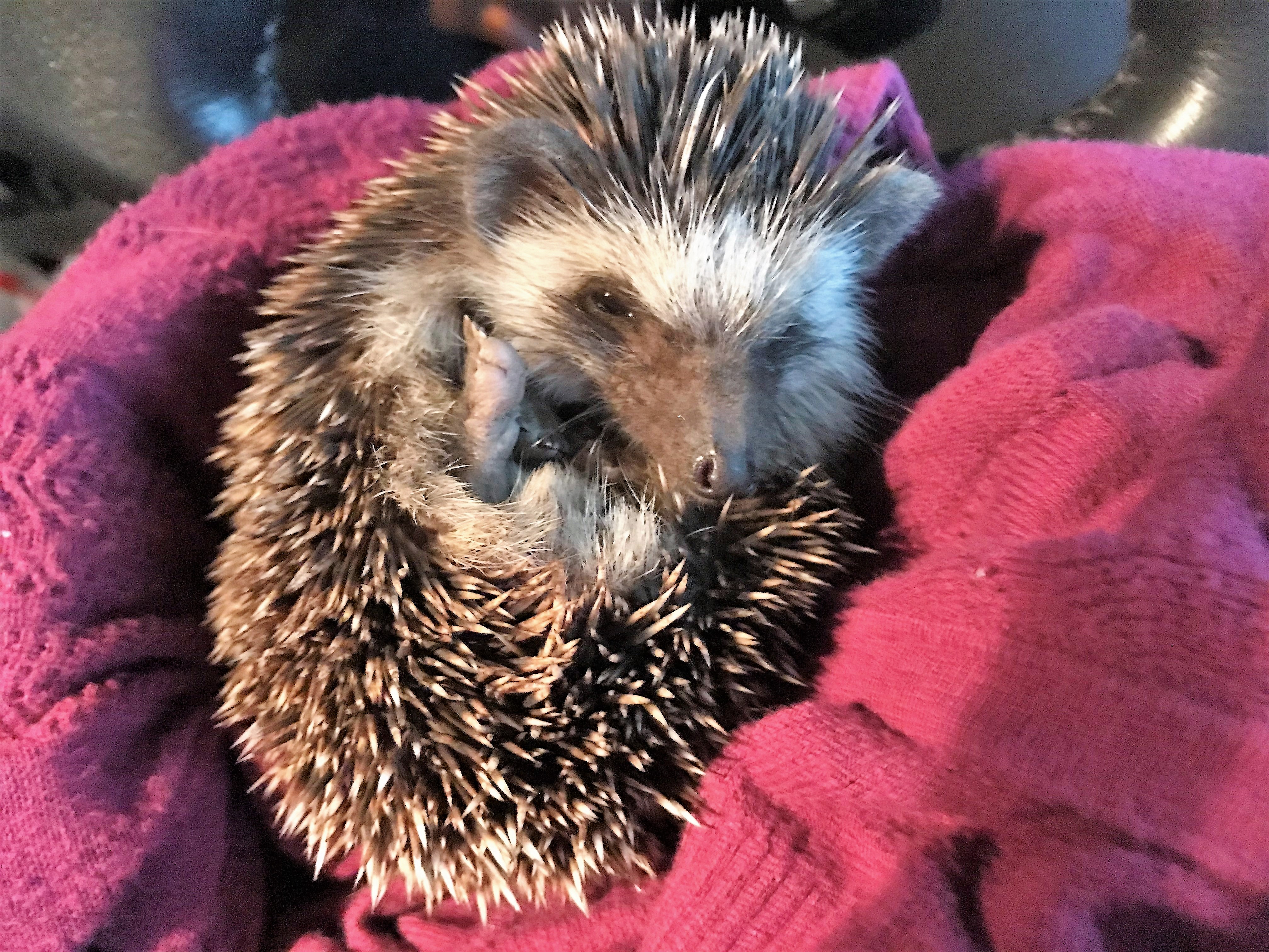
The rescuee

But I am comfortable enough on the road that when I recently drove home soon after 5 PM — Lilongwe rush hour I suppose — and saw a pygmy hedgehog curled up on a busy road, scared but hoping all the ruckus would just go away, I made a quick u-turn, parked half on, half off the road, and ran out into traffic, stopping it with my palm out.  I then yanked off my cardigan, swooped the little guy up, and bounded back to my car, much to the bemusement of all spectators.  Banana, as C named him, is now living his best life in our car-free hedgehog heaven of a yard.

Basically C and I have come a long way in our two years in Malawi.  That is not to say that all is sweetness and light, rainbows and puppies; its still not an easy place to live.  Poverty here, in one of the world’s poorest countries, is crushing.  The distance between the haves and the have nots, gaping.  My secure and coveted seat among the priviledged, often acutely uncomfortable.   The politics and corruption of this country, the coverage of which is the bread and butter of a political officer, continue to frustrate.  Days in which my impotence to effect change feel especially acute, draining.  I have had a bad cold or allergies for the past five weeks — a reaction to the changing season, the dust kicked up at the tail end of the dry season, the regular fires set to brush and yard waste, and who knows what else across the capital.

But the days in which C demonstrates how much she loves being here, is thriving in the school, or when just hearing the birdsong in my yard or I find myself chasing our chickens or rabbit around, can be a salve for the wounds of boredom, isolation, or frustration.  And sometimes, just sometimes, when I talk to a particularly passionate Malawian making a difference in the lives of vulnerable people, when I have the opportunity to meet with those who fight for justice and human rights, or even on the rarer times I personally seem to have said or done something that had a direct impact for positive change, those times feel especially rewarding.

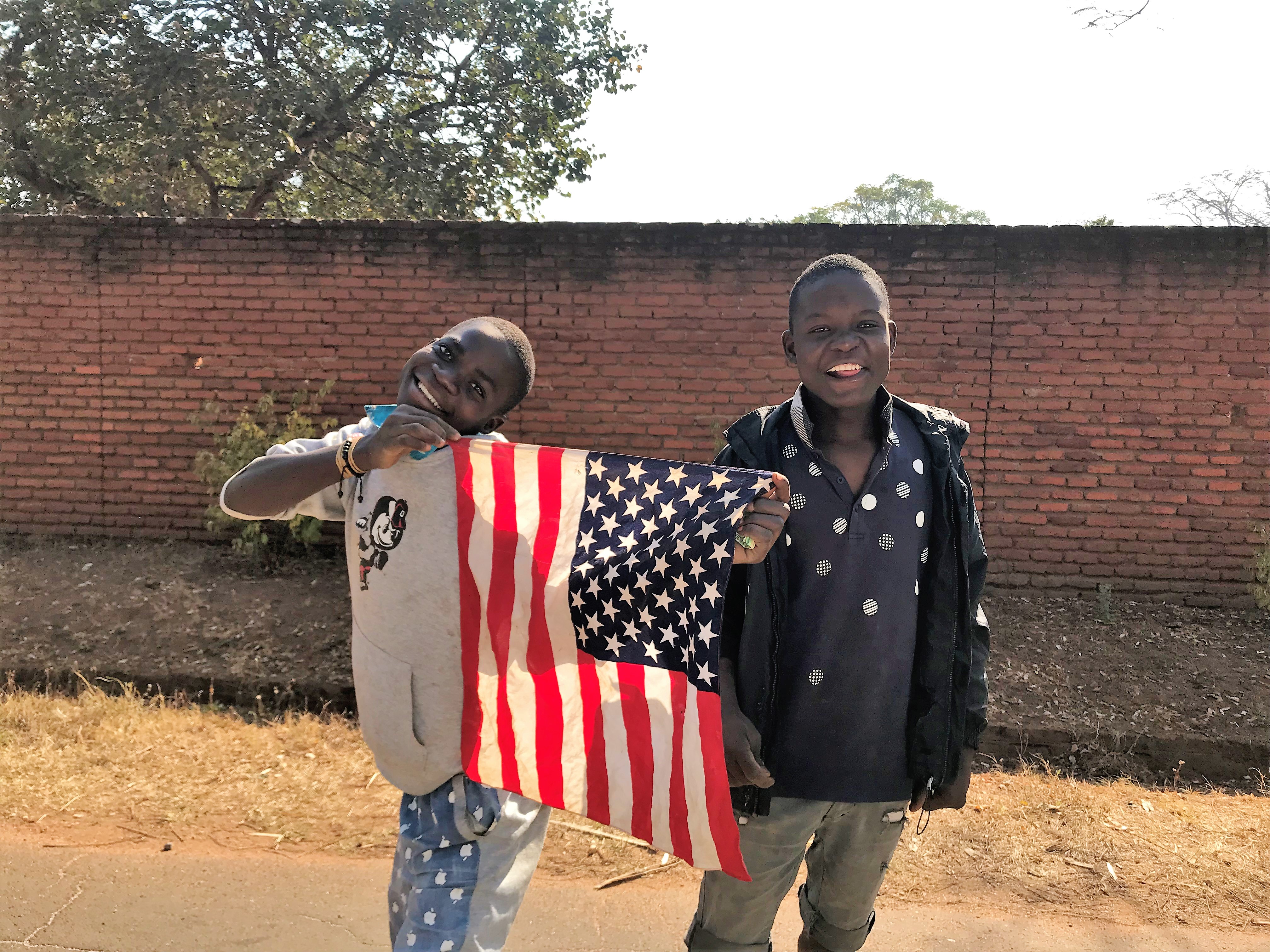
IMG_1734Take these two boys.  I have seen them, part of a group of some 5 to 7 boys aged around 8 to 14, begging at a traffic light near the Parliament building the whole two years I have lived here.  They hail from Kauma, a predominantely poor community in Lilongwe, basically a slum, not far from my own home.  I do not give the boys money, but I have from time to time given them boiled eggs, bananas, apples, crackers, bottled water, and the like.  From a few months ago, the gang seems to have split up — perhaps finding the corner of an oft-busted traffic light, on a road sometimes closed due to protests, not the plum place it once was.  These two boys seem to have migrated to my very own neighborhood where they pound up rocks and bricks to fill potholes the local and city government fail to ever fix.  They do the work and then sit back waiting for residents to pass by and reward them for the favor.  I have started giving them a little money — they are after all providing a real service now.  Imagine recently as I pass them, they stand, and one unfurls, of all things an American flag, that he had held tightly in his fist.  They jump up and down happily chanting “America.”
For all these reasons and more, the good and the bad, C and I are ready for two more years in Malawi.  Happy anniversary to us!


Home Leave: An American Education Part Two

The second half of my home leave return trip between my two tours in Malawi.

Part Two 1

C and her travel buddy Little C

After leaving Williamsburg we headed south to New Bern, North Carolina, where my long-time friend CZ and her son Little C live.  CZ and I go way back.  In fact, back to the College of William and Mary, when like Seinfeld and Kramer, we lived across from one another in our senior dorm.  We are also both single moms.  Back during our first Home Leave after two years in Mexico, we spent a week in New Bern when Little C was just a month old.   CZ and Little C visited us in Shanghai, and we met up with them in Paris.  Here we are returning to see them for a few days; Little C is now five.

New Bern is a bit like Williamsburg — lots of history but also plenty of natural activities.  We visited some places we had been before – such as my taking C and Little C to lunch at the Cow Cafe and then over to the Birthplace of Pepsi Cola (I may be a die-hard Diet Coke fan, but Diet Coke shortages in Malawi have led me to embrace Pepsi Light) – but other places like Tyron Palace did not fit this trip.  We did picnic near Atlantic Beach and then head out on pirate boat for some fun out of Beaufort.  We also took a National Park ferry service to Shackelford Banks for some beach time and wild horses.  Mostly, though the kids just were happy to see one another again, as were CZ and I.  It was bittersweet leaving CZ and Little C — the kids did not want to part (C had told another child we met along the way “Little C is like my brother, he just has a different mom”).  But CZ and I knew it would not be too long before we meet up again.

Part Two 3

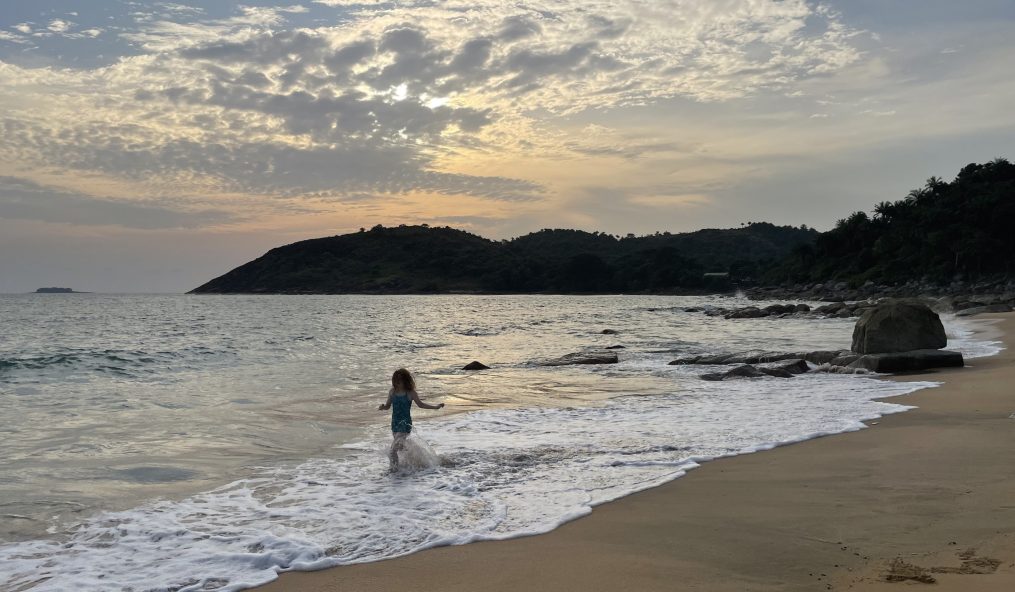
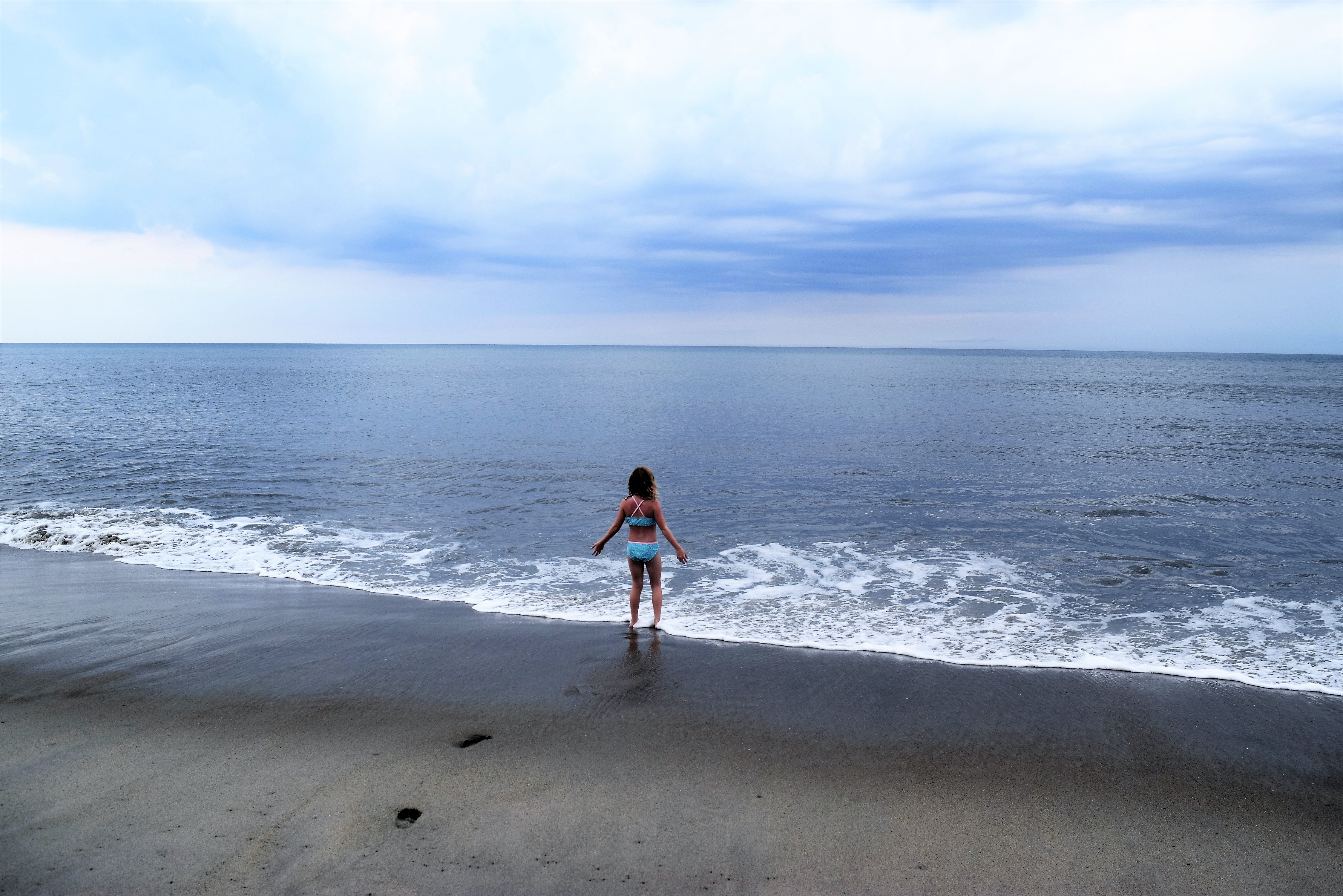
C at the beach in Nags Head

In the car again, we headed to our next destination: the Outer Banks.  A good destination for those with younger kids is almost always the beach, but I was still determined to shove some American history into C.  Wait, I mean, expose her to the wonders of America’s rich history.  And though C may not know a whole lot on that subject, she does know the story of the Wright Brothers and their first flight on the sand dunes of Kill Devil Hills.

Funnily enough, the last time I was in the Outer Banks was 1994, where I headed with my sorority sister CZ, just after graduation from the College of William and Mary.  The one other time before that, I was 16 years old, as the long-time babysitter for family friends.  (I remain friends still with this family — in fact just as I wrote this sentence a message box popped up from one of them).  Another American and personal history trip.

Part Two 2

The incredible stage at the performance of the Lost Colony

On our first day, we checked into the hotel, and then immediately we headed out to grab some quintessential American beachside food.  Ahhhh, ordering at a small window of a short order takeout place, then sitting at picnic tables, in the summer beachy heat under the shade of an umbrella.  There is nothing like it in Malawi.  Maybe nothing quite like it outside of the U.S.A.

That evening we headed over to Fort Raleigh National Historic Site on Roanoke Island to see the production of The Lost Colony, the nation’s longest running outdoor symphonic drama (that’s a mouthful, right?).  In its 82nd season, the play depicts the history, drama, and mystery surrounding the ill-fated first settlement in the “New World.”  The stage is set at the actual location of the settlement and has run every summer since 1937, only stopping briefly during WWII with the threat of German U-boats off the coast being able to see the lights from the theater.  Having already visited Jamestown and Williamsburg, I thought C would really enjoy the play.  Nothing could quite have prepared me for the emotional roller coaster that was to come.  C loved the antics of Tom, the drunkard turned heroic settler, and the pageantry of the scenes with Queen Elizabeth.  But the scenes of fighting between Native Americans and the settlers had her on her feet, full on sobbing, “Nooooooo!  Stop it!  Stop it!  Mom, why did you bring me here????”  I felt like a bit of a jerk making her sit through the entire performance and yet at the end she asked if she could have her photo with the actress who played Queen Elizabeth and she patiently waited in line to chat her up (Sir Walter Raleigh was there too, but she could have cared less), and on the car ride home she asked me lots of questions about it.  (“Mom, so why were the settlers always talking about God?”  “Mom, why are they lost if they carved where they were going on the tree?”  “Mom, why didn’t the guy from England just go to Croatan to find them?”)  So, despite wanting to sink into my seat at the theater as those near us observed my daughter’s very raw, and rather noisy, emotion, C seems to have gotten out of it what I had hoped.

Part Two 4When we returned the following day to visit the rest of Fort Raleigh, she had even more questions about the missing settlers.  Then we headed over to the North Carolina Aquarium because we are simply incapable of passing up on an aquarium. We followed up with a visit to Dare Devil’s Pizza so I could introduce C to the massive stromboli I remembered from my visit 30 years before and then we had some time to stroll and play on the beach.
Our activity for the following day involved driving an hour south to visit Hatteras Island and its famous lighthouse.  Nothing is more fun to do in the middle of long drives between destinations is to take another drive.  No, really, I love driving.  And while overseas I always miss American roads.  The state of Malawian roads especially has me hankering for the smooth, largely pot-hole free, clearly lined arteries that criss cross America.  I also love to hear C repeatedly asking from the back “How much longer?”

We didn’t just visit the historic site, but we climbed the 257 steps to the top.  My heart pounding, not so much from hauling my increasing out of shape self, but from the genuine fear that seized my heart walking up the curved staircase, holding (no, gripping) its low, surely not regulation height, handrail, trying not to look down at the increasing distance between my location and the ground floor.  Nah, just kidding, it was loads of fun, especially once back on terra firma.

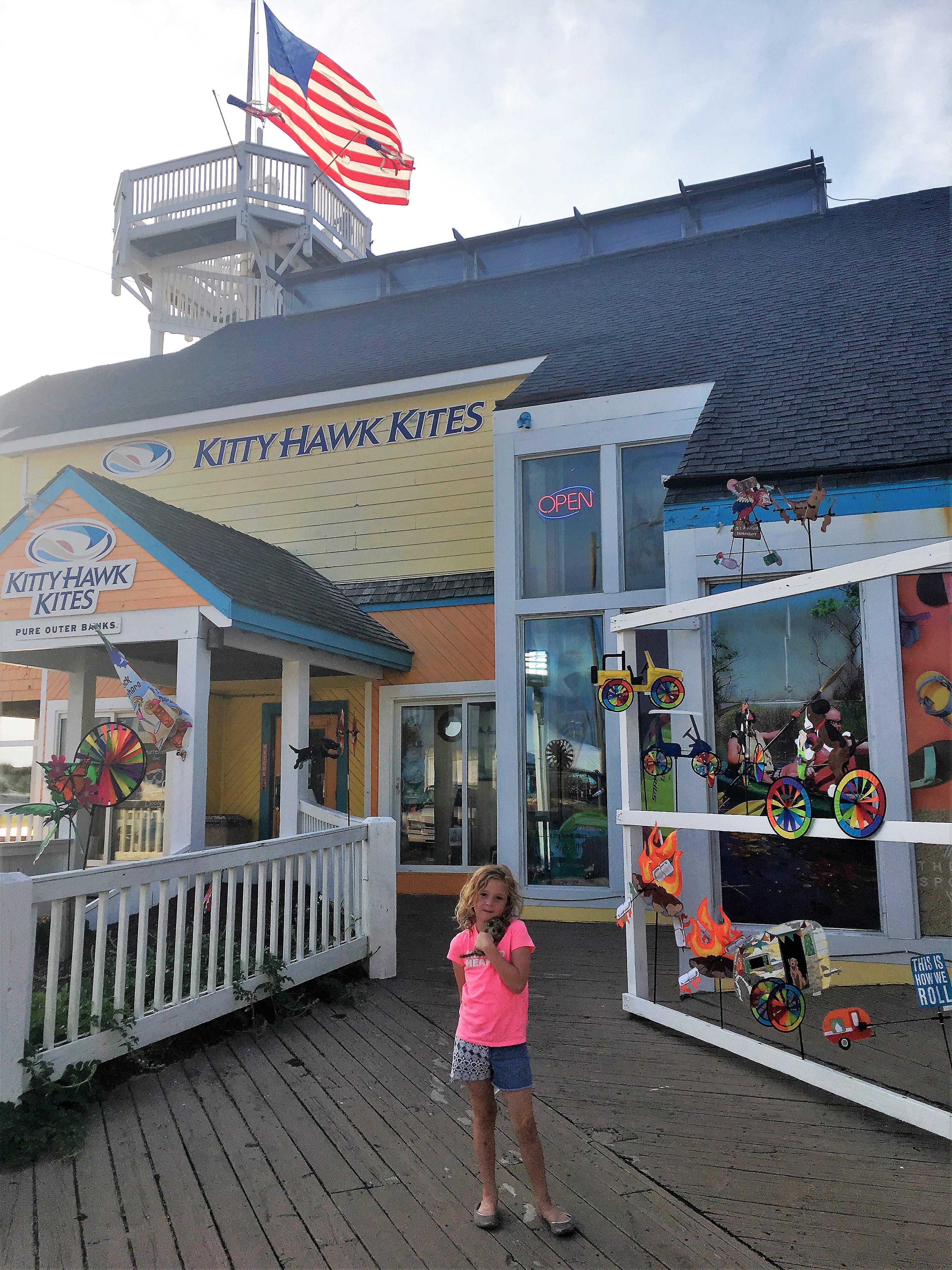
Part Two 7Once back in Nags Head we stopped at Kitty Hawk Kites because its an Outer Banks institution and I remembered visiting when I was 16.  It is also the place to go to book adventure tours and activities.  By the time we left about an hour later, C had convinced me to buy her a fox kite (word to the wise: know the dimensions of your extra suitcase so you do not buy a kite that is 4 inches too long to fit) and for me to sign us up for mother-daughter hanggliding classes on the dunes for the following day.
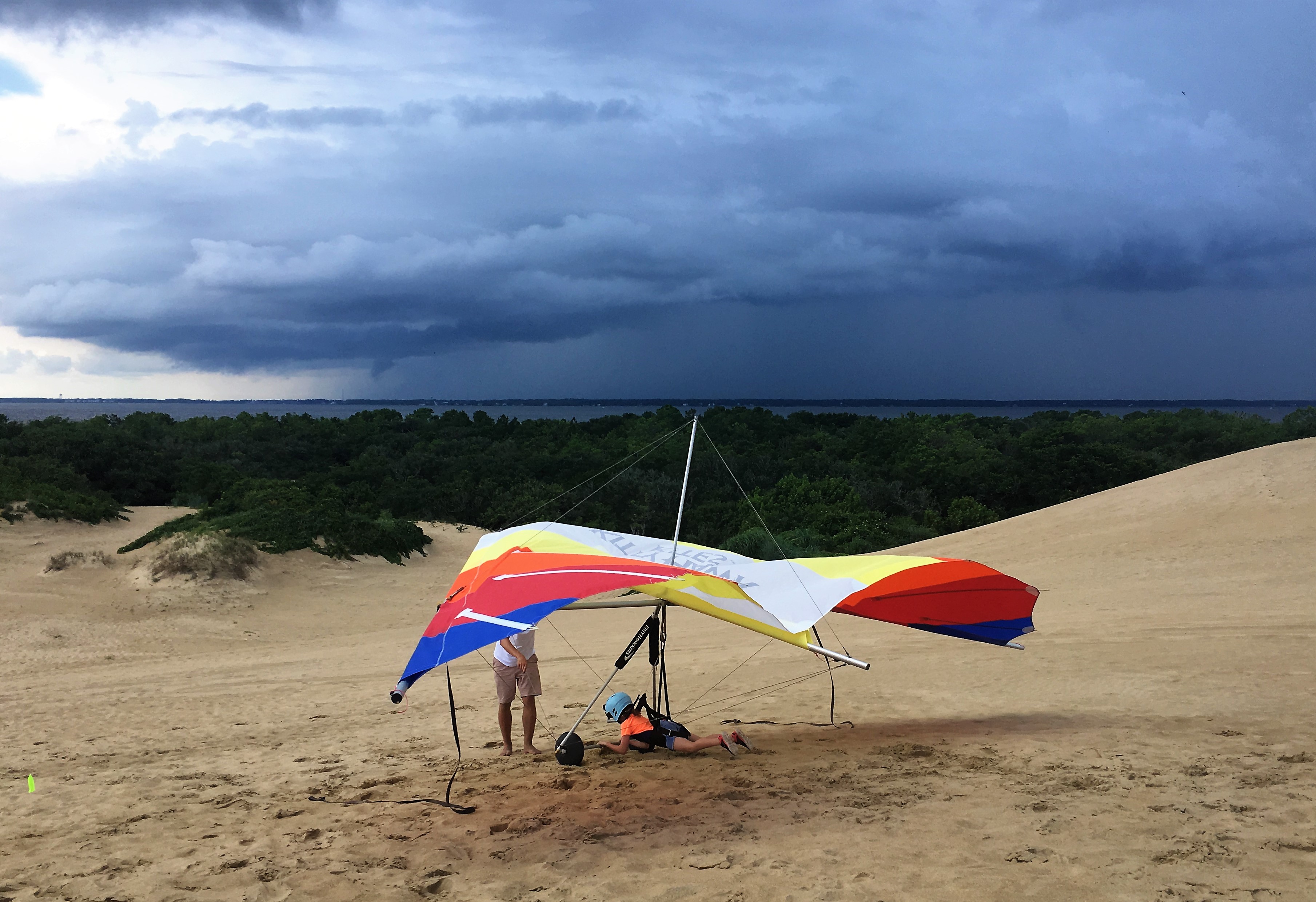
Ever since I had visited Jockey’s Ridge State Park at the age of 16, and watched the hanggliders on the dunes, I have wanted to go back and try it myself.  It took a bit of fast talk to convince C to give it a go.  She wanted to go to mermaid swimming school, but that was not on offer at the time.  But with a promise to give her a SpongeBob SquarePants ice cream after we successfully completed the course, she reluctantly agreed.

Together with the rest of our class, we marched up the dunes.  At the top we were re-instructed on the basics covered in the classroom and then we divided into three groups, with the children under 16 in their own group.  We all had five flights — two flights, then a rotation through the group, two more flights, another rotation, and then a final flight — I was able to watch all of C’s flights.  C seemed nervous at first, but in an all kids group she relaxed, soon in her element.  At one point she was surrounded by the other kids, all older, as they asked her about life in Africa.  When C went to do her flight, one of the other kids told me that “she is pretty great.”  I beamed.

It was an incredible day on the dunes.  I found it somewhat frightening and exhilirating.  We never really flew on our own.  The adults had a single instructor who ran with us the length of our flight, tethered to the contraption so we could only get so much lift and distance; the children had two instructors.  We only flew short distances, but I felt absurdly happy as my stomach dropped as the wind lifted me up.  I laughed.  A lot.  A storm moved across the Roanoke Sound.  The skies darkened, the wind picked up.  The instructors had to double up even for the adult fliers.  C finished up first so she could watch my final flight, then the two of us made our own way back to the training facility as the skies opened up.

Part Two 5

Bright light and storm clouds as C prepares to take off

Later that afternoon we drove about 45 minutes north to meet my sister, husband, and kids, and their friends at a popular seafood restaurant.  We had found out at the very beginning of our Home Leave that my sister and her friend’s annual beach week in Duck, North Carolina, the northern Outer Banks, would coincide during our week in the area.  It was fun to catch up in an unexpected way.


IMG_3015

History and Photography Fun

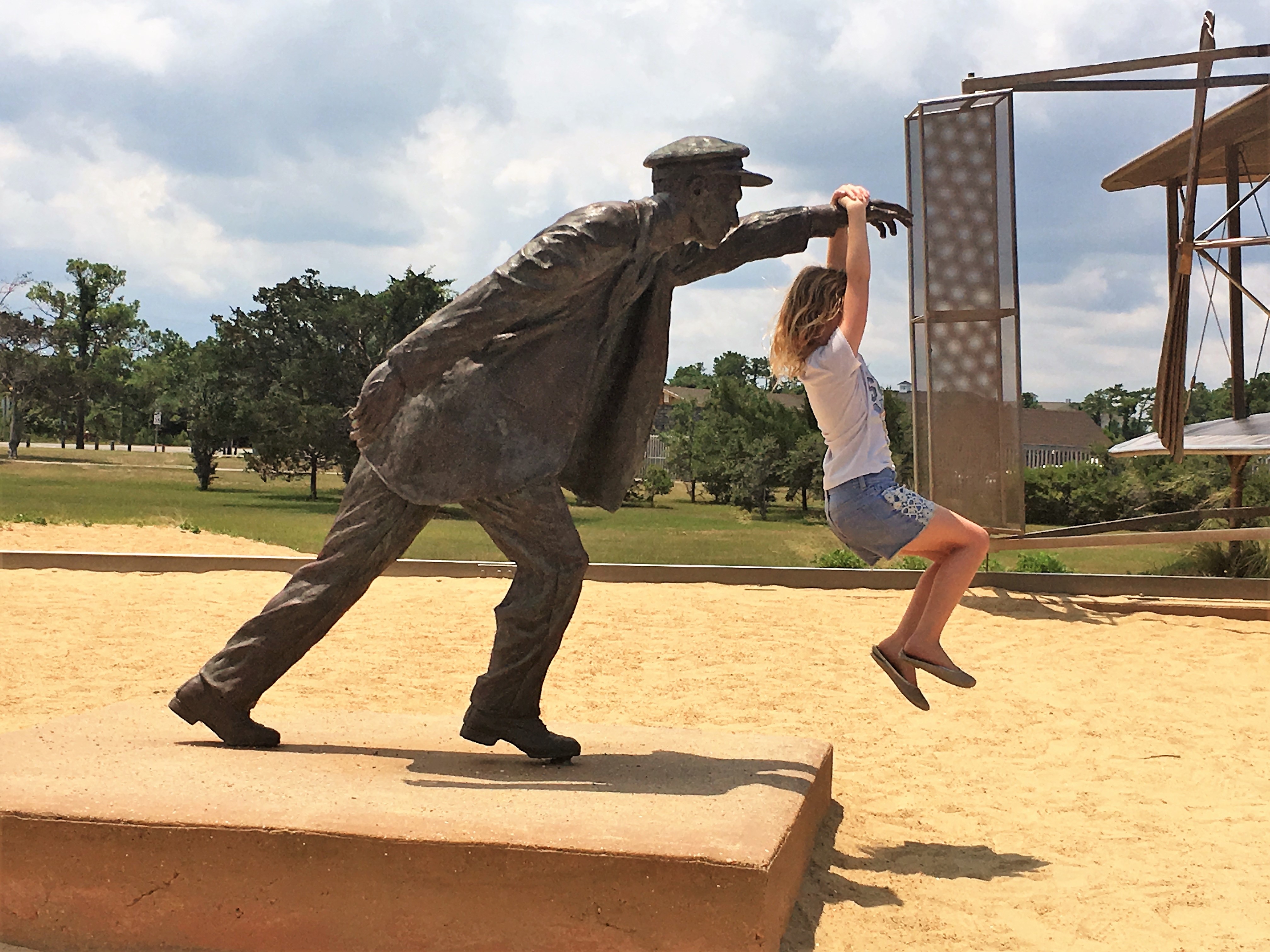
On our final day, we finally headed to the Wright Brothers National Memorial.  At last, C would learn more about the history of aviation in America right at the source.  It was a hot July day so we started off first in the wonderfully informative (and air conditioned!) museum.  Then we walked the flight path and up Kill Devil Hill, where the brothers conducted many of their glider tests and where now stands the 60 foot tall granite monument to their achievements.  We then returned to the car and drove around to the First Flight Centennial Memorial, where Orrville, Wilbur, the plane, and other observers of that first day are memorialized in bronze.  C and other kids (and many adults) loved that visitors can actually climb all over the sculptures, a sort of interactive historical playground.  I then took C to Dairy Queen to enjoy her first ever Blizzard, a wonderful, fattening, concoction of thick soft serve ice creams and yummy goodies.  Ah, America.

Next stop: Chincoteague, Virginia.  Finally, a place I had never been, but which has long been on my bucket list from way back when to I was a little girl.  Chincoteague and its sister island Assateague are two Virginian barrier islands (the northern two-thirds of the long and narrow Assateague falls into Maryland’s jurisdiction) are both part of the national park system – the Chincoteague National Wildlife Refuge and the Assateague Island National Seashore – but they were made famous by a children’s novel (Misty of Chincoteague) written in 1947 about the wild horses of Assateague and the annual pony swim to Chincoteague.  The book, still in print, still fires the imagination of young readers, especially those who love horses.  I read the book to C just before we began our trip.

Part Two 10

One of the famous Assateague ponies

Chincoteague has small town American charm (population about 2,800), but with its protected spaces and history of wild ponies woven into popular literature, it just has more.  Soon after checking in to our hotel (hours later than anticipated thanks to an accident on the ONE northern bridge off the Outer Banks), we headed out to dinner, walking up to a family-style italian restaurant to appease C’s hankering for some simple pasta.  Afterwards we played mini golf.

Monday, it rained.  We had a lazy morning, carry out lunch in the room, then in the afternoon headed over to Assateague to visit the two Visitor Centers.  Although they are not too big, C enjoyed finding out about the flora and the fauna, especially because one really fantastic young park ranger encouraged C to work on a park booklet to become a junior ranger.  As the afternoon waned, the sun came out just in time for a beautiful drive along a nature loop road.  On our last full day we went out on an early morning boat tour.  The weather was perfect and we not only had the opportunity to see the famous ponies, but also some other wildlife, including a bald eagle.  Then back over to the Visitor Centers on Assateague, including a climb up the Assateague Lighthouse.

Part Two 11

Some of the beauty of Assateague

Before we departed Chincoteague, I rented a bicycle with a trailor, so C could sit in cool comfort (even with her tablet) while I did all the work.  I love cycling and I have been waiting for when C is able to ride with me.  Our overseas life has not exactly been conducive to her learning to ride though.  In Shanghai, there was a rooftop linking the eighth floors of the two apartment buildings and the Ritz-Carlton Hotel.  It was not an empty area; there were tennis courts, an area for a bouncy castle, a trampoline, the swimming pool, and covered area with tables and bar-b-que areas.  A small child could cycle a little on a small bike, but scooters were all the rage in Shanghai.  And then here in Malawi, the roads are not all that safe.  There are no sidewalks or shoulders.  The bicycle carriage was the perfect compromise.  It felt AMAZING to out and about — the hour riding the trails and roads on Assateague was perfect.

Part Two 8We then drove on to Winchester, Virginia to spend a few days at my Aunt C’s, including a night at her cabin in West Virginia, and then a few days in Sterling, Virginia, my original home town.  We caught up with friends and family.  And then it was time to say goodbye to the U.S. How did four weeks pass by so quickly?  But we squeezed a lot in.  C had time in NY with her father, her paternal grandparents, aunts, uncles, and cousins.  I had time in Jacksonville with my Aunt C and doing more in my home-away-from-the-Foreign-Service.  We caught up with CZ and Little C in New Bern.  We visited my college town and soaked in some early American history, and had another walk down my memory lane and more American history in the Outer Banks.  And we both made new memories enjoying time in the beautiful barrier islands of Virginia.  We visited a total of five places in the U.S. National Park system.   Not bad at all for four fabulous weeks.

Then we needed to begin the journey home.  And it was going to be a loooooooooooooooooooong trip back, even longer than when we flew to the States.  Due to the amount of money authorized for our Home Leave travel by Washington, and the limited time between that authorization (early May) and our departure (mid-June), being in the northern Hemisphere summer time, we had to fly a different routing.  So we would fly from Washington Dulles on the eight hour red-eye flight to Frankfurt, Germany, arriving at noon.  Then spend 10 hours on a layover in Frankfurt before our ten-hour red-eye flight to Johannesburg, South Africa.  Then five hours in Jo’burg before our two-hour flight to Lilongwe.  But I was determined to make the most of our time in Germany.

Long, long ago, also when I was 16 years old, my sisters and I spent a month in Frankfurt with my Aunt C and Uncle D.  So the plan was to give C just a wee bit of a taste of Germany and a touch more of a walk down mommy-memory-lane.  We freshened up in an airport shower, went through immigration, stored our luggage, and then caught a train from the airport to the Frankfurt Main Train Station.  Then we headed to the Old Town to do a little sightseeing.  In three hours we had lunch and hit many a place from my store of old family photos.

Then and Now Frankfurt

At the David and Goliath sculpture at the Hauptwache Station, Frankfurt – My sisters and I in July 1989 (left) – the acid washed jeans a dead giveaway – and C in July 2019 (right)

Then it truly was the end of our mid-tour Home Leave and time to return home – to Malawi.


Home Leave: An American Education Part One

Part One 1

Jax Beach at sunset – my now official home away from Foreign Service home

Home Leave is here again!  Home Leave is the congressional mandatory requirement for Foreign Service Officers to spend a minimum of 20 working days in the United States between overseas tours so that we may reconnect and reacquaint ourselves with the people and the country we represent and serve.

But wait? Between tours?  Aren’t I still serving in Malawi?  Why yes, yes, I am.  However, I have extended my time in Malawi yet again and am now essentially serving two consecutive tours in Lilongwe.  Thus, Home Leave (HL), or rather Home Leave Return to Post.  This is my third HL, but the first time my daughter and I will return to the same place we were before the HL; the first time our pets and our belongings will be able to remain in the same place while we are gone.  For a Foreign Service Officer (FSO) this is rather novel.

Off C and I head to the U.S. of A to home leave with the best of them.  We begin with a long trip from Lilongwe to Dulles, Virginia via Johannesburg, South Africa, and Accra, Ghana.  We arrive late after weather-related delays cause flight schedule issues in Jo’burg; my one checked piece of luggage takes a detour and does not arrive with us; Customs and Border Patrol welcomes back this diplomat with a fun trip to secondary for extra scrutiny.  Hooray! (no, not hooray.  I jest.)  My sister, who has been circling the airport pick-up area with my mother for a good hour, picks us up and whisks us off to the local IHOP to meet the bro-in-law, niece, and nephew, for a quick family breakfast.  Well, I have a cheeseburger because A. who knows what time my body thinks it is? and B. I have missed a good American cheeseburger; I can get pancakes and eggs in Malawi.

Part One 2.JPG

Thanks FL!

I am whisked back to the airport to catch my flight to Jacksonville, FL.  C stays the night with her aunt, uncle, and cousins, and then is deposited back at the airport the next morning to meet her stepmom so they may flight up to upstate New York to meet her dad and his side of the family for paternal family fun.  Her dad and stepmom work jobs that are busiest on Saturdays, so we had to do it this way.  Seems complicated but with a lot of help (my sister and C’s stepmom especially), we make it work.

C enjoys her time in NY — goes out on her grandparent’s boat, played with her cousins, and had oodles of family time.  Me, I spent time with my aunt in and around our condo.  I went shopping for consumables (a special shipment of foodstuffs and personal and/or household items that are authorized for certain Posts like Malawi) and had the movers come pack them up, had a doctor’s appointment, consumed great quantities of Mexican food (there is a dearth of such cuisine in Malawi), took walks on the beach to watch the sunrise, sunset, and moonrise, and was midly insulted by a young ticket seller who insisted on selling me the senior rate for a movie.

C and I then flew back from our respective first locations to meet again in northern Virginia, grab the rental car, and begin the road trip portion.

Part One 8

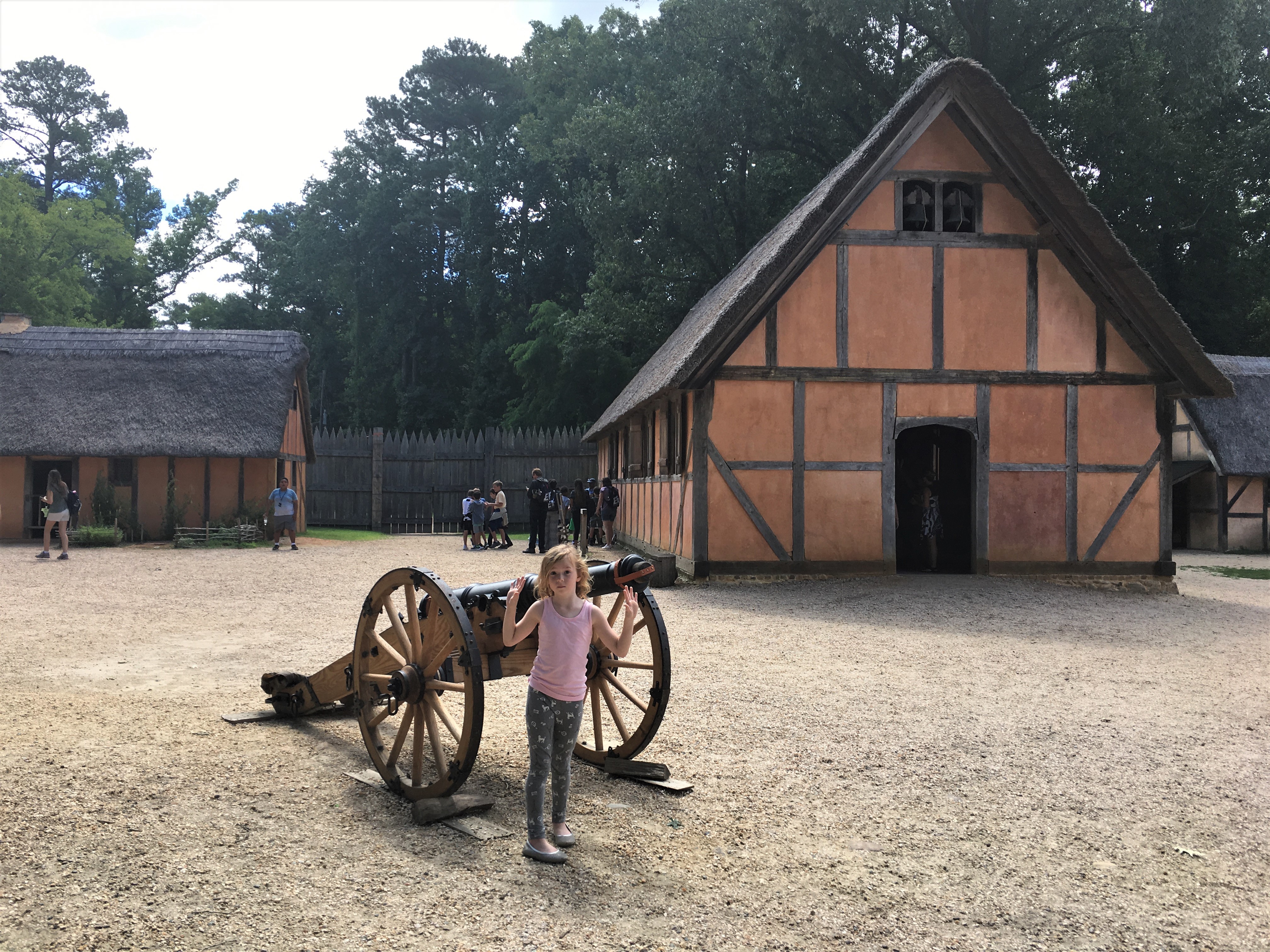
C at Jamestown

Being overseas in the FS life is amazing; my daughter is exposed to many different people, cultures, and traditions.  However, her exposure to American history and culture is limited.  Not non-existent, mind you.  She watches Disney Jr, and Nick Jr on television.  She discusses Five Nights at Freddy’s and Minecraft with her friends.  Yet although she attends a fabulous international school, it is not an overseas American school.

I therefore planned our home leave around introducing C to some of America’s most iconic historic locations.  Our first destination:  Williamsburg, Virginia, home to the historic Colonial Williamsburg, part of America’s historic triangle (with Jamestown and Yorktown) and my undergraduate alma mater, the College of William and Mary, the second oldest university in the United States.

We began first with a trip to Jamestown to learn about the first permanent English settlement in the Americas, founded in 1607.  There we visited the world class museum, walked through replicas of a Powhatan Indian village and the colonist’s fort, and boarded two of the three replica ships that brought the colonists across the Atlantic on their four-and-a-half month journey to their new lives in the New World.  C reports she liked she liked the ships the best, but I think she enjoyed touching the animal pelts in the Indian village the most.

Part One 3

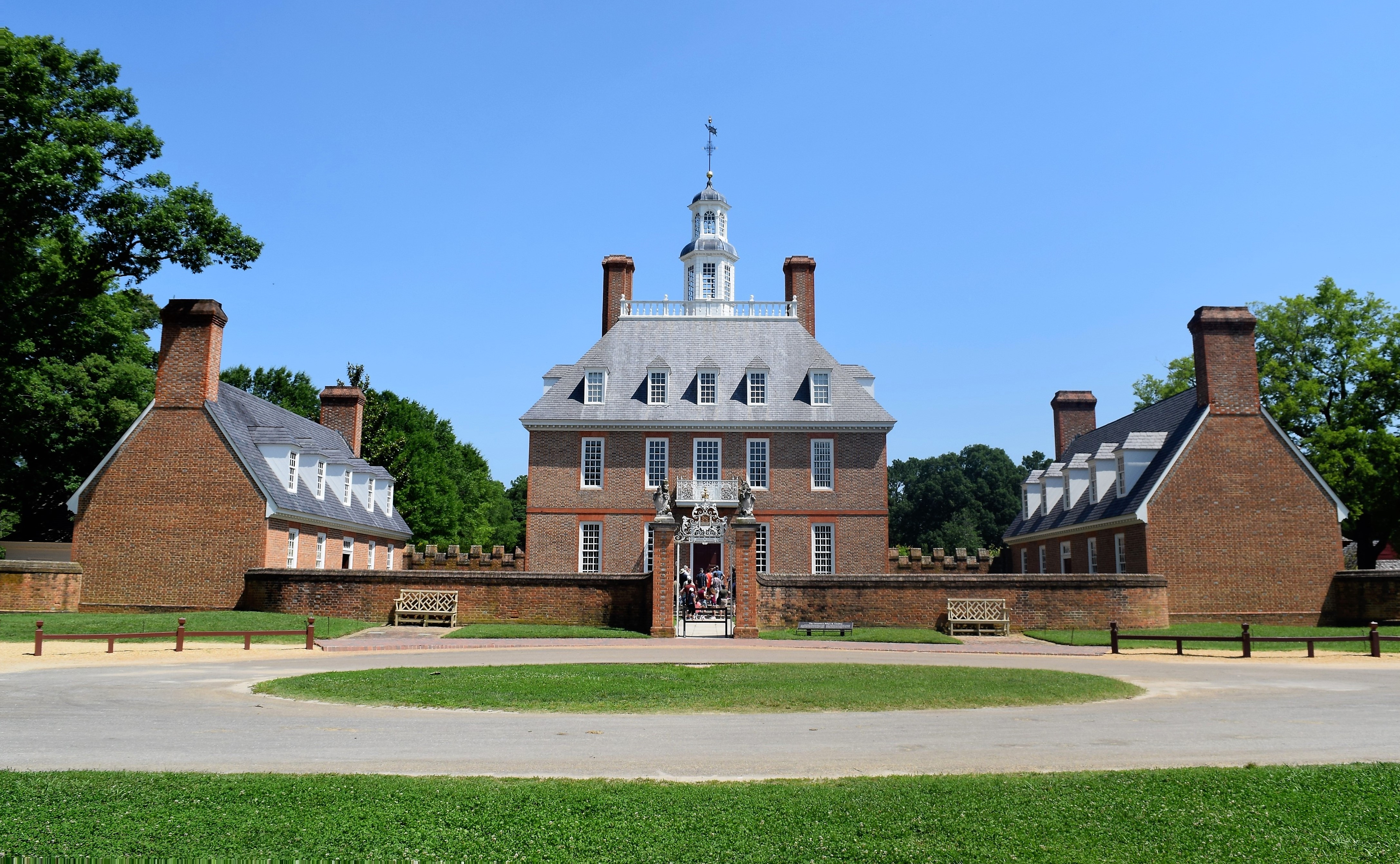
The beautiful Governor’s Palace in Colonial Williamsburg

We spent the rest of that first day walking the grounds of Colonial Williamsburg, the world’s largest living history museum.  Its costs nothing to stroll the streets of this extraordinary place depicting the reconstructed and restored 18th century city that served as the capital of the Colony of Virginia for 74 years (after the colonists moved from swampy Jamestown).  I had wanted to come here to have American history come alive for C, but I did anticipate how the memories of my own personal history would also come back to me.  We stopped at the Cheese Shop on the top of DOG (Duke of Gloucester) Street.  Though the shop now had a place on Market Square (instead of the side street where it stood during my day), their signature “bread ends and house,” which provided me so many days of sustenance in my college days, was just as good as ever.  We stood outside the Kimball Theater, the small movie theater, where I saw many an odd indie film back in the day.  Filled with nostalgia, I bought C and I matching William & Mary shirts at the college store.

On our second day, we headed to the Busch Gardens amusement park.  Here too were memories from college, as for graduation the college had rented out the park for seniors.  How cool is that?  I had regaled C with stories of the Loch Ness Monster coaster, once the world’s tallest and fastest coaster and still the world’s only interlocking, double-looping roller coaster.   C, who hated Disney’s Space Mountain and refuses to ride the Tower of Terror, was very keen to ride the Loch Ness and we headed there first thing.  Though I am too old to love coasters anymore (though truth be told, I never did), I still enjoyed the Loch Ness and C could not stop telling everyone she met how much she did too.

Part One 5

The famous Governor’s Palace maze (and W&M rite of passage)

For our last three days, armed with a three-day pass to Colonial Williamsburg, we could explore the living museum more fully, stopping in at tours at the Capitol, the Wythe House, and the Governor’s Palace.  We also lucked out getting a spot on 15 minute horse carriage ride (something I had never before done in the ‘Burg).  At the Palace, we took part in a children’s tour of the building itself, presented just right for C’s age group.  At the beginning, I asked the guide though, if William & Mary students still “jump the wall” as they did in the past.  “Jumping the wall” was a student tradition whereby students were to make their way to the Governor’s Palace at night, haul themselves over the perimeter wall, and then run to the center of the palace’s hedge maze, and then depart the same way without being caught.  I might have done it once…or twice.  The guide told the group that while it is still done, security advances have caught up with the college tradition – yet now there is supposed to be a “triathlon” of jumping the wall, streaking the Sunken Garden (a grassy field located on the W&M campus), and swimming Crim Dell.  This prompted C to ask what is streaking….

We then enjoyed our own exploration of the Palace gardens and of course a race through the maze.  I remembered, armed with my W&M ID, which gave me free access to many Colonial Williamsburg sights, sitting in the gardens on many a sunny day eating my Cheese Shop Bread Ends and House while reading for class.  I also remembered nearly peeing my pants when I thought we were caught as I raced across the gardens toward the maze on a ridiculously well moonlit night…

Part One 4

The Wythe House from its gardens

I tried to get C to join me on a Colonial Williamsburg ghost tour, but she refused.  There was one aimed listed as good for 4 to 7 year olds that started at 5:45 PM, but no matter how I tried to sell it (“it is for 7 year olds!” “when it starts it will not even be close to dark outside.”) but she would not have it.  I told her how I had joined a ghost tour when I was a student and had the beejeezus scared out of me.  Although she refused to do one, she did ask me about mine and I told her of the three stories I recalled.  One was of the Mistress Wythe, who after attending a ball at the Governor’s Palace had run the short way to her home with the red door, losing a shoe along the way, and then, well…she died, and her ghost is supposed to haunt the house.

So, we went to the Wythe House and I asked one of the historic interpreters for the fuller story, to see how much my brain had retained from a very scary night tour 25 years before.  I remembered it pretty well, but had left out the part where Mistress Wythe hangs herself.  Immediately, C latched on to that word and asked me to explain… That was unexpected.  Even more unexpected was when C, playing with an 18th century wood children’s toy in the upstairs hallway of the Wythe House, patiently explained the details of the hanging to another child, and then recommended the child go over to the Governor’s Palace maze where her mom had once run through the maze naked… (I had NOT — C had conflated the maze run with the Sunken Garden streaking.)  So to the mother of that other child, you are welcome!

Part One 9

Crim Dell

We visited the William & Mary campus.  I showed C some of my dorm and classroom buildings.  We passed my sorority house (yes, I was in a sorority!).  Memories flooded back.  Many, I could not share with a 7-year old.  We crossed Crim Dell, which my graduating class crossed many moons ago, and in the 90s Playboy magazine listed as one of the top 10 most romantic college places in the U.S.  Yeah, I know.  First, wtf is Playboy doing ranking romantic college locations?  And second, hey, its a pretty bridge with some nice trees, but ugh, that water!  I left out the Playboy connection for C.  I did not want to answer anymore odd questions.

I loved that as we cross the campus, C turned to me and said “mom, it sounds like you had a really great life here.”  Yeah, I did.  And I had forgotten so much of it until our visit.

Part One 6After educating (and sort of torturing) C with the American history lessons and walks down my memory lane, it was time to reward her with two fabulous days at Great Wolf Lodge.  GWL is a chain of indoor water park and amusement hotels.  My sister and her family had been a few times and I could hardly wait to bring C.  I must have splurged for a Cub Club room, where we could have fit 6 people, but had forgotten I did so.  What a fun surprise!  I thought C would be all about the water park, but she was actually all about the indoor MagiQuest game, where she ran around with a fake wand activating sensors and solving quests.  She made lots of friends doing this.  We also won the rubber ducky race — kids decorate a rubber duck in the morning and then enter it into the water park race.  All the ducks are dumped into one section of the lazy river and make their way to the finish line.  The winner gets to sit in a special section of the water park for 24 hours.  (Experienced Winner Hint: Show up on a day when only 4 people enter the contest and then be the only person to show up poolside during the activity. Yay, you win!)  It also turns out C has a wicked sense of timing for the arcade claw games.  Good thing I brought an extra empty suitcase….
It was hard to believe that after Williamsburg we were already nearly half way through our Home Leave.  It was time to move on to the next location….

Pacific Islands Travel 2004 Part Six: Circling Savai’I and Completing the South Pacific Sojourn

The sixth and final installment of my short, but amazing trip to the Big Island of Hawaii, Rarotonga in the Cook Islands, and Samoa.  I finally squeezed in some sightseeing in Samoa in spite of my continued transport challenges.  All part of the journey.  

samoa 4

Robert Louis Stevenson’s house at Vallima

My first true morning in Samoa, I needed to confirm my ticket back to Pago Pago.  This was always a risk, as I had only four days in Samoa (including my arrival day) and a plane to catch back to Honolulu from Pago Pago.  But I thought much of my trip thus far had been relatively “safe” and what was travel without a little risk?  Pale, the Polynesian Airlines guru, worked his wonders.  He booked me on a Polynesian Airlines flight at 7 PM on Wednesday arriving in Pago Pago before 8 PM, giving me a comfortable margin to check-in for the 10:30 PM Aloha Airlines flight back to Hawaii.  The flight was even departing from Faleolo Airport, the large international airport on the Western end of the main island of Upolo, rather than the small airport just minutes from Apia called Fagali’i.  This would make it possible for me to go over to the island of Savai’i and return by boat and encounter less hassle to go to the airport, as Faleolo is just a few minutes down the road from the ferry port.  I should have realized I was taking far too much for granted – but more on that later.

In the afternoon of my second day I headed to the home of Robert Louis Stevenson, the famous Scottish author of Treasure Island and Strange Case of Dr Jekyll and Mr Hyde.  Incredibly, due to his often-poor health and his doctor’s advice to seek other climes, he and his family left Scotland in 1887, traveled to America, and then onward the following year for many adventures in the South Pacific, eventually buying land and building a home in Samoa.  Ultimately, his mother, wife Fanny, stepchildren Lloyd and Belle, and Belle’s son’s Austin too settled in Samoa.  Stevenson was popular among the Samoans and when he died there some four years later he was accorded rites fitting someone of great stature and is buried not far from his home.  I could not help but think of the incredible travels Stevenson and his family, and other literati of the period like Melville and Twain, undertook.  I did not have the easiest time getting to Samoa, but it was certainly easier than their trips would have been.  I became quite entangled in these thoughts while enjoying the Stevenson house and photographs on display.  I think I was most impressed by Robert’s dourly dressed mother making the long journey.

samoa 8

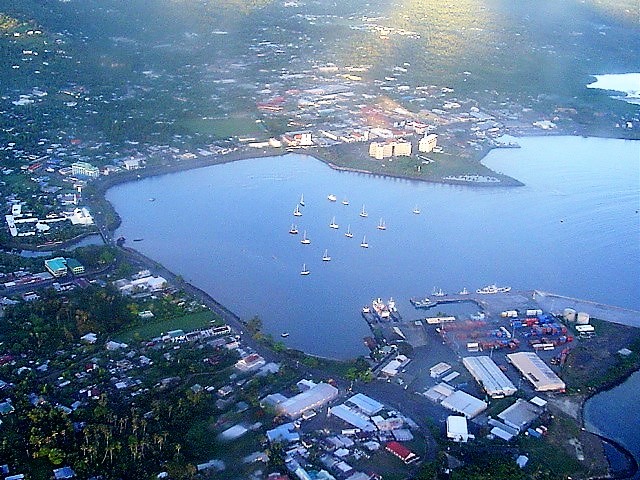
View of Apia Harbor on my flight to Savai’i

Again, in writing it appears I did very little, but I felt the day quite full and pleasant.  I had lovely meals in waterfront restaurants, wrote some email, and arranged my tickets back to Pago Pago and onwards to Savai’i.  I also arranged for my bag to take a tour of Upolo Island and meet me at the ferry port to go to the airport, as I was notified my six-seater plane to Savai’i would take only five kilos.  At first the thought of abandoning much of my belongings for a day and a half threw me, and then I felt oddly liberated to have only the small pack with me.  In fact, I found I had no need for anything I left behind.

Early in the morning of the third day, I boarded the small jet for the 20-minute flight to Savai’i.  I checked in at 6:30 for the 7 AM flight.  About five minutes before 7 an airline official approached me and asked if I was going to Savai’i.  When I said yes, he told me it was time to board.  He stepped over to an open door and then proceeded to take my boarding pass.  It turned out I was the only passenger.  Yes, it was just myself and the pilot on this flight.  And my five kilos of luggage.

The view was beautiful; I cannot begin to describe it.  Like the other islands of the Pacific, Samoa is the product of volcanic action.  Though smaller than the Hawaiian Islands, it was most certainly larger than Rarotonga.  There was the low flat area along the coast, a wide lagoon encircling much of the island, and then sudden sharp peaks in the interior.  And although I heard deforestation is a major problem in Samoa, the islands of Upolo and Savai’i seemed very, very green.  We flew across the channel and saw the two small islands there and the ferry steaming across to land in Savai’i port.  The airport was a very small wooden building with a single airstrip surrounded by a jungle of palms.  I felt very much I was flying somewhere far from civilization, but there was indeed a road, and soon my tourist van picked me (and my five kilos of luggage) up to begin our tour.

Samoa 1

At the Taga Blowholes

We picked up a passenger at the seaport, but deposited her soon at her accommodation and the Savai’i Circle Island Tour became T—-‘s personal Savai’i tour.  Much of the Circle Island tour was simply driving around the island.  It took quite some time as Savai’i is the largest island in Polynesia outside of Hawaii & New Zealand.  Yet despite its size it is sparsely populated, only a two-lane road circling the island.  No roads in the interior except those that lead to plantations.  Very small villages hug the road at intervals.  But there are stretches absent of population, often around lava flows where the land is simply hard solidified lava.  I waded with sea turtles and viewed the rainforest from a 30-foot high suspended forest walkway.

The best stop was at the Taga Blowholes, the largest blowholes in the world.  That day the waves were hard and high, and the blowholes then shot water high into the air, maybe as high as 50 feet.  There was a tremendous “Whoosh” sound as the pressure in the holes would build and the sea water was forced into the air.  Standing some 50-feet away, I was still dusted with a salty spray.

Though the tour was to also include a visit to the only waterfall on the island and a historical site, those were off the itinerary because, as my tour guide told me, there was an active court case involving the land.  This was disappointing as these are supposed to be two of the best sites on the island, but there was little I could do about it.  The weather was turning, the sky darkening, and some rain falling; I was tired and happy to go to my guesthouse.

I stayed at the Lagoon Chalets; a place that had come well-recommended.  I paid nearly US$25 to stay in a two-mattress shack.  This shack came with four walls, a roof, a floor, a shelf, and a bare light bulb.  I was told the light was a special touch not often found in such places.  The $25 also included two meals, though there was a limited menu to choose from.  Actually, there was no menu–you just ate what the manager and the assistant were having.  And it consisted of rice, taro root with coconut sauce, shredded cabbage, carrot, and beet salad, and fish of the day or noodle soup.  It was okay for one night; I could not imagine having taro root with coconut sauce day in and day out.  I had an early night in my room, reading by my bare light bulb, then falling asleep to the lapping waves.

samoa 10

Wading with sea turtles (they like mango)

I tried some more lazing about the next day.  I was to be on the 2 PM ferry back to Upolo and the ferry terminal was a 20-minute walk down the road.  I woke up and lazed in my chalet/shack.  I had a simple breakfast of eggs, tea, and toast.  I went down to the mini dock, and read a book while sitting on a picnic bench.  Then I simply lay on the deck in the sun.  I moved back to my chalet/shack.  Back to the dining area.  Back to the dock.  And so on.  I could never laze in one place for too long and there were only so many lazing places in the guesthouse area.  The hours until 1:30 dragged.  Then suddenly it was time to go.

I caught a ride with two other guys heading for the ferry.  I bought a water and a Baby Ruth bar before jumping on the ferry.  I did not want to have too much in my stomach on this boat.  I embarked, took my motion sickness tablet, some water, plus a fruit leather and half a small bag of walnuts.  In less than ten minutes after the boat was underway, I regretted having eaten anything at all.  The boat was listing heavily from side to side.  It seemed we were moving more back and forth than we could possibly be moving forward.  There was a great heave and a creak as we listed left and then a pause before we rushed back to the right.  Despite being next to the overworked air conditioner, I began to sweat.  I needed to make a decision:  either remain immobile the entire journey, laying prone on the front bench by the air conditioner, breathing heavily, and trying to keep my stomach down – or find a restroom quickly and be rid of anything that was sloshing about my stomach.  But I knew once I stood up, the time frame to find the restroom was going to be limited.

I bolted upright, scanning the room.  The cold sweat beading on my upper lip.  I saw nothing but seats.  The act of moving my head to look around was extremely unpleasant.  I felt a rise in my throat; I took a deep breath.  I stood and began to walk to the stairs down into the car area.  My balance was off terribly.  I stumbled around like a drunk.  Nothing appeared to be downstairs.  I could see several people laying as still as possible, eyes rolling into their heads, most certainly feeling much the same as I did.  I continued my search for a restroom, groping at benches as I was thrown from one to the other.  I tried to keep the panic down.  I found the restroom.  It was pitch-black, the only light coming from when the door would rapidly swing open on a list.  Inside the restroom was like a boiler room.  The air was humid and stagnant.  I was sweating profusely.  It was as if I were in the height of a malarial fever.  In the dark I found the stall, and well, you know.  I felt weary and slightly disoriented.  After maybe ten minutes I clumsily made my way back to the front bench in front of the blessed air conditioner, the television was screening the movie “Free Willy 3;” I lay down.  I rest quietly immobile for the rest of the hour and 20-minute journey.  Disembarking made me very happy.

samoa 9

Rainforest walkway

Then came yet more of the Samoan transport waiting game.  My bag, having completed its tour of Upolo, joined me at the ferry terminal.  Once reunited, the driver dropped my bag and I off at the Faleolo Airport three hours before the 7 PM flight.  Despite being the Samoa International Airport, there was almost nothing there.  There was a bank and a restaurant, but locked up tight.  There were also terribly uncomfortable plastic chairs, an ATM, and a restroom.  Luckily, I still had a book to read.  I chatted with a Spanish couple.  I tried various positions to comfortably read my book in those plastic chairs.  Eventually time moved forward and the check-in officials arrived 30 minutes before the flight.  By 7:30 PM we were all waiting for immigration to open.  Once through immigration (in record time), an announcement comes on informing us the flight had been cancelled due to a broken plane.  No one moved.  The announcer tried again.  This certainly elicited reactions.  Lots of swearing and declarations of “no way” and “you have got to be kidding” from the Westerners.  The Samoans and the family from Tonga weren’t happy, but they had more resigned reactions.  We all filed back through immigration, received our departure tax money again, and then went to wait at the check in counter.  There would be no more flights until the next day.  I would miss my connecting flight to Honolulu.

I accepted hotel accommodation in Apia offered by the airline.  The next day I had to return to the Apia airline office.  Despite having been told all flights to Pago Pago were full, an agent managed to get me on a 2:25 PM flight and rebooked me on an 11:30 PM flight to Honolulu.  After five and a half pointless hours at Faleolo airport the day before, I also had the grand opportunity to spend a further eight hours in the equally thrilling Pago Pago airport.

Looking back, I did not see as much of Samoa as I would have liked, but in the visit, I was happy and busy, even considering the long and frustrating transport waiting times.  Overall, I accepted that things just move on their own flexible schedules in Samoa and the people are very kind.


Pacific Islands Travel 2004 Part Five: Samoan Hospitality and Making the Most of the Journey

More on my three-week trip to three Polynesian islands – I arrive at my final destination, Samoa, and proceed to…get nowhere fast.  Another gentle reminder that in the South Pacific you cannot do anything but slow down, take your time, and smell the flowers.

samoa 6

Quite possibly the best part about American Samoa

I dislike arriving in a new country at night.  There is the confusion associated with trying to find your way around a new place when the landmarks and signs are cloaked in dusk or darkness.  There is also the very real possibility of being ripped off.  In my experience it is far easier to be taken advantage of in a new place in the dark than when I arrive in the day.  The banks, information booths, transport stations and the like are closed or running on far more limited schedules.  I have more confidence I can thwart would-be advantage takers when the sun is shining.  Whether it is truly the case or I have simply psyched myself up to believe this as truth I cannot say.  But on this trip, I could hardly avoid arriving after dark.  I suppose the Polynesian Islands are less frequently visited and therefore airlines can place those routes on the backburner, or rather on the less popular times.  If you want to go to Fiji or Rarotonga or Samoa, you will have to be satisfied with arriving at 2 am or 12:30 am or 9 pm or simply not go at all.

Despite Rarotonga being such a small island with a small airport, the late night (or early morning, depending on your perspective) arrival was very pleasant.  The terminal seemed to suddenly light up, a beacon to the weary travelers.  The light joke regarding the single baggage claim area brightened everyone.  The cheery ukulele music struck up as soon as the first person set foot in the terminal was welcoming.  There was even a small board with traveler information – from resorts to backpacker – available to the late arrivals.  And someone from the hostel was waiting for me in the arrival area to sweep me into a van and off to the hostel with no fuss and no worries.

samoa 3

This was long among my favorite pictures from Samoa

Not so arriving in American Samoa.  At 9 PM in the evening there were plenty of people inhabiting the waiting chairs, and standing in check-in lines, but there was very little else to do.  The vending machines were on, but no banks were open, no changing money facilities – not even an ATM that I could see – no restaurants, no tourist information booth, or even an information kiosk were available to the evening arriver.  This to me only heightens the confusion and immediately sets the traveler ill at ease.   There hadn’t been a shred of food available on the two-and-a-half-hour flight from Rarotonga; I was ravenous.  There was no one to ask about a good hotel or hotel rates.  I simply asked a security guard, and he told me the closest hotel was the Pago Pago Airport Hotel.  As my greatest ambition in American Samoa was to find the quickest way out and on to Western Samoa, I thought closest would be best – even at US$85 a night.  Though that may sound high, it is actually in the low range of accommodation costs in American Samoa.  Welcome to America.

My brief stay in American Samoa seemed as typically American as one can imagine.  I stayed in a relatively expensive hotel, watched CNN and Jay Leno and several other shows I cannot remember, I could not walk anywhere and thus had to be transported to the hotel in a taxi (in fact without a car you are pretty much stuck in American Samoa) and I had McDonald’s for dinner – the only restaurant still open when I found myself getting settled at the hotel at almost 11.  The proprietor of the Pago Pago Airport Hotel was a large, friendly Samoan woman who drove me to McDs, and arranged for my taxi back to the airport the next day (and even paid for it) – but this was about as Samoan as the experience got.

Samoa 2

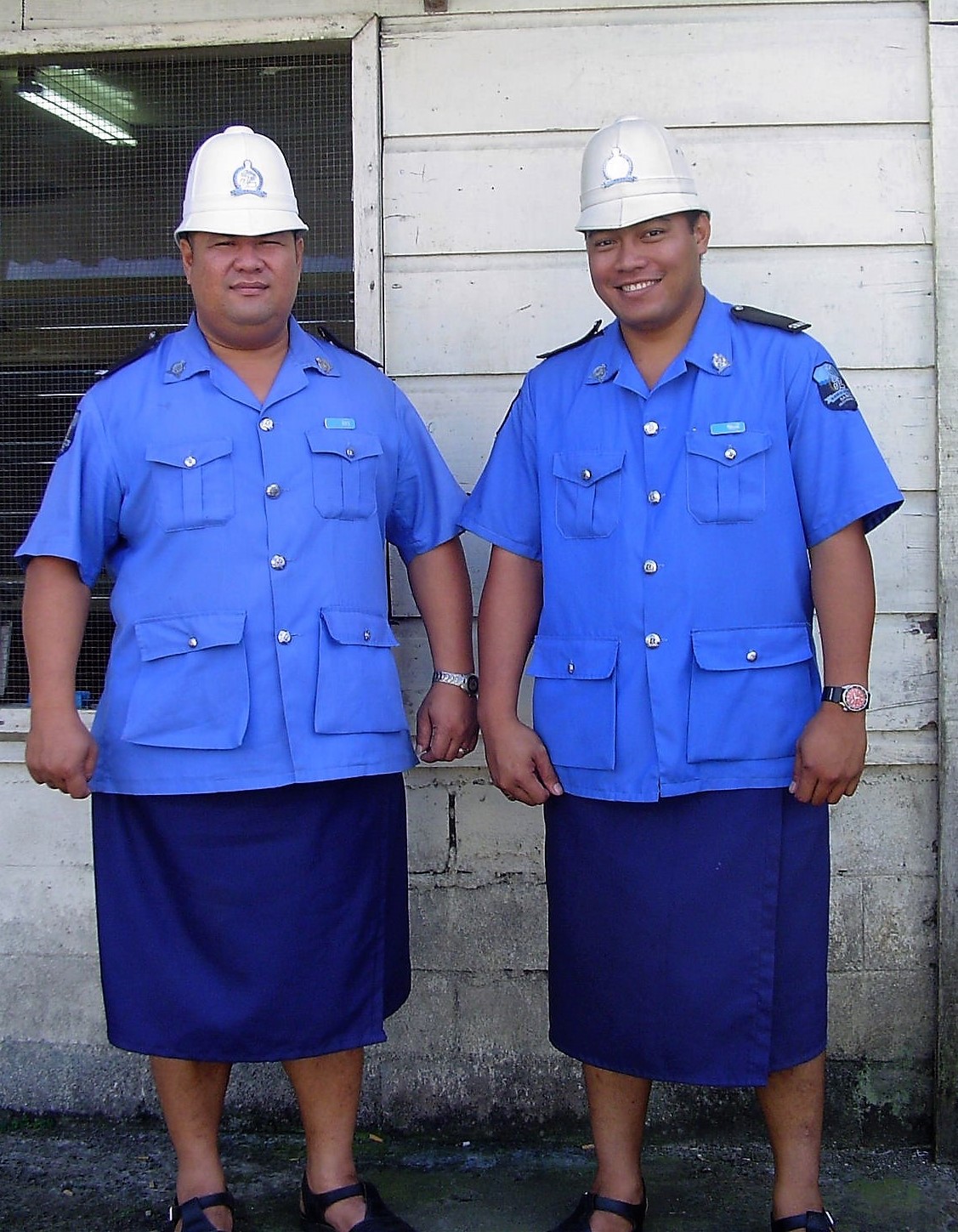
Friendly Samoan cops

The next day I headed to the airport around 10:30 as the first flight to Apia in Western Samoa left at 11 am.  I had no ticket.  As there were no airport staff around except for one check-in agent, and a few other random people who flanked the agent whose role was unclear, the only way to find out information was to stand in line.  This was the first time I have ever tried to check in to a flight on which I do not have a ticket.  But I gather that although this might be odd for me, it is not too terribly unusual in Samoa.  Quite a number of activities seem very flexible.

At the counter the agent told me to wait, someone would be along to help.  The agent would be right back; there was another foreigner also waiting to do the same.  And so, we waited.  Some friendly Samoans hanging around the counter engaged me in conversation.  A ticket agent arrived, told us to meet him in the Polynesian Air office, then immediately disappeared.  It took myself and the other foreigner some 30 minutes to find the office.  Tickets were sorted out; however, only outbound flights could be guaranteed; we would have to set the return in Apia the following day.  At least I had a ticket to Apia for 1:45 PM.

Back in the line, my new Samoan friends said they would take care of my bags while another woman took me to the local Cost-u-less store for some lunch.  One might think this an odd decision on my part.  My bags were out of sight with perfect strangers while I drove away with another one.  But really all they said they would do happened.  My bags were untouched where I left them and the woman drove me to the store.  Later, as I sat in the airport snack lounge (Cost-u-less was closed) the ticket agent asked for my ticket.  He trotted off and had me checked in and my bag taken care of within five minutes.  Samoan hospitality!

samoa 7

Downtown Apia

The hospitality did not end, but it turned out I was everyone’s new friend and thus needed to reciprocate.  An airport security officer thrust an open can of Mountain Dew in my hand, telling me to deliver it to my friend.  My “friend” being my new check-in helper and bag watcher I had only set eyes on an hour before.  I found myself wandering around the airport gingerly carrying his open Mountain Dew in search of him.  I must have looked terribly lost because another airport official approached me to ask me if I needed help.  I explained what was surely a bizarre story about searching for the owner of the Mountain Dew, but the man did not blink an eye and joined me in my search.  We found Mr. Mountain Dew at the immigration counter, where I handed over the can.

Now I had Mr. Customs to help me.  Noting that I still need to pick-up an order at the snack bar, he tells me he can take my passport and complete all the immigration paperwork for me while I am in the restaurant.  This seems one step too far on my trust-o-meter so I decline.  He decides instead to join me at the restaurant.  He sits at my table, orders a beer (despite being on duty), pays for my lunch, then takes my passport and completes my immigration departure forms.  HE waits for me as I eat, accompanies me back to immigration, then stamps me through.  There he tells me to wait, he will give me a letter to give to his friend in Apia.  I can hardly believe this is happening.  I look around, I am dying to share this bizarre situation with someone, but this must be completely normal in Samoa.  He returns with a letter I am to give to Gary at Polynesian Airlines in Apia, then gives me his telephone number in case I ever need help again in American Samoa.  Then he walked away, and I headed for the plane.

One would think this could not get stranger, but it does.  As I sit down in my seat, 1A, the pilot suddenly turns around and says “T—-, your friend Brian told me to tell you not to forget the letter for Gary.”  How did I get on a first name basis with the pilot and who the hell is Brian?  Brian told me he was the Prime Minister of Anu’u.  The pilot asks me if Brian explained how I was to know Gary when I saw him.  I said no.  The pilot tells me it won’t be a problem as Gary will most likely be the biggest guy I have ever seen.  And off we go to Apia.

samoa 5

Sunset in Apia Harbor – worth it!

Landing in Apia some 40 minutes later, the pilot reminds me again to give the letter to Gary.  After clearing immigration (which took all of about one minute) I find Gary quite easily.   He is a short but extremely stout man, perhaps as wide around as he is tall.  I say “Gary, I have a message for you,” and hand over the envelope.  Gary shuttles me and the pilot to an office with combination locks on the door.  I am told to sit in the chair by his desk.  I feel I have done something wrong.  He opens the letter, reads it, then barks at me “Who is this woman?”  There is obviously a woman mentioned in the letter.  I say “I don’t know.”  The pilot asks me “Didn’t Brian tell you about this letter?”  I say “No, I just met Brian 20 minutes before the flight.”  They decide the letter has nothing to do with me and I am free to go.  Welcome to Samoa.

Given all the work I put in just to arrive in country and settle in to the guesthouse, it is no wonder I spent the rest of the day doing very little.  I went only on a short self-guided walk around Apia town, the country’s capital and main port.  But I felt very accomplished and happy.

Pacific Islands Travel 2004 Part Four: Cook Islands Trekking, Dancing, and Flying

The fourth installment of my edited stories of my three-week trip to three islands in Polynesia.  My South Pacific pattern begins to be clear — it takes the first few days to get my bearings and then I can get down to the sightseeing and soaking up the culture.

DSC00481

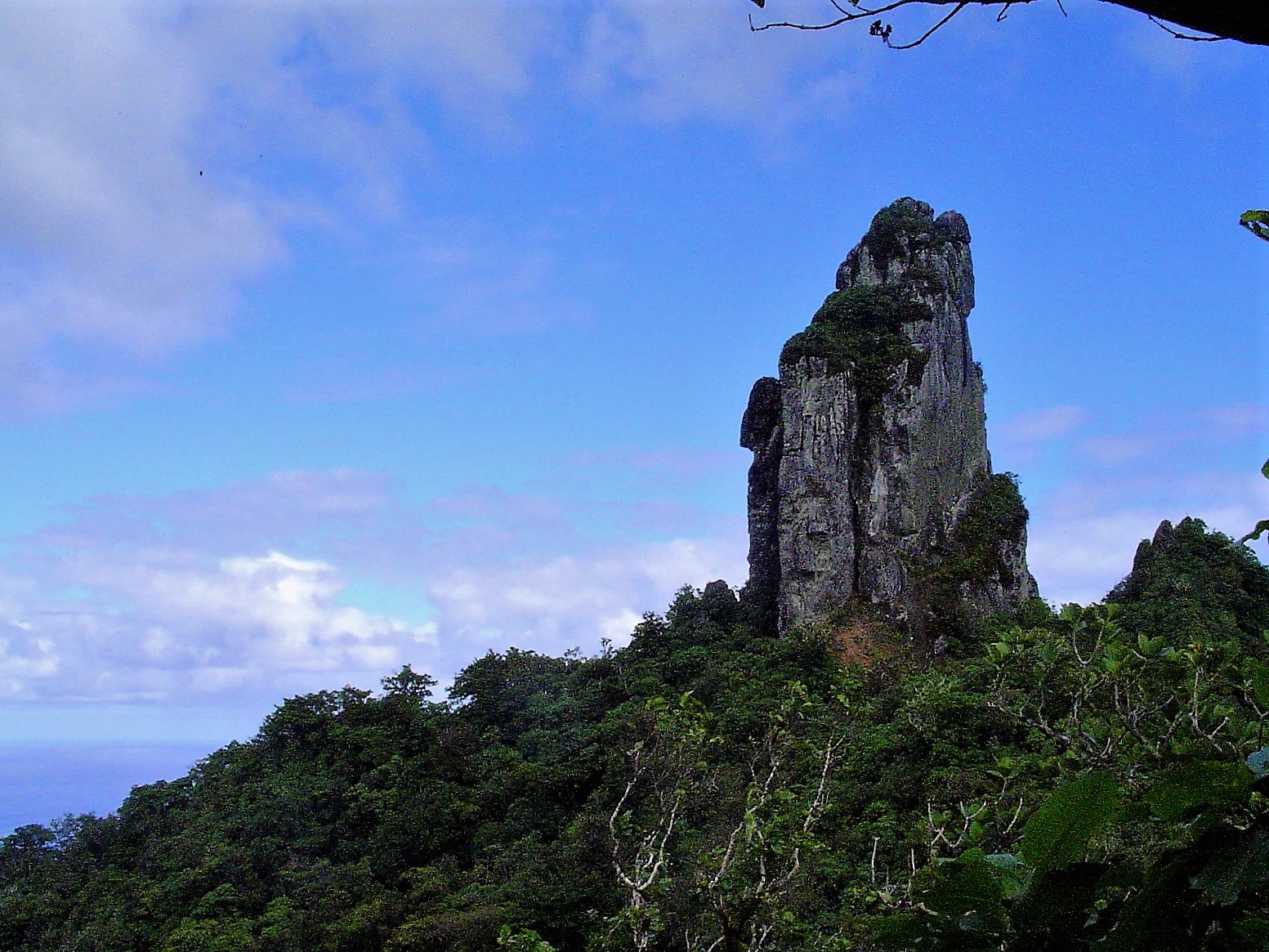
The view of the magnificent Te Rua Manga

On the morning of my third day on Rarotonga in the Cook Islands, I joined four others from the hostel on the cross-island trek, a popular three-to-four-hour walk across the north to south spine of the island with views of Te Rua Manga, or “the needle.”  To have a guide costs some NZ$50, but to do it on our own was free.

Rarotonga, though the largest of the Cook Islands, is just 18 kilometers lengthwise, and 32 kilometers in circumference.  Most people live on the flat coastal areas.  Being a volcanic island, the land rises quickly to sharp green covered hills.  We would be walking this.   Though at the beginning most of us were huffing and puffing up the sharp incline, we were good once we reached the Needle, the large sharp bare outcropping in the middle of the island.  Then it was mostly downhill.  Not easy mind you.  But downhill.  The view from the top was breathtaking, the ocean could be seen on all sides.  Hardly any sign of town could be seen, just the lush, green forest.  It was almost as if the island were uninhabited.  Except for the pesky wild chickens.  They were there, even on top of the highest point on the island.  I felt pretty good after doing the trek.  I felt strong and relatively fit.  Especially as three of the other hostellers were all in their early twenties, and they were huffing and puffing too.  At the end of the trail we hitched a ride back to the other side of the island in the back of a pick-up truck.  We all felt triumphant.  Tired, but elated.

cook islands 11That night I joined the other hostellers in a trip to a local dance spot/bar.  I was a wee bit reluctant to go (I am neither a drinker nor abar fly).  They were all playing drinking games to prepare for going out.  I read a book.  But I decided I might as well go.  While there, I started to feel a bit old.  Though there were certainly all ages in the crowd, I would say most were in their early twenties, and most were very keen on drinking as much as they could.  Still, the place was going to hold a dance contest, and I like dancing.  I start dancing with Jay, another guy from the hostel.  After the initial dancing was over, I was just standing by the side when the judge came up and asked me who my partner was.  I pointed at Jay.  The judge says, okay, you two are the final couple in the contest.  Our mouths hung open.  It turned out to be a contest of foreigners dancing to Cook Island music.  Basically, we had to dance like Cook Islanders.   We danced our little hearts out – I tried to remember anything from when I studied Polynesian dance as a child.  We came away as runners up, winning a case of vodka drinks.  Ha!  Just what a teetotaler who rarely goes to bars wants – Jay was pretty happy though.  I felt pretty impressed with myself.  I trekked for four hours AND danced away in a manic Cook Islands dance contest in the evening (along with two hours more of dancing) – maybe I was not that old after all?

Except for the next two days I did nothing.  On the following day, I slept in, lay around, read a book.  And relaxed, something I often have trouble doing.  I must have gotten the hang of it, because I did the same thing the day after as well.  Thank you Cook Islands!

cook islands 7

Ready for take-off

On Thursday morning, I joined a biking and kayaking ecotour.   The tour guide was a true Cook Islander, whose 97-year-old grandmother is a traditional medicine healer.  Out guide told us all about the medicinal benefits of plants around us, such as the salve found in the stem of a frangipani flower – good for hornet stings.  And how the juice from the noni plant helps people live longer (his grandmother drinks it every day).  He claimed two papaya seeds a day works as a natural birth control.  We saw papaya, banana plants (several kinds), taro fields, and noni – the major agricultural exports of the Cook Islands.  The guide also told us about Cook Island history – past and present.  About the tribal government, and the feuds they still have today.  He pointed out the traditional palace for his tribe.  A campaign promise by the current chief head (a woman) was to restore the palace.  Although she came to power in 1991, the palace still lies below overgrowth, barely discernable beneath the grass.  Her reign is being challenged by her sister.

Following the biking portion of the tour, we hopped into kayaks and paddled ourselves across a beautiful lagoon, then up a small tributary.  Several land crabs were brought to our attention as they scurried about.  Then back to the pristine lagoon.  We rowed against the current to see a traditional fish trap, built of rocks in the water, which during high tide channels fish into a stone pen where they are caught at low tide.   Then we lazily sat in our kayaks as the current pushed us back to our departure point – and we watched fish swim beneath and around our boats.   What I remember most about the kayaking was just watching several frangipani flowers floating across the surface of the sparkling water – so clear it was like a swimming pool. 

In the afternoon I decided to take a microlight trip.  Soon enough I found myself hopping into a two-seater mini plane.  We took off like a regular plane, barreling down a grass runway adjacent to the airport’s regular runway, but we took off quite quickly.  Up we went to 3,000 feet where I had a view of the entire island.  It was so amazing.  The island was such like that out of King Kong or Jurassic Park.  And the lagoon waters could clearly be seen against the darker blue of the Pacific Ocean, with not another island in sight.  Thirty minutes was just the right amount of time to see the island.   The only thing was the plane was open, and it was much cooler with a strong wind.  My nose was running like crazy and my ears were cold.  Well, also the pilot turned off the engine as we were cruising high over the lagoon and pretended it had cut off and he could not restart it.  It was funny, but also not funny.  In a way though, that brief sense of terror while looking down at something so breathtakingly beautiful, made the experience all the more special.


cook islands 6

Rarotonga from the sky

Although the Hawaiian Islands are supposed to be the most isolated in the world in terms of their distance from other land, these days they are not truly that remote.  The other islands in the chain are relatively close, the islands are larger, and well connected to the U.S., Japan, and other countries.  Tourism is huge in Hawaii.   Although there are some similarities with Hawaii, I did feel much further removed from any mainland while in the Cooks.

Another great thing about Rarotonga that puts Hawaii to shame is the public transport.  On the Big Island of Hawaii, which takes some five hours to drive around the island, there is only one bus per day going in each direction.  Rarotonga, just 20 miles around, has a bus going in each direction every hour from around 7 AM to 5 PM, and also less frequent night buses.  Three cheers for public transport in most places outside the U.S.

Thursday night I attended “Island Night” at the Staircase restaurant in downtown Avarua.  This is a night of food and island dance.  I was feeling cheap and only paid for the dancing.  The show was a full hour, though the last bit was more about making people in the audience look like fools with the dancers than anything else.  Still, I love Polynesian dancing.   Frenetic hip swinging for the women.  Knee knocking for the men.  What a workout.  I love the music.  The hollow wood drums make the most incredible sound.    The unfortunate thing about the show was that there were these beautifully dressed dancers in traditional grass skirts, leg adornments, headdresses, and coconut bikini tops.  They looked fantastic.  But the dancing was in a small area at the front of a restaurant, with a disco ball twirling on the ceiling, rather than on a beach at sunset with tiki torches.  Despite the small, even corny venue, I managed a few decent photos.

cook islands 1

Cook Islanders know how to shake it

I caught a cold sometime Wednesday night (the nights were surprisingly chilly) and I expect the microlight aggravated it, so I had a sore throat and the sniffles on Friday.  Oh well, another day to chill out on a tropical island.  I just hung out and walked about town in the morning.  Yet, I found out coincidentally that festivities would begin that day in the lead up to Constitution Day on August 4.

A parade was to begin at 1 PM.  I arrived at the market grounds at one on the dot to find no parade whatsoever.  It was 2:30 before there was any parade activity.  Ah, island time!  The government officials arrived in fancy cars.  The Prime Minister’s car being the most obvious, with the license plate – PM.  There were dancers on grass covered floats, interspersed with civil and religious groups carrying banners.  The floats of dancers were the best because they were colorful and lively, beating drums signaled their arrival.  I enjoyed seeing this slice of local life.

On Saturday morning I rented a bicycle and rode the entire way around the island.  It took me nearly three hours, including a 20-minute break to eat an apple and read a little in my book at the half way point.  It was an easy flat ride.  Very enjoyable for the morning.  I could hardly understand why there are so many cars on the island at all.

My flight left at 8:30 in the evening.  Around two I returned to the hostel, made lunch, watched a movie on the tv, then gathered my backpack for the walk to the airport.  Yes, walk.  I can think of few places where I could simply walk from my hotel to the airport (not counting those expensive airport hotels).  It took me only about 20 minutes to make my way along a country road winding by grazing cows.  I was sad to leave.  It struck me my short holiday was more than half way over.  I really wanted to be heading on to Fiji or Tahiti or New Zealand like the others in the hostel.  I love traveling so much.

Pacific Islands Travel 2004 Part Three: Arrival in Rarotonga

The continuation of my three-week Pacific Island travels in the summer of 2004, just after completing a research assistantship in Honolulu.  From the Big Island of Hawaii, I would head 3,000 miles due south to the small 15-island nation known as the Cook Islands.  Named after British navigator Captain James Cook who “discovered” the islands in 1773, the islanders are now considering changing their name to one that better reflects their Polynesian nature. 

cook islands 2

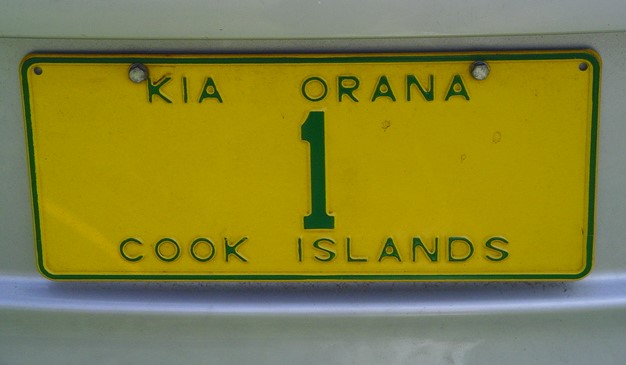
Kia Orana or “hello” in Cook Islands Maori – how lucky to find the #1 license plate

The regional jet departed Honolulu full to the gills.  Many of the passengers were Samoans who would disembark at Pago Pago in American Samoa.  I would continue on to Rarotonga in the Cook Islands.  Most of my second leg fellow passengers appeared to be locals, and they all seemed to know one another.  At landing at 12:30 in the morning, the flight attendant announced, “Checked luggage can be found at Carousel 3… Mind you, we have only one carousel.”  This made everyone on the flight laugh.  We needed something to wake us up.  As we stumbled toward the terminal, it suddenly came to life.  The lights were made brighter, a ukulele player began to play and sing, and the two immigration officers opened for business. To get the 22 of us through took only ten minutes.

I had reservations at the Tiare Village Hostel, located just behind the airport.  I made these reservations frantically by phone from the Honolulu Airport when I realized that very morning that booked accommodation was a requirement for entry into the Cook Islands.  Although no one actually checked, I was happy to have someone picking me up at the airport at nearly 1 AM.

cook islands 9

Cooks Corner — downtown Avarua

The following morning, a Saturday, I woke up early as I was told the hostel manager would drive newcomers into town on the first day for “orientation.”  It turned out to be quite informal with the orientation only consisting of the manager just pointing out the market, the banks, the information center (closed weekends), and the center of town.  The tour took just a few minutes.  Taking advantage of the lift into town, I ate lunch at a busy cafe/pizza/ice cream joint in the center of town near the roundabout (the only one on the island), then wandered about town for a bit, bought groceries, and walked back the 30 minutes to the hostel.  As I was quite tired from the flight and early morning arrival, I spent the rest of the day lazing about.

The Cook Islands are a group of 15 islands in the South Pacific.  They are divided into two groups, the Southern and the Northern.  The Northern Group is quite isolated and made up of smaller islands, generally accessible only by yachties.  The Southern Group is the more populated.  The total population of the island nation is about 15,000 with around 8,000 living on the main administrative island of Rarotonga.  The Cook Islands are a self-governing nation in free association with New Zealand.  It has its own government, parliament, and prime minister as well as traditional government districts.  There are eight traditional tribes on Rarotonga, seven of them are led by females.  But more Cook Islanders live outside of the nation than in, mostly in New Zealand and Australia.  The islands use New Zealand money, though they also mint their own, including the very collectible three-dollar bill.

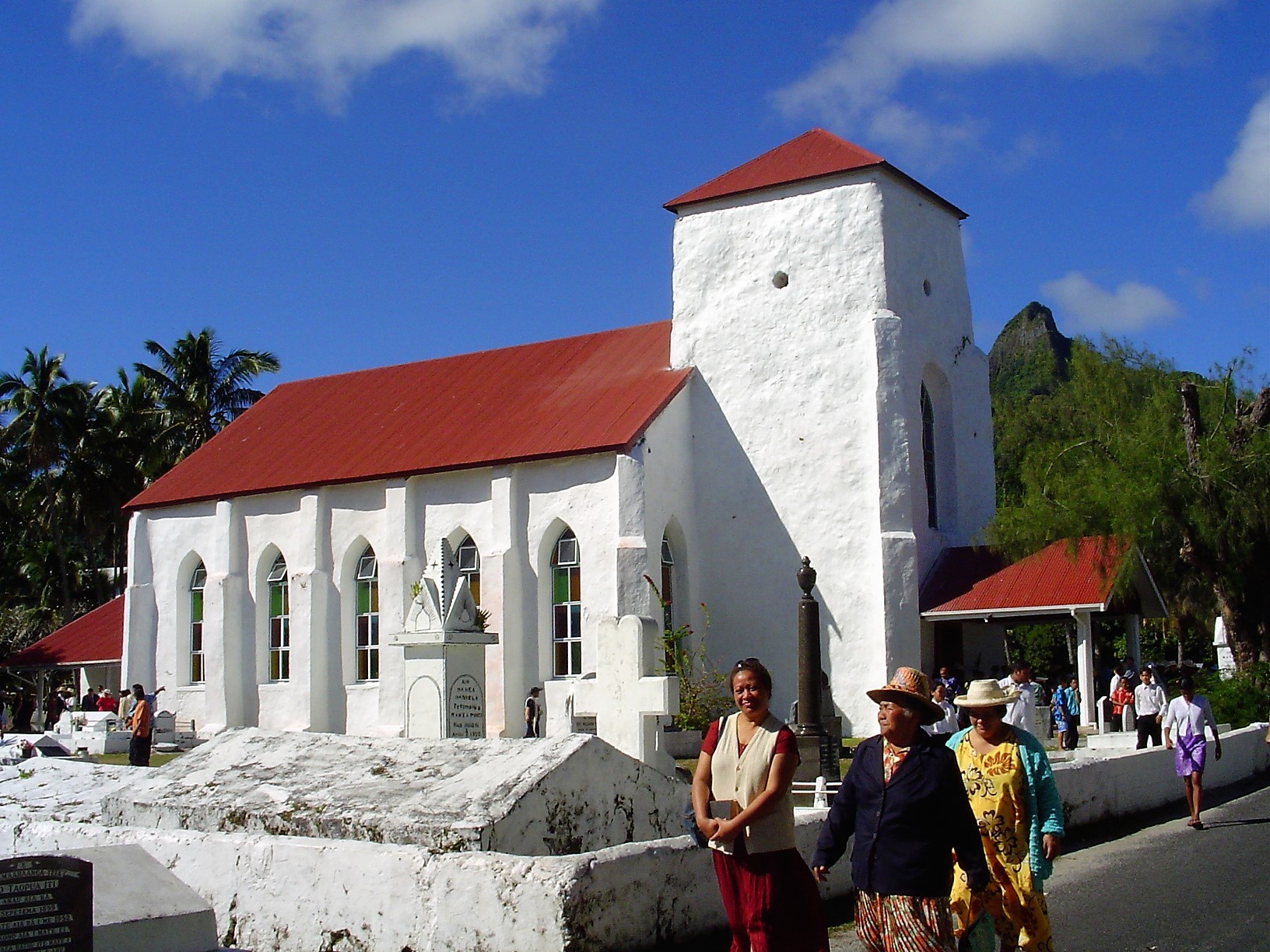
cook islands 10On Sunday morning I attended church at the Cook Islands Christian Church (CICC).  The service was mostly in Maori, the traditional language of the Cooks.  The local patrons were dressed in their finest – with women in colorful flower-patterned dresses and traditional straw hats; the men in flowered shirts.   The pews and beams and pulpit are made of a warm reddish medium wood, while the walls are a white stucco and the ceiling painted an aquamarine green – the kind popular in the sixties.  Though it seemed an odd color in and of itself, it worked in this church with its simple stained-glass windows.  Those sitting in the center section were clearly the most serious of church goers.  They stood up first for songs, sang the loudest, and sat down last.  They were also the best dressed.  Those on the lower section’s outer seats seemed the second tier of church goers.  Maybe they had not arrived quite in time to claim the middle seats for the day, but they were still dressed in their colorful finest and sang the hymns with vigor.
I sat in the upper section, which just might be the area for those who treat church more as a social occasion than a religious one.  There were many children up here, in bare feet, fidgeting.  Many simply ran around.  One boy scooted his way across a pew on his stomach.  We moved our feet to let him scoot by.  The boys on the opposite side seemed intent on poking each other as much as possible and looking at some cards they had brought with them to pass the time.  Two young, mischievous girls sitting in front of me played with their rubber bracelets, each other’s hair, and whispered things to each other and giggled.  A young teenage girl to their right sat with her mother or aunt – a very serious churchgoer who seemed to choose the upper section as a perfect vantage point to carefully watch the congregation, maybe so she could gossip later about those she felt were not properly pious.  Her daughter too gave the giggling girls a hard stare, though it was more for her mother’s benefit I think, as she looked as if she longed to join them.

The primary reason I attended the service was to hear the congregation sing, as they are famous for their harmonies.  Indeed, it was lovely.  Maybe, in part, because they sang in Maori?  But also, the men and women sing different verses almost the fashion of a round.  Most of the time the singing was pretty much in tune.  At times, it did seem the words and tune were getting away from the singers and the reverend seemed to stare at the ceiling, on to heaven, willing his flock to find their way back to the harmony.  It was a very enjoyable hour.  Afterwards, the reverend invited myself and the two other hostellers to tea and we might have joined if we were not scheduled to attend something else in the afternoon – Piri Puruto III’s great show!

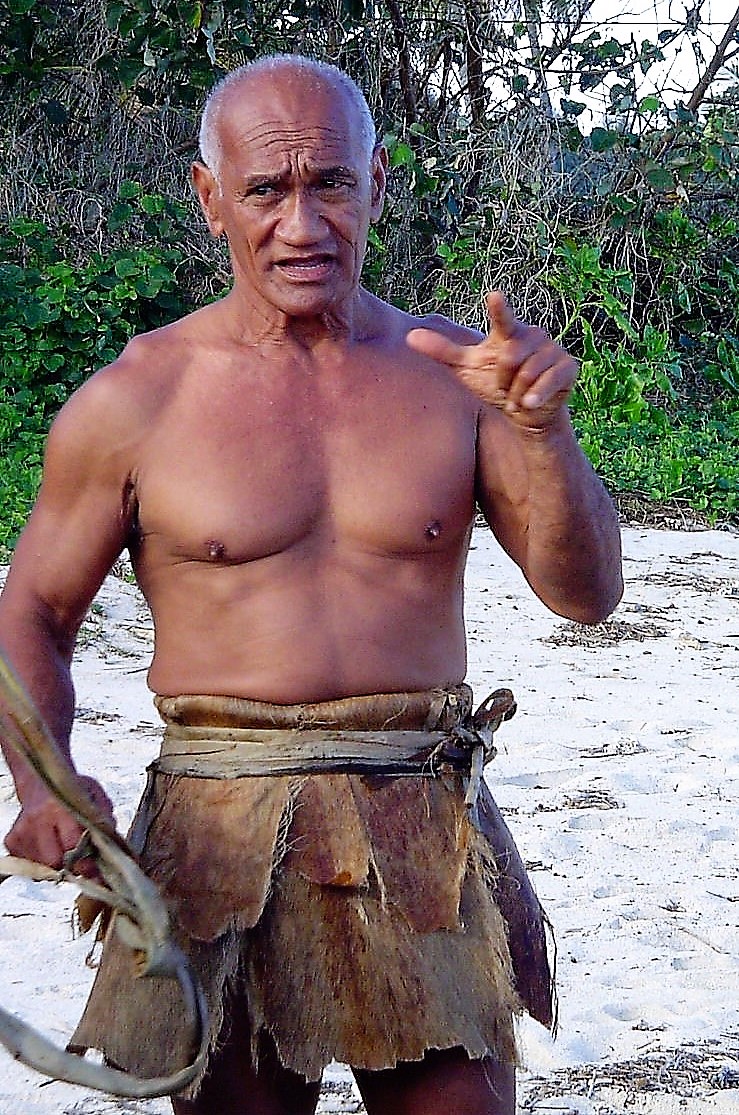
cook islands .5

Piri Puruto III lecturing us

Piri Puruto III is a 60-something-year-old man who performs his show most days of the week.  On Sundays he includes a traditional Cook Island lunch and dinner prepared in the umu – the underground oven.  We picked leaves for our plates, large leaves for the lunch, and then we weaved our plates for the dinner.  Piri believes everyone should participate in the cooking to truly appreciate the food.  I had to fetch a whole chicken from a bucket of saltwater, stuff it with local spinach, wrap it in noni leaves, then wrap the whole package with larger leaves, tying it together with the spine of the leaf.  After all the food was prepared, we placed it in the umu, and covered with many leaves, with Piri yelling orders at us like children with short attention spans.  He asked us to call him teacher.  He would yell at us, “students, get the leaves!  Get them!  Hurry.  Why are you moving so slow?  Teacher tells you do something, you do it!”

Then the show began.  Piri Puruto III climbs coconut trees.  We all sat in a circle while Piri prepared.  He had changed from his tank top and sport shorts to a tanned leaf skirt, bare chest, and coconut husk helmet.  He chanted in Maori as he entered the circle and began to tell his life story.  Born on one of the other islands, as a child he witnessed the last inter-tribal war.  He moved to Rarotonga as a teen, and then went on to Auckland to participate in boxing tournaments – winning his first title in 1959, and holding on to that title until 1964.  And now he boxes coconut trees.  We all follow him down the rocks in his backyard to the beach, and across to the beach to a magnificent palm, I don’t know how high – maybe 50 feet or more.  He makes some speeches.  Tells us that when he climbs, we must be ready to take pictures.  When he tells us “Students, prepare your cameras!” Then we are to do so immediately, or else miss the picture.  The guy was a complete ham.  But climb the tree he did.  With a rope binding his feet together, he spit into his palms, wet his toes, and scurried up the trunk, high into the air.  At the top he made his way into the fronds, stood atop the palm, picked a coconut, yelled at us to get our camera’s ready, and threw the coconut into the air.  Then he checked we indeed had taken a picture.  On the way down he did some acrobatics, skirting the trunk of the tree, holding the trunk and throwing his feet out to the left and to the right.  He all clapped as we were certainly expected to!  It was all shameless attention, but good fun to watch for sure.  He made his way back down and we headed back to the house for dinner.

Before we could eat though, we had to make fire!  The traditional way.  From the coconut tree, Piri had brought back a coconut, as we needed coconut fiber #1, coconut fiber #2 and coconut fiber #3 to do this properly.  I was a lucky one to help with the fire making, as my spit was used to roll together coconut fiber #2.   Then the men were to help with the logs, and we all had to chant following Piri’s example.  He told us the making of fire was like the act of making love.  The whole circle had a good laugh at this, and he said, “no don’t laugh, I’m serious.”  He said he would translate our chant in English.  It went something like Bang 1.  Bang 2.  Bang 3.  Bang 4.  Bang 5.  Bang 6.  I am man.  You are woman.  Fire!  And he furiously rubbed some bark against the log.  And a spark started.  Coconut fiber #1 is used to catch the spark.  It is then burrowed into coconut fiber #2.  Then the whole thing flamed with coconut fiber #3 and we had a big flame!   The dinner of baked chicken, potatoes, fish, and lamb, with local spinach, coconut and bananas was ready for the eating.  It was all in very good fun.

cook islands 5

One phase of sunset in Avarua harbor

It is fascinating to go back to my diary and stories from this visit.  I remember little of the things I wrote about, but I recall other details.  For instance, standing in Avarua harbor to watch the most incredible sunset I had ever seen.  With the quiet pace of island life, a 30-minute walk to town is not only exercise but an enjoyable activity.  So, one afternoon I strolled from the hostel to the center of Avarua, the Cook Islands’ capital and administrative center of the island of Rarotonga.  I stood marveling at the late afternoon light bathing the green volcanic hills rising behind the Avarua fishing harbor.  Then I turned to face the other direction and my breath caught in my throat.  Even to this day, I have not seen a sunset that equaled the extraordinary beauty of that one.  The sky changed from daylight blue to yellow, then orange, pink, purple, and finally to blue.  Standing alone in the shallow, rocky waters of Avarua bay at low tide just waiting and watching the sun and its light slowly sink below the horizon might be one of the most magical moments of my life. 


Pacific Islands Travel 2004 Part Two: Big Island Sightseeing

The continuation of my “last hurrah” whirlwind three week trip to three Pacific Islands.  This is the second part of the Big Island — when my German travel companion Carmen and I finally stopped screwing around, finally figured out our transportation issues, and started to actually see some of the sights.

Hawaii 2

Rainbow Falls

As Carmen and I drove back up from the lava coast, the clouds descended around us again, and dusk descended.  We drove to the small town of Volcano, a lush rainforest oasis of deep green ferns and dark red flowers engulfed in a light mist and chilly fog.  We planned to stay the Holo Holo Inn but had no map with it on, and with the growing dark and fog it was difficult to see the road signs.  We stopped in the small general store to ask directions.  The store had a very small town feel to it; a real general store stocked with just about every necessity.  Not a huge selection mind you, but enough for the artists who live in the area to not have to drive far for groceries.  I asked the woman behind the counter if she knew where I could find the inn.  She said she didn’t know.  But the tall white-bearded man who had just made his purchases, and was on a first name basis with the woman, told her she surely did.  He said it was just off the road near the Japanese school, and he says some Hawaiian road names.  She disagreed and said it is off another road.  He kindly tells her she is wrong and proceeds to tell us how to get there.  The woman good-naturally laughs at herself for not knowing the location.  The whole conversation had that warm feeling that comes from people in a small town knowing each other well, of regulars and long-time store proprietors joking with one another.

As Carmen and I drove up to the wooden house next to the Japanese school, it seemed dark.  The front driveway was littered with all kinds of garden and mechanical tools.  Carmen took one look at the place and said maybe we should just go.  It did seem almost deserted.  But when we rang the bell, the door was opened by a small blonde boy followed by a young Asian woman with delicate features.  In heavily accented English she welcomed us inside and showed us around.  The place was really beautiful.  All made of rich warm wood.  Wooden floors, walls, and ceilings.  Though it was chilly outside, it was a nice temperature inside, enough for bare feet upon the floorboards.  Our wooden bunk beds topped with heavy warm blankets.  The kitchen had a high ceiling, with large Japanese paper lamps hanging from the ceiling over a wooden table.  The cupboards were well stocked with beautiful Japanese ceramic plates, bowls, and cups – all for the hostelers use.  It felt very homey.

hawaii 4

Lava Trees State Park

On my fourth day on the Big Island we drove the rest of the way around the stopping to see many sites along the way.  The weather outside of Volcano was gorgeous.  Warm, crystal blue skies.  We drove first to Lava Trees State Park.  The lava “trees” were formed when a volcanic eruption some 200 years ago swept through the forest.  The lava climbed up the trees burning them but then hardening in the shape of the former tree trunks- making hollow lava cones of varying heights.  The drive, once we found the tricky turn, was gorgeous.  Huge trees on both sides dusting the two-lane road with leaves, and just a touch of sunbeams filtering through.  It felt a bit more like a drive in New England than in Hawaii.  The forest itself seemed almost primordial with tall, old, moss-covered trees.  A short circle trail led us around the ghostly lava trees.

We headed next to Rainbow Falls just outside Hilo.  The falls were absolutely beautiful – perhaps one of the best falls I have ever seen.  They were tall and thick, falling into a lush pool at the bottom, with a large cave behind them – supposedly the one-time home of the goddess Maui.  At the top of the falls, just before the water gushed over the edge, there was a large boulder which split the falls into two ribbons of water.  In the early morning or afternoon, if conditions are right, there is often a rainbow across the water, but unfortunately, we were not there at the right time.

On next to Akaka Falls State Park via a 4-mile scenic drive.  At the falls we were rewarded with two falls, much taller than Rainbow falls, though thinner as well.  At the top of the trail to the falls we sat at a picnic table and had our lunch of bread and cheese and fruit.

Hawaii 6

Waipo Valley lookout

On next to Waipo Valley lookout.  The drives were not long, perhaps an hour here or an hour there, but very pleasant.  At the Waipo lookout we stood on a cliff above the Waipo Valley and the sea, with a tremendous view of the undulating cliff coastline, the sparkling sea, and the beginning of the low valley.  There are some good treks and horse riding in the valley but they are costly, so we did not have anything planned.  But seeing the view was worth the drive.

We then drove through the town of Waimea with a magnificent view of Mauna Kea rising in the background, it dwarfed everything else on the island, rising quickly to its height of 13,800 feet.  The road ended at the town of Hawi, where the original statue of King Kamehameha the Great, the first king to unite the Hawaiian Islands – born on the Big Island – stands. (And in one of those amazing coincidences of life, I happened to be watching Hawaii 5-0 while editing this story, and the episode happened to be one in which they feature this original statue.  I was thinking, I just read about this…in my own story!)

Then we drove along the coastal road another hour to the Pineapple Park Hostel to the town of Captain Cook (where the famous navigator who discovered the Sandwich, or Hawaiian Islands, met his end).  Carmen and I stepped into the reception area of Pineapple Park at 8:30 pm.  The office was closed but there was a sign saying to ring the bell for after-hours arrivals.  Unfortunately, on the other side of the shuttered reception window was another sign indicating the hours were 7am to 7 pm and that THIS IS HAWAII – WE ARE NOT OPEN AT ALL HOURS.  The sign did not inspire confidence as I hesitantly pushed the bell and cringed.  A Japanese woman came from the hallway behind us, saying in a decidedly unwelcome tone “What do you want?”  I explained we wanted to stay.  “How many of you?”  The two of us were standing right in front of her…Of course, she made a point of telling us the usual hours are 7 to 7 and made such a case out of it as if we were really being a bother and she was being tremendously nice to let us stay.  I had a hard time not rolling my eyes.

On the wall of our room was a list of the hostel rules.  Some made some sense, some I found a bit humorous (copied word for word):

  1. No abusive- belligerent or disruptive behavior tolerated (must fit in)
  2. No drugs of any kind – alcohol in moderation
  3. Must be a traveler and have a picture I.D.
  4. Quiet hours 10 pm – 6 am; kitchen, TV, up stairs lounge closed after 10 pm
  5. Must have clean clothes and no offensive smell
  6. Must clean up immediately after using kitchen
  7. Five minute shower
  8. Do not take others food or drink

You will be asked to leave on the first violation – ALOHA

I had to crack up at the “ALOHA” in capital letters at the end of the list.  I hardly felt the Aloha Spirit emanating from this hostel.  What would happen if I haven’t had a chance to do laundry (i.e. have dirty clothes) or I do not fit in with the others?  And the five-minute shower?  Well, without the lock or even being able to close the shower door completely, I imagine I will be taking the quickest shower ever.

Hawaii 8

Hanging with some Hawaiian tiki friends

On the morning of the fifth day, Carmen and I woke up early to head out to swim with dolphins.  There was a small bay a short drive away where dolphins were often spotted swimming.  I did not really feel comfortable swimming with dolphins, but I thought it might be nice to see them.  Besides, I knew in the water I would not have my glasses and would probably not see a dolphin at all.  At the bay, a man pointed out some dolphins in the water.  I didn’t see any dolphins, only human beings floundering about in the bay.  But I took his word for it.  We entered the bay from a rocky shore; I am talking about mini boulders.   They made it difficult to get in the water.  We nearly fell a couple of times.  Carmen pulled on her snorkeling mask and paddled off.  I stood waist high in the surf, feeling the pull of the waves as the water rushed back to the sea.  It was a strong pull, nearly pulling me off balance.  The crashing in of the waves was also strong.  I tried to stand my ground.

Seemingly out of nowhere, a large wave knocks into us both.  I was tumbling underwater over and over.  After some 20, 30 seconds, I do not know how long, I stood up.  I called out to Carmen to see if she was okay, she was also calling for me.  Her flip-flops floated by.  Even my strapped sandals had been ripped off forcibly by the wave.  I think my hair was standing straight up, matted with sand.  There was sand in my ears.  Later I found a pound of sand pushed into the top of my swimsuit.  Carmen and I both agreed our little foray into the ocean was over for the morning.  We violated the five-minute shower rule back at the hostel.

Our next, and last, sightseeing stop was the Historical National Park Pu’uhonua o Honaunau (which means Place of Refuge at Honaunau).  This was an area where the Hawaiian ali’i (royalty) lived.  It was also a place where those who broke the strict rules of traditional Hawaiian conduct might find redemption – after swimming across shark infested waters.  In times of war, women, children, those unable to fight or wounded soldiers could also find refuge here.  In times of war in Hawaiian times all people were considered fair game in battle, and only those located in compounds of sacred refuge could be spared.  Sounds brutal.

hawaii 5Nowadays the Historical Park is peaceful.  The wall of the compound is all that still exists from traditional times beside white sand, a glittering sea, and reconstructed straw huts.  In one large boat house, an old native Hawaiian carves the traditional totem or Ki’i that guard the entrance to the landing lagoon reserved only for ali’i, and the site of some reconstruction, from evil spirits.  In the small lagoon a sea turtle swam around, another basked in the sun.

The following day I took Carmen to the airport and return the rental car; we said our farewells (though we remain Facebook friends to this day).  Later the same day, I embarked on my own flight away from the Big Island, leaving behind a magnificent view, but looking forward to the next leg of my journey….


Pacific Islands Travel 2004 Part One: Big Island Beginnings

Every so often I dip into the email stories I wrote during my pre-State department, pre-mom travels.  I review, edit, and re-package them.  In the summer of 2004 after completing my six-month research assistantship at the Pacific Forum-CSIS in Honolulu, Hawaii, I embarked on a three-week trip to the Big Island, Rarotonga in the Cooks Islands, and then Samoa.  After the trip I would participate in my assistantship final seminar, graduate from my Master’s program, and start looking for work.  I figured this trip would be my last hoorah for some time, as I would soon join the world of government work.  The trip would inspire me in ways I had not expected, and eventually led to my first published op-ed and my second published academic article, both on Chinese influence in the South Pacific.  My stories are sometimes far more about the vagaries of travel – the transportation hiccups, the interesting people one meets on the road, and unexpected adventures – than about the places themselves. 

DSC00369 (2)

Carmen and I stop for a break from Volcano National Park on the way to Kona

My flight left Honolulu for Hilo, on the eastern side of the Big Island, at 10 in the morning and landed an hour later.  I was at the hostel by noon.  As it was a Sunday, there was little to do in Hilo, with most shops closed.  I only walked around a little, had some lunch, and did some grocery shopping.

I met another woman at the hostel who struck me as odd.  She was from north central England, with a thick accent I could barely understand.  What really struck me is her plans to travel around the world for a year.  When I asked her about restaurants near the hostel, she told me she did not know because, as she said, she “did not eat foreign foods.”  I wonder how she will ever survive her trip.  I would love to run into her a year from now and see how she faired.

Hawaii 9

Lush green rainforest of Volcano National Park – Hawaii is not all beaches

On Monday I was up early, trying to figure out what I would do that day.  I was thinking maybe a helicopter ride over the volcano, but was still unsure I wanted to pay the price.  I thought perhaps I might rent a car and drive around on my own or to Mauna Kea, but I learned that to return a car to Kona, on the other side of the island (a whole 2.5 hours away), I would be charged an additional $85 for the drop-off charge; and one cannot drive to Mauna Kea in a rental car because the road is bad and the tour companies forbid it.  A rival hostel in town offered stargazing tours to Mauna Kea for the incredible price of $96, even though the stargazing program on the mountain is actually free!  The idea of them raking in nearly $1000 for 10 people with only the cost of gas there and back, perhaps $30 for a van, made me a feel annoyed and I was thus reluctant to give them a call.

On my first day I had met Carmen, a paramedic in the German army; she also wanted to go to Kona.   After two 6-month tours in Kosovo she was granted this five-month holiday.  She asked me what my plans were for the day, suggesting we could go to Kona together.  However, after the unfortunate news from the rental car agencies, we sat wondering what was best to do.  There is but one bus on the island that travels from Hilo to Kona once a day, from 2:30 arriving about 5:30.  It seemed I would have no plan for Monday and much of Tuesday would be spent on the bus.  I was beginning to think my five days on the Big Island would be a total bust.  Then in walked Sharifa – another woman staying at the hostel – doing her masters in Environmental Science at Yale and studying tropical plants, with field research on the Koa tree in Volcano National Park.  More importantly, Sharifa had a rental car, was driving to Volcano National Park, and then onto Kona to renew her car at the airport there.  And she asked if we might like to go along.   Carmen and I practically leapt to our luggage in a single bound to begin the frantic packing.  Sharifa said she would meet us outside in the parking lot across the street.  Packing was done in record time and soon Carmen and I and our bags were cozily ensconced in Sharifa’s beautiful black convertible and we were motoring down the road.

Cnv0040 (2)

I fancied myself quite the black and white photographer – this is one of my favorites –  ropey pahoehoe lava

Because Sharifa needed only to pick up a research permit at the Volcano National Park, we had only 30 minutes in the visitor center and a walk on a short trail overlooking one of the craters.   The rich volcanic soil and the high elevation create a lush rain forest atmosphere, and where there are rain forests, there is most certainly rain.  And it rained.  The clouds rolled in across the crater and it disappeared in the fog.  It grew cold and we huddled for some time with warm drinks near the fireplace at the Volcano Inn and looked at the photographs of magnificent eruptions, which lined the wood walls.  Sharifa needed to get her permit and be in Kona to renew her car rental before 5 o’clock and so we piled into the car and headed off.

Once we were some ten minutes out of the park, the sky cleared, the convertible top came down, the CD player was turned up, and we barreled down the road in high spirits.  On one side of the road dark grey glistening volcanic rock sloped upwards to the clouds heading for the peak of Mauna Loa.  On the other side the same moonscape rock dropping downwards towards the sea.  A fascinating landscape with sometimes dramatic vistas appearing before us of the dark blue sea alongside cooled coal-grey igneous rock.  At times it grew cool and would sprinkle some rain and the top would go up on the car.  The wind would pick up and we would feel chilly.  Not exactly the weather one might expect in Hawaii, but the Big Island temperature and climate is amazingly diverse.  In the winter, even the peak of Mauna Kea is covered in snow while the beachside with be basked in warm sun and temps in the 80s.

Hawaii 3As we bid Sharifa farewell at the airport, I made a reservation for my own rental car the next day.  This was a big deal for me as I could not recall the last time I had driven a car.  The Kona hostel, located in a residential area, was not easy to find because there was not a sign at all.   The manager had a weird laugh after just about everything he said.  He was young, around 30 years of age, and although he laughed, he did not seem pleasant.  Carmen immediately told me in the room she did not want to stay there another night.  I also felt bad karma from that guy.  The hostel was new and clean, but the guy made the whole thing feel like an episode of the Twilight Zone.  Carmen and I walked down to the supermarket to get fixings for dinner and spent an early evening in the hostel reading, showering, watching tv, and eating.

We were up the next day to head over the airport to pick up the rental car.  We were out of the hostel before 9 am; we did not say anything to the manager as we left.  The tricky part was getting to the airport.  Although just seven miles out of town, there is no bus because, of course, America.  We tried to flag down a taxi but the first one told us we had to have a reservation.  We asked if he could call in and tell a taxi to pick us up and he said he would, but 15 minutes later and two taxis had passed us in the opposite direction without turning around or stopping.  So, we walked to a gas station.  We asked the woman behind the counter if she would call for us and she did, but it turned out that one company was so busy they were not picking up their phone, the other said it might be an hour.  I thought of Mr. Weird Manager back at the hostel and kept checking my watch.  I had a feeling he would not like it if we checked-out AFTER the check-out time.  There was a man standing in line next to us and I asked him if he was heading by the airport and if he could give us a lift.  A minute later he signals us from the car a thumbs up and Carmen and I get in.

A line awaited us at the rental car counter.  We were back at the hostel by 10:15 to find the door to the hostel locked and neither of our keys working.  Suddenly Mr. Weird pops up from nowhere behind us and in an unfriendly tone tells us our keys will not work.  He opens the door telling us he had already removed our things from the room because of the 10 AM check-out time.  He makes an unpleasant comment about the amount of luggage we have, followed by his disturbing laugh.  He even helps us to take our luggage to the car, but not out of any kindness I am sure.  He seemed quite eager to be rid of us, and Carmen and I felt quite happy to pull out of the drive and see the back of that guy.

DSC00384

Lava pouring into the sea

We headed back to Volcano National Park and drove around the crater road stopping to take pictures of the lava flow formations, of steam rising from craters, and sniff the sulfuric air.  The air was cold, the sky grey and overcast.  Light misty rain fell.  However, as we drove down Chain of Craters road towards the sea, the clouds disappeared and the blue sky and sea appeared below.  It was a beautiful drive.  The sides of both roads were covered with undulating hard lava flows from the past several decades.  The sight was almost surreal.  The ocean was the most incredible blue.  At the bottom of the road, alongside the sea we parked our car.  The road once continued along the ocean, but with the more recent lava flows it had been closed.  We walked over the hard lava on the road, occasionally coming across buried road signs.  At the end of the pedestrian trail, where visitors could proceed no further as the lava, though grey and cooled was nonetheless still molten under its crust and still inching toward the sea, we could observe the red-hot lava pouring into the sea.  Great billows of steam rose up as it dripped off the island into the sea.  Here I was standing just 100 feet from an active lava flow.  Incredible.


Malawi Elections: Politics Front and Center

8

The stage is set for the third and final Presidential debate

I generally do not blog about my job.  Not that I do not have an interesting one, I do, but my blog is instead about myself, my daughter, our travels, our life abroad.  And my job enables much of that, but its not all I am about.  One thing I like to write about though is what I see around me, the everyday of Malawi.  And right now my job and the everyday are one and the same.

I am a political officer, so my job is to understand the political situation in a country – how the structure of government, the methods of decision making, the form of representation, the formation and implementation of policies come together to shape the country and its domestic and international relationships.  As a traveler, I have always been intrigued by more than just the tourist sites, but also the interplay of history, politics, and culture.  Elections brings politics front and center and give one a fascinating peek into the character of a country.

2

Makeshift voting booths in a school courtyard in the October 2017 by-elections

Malawi will hold its general elections on Tuesday, May 21.  Ten days from now, Malawians will go to the polls to elect their President, Parliamentarians, and Local Councilors.  This will be their sixth democratic election.  And I am here to see it happen.

Actually, this whole shebang has been unrolling since I landed in Malawi.  Within weeks of my arrival in August 2017, the Malawi Electoral Commission (MEC) held six by-elections for parliamentary and local councilor seats that had been vacated.  Already, the rivalries for 2019 were on display.  Like the good ole U.S. of A, Malawi starts campaigning real, real early.

With my observer identification, I had an opportunity to visit several polling sites to observe the process.  Although I have voted in a good many elections in the U.S., I have almost always, by nature of my nomadic overseas lifestyle, done so by absentee ballot.  On only three occasions have I voted in person and two were small local elections.  In 2008, I voted in person in a presidential election.  At the time I lived in Washington, D.C., and I found it thrilling to stand in a line that spilled outdoors and around a corner.  For the first time I truly felt the thrill of exercising my right to vote.  Watching Malawians do the same was at least equally exciting, perhaps more so given how much more Malawians have to go through in order to vote.  There is no early voting, no absentee ballots.  Polling stations are often at schools, many in poor shape.  October is hot and dry, there may be little or no shade.  Though these were just by-elections in a few constituencies, and turnout was not high, I was nonetheless impressed, even moved, by those who made the considerable effort to vote.

parties

Seeing election fever first hand (from left to right) Democractic Progressive Party youth supporters; dancers open up the People’s Party convention; United Transformation Movement supporters show off the new party clothing

As the pre-election season continued I attended many election-related events.  The MEC launched its electoral calendar; I was there.  Some government events turned into political rallies; I was there.  After April 2018 by-elections in the southern district of Mulaje turned violent, the Multi-Party Liaison Committee, a district-level conflict management group made up of district election officials, traditional chiefs, political party representatives, local police, and more, met to hash out what happened; I was there.  When the current Vice President defected from the ruling party to launch his own; I was there in the crowd.  And when the People’s Party held its convention and re-elected former Malawi President Joyce Banda to lead the party again, there I sat, just one row behind her, the only mzungu (“white person” in Chichewa) in the audience.

As the country moved into its voter registration exercise (prospective voters cannot register whenever they want but only during specific two-week timeframes in their respective constituency), I too had the opportunity to observe the process.

3

I was thrilled to be in the audience at the final Presidential election, the signing of the national peace pledge by presidential candidates, and attend the National Prayer Breakfast held at State House, the equivalent of the U.S. White House.  I have met in person two of the presidential candidates (the President of Malawi and the leader of the Malawi Congress Party), the former President Joyce Banda, and the wives of the Health Minister and the current Vice President (both accomplished women in their own right).  Sometimes I have to pinch myself.

There is so much excitement and pageantry in Malawian elections.  While in the U.S. we have a two-party system, in Malawi there were 52 registered parties at the beginning of this election season.  In reality, many of those are small “briefcase” parties, but there are seven running for President (one Independent) and 14 contesting parliamentary seats.   Supporter clothing is vibrant, and often in traditional fabric called chitenje; its so much more than just red and blue.

6

The three main contenders — get these to hang on your rear view mirror

I feel incredibly privileged to be here in Malawi at this time, to watch a young and vibrant democracy in action, in a country that serves as a model in the region and the continent.  It is of course my job to cover these issues, and as such I have had greater access than most, but my interest goes beyond my career.  This is history in the making and the outcome — no matter who wins (and its anyone’s game at this point) — will shape this country for years to come.