The Holidays in Lilongwe

1. Holidays

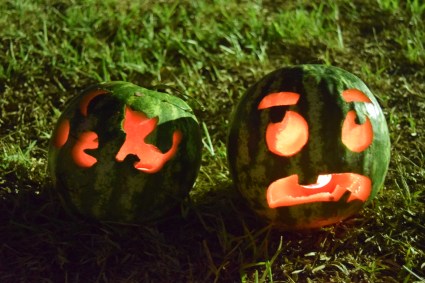
I do not always carve watermelons for Halloween, but when I do, my carving is awesome

I grew up in the US and had the usual holidays.  My mother used to sew our Halloween costumes.  She asked my sisters and I what we wanted to be several months before and then made it.  We trick or treating door to door in our neighborhood.  When I was younger, my aunt, and grandparents would come to our home for Thanksgiving dinner.  Once we realized we were not huge turkey fans we switched to our favorite: chicken schnitzel.  My mother made her own advent calendar and we made cookies and made crafts leading up to Christmas.

But there is a strangeness to moving frequently that challenges holiday traditions.  One never knows what will be available from one country to the next and what local customs may or may not exist.  We have to get creative.  Also, in the Foreign Service most of us head to a new post over the summer, and as we are struggling to settle in to new schools, new jobs, new homes, new routines, the holidays of autumn arrive.  One after another.

Prior to arriving in Lilongwe, C and I had already decided on her costume for Halloween.  She would either be Wonder Woman or a genie / belly dancer; one was packed in our UAB (unaccompanied baggage), arriving not long we we did, the other was ordered in August to arrive many weeks before the big day.  About a week before the holiday, the Embassy hosted a family-friendly snacks and happy hour with BYOP (Bring Your Own Pumpkin) for carving.  As the day approached I wracked my brain for where I might buy a pumpkin.  I vaguely recalled having seen something pumpkin-like at a supermarket.  But which one, I did not remember.  And, thinking back, the pumpkins had been white or green, but definitely not orange.  I asked around.  People were not sure.  An orange pumpkin seemed a tall order.  On the other hand, watermelons were in season and sold at regular spots alongside the road… Our first Halloween in Malawi also turned out to be my first time ever watermelon carving.  It turned out almost every had the same idea.  It also turned out that carving a watermelon is a little easier than carving a pumpkin, and the insides are more immediately consumable.

2. Holidays (1)

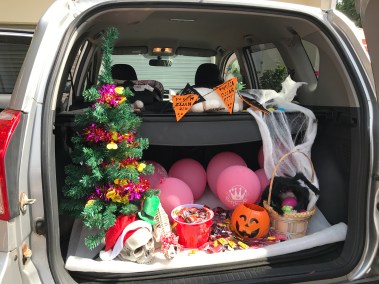
My “very confused holiday” trunk or treating decoration representing Halloween, Easter, Christmas, Birthdays, and Valentine’s.

The Embassy also arranged a little “trunk or treating” and party for the community.  I have now learned that other posts do this, but it was my first experience with it.  In Juarez there was trick or treating at the Consulate and in Shanghai residents of our apartment complex signed up with apartment management to give out candy.  In Malawi, we all live in free standing houses and although none of us live more than 15 minutes drive from another, we are somewhat spread out.  With trunk or treating, approximately 20 community members volunteered (me included!) to decorate the trunks of their vehicles.  The cost of admission for each trick or treater was a bag of candy.  Then bags of candy were distributed to each trunk decorator so there was plenty to go around.  Trunk decorators parked at the party location and kids trick or treated from trunk to trunk.  There was PLENTY of candy to go around, especially as kids could visit every vehicle in twenty minutes or less and then circle back around and do it all over again.  I had a few visitors come by about ten times!

Halloween in Malawi this year had an extra wrinkle.  Starting in September, rumors of supernatural “bloodsuckers” began in the southern part of the country.  Over the course of approximately two months, the rumors spread, accompanied by vigilante justice to capture, and even kill, those suspected of either being bloodsuckers or their associates.  While this may seem rather unbelievable–the rumors and the violent response–it was all too real and had a sobering effect on our work and celebrations.  The international school cancelled the costume dress up day; the Embassy cancelled an evening party; and I kept my scarier decorations in a box at home and came up with something else.

3. Holidays

Not my usual Thanksgiving tableau

For Thanksgiving C and I stayed in town.  There is just the two of us and I am not really much of a cook.  Certainly not Thanksgiving dinner kind of cooking.  You know, a meal that involves more than two dishes.  The Embassy Community Liaison Officer organized a event at a nearby lodge with a restaurant set by a pool and among gardens.  There, in 80 degree weather, approximately 20 of us met up for swimming and lounging poolside and a custom-made dinner.  The hotel staff did a pretty good job re-creating a traditional meal complete with turkey, mashed potatoes, green beans, and corn on the cob.  The corn unfortunately was too tough / too raw to eat, but everything else was quite good.

Then of course the Christmas season followed.  Unlike other places I have lived overseas, Malawi went full on Christmas-mode.  In late October I headed to the Shoprite supermarket at Gateway Mall for some grocery shopping.  There the entrance was decorated in all its holiday splendor – a Christmas tree, gigantic tinsel arches, large dangling ornaments, and even a huge silver bow.  Inside there were two aisles of plastic trees, tinsel, lights, tree topping stars, Santa and elf costumes, and loads of wrapping paper.  Wrapping gifts would be no problem. Getting them is a little bit more work.  In late October the Embassy mail room notified the Embassy community that in order to ensure delivery for Christmas orders would need to be received at the mail facility in Virginia by November 10!   Impromptu gift shopping can be tricky for many of us overseas. Not even a chance to use Black Friday deals for Christmas gifts.

4. Holidays

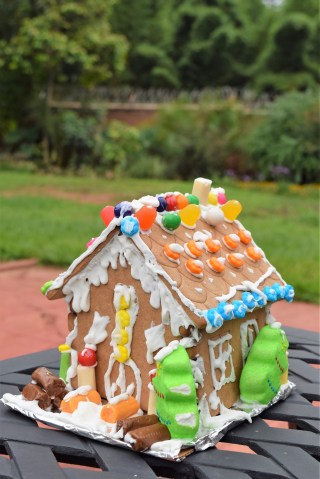
Gingerbread house in the subtropics

C and I headed back to the US in early December; I had training. The stores there too were chock full of Christmas.  As usual the back corner of Target was as if Santa’s workshop had exploded.  C wanted ALL the Christmas decorations.  In particular, she wanted a three foot tall light-up lawn unicorn.   I tried to explain that it would not fit in the suitcase.  And that the plug and voltage would not work in Malawi.  And finally, that in America people decorate their lawns for other people to see, but we had a high wall all the way around our house.  C said that without that unicorn it would be the WORST Christmas EVER! But she also desperately wanted a gingerbread house, so I bought one.  I put it in the suitcase, snug so that it would not get crushed, and transported it the two flights and 17 hours back to Lilongwe.  Not a piece broken. C said it would be the BEST Christmas EVER!

We missed the Embassy Christmas parties, but returned in time for our own Christmas celebrations. We made the gingerbread house.  We put up our tree and decorated it–C had insisted I trade in the small tree I bought in Shanghai for a larger one, so I had purchased a five foot fake in the US and brought in my household goods shipment.  I hung up our stockings, with two new stocking holders just bought at Target — great for those who have no idea if they will have a fireplace or anything resembling one as they regularly shift around the world.  And I began the my tradition of the weeks of gifts for C.  We also prepared gift baskets for the staff.  I know, I still feel weird saying–and writing–that I have staff.  But it is a reality for many in the Foreign Service and there is no reason to pretend otherwise.  I had initially not been sure what to include thinking I might get something special while back in the States.  But I learned that what most people want are the staples – rice, sugar, salt, cooking oil, biscuits for tea – because Christmas in Malawi is about food and family.  I really enjoyed buying the baskets and the contents and assembling them, though giving was most definitely the best part.  Because I spend so much time overseas and even when back in the US my family has opted for the past several Christmases to do a gift exchange, it had been a long time since I had given gifts to so many people.

5. Holidays

The Christmas baskets

Then we headed to Majete for Christmas.  New Year’s was a quiet affair for us.  We headed out again to Gateway Mall – the closest thing to come to a US-style mall in Lilongwe.  C rode a motorized animal and we goofed off in the equivalent of the dollar store.  At home we had ice cream and watched The Goonies.  C, snuggled up against me on the couch, dozed off long before midnight — probably a good thing because when 2018 rolled around it sounded as if the neighborhood was under attack.  I hugged her tight.  Our holidays here, and our first five months, were different, but pretty okay.

Majete for Christmas

20

A pool with a view

Our Christmas was not your usual snowy yuletide affair.  Though if I recall correctly, in the past twenty years I have spent only four in the U.S. and if given the choice I have a tendency to choose warmer climes over cold.  Still, I do not remember a Christmas quite like this – hot and humid, yes, been there and done that, but absent the African animals.

I knew being the new colleague on the block would likely mean a shorter holiday.  That I was prepared for.  The requirement to stay within Malawi though threw me for a loop.  Initially.

68

Hippo, waterbuck, and impala by the banks of the Shire

Then I realized this was a wonderful opportunity for C and I to spend some time exploring Malawi.  I settled on Majete Wildlife Reserve located in Chikwawa District, in the far south-west of the country.  Majete is a Malawian success story.  Though established in 1955, by the 1990s the refuge had been poached to nearly nothing, with large game completely gone from the area and only a few hardy animals present, though at critically low populations.    Things looked pretty bleak for the park until 1993 when African Parks, an international NGO focused on environmental conservation issues in Africa (they just appointed His Royal Highness Prince Harry as their President), working with the Government of Malawi, took over management and rehabilitation of the reserve.  Today the reserve and its animals are thriving with more animals to be relocated to Majete in the next few years.  It is currently the only place in Malawi where one can see the Big Five (elephant, cape buffalo, rhinoceros, lion, and leopard).

59

Baby yellow baboon

On Friday, December 22 C and boarded our flight from Lilongwe to Blantyre.  The 40 minute flight, just twice as long as our 20 minute drive from home to the airport, was probably the shortest flight my daughter has ever taken, one of our closest getaways.  C, who usually asks me how many planes we will take to our destination, was very amused that just about the time we reached our cruising altitude the pilot announced our impending landing.

At the airport we were met by a representative of Robin Pope Safaris—a big factor in visiting Majete was the opportunity to stay at their luxury lodge Mkulumadzi. We were driven the two hours from Blantyre to the reserve.  We traveled through the city of Blantyre, then up into the hills, finally over a hill into Chikwawa with a breathtaking view of the valley below with the Shire (pronounced Sheer-ray) River snaking through it; then down into the valley, across the Shire, through the provincial Chikwawa capital, and to the park entrance.

5

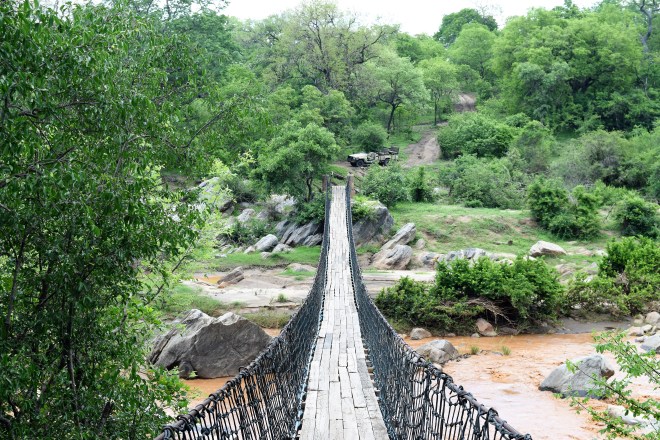
The bridge to Mkulumadzi

From the reserve entrance to the lodge we spot kudu, waterbuck, impala, nyala, three elephants, several warthog and baboon.  Then we arrived.  Well, not really.  We arrived at a parking lot.  From there guests of the lodge cross a suspension bridge over the Mkulumadzi river.  Once over we jump into a jeep for a short two minute ride to the lodge.  This would become routine.  Lodge to jeep, two minute ride, cross suspension bridge, board safari jeep.  Return and do it all again in reverse.

At the lodge we are greeted curbside lodge management.  A short walk down a path to the main building of the lodge and we are received with cold washcloths.  C does not know what to do with it but I am grateful.  The south of Malawi is warmer and our transport vehicle had no A/C.  I was hot and sweaty.   The kitchen prepared our lunch.  We took a dip in the pool.  At 3 PM the lodge served tea and at 4 PM we headed out on a game drive.  C and I were the only guests the first day, which meant we had the game drive to ourselves.  That was a very good thing as game drives are long.  In Zambia, the four hour drives were not only long for C but also for me, especially the afternoon drives that went two hours after sunset.  For our first Majete drive we were out only 2 1/2 hours but added hippopotami, crocodile, vervet monkeys, and dung beetles pushing a ball of dung across the road.

DSC_0948

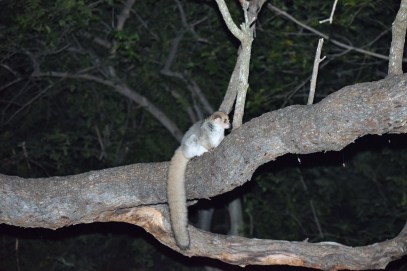
A friendly neighborhood bushbaby

Back at the lodge a bushbaby makes an appearance.  She is apparently a regular, showing up a few nights a week for some peanut butter.  I had never seen a bushbaby before, so this was a highlight.   We have dinner.  Afterwards it is 8 PM and time for bed.  The morning drives begin at 6 AM.  Because Malawi is so very, very dark at night, with so few lights.  Because we are staying in a reserve with even less light and our chalet is separate from the main building, and we are in a nature reserve with wild animals, we must be escorted at night.  Our guide has a flashlight but it barely penetrates the night, we can see only a few feet in front of us.  But it is enough light for me to see the scorpion cross our path.  Yikes!

Back in the chalet, the mosquito nets have been dropped around the bed and the tented wall lowered.  Our chalet is lovely.  It’s fancy and simple at the same time.  A large room with the bed placed at the center.  Sturdy walls on three sides, but the fourth is open to a deck that looks out to the Shire River.  From there we actually observe hippos in the river and hear their bellowing throughout the day and night.  We see both vervet monkey and baboons in the trees.  A family of warthogs walks by the deck.  In the bathroom the deep bathtub faces large windows; the shower too is open — though the only prying eyes that might see us are the animals.  There is no A/C but instead a cooling unit.  The whole vibe is relaxed and natural.

10

A view of our chalet

Except at night.  It is all too natural and thus a little bit less relaxed.  Large beetles buzz around bumping into furniture.  Moths, some really quite large, fly around the room.  And spiders.  A daddy long legs sits by a basket in the room.  He does not bother me so much.  A two inch rain spider scurries across the floor towards me.  There was definitely screaming involved.  The spider makes no noise.  After he is dispatched I find an inch long black one watching and waiting high above the sink as I brush my teeth.  C and I can hardly wait to get inside the mosquito net and turn off the lights.

The following morning we are up early, but not too early.  We are still the only guests and thus the game drive departs when we want to depart.  We slept with the tent side down, but with only the netting and thus as soon as the sun rose the beautiful morning light filtered into the chalet as did the sounds of nature – the rushing of the rain-swollen river, the chatter of insects, lizards, monkeys and birds, and the honks and sighs of the hippos.  As I stood out on the chalet deck a rustling in the underbrush revealed a family of six warthogs passing by.

18

C watches the warthog family from our deck

We headed out on the game drive at 7 AM instead of 6.  Maybe our late start was a factor, but we saw few animals.  The usual suspects – the impala, waterbuck, baboons, and warthogs – were out.  We also had the opportunity to briefly see some sable and two eland, the latter the largest antelope.  A massive male eland stood majestically in the middle of the road for a few long seconds before leaping into the brush, but I was not fast enough with my camera.  Later, we came across a male elephant taking a mud bath.  But C began to grow bored, demanding “new” animals.  I wondered about this – is my child so well traveled that she is already bored by safaris? “Ugh, it’s just and elephant, mom,” she says, accompanied by an eye roll.

Back at the lodge we enjoy our second breakfast and then retire to the chalet.  I read some while C plays with her toys.  I lie down for a nap.  C protests (she almost always seems affronted by the idea that mom might take a nap) but soon enough she is snoozing on the sofa.  It is hot and humid but the breeze and the tiredness that comes from keeping an eye out for animals on a long drive lull us to a delicious sleep.  We have a late lunch — its served when the guest wants anytime between noon and 2 — around 1:30.  We are dining when the much anticipated family with two kids arrive.  As soon as C had heard of their arrival the day before she had been eagerly looking forward to meeting them.  They did not disappoint.

64

Shire river bend and lush rainy season foliage

A note here.  The lodge is really quite the get away.  It turned out they had no television, no wifi, no telephone signals.  I suspected there would be no television, but the lack of wifi was a bit of a surprise.  When our on game drives the adults are not only looking for the rare animals but with phones in hand are trying to catch the elusive wifi signal.  Here we were already the second day, with two and a half days still stretching ahead of us, and I wondered how we would survive.  Well I had brought my Kindle and my journal.  For C I had two books, presents from her grandparents she opened our first day, and she also brought her new Lion Guard set of characters.  Also, game driving can be tiring.  There was a pool.  And the lodge also had a number of board games, a few toys, and paper and colored pencils.  Still, I thought I might I have booked one day/night combo too many.

45

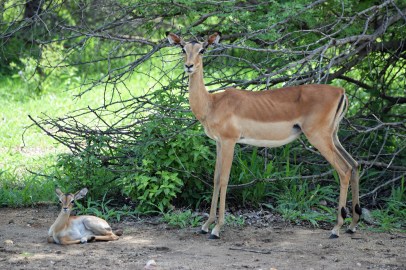
Mom and baby impala

The family, two sisters with two children aged 4 and 9 (C is almost 6), joined us for the afternoon drive.  Again, a good combination as we could (and did) decide to head back a bit earlier as the kids flagged in energy and enthusiasm.  C was thrilled to have other children along.  We saw only one new animal, the bushbuck, but otherwise the same cast of characters: impala, nyala, waterbuck, warthogs, baboons, and hippos.  Though almost all of them had babies in tow as it is early summer.  Yet, I am somewhat embarrassed to admit, I too was growing tired of not spotting new animals.  But the weather was good, the skies, blue, the air fresh, and we were in a national park in Africa.  Not too shabby.

Our third day, another game drive.  Another two minute ride in the jeep.  Another walk across the suspension bridge.  We drive for long intervals, sometimes for as much as 20 minutes, without seeing a single animal.  But we stop for a morning tea break at a viewpoint overlooking a bend in the Shire, the longest river in Malawi.  It’s 402 kilometers long from Lake Malawi until it flows into the Zambezi.  The greenery and blue tinged hills in the distance set off the brown fast flowing river gorged with rain; it’s beautiful.

It is Christmas Eve and we are slated for a river safari in the afternoon, but instead it pours rain heavily for hours.  We nap again and it is refreshing.  That day I do not mind.  But Christmas Day is the same: a game drive in the morning with few animals and an afternoon downpour that scuttles the planned river safari.  I have a harder time shaking it off on Christmas.  Though I am not used to Christmases with friends and family, we are away from home, disconnected, and I feel a sense of melancholy.  But the lodge puts together a lovely Christmas buffet lunch and includes small gifts for the kids.  C happily draws pictures and plays.  In late afternoon, as I return from fetching something from the chalet, the rains having finally moved on, I look up to see an incredibly beautiful late afternoon light in the sky and a rainbow.  I am restored.

89

Elephants along the Shire

On our final morning we do manage at last to take the river safari.  The river is high and swift.  We see some fishing birds along the shore hunting, hippos lying low and dangerous in the water, and a family of elephants enjoying a gathering on the banks.  We see the Kapichira hydropower station.  It was here, at Kapichira Falls, where Dr. David Livingstone’s 1859 expedition halted, being unable to continue further up the Shire.  And now there is the hydropower station, which is significant for Malawi as the country generates at least 90% of its electricity from hydropower.

Back at the lodge we have lunch and then it is time to begin the two hour drive back to Blantyre and the flight to Lilongwe.  Despite the day before wanting desperately to be home, I feel now a little tug to stay.  It was a great getaway for C and I; I hope one she will remember well.


Golden Triangle Travel 2002-2003 Part Seven: Final Days–A Buddha in Spectacles and a Golden Rock

dsc_0830

JJ and I took the bus to Pyay to break up our journey to Rangoon.   The bus was scheduled to arrive at 1 AM, but schedules in Burma mean nothing.  We arrived at 2:30 AM instead.  We were the only people to get out of the bus, i.e. the only people insane enough to arrive somewhere in Burma r at 2:30 AMWe were immediately set on like a pack of wolves by a group of late night trishaw drivers who wanted to compete for our business.

Although the trishaw drivers were plenty, the available rooms in town were not.  We were taken to guesthouse after guesthouse, but each one was full.  Though initially fun to speed around a never-before-visited Burmese town in a trishaw in the middle of the night, after an hour I began to lose some of my joie de vivre.  Two proprietresses sitting out front sadly informed us they too were full.  Then the two women talked amongst themselves and offered me a cot in in the lobby.  I took the cot and JJ headed back to the first guesthouse where there had been only one bed.  Around 7:30 AM one of the women woke me up and told me I could move to a room.  I groggily gathered my things, moved to the room, and fell back to sleep.  Unfortunately, not for long.  A local Buddhist group was doing a donation drive; their loudspeaker droned directly across the roundabout and from that time onwards I heard only the sounds of garbled pleas for money interspersed with scratchy Buddhist music.  It was awful.  I nearly lost my mind!  At 9 AM I got up with very little sleep to my credit.

At breakfast I met two other female travelers planning a share taxi tour of Pyay.  JJ arrived from his guesthouse and we all made plans to sightsee together.  We first went to see the Buddha with spectacles, reportedly the only of its kind.  At the site a guide told us this story:  Once upon a time there was a ruler of ancient Burma who had the gift of second sight.  He could tell the future and help people by doing this.  One day he lost his gift and did not know what to do.  Some monks meditated on his problem and told him the solution would be to donate a pair of spectacles to the local Buddha statue.  Thus, a huge pair of eyeglasses were fashioned for the Buddha. Once placed before the Buddha’s eyes, the king’s gift returned.  After some time, his wife had difficulty with her vision so an extra pair of spectacles were made and placed in the Buddha’s hand. Afterwards the queen’s eyesight too was restored.

We visited two more stupas, some of the oldest in Burma, but my lack of sleep adversely affected my interest.  Perhaps I was a wee bit “stupa-d” out.  There are only so many stupas one can see in a short span of time and retain one’s enthusiasm.  Afterwards, then suffering from a pounding headache, I had the taxi drop me near the hotel so I could walk back to the guesthouse while the others continued on to yet another stupaAlong the way saw numerous sidewalk plaques prescribing how people should behave in certain filial situations.  Here are two that even in my exhausted headache-y stupor I found amusing:

Duties of a Wife to Her Husband

  1. To perform her duties in perfect order
  2. To protect his possessions
  3. Not to be unfaithful
  4. To be hospitable to the people of the neighborhood
  5. To be industrious and not be lazy in discharging her duties

Duties of a Husband to His Wife

  1. By courtesy
  2. By handing over due authority to her
  3. By faithfulness
  4. By providing her with ornaments
  5. By not despising her
DSC_0840

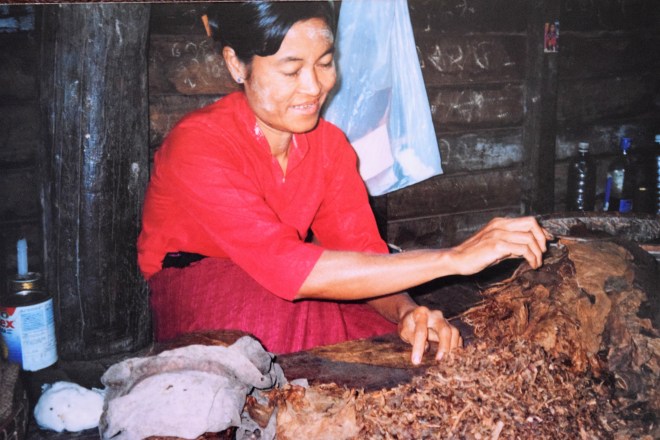
Woman cigar roller in Bago

I was unable to sleep the rest of the day though as the madman and his megaphone continued.  At 10 PM I headed to the bus station.  Though JJ and I parted ways here in Pyay, our adventures in Mandalay, Bagan, and Pyay were only the beginning of a friendship.  My next destination would be Bago, but without a direct bus from Pyay I had to change buses in Rangoon.  Surprisingly, the bus not only left Pyay on time, but also arrived in Rangoon early.  Unfortunately, it was 3:30 in the morning.  The taxi drivers all tried to convince me that there were no buses to Bago I was surprised the bus left just about on time, and even more amazing is that it arrived EARLY in Yangon, at 3:30 am!  It was a challenge arriving at an unknown bus station in the middle of the night.  There were others around, but few women. The taxi drivers told me there were no buses to Bago.  I had to pee badly but the toilet was locked tight, so I had to sneak off to relieve myself in a dark alley.  And a ticket seller ripped me off for the price, pocketing the extra 200 kyat right in front of me as he and his friends laughed.  It was a long 2 ½ hours waiting for the bus.

I slept hugging my backpack, but still arrived tired in Bago.  After a nap, I hired Mani, a nice Indian trishaw driver with a cheerful disposition and good English.  He was very good because he kept me from paying the overpriced foreign tourist fee to the sights.  He took me to back entrances, told me the tricks, and I had a good time.  I visited two pagodas and a sleeping Buddha statue, and a cigar factory.  I liked the cigar factory best.  In a house along the main road is a family owned and operated cigar factory.  This was not the traditional Burmese cheroot cigar wrapped in green leaves, but an honest to goodness cigar.  The women were doing all the work.  In the front room men sat playing Playstation, talking, laughing, and smoking, while in the back room the women sat amongst the dried leaves and rolled the cigars, eight hours a day, seven days a week.  I chatted with them with Mani as my translator; they were very friendly and cheerful, despite the work.

dsc_0828

Mani and I

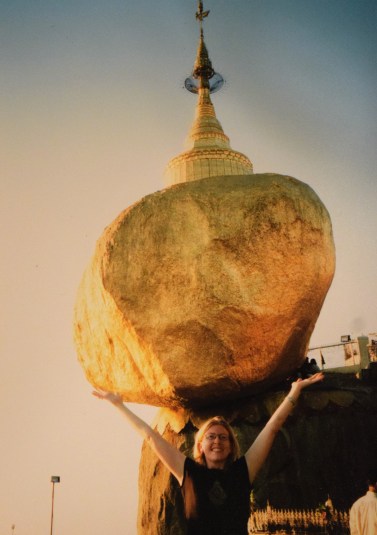
My plan had to continue on the next day but I was feeling worse.  Mani helped me get some medicine and given I had only a few weeks before recovered from the mumps, I made the decision to take a rest day.  From Bago I took the four-hour bus ride to Kyaiktiyo.  Kyaiktiyo is one of the three most holy Buddhist sites in Burma along with Shwedagon and Mahamuni in Mandalay.  The Kyaiktiyo stupa is small, only 24 feet high, but perched on top of a rock covered in gold leaf, balanced precariously on the edge of a cliff on a high hill.  It had only recently been opened to foreign tourists.

I met Chris, a Belgian-Filipino, at a restaurant in Kyaiktiyo town.  We had met two days before in Bago; he had snapped the picture of Mani and I.  We had lunch together and then made plans to head to the Golden Rock.  We waited a full 30 minutes for the truck to the stupa to fill.  The truck resembled a dump truck with benches in the back, but by the time it took off it was jammed full with some 50 people.  The drive was like a roller coaster.  The driver seemed to love fast driving.  We would fly over a small hill and then swoop down, and all of us in the back would be temporarily.  It was certainly a thrilling 30 minute ride.  By the time we reached the parking lot it was after 4 PM.  There was a 40-minute climb ahead of us.  We would have to haul ass up the hill, see the Golden Rock, snap a few pictures, then hightail it back down to meet the last truck back to town at 6 PM.

I had been feeling unwell since Bagan and the climb was steep.  My legs were okay, but I was sweating like a stuck pig, my mouth gaping open and closed like a fish out of water, and my heart was pounding.  Four palanquin carriers spotted me — I must have looked like their favorite victim.  They hurried over with their stretcher-like chair and began walking alongside me.  As I huffed and puffed my way up the road, one of them whispered to me “Ah, so hard, so very, very far.  $4” and pointed to the palanquin.  I managed to decline between gulps of air.  They walked in step with me.  After another twist in the road, they started again.  “Oh, long, long, long way.  Very hard.  You are very tired, $3.”  I was sure I was moments from collapse, but I was not going to give in.  No, I said and continued to trudge up the hill in slow motion.  After a few more turns they tried once more.  “Oh, you so tired.  So hard, so long way.  Much higher, much further, $2.”  I could not take it anymore, agreed, and threw myself on the palanquin.  As they lifted it up they proclaimed “Oh so heavy!”  I shot them a dirty look.    They carried me up a short way and complained that they needed to rest.  They stopped a few minutes later and asked me to buy them drinks.  I refused. They carried me 5-10 minutes more and told me it was the end of the line.  What?! I was just minutes from redemption, from making it on my own, and now I had to pay these clowns?  Then they tried to ask for $2 EACH.  I handed over 500 kyat (50 cents) to each carrier and walked away.

Fifteen minutes later we were at the rock and had a glorious view of green covered hills and the river beyond.  There is much more up there than just the golden rock–many smaller shrines, statues of Buddha, figures of Nats, and the like.  I wanted to touch the rock but unfortunately it turned out women are not allowed, and guards were posted at the staircase to the rock to keep women out.  This did not sit well with me.   

dsc_0824

As close as I could get to touching the Golden Rock

Once again transport became an issue – I find it somewhat incredible as I near the end of retelling my story from all these years ago how much the transport – the buses, boats (missed and taken), trishaws, palanquin, etcetera – are more central to this trip than the temples and historic buildings and other sites.  It really is more about the journey than the destination.  The return from the Golden Rock to Kyaiktiyo town involved trickery and a standoff.  We chanced staying at the top for sunset knowing the final truck back left at 6 PM.  In full sight of the waiting truck we grabbed a snack but it left without us and we then had to negotiate a return with whatever transport remained.  There was some hard bargaining and threats (to us, not to them) but we finally agreed on four FECs.  But it was not over as the drivers – because of course it was a group and not an individual – tried to get the money several times on the way back but we held our ground until they returned us to our guesthouses.  Exhausted I said farewell to Chris and went to sleep.  The next day a six-hour bus ride returned me to Rangoon, where I spent one more night at the Mahabadoola Guesthouse before returning to Singapore.

My seven-week journey to Northern Thailand, Laos, and Burma was at an end.  I had survived the mumps and a stomach bug, a two-day slow boat down the Mekong, and many, many long bus rides of varying quality.  Yes, it was very trying at times and difficult to be out of touch for so many weeks (at the time Burma had no Internet), but I saw some extraordinary places and met some interesting people.  All in all, it was an amazing adventure.  Looking back now, fifteen years later, I do wonder at the woman who took off on this journey.  After contracting the mumps, she did not throw in the towel but kept on traveling and she did the trip on her own.  She really had some chutzpah.

Golden Triangle Travel 2002-2003 Part Six: Bicycles in Bagan

My cheap backpacker self liked the idea of an overnight bus because I could make some distance and save on accommodation.  Unfortunately, as my sojourn in Burma continued the quality of the buses declined as did the quality of my sleep.  I arrived in Bagan, one of Southeast Asia’s great historic cities, yet my primary motivation was to take a nap.  To fight my desire for sleep I went in search of a bicycle for rent.

dsc_0834
Balloons over Bagan

I rode off jerkily.  Oh, it was slow going.  It had been ages since I had been on a bicycle.  Old Burmese men smoking cigarettes cycled speedily past me.  Yet after just a few minutes I began to happily enjoy the ride.  Over a small crest the first of the Bagan temples came into sight and it was breathtaking.  I went down a side road toward the temple.  The day was lovely and the sun was high, and against the blue sky the hundreds of brick temples stood out in the dry yellow grass fields.  At the first temple I bought a painting for myself.  Most of the paintings were copies of carvings in the temples or other Buddhist texts, but the one I bought was in the artist’s words “from his own mind.”  Let’s just say, I liked the way he thought.

DSC_0857

Bagan Temple Painting

I met one of the Korean students from the cargo bus – he and his friends are students at a Pusan language university studying Burmese.  He invited me to join them riding and sightseeing.  We rode and visited a few temples together until my lack of sleep catching up with me.  I went into a tourist office to ask for some information, though the men had no idea how to answer my question, they invited me to sit down and have tea with them.  We talked for a while and then I began to ride back Nyang Oo, where I was staying.  The cooling breeze, the mid-afternoon sun and the lovely ride invigorated me so decided to ride down to the ferry point and find out about the ferry to Pyay.  Since I had missed the opportunity to take the boat from Mandalay, I thought I could then take the boat down river to Pyay.  I learned the boat left in two days’ time but the journey would take three days, which sounded rather long.  I would need to buy food, but also a blanket.  I was starting to feel a bit under the weather, and worried about the chill sleeping on the deck. Yet it was December 30 and my intel told me there were no buses south from Bagan until January 6.  I went home to sleep on it. 

I did not sleep well–and thus the decision was made, I would leave Bagan by bus.  The night had been cold and though I had a blanket and wore a lot of clothes, it was not enough.  I had a lie in then spent half the day exploring Bagan on bicycle.  Many of the temples in Bagan cannot be climbed for preservation efforts, but I could climb the largest.  Towards the east there is a lovely view of the river, and to the west a stunning view of the plains filled with other temples, large and small.  I sat there for some time.  I ran into JJ, my friend from Mandalay.  We sat and talked for a while, then watched three hot air balloons float over the ancient city of Bagan. 

dsc_0831It was New Year’s Eve.  JJ and I had dinner and watched a Burmese traditional marionette show.  The puppets are wonderfully crafted and the puppeteer incredibly manipulates the marionettes to appear lifelike.  After dinner and the show, I returned to guesthouse and went to sleep.  I figured it was midnight somewhere in the world. 

The following day I sat out on the bench in front of the hotel waiting for JJ.  I was writing in my journal and watching life go by on the street.  There was a race with most of the runners barefoot.  Then nuns came to collect alms.  I had seen a nun here and there in Burma, but not more than one or two at a time.  There are many, many monks, but not as many nuns.  This time there were perhaps 20 walking single file.  I thought of the differences I had seen between the young monks and young nuns.  The nuns wear pink or orange robes, and shave their heads, but I am told mostly orphan girls become nuns.  Monks on the other hand are not without families.  Families receive lots of merit if their son becomes a novice monk, even if he does it for just a month or two during the school holidays.  I saw monks receiving alms on many occasions and often it was hot, cooked food.  Yet the nuns were receiving uncooked rice.

I spent a day just relaxing with medicine and a book.  Then another day JJ and I arranged a share taxi with two Japanese to visit Mount Popa, about 90 minutes from Bagan.  Mount Popa is something akin to the Mount Olympus of Burma, the supposed home of the country’s nats, the Burmese animist spirits.  Mount Popa reminded me of the monasteries perched on huge limestone rocks in northern Greece.  From afar the temple on Mount Popa seemed inaccessible; the rock stands out from the plains.  To climb one has to remove their shoes and walk up 777 steps.  Once up there I found the temple to be a bit ordinary, not what I would expect of the abode of gods, but the view was quite nice.  It was terribly windy at the top and my ears turned red and my hair blew about me like mad.  I stayed up there only about 30 minutes, though it turned out I was the last of our group to descend.

DSC_0847
Young nuns asking for alms

On the last half day in Bagan, JJ and I hired a horse cart to take us to some of the less accessible ruins.  Off we went to see the ruins.  In my opinion these were the most impressive in Bagan. Maybe because there were fewer tourists and they were off the beaten track, but the carvings on the outside and paintings on the inside of these stupas were more intact than in the others I had seen. They were also on a slight hill which gave a fabulous view of all the temples large and small down to the river.  There was even part of what was a city wall intact along the road, which I had not expected at all.  The last temple we visited was quite large and unlike any of the others as it had been renovated and the grounds landscaped.  It also had a large gold stupa on the top.  It afforded wonderful views of the surrounding temples as well. 

There I am in one of the most historical and cultural sites of Burma and Southeast Asia.   Yet, have only vague memories of the temples and atmosphere.  I know I loved my time in Bagan; riding a bicycle down dusty, dirt pathways, seeing stupas rising out of the plain; hot air balloons picturesquely floating across the sky.  I spent a lot of time thinking, sometimes sitting among the temples, other times in the guesthouse or in restaurants.  But my diary focused on the upcoming new year; my email stories focused on the tedious, though often hilarious (in retrospect) hiccups of traveling – such as the struggles to get a decent shower, a decent night sleep, or to change money.

dsc_0839

Mount Popa

Before setting off on our final Bagan adventure, JJ wanted to exchange traveler’s checks. He was down to only enough money to pay the driver of our horse cart, but without money to pay his hotel bill. There is only one bank in Bagan.  We asked the driver to stop on the way to the ruins, but the driver informed us the bank was closed because of the holiday.  Therefore, after the ruins we planned to head to the city of New Bagan, in hopes they would have an open bank.  In New Bagan we tried first with the employees at an airline office, who offered us no help.  Then to a tourist information center, who reluctantly agree, but at 20% commission.  We found another exchange shop, but they too were closed.  A man at the shop next door said his brother-in-law might exchange the check.  The first man closed up his shop and joined us in the horse cart to direct the driver to his brother-in-law’s shop.  Ten minutes later we arrive and observe a negotiation in Burmese.  The end result though is that they will exchange with only a “small commission” of 25%.  Back at JJ’s guesthouse he tells the manager he cannot pay the bill because the bank is closed.  She says, of course it is open, but only until 2 PM.  The clock reads 1:45 PM (our bus to Pyay is to pick us up at 3 PM).   The manager tells JJ her friend will drive us to the bank– we drive like maniacs through the crowded streets, horn blowing, to the bank.  But it IS closed.  The driver parks anyway and honks the horn.  Turns out the bank manager lives in the house behind the bank.  He comes out and there is much discussion, but the manager refuses the change the traveler’s checks.  JJ is still without money.  But there is still a happy ending to the story.  A friend of JJ’s guesthouse manager is a long-distance taxi driver from Rangoon.  He agrees to loan JJ 75 FECs to pay his hotel bill and other expenses until he arrives in Rangoon.  The taxi driver hangs on to the unsigned traveler checks.  JJ will meet him in Rangoon, exchange the checks, and pay the man back. Only in Burma.


Golden Triangle Travel 2002-2003 Part Five: Ancient Cities and Moustaches

My second day in Mandalay started off a little wobbly with an unfortunate deal with some other travelers.  Backpackers can be collegial or cutthroat and unfortunately this couple I met fell somewhat in the latter camp.  They approached me in the guesthouse lobby with an opportunity to join them for a day of sightseeing of Ancient Cities and gave me a few minutes to decide.  I made a snap decision to do so.  Despite how things turned out with them, I did end up meeting another traveler as a result, who I remain in contact with to this day.

dsc_0822

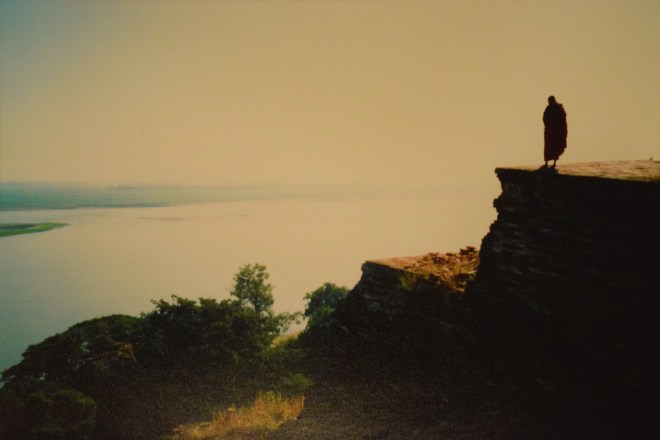
Monk looks across the Irrawaddy from Mingun

I agreed to accompany an Austrian couple to the four ancient cities around MandalayAt first I thought I misunderstood, four in one day, but that was their intention.   They had already hired a car and driver for the day for $10 and clearly wanted to defray the costs.  Once our car arrived at a boat landing point ten minutes away though, I saw the flaw in their plan.  To visit Mingun, the first city, one needed to take a boat and arrive at the boat landing 30 minutes before the 9 AM departure.  Thus they had hired a driver to drive them 10 minutes and then wait for them for about 5 hours. I tried to strike up a conversation with them but they only seemed interested in talking with each other.  They did not speak to me the 30-minute boat ride.   Once at Mingun they took off.   

I actually made an effort to find that Austrian couple again.  I went back early to the boat landing, lunching at a restaurant with a view of the road.  Then I stopped at a café at the boat landing, again with a view.  That is where I met JJ, we struck up a conversation.  Back to Mandalay on the boat and I waited again for the couple on the other side.  Never saw them.  I gave up.  More than half the day was over and they had planned to visit three more ancient cities; I admit I did not really want to find them.  Later that evening they actually cornered me at the guesthouse and claimed they saw me get into the “wrong” boat and demanded I pay them the extra dollar the driver charged them for me.  I handed it over and was grateful I dodged spending the day with them.

dsc_0821

The Moustache Brothers

That evening I went to see the Moustache brothers – Par Par Lay, Lu Maw and Lu Zaw.  They are a famous comedy troupe; two of the three brothers (one actually a cousin) were jailed due to a political joke at an Aung San Suu Kyi rally.  One received a sentence of five years, the other two years.  Because of this danger of being jailed, the comedy and dance routines are now done strictly with family members.  I arrived early and could talk with the brothers, get their autographs, and take their pictures.  Par Par Lay, the main comedian, asked an Australian couple for the correct term for being watched by security men and they told him “under surveillance.”  Throughout the whole show he kept saying “…Because the Moustache Brothers are under surveillance” in a false whisper.  Most of the routine was a one-man monologue about the problems in Burma couched in comedic terms and alternated with dance and Burmese traditional costume modeling by his wife and sister.  He noted security forces watched the house and joked his father was outside ready to make the agreed upon signal if those forces closed in.  He talked about the conditions of the roads (“See how nice the roads are after a government official comes to visit.” Or “Notice the road in front of our house is in such bad repair compared to the ones nearby”), about price changes (last year the price of a kilo of rice was 1000 kyat, now it is 3000 kyat), about the vagaries of Burmese currency (he handed out now worthless 75 kyat notes), and so on.

DSC_0834

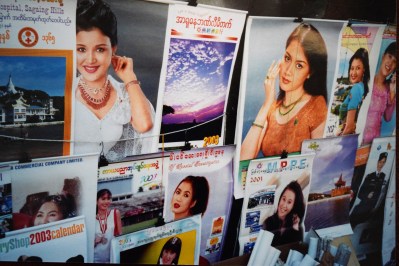
Burmese calendars on Mandalay roadside

It was a good show and one of the most enlightening and memorable activities of my visit to Burma.  Naturally much of my three weeks was shaped by the tourist lens.   On only a few occasions did I have glimpses of a dark side – at least once, in the early morning hours as a bus slowed through a construction area, I saw small children carrying large rocks, what appeared to be manual child labor.   Seeing the Moustache Brothers – though also aimed at tourists as it would be too dangerous for locals – gave the trip greater context.  Linking my socio-historical background with current events.  Years later when I read of the death of Par Par Lay I was easily transported back to the one night I had an opportunity to meet him.

On the way back from the Moustache Brothers I came upon a performance of traditional Pwe theater.  It was amazing how many people sat and stood around to watch this.  I remember reading about how when the British colonized Burma, they thought the Burmese people were lazy because they spent much of their extra money on merit earning (building small shrines, donations to temples and the like) and spent time watching these Pwe performances.  I am glad the Burmese are such resilient people to have withstood years of colonial rule and the current government. 

DSC_0854

Nat shrine at trishaw driver’s home

I had planned to travel from Mandalay to Bagan on the Irrawaddy River boat – true Road to Mandalay (in reverse) but because of the holidays the boat was full.  Instead I would take the night bus, saving on accommodation and a day’s travel.  Thus, I had another day in Mandalay.  My trishaw driver invited me over to his house for a midday meal.  His mother and sister were very gracious, and many of the neighborhood children came over the stare and laugh with (at?) the strange foreigner.  After lunch, my trishaw driver I went in search of a bus to take me to Ava and Amarapura, two of ancient cities.  The bus turned out to be a wild goose chase, either it did not exist or I was not meant to find it.  So, I rented the taxi of a friend of the trishaw driver, and together we set off to see these towns.

I did not care so much for Ava.  The ruins were not as impressive as the ones at Inle and seeing them involved a fair amount of extra work.  I had to pay for a ferry boat to take us across the river, and then rent a horse and cart to take us around.  The cart ride was nice enough and I would have preferred to have just stayed in the cart then to get out at each stop.  The aggressive souvenir selling, with children running full speed behind the horse carts, was tiring and ultimately depressing.  But at Amarapura things were better again.  There was a monastery, but also a beautiful teak bridge – the longest and oldest such bridge in the world.  I regret I did not have more time there; the Moustache Brothers and Amarapura were the best parts about Mandalay. 

dsc_0840

Sunset from the Amarapura teak bridge

I returned to Mandalay to pick up my backpack and catch the 9 pm cargo bus to Bagan.  Once again, the departure time came and went, and still they were loading cargo.  The space under every seat and the entire aisle was filled with cargo.  This worked in my favor because I could place my head on the tarp covered rice bags and sleep.  A group of Korean students sitting in the back of the bus did not fare so well—next to them a broken window blew in cold air all night and the sacks loaded in the back were full of garlic. I slept fairly well though the ride was not without incident.  I woke up when our tire blew out, then again when we stopped for the bus personnel to look at the tire, and again when we stopped at an open-all-night roadside mechanic.  We were to arrive at Bagan at 5 am.  By 7:30 we were still cruising along the road without any indication of how much further we had to go.  We then began to pick up more passengers.  Anyone who flagged down the bus was welcome.  When we started in Mandalay there were about 25 passengers, lots of empty seats.  By the time we pulled into Bagan at 9, four hours late, every seat and every space available on top of the cargo-lined aisle was filled.  I was glad to arrive in Bagan and settle in to the Lucky Seven Guesthouse for a nap.


Golden Triangle Travel 2002-2003 Part Four: Leg Rowers and the Road to Mandalay

dsc_0818

Fisherman on Lake Inle

There is something to be said about endurance and learning what you can really put up with.  In Laos I spent 6-7 hours sitting on a wooden plank in a cramped boat for two days and 6-9 hours on some long, uncomfortable bus rides.  Burma would take it to a new and different level.  On 23 December (2002) I took a bus from Rangoon to Taunggi, near Lake InleThe bus was to leave at noon and take 18 hours.  We only departed 45 minutes late but arrived the next day 23 hours after departure.  To tell the truth it wasn’t all that bad.  It wasn’t Laos-bus-journey-bad.  First, this was a super plush deluxe coach bus.  We had reclining seat!. Second, the other passengers seemed more used to travel, no need for all the sickness bags.  Third, the music.  Burmese music is rather pleasant.  Probably because most of the hits played were actually Western songs with Burmese lyrics!!  The first time I heard a few bars of a well-known English song, I opened my mouth to sing quietly along, only to hear Burmese instead.  I heard pirated songs of Celine Dion, Craig David, The Coors, Shania Twain, The Eagles, Marc Antony, and more.  I could not sing along, but I could hum along, and it made the trip easier somehow.  Fourth, they also played movies; two in Burmese and two in English!  I was really surprised about the English movies yet happy to watch them, though we were not cinematic masterpieces (one was about a dog from outer space).  Still, many hours after the scheduled arrival time, I started to worry I had missed my stop.  It would not be the first time.  Luckily, at a rest stop an English-speaking fellow passenger told me I had one stop to go.   Finally, I was dropped at the intersection to Lake Inle where I caught a taxi on to Nyaung Shwe.

Let me be clear: I am not a foodie.  I have lived overseas the majority of my adult life and traveled to over approximately 100 countries.  I have come a long way in the food department from my childhood, but I am still not an adventurous eater.  Thus finding good Western food in unexpected places is a pleasure, particularly when on the road for longer periods.  I spent the first day only exploring Nyaung Shwe, recuperating from the bus ride.  I check into my guesthouse – a bargain at $3 a night because the in-room bathroom did not work.  To take a shower I only had to walk down the hall, into the courtyard, up a flight a stairs, and down another corridor.  In my towel.  Magical.  The guesthouse also had a restaurant with items like pasta, pizza, and hamburgers on the menu.  I am impressed.  Till I tried to order.  I point to the burger, but the man informs me they do not actually have that.  I point to the pizza.  Sorry, he says, do not have.  He tells me, “no price, no available.”  I then notice that everything on the menu has no price except for omelets.  I go next door where unbelievably there is a small restaurant with freshly made pasta – made by a Burmese taught by an Italian chef from Bologna.

dsc_0819

My leg rowing guide on the canal

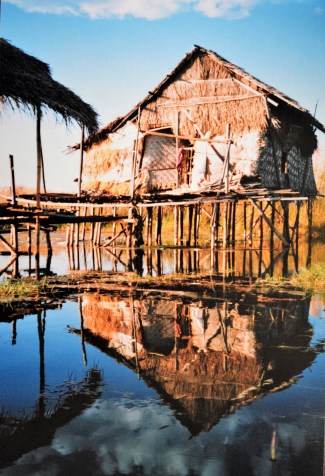
On my second day I spend the morning chatting with fellow travelers and am rewarded with a not-yet-expired Inle Lake Tourism (i.e. foreigners) Region Entrance Fee Ticket.  It saves me US$3, which is a night’s hotel.  In the afternoon, I arranged for a canal tour.  It was a wonderful trip on the most beautiful day.  The sky was blue and the water is so incredibly clear that one could look down and see the thick grass and water lilies just below the surface.  Due to this thick grass Inle Lake is famous for its leg rowers.  In order to navigate around especially thick clumps of submerged grass, the rower benefits from standing, and uses his legs to continue rowing from a standing position.  I have the most wonderful picture of my very photogenic rower standing on the back of the canoe, with a gorgeous blue sky complete with perfect cottony white clouds in the sky and reflected in the water.  All the houses are built on stilts and are also beautifully reflected in the water in a near perfect mirror image.

A Singaporean traveler and I rent a boat on my third day to travel to the village in the middle of the lake.  From Nyaung Shwe the journey took thirty minutes–leg rowers, fishermen, and grass collectors along the way.  We first visit a weaving center and then head to the ruins at Indein.  There were so many small wiry stupas here seemingly forgotten by time, and the government.  There were few tourists.  In fact there were many more souvenir sellers than souvenir buyers.  Several of the carvings were quite intact and reminded me of those at Angkor Wat, the shapely Apsaras dancing next to entrances to the temples.

DSC_0844In the center of the lake there was also a floating market (otherwise known as the floating tourist trap – one can’t just walk away, especially when the souvenir sellers surround your boat), a floating garden and a Buddhist Temple.  The most amusing place by far was the Temple of the Jumping Cats.  This is not the actual name of course, but it has become known by this for the monks have trained the stray cats at the temple to jump through hoops!!! Neither the monks nor the cats seem to particularly like or dislike this.  Visitors arrive and see a couple of monks lounging lazily in chairs and beneath them their protégés, the talented cats snoozing away.  After enough people arrive, a monk reluctantly gets up and claps his hands and says “okay” unenthusiastically.  He grabs a bag of dried fish, throws it on the floor and then prods a few cats awake.  For those cats not willing to get up, he snatches them up and drops them in the center of the visitors and the dried fish.  Then he pulls out a hoop and one by one grabs a cat and places him on the floor, then prods it.  The cat looks up at the hoop, wiggles its behind and effortlessly leaps through the hoop and then slowly crawls back towards some dried fish.  After most of the cats had performed this feat, the monk just says it is over and goes back to his deck chair.  What an unusual monastery- but given the number of tourists who handed over money to see this spectacular stage show, they are also really smart.

DSC_0853

Cats jump through hoops to entertain

By 7:30 PM that night I was again on a bus, taking the Road to Mandalay.  Although shorter, this ride was not as pleasant as the last.  The seats were closer together and my knees we rammed up against the seat in front of me.  A chilly draft keeping me from being warm; there was a terribly-acted Hong Kong film on the screen.  The trip took 11 hours to reach Mandalay, though it was supposed to take eight.  We arrived early in the morning; the bus station was full of novice monks asking for alms.  As I realized that they wanted to collect their meals for the day I started to unload the extra food I had (Tin Tun had provided me too much): pears, plums, cashew nuts and pumpkin seeds.  Another American gave one lucky novice a can of sardines and he scampered away extremely happy.

A long tuk-tuk ride into town brought me to another guesthouse, another $3 room. This was a room just for me.  With a bathroom, with working water—even hot water for showers! It also had a tv, with one channel that came in maybe once a day, and included a wonderful breakfast of watermelon, pineapple, toast, jam, tea or coffee, and a cooked-to-order egg.  Despite these spenders, the overnight bus has been less restful than I had hoped.  Before lying down to nap I went to ask the front desk something.  Once downstairs I noticed that my key ring did not have a key.  It must have fallen off.  A group of boys, I guess hotel assistants, went up to my room with a bag of keys, none of which was labelled, and tried one after another after another on my room.  Half an hour later they were still working from the pile of keys on the floor… 

DSC_0855

Temple in Mandalay

It is perhaps little surprise that this beginning did not bode well for a first day in Mandalay.  I needed to buy film (it was 2002 after all) and also needed to change money.  The hotel and nearby hotels were either offering terrible rates or not changing money at all.  Not surprisingly of course a helpful individual presented himself and led me to an Air Mandalay office with a decent exchange rate.  He turned out to have a trishaw and a handsome 24-year-old son, named Gypsy, who would be perfect to take me around sightseeing.  Gypsy showed up on time at the hotel three hours later to cycle me to several temples and Mandalay Hill.  I purchased a combination Mandalay visit ticket, which for $10 would grant me entry to the main sites of Mandalay and the ancient cities of Ava and Amarapura.  Mandalay should have been magical.  A temple with elaborate wood carvings on all the doors and walls impressed me enough to write about, but I mention little to nothing else of the gleaming white and gold palace and temples and the famous Mandalay Hill.  All these years later and I have no recollection of walking up those 1700 steps, though I know I climbed all the way to the top. I wrote it took me 45 minutes.  Plus, I have pictures!   What stands out in my memory of that first day in Mandalay are two things: the first is that after visiting one of the temples I came across a young woman or women outside the gate.  Like many women in Burma, their faces were painted with a yellow paste, a traditional kind of sunscreen called Thanaka, made of ground bark.  Yet, unlike other women, who wiped it across their faces in swathes that made it look like they had run into a yellow paint brush, these women had painted designs.  They offered to make one on my very pale skinned face, and I agreed.  For a few minutes I was not sightseeing or traveling at my hectic pace.  I was just sitting still as a giggling young woman painted a leaf on my cheek.  The second is while at dinner that evening in a European style restaurant, I sat next to a table of US diplomats.  I do not remember the conversation, but I do recall thinking I might like to be a diplomat too.  And well now, incredibly, I am.

At the end of the evening, when Gypsy dropped me off at the restaurant after several hours of serving as my guide and transport, he professed his love for me.  He was not the first trishaw/taxi/tuk-tuk/bemo driver / tour guide / hot air balloon pilot to make such a declaration.  Surprisingly, perhaps, I doubted his sincerity, but let him off gently.  And made the decision to find another guide the following day…


Golden Triangle Travel 2002-2003 Part Three: Rangoon Days

After crossing the Friendship Bridge between Laos and Thailand, I returned to Bangkok by train.  I applied for my visa for Burma – opting to apply myself at the Embassy instead of using the usual Khao San Road travel agents.  I took a brief detour from the Golden Triangle to travel to Brunei for two days.  Yes, Brunei.  And it was my second trip to the small country.  Suffice to say one of my graduate topics was Southeast Asian Maritime Piracy and I was there for research purposes.  Then back to Bangkok for an evening before flying to Burma the following day.  I had dreamed of visiting Burma since 1994, when I had watched a movie about the events of 1989. I had an evening flight, something I generally try to avoid; however, in this particular case it turned out to be lucky.   Strangely, I remember almost nothing of my time in Rangoon, a name that evokes something akin to romantic colonialism.  (Though I know very well colonialism is not romantic.  My title is a take on George Orwell’s Burmese Days) I remember walking a long way through the older, colonial part of town looking for something, but I do not remember what it was or if I found it.  Most likely it was the Strand Hotel, as it used to be one of the most famous and luxurious hotels of Colonial Southeast Asia.   I recall the tea house from the first evening, the low lighting, the smoky air.  I remember drinking Star Cola, Burma’s answer to Coca Cola as the US brand had not been sold in the country for years (in 2012 Coca Cola returned to Burma after half a century away). I can vaguely conjure up the second-floor entrance to my very cheap guesthouse.  And standing in the grocery store while my Burmese seat-companion-turned-benefactor gleefully helped me shop.  And even those memories are just fragments.

dsc_0814

Wearing my backpacker best at Sule Paya

On my flight I sat next to Tin Tun, a Burmese living in Singapore, working in Algeria, heading home to Rangoon for a week.  We talked half the flight.  Tin Tun and his family are expatriates who have made their lives outside their homeland.  He has lived in Singapore for 15 years, his sister is a doctor in Brunei, his brother-in-law a bank advisor in Manila, nieces in New York.  He told me a brother-in-law, who was picking him up at the airport, might take me to the guesthouse of my choice.  His brother in-law drove me first to Tin Tun’s home, a lovely lakeside house on the outskirts of Rangoon, where he plans to retire.  Tin Tun had brought gifts from Algeria for his family.  It was like Christmas.  And the family treated me so nicely and made me feel at home, that I would not have been surprised had Tin Tun pulled a gift out for me.  In a way he did.  He and his brother-in-law decided it was too late at night to take me to a guesthouse in a new city, so they told me I must stay the night.  And that is how I came to spend my first night in Burma a room on the banks of Lake Inya.   After breakfast the next morning Tin Tun drove me to the guesthouse.

I stayed at the Mahabandoola Guesthouse in the center of town.  Although it was a bit run down, it was only $3 a night and suited me fine.  It was also right next to the Sule Paya, one of the most popular Buddhist temples in Rangoon after Shwedagon.  I learned the Burmese staying at the guesthouse paid only US$1.  I do not mean they paid the equivalent of US$1, but an actual dollar bill.  Burma essentially has a three-currency system.  The USD, the Foreign Exchange Certificates (FEC) and the local Kyat (pronounced Chat). (The FEC was abolished in 2013) Supposedly the FEC is equivalent to the US$ on a one to one basis.  That is even printed on the bills themselves, but in practice it is not the case.  But nothing is really as it seems.  The official exchange rate is something like US$1=6 kyat, but the unofficial, black market rate was US$1=1000 kyat!!  But 1 FEC would only fetch about 920 kyat.  Foreigners though are forced to purchase 200 FECs at the official rate at the airport.  It is all a government racket.  Kyats and dollars are really the currencies of choice.  The kyat gives you the best spending power; FECs the worst.

betel nut leaves

Baskets full of betel nut leaves

Rangoon is a sprawling capital of wide dusty streets lined with many British colonial period buildings.  The most popular sights are the Sule Paya and Shwedagon Paya.  On my first evening I went to a tea house lauded in my travel book as the best in the city.  I liked it so much I went twice more while in Rangoon. There I had a lovely Burmese tea, rather like Indian chai, of dark tea with milk and sugar and a plate of bain mokBain Mok is an opium cake, although today the seeds sprinkled on it are no longer opium.  The café offered a wonderful atmosphere to see Burmese relaxed with one another and to write in my journal.

On the walk home from the tea house I met a Burmese man, who popped up alongside me and asked to speak with me.  After making sure he did not want to change money and sincerely just wanted to talk to a foreigner we sat for a soda at a street café.  These are all over Myanmar.  In the evenings these establishments spill out onto the sidewalks and even the street, with small folding tables and even smaller, almost preschool-sized, chairs.  He was nice enough but I was a bit put off by the fact that he A. wanted to accompany me on my trip all around Myanmar though we had just met and upset that I did not think it a good idea, and B. his betel nut habit.  One of the worst things about Myanmar has got to be the addiction to betel nut.   he nut is put in a green leaf and chewed in the mouth, like chewing tobacco.  Users must spit out the juice which is a horrible bright red color that stains the teeth, the gums, the lips and the pavement it is spit upon.  This guy kept chewing his betel nut, and even when he wasn’t, his red stained mouth was distracting.  Throughout the trip I grew to hate betel nut more and more…

Shwedagon Paya was lovely, though it was first place in Burma where I faced the foreigners-pay-more practice.  For Burmese entry is free; for foreigners the price is US$5.  There is a long shop lined arcade up stairs leading to the temple, during which the whole time one must be barefoot.  There were ceremonies of families with golden painted parasols touring the paya as their sons were to become novice monks.  There are shrines around the paya to which people pray depending on the day of the week they were born.  I visited the Tuesday shrine and poured XX (a whole lotta) cups of water for my age + 1 and threw in a small donation to appease the Buddha and bring me luck.  As it was a Saturday the shrine for that day of the week was the busiest.  There are also places to worship the Nats, who number more than a hundred, and are the animist gods of pre-Buddhist Myanmar, but reign alongside Buddhism to this day. 

dsc_0816

Approaching Shwedagon

After Shwedagon, I returned to the guesthouse and called Tin Tun, who had told me we could meet again for dinner.  However, when I got ahold of him, he said he was quite sick with food poisoning, but he would take me out anyway.  He picked me up around 6:30 PM and we drove down to Chinatown (which to be honest didn’t look any different from any other part of Rangoon, and was only a few blocks away after all).  Then he started buying me food right and left.  He also took me to a supermarket and bought me a bunch of food.  He said he was worried about me traveling by myself and that I needed some food for the travel.  I tried to say it was not necessary but he told me that he was older, had a lot of money, no children and not much else he wanted to buy in life having most of what he needed and wanted already.  Well….okay, you do not need to twist the arm of a no-income graduate student.  I would be well stocked for days.

On a walk during my first day I did experience an odd and rather disturbing situation.  I wrote about it in my journal:  Today on the street a man tried to give me a child.  I had stopped to look at a cute little boy when suddenly a man was beside me asking “Do you like baby?”  I said, “Yes, the boy is very cute.”  The man asked where I was from and then told me I can take the baby to America.  He then stooped down to ask the boy, who was about four years old, if he would like to go with me to America.  The boy looked scared.  Then man scooped him up in his arms, told me the boy’s name is Mohammed and tried to pass him to me.  I have traveled to quite a few developing countries but never before or since has someone tried to give me a child.

On my third day I traveled to the town of Twante, famed for its weaving and pottery and located across the Irrawaddy River and along the British-built Twante Canal.  Twante itself turned out not to be that interesting other than giving me the opportunity to see a satellite town of the capital.  What turned out most interesting, as so often is the case, was the journey there and the completely unexpected turn the day would take.  First, I crossed the Irrawaddy by ferry.  I had wanted to take a boat up the canal but no boatman would do so without charging me an exorbitant foreigner price.  So, I opted for a mini bus.   The trip to Twante was about an hour along a bumpy, dusty road.  Though I could not see any of the scenery as I was seated on the inside.  The truck has a small covered bed lined with benches, similar to the jeepneys of the Philippines.  I was jammed on the very last seat towards the open back, though with only half of my behind on.  When we hit a bump I was airborne, but did not fall out because the entire back of the truck was lined with men.  There were 10-15 men standing hanging on to every available piece of rail on the back and sides of the truck.

dsc_0817

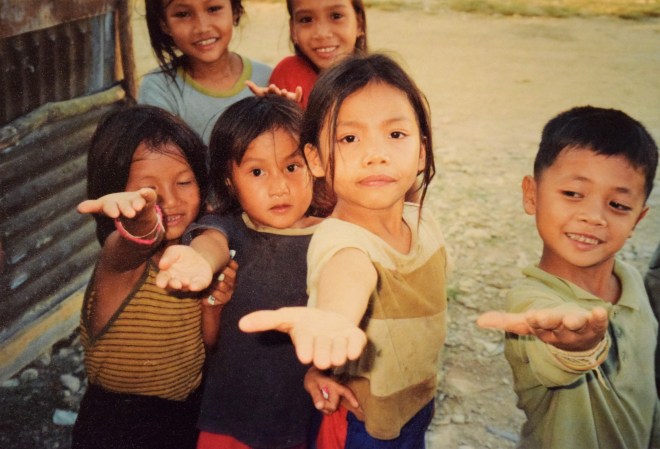
Kids in Twante (they wanted Polaroid photos)

Once in the town I wandered around trying to find anything resembling the famous pottery or weaving, but no one spoke English and there did not seem any obvious I came upon a small boy who must have never seen a white person before.  Normally this results in shrieks and screams and running away (I have had this happen many times) but for him it resulted in absolute incredible delight.  He began laughing and laughing and laughing.  Pointing at me and saying something to some other boys.  He ran up and threw his arms around my leg and looked up at me continuing to laugh with un-abandoned delight.  I took his picture with my Polaroid and tried to give him the picture, but he didn’t understand, so I kept it. (and I still have it taped in my journal).

After being unable to find anything of note in Twante I prepared to head back and hopped into a truck for the ferry.  It was not full and I would wait a long time for it to fill up and return to the ferry.  An Indian man in the truck asked if I had been to the pagoda and since I had not, I decided to get out and go in search of it.  I walked and walked but without any luck.  No one seemed to know where the location of the pagoda.  Several children ran after me screaming “I love you,” so I stopped to blow them a kis,s which threw them into hysterics and made them follow me all the more. Somehow, I ended up being invited to a wedding reception.  Soon I was in a large covered all seated next to the newlyweds eating ice cream and having our picture taken together.   I left with the whole party waving goodbye to me.  I returned to the ferry in a truck chartered by an Italian couple, stopping at a monastery along the way.

I ended up staying a few extra days in Rangoon than expected because with the work and school holidays it turned out difficult to get a bus ticket out.  The earliest ticket I could get was on December 23rd.  I did meet Tin Tun one last time, back at the tea shop.  Then it was off to the next stop: Lake Inle.

Golden Triangle Travel 2002-2003 Part Two: Large Jars and Long Bus Rides

dsc_0803

Touring in style in Phonsavan

In Luang Prabang I was finally able to eat again and what a joy to do so.  Two days on a slow boat while recovering from the mumps can do funny things to one’s brain.  I had begun to imagine Luang Prabang such a paradise on earth, at least in Laos, that we would be greeted off the boat with Laos women carrying steaming plates of pizza with real mozzarella or spaghetti or lasagna.  (For some reason I confused Laos with Italy.)  While no one welcomed me from the boat with fresh pasta, once I found a place to stay, I did find pizza that only caused my still recuperating jaw just a wee bit of trouble.  Apparently, there was a bit of a scandal when this Italian place opened on the Luang Prabang main street as the town is a UNESCO world heritage site.  I also found myself a bookstore, thank goodness. 

I must confess I don’t remember much of what I did in Luang Prabang.  It is a lovely laid-back town on the banks of the Mekong, with the dusty colonial architecture amongst dozens of Buddhist wats and temples.  Luang Prabang lies between the Mekong and a tributary, almost an island.  I did go to the former palace, now a museum, which was small, but enjoyable, though the opening hours were challenging.   The first time I arrived just before it closed for lunch, later just before it closed for the day.  My persistence paid off the third time.  I did not make it to the famous Pak Ou caves or to the Kuangsi waterfall.  Though I tried, I always called at the tour operator at the wrong time, too early or too late.  After all that time cramped on the boat, I was just happy to wander the streets, sometimes talking with novice monks. 

dsc_0802

Hanging out in the Plain of Jars

The bus from Luang Prabang to Phonsavan was nine hours.  NINE.  A friend of mine told me he had taken the trip a few years before me and at the time it took him two days in the back of a truck.  I suppose nine hours was an improvement.  Funny though, weeks and even years later, it is the boat ride and the bus rides that stood, and stand out.  And though we were well into the digital age I traveled a bit more old school.  While I saw younger travelers with electronics – Kindles and iPods – I still had just paper books and my own imagination to while away the hours.

There were twenty seats in the bus, excluding the driver seat, and yet we had 25 people including the driver and three bus attendants.  I am not sure why this works like this, but there was the driver, and another guy who I assumed was the relief driver, whose primary job seemed to be either to sleep or amuse the bus driver.  Then there is the guy who gets of the bus at official check points and hands over paper and puts people on the bus.  If we pick up other people, he hangs out the bus door and yells at these people we pick up along the way, to check their destination and hurry them on the bus.  Then there is the woman who collects the fares.  I had heard the departure was 8 AM, another passenger said it was 8:30, while another insisted it was 9:00, though we were all told to arrive at the bus station by 7:30.  We were full by 7:45 and just sat there.  We left at 8:30, drove 10 minutes to the gas station, then drove a few meters down the road to have the tire fixed, and then another five minutes to the police checkpoint.  Surely there is another way to do this?

dsc_0804

Early morning at a Laos bus station

It was a long trip.  Though I slept at least half the journey, it was not easy. Whenever I began nodding off, the driver would blast Lao pop music.  The second half was through the mountains–around and around and around curves.  I am talking about curves with drops down hundreds of feet without a guard rail in sight.  We went through many hill tribe villages — their front yards the road, their backyards the hundred foot drop.  When we sped through these tiny villages we laid on the horn so anyone on the road would scatter.  Besides people, there were also many animals on and alongside the road: chickens, turkeys, pigs, dogs, cattle, and goat.  Once we even passed an elephant! 

Like my arrival in Luang Prabang, I was extremely happy to arrive in Phonsavan. I secured a room, ate, and went to bed.  Electricity at the time ran only five hours a day, from 6 to 11 pm.  Reading that now, it sounds rather generous.  I was in bed long before 11.  The following day I had a tour of the Plain of Jars.  It was really just a guy in an old Russian car who drove three of us foreigners around to the sights.  And by sights, I mean we visited plains with large and small stone jars littered across them.  Then I knew it only as a place of unknown purpose – though now I read it is one of the most important prehistoric sites in Southeast Asia.  It was a good day; I was fascinated.

dsc_0811

Hmong girls lined up to play ball

While in Phonsavan I also happened to stumble upon a Hmong gathering.  It was the Hmong New Year’s and Hmong tribes from Laos and even Southern China, were gathered to celebrate.   Young Hmong women, between approximately 14 and 20 years of age, dressed in their finest, lined up to play a game of catch.  My guide informed me this was a way for the girls to find husbands.  Though many of the girls were tossing the balls to each other, a man could step in and begin the ball toss with the girl.  He might toss the ball and say “I do not have much money.”  The girl would throw the ball back and tell him “That is okay.”  He would say “You will have to work in the fields.”  “That is alright,” might be the answer.  And back and forth they toss the ball until some decision is made.

I had planned to head to Vientiane the following day, but the thought of another ten-hour bus journey was more than I could bear; I chose instead to take a detour to Vang Vieng.  This ride was worse.  The bus to Phonsavan had been small, full of foreigners.  On this larger bus, I was the only foreigner.  Though it was to depart at 9:30 AM, it was full by 7:45 AM.  The passage in front of the door already blocked with sacks of rice that everyone had to climb over to get on or off the bus.  I watched two motorcycles being loaded onto the top of the bus.  We all sat there, or walked around the bus, until it left, half an hour early at 9 am.  And we promptly drove to a gas station!

dsc_0842

Vang Vienh, a good place to stay awhile

Most of the Laos seemed inexperienced in bus travel.  Perhaps they made the trips only rarely?  As a result, most passengers were sick.  The bus assistants passed out plastic bags – they served the same purpose as the bags found in airplane seat back pockets.  As we passed over the hills and the narrow roads with steep drops, the Lao people would ooh and aah and stand up and lean over to that side of the bus to examine the drop.  I thought it would surely tip the balance and down we would plunge.  The woman in front of me and a man behind me were sick out the windows, making it hard for me to look outside and try not to be sick myself.  We had one pee break on top of the hill in the middle of nowhere, where each person ran off to find their own peeing bush.  There was more Lao pop music– I was getting thoroughly sick of it.  I was extremely happy to get off the bus at Vang Vieng seven hours later.

I meant to stay only a day in Vang Vienh, to break up the long journey to the capital.  However, I ended up staying a three.  I took a tube down the river with an Irish girl named Claire.  I am fairly sure Claire was high as a kite for the duration, and though I do not generally relish being trapped alone with strangers for hours on end, I had not laughed so hard in ages.  We made a game of our 3.5 HOURS float down driver, paddling furiously with our flip flops to maneuver around obstacles.    The following day I was aching from a bad sunburn, a sore knee where I had hit a rock, and a huge scratch I received from a submerged stick.  I signed up for kayaking the next day, but it poured rain and the trip was cancelled.

Then I headed to Vientiane and what a relief it was to spend only THREE hours on transport after so many marathon long trips.  I spent two quiet days in the quiet capital, resting up for the travel to come, often enjoying a dinner looking across the Mekong to Thailand as the sun set.  Then I crossed the Friendship Bridge back to Thailand and returned to Bangkok for the next phase of the trip.

Vientiane Victory Arch

Patuxai – The Victory Gate of Vientiane

Golden Triangle Travel 2002-2003 Part One: Mumps in Thailand, Boat Down the Mekong

From July 2002 to July 2003 I was in graduate school in Singapore.  Over the winter break I took seven weeks to travel solo in northern Thailand, Laos, and Burma.  I sent out fairly regular email updates to my friends and family during my trip and these are the edited stories – a combination of email and diary excerpts, reminiscences from my admittedly faulty memory, and thoughts from today.  I find it curious, with the passage of time, what I wrote and took photos of, what I have remembered and forgotten.

dsc_0796

The border crossing

I had plans to stay only a few days in Thailand before heading to Laos.  I meant to spend 3 weeks in Laos, starting with a Mekong river voyage, some two weeks in central Laos, and then a third week down the slender tail where the Mekong hugs the border between Thailand and Laos to the Si Phan Don (Four Thousand Islands) area.  But things did not go at all as planned.  As so often happens with travel—and really one of the key reasons to do it—I could not have anticipated the people I would meet and the adventures, including coming down with a serious viral infection for which I had been (supposedly) inoculated against as a child…

On Friday, November 23 I flew from Singapore to Bangkok, Thailand to begin the first phase of my journey.  After checking into my guesthouse, I notice the right side of my jaw is swollen; it looks like a gumball is lodged in there and it feels tender and sore to the touch.    I write: I appear to have a minor bout of the gout.  The next day I flew from Bangkok to Chiang Rai.  My jaw hurts even worse; I feel ill and uncomfortable on the flight.  As I disembark at my destination it takes nearly all my energy to drag myself from the plane through the airport to transportation to take me to my Chiang Rai guesthouse.

At the guesthouse I can barely drag myself from check in up the stairs to my room. I know I should see a doctor and ask at the front desk.  The man informs me there is a clinic just 300 meters away, within walking distance.  I tell him I cannot make it.  He insists it is not far.  I walk a few steps, my knees buckle, and I vomit.  In an extraordinary show of kindness from a stranger, the man gets his motorcycle and takes me to the clinic.  He waits with me there and afterwards takes me to a pharmacy, then back to the guesthouse.  With medication and some beverages, I hole myself up in my room and fall asleep.

dsc_0800

The slow boat — aka, my ride

The doctor told me I had Mume.  The following day I head to an Internet café to see if I can learn more about my illness.  Since my face is so swollen I grab a hoodie so I can wear it to mask my face.

I type in my symptoms and what should pop up but mumps!  I almost laughed.  That is if laughing were not so painful.  Both sides of my jaw are completely swollen.  It is very painful.  I cannot eat.  The day before in a fit of desperation I bought a bag of potato chips.  I ate about 10 and was sorry for over two hours, my jaw throbbed horribly from the effort.  I stood in front of a restaurant yesterday staring at the food through the window, then went to buy instant ramen at 7-11 which I gobbled up with great glee back in my hotel room.  I carried the little cup with boiling water the three blocks back to my guesthouse like it was my most precious possession. 

I spend two days in my room.  I read a book.  I play solitaire.  I write in my journal.  I nap.  I think about eating but do not dare because it hurts too much.  But slowly I begin to feel better.  I make plans to move on.  I buy some supplies, check bus times, and prepare to collect my passport with my visa to Laos.  But the next day was not to be.  I could barely drag myself down to the travel office and when I did it was closed.  I gave up and went back to my room.  Later someone brought my passport to my room—I merely rolled over in bed, unlocked the door, took the passport, closed the door, and went back to sleep.

dsc_0798

One of the few times I saw people along the way

The next day I wake at 6 AM and head to the bus station to catch the first bus to Chiang Kong, the Thai border crossing.  The slow boat down river departs at 10:30; the bus should arrive on the Thai side at 10 AM.  But it arrives at 10:15. I quickly catch a tuk-tuk to the boat landing, but then the immigration official takes a short break.  Then shoots the breeze with his colleague.  10:30 comes and goes.   The slow boat has surely departed.  I head up the steps to Laos immigration and then wander in to town.  I went into a guesthouse to ask a woman about the boat.  She told me “It already leave.  Stay here.  Stay the night.  You are tired, right?  Don’t you want to rest?”  And she lured me.  Because I was tired and I did want to rest.  My first day in Laos was not off to a good start.

The Laotian town of Huay Xai is a one road town.  A road into town and a road out, a single intersection.  There were a few guesthouses and restaurants catering to all the people who “missed the boat” (literally!) and that is about it.  Seemed a nice enough place to rest up for the two day boat ride commencing the next day.  There were speed boats, but the riders are strapped in, immobile, with life vests and crash helmets, their baggage pinned against their feet as they hurdled down the river for six hours with the deafening motor in their ears.  While I thought for adventures-sake this might be fun for all of maybe 5 minutes, and interesting for maybe an hour, but with my stiff neck, swollen jaw and extreme tiredness, I could not think of subjecting myself to that torture.  It was to be slow boat torture for me.

The next day the slow boat departed at 11:15 AM.  I could have made it the day before.

We were packed in like cattle, sixty of us, sitting on hard wooden benches.  I left my book in the hotel.  Few people were in the mood to talk.  Looking around every available space filled with a person with a book balanced on their lap; I was so envious.  I would try and look out the window for awhile, to give my bum a rest from the plank, and within fifteen minutes my knees felt as if they were welded to the wood and moving them was extremely painful.  The muddy river, the green banks, slid by minute after minute, hour after hour with little change in scenery.

dsc_0801

Colonial building in Luang Prabang

After six hours the boat arrived at Pak Beng, where we stayed the night.  I still was not 100%.  I had some soup but I could not sleep.  Under a mosquito net I felt too hot.  I thought a shower might help.  There was a huge cement cistern.  And a shower head.  In the corner a huge spider sat on the wallI had my glasses off so I could not make it out very well, though I kept my eye on it as well as I could.  The water was so cold I felt unable to stand and found myself squatting on the floor, shower head in hand, my mouth gaping open and closed like a fish out of water, just to brace myself against the icy coldness of the liquid running down my scalp and neck. Shampooing up, I didn’t know if I could stand to run the water over my head again to rinse, but again in silent screams I washed my hair.  I was certainly cooled off then and fell into a lovely slumber, despite the sound of rats scurrying overhead…

I thought the day before as I got off the boat that someone would have to drag me kicking and screaming to the boat the next day, with me screaming “no, not the boat, not the BOAT!”  But I walked on of my own accord the next day.

The second day on the boat was much like the first, except that I managed to procure myself a book.

I am on the boat again – we have been going for four hours, though I do not know what that means in terms of the journey as there is a debate over whether we are to travel six hours or eight today.  I sincerely hope it is only six.  I inherited a book from another person and read the whole thing before noon…The boat meanders lazily down the Mekong.  The water a muddy hot tea with milk color, on both sides thick green jungle.  Only rarely does a house appear, and even more rare, people.  It always surprises me when there are people because they appear smaller than I expected, dwarfed by the scenery around them.   I cannot even begin to explain the mind-numbing boredom of those two days.  Nor how much my bottom hurt from sitting on the wooden plank for so many hours.  And I paid for the experience.

We pulled into Luang Prabang 7 hours later and I gratefully got off the boat, scrambled up the bank at a sprint, and never looked back.


Zomba & the Lake

Two weekend getaways two months apart in two of Malawi’s most extraordinary places.

48

A view down to Zomba town through the trees of the Plateau

Just a few weeks after arriving in Malawi our social sponsors, the family that prepared and eased our transition to the country, whisked us off for the Labor Day weekend.  Our destination: Zomba, the colonial capital of Malawi.

Early on Saturday morning, N–, S–, and Little N, their 5 year old daughter and already one of C’s favorite new friends, arrived to collect us.  N– did the driving the four plus hours from Lilongwe.  Having only recently arrived and only driven myself from home to Embassy or home to supermarket and back, the drive was an eye-opener.  It is hard to capture in words the changes from Capital City Lilongwe, where most of the expat community lives, with its large, high walled compounds, through the neighborhoods of the everyday population, where one steps directly from a simple brick home right onto the bright rust red earth alongside the road; chickens and goats roam freely.  Then a turn onto the M1, the main artery that stretches from the very northern border with Tanzania to the furthest tip in the south into Mozambique.  One might expect a major road with such a prominent name to be something of significance, yet there is no marker, no sign, to indicate that the two lane asphalt road is anything special at all.  Then at a large roundabout N– mentions that this is the borderline of Lilongwe.  There is again nothing to mark this change.  But soon the signs of urbanization fall away and although Malawi is one of the most densely populated countries in Africa, there are times when there is no sign of civilization as far as the eye can see.

100

The lovely Embassy Cottage

The scenery is unexpected.  The country is more undulated hills than flat.  I had expected flat, though I cannot say why.  We alternate driving on high plateaus and in valleys, past traditional villages, and thriving market towns.  Though there is more greenery than I expected, especially at the tail end of the cold and dry season, and more trees despite deforestation, the scenes are mostly sparse and dry, particularly in the latter half of the journey, after we have passed the town of Ntcheu, skirting the border with Mozambique, and left Central Malawi for the Southern region (the turn off which again gives no indication taking that right would lead you soon to an international border).

We arrive at Zomba but our actual destination was up, up, up the winding road of the Zomba Plateau, which rises some 6,000 feet above the Shire Highlands.  Near the top we stop, just past the famous Sunbird Hotel, at the U.S. Embassy cottage.  I had heard the cottage previously served as the summer retreat for the Ambassador when our Embassy was located in Blantyre.  The rustic wooden three bedroom cottage, seemingly to have escaped the worst of 1960s architecture, is built into a hillside; the front of the house just peeks over as you drive in and in back opens onto an expansive sloping yard.  Several baboon scurried away towards the trees as we approached.  There was quite a lot of greenery and the air was fresh; the altitude contributed to a cooler clime.  We were still in Malawi, but felt very far from the capital.

105

Berry goodness

After unpacking the car and selecting the bedrooms, we made lunch in the cottage kitchen and ate out on the back patio.  Then S– and I and the two girls headed out for a walk toward the Plateau Stables to look into horseback riding for the following morning.  At the cottage gate hopeful berry sellers waited; they must have seen us pull in as there were no other residences at the end of the bumpy dirt drive.  I suspect Embassy folks are almost always good for a sale.  We did not disappoint as we not only bought strawberries and raspberries but also arranged to buy strawberry plants to take back to Lilongwe.

The Plateau Stables are just a 10 minute walk from the Embassy cottage, or a good 20 minutes if you walk with two five year olds.  No matter.  We had little planned but walks and relaxing and getting to know one another.  Along the path — deep orange dirt and jutted, wide enough for cars though surely a challenge during the rainy season — we came across baboon.  They strode forward purposely and though I tried to act nonchalant, as though I come across large primates on walks all the time, I doubt I was fooling anyone, least of all the baboons.  I eyed them warily as they too eyed me and we all kept on walking.  We arrived at the stables and while S– set out to organize our ride for the next day, the girls and I headed into the pasture in search of horses.  Little N had been before and had a particular horse in mind, C just wanted to see any horse, and then of course to pet a horse, and then of course to ride.  The scene was idyllic, green grass, tall trees, crisp mountain air, horses grazing…and baboons running around.  You know, the usual.

104

Just another mom and child out for a stroll

It was not easy tearing the horse-crazy girls away from the stables, but after some time we walked back.  We prepared and sat down to dinner and then the cottage caretaker prepared a bonfire in the stone pit located in a gazebo in the backyard.  S–, the consummate host and planner, had brought music and the makings for S’mores.  The wood must not have been right for a bonfire as it smoked terribly.  Not being particularly woodsy myself, I could not have pinpointed the problem, but we all made do.  The girls and I did a lot of dancing to some Disney favorites and whenever the smoke made its way toward us, we shifted our dance location.  The cottage is stocked with movies and N– tried valiantly to set up the DVD player for some Disney classics selected by the girls, but it was not to be.  In the end the girls settled for some kids TV and us adults ran off to do what adults do when kids are distracted (shower without interruption!).

102

The following morning we slept in and then enjoyed a homemade breakfast of eggs and toast and bacon.  Then S–, myself, and the girls headed off to our horseback riding adventure.  It was a cool morning, the temperatures perhaps in the upper 50s.  Mist hung over the plateau.  We rode the horses first across the Mulunguzi Dam.  With the dark green hills of tall pine, the nearly white overcast sky, and the steel grey waters, I felt as though I were somewhere in Europe rather than central Africa.  I half expected the Loch Ness Monster to rise from the waters or, at the very least, a crocodile to remind me where I was, but only the wind disturbed the surface of the lake.  Once across the reservoir, our guides lead us up into the forest.  With the exception of our own chatter and the occasional small group of women carrying bundles of branches on their heads (deforestation is a huge problem in Malawi–the wood is used to make homemade charcoal for cooking) to whom we called out “Muli bwanji” (“Hello” in Chichewa), the forests held a quiet stillness.  We only rode for an hour but it was a soul nourishing hour.  Or at least a soul-nourishing 50 minutes.  And then my rarely-in-the-saddle behind began to insist on getting down.

We regrouped at the cottage and then headed up the road to the Sunbird Ku Chawe hotel for lunch.  The weather was still chilly and we sat as close to the fireplace as possible.  Then an after lunch rests at the cottage — I indulged in a mountain cottage nap.  In the afternoon C and I met a guide who took us on an hour long mountain walk.  Initially, it looked like C might scuttle the walk complaining loudly in the first five minutes how incredibly far the walk had already been, but soon enough (thankfully) she got into the groove, looking for flowers and monkeys, or at the very least gave in.   Occasional forced walking in nature is good for children.

We spent another lovely evening at the cottage.  A quiet dinner, a fire in the fireplace.  Some board games.  I slept perhaps the best I had since arriving in Malawi.  The next morning after an early breakfast we packed up the car and by 7:30 AM were on the road back to Lilongwe.  Though it was just a day and a half and two nights, the plateau getaway had been restorative.

Two months later I pack up the car for our first self-drive trip outside of Lilongwe; our first Mommy and C trip in Malawi.  This time we headed east to Senga Bay, the closest beach on Lake Malawi.  I admit that I was a little apprehensive about the drive but I had been told it was very straightforward: head north on the airport road, turn right after the Carniworks store (a prominent butcher/grocery) on the only road that goes to the right, and then take that road all the way to the Lake.  An easy peasy 90 minutes.

1

Its a lake that looks like an ocean

Well, perhaps not quite.  Everyone had told me an hour and a half, but it took me 2 hours.  Maybe it was that one wrong turn?  Or driving behind the truck piled high with people, standing room only, for way too many miles?  Maybe there was an extra police stop or two? Or maybe people just like to round down?  By the time we arrived at the Sunbird Livingstonia, at the very, very end of the road, I was tired and cranky.  Did I mention it is the super hot season in Malawi?  And also I still have not replaced the air conditioning in the car, inoperable due to someone stealing the relevant fuses somewhere between Durban and Lilongwe?  When my daughter tells me her armpits are melting, I tell her I did not have air conditioning in my cars growing up, but I actually really, really want to get those fuses replaced.  I just have not found the time just yet.  A hazard of being a single working parent in a new country.  But at long last we did arrive, maybe more than a bit sweaty, and I was underwhelmed.

At first.  Then we went for a walk along the beach – and it is a beach – as the sun set.  My daughter had asked to change into her swimming suit and I told her it was not necessary because we were just going for a walk.  I should know my daughter by now.  She had to walk in the waves.  And jump.  And skip.  And fall in.  On purpose.  She was so happy and it made me happy.

10

Good Morning Senga Bay

It is dark early in Malawi.  By 6:30 all traces of day are gone.  We had an early dinner at the hotel and then headed back to our room – a cute little round chalet.  There was no air conditioning as the power does not support it (power is a continual problem in Malawi) but the hotel had provided a rotating fan.  I opened the windows and turned on the fan and we fell asleep to the sound of the waves.  Again, some of my best sleep in Malawi.

When we woke and opened our front door I was confronted with a dazzling view.  The whitewashed gate to our chalet stark against the hotel greenery, sunlight glinting off the blue lake waves.  Rainbow skinks skirted across the sidewalk.  Large glossy black and white pied crows, soared from palm to frangipani tree.  Wow.  I was both immediately glad I had booked two nights so that we would have an entire day, and simultaneously sorry we did not have longer.  C was ready to get down to business and demanded we eat breakfast as soon as possible so she could *finally* put on her swimming suit and properly get into the lake.

On the beach C ran at full speed across the sand, leaped repeatedly over waves, and could not seem to decide if she should have her pool noodle or the inflatable ring or neither.  She collected shells.  She lay on the beach staring into the sky.  She covered herself in sand.  At 2 1/2 hours I said we needed to go in and clean up for lunch.  We are very fair skinned folks; I usually try to limit our beach and pool time.  But I let her play a long, long time (and as a result we ended up with her first ever sunburn — though with such fair skin I am amazed we made it nearly 6 years without a burn).  Her laughter was too infectious.

20

The Goat Herder

We drove to another hotel known for its extensive menu of Indian and Chinese dishes for lunch.  Along the way, we drove through a village and C declared that she very much needed to pet a goat.  I asked that she wait until after eating for the goat experience and she reluctantly agreed.  Following lunch I parked across the street from the hotel entrance, near where we could see some goat kids playing.  C declared that it would be quite easy to catch a baby goat due to their small size and her incredible speed.

The goats proved more resourceful and speedy than she anticipated.  Fairly soon, the sight of a blonde child running after goats in the village drew the attention of a crowd.  Several children approached me but I could not answer their questions as they did not speak English.  But soon enough a woman stepped forward as translator and I explained my daughter’s desire to pet a goat.  This was communicated to the group of children, who hooted with laughter and then set off to catch one.  One boy managed first to rope a large goat and dragged it over to my daughter to the seeming delight of everyone.  C was pleased and shyly pet the goat.  The boy then set off to capture a baby goat to also offer up for for some hugging.

2

Beach boulders – even the bird crap looks cool

Back at the hotel we had some pool time (and by “some” I mean another 2 hours!) and C quickly made some friends with some other children.  Most of them were also from Lilongwe and also attended the same school.  We then took another sunset walk on the beach — I wanted to head over to some rock formations at the far end.  They did not disappoint.  The large boulders, the sand, the water, the darkening sky with just a hint of pink: it was beautiful.  C was initially skeptical about the walk and the rocks, but soon enough she was crawling on them and leaping off.  She even posed on all fours, facing out to sea, head raised in a roar — she told me this was Pride Rock and she was in her “Lion King pose.”  Walking back she actually ran right into a classmate from school and I had a chance to talk to him mom while the kids played.  It seemed all of Lilongwe had come to Senga Bay for the weekend.

I suppose if I had grown up around one of the Great Lakes, I would not be so surprised and taken with a lake that looks like an ocean.  The waves that roll along a sandy beach, the whitecaps as the wind whips up the water.  And a horizon in which one does not see another shore, only perhaps an island.  And yet without the salty smell of the sea.  Of course I grew up in Northern Virginia instead, but I am sure Lake Malawi would be impressive anyway — the third largest lake in Africa and the ninth largest lake in the world.

Two weekends away in Malawi.  Extraordinary.

31

C looks out at Lake Malawi