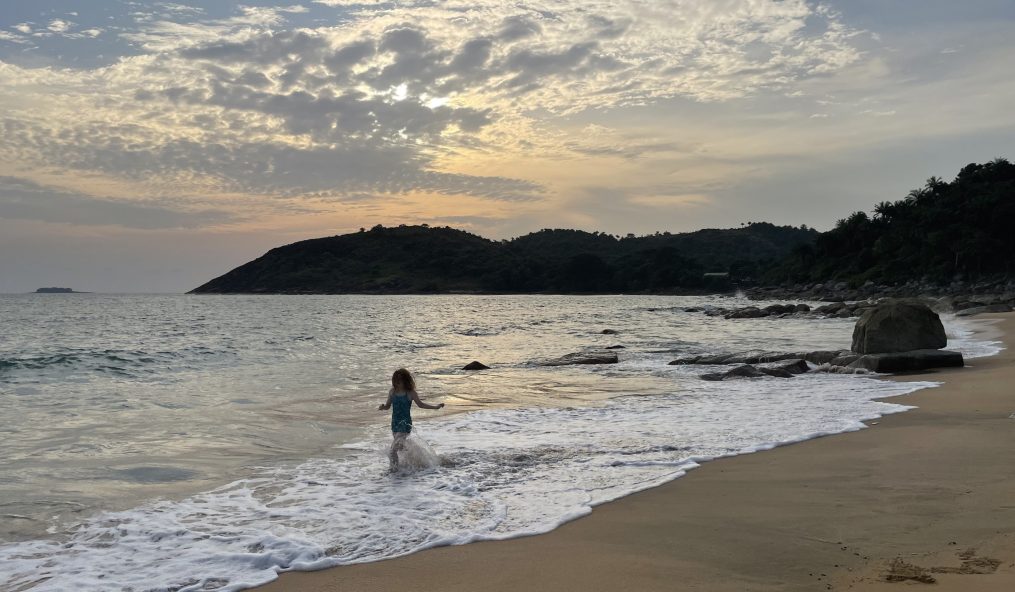
Autumn is when Foreign Service Officers about a year out from the end of an assignment bid for their next position. As I had just started a new job, I was exempt from taking part, but soon I began to see a flurry of excited postings online about where my friends would be going next. I am not a fan of how we go about obtaining our next assignments (I honestly do not know anyone who is), but I do feel a twinge of envy when others are going through it. Next year I will be bidding again, and the realization made me think about how quickly the time here in the U.S. might pass. I have often been posted to places that do not have an autumn, and thus I really want to make the most of the ones we have.
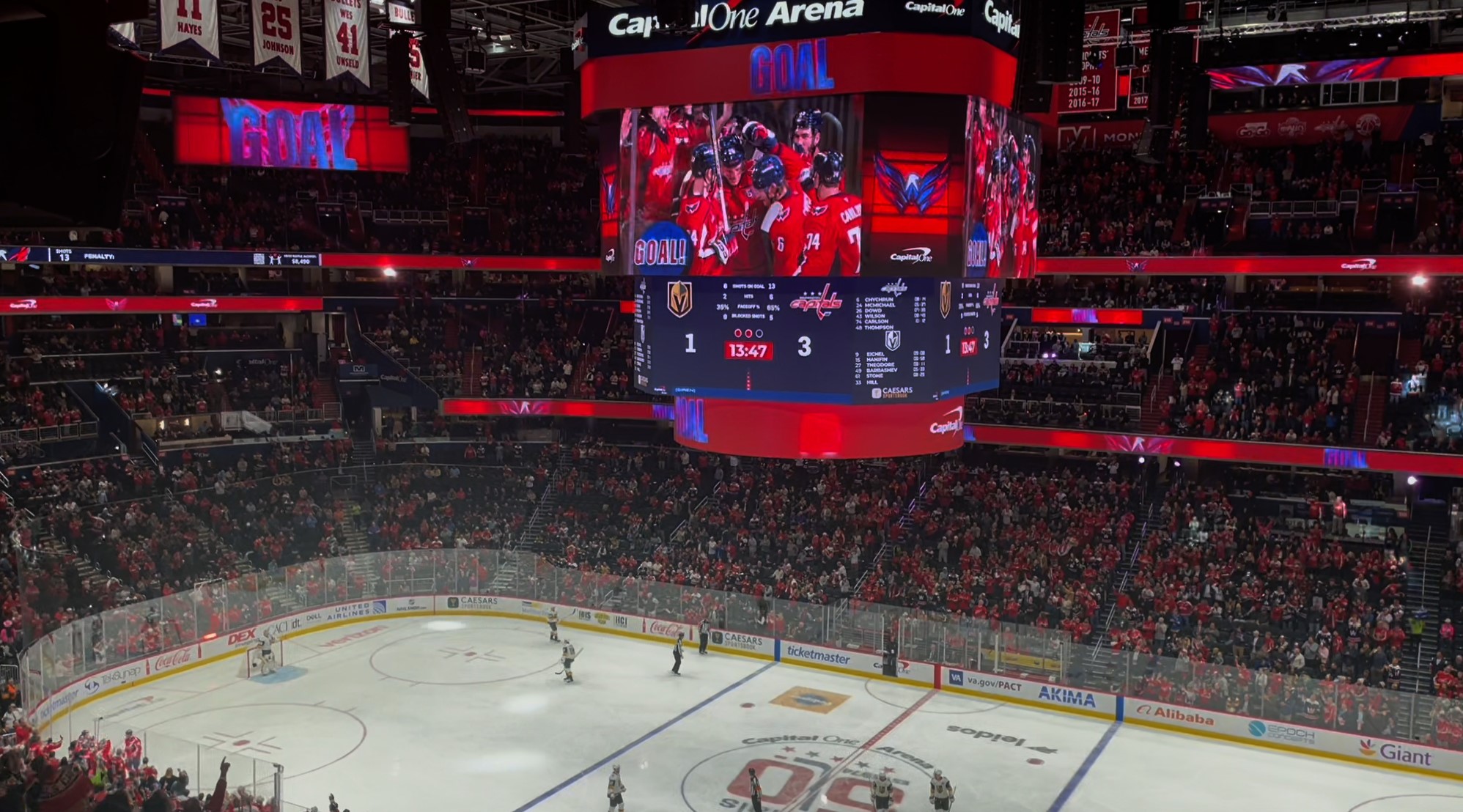
I may not know much about hockey but Caps fans really love the sport and it was exciting to be there in person!
In August, my daughter C started ice skating lessons at the Medstar Iceplex, where the Washington Capitals, the national ice hockey team in the area practice. She told me she would like to attend a hockey game. As luck would have it, an old friend from college reached out to ask if C and I would be interested in joining him at his company’s box for a Washington Capitals game in early October. I have taken C to see a good number of baseball games, but never to a hockey game. I had never been to one in my life. My friend also had two extra tickets for C to invite two friends. Though it was a school night, her friends’ parents let them join us and the girls had an amazing experience that surely gained them some cool points at school.
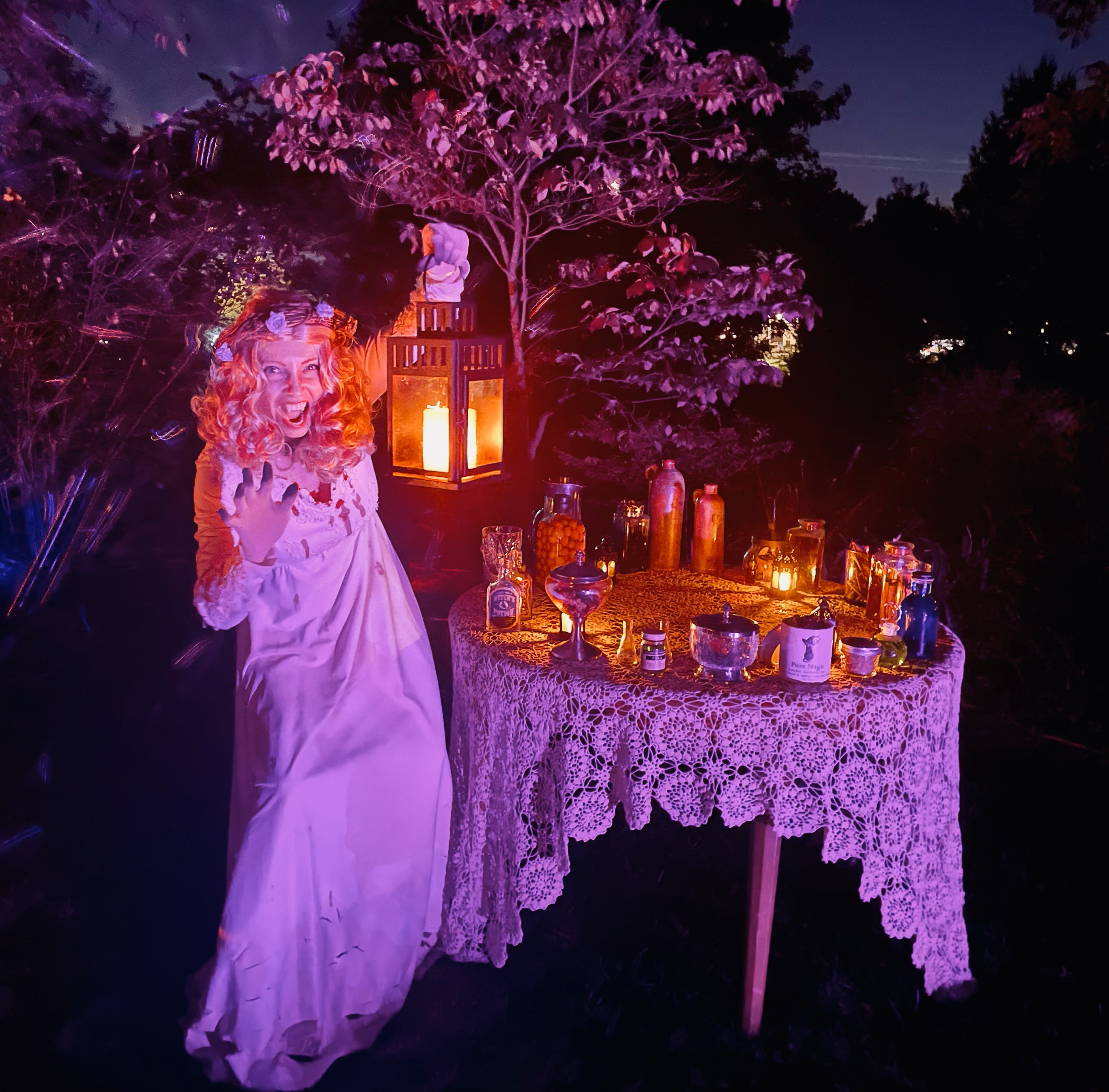
My sister scaring the beejeezus out of attendees at the Dracula Experience
I thought I might like to take C on a haunted walking tour in the area — there are plenty of ghost tours around. She has recently told me she was old enough to do one. As I cast around for which would be the best tour for a pre-teen, my sister posted that she had been cast in a “Dracula experience” in Leesburg. It would be part performance play and part Halloween-y experience in the garden of a historic manor. We met my brother-in-law and nephew at the location to see my sister play one of the three brides of Dracula. It was spooky, corny, and fun and another great opportunity to share something with family while supporting my sister in her acting passion. These are the kinds of things we could not just decide to do while living on another continent.
Two weeks later, I returned alone to that historic manor in Leesburg for a house tour. What was this manor? Dodona Manor, a National Historic Landmark that served as the residence of General George C. Marshall from 1941 until his death in 1959. Marshall served as the Army Chief of Staff, Secretary of State, Secretary of Defense, and U.S. special envoy to China. He was the architect of the Marshall Plan, an economic recovery act to assist with the support and reconstruction of Europe after WWII. He was Time Magazine’s Man of the Year twice and a recipient of the Nobel Peace Prize. It seemed weird that just a few weeks before we had been screaming in the rose gardens as we watched a spooky play and people jumped out of the bushes at us. I had grown up in this area and had not known this site existed until I attended my sister’s performance. Granted, Washington, D.C. and its environs are chock full of historic sites and the former homes of our nation’s leaders. There really is not enough time to see all that this area has to offer; we really are spoiled for choice.
Dodona Manor from the rose garden in early November
On Veteran’s Day, we joined my friend NP and her family for a hike at Gulf Branch Park. NP and her husband BP, also a Foreign Service family, are into spending time in nature and finding fun and interesting low-cost or free things to do. We love hanging out with them. They introduced us to Donaldson Run Park in September and gave us another education on the incredible local parks available in Arlington. Although by this time it was late fall, the autumnal colors of the trees were still very much on display. C needed to learn about some plants for a Scout requirement and BP, who knows a lot about flora and fauna, patiently talked to her about them while I talked with NP and their kids ran and laughed. C and I are a small family unit, just her and I, so it is fun to spend time with NP’s big, joyous family.
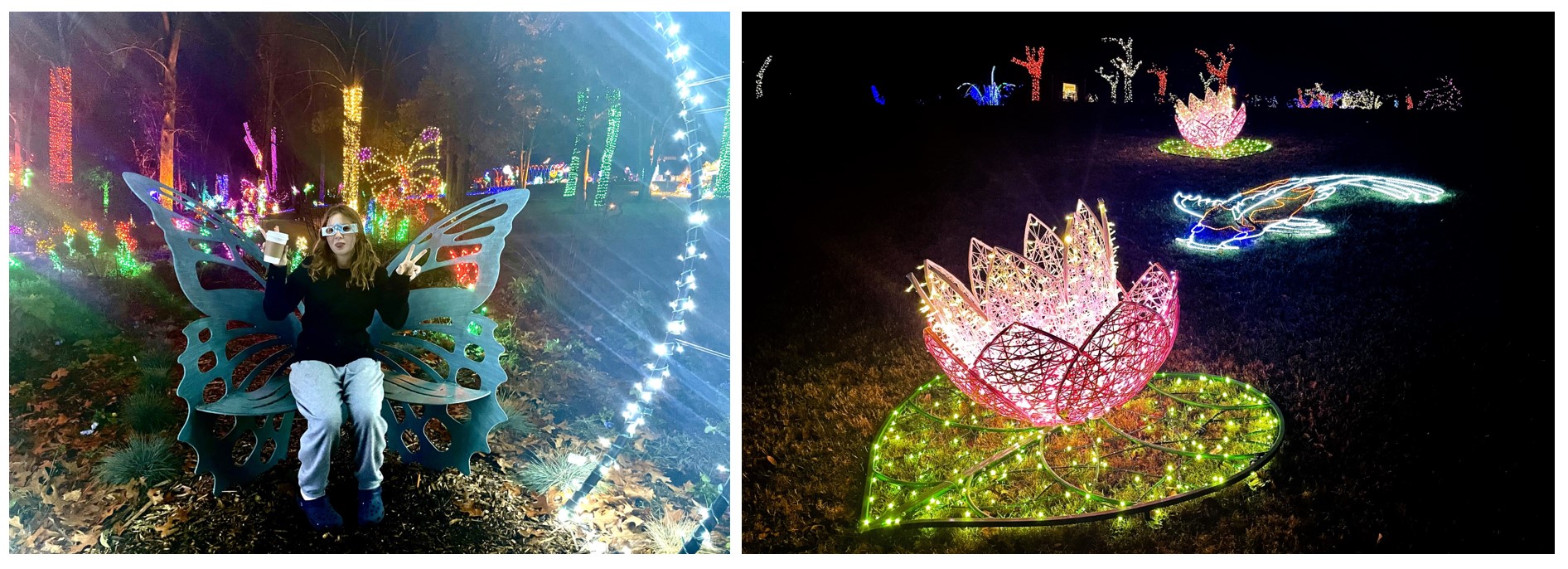
Later that week, C and I joined another of our long-time Foreign Service friends on an outing to Meadowlark Botanical Gardens in Vienna, Virginia. Once again, I grew up in this area and had never heard of nor been to this place. While searching for something fun to do, I came across this place and read they put on a great holiday light show called the Winter Walk and I invited the JKs, who are currently in D.C. for training. The JKs served with me on my first tour in Ciudad Juarez and we later visited them in both Chiang Mai, Thailand and Harare, Zimbabwe. We had dinner with them and then headed to Meadowlark. The organizers had done an amazing job decking out the park with elaborate light displays. We stopped at a beverage stand for some hot cocoa, and towards the end of the walk bought marshmallows for roasting over a large fire. It was just the right kind of cold – chilly, but not too much so. Perfect for warm drinks and good company. I expect the park is also really great to visit in Spring and we may do that.
Meadowlark Botanical Gardens puts on a lovely lights display
On that weekend, I took C and her friend AH to an archery merit badge class at Burke Lake Park, a local park in Fairfax, VA. As the girls did their course, I took a long walk. It was another gorgeous fall day and the park, another in the area that I have no memory of visiting, is a large one at 888 acres. I read that the land was originally set aside for an international airport but then another site was found in neighboring Loudoun County for Dulles International Airport. And Burke Lake, with its golf course, hiking trails (including nearly a 5-mile one around the lake), playgrounds, picnic areas, fishing pier and marina, and mini train, became this incredible public park. With the weather as good as it was, golfers, walkers, joggers, cyclists, archers, ultimate frisbee players, and families were taking advantage. Yet, though there were many people, I still felt I had space to enjoy it on my own, and I enjoyed a good two hours of walking meditation and forest bathing.
Burke Lake Park – fantastic for autumn forest bathing; C and her friend practice archery at the park
C and I wrapped up our fall activities with a magic show at the Kennedy Center. I think we managed to do a little bit of everything from sports to art, history and nature. It was a great fall. I hope others take advantage of and not take for granted the amazing wealth of activities available in the Washington, D.C. area.
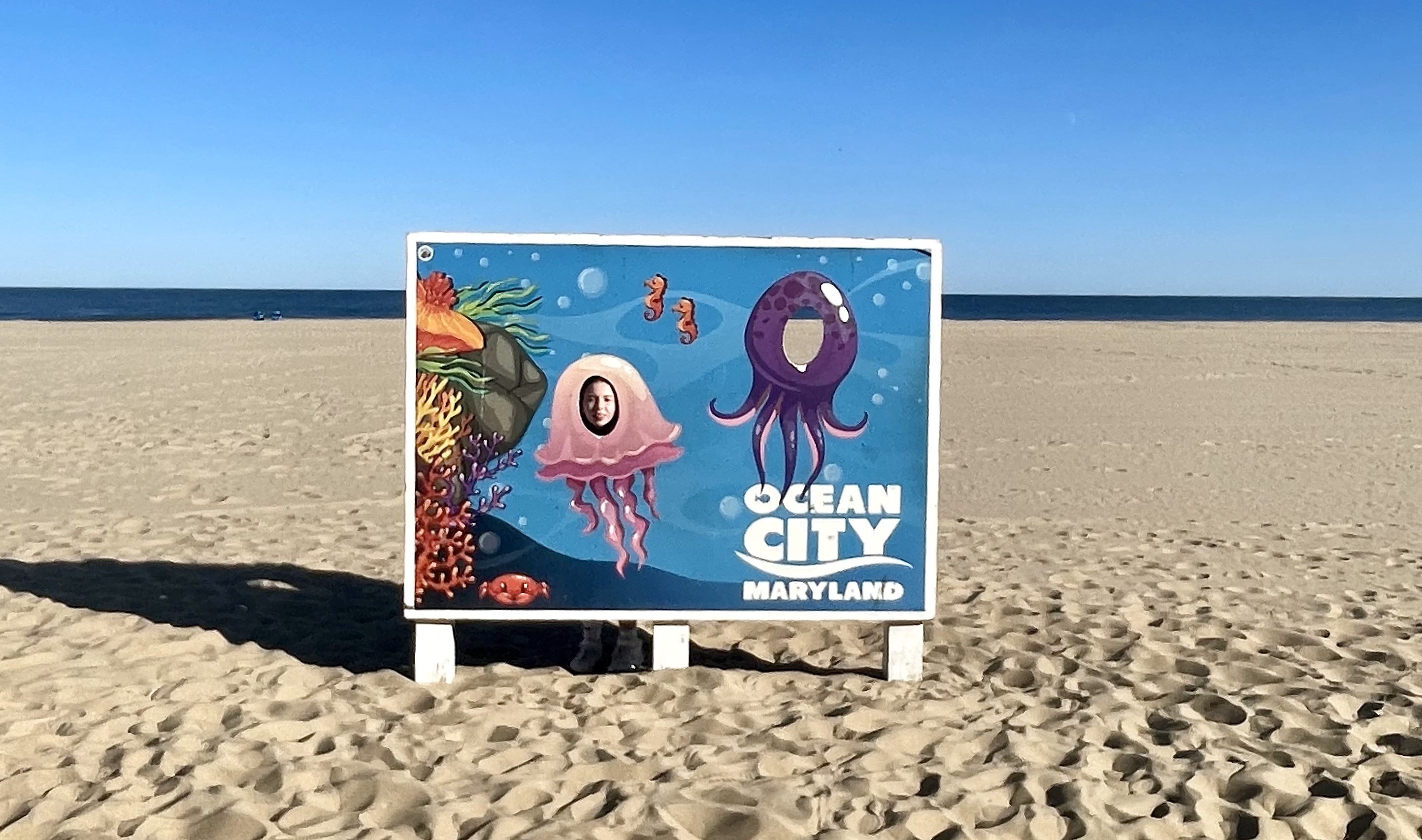
When C and I lived in the northern Virginia area when I was studying French before heading to Guinea, it was C’s first time going to school in the United States. She was in the fourth grade. I recall that a friend of hers had traveled to Boston with his family and he sent her a text with a photo of a baseball stadium: Guess where I am? C had no idea. He came back, “I am at Fenway Park! Haven’t you ever been?” And C seemed a bit concerned that she hadn’t. I told her to ask him if he had ever been to the Great Wall of China or the Stone Town in Zanzibar or the Maasai Mara? But while that might be a great game amongst foreign service kids, it did not work so well among the other kids. Now that C is in middle school, where it is not so important to stand out but rather to fit in, C had asked me if we could go to Ocean City, Maryland, a place she had heard about many times from these other kids.
Sun & sand without the crowds
We had already had our major trip to Japan in the summer, and with the prices and temperatures in Ocean City higher than I wanted to deal with, I opted to plan our trip for the long weekend in October. The downside would be that some boardwalk attractions, like the small amusement parks, would be closed, and the crowds and lifeguards would be gone from the beaches. I had only been to Ocean City twice; both were as a child with my friend Jennifer, her mom, and her mom’s boyfriend. I did not like the crowds or spending a long time on the beach then and still don’t. I hoped to find enough for both C and I to get what we wanted out of Ocean City.
The weekend started with the drive. I do so love a drive and the three hours that include the Bay Bridge and the Assawoman Bridge on the final approach to Ocean City is a pretty nice drive. We lucked out with the weather! It was almost summer-like hot, but despite a major car show in town for the long weekend, tourist numbers were far below summer levels. A quick check-in to the hotel, then lunch, and then a drive to the northern end of the Boardwalk at 27th Street. C and I walked the full 2.9 miles of the Boardwalk to its southern terminus at the inlet, stopping to take in the beach, grab some snacks, and do a little shopping. C loves to buy t-shirts and hoodies with locations on them and she was determined to acquire some cute Ocean City attire to show off at school.
Sights along the Boardwalk – C in a funny cut out by the shuttered Ripley’s Believe It Or Not, a sand sculpture, and the Coca-Cola chair on the empty beach
At the Boardwalk’s terminus, where most of the famous sights and activities are located, we found several arcades. For me, an arcade, especially if it has skeeball (actually, it had better have skeeball), is just part of the Boardwalk experience. Though C loves arcades I do not often take her as she will clean me out. But for the Ocean City Boardwalk, I made an exception. Afterwards, C got some ice cream and I bought a single size of the famous Thrasher’s fries. And C and I walked the whole way back up the Boardwalk together.
On our second day, I drove the 15 minutes south to the Assateague Island Visitor’s Center. C and I last visited in 2019 during our mid-tour Home Leave from Malawi. Then, I rented a bicycle with a carriage to ride around Chincoteague; this time C had her own bicycle and we would explore the other of the two famous islands on two wheels.
Assateague ponies in the distance
We were just over the causeway to Assateague Island when we caught sight of a small herd of the famous ponies grazing near the water. It was the only time we saw them that day, though we still enjoyed our two-hour ride and a short walk along a nature trail in the dunes alongside the remains of the abandoned Baltimore Boulevard (a once grand idea to build a development on Assateague that Mother Nature destroyed leading instead to the protection of the barrier island). Once again the weather was warm and bright, perfect for a ride. We saw only a little more wildlife, including some migrating monarch butterflies and a black snake that struck out at C riding by when her bicycle surprised the reptile sunning itself on the asphalt (both she and the snake were unharmed).
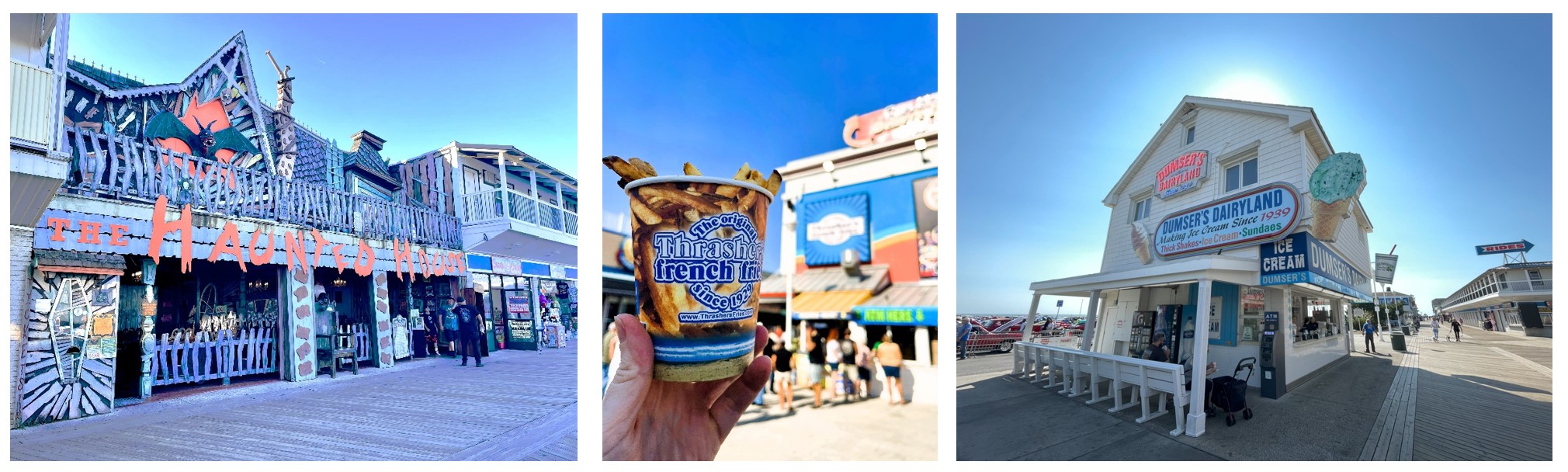
Some of our stops on the southern end of the Boardwalk
After our ride, we were ready for some lunch and the siren song of Boardwalk goodies called us. Having only tried the deliciousness of Thrasher’s french fries the day before, C and I completely understood why the combination of fresh-cut potatoes, fried to perfection, and then doused in salt and vinegar, have been a Boardwalk staple since 1929. It was not the healthiest lunch, so we went whole hog and chased our fries with some ice cream from Dumser’s Dairyland, another Boardwalk institution (since 1939). C had been telling me for a few months that she was ready for ghost tours, so we opted to give Trimper’s Haunted House, on the Boardwalk since 1964, a try. It’s a simple dark ride where two occupants sit in coffin-shaped car that follows a track through a building’s first and second floors. It is just dark enough with enough creepy design to keep us guessing. But it was really the two live actors that jump out and grab you that really made the ride. C and I were screaming at the top of our lungs. Boy, that sure was fun! (though C says maybe she isn’t ready for another Haunted House for some time). To calm down our fast-beating hearts, we once again hit the arcade.
C makes Go Ape look easy
Thus, C tried to chicken out of our evening adventure at Go Ape. We had signed up for the Fright Night activity. I did not know quite what to expect having not been to any of the Go Ape locations ever, but I thought it would be ziplining in the dark and perhaps there would be people dressed up to make it a bit scary. Instead, it was a two-level ropes obstacle course, with the lower level about fifteen feet above the ground and the second level probably 30 feet. The entire time one is attached to a safety line, but it does not feel as if one is (at least not to me). When guests asked “what happens if I fall?” the staff would respond, “you don’t fall, you just dangle.” C caught on very quickly and completed all the obstacles on both levels. She even purposely dangled several times. I could only complete the first level; though I climbed up to the second level, I stood paralyzed at what looked like the easiest of my scary choices for a good five minutes before heading back down.
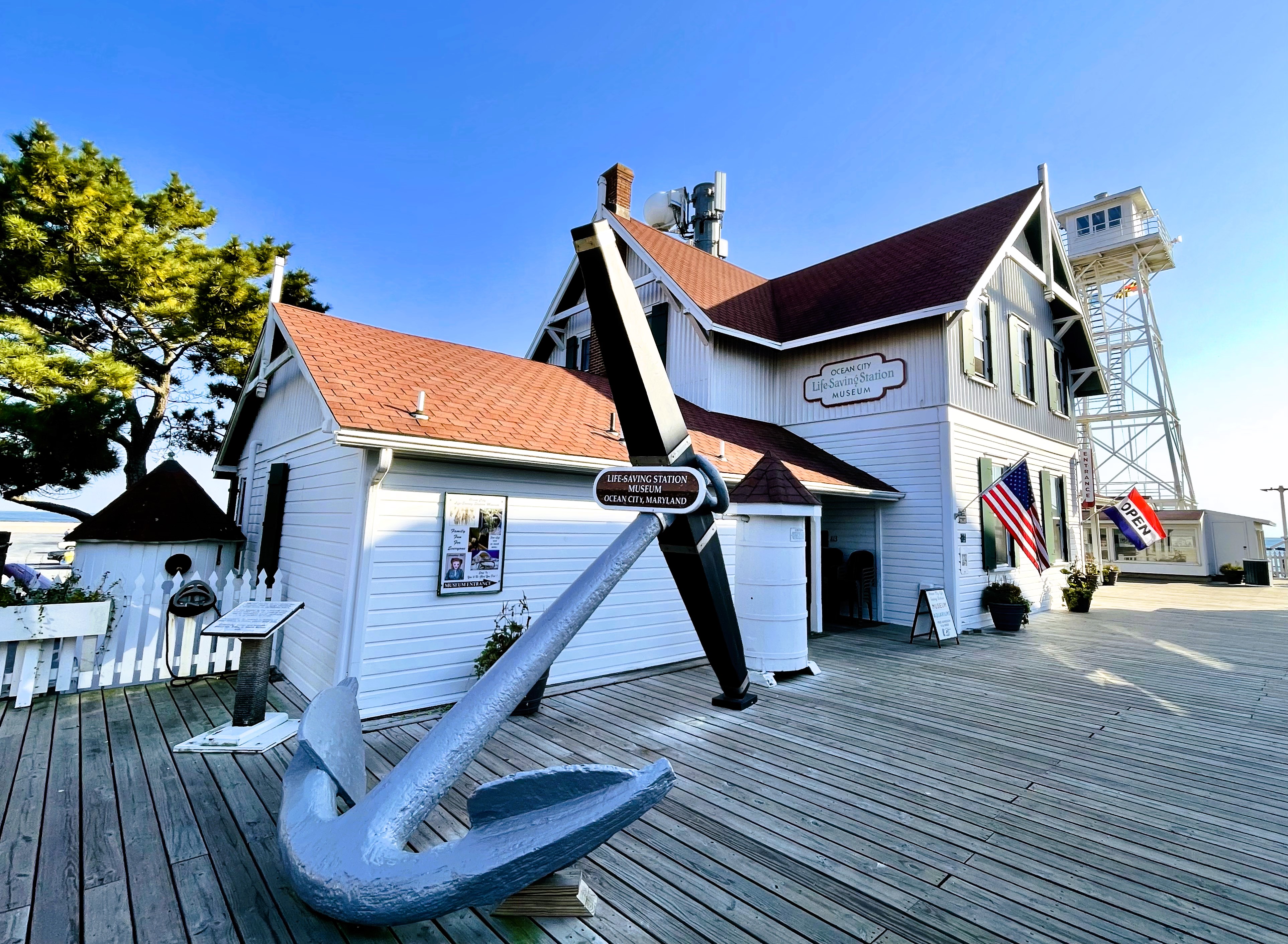
On our final day, we first took an hour walk along the beach. The good weather continued and I wanted to soak it in, with sand between my toes and my lovely daughter by my side. Before leaving town, we made one last stop on the Boardwalk. We visited the Ocean City Life Saving Museum. Though small, it provides a wonderful history of Ocean City, which has delighted tourists since 1875, and the U.S. Life Saving Service, the predecessor of the Coast Guard. The museum is housed in a former USLSS station from 1878. Even C found it somewhat interesting, so that is saying something.
The Ocean City Life Saving Station Museum
Because I love throwing away money on rigged games of chance and enabling my child to do the same, we once again hit the arcade. We had to get enough points on our cards to finally trade them for some items that we could have purchased for far less than we spent (but with much less fun). With her new stuffed pig and stretchy shark, we headed to the car for the drive home. Another successful foray into Americana under our belts.
August was a busy month for C and I what with my starting my new job as an entry-level Career Development Officer at the State Department while managing C’s final three weeks of summer camps then the start of seventh grade, and C pursuing several merit badges for Scouting. It still sometimes feels a little strange to me to be posted to Washington, D.C. and to have so many activities at our disposal. Had we remained in Guinea we would have had one more year left. There would have been no summer camps and we would have had only a fraction of things to see and do.
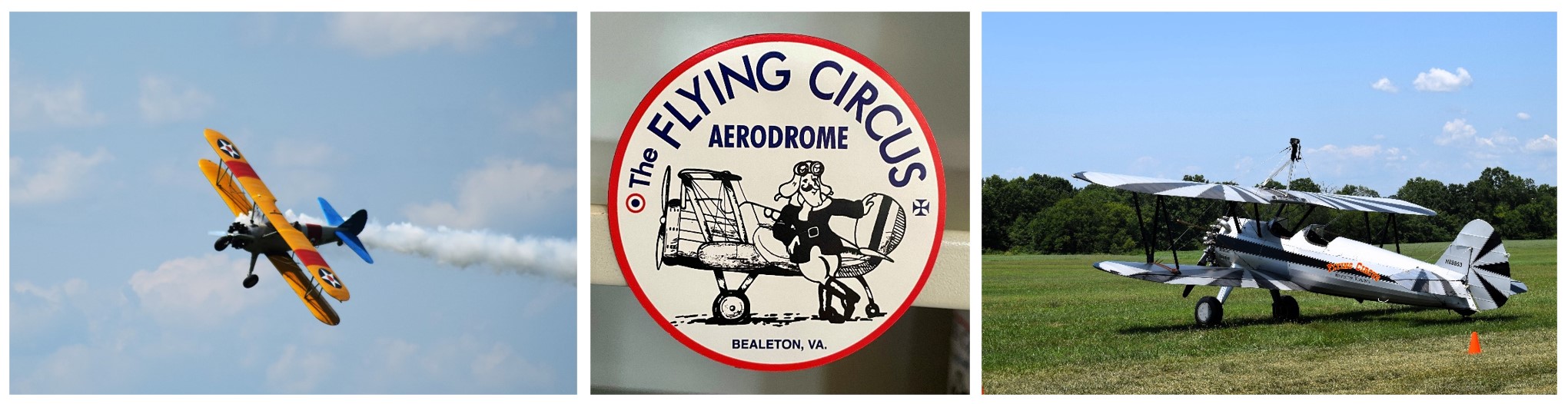
Our first activity of the month (actually the tail end of July), was a visit to the Flying Circus Air Show in Bealton, Virginia, about an hour southwest of DC. One of C’s merit badges, in Aviation, had a requirement to either tour an airport, visit an aviation museum, or attend an airshow. In Malawi, C had a tour of the airport and control tower for a school field trip and we had been to the National Air & Space Museum a few times, so an air show sounded like something different to do. A quick Google search brought me to the Flying Circus. How lucky that there was an air show every weekend throughout the summer within an easy drive. Of course there was. I wonder sometimes if there is anything this area doesn’t have?
Photos from our afternoon at the Flying Circus
C and l located our lawn seats, last used when C was a toddler, and headed out to the air field. It was a real hot and muggy mid-summer day, perfect for grabbing some food truck goodies and hiding in the shade of one of the free trees to watch the aeronautic acrobatics. These daredevil pilots go up in their WWI replica open air planes every weekend to demonstrate the barnstorming tactics of the early airmen and women. Pretty fantastic stuff.
Gunston Hall from the garden
Three weeks later C had her merit badge event in Lorton, Virginia, on the expansive grounds at Gunston Hall, the residence of U.S. founding father George Mason. As C would be there a good eight hours, I decided to make excellence use of the time and do a little sightseeing. I had not visited Gunston Hall before, so I booked myself a house tour with access to the gardens and grounds. As luck would have it, I was the only person on the tour that morning; I very much enjoy historic home tours, especially when I get the guide to myself.
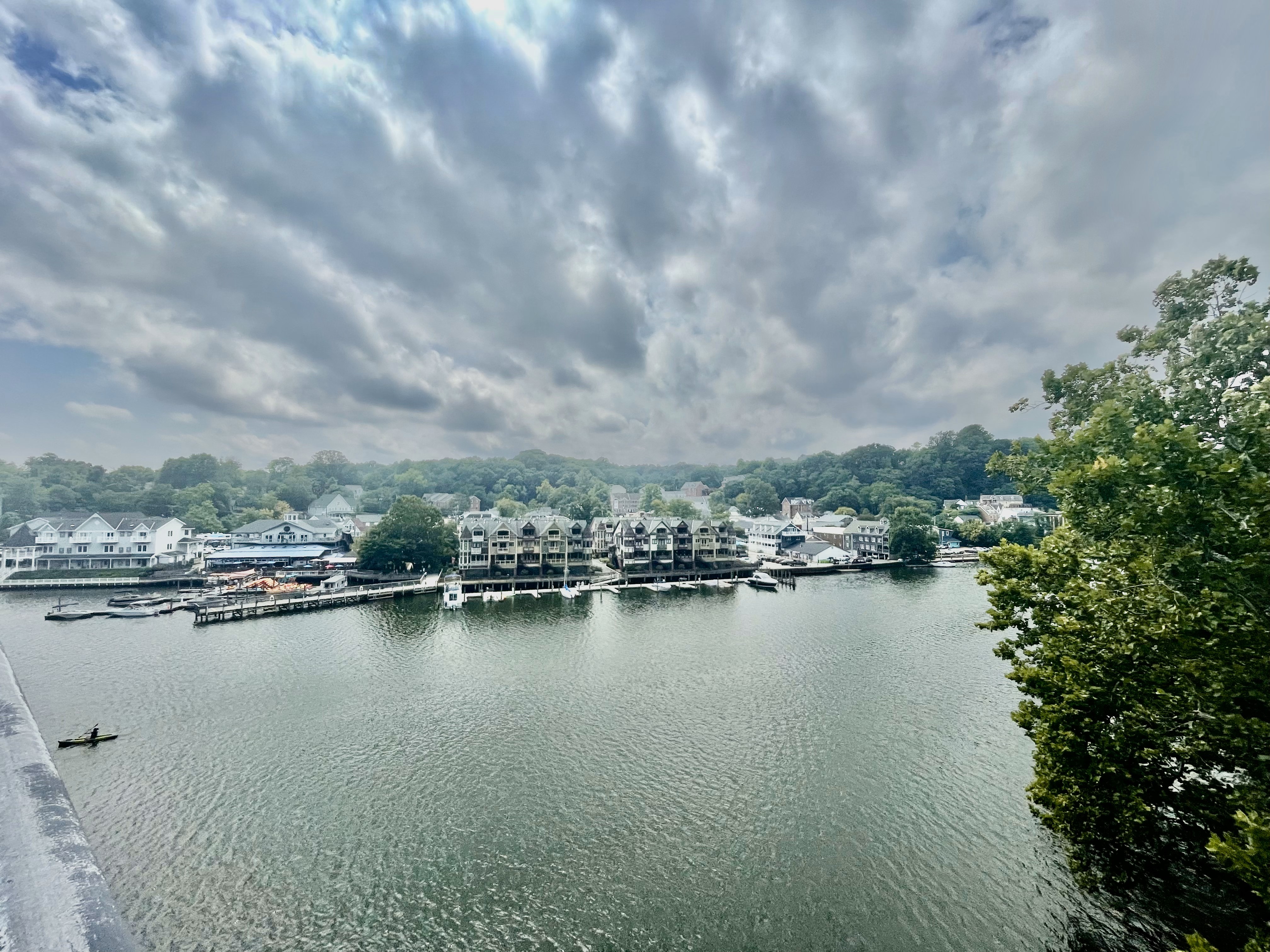
Gunston Hall sits on a plain overlooking a slightly over a half-mile tree-covered slope down to the Potomac River. It’s a grand location about eight miles south along the Potomac from George Washington’s home at Mount Vernon. Though river travel was the way to go, Mason didn’t like to do it much as his father had died when his boat capsized on the same river and I learned he was a bit of a homebody. I suppose with an estate like Gunston Hall (and the wealth and privilege it conveyed) it was not so bad hanging out at home. I enjoyed the tour and a little meandering outside before heading over to the small historic town of Occoquan for lunch.
A colleague recently told me how much she enjoys walking in and around Occoquan, with its lovely location alongside the Potomac tributary of the same name. I found a nice table at a restaurant on the water, to enjoy a delicious meal and take in the view. Boats of families were coming and going in the small marina, and visitors were kayaking or stand-up paddle-boarding. After lunch, I took a long stroll through town, including a loop using the footbridge across the river, up back to the highway, and then back over the pedestrian sidewalk on vehicle bridge, ending with a big cup of frozen custard. I spent the last bit in the small local museum and a riverside park. The history of the town, established in 1804 but with colonial tobacco warehouses and mills set-up as early as 1734, is well worth a stop. I would have liked more time to visit both Occoquan, maybe getting out on the water, and Gunston Hall, where the numerous trails on the property beckoned for a long walk.
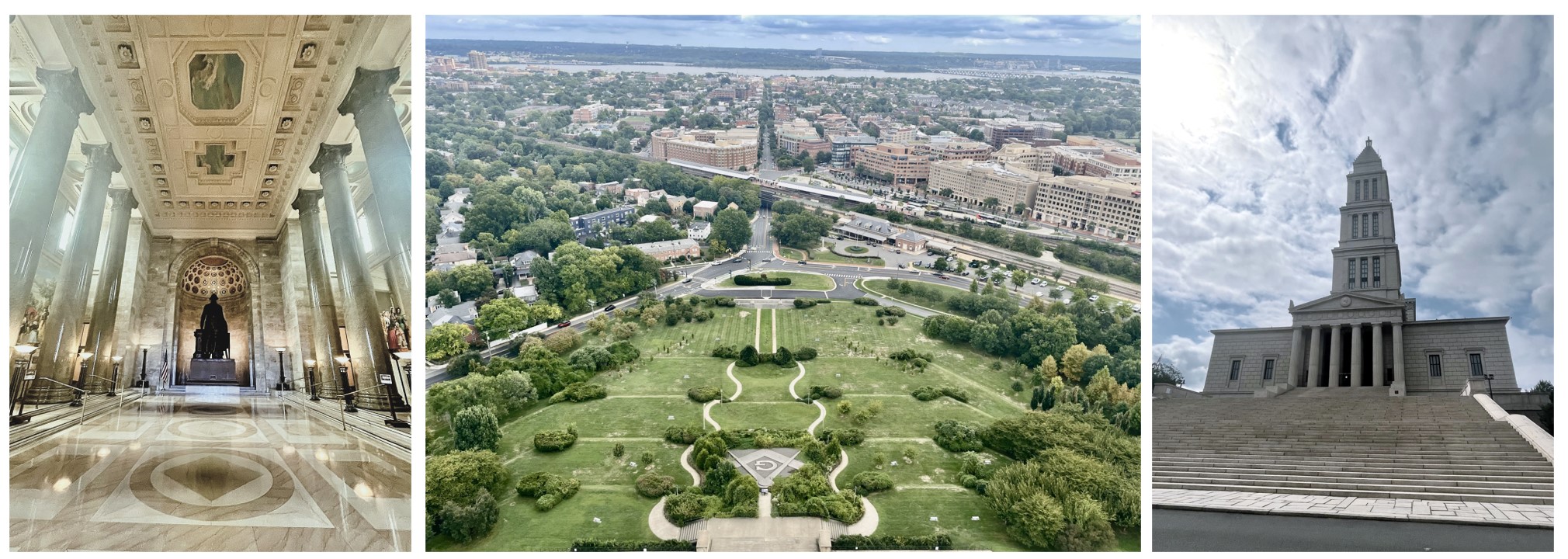
We wrapped up the month of sightseeing with a visit to the George Washington Masonic National Memorial located in Alexandria, Virginia. I remember in the early 90s dropping off a boyfriend at the Amtrak Train Station across from the memorial and thinking, I really ought to visit there someday. I grew up in northern Virginia and spent several parts of my life here, but it took until now to finally visit this extraordinary memorial to both masonic traditions and the first president of the U.S.
The fantastic George Washington National Masonic Memorial– left: the grand hall; center: the view; right: the memorial itself
In the early 1900s, American freemasons decided to build a monument to George Washington, not only the country’s first president but also a prominent freemason. They hired a famous New York skyscraper architect, who went on to also work on 30 Rockefeller Center, and its rumored the building is at least partially inspired by the ancient lighthouse in Alexandria, Egypt. Work began in 1922 but was not completely finished until 1970; in 2015 it was designated a National Historic Monument. Sitting on Shuter’s (or Shooter’s) Hill, the 333-foot tall building is at once both imposing but also seems smaller than its true size. Standing in the grand hallway, with its 40-foot high columns flanking either side and a much-larger-than-life statue of Washington at one end, the place feels so much bigger than expected. The tour took us to the replica of the Lodge room where the freemasons of the area would have met (Washington was often too busy being president to attend), including a chair of Washington’s. On other floors we could visit a chapel, a small museum to freemasonry and other related fraternal organizations, and to a platform on the top floor allowing 360 views of Alexandria, the Potomac River, and off into Maryland, and Washington, D.C.
C sporting her new nationals football-style jersey at Nationals Park
But that is not all! Oh no, we really had a very full month. We also caught another Washington Nationals game. C and I love to catch a game at Nationals Park and we try to go to 2-3 a season. C especially likes to go on promotion nights. We also attended a performance of MJ the Musical at the National Theater, where each season they bring Broadway blockbusters from New York. MJ is a biopic about Michael Jackson told through his songs and music. There are several of these types of Broadway plays out there such as about Tina Turner, Britney Spears, Neil Diamond, and the show We Will Rock You, which uses the music of Queen and we saw on our cruise ship to Norway last year. I don’t now how many of those C would like, but she lists “Smooth Criminal” among her favorite songs of all time, so I figured this would be a hit, and I wasn’t wrong. At the end of the month we also took in the Cat Video Fest at the Alamo Drafthouse Cinema in Crystal City, Virginia. The film was just 90 minutes of video clips of cats. Like watching one really long YouTube Video. BUT, the money goes to support shelters and other cat support organizations. We went with Foreign Service friends we met the year I was here for French training and who have just returned to the States for another year. It was an hour and a half of wholesome fun in comfy theater seats and yummy, not-all-that-healthy food.
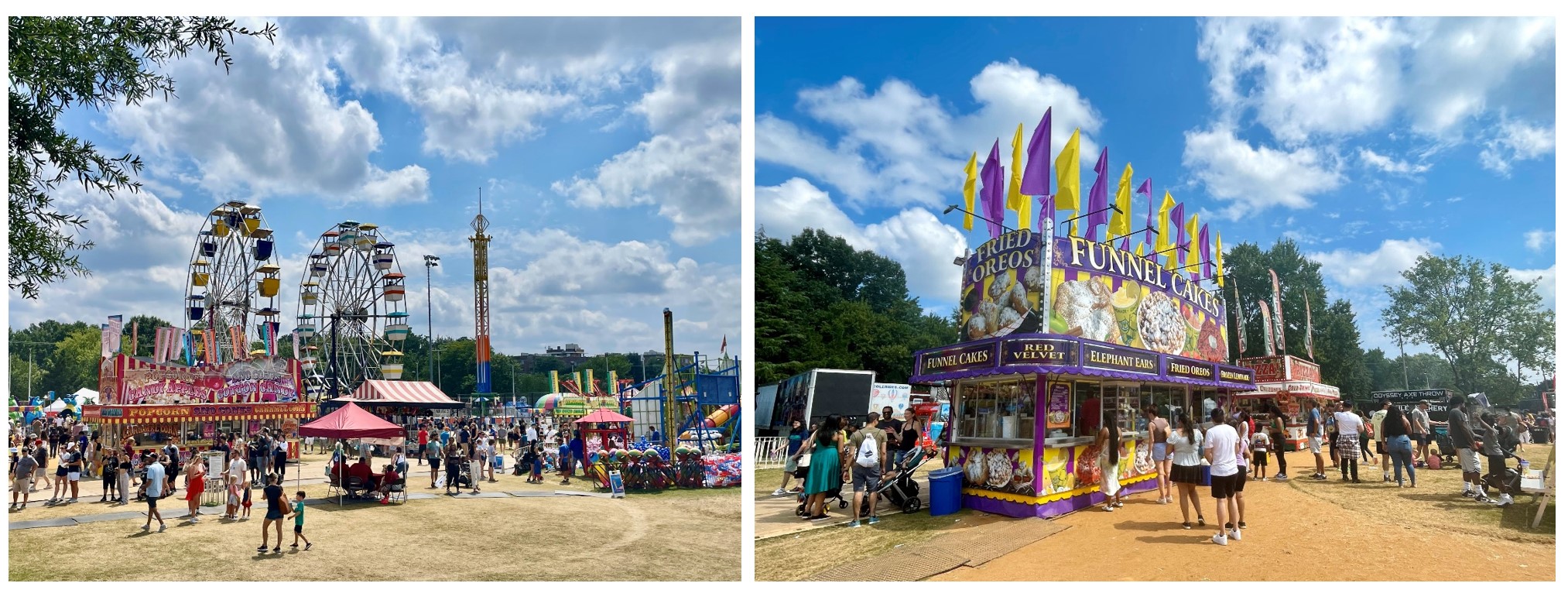
C and I rounded out our month with a visit to the Arlington County Fair. I could not remember when I last went to a county fair! As I try to recall, the last I remember was in Frankfurt, Germany, in the 90s. Foreign Service friends of ours on a domestic tour who were volunteering at the fair invited us to spend the afternoon with them. They had been given some ride tickets for volunteering and their eldest daughter received a bunch of ride tickets as a prize for her winning photograph. The forecast had been for a bit of rain, but the weather turned out spectacular! Carnival rides, games of chance, and fair food like corn dogs, pizza, nachos, funnel cakes, deep fried oreos, and cotton candy were in abundance. Ah, so, very, Americana!
All in all, we had a great final month of summer; we really made the most of it. As of now, the spring and the summer have felt like they have been around a long while, and I love it. The weather will remain warm for another month or so, but soon enough things will cool down. It is, I think, harder for me to appreciate being in the D.C. area when the cold of late fall and winter roll around. Still, I will continue my attempts to make the most of our domestic tour in Washington.
The Washington Monument from the fountain at the WWII Memorial
This post is long overdue. One could even say it has become OBE or Overcome By Events in State Department parlance. And yet I cannot quite shake the thought of putting pen to paper in an attempt to explain at least some of the processes we went through to unexpectedly curtail from an overseas tour to Washington, D.C. To explain what is largely a bureaucratic logistical exercise based on policies and procedures laid out in the State Department’s Foreign Affairs Manual but can become exasperating and stressful.
Moving the Cats from Guinea In a Hurry. Traveling internationally with pets has never been without its challenges. {see here and here and here for example] On airplanes, my cats have traveled cargo, excess baggage, and in-cabin, but also in the car when we drove across the U.S.-Mexican border to Ciudad Juarez. Transportation though is just one piece of the puzzle. The greater challenge is the @%$&! paperwork. It has to be done quickly and correctly in a short timeframe within the 3-7 days of travel. Before going to Guinea, Europe had instituted new rules that required all pets transiting the EU to meet the same requirements as if they were entering those countries. Though we needed an extra document endorsed by the United States Department of Agriculture / Animal and Plant Health Inspection Service (USDA-APHIS) for the plane change in Brussels, that was all given that our travel originated in the U.S. However, coming from Guinea, designated as a high-risk rabies country, one needs to have a titer test completed at least three months before travel. This would not be possible with my shortened departure timeline. Therefore, we could not fly to the U.S. through Europe. Instead, we took Ethiopian Airlines via Addis Ababa, which required us to fly nine hours in the opposite direction first, subjecting ourselves to 34 hours of travel time door to door. And the cats to 34 hours in their carriers. This included Ramen, our new diplo-kitty. It was stressful, as usual, but we managed, again.
Temporary Lodging. When transferring from an overseas posting to the U.S., a Foreign Service employee can utilize the Home Service Transfer Allowance or HSTA. It helps employees and their families to defray costs upon their return. It can cover lodging and some per diem for up to 60 days, with some possibilities to extend should household goods not yet arrive. This gave C and I a place to stay while I worked out my next steps.
Before our arrival, I had reached out to the same company that provides temporary lodging for government workers that had housed us the year before. I wanted us to be in the same apartment building we had lived in during my French training as I figured it would provide the easiest post-curtailment landing for my daughter. I did not know where we might be after the temporary lodging, but at least I could initially ensure she would be somewhere familiar and would start at the same elementary school she had been at before we went to Guinea. We move so frequently in the Foreign Service that living in a place more than once is a rarity. Not only were we able to get the same building, but when we checked in we found we had been assigned the exact same apartment we had vacated only 7 months before! Alas, the HSTA covers for only so long and I needed to find something more permanent.
Enrolling the Kiddo in School. Once we moved to Guinea, I thought I was done doing the school enrollment for a few years. Yet here we were suddenly back in northern Virginia. Luckily, I had been through the process once before when preparing for my Guinea assignment at the Foreign Service Institute in Arlington, and the schools in the area are very familiar with military and foreign service families moving in and out of the area. Thus the paperwork was pretty straightforward. One thing I could not do in advance though was the tuberculosis test, which is mandatory for enrollment. Though our Health Unit at the Embassy in Guinea could perform the test before departure, a test conducted while still in a country with a high incidence rate of TB will not be accepted.
It had taken longer to arrange the curtailment than expected – with bureaucracy it is always a waiting game – and thus our flight got us back to the U.S. after school had been in session for a week after winter break. To get my daughter C enrolled as quickly as possible, the TB test was a top priority. After landing, we went through immigration, gathered our belongings, got a taxi to the hotel, and then with my father’s car waiting at the hotel, we headed straight to a clinic to get that blood draw. C was then able to start school a few days into the following school week.
[Not so fun fact: Later screenings found that my daughter has latent TB, most likely as a result of our serving in Guinea. The majority of persons with latent TB in the U.S. acquired it overseas. She had to undergo long-term monitored treatment for it. Just one more gift from Guinea and an unexpected side-effect to our lifestyle.]
The Search for Permanent Housing. As a Foreign Service Officer, there is not really any housing that is permanent until one leaves the service, thus permanent housing refers to the lodging one lives in for the majority of the tour. Overseas that is one’s assigned housing. In the U.S., it is the housing the employee finds to live in.
With my 4 years of college living in dormitories, my 7 years living overseas with various study, work, and travel, and the combined 14 years overseas with the government, I have not had a whole lot of experience looking for housing. Though I had found a remote assignment and could have lived anywhere, like my condo in Florida, I felt that 1. professionally it would be better for me to be in DC, and 2. personally it would be better for my daughter to be where she had been before. When I took her to school the first day back, a friend of hers from the year before spotted her, ran toward her, and they hugged while spinning around as if they were in a movie. I knew then that staying in the DC area would be 1000% the right decision.
However, knowing you want to be in a certain area and finding housing there are two very different things. House hunting is exhausting. There is research into what one is looking for and then checking out what is actually available on the market. Then setting up viewings. Each place has positives and negatives and I imagine C and I living in each one. In many ways, it feels similar to the bidding process we go through to get our next assignments. Then one finds a place and has to apply and hope the other side likes you too.
Thankfully, I absolutely lucked out and the fourth place we look at is a gem and the owner likes us and picks us over the other potential renters. Then, because I have lived in furnished places for decades, I had to buy furniture. I had odds and ends such as a rocking chair, a decorative bench, two wood storage cabinets, a piano, and many wall hangings, but I did not own a sofa or a bed, end tables or a TV stand, dressers or desks, bookcases or lamps. I expect that seems odd for someone my age, but it must be fairly common among those with this kind of nomadic life, right? Even though I tried to buy economical pieces, all the expenses did add up. Still, there was a bit of fun to the shopping spree.
After all that, it is little wonder that I was not very keen to pull up stakes again only six to 12 months later and decided instead to remain in DC. Every move just comes with so many challenges; it never seems to get easier. It might indeed be getting harder the older I and my daughter become. Yet there are many positives to being here and C and I look forward to spending some more time here before we head back overseas. Now that the mechanics of settling in have given way to feelings of being settled.
On the road in Death Valley heading toward Panamint Springs
On our second morning in Death Valley, we woke early in preparation for our departure from the park. I knew I would want more time in the park, so I reserved a hotel halfway back to Los Angeles instead of making the full drive that day. We would backtrack first, heading toward Death Valley Junction to visit Dante’s View.
Dante’s View, considered one of the best views in Death Valley, sits atop Coffin Peak and 5,575 feet above Badwater Basin, and provides an amazing panoramic view of the southwest part of the park. It allows one to see both the lowest area of the park (Badwater) and the highest; the 11,049-foot Telescope Peak sits on the opposite mountain ridge. Apparently, the early visitors to the area from the borax companies found the view evoked visions of Dante’s nine circles of hell. I cannot imagine what they were thinking given the spectacular beauty of the scene laid before us. From the height we could really see the size of the temporary lake in the basin below. The view is somewhat famous as it appears briefly in the first Star Wars movie as Luke, Obi-Wan Kenobi, C3P0, and R2-D2 get their first view of Mos Eisley. There was certainly no water visible at that time.
Our view from Dante’s Peak
From Dante’s View we would drive about two hours over the majority of Route 190, past Panamint Springs, to the Father Crowley Overlook. It felt further and longer. Though the park was busy, there were times when we saw few other cars. The height of the mountains towering over the valley, the sheer expanse of the seemingly barren wilderness emphasized how very small we are. Maybe it was in part due to these feelings that when we at last arrived at the Overlook, we found it rather disappointing. The steep and narrow Rainbow Canyon, where fighter jets from the China Lake Naval Air Weapons Station or Edwards Airforce Base once practiced tricky maneuvers, is impressive, but I found the windy road, with its hairpin turns, far more interesting. If you find white-knuckle driving interesting. (I sort of do and don’t)
We turned around, and retook the twisty-turvy road, passing Panamint Springs again, before taking Panamint Valley Road out of the park. Suddenly, there was a valley full of golden flowers. It had been days since we had seen many natural colors other than the piercing blue sky and the varied tans and browns and muted reds of Death Valley. Although there is wildlife in the park, we had not seen any. Not a bighorn sheep or a lizard or a hare. We could not recall seeing living insects, just some dead in the salt flats of Badwater Basin. I do not remember any other flowers.
Wildflowers gone very wild near the Panamint Springs entrance to Death Valley
Before driving on to the big city lights in the direction of Los Angeles, I wanted to visit a ghost town. We had driven through several, but I had read about one in the area I thought we could stop at Baharat (or Ballarat)
Founded in 1897, Baharat was a thriving borax mining supply town. At one point there were reportedly as many as 500 people in the town and a swinging lifestyle with a saloon and several hotels. By 1920, the town was abandoned. Stories abound online that Charles Manson and his gang visited in the 1960s, leaving behind some graffiti and an old truck.
I turned off the highway down a dirt track toward the mountains and Baharat. Ahead I noticed a lot of dust rising, and it took me about half a minute to realize what it was – because I could not quite believe it. A single-engine plane was taxiing straight for us! It was still maybe 200 feet ahead when it was up and away and flew over the car. What kind of ghost town has private planes stopping by? That turned out to be the most interesting bit of our short visit to the ghost town of Baharat. I had hoped for more atmospheric photos of old buildings, but instead, there was a group of young men on noisy ATVs returning from an outing, a dude in an old truck yakking on with a visitor while his old dog lay just by the tires of his idling truck, and in front of the old fashioned trading post advertising “Shooting Range, Guns N Bombs! 200 yards” the proprietress was regaling a couple with some stories. Baharat or Ballarat did not seem like our kind of place. I got back in the car and we left.
The Baharat (not Ballarat!) sign post and supposedly Manson’s old truck
From Baharat, we had only an hour’s drive to our stop for the day in Ridgecrest, California. The road rose first into the Argus mountain range and then slipped into the Searles Valley. I thought the drive from Baharat into the mountains was nice, but once into the valley, the scenery was less so. We drove through a few dusty towns like Trona, that are functioning, populated towns with a gas station, schools, and a library, but still had the air of a ghost town. The area was dominated by a large mineral lake operation. As we approached Ridgecrest, much of the area to the right of the road was fenced off as it was part of the China Lake Naval Air Weapons Station, the navy’s largest installation that covers an area larger than the state of Rhode Island. We stayed just the one night in Ridgecrest. We ate Little Caesar’s pizza and chilled out in the room.
The next day we drove to Disneyland in Anaheim. Although the return to increasingly larger towns and cities was gradual over several hours, the arrival back in the U.S.’ second largest city after spending days in desolate wilderness areas was a little shock to the system. C and I checked into the same hotel within walking distance of Disneyland that we stayed at in 2016. Then I left 4-year-old C in the room for just 5 minutes while I went to the first floor to get something. I told her to stay in the room and to only leave if it were an emergency. Unfortunately for us, while I was downstairs the Disneyland fireworks show occurred and C thought they were the signal of an emergency; I returned to find her running up and down the hall screaming… I made her recreate her hallway escapade for a video.
The Disney California Adventure Park opened in 2001
Disneyland was a big part of our 1984 family trip to California. What I remember is waiting in really long lines while sweating in the heat, being really scared on Space Mountain, and loving every minute of the Haunted Mansion. For my 9th birthday, I had a slumber party and as we settled down in sleeping bags in the living room we listened to my 45 RPM record of the Disney Haunted Mansion story.
The Disneyland of today is far more like the Disneyland of 1984 than Universal Studios. Many of the rides you can enjoy today are not only the same ones we waited in long lines for in 1984, but they were also part of the original 1955 park like Autopia, the Jungle Cruise, the Mad Tea Party, and Dumbo.
Creepy Christmas decor at the Haunted Mansion – one of my favorite Disney rides
C and I spent the first day at Disneyland and the second at California Adventure. It was our first time at the latter park. We loved California Adventure! The Incredicoaster was our absolute favorite ride – we got on it three times! – and it might have knocked the Loch Ness Monster in Busch Gardens Williamsburg off the top of my favorite coasters list. It was a great way to top off our amazing winter vacation.
Our trip was not all a recreation of the 1984 family trip. I remember parts of the trip, but so much is forgotten. My siblings, who are younger than I, remember even less. My sister C remembered playing cards on the train, barren landscape through which the train journeyed, and feeling like royalty eating in the train dining car. My sister A most remembered the Chicago Museum of Science and Industry, visiting Sea World in California (which I completely forgot about!), and the jolting of the automatic transmission rental car when our mom slammed on what she kept thinking was the clutch. My Aunt L passed away over ten years ago. My mom is currently in the hospital and unable to tell me what she remembers.
Of course, one cannot ever truly recreate the past and that was not my intention. Yet here I am, all these years later, and that 1984 travel adventure had made such an impression on me. This trip sure did shake loose some old memories and gave my daughter and me some new ones.
When I planned out our trip, I had a strong desire to drive through the Mojave National Preserve. It would be quicker to drive using larger roads such as CA-247 to Barstow and then Interstate-15, but I was not necessarily looking for the fastest route. That way would not take me through the Preserve. Then again, I did not wish to be long delayed and there was a risk that driving through the Preserve we could be held up for as long as an hour by railway siding operations at the Kelso Depot. I opted to take the chance.
Road through the wilderness on Amboy Road
We left Yucca Valley early as there was a long drive ahead to Death Valley National Park. Soon after leaving Twentynine Palms, it was as if civilization disappeared (well, except we were on a nicely paved road). There was desert, scrubs, hills, and sky. There was little else until we hit the junction of Amboy Road and I-40, and the teeny, tiny town of Amboy.
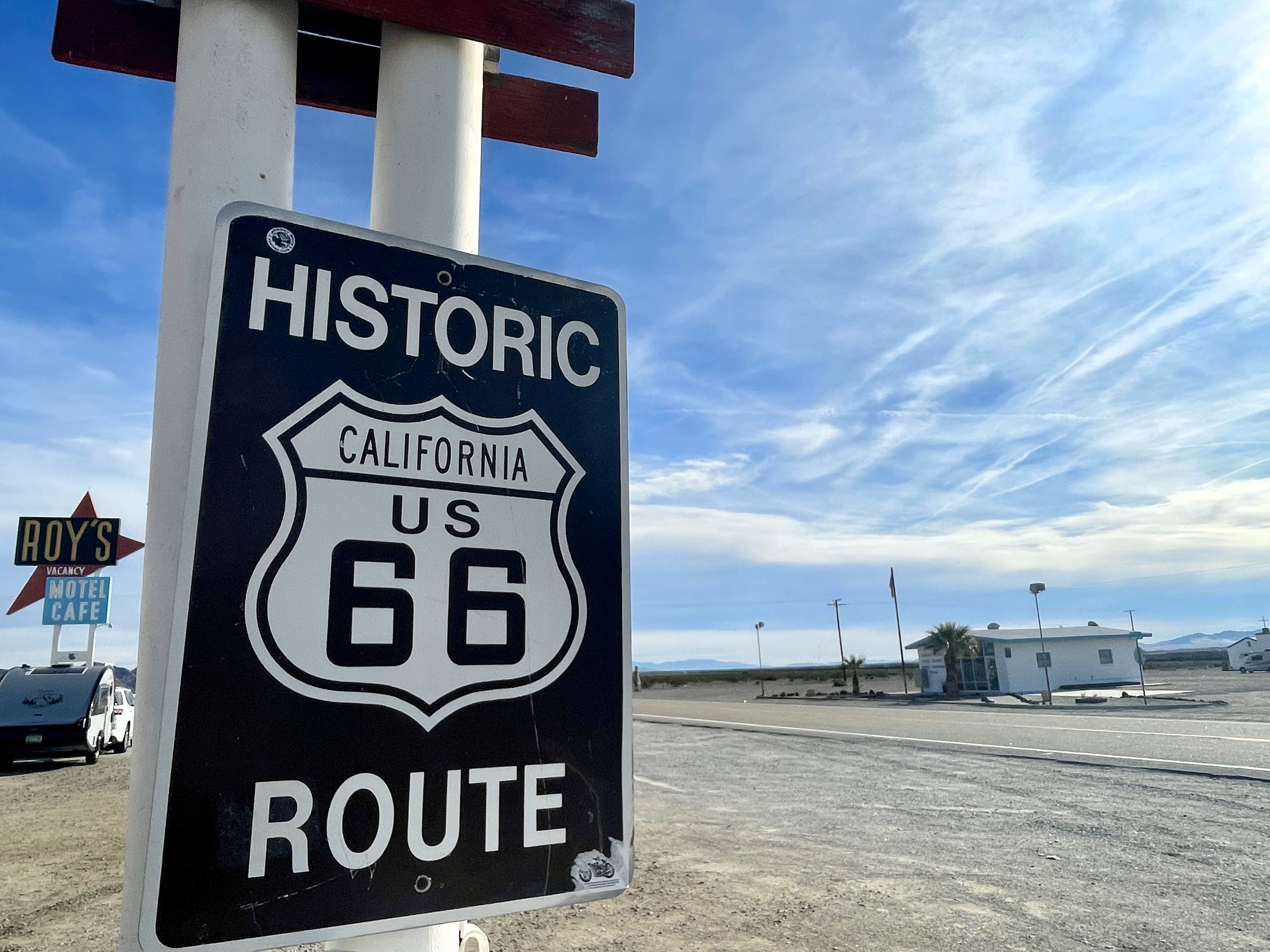
Amboy historic sign with a view of the post office building and Roy’s
A historic 1850 railway station settlement and later popular stopover on the historic Route 66 highway, Amboy is now just a shadow of its former self. It still boasts the old post office building, though services appear permanently closed, and Roy’s Motel and Cafe (and service station) dating back to 1936. Online information says these businesses are run by the four people who still call Amboy home, though when I asked the guy behind the counter if he lived in town, he gave me a good long suspicious look, asked me if I were a journalist or something, then told me, no, he does not live there but he drives in from about an hour away. I liked the nostalgic symbols of the 1950s travel heyday–the diner, the roadside motel signage, and the Route 66 sign–but I did not wish to linger; the place felt trapped in time. Most of the other towns that once existed in the area have been long deserted.
We drove on taking Kelbaker Road through another wilderness area and into the Mojave National Preserve. For a long while the preserve looked little different from the other stark landscapes thus far that day. I know there was much more diversity in the terrain off the main road, but as our time was limited, I had to make do with the drive-through. Once we crossed over the railroad tracks at Kelso, then safe from the potential cargo train delays, I took the opportunity to make a quick stop.
The southern entrance to the Mojave National Preserve and a stop at the historic Kelso Depot
The Los Angeles & Salt Lake Railroad built the Mission/Spanish Colonial Revival Kelso Depot in 1924, replacing the earlier building from 1905. The once thriving railroad worker town had long ago fallen into disrepair although there are still some workers living on the other side of the tracks and the National Park Service is preparing the building to house a visitor center. That day I met a National Park ranger and an intern with brochures, pins, and stickers on a table in front of the building; they were happy to answer questions. Again, I could not linger because I still had a long way to drive and also C refused to get out of the car to even read one information plaque. So, I got back in the car and continued north.
C stands in the desert alongside CA-127 as we await the green light to move past the road construction
It was another 40 minutes through the desolate Mojave desert to the town of Baker and then north again on CA Road 127. About 30 minutes north of Baker we were stopped by road construction. There was already a line of several cars and motorhomes. I wandered up to the lone construction worker holding the stop sign and asked how long the wait would be. He said we needed to wait for the “escort car” and it could be about an hour. Big sigh. There was nothing to be done about it though. There was no telling how long it would be for that “escort car” to arrive as looking ahead I could see no road construction at all. I used the port-a-potty (thank goodness they had one as I had been swigging down the water) and moseyed back to the car. Other travelers were wandering off into the desert alongside the road. Some were already quite far from the road. No one expected this to be a short stop. I alternated small talk with the guy on the motorcycle behind us and hanging with C in the car or on the roadside. It was about 45 minutes in total before the escort vehicle leading the group of cars from the far side of the construction came through.
The Ranch at Death Valley seemed an almost impossible oasis surrounded by an unforgiving otherworld.
We were now quite far behind schedule. C fell asleep in the car. My eyes glazed over the scenery as we drove on, and I took little in. Despite the occasional breathtaking view, the pretty oasis town of Shoshone, and the rather bizarre Death Valley Junction, reported to have a population of “less than four people” and a boarded-up building with an “opera house” sign, the view was mostly the same bland tan sand stretching for miles. From Death Valley Junction we turned west toward Death Valley and within 30 minutes we were pulling into the oasis that surrounds the resort complex of the Ranch at Death Valley, our accommodation for the next two nights. With a park the size of Death Valley, the largest in the contiguous United States, I knew we would want to stay inside rather than outside.
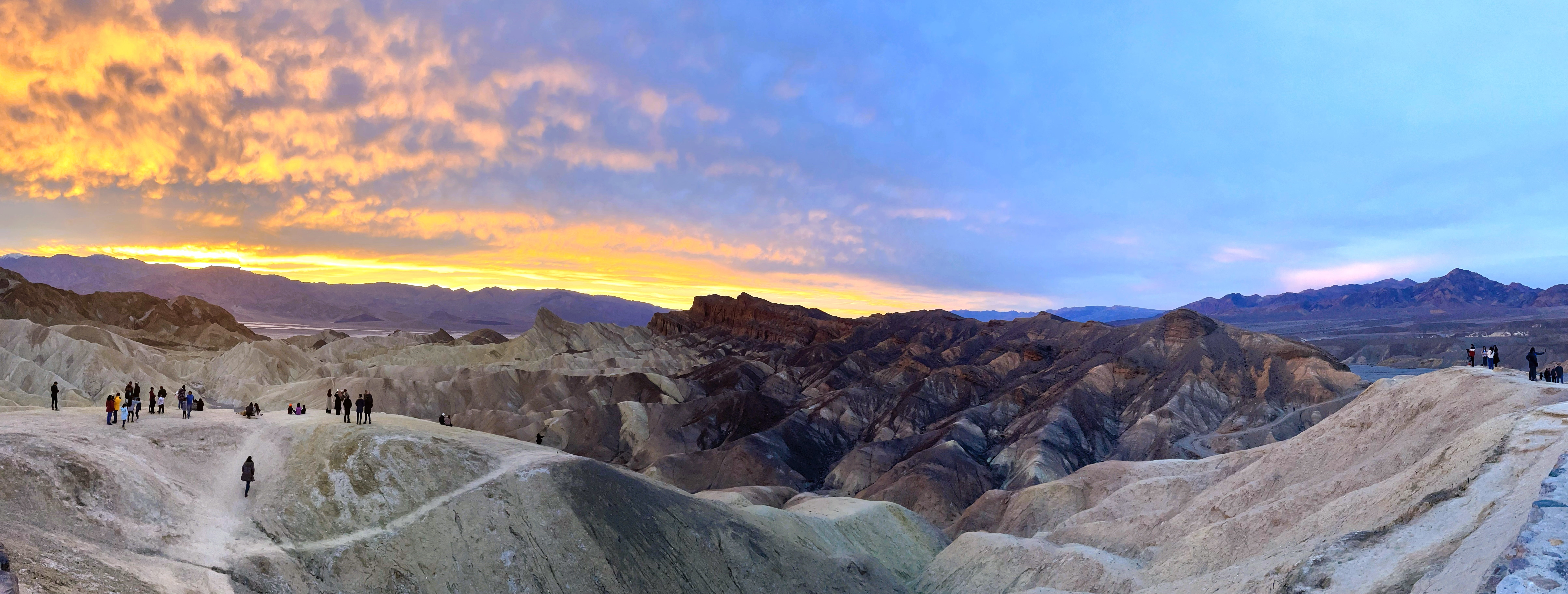
The stunning sunset at Zabriskie Point
As the drive had taken longer than expected, we had only so much daylight left. We checked into the hotel quickly and then drove back to Zabriskie Point. We arrived just around 3:45 PM, luckily scored a parking spot immediately, and sped-walked up the paved walkway to the viewing area. Spread out ahead of us lay the undulating convolutions of sentiment carved after millions of years. Breathtaking.
We had an hour to wait for sunset so we walked down to a dusty plain below. Perhaps the flattened area and dust left after years of borax mining in the area? We goofed off a bit and then climbed back up to watch an absolutely stupendous sunset.
In the morning, we made our way to Badwater Basin – the driest place in the U.S. and at 282 feet below sea level, also the lowest point in North America. At the time though, Badwater Basin was actually not dry as a small lake had formed after heavy rains the previous summer and some of that water yet remained. I had looked forward to photographs of the geometric salt polygons, but instead, we found piles of salt sticking up out of a glassy, shallow lake, like lumps of sugar in a giant cup of tea.
As we drove back from Badwater towards the Ranch, we stopped at the Devil’s Golf Course, an expansive plain of jagged salt crystals, and the Artist’s Palette. At the latter, we parked far from the site and walked over a few hills to get to the view of the swath of colored volcanic deposits on a hillside. Honestly? The palette was smaller than expected and lacking in variety; it was mostly a chalky mint color with a small spray of pale pink against the predominantly golden dirt. Still, it was fun to get there – especially after climbing up and over a few hills to then see a parking lot just below the palette…
The ruins of the Harmony Borax Works at Furnace Creek, Death Valley
Following lunch back at the Ranch, we drove only a short way to the site of the Harmony Borax Works, listed on the National Register of Historic Places. The 1880s to the early 1900s marked the heyday of borax mining in Death Valley. Harmony was the mining operation that opened the valley to large-scale borax mining and was famous for its use of 20-mule teams that hauled the borax across the valley to the railroad 170 miles away in Mojave, California, though it operated only five years from 1883-1888.
I then drove us 30 minutes to the Mesquite Flat Sand Dunes. As we had for the whole trip, we were racing the early winter sunset. Arriving at 3:30 PM, we would have an hour to crawl around the dunes before we would lose the light. Though large areas of sand dunes are not plentiful in Death Valley and the Mesquite Flat Sand Dunes are not the only ones, they are both lovely and very accessible, sitting just off the park’s main road.
The sun sets on the Mesquite Flat Sand Dunes
C and I climbed up and down the dunes, our feet sinking deep into the soft sand. We were having fun running hand and hand down the dunes until C smacked me in the face with the shoes she held in her hand and swung wildly as she ran. I opted to lope down the dunes beyond arm’s reach from her after that and to video her cinematic rolls and crawls on hands and feet. We watched an foolish driver in the distance with their car hopelessly stuck in the sand (an alerted ranger had to call in a team to get them out) and another foolish guy flying his drone above the dunes, expressly against park rules. But mostly there seemed a lot of happy people sitting or strolling on the dunes. Here we all were, experiencing the stark beauty of one of the most inhospitable places on Earth.
After the sun slipped below the horizon we headed back to the car and drove back to the Ranch. Though we had reservations in the fancy dining room there, we canceled them. After a day of exploring and hiking, we were up for a quiet night before we would depart the park the next day.
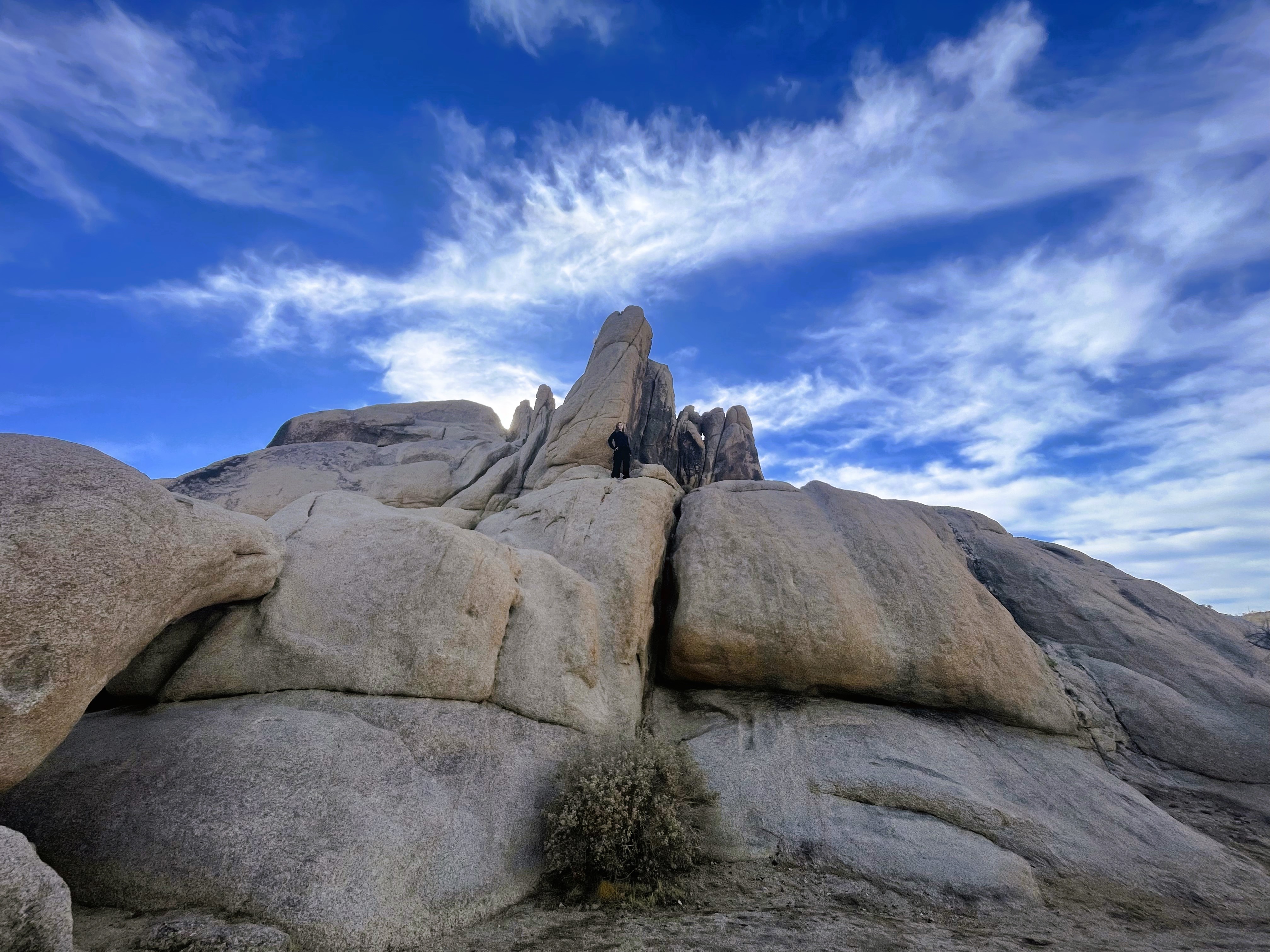
On Christmas morning, C and I woke not to stuffed stockings or piles of presents beneath a tree (we had done that the Sunday before we started our trip), but to a travel day. Today, we would completely depart from the itinerary of my 1984 family trip to Los Angeles. We were driving to Joshua Tree National Park.
C prepares to dance atop the rocks
Among C and my favorite things to do (besides seeing Broadway musicals, visiting aquariums, enjoying amusement parks, and eating at Hard Rock Cafes) is visiting National Parks. A big part of deciding on southern California for our winter holiday was the chance to visit some of the parks I have long wanted to. I wondered why my mother and Aunt L had not made Joshua Tree, just a 2.5-hour drive from Los Angeles, part of our 1984 vacation. Though they were not particularly outdoorsy, the bigger issue was that Joshua Tree did not exist as a national park in the 80s. President Franklin D. Roosevelt established Joshua Tree as a National Monument in 1936, but it did not become a National Park until 1994.
Sign at the West Entrance station to the park
C and I packed up, had breakfast, and called an Uber to take us to Los Angeles International Airport, where I had a rental car waiting. As it was Christmas, I fully expected another Chinese-American Uber driver, but instead we had an Algerian American transplant from the mid-west with a love for Italian pop music. As we cruised easily through the largely empty streets, I recognized the songs but could not place them. When I asked the driver, he told me it was Eros Ramazzotti, and I was transported back to the summer of 2000 when I backpacked through Europe and first heard these songs. This trip was giving me more travel flashbacks than I had anticipated.
Getting to the airport went quickly enough, but there was a long line at the car rental office. It took an hour to get through it, so we were on the road later than I had hoped. Still, the traffic, even on Los Angeles’ notorious freeways, remained light and soon enough we were beyond the city limits and heading into the desert.
We arrived in Yucca Valley, California, population 22,000, one of the small cities that lie along the northern borders of the National Park. We checked into our motel and grabbed a bite to eat at the nearby Denny’s so that we might get at least a little time in the park. I was reminded again that travel in the winter restricted our sightseeing with the sun setting so early, around 4:45 PM. Yet, summertime visits to the desert mean scorching temperatures.
Some of the vibrant flora of Joshua Tree
The drive to the West Station entrance of Joshua Tree National Park is 25 miles from our hotel in Yucca Valley. The winding road took longer than expected and the line to enter the park was also unexpected. But the park is popular for night sky viewing and camping, and it would seem the Christmas holiday is an excellent time to do it. So, once I purchased our annual America the Beautiful park pass from the ranger, we only time for a 30-minute drive in and a few photos of the eponymous trees set against rock formations and a pinkening sky before it was time to turn around. It was a great introduction to the stark beauty of Joshua Tree. C very much wanted to get out and run around and made me promise to let her scamper over the rocks on our return.
Bright sunshine over the grasses and palms of the Oasis of Mara
On our full day in Joshua Tree, we drove down the highway to Twentynine Palms to begin with the Oasis of Mara, north of the park’s north entrance. Unlike much of Joshua Tree, where the flora are primarily succulents, like the Joshua tree, the oasis has palms and grasses that survive with the underground springs. The indigenous Serrano people named the area “Mara” meaning “the place of little springs and much grass.” C and I enjoyed a little stroll around the oasis area.
Then we entered the park at the North Entrance. We turned off from the Park Boulevard and onto Pinto Basin Road. Soon after the turn off we came to our first grouping of large rocks at the Belle campground; C insisted we stop. She needed to climb! After a good long stop for rock scampering and photography, we drove on to the next stop at White Tank. The rock formations are impressive. These are actually not mere rocks, but massive granite boulders piled atop one another. Some more scampering on rocks occurred – with me joining in! – before driving on to the next site.
A cholla cactus stands out from the crowd
The Cholla Cactus Garden is an area just off the main road blanketed with some 10 acres of the cactus known as Teddybear cholla. These cacti certainly look cute and fuzzy but are anything but with extremely sharp barbs with a reputation to painfully latch on to passersby. There is a pedestrian trail, partially boarded, through these plants but one can get as close as one dares. That surprised me. Given the silly things that some people get up to in our national parks, visitors are still given quite a bit of leeway. After about a half hour there, C and I departed unscathed. We had already been in the park several hours and it was time for lunch. I had opted to drive out of the park into Twentynine Palms for lunch rather than to pack one. We grabbed lunch at a Tex-Mex place in town and then returned to the park.
Our first stop was Jumbo Rocks. It is an apt description as the size of the rock formations and boulders were easily the biggest we had seen that day and spread out over a larger area. This campground also seemed more popular and the crowds of visitors were larger than we had run into in the boulder areas off Pinto Basin Road. We parked where we could and followed the parking lot to a trailhead into the boulders. I think we got off the Jumbo Rocks trail on to the Heart Rock and Arch Rock trails. Then C just wanted to climb over whatever she could in whatever direction took her fancy. There were points – like around Heart Rock – where we saw many other people, and others where we might see no one else for a five minutes or so. We completely lost track of time. The weather was beautiful, the temperatures warm but very comfortable, and the sky sapphire blue. It was just us climbing up and down and between rocks.
Heart Rock and Skull Rock in the Jumbo Rock boulder area
But I knew we had only such much time given the early winter sunset. We made our way back to the car and drove on a little ways to the Skull Rock area. There we did more climbing amongst the rocks, but we did not have time for the same carefree wanderings. I wanted us to get to Keys View for the sunset with a stop at Hidden Valley along the way.
Unfortunately, at Hidden Valley the parking lot was completely full. I drove through four times very slowly – and we were not alone in doing this – but a spot never opened. I gave up and drove towards Keys View but there too we ran into an issue, the road was closed off with a sign “Road opens just before sunset” and a ranger standing sentinel to make sure visitors obeyed. But it was not long til sunset. As I turned around and left the turn off, rangers were closing off more of the road, not opening it. We would not get to visit one of the park’s primary sunset locations. I turned back toward Hidden Valley hoping we might still have a chance to visit and lucked out with a parking space on my third time through the lot.
Sunset at Hidden Valley
I planned to find the Hall of Horrors, a slim chasm between two high rock walls. I had read about it before the trip and wanted photos of C standing with legs and arms spread touching both sides of the Hall. I failed though to note the coordinates of the Hall and we wandered about aimlessly for 20 minutes without finding it or even a clue as to where it might be. C was chomping at the bit to get some more boulder climbing in and begged me to give up our search. Disappointed, I did.
Yet as the sun set across the boulders, desert, scrubs, and Joshua trees at Hidden Valley, we were treated to a magnificent burst of orange as the blue deepened in twilight. Perhaps sundown at Keys View was great that day, I do not know, but it was definitely perfect at Hidden Valley.
We ate a simple dinner from the supermarket in the motel room that night as we relaxed from our day of climbing adventures. I would have liked another day at least in Joshua Tree, but the following day would be a travel day on to our next destination.
It has been a year since C and I returned to the US after curtailing from Guinea. Now that we have been here awhile and begun to really settle in, I think its time to talk about the positives and negatives of Washington, D.C. as a place of assignment such as I did for Ciudad Juarez, Shanghai, and Lilongwe. (Sadly, we were not in Guinea long enough for me to experience many of the “pros.”)
The Pros
1. Greater Autonomy. Living overseas as part of a diplomatic mission comes with a few extra rules, requirements, and restrictions. There are the mandatory radio checks – call ins to the Marines Post using the Embassy-issued radios to make sure they are in working order in the event of an emergency. These could be weekly or monthly depending on the Post. We also must submit an “out of town locator” every time we travel, domestically or internationally, for security and accountability.
In some of my posts, like Ciudad Juarez, Malawi, and Guinea, mission personnel were prohibited from taking public transport. In Malawi and Guinea, one could not drive outside the city limits between sunset and sunrise, which within 15 degrees of the equator means half the day. When I was in Ciudad Juarez, we were unable to drive beyond the city limits further into Mexico and even some parts of the city were off-limits to us.
At each of my posts, due to either high visa numbers (Shanghai and Ciudad Juarez) or a small staff (Malawi and Guinea), scheduling vacation has been quite the production. Taking a big chunk of time off during the busy summer transfer season, like this past summer, was very unlikely. Even during my previous stints in the U.S. with the State Department I could not as the Foreign Service Institute allows for little leave during training.
But now? No radio checks, no phone trees, no out-of-town locators, no special travel restrictions. And vacationing is a whole lot easier! While not all D.C. offices might be so accommodating, I am very glad for mine. It is nice to have, at least for a little while, far fewer persons from work involved in my free time.
2. Mail That Arrives Fast. Gone are the days of waiting weeks and weeks for our mail to arrive. In Ciudad Juarez, we had a post address in El Paso, Texas, just across the border, and mail staff would pick it up every few days, so it might take only a week to receive our mail. In Shanghai, we had the Diplomatic Post Office (DPO) but our post was routed through Hong Kong, so the delivery times were closer to 10 days to two weeks. Yet, in Malawi and Guinea, mail took quite a bit longer; on average it would take 3-4 weeks, though sometimes longer. For Halloween, I would ask C what she wanted to be in August so we would be sure to have a costume. I would place orders in early November for Christmas and her birthday or risk them not arriving in time. But now? I can now place an order online with a retailer and have it within a few days, if not sooner. It seems quite miraculous.
3. Public Services and Spaces. While some Foreign Service Officers may spend their careers wholly or in part in developed countries, I have leaned toward the less developed, more off-the-beaten-track locales. There have been positive aspects to every place I have lived and served, but one category of things, which are often taken for granted when one has them and greatly missed when one does not are public goods. For example, sidewalks. One of my favorite activities is a nice long walk. Shanghai had many great sidewalks. Ciudad Juarez had a limited number. But they were nearly non-existent in Malawi and Guinea. While I do enjoy walking in an urban environment, there are also many public walking and hiking trails. Or biking, if I ever get around to buying myself a bicycle again. I also rather like public transit and although the U.S., with Americans’ love of the automobile, isn’t exactly a mecca of such, in Washington, D.C. and the cities immediately surrounding it, the bus and metro system is pretty good. Then there are the public libraries (oh, be still my voracious reader heart), public parks, and playgrounds. And museums! The Smithsonian museums of Washington are amazing and free. And schools: my daughter attends a wonderful public school she loves and is thriving in. Even consider emergency services. While the somewhat regular sounds of firetrucks and ambulances (my apartment building is within a mile of two fire stations) might sometimes be annoying, I recall how limited fire, rescue, and police vehicles were in Malawi and Guinea, and I am grateful we have these services.
4. Activities Galore. I have tended toward serving in more “make your own fun” kind of posts where there are often fewer locally organized activities and places to visit. One of the (quite a few) reasons we left Guinea were the few activities for my daughter. There were no summer camps or community centers or parks. While the school offered a limited number of after school activities, there was no late school bus for those who participated in them. I worried my daughter was missing out. Now that we are in Northern Virginia, she is spoiled for choice! The school offers many after school clubs and sports activities and that very important (especially for a working single mom) late school bus. C is participating in chorus and technical theater at school as well as math tutoring, guitar, and Scouts in the community. This past summer she attended summer camps focusing on space, tennis, and writing code. She has expressed interest in getting involved in some of the school sport teams and also maybe taking skateboarding, ice skating, or Irish dancing in the community. All of that and so much more is available!
There is also just more for C and I to do in and around town. In the year we have been back we have visited the Museum of Illusion, the National Portrait Gallery, the National Museum of Asian Art, the National Natural History Museum, the U.S. Holocaust Memorial Museum, Planet Word Museum, the National Zoo, and the U.S. Botanical Garden. We also attended two Washington Nationals baseball games, and saw Cirque du Soleil, the musical Evita, and a traditional concert of the Christmas Revels. There are just endless opportunities for recreation here.
5. Friends and Family. Living the nomadic life we do with so much time far from the U.S., we often miss out on seeing our family; and with so many friends also in the Foreign Service (FS) it is often difficult to catch up with them as they are scattered around the world. But an upside of now living in Washington, D.C. is my family is from the area and live not too far, there are friends from different parts of my life living here, and every FS family has to cycle through Washington at some point. In the past year, C and I have twice been able to see my sister perform on stage with her community theater group. We also attended my brother-in-law’s birthday party. My aunt came up to stay with us for a few days and we traveled down to her in Jacksonville for the Labor Day weekend. In March, we went roller skating with a group of people we served together with in Malawi; in June we met up with a FS friend and her kids at the Natural History Museum for a “Night at the Museum” family event. When friends from Guinea spent a few days of home leave in D.C., we got together with them and another family who had served in Guinea for a day of food and conversation. When other friends from our Malawi days visited D.C. in October, we headed out to Cox Farms for some traditional American fall festival fun. C was able to spend several days in New York with her paternal grandparents during the summer and Thanksgiving at her dad’s in Kentucky. There has been so much more, but the point is that being in the U.S., and especially in D.C., has given us the opportunity to spend more time with friends and family than we have in the past few years combined.
The Cons
#1 Cost of Living. Moving to Washington, D.C. has meant an adjustment in the personal finance department. Depending on which index you look at, D.C. may be listed as the fifth, seventh, or tenth most expensive city in the U.S., but it all points to shelling out more bucks to live here. Rents are particularly high and as a single mom, I am feeling the pinch. When overseas, our housing is part of our benefit package and when I have been in the U.S. on training between assignments, the Department has paid for my housing as part of per diem. This might sound a bit crazy (and I know after I say this I may lose quite a bit of sympathy points from non-Foreign Service readers), but this is the first time I am paying rent and electricity in over a decade. I do get the full Washington, D.C. locality pay, a bump in pay based on the cost of living in certain locales, but I, of course, am no longer receiving the plus up in pay from post differential (added compensation for service in foreign areas that differ substantially from the U.S.) or the cost of living adjustment (COLA; a bump in pay to counteract higher costs in another location). I am also just paying more in activity costs for all those great things we can do. But, I will say, with our wonderful library, my book costs have gone way down.
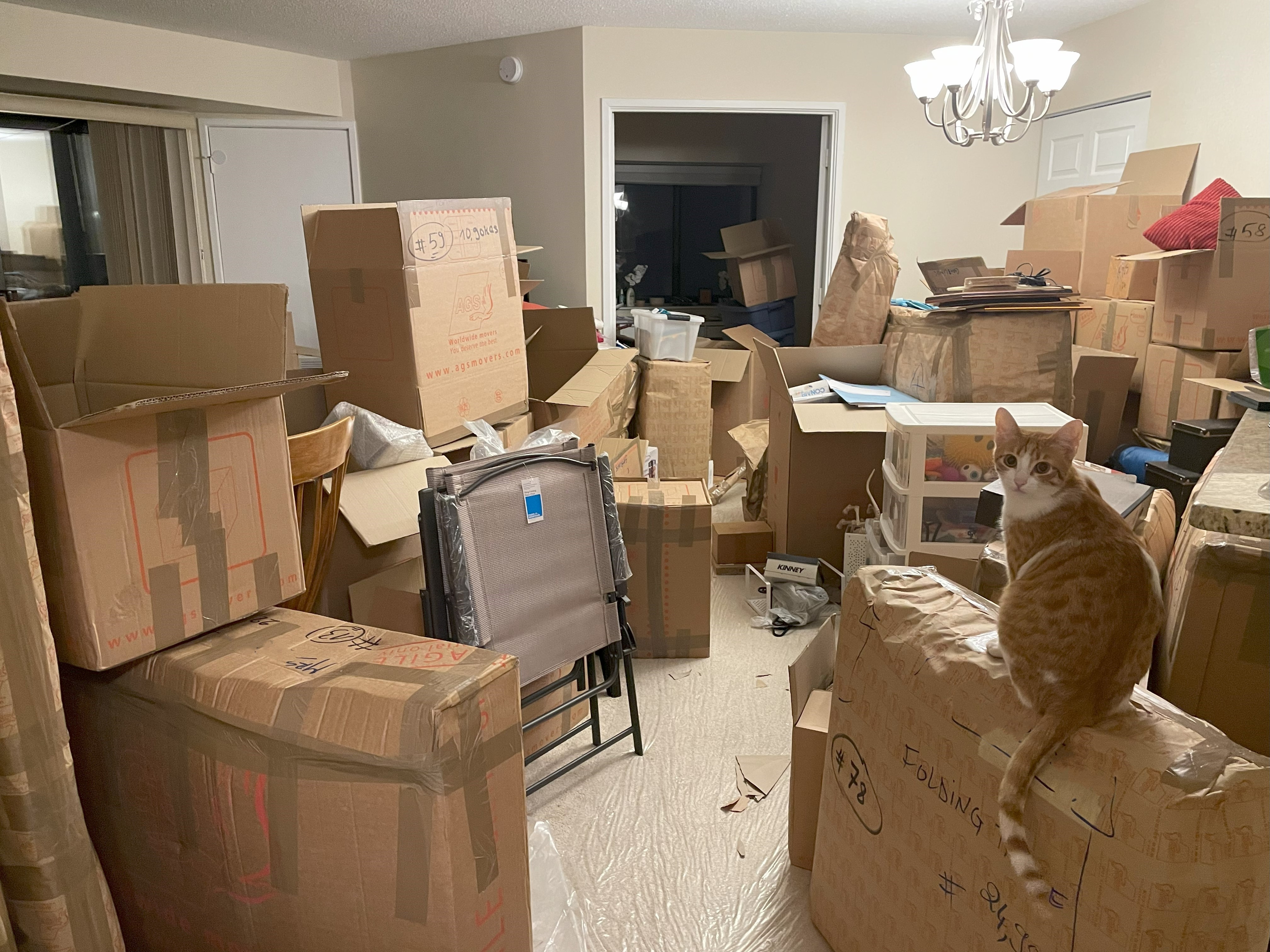
Ramen surveys the chaos of the living room after delivery of our HHE
#2 Smaller Housing and ALL Our Stuff. As previously mentioned, when foreign service officers work overseas our housing is provided as part of our benefits. With the exception of Guinea, I have been provided a lovely (sometimes quirky) three bedroom house or apartment; though our Guinea apartment was a two bedroom, it was very roomy. In D.C., I was lucky to find a nice two-bedroom just outside the city right by a metro (subway) station. It is an older build, so more roomy than many of the newer apartments, but it is still smaller than every one of my Embassy/Consulate homes. When we are in training in the U.S. between overseas positions, the majority of our things are kept in storage. This time though, every one of the 100 plus boxes of our household goods would be delivered to us. I have not had all of my things in the U.S. with me since I first went overseas to work for the government in early 2009. And I have bought quite a few more knick- knacks since then. And acquired a daughter with her own accoutrements. But with the help of a storage room in our building and giving away items in our local Buy Nothing group, we have made it work.
#3. Doing all the chores. I know this one, too, will not make me popular among the non-expat readers, but I keenly feel the lack of household support. As a single working parent, I have chosen posts overseas where I have been able to hire staff to help with the chores. I have had a housekeeper/nanny the previous four postings. In Malawi, I also had an amazing gardener who worked wonders with our yard. C has basically outgrown the nanny and we have no yard to garden, but the chores – the dishes, laundry, vacuuming, taking the garbage out, and more – are all now for me. Well, C is certainly old enough to help, so there is that. And, shhhhh, its a bit of a secret, but sometimes I find I even like to do some of it. There is also the lack of support from the Embassy on household repairs. When something needs fixing in our housing overseas you submit a work order and the facilities staff will take care of it. It isn’t always as fast as one would hope, but they get it done. Here, even though I am renting, I do have to manage the apartment more. When we first moved in, a handle broke off the closet door, the fridge water filter needed replacing, the oven started to smoke upon first heating, and the shower curtain bar fell (on top of me). It’s fine. It is just adulting without Embassy support – what the majority of people deal with. But it is something different.
#4. Winter. I am not a fan of the cold. For years now, I have tried my best to implement a winter avoidance strategy. Having lived in Hawaii, California, Florida, the Philippines, Indonesia, Singapore, Malawi, and Guinea, I think I can say that I have done a fairly good job. Even Ciudad Juarez and Shanghai were rarely very cold and the snow that came once or twice a year was light and short lived. Returning to middle of winter Northern Virginia from always tropical Guinea had been a shock to my well-laid plans. Having culled many of our winter clothes for a multi-year tour in West Africa, we were somewhat unprepared. Though 2023 was fairly mild, the winter of 2024 is predicted to be snowy. I missed D.C.’s major snow storms of the past few years like Snowmaggedon in 2010 and Snowzilla in 2016, but it is possible with several planned years in Washington, that my luck will run out.
#5. Fear of Missing Out (FOMO). I love living overseas and have done so for nearly 19 years in the past 30 in nine different countries. Though we have been back in the States for vacation and training, the longest stint, since January 2009, was the year I joined the State Department. I am a Foreign Service Officer, with the key word being “foreign.” In the past year, we have seen friends move to new countries like Ghana, Turkmenistan, Nicaragua, Kazakhstan, Cameroon, and Nigeria and others announce their next move to locations such as China, Mongolia, Germany, and Laos. I feel a twinge of envy reading every one of these, knowing the mix of excitement and trepidation when one gets a new assignment and then starts it. I know though that staying here in Washington a bit longer was the right thing to do for myself, my daughter, and the cats. Believe you me, the cats really would like to prolong the time before I next shove them into a carrier for another 30-hour journey.
All-in-all, although I do miss the good things we experience overseas, every place comes with the good and the bad, and the positives far outweigh the negatives here in D.C.
This is not where I expected to be: neither in Washington, D.C. nor bidding for my next job. I expected to still be working in Guinea and to have another year before my next bidding cycle. But, here I am.
It was in 2020 that I last went through the U.S. Foreign Service bidding cycle, when those whose tours are coming to an end apply, or rather “bid,” for their next assignment. With nine months of training and then a planned three-year tour, I expected to work in Guinea until the summer of 2025, with bidding then landing in the fall of 2024. Unfortunately, for a host of reasons, I curtailed from my assignment in Conakry after only six months, and returned to Washington in January 2023.
I landed a great assignment in the Afghanistan Special Immigrant Visa Unit reviewing application documentation from Afghans who were employed by or on behalf of the U.S.. When Kabul fell and the U.S. made its final withdrawal from Afghanistan in August 2021, I was on my Home Leave between my assignment in Malawi and starting my training for Guinea. As many of my colleagues assisted with the final evacuation or with Afghans resettling in the U.S., I felt useless watching it unfold and not being in a position to assist. With my current posting, I am now able to help in a small way.
Conventional wisdom in the Foreign Service says that an officer should spend the first two tours overseas and the third in D.C. And plenty of people follow this playbook. The thing is everyone knows an exception to the rule, including quite a few high level officers. For me, I figured A. I spent several years working for the federal government in Washington before joining the State Department and B. The high cost of living in and around the nation’s capital is not at all single-parent friendly.
Yet at the beginning of 2023, counter to all my best-laid plans, I found us in Washington. A condition of my curtailment was to work here at least one year, and I was lucky to secure a position for a year and a half. Though a part of me would like to be abroad again, another, much stronger, part could not fathom moving again so soon. We had moved three times in nine months. To Guinea in June 2022, to temporary housing in the States in January 2023, and then into more permanent housing in March 2023. Throw in the second half of our between tours Home Leave with a trip to Grand Teton and Yellowstone and then nearly two weeks in a hotel and it’s more upheaval. Add in our departure from Malawi and then Home Leave in Florida in August 2021 and then the move to Virginia in September 2021 for nine months, and the tally is five or six moves in a 20-month period. Guinea was supposed to have been for three years. My daughter, my cats, and me, well, we deserve to settle in for a spell.
And so this is where I found myself: bidding earlier than expected, bidding from a different place than expected, and bidding on different jobs than expected.
On the Auction Block
It is not easy to explain the whack-a-doodle (why yes, this is a diplomatic term) process the Foreign Service has its mid-level diplomats go through to procure their next assignment. Here we are, having already passed a multi-step rigorous entrance exam to join the ranks of the diplomatic corps, every two to four years in a stressful and time consuming competition for our next assignment.
I have bid mid-level twice before. The first time was in 2016, when I tried to compare it to how teenagers might finagle a date to the homecoming dance. My second mid-level bidding session occurred in 2020, smack in the middle of all the weirdness of the first six to eight months of the COVID-19 pandemic, when I attempted to equate bidding to buying a house in a very competitive market. This year though, the whole thing felt more like an auction.
It is not a perfect analogy. Though I have not been to a live auction, I have seen them portrayed in movies and television, and they move with lightning speed. You have an item up for bid, the auctioneer gives a little introduction and then a starting price, and then away it goes. Within minutes the item is sold and the next item is up for bid. The government, however, does not do anything quite that fast. Our bidding is a slow burn that takes place over weeks. We have our catalog of open positions with written descriptions and we set up calls with the incumbent to gather more information. We can see in the system how many people are bidding our target jobs, but we are not in the room with them. We do not know how serious their bids may be, we do not know what they are bringing to the table. They might raise their paddle to express interest, but they can later decide not to make a final offer. We are hoping that our bid package–a combination of our past assignments, references, and interview responses–will make us the highest bidder on at least one of our preferred jobs.
In the early days of the bid season, I felt very much like a competitive bidder. With multiple tours under my belt at different posts (some Consulates, some Embassies, and now a DC job) and in different career tracks (some consular, some political, and now a management designated one), I felt fairly confident as I strode into the virtual auction houses. During interviews I felt like a bidder on the edge of her seat, straining to hold my bid paddle higher than any others, basically yelling “pick-me!” with every response.
However, as the day approached to lock in bids, I felt less like a bidder and more like the auctioneer trying desperately to sell myself, the “as-is” vase sitting alone on the pedestal in the glaring spotlight. “The next item up for bid is this capable mid-level officer with twelve years in the Department. She has both consular and political positions under her belt. She is about as handy as a pocket on your shirt. Let’s start the bidding at….” The power had shifted to the offices, who were now the buyers. Would any one of them bid on me?
Joining the Club of the Unassigned
The bid season lasts approximately eight weeks. For the first five weeks, bidding officers and offices with open positions prepare their respective bid cards, with bidders figuring out which positions will make their official bid list and offices ranking those they interview. At the end of the five weeks, bidders lock in their final five to ten bids in the system and hit submit. During the last three weeks, offices work out who they want. Shortlists of the top three to five candidates are made. Those who make the shortlists are informed. Top candidates will be sent a “Bureau Leading Candidate” (BLC) email about five days before the last day of the official bid season. Offers, called “handshakes,” are sent out on the last day.
I did not receive one.
While many may receive one or more offers on Handshake Day, a good many will not. This year I noticed several emails touting the statistic that 30-50% of positions remained unfilled a month after Handshake Day. Still, though we are told this and we tell one another its normal and not to put too much stock into it, when you see many friends and colleagues posting about their next assignment on the day, it does not feel all that great to be without.
And this was the first time I had not received a handshake on the day. During my first go-round my offer arrived two days late though it was dated handshake day (the bureau, it seemed, had forgotten to send it). In my second mid-level bid season, I received two BLC emails (not really a humble brag — my strategy? Bid jobs with few to no other bidders!), and once I made my preference known, the official offer came on Handshake Day. Nonetheless, this time, I had become an “unassigned bidder.” The auction had closed, and I had been swept off the display table to be stored in a back room until I found an office to proffer me the coveted handshake.
Success at Last!
Luckily, though Handshake Day might be the end of bidding for some, for others this is when things just get going. In this auction, an individual can only be the successful bidder on one item; any unfilled positions are then back in play. A week after Handshake Day, I was back searching the available jobs and found not only a few new-to-me unfilled positions, but also positions still open among my top four choices! Two weeks after the official Handshake Day, I received an offer for one of my original top desired jobs and I readily accepted. The day after I received another and had to turn that one down. All’s well that ends well, I suppose, but I am glad to be done with it, at least for (fingers crossed) two more years.
Our next assignment: Another domestic job in Washington. (I know, the whole title was a spoil alert!) I will be a Career Development Officer, like an assignment counselor, for first and second-tour officers. And for the first time in my Foreign Service career, I will not have to move when I change jobs.
Amish carriages parked in the early morningin Ronks, PA
One of the good things about being in the U.S. now are the many opportunities for wonderful weekend getaways. And though my 11-year old is extremely well traveled internationally, she has far less experience in our home country. It is important to me that she has the opportunity to see sights around the U.S. that also introduce her to the variety of cultures, history, people and places that our nation offers.
For the Veteran’s Day weekend, I decided C and I would visit Lancaster, Pennsylvania. I have vague memories of visiting the area when I was a child, perhaps 8 or 9 years old, with a friend and her mom, also a single mother. But other than having spent a day there, I had no other recollections. With good weather and a fair amount of trees still in their autumnal leaf glory, Lancaster seemed a great place to get away from our every day.
A delicious assortment of macarons at Bistro Barberet
Our first stop in Lancaster was the Bistro Barberet, an authentic French restaurant and bakery owned and operated by an award winning French chef located in the historic downtown area. C loves French pastries and desserts and insisted she needed some bona fide macarons a.s.a.p. She left with the macarons, which must have passed muster as she ate every one of them (I got none).
Next we headed to the Lancaster Central Market. Founded in 1730 as part of the town’s original design, the market is the longest continuously operating public market in the country. It’s 60-some vendors offer a little bit of the old – from fresh local produce, homemade canned and dried goods, and family-owned meat, seafood, and poultry options – to the new, including Puerto Rican, Thai, and West African foods. Once inside, C immediately made a beeline for the West African stall as she identified the flags of Guinea and Liberia on the stall at once. Though we had not really immersed ourselves into the local food scene in Conakry, the flag was a pleasant reminder of both our personal journey and the international connections around us. C really loved the market. She tried the local favorites like soft pretzels and whoopie pies, and declared the market a wonder that she wished were closer to us.
Hankering for something a bit more substantial for lunch, we headed up the street to Brooklyn Pizza Grill & Pasta. It was a little chilly and overcast with a slight drizzle outside, but the wafting smell of fresh baked pizza, the heat from the ovens, and the cheery greetings from the staff were very welcoming. There are only a few tables, so we perched on bar stools at the small table in the window as we chowed down on delicious hot and greasy New York style pizza as upbeat salsa tunes encircled us. Fantastic!
That afternoon we had bookings for the Amish House & Farm tour. For some reason, I thought the tour meeting spot would be just nearby, and when I learned I had a 25-minute drive we made a hasty retreat over. I was a little surprised to find an 1805 farmhouse in a Target-anchored shopping center, but we ended up having a wonderful tour. We started with a 90-minute bus tour through the surrounding countryside accompanied by commentary from the guide on the history and culture of the Amish. We made three stops at Amish businesses along the way. At the first we never even got inside the store as the small petting zoo with adorable goats, the soft pretzel stand, and the large bin of free pumpkins kept C and I plenty busy during the 15-minute break. The second stop was a small single-family run housefront store with handmade goods, many made by the family’s children. At the third, we spent nearly the entire time in the barn as C and several other children from the tour oohed, aahed, and cooed over a little of adorable havapoo puppies for sale. Back at the farmhouse, we had the opportunity for a further 30 minute tour of a mostly typical Amish home. Though I think the puppies were C’s favorite (ok, maybe mine too), the tour was very educational for us both.
Our “room” at the Red Caboose Motel at Paradise Station in Ronks, PA
We were to also have a self-guided tour of the adjacent farm, but with the recent time with daylight savings, the farm was far too dark to check out when we finished the house tour. We drove on to our hotel–the delightful Red Caboose Motel in Ronks, PA, where we would spend the next two nights in a renovated train caboose. We loved our room at once – it was cleverly converted and very cosy. C had her choice of 4 bunk beds but chose instead to squeeze in with me in the double; though she often asserts her independence, I think she might have been intimidated by her first stay in what essentially looked like a train yard. Dinner (and the following morning’s breakfast) was hearty portions of Americana in the Casey Jones’ restaurant where patrons sit in two train dining cars.
It is perhaps impossible to capture the pure joy of experiencing this view first hand – the crunch of frost covered grass beneath one’s feet, the evaporating chill still tingling the nose, and the calls of the boys to their horses in the fields
When we woke up the next morning there was frost and a fine mist hovering over the ground. Though chilly and in the upper 30s (Fahrenheit), the sun and sky were bright and clear. Before breakfast, I grabbed my good camera and did a perambulation around the property. The view across the fields was absolutely stunning. I do love our neighborhood in northern Virginia, but though the residential streets are tree-lined and there are plenty of parks, it cannot compare to the beauty of open land. I do not think I am designed for country living, but I sure do enjoy taking time to drink it in.
Wheatland on a lovely autumn day
After breakfast, C and I headed to Wheatland, the preserved home of the 15th President of the U.S. James Buchanan. Buchanan, thus far the only bachelor president and the only one from Pennsylvania (though some are now divided on that President Joseph Biden was born and lived the first decade of his life in the state before his family relocated to Delaware), was a controversial figure who, though an accomplished statesman, is probably most remembered (when he is remembered) for presiding over the succession of the southern states and the start of the Civil War, which began just six weeks after he left office.
It was a very good tour. C, who has often seemed bored by house tours, was well-engaged by the former 5th grade art teacher turned tour guide. We were also a small group of six; in addition to C and I there were two 20-something male history buffs and, as luck would have it, a just-retired Foreign Service couple. What are the odds? There were a few things that struck me as rather extraordinary about the tour: 1. the 20-minute introductory film makes no bones about the controversy surrounding the man and 2. that so much of the furniture and decor were not only original to the house and family but that we were free to move around (though not touch) the rooms. In nearly every home of a person of such historic value, the rooms are cordoned off in some way, with either carpet runners you must stay on or by stanchions or plastic barriers that allow guests only too close.
We crisscrossed the county again, grabbed lunch at a small mom & pop taqueria, and then headed to the Strasburg railroad where we boarded a luxury lounge car for a leisurely 45-minute out-and-back ride on the country’s oldest continuously operating steam train. C’s pre-teen tendencies were beginning to show as she grumpily dropped into her velvet armchair; though the fun of an historic train ride did not perk her up, an iced tea and a M&M brownie did the trick and soon enough she conceded it was sort of interesting. I enjoyed the ride, though would have liked it more had it been a wee bit longer. It felt that as soon as we got going it was time to turn back and then it was over.
After the train ride, we drove along the back country roads visiting a few of Lancaster’s covered bridges. I had not realized at first that there would be so many such bridges as they are often more associated with New England, but there are at least 20 of them in the county. We passed by four of them, but it was the Kurtz Mill Bridge, dating from 1876, that provided the best opportunity to really see a covered bridge due to its location in the county’s central park.
C leaps at the Kurtz Mill Covered Bridge
On Sunday morning, I took one last stroll around the Red Caboose Motel grounds, listening for the clip-clopping of the Amish carriages on their way to a friend’s or neighbor’s home. C and I then packed up and made one final stop in Lancaster, so I could take a photo of the Lancaster County Prison, which the mid-18th century town leaders decided should be built like an English castle. Just another unique feature of Lancaster, I suppose.
I was reluctant to depart and head home; it was a great weekend away.