Restoration on the Lower Lake

30

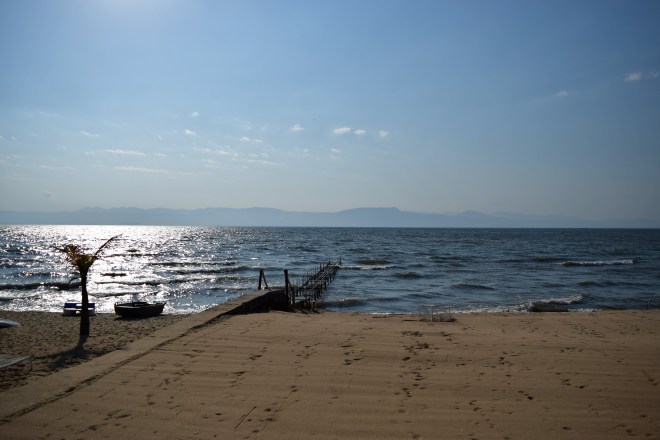
Beautiful early morning view of Lake Malawi from Sunbird Nkopola

It was a long summer.

I mean, weeks and weeks and weeks of covering for other positions empty during a transition gap, different duties due to a dearth in staff, and the unexpected because it was summer and we were short staffed and by Murphy’s Law this meant an uptick in political, economic, and consular activities.  It is one thing to anticipate it, but another to live it.  Do not get me wrong–I am not lamenting the work, much was quite interesting–but I was envious scrolling through the photos from weeks-long Home Leave or vacations of friends.  I might have had a wee bit of uncharitable, or rather undiplomatic, thoughts when a colleague told me in mid-August how he was so ready for a vacation, six weeks after returning from a month off in June.   It took a great deal of my diplomatic training to just smile and say “I hear you!” and not trip or shove him.  Diplomacy is such an amazing art.

It will still be six more busy weeks before C and I take off on a much deserved out-of-Malawi mommy-daughter holiday, but I decided that at least for the Labor Day weekend we would get out of Lilongwe, tackling some place on my Malawi bucket list.

Lake Malawi is the third largest lake in Africa and is sometimes called the “Calendar Lake” as it is approximately 365 miles long and 52 miles wide.  On the western shore of Lake Malawi, about ten miles north from where the lake ends, narrowing drastically as it flows into the Shire River (pronounced Sheer-ray), lies the small lakeside town of Nkopola.  This was our destination for the weekend.

32

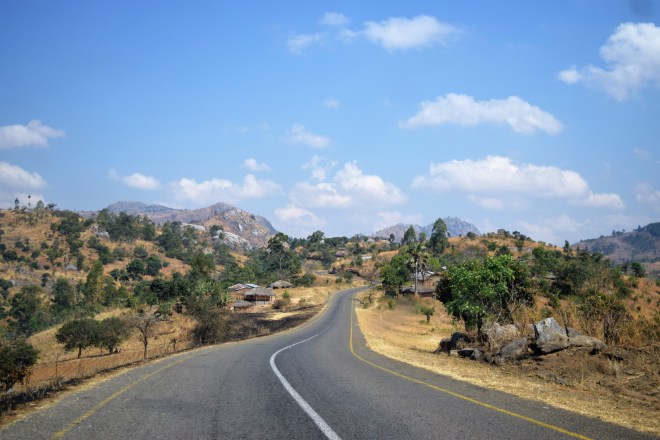
The road through the high hills

Malawi is surprisingly hilly (surprising to folks like myself who prior to arriving had little knowledge of African geography).  The country sits at the southern end of the East African Rift; the north and central western portions of the country an undulating series of hills rising and falling between 2,000 and 5,000 feet above sea-level.  I decided instead of heading east and then south, we would first head south on the M1 and then just past Dedza, which skirts the Mozambican border, turn to bisect a high hill range towards the banks of the lower lake.

I had heard the road would bend and curve, yet I was still unprepared for the serpentine twists that with each turn would reveal yet another stunning view of the stark, yet beautiful, countryside.  Little traffic (there was more foot traffic than vehicles) meant I could stop on the road now and again for a few moments to snap a photo or simply gaze in happy astonishment at the vista before me.  C too gasped occasionally from the back seat.  This road took only about 40 minutes of the three and a half hour drive, but it stands out in my mind.

4

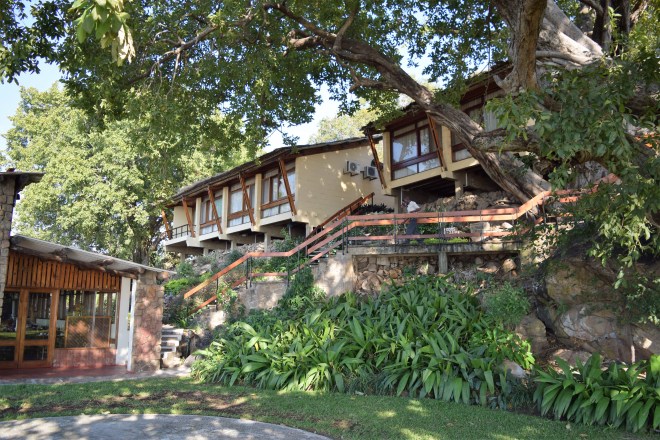
Rooms built against the rock face

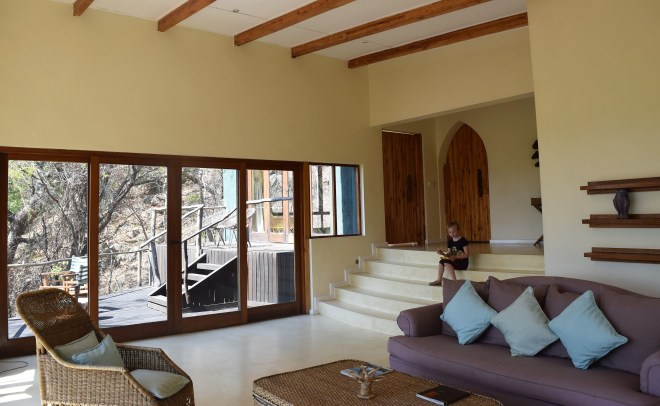
We arrived at the hotel just at lunch time and happily checked in, finding we had been assigned one of the unique rooms built into the face of rocky outcrop fronting the beach.  The rooms themselves were nothing to right home about.  There was a decent queen sized bed, a nondescript desk, and a too large chair that would not push under the desk enough to allow easy passage between the bed and desk.  Outside our window a large cactus obscured almost all view of the beach.  But you could hear the waves, see the bright sunlight glinting off the cacti thorns and a brilliant blue sky between cactus spines, and C breathed in deep and declared the air to be fresh and clean.

The room may not have been all that, but the lush hotel landscaping, particularly on the side of the grounds where are room was located (the other side were ground level rooms and rondavals with much less greenery) certainly made up for it.  Hungry we headed to lunch.  The tasteless interpretations brought to us left so much to be desired, but it being hot and beachy, we had little appetite anyway.  C just wanted to get her swimsuit on and enjoy the water.  Pool, lake, whatever.  We headed to the pool where C quickly made friends (it helps to bring diving fish toys and a giant inflatable sea turtle on which at least four kids can ride), and I enjoyed a book.  I felt inexplicably angry about the lunch service, but I could feel the tension beginning to melt away.

2

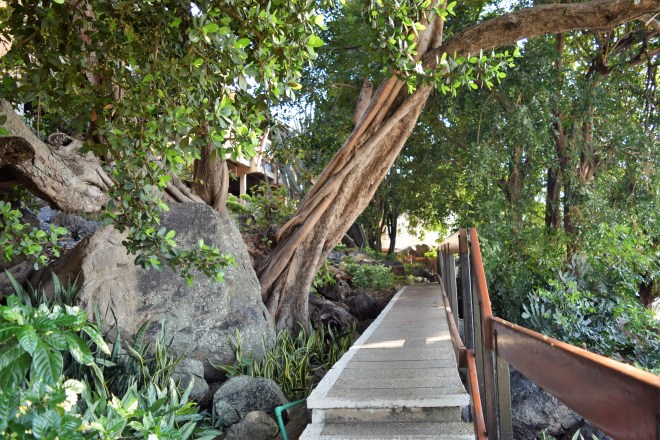
The pathway to our room

We had a quiet evening.  By that I mean we did little but hang out in our room watching a Marvel movie on the television and dining on the half decent version of room service pizza.  However, a large conference of Malawian auditors rocked on late into the evening, the thumbing music from their venue reaching even to our location at nearly the furthest room away.  Still we slept well.

After breakfast on Sunday we drove the twenty or so minutes to the township of Mangochi.  Once called Fort Johnston during colonial days, it was originally established in the 1890s as a defense post on the Shire as it flows from Lake Malawi and as a deterrent to the Yao slave traders.  Today there are few traces of this colonial past.  We stopped to look at the Queen Victoria Memorial Clock Tower built in 1901, its dilapidated clock face almost entirely missing, and a cannon from the Gwendolen, the Mangochi-built British gunboat and the largest ship to patrol Lake Malawi. It took almost as long for me to write that sentence as it took to circle the clock tower and read its historical markers.

24

Despite its condition, the fact it remains standing and its placement at the edge of town and ahead of a bridge over the Shire, make it worth at least a cursory visit

C and I then headed over to the Lake Malawi Museum.  I only know of three museums in all of Malawi and I have been to “museums” in developing countries before, so I had set the bar appropriately low despite the surprisingly high marks on Google Reviews (six reviews giving it an average of 3.8 stars out of 5).  As we approached the single story ranch style building, which resembled a cross between a warehouse and a home, a sad metal playground consisting of a slide and the cross bars of a swingset without the swings in the yard to the right, it was not immediately clear it was open or operational.  The wide concrete slab in the yard likely a parking lot for cars that never come.  But two individuals, a thin older man and woman, sat on the porch next to the open door, giving more the impression of squatters than museum curators.  As I read the entrance fee of 500 Malawian Kwacha (USD 70 cents) and tried to hand over the money to cover both C and I, the man informed me in garbled English that the museum, though technically open, had no electricity.  I said that was fine, we would still go inside, figuring some windows would still provide some light.  But there were no windows and the darkness inside was near complete.  Not wanting to miss out on one of the major attractions of Mangochi, I asked the man if he had a light.  He pulled out a small torch and I lit up the flashlight on my phone and together we made our way through the tiny museum, past sad dioramas of Malawian wildlife, a replica of the deck of the Gwendolen, and a pathetic aquarium.  Well, if it had had fish it would have been poor, but the four small tanks empty of water and life did not even rate it the name “aquarium.”

As I handed over the money and thanked our torchbearer, and turned to leave, I mentioned to C it had been a waste of time.  She however insisted we go back inside one more time!  She said she had not seen enough of the boat deck, though I noted given how dark it was, it was hard to see anything at all.  She was adamant so we had a second visit.  C gave the museum 5 stars; I give it 1/2 a star, due in a large part for the amusing adventure of going through it in the dark.

14

Beach view from the rockface stairs (the monkey on the roof also enjoying the scene)

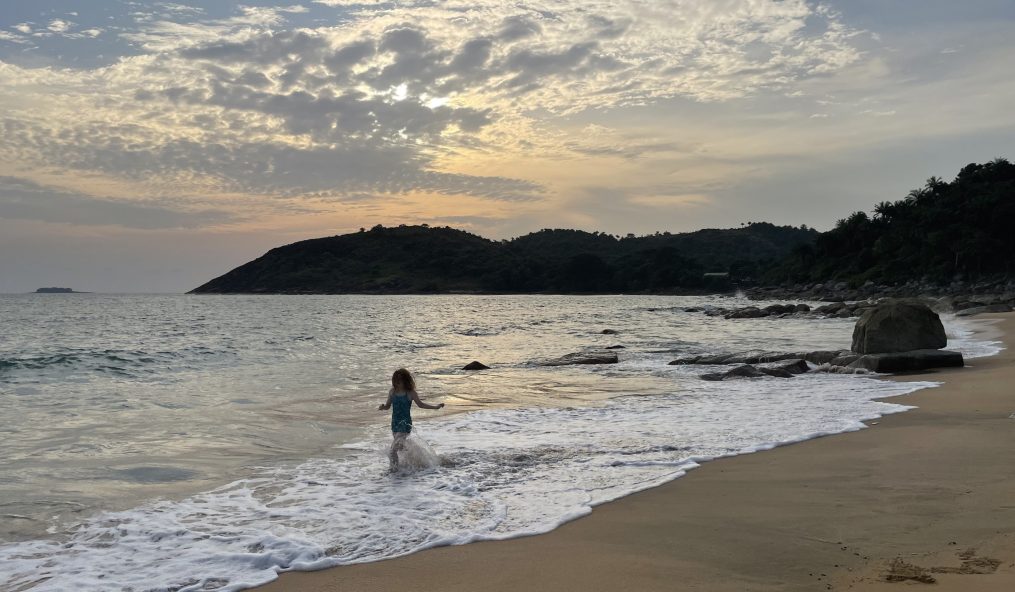
Not relishing another poor lunch at the Sunbird, we had lunch at another nearby resort and then stopped at a wide expanse of dirt where dozens of goats were lazing about.  C dubbed it “Goatland” and boasted that she would easily catch a baby goat and implied we would then toss said goat into our car in and add to our growing menagerie.  Though I made it clear we would not be making off with some villager’s goat, I am glad C is not as good at goat catching as she proclaimed.  We then spent several hours on the beach – C playing in the surf and in the sand, with myself again reading a book.

The following morning I felt completely refreshed.  I took some time to just breath in the lake air and listen to the soothing sounds of the lake waves and the twitters of morning birds.  The restorative powers of a beach, nature, rhythmic swells, felt almost overwhelmingly strong.  Once again I felt surprised how even a few days of a change of scenery could do so much for my spirit.  C and I snuggled for a bit; how I love sharing these moments and places with her.  Then we packed up for the trip home.  Even the drive made me happy.


One Year in Malawi

It has been one year since we arrived in Malawi.  I have killed approximately 3,755 insects.  This includes the Great Moth Massacre of 2017, when overrun with small light brown moths whose exuberant spawning blanketed all outside walls of my home drove me to terribly irrational behavior.  I grabbed one of my black slip-on Skechers and ran outside smacking moths right and left, determined to end the lives of at least 1000.  I did it, but my temporary insanity rubbed the skin of purlicue  (the fascinating word for the web-like area between your index finger and thumb) raw of my right hand.  There was also the Terrible Termite Invasion of 2017.  While sitting at the dining room table, a few winged termites lazily swooped around the room.  I wondered how they had come inside and wandered into the kitchen to search for the wonderfully named bug spray, Doom, only to find hundreds swarming around the ceiling light.  My reaction may have involved some cursing, mild screaming, and some jester-like leaping about.  There were also bees in my bedroom and wasps in the yard, and evidence of large spiders lurking about (about an inch and a half diameter — two found dead in my home but one killed with a bloodcurdling screech as it ran across the room straight for me in Majete).  And of course mosquitos–after all we take antimalarials daily.

I am on my third stove due to some of the frequent power outages, or rather the subsequent surge after the power came back on.  In all my previous years in so many employer-provided homes around the world, I had not lost a stove.  But here I lost two; they literally went up in smoke.   Then in the midst of the dry season I awoke to find my house flooded.  A pipe on my water distiller, needed as we of course cannot drink the water, disconnected and water flowed full speed for hours through the night, covering the kitchen floor, making its way through the dining room, down the hall, and seeping into the hall bathroom and each of our bedrooms.  And today I find myself once again at the Kwik Fit mechanics next to the Embassy for my second punctured tire from nails in the road.

It’s all just part of living in Malawi, or just part of a certain level of living in the modern world.  Sure I may have experienced more insects and electrical issues here than in other places I have lived, but these basically mirror the lives of friends in the US – bust water pipes, malfunctioning appliances, pest control issues, and flats.   Malawi is our home.

And we have really settled in.  From our glorious garden to the joy of having fresh eggs provided daily by Carmen, Can, Leash, and Lou, our sweet egg-laying chickens (they love being pet!), our home is an unexpected oasis such that I have never experienced before.  This jet-setting world traveler is quite happy to spend my weekends idly circumventing the yard, sitting on our konde (screened in porch) listening to bird song and feeling the breeze, or better yet napping in my hammock.  On Sundays we hold “chicken run” days, in which we let our birds have free range of the yard for 10-20 minutes.  And we have acquired yet another family member!    After lunch with friends at the delicious Chinese restaurant at the Golden Peacock Hotel, our daughters excused themselves early to explore and returned with news of something you just have to see!  Behind the kitchen doors they had found a cage crammed with rabbits…and that is how Judy the Bunny came to live with us (released to us—and our friends who rescued one too—for 4,000 Malawian Kwacha or about $5.50). A handy friend is building her hutch, while Judy currently enjoys the konde and the bounty of our garden.

We are settling in in other ways.  I have rekindled my passion for reading.  Well, I never lost my interest in reading, I simply didn’t have the time or energy to do so.  Yet over the past six months I have happily devoured at least 30 books.  While that may not seem much to some readers please consider my occupation, my parental status, my prolific writing (!), and other hobbies like traveling and dabbling in small-time farming and chicken and rabbit rearing, and then my ability to read is nothing short of a miracle and should probably get me some kind of spot in the Guinness Book of World Records.  Am I right?

C (and I) made it through her first year at Bishop Mackenzie International School. Although she had attended preschool in Shanghai, this was full day school including riding the bus. Well, full day for what BMIS calls “lower primary” is only 5 1/2 hours, but with bus times she is gone 6 1/2 hours.  For this night owl raising a night owl, it was the early morning hours that posed our greatest challenge. C’s bus picks her up at 6:30 AM!! To make sure we don’t miss the bus I wake up at the crack of dawn, or even before (!), then the  nanny arrives at 5:30 to wake C the beast and get her ready for school. On weekends we revel in sleeping in until 7.  But as hard as it is for C to drag herself out of bed in the mornings, she loves her school and so do I.  And now my sweet, funny, smart six year old just started first grade.

And work.  Wow.  What a year.  I arrived having never before done this particular position and being the only one.  Learning on the job is a State Department specialty and it has been a steep, STEEP learning curve.  But Malawi, well, what a place to parachute in and figure it all out.  Not only is Malawian politics and political culture fascinating (I’ll just leave this here:  Bloodsuckers.  Google it.  Never a dull day in Malawi), but it is also very accessible.   I have met a former President and Vice President, the First Lady, the Second Lady, Members of Parliament, political opposition leaders, up and coming leaders, prominent academics, walked right into various government ministries (and not been subsequently thrown out).

C and I were able to travel some around Malawi, the region, and further afield.  From Zomba and the lake at Senga Bay and Cape Maclear to Majete National Park.  I took C on her first safari when we visited South Luangwa park in western Zambia.  Holidays in Paris and Cape Town rounded out our year.  I fear this post is beginning to sound a little bit too much like one of those end of year updates people send out in their Christmas cards…

Malawi is one of the poorest countries in the world.  Most people probably could not find it on a map, many have never heard of it.  But it has been my home for the past year.  This first year in Malawi has been an overall a quite happy, though admittedly difficult at times, adventure.  C loves it here.  She tells me often.  I am a fan as well.  The big news is we have extended for a third year in Malawi; we like it that much.  We look forward to what our second year here has in store for us.

Intro to Lilongwe

1

Not much to see here folks

Here I am, nearly a year living in Lilongwe and only now beginning to write an introduction to Malawi’s capital city.   Yet it is just recently that I began to truly transition from Lilongwe being just a place I have moved to for work to a place where I live.  I am not a local; I am not a long-time expatriate.  Nor am I a mere tourist.  But I only wander so far; I have my routines.  So this is my introduction to Lilongwe.

3

The Bingu International Conference Center and the President Walmont hotel, both Chinese-built modern marvels in Lilongwe

Malawi’s capital city is not particularly large, its population hovers around a million, yet the city is spread out with few buildings taller than two stories.  The tallest building in the city, I think the whole country, is the twelve story President Walmont hotel, located in the City Center.  Well, that is somewhat a misnomer.  Lilongwe’s core is divided by the Lilongwe nature sanctuary/forest reserve.  One one side the older part of the city, where the old town is located, on the other, newer side you find City Center, Capital Hill, most Embassies, including that of the U.S., and areas where most expats live.  The city is literally divided into Areas — all with numbers, a few go by names.  But its a patchwork with Area 10, 11, and 12 adjacent to one another but also next to Area 43.  Area 40 sits next to Area 13, 16 and 19 (and make up much of City Center).  We live in Area 10 and my daughter’s school is in Area 3, but they are across town from one another, 20 minutes by car on a good traffic day, nearly an hour on a bad one.  Confused?  Often so am I.  Sometimes I do not know why I bother to ask someone where they live because if they say some place other than Area 10, 11, 12, or 43, I would be hard pressed to know where they are talking about.

9

A jacaranda-lined road in Area 10

Staring out the window of the airplane as we descended into Kamuzu International Airport, I strained to see signs of the city that would become my new home.  I could make out only a few buildings scattered among faded green brush and burnt orange earth.  Soon afterwards as we bounced along the two lane tarmac to town I wondered aloud the whereabouts of the city.  Having already driven a good 20 minutes I had yet to see signs of a capital.   That day it never really materialized as we turned off the M1 into Area 12, then Area 10 to my new residence, located in the relatively leafy, well-to do zone.  Our homes, with high brick walls, often topped with a profusion of barbed wires, and guarded by dogs or security personnel or both, do not necessarily scream “foreigner,” as there are locals and local government buildings scattered throughout these residential locations, but they most certainly project privilege.  Yet even those first days and weeks driving from home to the Embassy or to Old Chipiku, one of the most expat-oriented supermarkets, Lilongwe seemed remarkably unoccupied, provincial.  Only after more time did I expand my driving radius, finding there are in fact crowded, congested parts of the city, yet they remain outside of my usual stomping grounds.

6 Kamuzu Memorial

The monument to Malawi’s first president, President for Life Hastings Kamuzu Banda.  Now you have seen it.  You’re welcome.

There are not many tourist sites in Lilongwe.  Normally when I arrive in a new place, I like to hit the ground running and do some sightseeing as soon as possible.  Certainly in Shanghai, my bucket list was long and I had no time to waste.  Here, I focused more on just getting myself and C settled as a read of my guidebook weeks before had already informed me the touring would take little time.  There is the Lilongwe Wildlife Center, which will give visitors a one hour tour of the facility, though there are not many animals there, especially after their two lions passed away.  They have one of the nicest playgrounds in the city and a pretty good restaurant/cafe.  Sometimes they have concerts and show movies under the stars.  I expect many people might be disappointed by a visit, especially if they have already joined a safari, which is unlikely if they have made the trek to Africa.  But the center is still very much worth a visit as they are a major player in animal conservation in the country.

7 WWI monument & view

Visiting the King’s African Rifles monument

Guidebooks also list the Kamuzu Banda memorial, the WWI / King’s African Rifles monument, and for lack of much else to add, the Parliament building.  The mausoleum of the country’s first president is wedged between Umodzi Park, with the Chinese-built President Walmont hotel and Convention Center and the Chinese-built Parliament building.  I do not know anything on Banda’s thoughts on the Chinese other than the Chinese Embassy assisted some of his political rivals to flee to Tanzania, thus with that he might not enjoy his final resting place.  But it is a quiet and pleasant place to spend 15 to 20 minutes unless Parliament is in session as then the grounds swarm with ruling party supporters.  Banda’s statue also graces the plaza in front of the WWI / King’s African Rifles clock tower, located not far from the Parliament.  Here you have a good chance of someone with some keys letting you inside to climb maybe 300 stairs to near the top landing where one has to switch to a narrow metal ladder hanging over the terrifying gap all the way to the cement floor below.  Our “guide” pushed my then-5 year old daughter up to the final landing and it scared the beejeezus out of me.  I insisted he get her down and she stand flesh against the wall on the stairs.  My heart pounded as I climbed up myself.  The one dingy window on that landing is set too high up for my 5’5″ self to look out so I took pictures holding my camera high above my head and hoping for the best.

4

The view from the top floor of the President Walmont Hotel

Our lives in Lilongwe are quiet.  Weekends are generally spent at home, puttering about our yard.  We head to the Lilongwe Wildlife Center to recycle, stop by Old Chipiku for groceries, maybe get a mani-pedi up the street or head to my boss’ house to use the pool.  As one of the Marine Security Guards told me just before his departure — “Lilongwe is a nice enough place to live but if you are between the ages of 17 and 30 it is on the boring side.  There isn’t anything to do.”  Good thing C and I fall outside that age range and thus for us Lilongwe is pretty okay.

10

One of my favorite things about Lilongwe are the advertisements on the trees

Faces of Malawi: Fruit Sellers

1

Seventy percent of Malawians live below the international poverty line of $1.90 per person a day.   Therefore for the vast majority of the population, life is hard every single day.  I do not understand those who say those who are poor are so because they are lazy.  Here I meet so many people who work really, really hard yet find themselves just keeping their and their families’ heads above water.

Located in Area 4, close to the center of the oldest part of Lilongwe, is the “Old” Chipiku supermarket.  It is called the “old” one to differentiate it from the newer one found in the center of the Old Town.  It’s chaotic parking lot is half dirt and half chewed up asphalt.  At the far end of the parking lot are a few large trees where the fruit sellers have set up their makeshift selling center.  They are not the only fruit sellers in town of course, there are plenty of corners and parking lots where fruit sellers may congregate, but I have found the largest concentration to be at the Old Chipiku.

These are young guys.  They range in age from 20 to 32, and most of them have sold fruit the majority of their adult lives, some even starting as children.  They work from 6 AM to 6 PM, seven days a week.  They have little to no time for hobbies.  Most live in either Area 36, the outer part of Lilongwe proper or in Bunda, rural Lilongwe.  It costs between 500 and 1000 Malawian Kwacha (MWK) (68 cents to $1.37) one way for them to get from home to work.  They live with their mothers, their wives and children, or on their own; none of the wives work.  Housing costs range from free to 8000 MWK ($11.00) a month.  Each week they clear on average 5000-6000 MWK ($6.85 – $8.22).  So although these young men work twelve hour days, 84 hour weeks, they live below the international poverty line.  They do not dream big, they just want to live a bit better, have more stability, and regular income.

We talked in English although the majority do not speak it well, just enough to make a sale with English speaking customers.  Those who could understand and speak better assisted with Chichewa-English translation.

2

Steven


Steven is 22 years old.  He lives with his mother in rural Lilongwe.  One of five children, he has been selling fruit since 12 years of age, for ten whole years.  Basically since he left primary school.  When asked about his hobbies, he was at first very confused as he doesn’t have much free time with twelve hour days and an hour commute each way.  Pressed, he revealed he enjoys playing football (soccer).  If he could do anything else for a profession, he would like to be a mechanic.


3

Leonard


Though he looks older, Leonard is only 21 years old.  Not only that but he is married with two children, one six years of age, the other, one.  He usually sells papaya, but when it is not in season he works on his mother’s farm; she grows groundnuts (the groundnut production in Malawi happens to be dominated by female-headed households).  One of seven children, with three brothers and three sisters, his parents could not afford his school fees, so he only finished two years of secondary school.  He also enjoys playing football in his little free time and would also like to be a mechanic.


4

Willard

Willard is 32 years old, married with two children.  He has been selling fruit for 17 years!  Willard has a certain aggressive, but charming, method to approaching customers.  It must work as among the fruit sellers interviewed, he reported the highest weekly profit – 20,000 MWK ($27.40).  In his free time he not only plays football but also makes wood furniture.  If he had the money he would like to become a driver and build his own home.


5

Ishmael


Ishmael is 25 years old and has been selling fruit for 12 years.  Originally from Mangochi, he lives in Area 36 with his younger brother.  He is still single because, he says, he is just not ready to settle down.  He too enjoys playing football, but if he were to have another job, he would like to be a “big businessman,” though the type of business does not really matter to him.


6

Ibrahim


Also from Mangochi, Ibrahim is 28 years old and has spent the past seven years selling fruit.  He was the only Muslim among those interviewed, which matches the approximate 15% of the population who identify as Muslim.  He is single and lives alone in Area 36.  He only finished primary school, but has dreams of being a mini bus driver.


9

Saidi

Saidi is 30 years old, married with two children.  He is fairly new to fruit selling, having only been doing it for three years.  Previously he grew cotton on his own plot in Mangochi.  In Malawi, cotton is primarily grown by smallholders in the south of the country, but the industry had not been doing well the past few years.  He wishes he could be a freelance mechanic — he wants to take work when available and set his own hours but have better pay.  In his free time he plays “draft” or draught, the British word for checkers.

7

Zachias


Zachias is a 28 year old from Zomba.  He only finished primary school.  Previously working as a manual laborer, he has only been selling fruit for three years.  He is married with three children.  They live together in a single small apartment, what they all referred to as “boys quarters,” with one bed for 2,500 MWK ($3.42) a month.


10

Onesmo


Onesmo is 25 years old and has been selling fruit for five years.  He is originally from Zomba, in south-central Malawi.  He is married with two children.  Like the majority of the fruit sellers he only finished primary school because his parents could no longer afford the school fees.  (Although free primary education – through the first eight years – was introduced in Malawi in 1994, but secondary schools charge fees).  If he had the chance to do anything else, he would like to be a mechanic.  He said he had no hobbies other than praying.

8

Levy


Levy is 31 years old.  He seemed the most serious and educated of the group.  Born in Chiradzulu, in the south-west of Malawi, he nearly finished high school when his parents both died in quick succession from an illness he would not name.  With four brothers and three sisters, he had to make a living somehow and packed up his bags and came to Lilongwe.  That was 11 years ago and he has been selling fruit ever since, now supporting his wife and two children.  He would really like to sell a durable good.  Selling fruits is inconsistent, they spoil quickly and there is no guarantee each day how much will sell.  Cell phones seem like a safe bet for him.  In his free time he enjoys playing “draft.”


DSC_0112

Francis

*Francis is 31 years old.  He is married with two children.  Unlike many of the other sellers, he has only been in Lilongwe for three years, and only selling fruit for a year and a half.  Previously, he sold hardware but changed to fruit because he makes more.  Before Lilongwe, he was one of Malawi’s many smallholder maize farmers.  In 2015 periods of drought and then severe flooding led to a sharp decline in maize production.  He would also like to be a driver so he could earn more.  Since he has a history of steadily moving into better paying jobs, of all the men I interviewed I believe Francis just might get there.  Francis is the reason I wanted to do this photo-story series.  He is my go-to fruit guy.  He always has a smile on my face.  The day I went to visit the fruit sellers for photos and interviews, Francis had left early to return to Mulanje to bury his mother.

During the interviews the atmosphere was jovial. These men were eager to share their stories and have their photos taken.  They joked and laughed and their spirit was infectious.  But later I felt a sense of anger and sadness overcome me.  The stories so depressingly similar, the dreams so simple, yet deceptively so as they are, for the most part, unobtainable.  My privilege so glaringly obvious as the groceries in the back of my car cost twice their monthly take home.   At 2000 MWK a pop, I had spent 16,000 MWK just on eight bottles of flavored water, what they might net over two and a half weeks.  And I am very aware that my posts on Malawian life are uncomfortably juxtaposed with my vacation and travel posts–activities so far out of the reach of the average Malawian.  These are but some of the faces of Malawi.


Malawi: The First Summer Begins

IMG_E1950

Sleepover fun with star light

Summertime.  Remember when you were a kid and you looked forward to the hot, leisurely days with your friends through a long school-less summer?  Maybe you even piled into the family car for a drive to the beach for a week?  Spent a week or more at a summer camp?  Or maybe you do not even have to think back that far — you might be on your summer holiday right now.  Perhaps a road trip?  Or spending some time at the lake or at a mountain cabin?  Have your toes dug deep in some sand?  Whenever summer comes around I still associate the season with those long languid days.  I long for Summer Americana.

Foreign Service summers though are different.  In the Foreign Service, summer generally means either you are transferring or you are covering for those who are (or those who have to take mid-tour home leave), and thus watching colleagues, some who have become good friends, leave.  Summer is the end of an era.  One in which you are too busy to mourn until September rolls around.

As this summer gets underway, it feels even stranger.  In Shanghai I did not take any leave between May and September for either of the two summers.  But then again, neither did anyone else — all my co-workers in the visa trenches slogged through the high visa season together.  Here though, in this much smaller Embassy, we are on the cusp of a very busy, and somewhat lonely, summer.

IMG_E1983

Sleepovers mean sleeping fun in the living room

OK, hold up.  I know, do not cry me a river.  I DO get vacations.  Absolutely.  I was just in Cape Town last month, Paris in April, and last Spring you would have found me enjoying a not-at-all-shabby seven week Home Leave.  I am not at all vacation deprived.  But indulge me if you will, because while the Foreign Service certainly has its perks, it has its downsides and sacrifices too.  I try to keep it real.

One downside is the transfer season position pile-up.  This is not my first rodeo–summers in the service are always busy, but this is the first time as the sole direct-hire Foreign Service officer in a section at a small Embassy.  I am the political-military officer.  I also cover the economic-commercial office in the absence of that individual, and back-up the Consular officer.  This summer there will be gaps–multiple weeks with no Economic, Consular, or Public Affairs officers.  I am also a social sponsor for an arriving family, an office sponsor for another new officer, and will serve my duty week (when Embassy personnel man the after hours American citizen emergency line) this summer.  And politics in the country are heating up ahead of next year’s elections.

Another downside is the wee bit of mommy guilt that sometimes tickles in the back of my brain.  Here I am giving my kid an international life full of once in a lifetime experiences, but my parental conscience pricks me all the same.  She is the single child, of a single mother, whose job requires us to move every few years.  Maybe “guilt” is not quite the word, but I wonder at times about this lifestyle and the effect it will have on my daughter.  Last year we lived in three different countries on three continents, so while it is a relief to not be moving this year, the goodbyes happen regardless.

IMG_2012

Now that her friends are leaving, C has to get creative with her playmates — she invited our chickens into her play fort.  (the cats are also thrilled at her increased desire to cuddle and play with them)

C just finished up her first year at the international school.  She has 8 1/2 weeks off before the next school year begins.  It is not just that it is the summer holiday and she will not see school friends for awhile, it is more than that.  Several of her friends are leaving, or have already left, Malawi for good.  And now that she is older these friendships mean more to her than in the past.

To help her say goodbye, we hosted sleepovers for the first time at our house for four of C’s best mates who would move away this summer.  I tried my best to make them Sleepovers To Remember.  We had movies and popcorn, turned our rooms into dance clubs with revolving colorful star displays on the ceiling and C’s favorite pop songs “blasting” from my mini speakers, and did fun crafty things like make suncatchers or Shrinky Dinks.  We stayed up late.  We went to the Italian restaurant around the corner in pajamas.  We had chocolate chip pancakes.  The guest child got to collect the eggs from our chickens in the morning.  I repeatedly heard THIS IS THE BEST SLEEPOVER EVER.  Top Parent Award Achieved.

The final sleepover was perhaps the hardest.  C’s best friend is our next door neighbor WW.  Like C he is six, enjoys music, playing for hours, and butt jokes.  He and my daughter are thick as thieves.  I think back to when I was five and six and my next door neighbor Kent was my best friend.  He too moved away after Kindergarten.  Dang, this is going to be hard.

IMG_2020

Ready to walk to “summer” camp in the chill

It is what it is.  A phrase that rolls off my tongue with increasing regularity.  To try to stem the summer boredom and sadness I have come up several ideas to keep C engaged.  She will attend “summer” camp the first week of July (actually one of the coldest months in Malawi with temperatures in the low 50s Fahrenheit overnight/early morning) with the possibility of additional weeks (the nearby preschool offers up to four weeks for children aged 2-8 at a cost of $5.50 per day).  I am increasing her guitar lessons from once a week to twice.  Recently I started reading chapter books to C, so I bought several books to read this summer such as James and the Giant Peach, The Indian in the Cupboard, and My Father’s Dragon.  One of my New Year’s Resolutions this year is to do more arts, crafts, and activities with C, so I ordered several things to facilitate this (because I just do not have the energy to be a Pinterest mom).  I have art supplies, Kiwi Crates, and an Easy Bake Oven I gifted C as an early half birthday present.   I ordered “American History in a Box” for Kindergarten and First Graders, a great resource for American kids living overseas and attending schools that do not teach U.S. history.

Basically, I have got a ton of things for C to do.  I just wish I could take some time to spend with her doing them, but that is not in the cards for me this summer.  It is certainly not going to be Summer Americana.  It’s more Summer Foreign Service Style.


Conjuring Paris Memories

Three years ago I knew I would someday soon write this post.  As a teenager I had visited Paris and then thirteen years later I returned while in graduate school.  I thought it would be fitting to return yet again after another thirteen years, this time with my daughter.  Though I missed the mark by three years, C and I did make it this year, and what a trip it was!  So many things that could go wrong did.  I could not have foreseen how either this year’s trip or this post would turn out, especially how digging into my memories would reveal some surprising similarities — it turns out that every trip to Paris has had its hiccups.

DSC_0079

In the Latin Quarter – for some reason the only photo I have of the 1989 trip to Paris

Summer 1989.  My sisters and I spent a month with my aunt and uncle in Frankfurt, Germany.   This was my first time traveling overseas–the trip that would launch all the rest.  For the July 4th weekend we took the train to Paris for a four day holiday.  If you know Paris in summer then you know it is hot and crowded.  If you know your Paris/French history, you then realize July 1989 was the 200th anniversary of the storming of the Bastille, the start of the French Revolution, and French independence.  Also, the 100th anniversary of the Eiffel Tower.  Perhaps not the best time to visit Paris.  Yet we did.

It has been so many years but I still remember quite a few things.  We stayed in a B&B on Montmartre.  I noted in my journal “we trudged up steep hills and stairways, dragging our luggage…but it [the hotel] is quaint and the owner is a kindly, cheerful man whose wife will serve us breakfast to our room in the morning.” Yet that merry man and his wife later locked my sisters and I out of the hotel.  They did not want to give keys to children and one evening while my aunt and uncle caught a show at the Moulin Rouge, we went to wander the artist stalls.  Returning just after 8 PM we found the front door bolted tight, all the lights off.  What could we do but ring the doorbell?  Again and again, til finally they grudgingly let us in.  We were on their sh*t list after that, but the croissants they brought in the morning were still buttery soft and delicious.

At the Arc de Triomphe we were, for some unknown reason, unable to find an underground passageway so we ran across the roundabout, all six lanes or so of traffic.  Probably not our brightest idea, but it was certainly exhilarating!  We then walked to the Louvre.  It is not actually all that far, but at the time I thought it took forever!  Temperatures were high and we were sweating; the Champs-Elyses and Jardin des Tuileries were lined with flags from across the world as many foreign leaders and tourists were in town for the 200th anniversary celebrations.  I saw a Tale of Two Cities chess set in a store window along the way and wanted to buy it, fancying myself a budding chess player or at least chess set collector (neither of which was borne out).  We arrived at the Louvre to find the line so long we did not even go in!

Also, although we visited the Cathedral of Notre Dame, we spent little time inside and did not go up to see the gargoyles or the view.  Instead, we hung out in the park behind the cathedral feeding the pigeons.  At some point, while waiting on a subway platform, we were subjected to tear gas wafting in from above.  That was my first tear gas experience (I had have two more, both in Korea).

1 Paris

                                         Extraordinary — 2002 but nearly the same view as 2018                                            (and no, I did not check my old photos before my new trip)

Fast forward to Spring 2002 when on a lark I decided Paris would be my graduate school Spring Break destination.  Seeing Paris alone as a 30 year old is very different than as a 16 year old with family.  I am sure that does not come as a surprise to anyone.  And yet once again things did not all go as planned.

Six days was the perfect amount of time in Paris.  I visited the Eiffel Tower, Versailles, the Musee d’Orsay, the Louvre, the Arc de Triomphe, the Picasso Museum, the Dali Museum, the Rodin museum, Montmartre, Notre Dame, the Montparnasse and Pere Lanchaise cemeteries, the catacombs, took a river cruise and a bike tour.  I think I covered just about everything. 

2 ParisBut I was so tired when I arrived and then the airport was confusing.  There were signs, but I do not think they told anybody anything.  I changed money at a terrible rate with a horrible charge, and could not work the phones (although truthfully I don’t think anyone could — foreigners were staring blankly at payphones all over the airport), and was treated rudely by some guy at the tourist information counter who surely thought I must be a moron given I was unable to work the phones  Welcome to France!

My visit to the Eiffel Tower, Versailles, and the Musee d’Orsay went off without a hitch.  At Notre Dame I not only spent more time inside the church but even ventured to the tower.  The Louvre though was a different story.

On Monday I went to the Louvre.  It is a really big place.  It is said that if one spent one minute before each of the art works exhibited it would take 200 days, 24 hours a day, to see it all.  I arrived just after 9 AM and took a break at 12:30 for lunch in the Louvre cafe.  After lunch I planned to spend another hour there and was on my way up to the 2nd floor, when a siren went off.  Whir-whir-whir.  Then an announcement: “All patrons should now exit the Louvre immediately.  You will be notified once the security situation has returned to normal and you can return.”  The elevators and escalators were shut off as well as a number of rooms sealed.  [This was a year before the Da Vinci Code came out – but I saw those security doors come down]  What was happening?  When I reached the foyer, people were still being sold tickets and entering the museum.  I asked a guard and he said he did not know what was going on but that it seemed okay to go back in.  I spent another hour on the 2nd floor; there was no other announcement about the “security situation.”

3 ParisAnd then there was the visit to the Arc de Triomphe.  As I arrived in front of the Arc and starting towards the underpass, a police caravan rode up.  Two motorcycles and about five trucks of police.  The police jump out, in full riot gear, with helmets and shields and such, and stand in formation on the circle facing the Arc.  What is happening?  I look around for snipers or a jumper or any situation that would warrant this response.  Nothing.  Just other tourists milling around.  The underpass is closed to I walk to the other side.  The police in the tunnel do not do anything to stop walkers.  Turns out there was a strike of hospital personnel that day and the police were there for them.  After 15 minutes the stairway to the Arc reopens and the police caravan turns on the sirens and speeds away.

A last minute trip to the Cemetery of Pere Lanchaise ended in a frantic rush.  I made it to Jim Morrison’s headstone before two guards approached me to let me know they were closing.  There was still 25 minutes left but they told me at 5:30 the gates were locked and they let the dogs out.  I tried to find the grave of Frederic Chopin with their directions but I was too preoccupied with being locked in a cemetery at night with dogs hunting me, so I just headed for the exit.  And the search for Victor Hugo’s home took far too long wandering small streets only to find out it was closed.

4 Paris

A beautiful day in Paris — one of my most absolute favorite pictures of me

What really stays in my memory though is my bicycle tour.  I barely remember where we went but only that I loved seeing the city from a different angle.  I had walked, and walked, and walked around the city for hours on end  (Oh how I loved all that walking! I miss being in a walkable city), so a few hours on wheels was very refreshing.  The weather was quite warm for March–I was in a t-shirt–and the sky sunny and clear.

I found myself on the airplane waiting on the tarmac about to head home.  I sat staring out the window.  And then there was this strange sound.  A ticking sound.  Several passengers around me could hear it.  And the flight attendants were looking for something.  The plane continued to sit just a little way past pushback.  Tick. Tick. Tick.  The flight attendants rushed down the aisle.  We sat there a good 10 minutes and we began to move.

Fast forward to April 2018 and as we sat on the airplane bound for Addis Ababa listening to a deportee yelp in the back of the plane, flight attendants rushing up and down the aisles, and concerned passengers looking around and I thought of my past and present Paris trips – of the tear gas, the labor strikes, unpredictable weather, closed for renovation museums, odd airplane events, and other out of the ordinary experiences.  Though heading home again, I already looked forward to the next Paris adventure and hope it will not be so long in coming.


Escape to the Cape (Town)

IMG_0818

C jumps for joy atop Table Mountain

Cape Town.  I have long wanted to visit.  In 2010 I visited South Africa.  I was living in Jakarta and one of my best friends was living in Luanda, so we met up in Johannesburg for ten days of Jo’burg, Pretoria, and Kruger National Park.  But not Cape Town.  So after years of hearing about the city that some say is their favorite in Africa, and others say is their favorite in the world, it was time to experience it for myself.

Cape Town.  I have long wanted to visit.  In 2010 I visited South Africa.  I was living in Jakarta and one of my best friends was living in Luanda, so we met up in Johannesburg for ten days of Jo’burg, Pretoria, and Kruger National Park.  But not Cape Town.  So after years of hearing about the city that some say is their favorite in Africa, and others say is their favorite in the world, it was time to experience it for myself.

First we had to get there.  Seems simple enough.  Go to airport.  Get on plane.  Fly to South Africa.  If it is just you traveling, it probably is that straightforward.  If you are traveling with a minor…  Nope.  In 2015, South Africa instituted new laws for anyone — South African or otherwise — traveling with children under the age of 18.  Along with a passport, your child(ren)’s unabridged birth certificate is now an essential travel document.  This is if you are one or two parents traveling together with your kids.  If you are married but not traveling together, you need to have the affidavit granting permission.  And if you are a single parent you are supposed to travel with whatever document gave you that status — a divorce decree, a death certificate.  My status is fairly simple; I have never been married and I am the only parent on the birth certificate.  Yet that fact seemed to complicate things when traveling to South Africa with my child. The year before the American Citizen Services section in Pretoria had said I would be good with just my daughter’s birth certificate.  It was time to check that.

IMG_0680

View of Chapman’s Peak and Hout Bay from SC’s home

We rolled up to the check-in desk.  I smiled at the woman.  She smiled at me.  I handed over our passports.  Then she asked for the birth certificate and an affidavit.  I handed over the BC but said I did not have an “affidavit.”  The woman left the desk with the BC and huddled together with another woman.  They looked at the BC.  They looked at me.  They looked at one another.  What the what?  She then returned and began typing away on the computer – not a word to me.  Were we getting boarding passes or not?  After some seconds that felt much, much longer, I asked.  She told me the BC was sufficient.  Whew.  I breathed a sigh of relief.  But then she stepped away again.  Again some consultations with the supervisor.  She returned.  “I am afraid that we are going to need the affidavit.  Please step aside.”  Oh no!  I pulled out my secret weapon–a notarized document everyone had told me was unnecessary.  She looked it over, told me all was in order, and then printed out our boarding passes.  Crisis averted.  We were on our way!

Our flight took us to Johannesburg, where we cleared immigration (no single parent issues there), and then flew on to Cape Town.  My friend from college, SC sent an Uber to pick us up.  It took a wee bit of work to find him.  Once in the car I joked with the driver that the parking garage at the airport is larger than most buildings in Malawi (though I expect its true).  We wound through the darkened streets from the airport to SC’s home.  Even in the darkness, the development compared to Malawi was obvious.  At SC’s home, a smallish but beautifully appointed condo fronting the beach at Hout Bay, SC and I spent time catching up on old times and new while C and SC’s daughter M got to know one another.

IMG_0688

Norval Foundation sculpture garden

On our first full day we puttered around in the morning in our pajamas having a long leisurely breakfast while the kids played.  We took advantage of SC’s amazing view of the bay from both her yard and balcony.  Then we all headed out to the Norval Foundation to meet a half dozen of SC’s mom friends and their kids for a Mother’s Day lunch.  It was an interesting group, including another American Foreign Service Officer (working at the Cape Town Consulate) and another single mother.

The Norval Foundation is a just-opened (only two weeks before our visit) private museum of contemporary and South African art and sculpture garden, in addition to an incredibly beautifully designed restaurant.  There we gathered for an epic luncheon lasting over three hours.  Part of the reason it took so long was extremely slow service, but it was also the conversation.  And while the moms talked, the kids took advantage of the garden.  I regret I did not walk the whole garden or visit inside the museum!

IMG_0717

C as a squirrel monkey playground

On Monday SC had some morning meetings and M had preschool, so I booked my very first Uber driver to take C & I to the World of Birds (and surprise, surprise, our first Uber driver was a woman from Malawi!).  My initial impression of the place was not favorable.  I thought we might only spent 30 minutes, maybe an hour there.  But I was wrong.  World of Birds may predominantly feature birds, but there are many other animals there.  C particularly enjoyed seeing the guinea pigs, marmoset, servals (mostly she enjoyed that one serval took an immediate dislike to me and growled and hissed at me), and the squirrel monkeys.  The last were the absolute best as visitors can go inside the enclosure, sit still, and if monkeys crawled on you, then so be it.  We easily spent 30 minutes there alone.  C also loved the birds.  She took a liking in particular to the golden pheasant, which she immediately (and correctly) identified as Chinese.


DSC_1478

Penguins at Boulder’s Beach

That afternoon we met up again with SC and M, and headed to Noordhoek via the stunning Chapman’s Peak drive (rated as one of the most spectacular marine drives in the world).  There we enjoyed a long, late lunch while the children wore themselves out on the playground.  At 4 SC headed out–she would fly to London that night on business.  The girls and I returned to SC’s house for an evening of play and silliness.

Tuesday found C and I saying goodbye to M and her nanny, then Uber-ing to our hotel in the heart of Cape Town.  We settled in quickly and then walked to the Victoria and Albert Waterfront.  There we rode the Cape Wheel, visited the Two Oceans Aquarium, and searched for the best rocks at the Scratch Patch.  These were all fun, but there were also simple pleasures we had missed in Malawi — eating at McDonald’s (please do not judge — there are none in Malawi), walking through a shopping mall, the presence of sidewalks.

DSC_0025

View of the Peninsula from the Cape Point lighthouse

The following day we headed out on an epic tour of the Cape Peninsula.  We were once again blessed with stunning weather.  I had planned for weather in the region of 60-70 degrees but we were getting mid to upper 70s, even 80s.  The sky a dazzling blue.  While some may eschew the group bus tour, I sometimes find it provides just what we need.  This tour took us to Boulder’s Beach at Simon’s Town to see the penguins and the Cape Point National Park, to include the lighthouse, funicular, and the Cape of Good Hope.

IMG_0807This is someplace I had long wanted to visit, but I can not even begin to describe seeing it in person, being there with my daughter.  Everything was perfect.  Well, not everything.  There are downsides to taking a group tour after all.  One being having to wait for folks who are not conscious of other peoples’ time.  There was a walking tour from Cape Point to the Cape of Good Hope.  The guide informed us all beforehand that the hike would require a level of fitness, i.e. those with heart, back, feet, knee, breathing or other such problems should not join.  And still someone joined who should not have, and we all had to wait an extra hour for that individual to make their way to the bus.  This brought us back to the city late and earned us another hour sitting in traffic.

The obligatory trip up Table Mountain was next on our agenda.  Again, the day broke to reveal another absolutely beautiful day.  We took the hop on hop off sightseeing bus to the Table Mountain visitor’s center.  I had read of the potential long lines at the aerial cableway and could hardly believe our luck to find there was no line at all!  We simply paid and walked right on.  The gondola is large, it can hold 65 passengers, but it too was only half full.  What magic was this?  And then, the car began to rotate.  No kidding.  Although I had read up enough to know the aerial cableway existed, I had not known it would turn.  Mind blown.  And the views.  Wow.

Atop Cape Town

View from the cable car as it nears the top; a dassie chills out

At the top we took our time.  With the temps in the 70s and us standing 3500 feet atop a near-bare stone plateau, we were in need of some popsicles.  While looking out towards the southwest, with the spine of the mountains directly in front with the ocean against one slope, we caught sight of what appeared to be a large rodent of sorts on the terrace below.  My daughter, being the animal lover she is, identified it as a hyrax.  Turns out locals call them dassies.  But dassie or hyrax they were plentiful and inquisitive, and our visit to Table Mountain turned into as much about spotting these creatures as drinking in the breathtaking views.

We continued on the sightseeing bus back to the Victoria & Alfred Waterfront for lunch and then a short cruise of the harbor.  We were sleepy, lulled by the warmth of the afternoon sun and frankly little else we would see that day could compare with Table Mountain, though having Thai food and frozen yogurt at the mall sure came close.

DSC_0068The next day C and I ventured 45 minutes out of Cape Town to the Cheetah Outreach Centre.  C loves cheetahs.  They are her spirit animal.  In fact, she has told me for at least two years that she is half cheetah.  It’s true – that she tells me that.  In researching Cape Town I had found out about this place where one could not only see, but also touch cheetahs.  I had not realized how far out of town it is located.  I began to think it would be easier not to go, except that C would never forgive me.  Though I tried to explain the distance, she looked stricken at the idea of not going.  I had to make it happen.  Part of the problem was that my data roaming, though on, did not work.  I could order an Uber when connected to wi-fi, but otherwise could not.  There is no wi-fi at the center.  I thought of renting a car, but just was not keen.  I thought of pre-ordering an Uber for pick-up but was not sure how long we would need and concerned that without a connection to data, I would not be notified of the pick-up car details.  I took a chance though of just ordering an Uber and leaving it to fate to figure it out later.  And it worked.  The driver asked us how we were getting back and I took down his number and called him when we finished.

Given C’s age we were only able to take part in the adult cheetah encounter (she was too young to pet baby cheetahs, meerkat, or bat eared foxes).  No matter.  It is not every day you get the chance to stroke the fur of a live cheetah.  Though the Uber there and back cost more than the entrance and encounter fees by double, the big smile on my daughter’s face was, as they say, priceless.

IMG_0893

C and a squirrel have a chat

Afterwards, we headed back to town and on to the Company’s Garden.  Originally set up in the 1650s to grow produce for the Dutch East India Company “refreshment station,” where ships restocked on the voyage from Europe to the East Indies, it is now a heritage park on prime real estate in the center of old Cape Town.  And while the site of a beautiful historic garden is a good enough reason to visit, it is also the home to some incredibly hungry, and tame, squirrels.  At the park entrance several vendors sell packages of nuts to feed the very friendly rodents.  We hardly made it ten steps when a squirrel confronted us.  He knew the deal.  He knew we were newbies.  He knew enough to try to get our attention before we even entered the formal part of the garden.  Before we met his many friends.  He lucked out but so did many other squirrels.  I have never before in my life seen squirrels just run right up to people, climb up their leg, sit on their shoulder, and try to pry nuts from one’s hand.  It was so awesome.  I almost forgot that we had pet a cheetah that morning.

IMG_0912

Guinea fowl in Kirstenbosch

For our final day, we headed to the Kirstenbosch National Botanical Garden.  Located on the lush Eastern slopes of Table Mountain, Kirstenbosch is touted as one of the most beautiful botanic gardens in the world.  Certainly the setting is hard to beat and the dramatic backdrop reminded me of the Limahuli Gardens in Kauai.  Our favorite part of the gardens was probably the tree canopy walkway, which literally snakes its way through the tree tops 12 meters off the ground, so much so that it is referred to as the “boomslang” (tree snake).  Our visit coincided with our first cloudy day, yet the views were no less amazing.  SC and M joined us for another long lunch at the wonderful Moyo restaurant located at Kirstenbosch.

It was not easy leaving Cape Town.  It is easy to see why it is a favorite destination.  I very nearly had to drag C kicking and screaming to leave.  She insisted she wanted to stay.  I could hardly argue; the trip had been near perfect.  We hit so many of the highlights, enjoyed fabulous weather, spent time with friends, and had many, many great experiences with wildlife.   The Cape has spoiled us for upcoming vacations.


Packages & Patience

IMG_0083

Monday = Mail Day!

Mail.  Once upon a time, way back when, getting mail was exciting.  As a child my sisters and I would compete for the opportunity to check the mailbox.  We lived in what we called a condominium — I am not sure this phrase is even used any more — but it is basically a townhouse, if not somewhat smaller.  The mailbox was located across the street in a cluster box unit.  Getting hold of the key from my mom was like winning the lottery, or at least on the same level as scoring money for the ice cream truck.  Sure, there was junk mail then, and of course bills, but receiving a card or handwritten letter would happen with a fair amount of regularity.  Arriving at college, mail — letters from friends and family and care packages — also held a special magic.  Even when I lived in Korea and Japan, before the internet and email really took off (dating myself again), I regularly composed and received long missives. Yet these days in the world of instant messaging via smart phones, email, Facebook, and a whole host of other social media sites that I have no clue about, waiting for the post has lost its significance, at least for the majority of Americans.

Not so for the American expat, especially those located in more out of the way places.  First let me caveat all that I write here with the fact that I am a Foreign Service Officer and thus have access to Embassy mail; other expats generally have to rely on the local postal system.  This means I actually have a U.S. address located at a State Department facility in Virginia.  My mail goes to that facility where they then forward it on to our Embassies.  Some overseas missions have the Diplomatic Post Office (DPO), which essentially establishes a branch of the U.S. Postal System at select diplomatic missions overseas.  Here in Malawi we have the former, which is a little slower and has more restrictions than using the DPO.

These days of course I do the vast majority of my correspondence via the Internet, but when it comes to packages, well,  “snail mail” it is.  While folks in the U.S. are getting their packages within a few days, even same day, our mail takes just a wee bit longer, on average three weeks.  At certain times of the year, for instance Christmas, it can take longer as our mail flies “space available.”  There are then no quick last minute online purchases. Last year we received notification in late October that packages should be ordered for receipt at the Virginia pouch facility by November 10, to ensure delivery before the holidays.  When C’s school emails on Monday that Thursday is book character day, there is no way to order something to arrive in time.

Until recently we received two air shipments a week, with the mail being sorted for pick-up on Monday and Tuesday.  But a few weeks back the mail room supervisor notified the Embassy community that shipments would be reduced to once a week, and due to the short notice we would not receive a delivery either that or the following week.  However, overall we are a large mission, with lots of employees.  And, as it turned out, we had quite a lot of mail heading our way.  So, in the second week the decision was reversed — an Emirates air freight flight would arrive Friday afternoon in Lilongwe bringing in our many, many kilos of mail, and to accommodate the large delivery the mailroom would re-open for pick-up between 5 and 5:30 PM.  (This is an especially big deal as we work longer hours Monday to Thursday so the Embassy closes for business at 12:30 on Fridays)

At a quarter to the appointed time, C and I began our drive to the Embassy.  The late afternoon sun directly in my eyes; I felt giddy.  There is always excitement surrounding an out-of-the-ordinary event.  Once in the Embassy parking lot we saw many more of my colleagues’ cars pulling in.  I smiled and recalled a story a fellow book club member had shared when I lived in Jakarta.  The woman and her husband had served in Yemen in the 70s.  Naturally, foreign products were hard to come by, so when someone got word the cargo plane from France was landing, the news traveled fast.  People stopped what they were doing, jumped into their cars, and drove down to the airfield to welcome the flight carrying wine and cheese and other goodies from Europe.

Our convergence on the mail room at Embassy Lilongwe in the Spring of 2018 cannot really compare to dozens of international diplomats flocking to the sand swept Sana’a airfield of the late 1970s.  The latter holds a certain element of romance to me.  And yet, the diplomats of today were likely no less desperate for their delivery as the diplomats of yesteryear; its all relative after all.  Of course we have access to the internet and thus online shopping with our favorite retailers like Amazon and Walmart.  But whether we rush to pick up a package of our kid’s favorite cereal or hoof it to meet a plane with some much desired fromage, we are trying to have a little taste of home while soaking up the culture of afar.  And that Friday the mail room and the area just outside had a festive feel.  Coworkers and spouses gathered around catching up and laughing. For the children, it was as if we had organized a spontaneous play date – several clamoured into one of the mail carts, others ran impromptu races, they played on the gymnastic bars outside the gym.  In the fading light as we awaited our names to be called so we could sign for and carry off our boxes, there was most certainly a sense of shared community and happy anticipation.

Oftentimes when I receive the “you’ve got mail” notification in my in-box I cannot even recall what I have ordered.  Not so much because I purchase a lot but because I barely remember what I did the day before.  Just kidding.  It’s more a function of never quite being sure which order made it into which pouch and plane.  It’s a bit like Christmas every time, sort of a secret Santa gift exchange with yourself.  And while there can be a level of frustration marking time for the arrival of  that one thing I really need (or convince myself I need), I must admit to an overall enjoyable level of satisfaction in the biding of time.

Waiting for the post for weeks does, I believe, teach patience.  In a world of ever increasing desire for the instantaneous – and an ability to meet those expectations –  it is almost refreshing to have to cool our heels in anticipation.  Over time one finds there are many things one (and one’s children) can do without.  If I cannot order some seemingly needed item for the  book character/international day/Star Wars themed event at C’s school, then, well, it’s not really that vital.  We can in fact soldier on quite well without it.  Little by little I order less, I find local substitutes, or my tastes change and I no longer crave those same favorites from home.  Not that I stop ordering altogether mind you, I have a fairly strong, bordering on unhealthy, addiction to Amazon.  I cannot quit just any time.

I miss composing and posting long letters.  The stationery, the stamps, dropping them in a mailbox.  Yet, I love that living overseas means mail still holds a wee bit of mystery – even if it’s just wondering if the package contains the special diet cat food or chocolate Lucky Charms.


Easter Over and Over

DSC_1246

C finally doesn’t run the other way when confronted by an adult in a giant bunny costume (played by one of our fine U.S. Marines)

I did not used to care much for celebrating U.S. holidays while overseas.  In many of the places I lived before the Foreign Service – Korea, Japan, China, Philippines, Singapore – most of the big U.S. holidays celebrated when I was a kid (Easter, July 4th, Halloween, Thanksgiving) were, while not always completely unknown, not of any local consequence.  Only Christmas seemed to have penetrated these countries to varying degrees.  And that is usually when I went on vacation.

Now that I have a child, and C is of a certain age, building holiday traditions is important to me.  And having her participate in U.S. cultural activities can give her a foundation in “American-ness,” even though she has spent most of her life outside her country.  Yet even though we live in Embassy and expat communities, the translation of U.S. traditions abroad is, well, sometimes, creative.  It’s a combination of what is available overseas, budgets, and local interpretation.

This year we celebrated Easter four times and each time we got something a bit different.

Our first Easter event was that organized by the Embassy’s Community Liaison Office.  The USAID Director graciously volunteered to host the event at his beautiful home, complete with very large – perfect for Easter Egg hunting – yard.  It was a lovely Spring, er, Fall (Malawi is in the Southern Hemisphere after all) day and C was dressed in Easter-appropriate finest.  There was face painting, Easter Bunny photo ops, and brunch potluck.  And, of course, an egg hunt.  Divided into age groups, the Embassy children lined up for their chance to participate.   A huge swath of the yard was littered with eggs.  For the littlest group this was perfect – but by the time even C’s group stepped up to the starting line, the kids were already plotting how to go beyond the little group, to the far end of the lawn.  The rope dropped and they flew past the eggs in front of them, running at full speed.  While there were a few eggs placed on top of large rocks on in trees, all the eggs were hidden in plain sight.  Once the time was up, the children turned in their eggs to receive a prize bag with candy, stickers, tattoos, and pens.  C very much liked her gifts but disapproved of the ease of the hunt.

DSC_1256

C blows by dozens of easy eggs

No problem.  Our next hunt would solve that issue.

One of the (if not the) nicest hotels and restaurants in Lilongwe advertised an Easter event including an egg hunt.  As I had not yet been there I thought it a good opportunity for us to have lunch, check out the hotel, and secure more Easter booty.  C had been sick as a dog the night before, but rallied for a chance to join another egg quest.

Approximately 35 children lined up to participate.  And waited.  Some baskets were handed out.  We waited some more.  Some hotel staff said it would start “soon.”  More kids showed up and needed baskets.  More baskets were fetched.  More waiting.  After awhile it was apparent this event was running on Malawian time.  At last the kids were released.  Almost immediately there was confusion.  The organizers had pointed the kids toward a walled area and said the eggs were hidden in that area…and also the area to the right of the pool…and around the building.  Everyone headed first into the walled garden and we looked and looked and looked.  For a good ten minutes no one found a single egg.  Even parents helping were unsuccessful.  This was an event for children aged 4-12, yet the eggs were hidden so well that the kids might have had a better chance unearthing Jimmy Hoffa, the Fountain of Youth, or the Lost City of Atlantis.

DSC_1296

Hunting in Paris

Finally a few older children found some eggs and a sense of hope resurfaced in the others.  C actually found an egg!  I was so proud of her.  Then the organizers said all the eggs on that side had been found and we should return poolside to look some more.  C found another egg!  But she would not pick it up, requesting I do so, because it was broken.  And then I got a good look at what we were hunting for.  They had not hidden plastic eggs.  They had not even hidden hard boiled eggs.  They had hidden brown, haphazardly painted, raw eggs!!  I asked an organizer how many eggs there were — 40.  Forty brown chicken eggs masterfully hidden in two large hotel yard areas for 35 children with a wide age span.  I tried to put myself into the shoes of whoever planned this life lesson in massive disappointment…

C and a few others had managed to find 3-4 eggs.  An older boy, maybe 10 years old, had found 8 eggs.  Another older boy had 9.  A girl a few years older than C had 13.  She won.  (Later she revealed she had simply asked those sitting next to her to contribute their eggs to her basket so someone would beat the older boys – brilliant)  Most of the kids had found none. Only the top three winners received a prize.  Again C felt disgruntled.  This hunt had been (WAY) too hard.

DSC_1303Our third Easter hunt took place in Paris.  As my friend and I had planned our trip to arrive in Paris just before Easter, it made perfect sense to track down a Parisian egg hunt.  And we found one advertised online at the Parc Andre Citroen for a mere five Euros.  We only had to wait for the tickets to go on sale; we checked online regularly for the release date.  It was like waiting for Taylor Swift concert tickets.   Purchasing opened and we snapped up two, one for each of the kiddos.  Once at the park, we went to the registration booth, showed our tickets, and received instructions.  The kids 3-6 years of age were to find only three eggs- one white, one orange, one pink.   In a field there stood several red cardboard boxes.  Inside were plastic eggs — one box would hold all blue eggs, another box all green, another all yellow, and so on.  So the kids had only to run to a box and if it had the color egg they need, pluck one out.  It never would have occurred to me to set up an egg hunt in this way.

The kids finished so quickly and then turned in their three eggs for a gift bag that contained a juice box, pan de chocolate, applesauce, and Kinder Eggs.  The real thing.  Not that stuff passed off as Kinder Eggs in America, the Kinder Joy, but the real, honest to goodness, banned in the U.S., Kinder Surprise.   Oh boy!  Although C seemed to find the hunt on the lame side, she forgot all about it once she received her reward.

DSC_1429

Find me quickly before the poultry does!

Our first weekend back in Malawi I prepared our fourth and final egg hunt — this one would be at home and based on the at-home searches organized by my mom when I was little.  I filled a mismatched pile of some 37 plastic eggs with jelly beans and miniature chocolate bunnies.  For the largest and most decorative of the eggs, I inserted a piece of paper on which I had written a clue.  Then I hid them in our living room, on the konde (our screened in porch), and the backyard.  Then I called for C to begin looking.  Some eggs were easy to find, some not so much.  My nanny and her sister sat in the living room observing the proceedings with what seemed a mix of amusement and wonder.  After C had found all the eggs, she opened the three with the clues.  One read “I am not a chocolate chicken, but I can be found among my feathered friends.”  C raced off to the chicken coop to find a large chocolate bunny nestled in the wood shavings.  Another clue led her to a drawer embedded in the stairs to her loft bed, and the third to the playground outside.  At the latter two she found gifts to unwrap.

Truth be told — I had never had an Easter egg hunt like that growing up.  As a child, my siblings and I would come downstairs on Easter morning to find our Easter baskets filled to the brim with goodies — always a solid milk chocolate rabbit, jelly beans, maybe Peeps, and some small gifts.  Then we would have an egg hunt in our living room.  But here I was making do, making my own tradition, and C declared it the BEST Easter egg hunt EVER.


The Paris Excursion

DSC_1316

It was a trip loooooong in the planning.  We had easily been talking about it for a year.  I bought my plane tickets and booked my hotels six months beforehand.  It was Springtime, even Easter time, in Paris after all.  There was no time to waste.  We both had visited Paris in the past and this was just about seeing each other and introducing the kiddos to the City of Lights.  Single parent friends with a 25 year old friendship.

As the departure date grew closer, I began to have a few misgivings.  The forecast indicated cooler and wetter weather than we had hoped for.  And work, it was busy.  Very busy.  I began to think this could possibly be the worst time I could have chosen for a holiday.  But it was C’s school holiday.  Also, our first longish vacation since arriving in Malawi.  And, as one person told me, “croissants still taste good in the cold and the rain.”

We departed on a Friday.  Ethiopian Airlines from Lilongwe to Addis Ababa via Malawi’s second city Blantyre.  A two hour layover in possibly one of the worst airports in the world (Bole International Airport seems to be in constant construction mode), then a seven hour flight to Paris, arriving at 6:30 AM.  Yes, AM.  We both had the sniffles and had developed a cough, but we were no worse for wear.  After a wee bit of difficulty finding our shuttle to our hotel, we checked in before 10.  CZ and Little C, who also visited us in Shanghai, were already in Paris, though at a different hotel.  CZ reserved her hotel with points and had been able to redeem at the swanky Westin.  Swank was too dear for me, so I booked around the corner at half the cost.

DSC_1273

View toward Montmartre from the Roue de Paris

We met up and hit a sidewalk cafe for brunch.  It was simple.  Avocado toast.  Fruit salad.  Hot cocoa.  It cost a pretty penny but there is nothing like it in Malawi.  We headed then to the Tuileries where C and Little C enjoyed the carousel and trampoline park.  Next, we rode the Roue de Paris, the Paris Ferris Wheel, located at Place de la Concorde.  This summer the wheel will be disabled so I wanted to ride it before it is gone.

DSC_1283

I just wanted a picture of my kid on the carousel, but that metal scaffolding in the background…

Not having tired out our 6 and nearly 4 year olds nearly enough, we hustled them on to the metro and headed over to the Eiffel Tower.  We had no plans to go up but both kids wanted to see it.  And the moment when they caught sight of it — fantastic!  They were so taken it with it took a little convincing to get them to move along to the beautiful double-decker carousel across the street.  Several rides and a snack later they were satisfied.

Next up we planned to take the one hour cruise on the River Seine with the Bateaux Parisiens.  We could all use a little time off our feet and give the kids a good view of many famous landmarks.  But here is where we ran into our first bit of trouble.  The boats were running, but due to heavy rainfall the Seine levels were too high to take the usual route.  We declined.  We headed back to our hotels.

Day 2.  Easter Sunday.  We had been lucky to score tickets to an egg hunt and Easter festivities at the Parc Andre Citroen.  We had a late start in the morning – CZ and Little C still had jet lag and C and I had overnight-flight-itis.  It was also on the cold side and quite overcast.  Yet the Easter event turned out to be quite a lot of fun, and all for 5 Euros.  The kids took part in a super easy egg hunt and then turned in their eggs for a fabulous gift bag.  They also were able to play a few free games and pick up some more toys and books.  Afterwards though the plan had been to ride the hot air balloon (actually a gigantic helium balloon) that is also located in the park; however, due to high winds it was not operating.  The kids were happy to play at the park’s many playgrounds but I felt a bit grumpy to miss out on something else from my Paris 2018 must-do list.  We had lunch and headed over to the Paris Aquarium.  At least that was on my list (because I have a passion for aquariums — I am serious).

DSC_1313

The children play in the shadow of Notre Dame

By the third day, the sniffles C and I had acquired during our flights had turned into full on colds with hacking-up-lungs strength coughs.  Instead of admiring the Moulin Rouge as we awaiting the mini train to the top of Montmartre, I headed to a pharmacy.  I came all the way to Paris to go to a pharmacy… Then as I drugged myself and C and we waited for the mini train, C and Little C played on a giant sewer grate with air flowing up.  One of our best 30 minutes in Paris.  I kid you not.

The train ride was fun.  The massive crowds of people at the top, less so.  We grabbed lunch in the square.  C tried chocolate mousse for the first time.  Declared it delicious.  No doubt about it, it was really, really good.  The architecture beautiful.  The artists’ works amazing.  I had been to Montmartre in 1989 and 2003; I love it.  Yet the low temps, light rain, pushing a stroller on cobblestone through swarms of people, and our colds were getting to us.  We decided to locate the Dali Museum — CZ had read that kids actually respond well to Dali’s whimsical and quirky works of art and it would be a chance to be indoors for awhile.  We found it, but wouldn’t you know it, closed for renovation!  And then C had had it.  She had no interests in taking the funicular, no interest in finding the carousel.  Something is definitely wrong when my kid does not want to ride a carousel!  CZ and Little C stayed at Montmartre and C and I made our way back to the hotel for a nap.

I expect right about now everyone is really, really jealous of our trip to Paris.  Flooding, high winds, chilly temperatures, a closed museum, and taking care of a sick kid while feeling under the weather yourself.  It certainly had all the hallmarks of a magical getaway.  Then we learned of the transportation strike to be held over the next two days.  #winning

DSC_1394

C as Princess Anna in front of the Disneyland Paris entrance

On our fourth day luckily I was not the only tired mommy.  CZ too was flagging.  With the strike we were not sure of our transport options and wanted to stay close by.  Lucky for us we were staying in the heart of Paris, so we walked through the Tuileries to pass the Louvre and then over to Notre Dame to show the kids the church and gargoyles.  They oohed and ahhed and then made haste for the playground.  Given the state of the few playgrounds in Malawi, this still made our trip to Paris worth it.  Although it felt the coldest day so far, the restaurant in the Latin Quarter warmed us all right up.  It was cosy, crowded, with good food, and the waiter messed up multiple things on our order.  C’est la vie.

No worries.  The following day we headed to one of the happiest places on Earth: Paris Disneyland.

First though we needed transport.  We had had the idea to take the RER train to the Paris Disneyland station.  Kids love trains.  CZ and I love trains.  But there was the transportation strike.  Although both of us were beginning to think walking 15 minute from the hotel to the train station with 2 little kids, their strollers, and our luggage might be too much.  (OK, I was still convinced we could do it though I was strongly sensing CZ thought me off my rocker on this point.) So we booked an Uber – and we rode to our Disneyland hotel in the comfort of a sleek Mercedes van.  And the sky was blue!  And the weather warm!  C’s cough was gone!  The magic of Disney?

DSC_1318

I watched the kids so CZ could ride Space Mountain

I would like to say our 5 days at Paris Disneyland were idyllic, but any parent of a child would see right through that.  Little kids passing the Rainforest Cafe gift shop, the World of Disney, and LEGO stores every single day, not to mention all the goodies in Disneyland itself, is not a recipe for contentment — well unless the parent buys many of said goods.  C managed to wrangle a whole Princess Anna costume, including cloak, out of me.  She wanted the boots too but I negotiated for 2 LEGO sets instead.  Yeah, I have never been very good at haggling, clearly.  We all just had a really good time.

It was with great sadness that our final day in France arrived and we had to say goodbye to our friends (and to Paris and all it has to offer, which is, no surprise, different from Malawi).  C and I had our final dinner in Paris in the airport — at McDonald’s.  Don’t judge.  There is no McDs in Malawi.  Then we boarded our overnight flight from Paris to Addis Ababa.  We settled into our seats, preparing to start snoozing as soon as possible.  We watched the safety video, the flight attendants prepared for push back…

Then someone in the back of the plane, about ten rows back, started yelling.  In the first few seconds I will admit my thoughts went to terrorism — when someone in the back of the plane suddenly starts yelling “Listen up people!” once we are all buckled in, it is probably natural to think so.  But as he continued his purpose became clear “Help me!  I am a refugee.  They are taking me back to my country and they will kill me.”  He repeated this over and over and over in loud yelps.  He was a handcuffed deportee being escorted by 2-3 armed French police.  What was amazing — still amazing — to me is that so many other passengers inserted themselves into the drama.  Passengers were verbally sparring with the police officers and the flight attendants.  I am fairly sure in the US this would guarantee these passengers an escort off the plane.  But in this case, it did not.  Over time, other passengers came from the front of the plane to also throw in their two cents.  There was definitely a camp for the deportee and a camp against.  And no respect for the police or flight attendants.  It took over an hour to resolve the issue — the removal of the deportee from the plane.

DSC_1372

CZ watched the kids so I could get my hot air balloon flight at the Disney Village

Our Addis to Lilongwe flight too had a late departure.  No reason given.  I fell asleep soon after boarding only to wake up two hours later and find we were still on the tarmac!  As soon as we landed I sent a message to my nanny/housekeeper/driver who had come to pick us up at the airport.  She said she was there though not feeling very well.  I tried to get C and I through immigration and baggage claim and customs as quick as possible.  TJ, our nanny, waited outside.  As we walked to the car, she collapsed in the parking lot.  Malaria.  There I am after traveling for 14 hours with C, a cart with 2 suitcases, a stroller, a backpack, still with my racking cough that doubles me over, attending to my disoriented and very ill nanny lying in the parking lot.  I do not know where my car is — TJ has the keys in her hand but can barely talk or lift her head.  But a bunch of good Samaritans help us out.  One man runs through the parking lot with me looking for my car — my nanny had been able to whisper my license plate to him.  We find it and I drive quickly to where my nanny and C wait.  I had left my 6 year old and my handbag with my wallet and passport sitting on the luggage cart.  Two men helped TJ into the back seat.  Another put my luggage in the trunk.  And yet another got C into her car seat.

My nanny went to the hospital for four days.  I was diagnosed with a lower respiratory infection and stayed home from work for two days.

So wow, yeah, that was certainly not the Paris getaway I had planned.  Never a dull day for sure.  CZ and I cannot wait to plan our next trip!