Golden Triangle Travel 2002-2003 Part Five: Ancient Cities and Moustaches

My second day in Mandalay started off a little wobbly with an unfortunate deal with some other travelers.  Backpackers can be collegial or cutthroat and unfortunately this couple I met fell somewhat in the latter camp.  They approached me in the guesthouse lobby with an opportunity to join them for a day of sightseeing of Ancient Cities and gave me a few minutes to decide.  I made a snap decision to do so.  Despite how things turned out with them, I did end up meeting another traveler as a result, who I remain in contact with to this day.
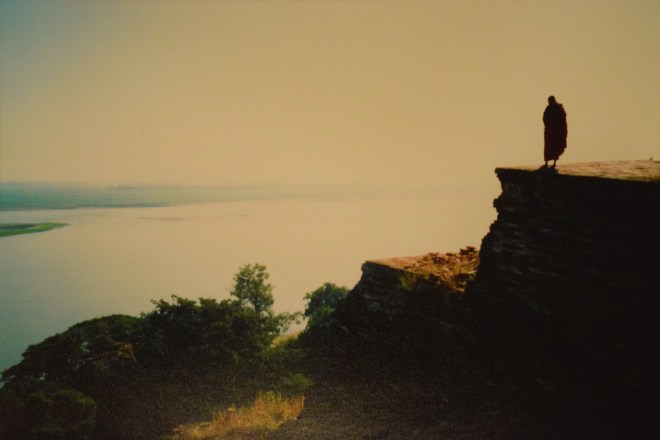
dsc_0822

Monk looks across the Irrawaddy from Mingun

I agreed to accompany an Austrian couple to the four ancient cities around MandalayAt first I thought I misunderstood, four in one day, but that was their intention.   They had already hired a car and driver for the day for $10 and clearly wanted to defray the costs.  Once our car arrived at a boat landing point ten minutes away though, I saw the flaw in their plan.  To visit Mingun, the first city, one needed to take a boat and arrive at the boat landing 30 minutes before the 9 AM departure.  Thus they had hired a driver to drive them 10 minutes and then wait for them for about 5 hours. I tried to strike up a conversation with them but they only seemed interested in talking with each other.  They did not speak to me the 30-minute boat ride.   Once at Mingun they took off.   

I actually made an effort to find that Austrian couple again.  I went back early to the boat landing, lunching at a restaurant with a view of the road.  Then I stopped at a café at the boat landing, again with a view.  That is where I met JJ, we struck up a conversation.  Back to Mandalay on the boat and I waited again for the couple on the other side.  Never saw them.  I gave up.  More than half the day was over and they had planned to visit three more ancient cities; I admit I did not really want to find them.  Later that evening they actually cornered me at the guesthouse and claimed they saw me get into the “wrong” boat and demanded I pay them the extra dollar the driver charged them for me.  I handed it over and was grateful I dodged spending the day with them.

dsc_0821

The Moustache Brothers

That evening I went to see the Moustache brothers – Par Par Lay, Lu Maw and Lu Zaw.  They are a famous comedy troupe; two of the three brothers (one actually a cousin) were jailed due to a political joke at an Aung San Suu Kyi rally.  One received a sentence of five years, the other two years.  Because of this danger of being jailed, the comedy and dance routines are now done strictly with family members.  I arrived early and could talk with the brothers, get their autographs, and take their pictures.  Par Par Lay, the main comedian, asked an Australian couple for the correct term for being watched by security men and they told him “under surveillance.”  Throughout the whole show he kept saying “…Because the Moustache Brothers are under surveillance” in a false whisper.  Most of the routine was a one-man monologue about the problems in Burma couched in comedic terms and alternated with dance and Burmese traditional costume modeling by his wife and sister.  He noted security forces watched the house and joked his father was outside ready to make the agreed upon signal if those forces closed in.  He talked about the conditions of the roads (“See how nice the roads are after a government official comes to visit.” Or “Notice the road in front of our house is in such bad repair compared to the ones nearby”), about price changes (last year the price of a kilo of rice was 1000 kyat, now it is 3000 kyat), about the vagaries of Burmese currency (he handed out now worthless 75 kyat notes), and so on.
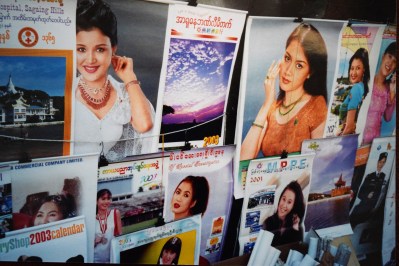
DSC_0834

Burmese calendars on Mandalay roadside

It was a good show and one of the most enlightening and memorable activities of my visit to Burma.  Naturally much of my three weeks was shaped by the tourist lens.   On only a few occasions did I have glimpses of a dark side – at least once, in the early morning hours as a bus slowed through a construction area, I saw small children carrying large rocks, what appeared to be manual child labor.   Seeing the Moustache Brothers – though also aimed at tourists as it would be too dangerous for locals – gave the trip greater context.  Linking my socio-historical background with current events.  Years later when I read of the death of Par Par Lay I was easily transported back to the one night I had an opportunity to meet him.

On the way back from the Moustache Brothers I came upon a performance of traditional Pwe theater.  It was amazing how many people sat and stood around to watch this.  I remember reading about how when the British colonized Burma, they thought the Burmese people were lazy because they spent much of their extra money on merit earning (building small shrines, donations to temples and the like) and spent time watching these Pwe performances.  I am glad the Burmese are such resilient people to have withstood years of colonial rule and the current government. 

DSC_0854

Nat shrine at trishaw driver’s home

I had planned to travel from Mandalay to Bagan on the Irrawaddy River boat – true Road to Mandalay (in reverse) but because of the holidays the boat was full.  Instead I would take the night bus, saving on accommodation and a day’s travel.  Thus, I had another day in Mandalay.  My trishaw driver invited me over to his house for a midday meal.  His mother and sister were very gracious, and many of the neighborhood children came over the stare and laugh with (at?) the strange foreigner.  After lunch, my trishaw driver I went in search of a bus to take me to Ava and Amarapura, two of ancient cities.  The bus turned out to be a wild goose chase, either it did not exist or I was not meant to find it.  So, I rented the taxi of a friend of the trishaw driver, and together we set off to see these towns.

I did not care so much for Ava.  The ruins were not as impressive as the ones at Inle and seeing them involved a fair amount of extra work.  I had to pay for a ferry boat to take us across the river, and then rent a horse and cart to take us around.  The cart ride was nice enough and I would have preferred to have just stayed in the cart then to get out at each stop.  The aggressive souvenir selling, with children running full speed behind the horse carts, was tiring and ultimately depressing.  But at Amarapura things were better again.  There was a monastery, but also a beautiful teak bridge – the longest and oldest such bridge in the world.  I regret I did not have more time there; the Moustache Brothers and Amarapura were the best parts about Mandalay. 

dsc_0840

Sunset from the Amarapura teak bridge

I returned to Mandalay to pick up my backpack and catch the 9 pm cargo bus to Bagan.  Once again, the departure time came and went, and still they were loading cargo.  The space under every seat and the entire aisle was filled with cargo.  This worked in my favor because I could place my head on the tarp covered rice bags and sleep.  A group of Korean students sitting in the back of the bus did not fare so well—next to them a broken window blew in cold air all night and the sacks loaded in the back were full of garlic. I slept fairly well though the ride was not without incident.  I woke up when our tire blew out, then again when we stopped for the bus personnel to look at the tire, and again when we stopped at an open-all-night roadside mechanic.  We were to arrive at Bagan at 5 am.  By 7:30 we were still cruising along the road without any indication of how much further we had to go.  We then began to pick up more passengers.  Anyone who flagged down the bus was welcome.  When we started in Mandalay there were about 25 passengers, lots of empty seats.  By the time we pulled into Bagan at 9, four hours late, every seat and every space available on top of the cargo-lined aisle was filled.  I was glad to arrive in Bagan and settle in to the Lucky Seven Guesthouse for a nap.


Golden Triangle Travel 2002-2003 Part Four: Leg Rowers and the Road to Mandalay

dsc_0818

Fisherman on Lake Inle

There is something to be said about endurance and learning what you can really put up with.  In Laos I spent 6-7 hours sitting on a wooden plank in a cramped boat for two days and 6-9 hours on some long, uncomfortable bus rides.  Burma would take it to a new and different level.  On 23 December (2002) I took a bus from Rangoon to Taunggi, near Lake InleThe bus was to leave at noon and take 18 hours.  We only departed 45 minutes late but arrived the next day 23 hours after departure.  To tell the truth it wasn’t all that bad.  It wasn’t Laos-bus-journey-bad.  First, this was a super plush deluxe coach bus.  We had reclining seat!. Second, the other passengers seemed more used to travel, no need for all the sickness bags.  Third, the music.  Burmese music is rather pleasant.  Probably because most of the hits played were actually Western songs with Burmese lyrics!!  The first time I heard a few bars of a well-known English song, I opened my mouth to sing quietly along, only to hear Burmese instead.  I heard pirated songs of Celine Dion, Craig David, The Coors, Shania Twain, The Eagles, Marc Antony, and more.  I could not sing along, but I could hum along, and it made the trip easier somehow.  Fourth, they also played movies; two in Burmese and two in English!  I was really surprised about the English movies yet happy to watch them, though we were not cinematic masterpieces (one was about a dog from outer space).  Still, many hours after the scheduled arrival time, I started to worry I had missed my stop.  It would not be the first time.  Luckily, at a rest stop an English-speaking fellow passenger told me I had one stop to go.   Finally, I was dropped at the intersection to Lake Inle where I caught a taxi on to Nyaung Shwe.

Let me be clear: I am not a foodie.  I have lived overseas the majority of my adult life and traveled to over approximately 100 countries.  I have come a long way in the food department from my childhood, but I am still not an adventurous eater.  Thus finding good Western food in unexpected places is a pleasure, particularly when on the road for longer periods.  I spent the first day only exploring Nyaung Shwe, recuperating from the bus ride.  I check into my guesthouse – a bargain at $3 a night because the in-room bathroom did not work.  To take a shower I only had to walk down the hall, into the courtyard, up a flight a stairs, and down another corridor.  In my towel.  Magical.  The guesthouse also had a restaurant with items like pasta, pizza, and hamburgers on the menu.  I am impressed.  Till I tried to order.  I point to the burger, but the man informs me they do not actually have that.  I point to the pizza.  Sorry, he says, do not have.  He tells me, “no price, no available.”  I then notice that everything on the menu has no price except for omelets.  I go next door where unbelievably there is a small restaurant with freshly made pasta – made by a Burmese taught by an Italian chef from Bologna.

dsc_0819

My leg rowing guide on the canal

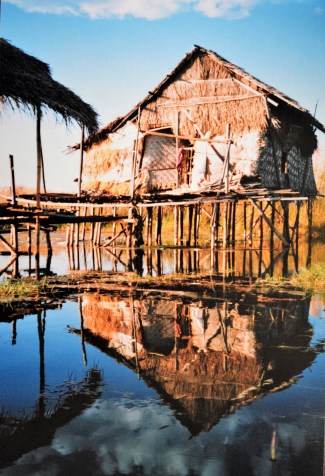
On my second day I spend the morning chatting with fellow travelers and am rewarded with a not-yet-expired Inle Lake Tourism (i.e. foreigners) Region Entrance Fee Ticket.  It saves me US$3, which is a night’s hotel.  In the afternoon, I arranged for a canal tour.  It was a wonderful trip on the most beautiful day.  The sky was blue and the water is so incredibly clear that one could look down and see the thick grass and water lilies just below the surface.  Due to this thick grass Inle Lake is famous for its leg rowers.  In order to navigate around especially thick clumps of submerged grass, the rower benefits from standing, and uses his legs to continue rowing from a standing position.  I have the most wonderful picture of my very photogenic rower standing on the back of the canoe, with a gorgeous blue sky complete with perfect cottony white clouds in the sky and reflected in the water.  All the houses are built on stilts and are also beautifully reflected in the water in a near perfect mirror image.

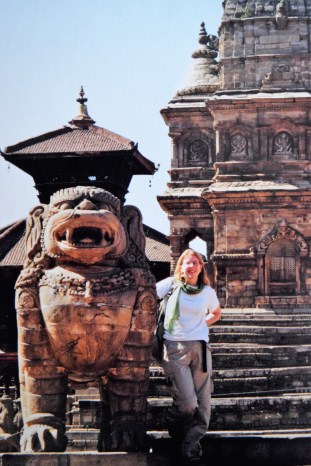
A Singaporean traveler and I rent a boat on my third day to travel to the village in the middle of the lake.  From Nyaung Shwe the journey took thirty minutes–leg rowers, fishermen, and grass collectors along the way.  We first visit a weaving center and then head to the ruins at Indein.  There were so many small wiry stupas here seemingly forgotten by time, and the government.  There were few tourists.  In fact there were many more souvenir sellers than souvenir buyers.  Several of the carvings were quite intact and reminded me of those at Angkor Wat, the shapely Apsaras dancing next to entrances to the temples.

DSC_0844In the center of the lake there was also a floating market (otherwise known as the floating tourist trap – one can’t just walk away, especially when the souvenir sellers surround your boat), a floating garden and a Buddhist Temple.  The most amusing place by far was the Temple of the Jumping Cats.  This is not the actual name of course, but it has become known by this for the monks have trained the stray cats at the temple to jump through hoops!!! Neither the monks nor the cats seem to particularly like or dislike this.  Visitors arrive and see a couple of monks lounging lazily in chairs and beneath them their protégés, the talented cats snoozing away.  After enough people arrive, a monk reluctantly gets up and claps his hands and says “okay” unenthusiastically.  He grabs a bag of dried fish, throws it on the floor and then prods a few cats awake.  For those cats not willing to get up, he snatches them up and drops them in the center of the visitors and the dried fish.  Then he pulls out a hoop and one by one grabs a cat and places him on the floor, then prods it.  The cat looks up at the hoop, wiggles its behind and effortlessly leaps through the hoop and then slowly crawls back towards some dried fish.  After most of the cats had performed this feat, the monk just says it is over and goes back to his deck chair.  What an unusual monastery- but given the number of tourists who handed over money to see this spectacular stage show, they are also really smart.

DSC_0853

Cats jump through hoops to entertain

By 7:30 PM that night I was again on a bus, taking the Road to Mandalay.  Although shorter, this ride was not as pleasant as the last.  The seats were closer together and my knees we rammed up against the seat in front of me.  A chilly draft keeping me from being warm; there was a terribly-acted Hong Kong film on the screen.  The trip took 11 hours to reach Mandalay, though it was supposed to take eight.  We arrived early in the morning; the bus station was full of novice monks asking for alms.  As I realized that they wanted to collect their meals for the day I started to unload the extra food I had (Tin Tun had provided me too much): pears, plums, cashew nuts and pumpkin seeds.  Another American gave one lucky novice a can of sardines and he scampered away extremely happy.

A long tuk-tuk ride into town brought me to another guesthouse, another $3 room. This was a room just for me.  With a bathroom, with working water—even hot water for showers! It also had a tv, with one channel that came in maybe once a day, and included a wonderful breakfast of watermelon, pineapple, toast, jam, tea or coffee, and a cooked-to-order egg.  Despite these spenders, the overnight bus has been less restful than I had hoped.  Before lying down to nap I went to ask the front desk something.  Once downstairs I noticed that my key ring did not have a key.  It must have fallen off.  A group of boys, I guess hotel assistants, went up to my room with a bag of keys, none of which was labelled, and tried one after another after another on my room.  Half an hour later they were still working from the pile of keys on the floor… 

DSC_0855

Temple in Mandalay

It is perhaps little surprise that this beginning did not bode well for a first day in Mandalay.  I needed to buy film (it was 2002 after all) and also needed to change money.  The hotel and nearby hotels were either offering terrible rates or not changing money at all.  Not surprisingly of course a helpful individual presented himself and led me to an Air Mandalay office with a decent exchange rate.  He turned out to have a trishaw and a handsome 24-year-old son, named Gypsy, who would be perfect to take me around sightseeing.  Gypsy showed up on time at the hotel three hours later to cycle me to several temples and Mandalay Hill.  I purchased a combination Mandalay visit ticket, which for $10 would grant me entry to the main sites of Mandalay and the ancient cities of Ava and Amarapura.  Mandalay should have been magical.  A temple with elaborate wood carvings on all the doors and walls impressed me enough to write about, but I mention little to nothing else of the gleaming white and gold palace and temples and the famous Mandalay Hill.  All these years later and I have no recollection of walking up those 1700 steps, though I know I climbed all the way to the top. I wrote it took me 45 minutes.  Plus, I have pictures!   What stands out in my memory of that first day in Mandalay are two things: the first is that after visiting one of the temples I came across a young woman or women outside the gate.  Like many women in Burma, their faces were painted with a yellow paste, a traditional kind of sunscreen called Thanaka, made of ground bark.  Yet, unlike other women, who wiped it across their faces in swathes that made it look like they had run into a yellow paint brush, these women had painted designs.  They offered to make one on my very pale skinned face, and I agreed.  For a few minutes I was not sightseeing or traveling at my hectic pace.  I was just sitting still as a giggling young woman painted a leaf on my cheek.  The second is while at dinner that evening in a European style restaurant, I sat next to a table of US diplomats.  I do not remember the conversation, but I do recall thinking I might like to be a diplomat too.  And well now, incredibly, I am.

At the end of the evening, when Gypsy dropped me off at the restaurant after several hours of serving as my guide and transport, he professed his love for me.  He was not the first trishaw/taxi/tuk-tuk/bemo driver / tour guide / hot air balloon pilot to make such a declaration.  Surprisingly, perhaps, I doubted his sincerity, but let him off gently.  And made the decision to find another guide the following day…


Golden Triangle Travel 2002-2003 Part Three: Rangoon Days

After crossing the Friendship Bridge between Laos and Thailand, I returned to Bangkok by train.  I applied for my visa for Burma – opting to apply myself at the Embassy instead of using the usual Khao San Road travel agents.  I took a brief detour from the Golden Triangle to travel to Brunei for two days.  Yes, Brunei.  And it was my second trip to the small country.  Suffice to say one of my graduate topics was Southeast Asian Maritime Piracy and I was there for research purposes.  Then back to Bangkok for an evening before flying to Burma the following day.  I had dreamed of visiting Burma since 1994, when I had watched a movie about the events of 1989. I had an evening flight, something I generally try to avoid; however, in this particular case it turned out to be lucky.   Strangely, I remember almost nothing of my time in Rangoon, a name that evokes something akin to romantic colonialism.  (Though I know very well colonialism is not romantic.  My title is a take on George Orwell’s Burmese Days) I remember walking a long way through the older, colonial part of town looking for something, but I do not remember what it was or if I found it.  Most likely it was the Strand Hotel, as it used to be one of the most famous and luxurious hotels of Colonial Southeast Asia.   I recall the tea house from the first evening, the low lighting, the smoky air.  I remember drinking Star Cola, Burma’s answer to Coca Cola as the US brand had not been sold in the country for years (in 2012 Coca Cola returned to Burma after half a century away). I can vaguely conjure up the second-floor entrance to my very cheap guesthouse.  And standing in the grocery store while my Burmese seat-companion-turned-benefactor gleefully helped me shop.  And even those memories are just fragments.

dsc_0814

Wearing my backpacker best at Sule Paya

On my flight I sat next to Tin Tun, a Burmese living in Singapore, working in Algeria, heading home to Rangoon for a week.  We talked half the flight.  Tin Tun and his family are expatriates who have made their lives outside their homeland.  He has lived in Singapore for 15 years, his sister is a doctor in Brunei, his brother-in-law a bank advisor in Manila, nieces in New York.  He told me a brother-in-law, who was picking him up at the airport, might take me to the guesthouse of my choice.  His brother in-law drove me first to Tin Tun’s home, a lovely lakeside house on the outskirts of Rangoon, where he plans to retire.  Tin Tun had brought gifts from Algeria for his family.  It was like Christmas.  And the family treated me so nicely and made me feel at home, that I would not have been surprised had Tin Tun pulled a gift out for me.  In a way he did.  He and his brother-in-law decided it was too late at night to take me to a guesthouse in a new city, so they told me I must stay the night.  And that is how I came to spend my first night in Burma a room on the banks of Lake Inya.   After breakfast the next morning Tin Tun drove me to the guesthouse.

I stayed at the Mahabandoola Guesthouse in the center of town.  Although it was a bit run down, it was only $3 a night and suited me fine.  It was also right next to the Sule Paya, one of the most popular Buddhist temples in Rangoon after Shwedagon.  I learned the Burmese staying at the guesthouse paid only US$1.  I do not mean they paid the equivalent of US$1, but an actual dollar bill.  Burma essentially has a three-currency system.  The USD, the Foreign Exchange Certificates (FEC) and the local Kyat (pronounced Chat). (The FEC was abolished in 2013) Supposedly the FEC is equivalent to the US$ on a one to one basis.  That is even printed on the bills themselves, but in practice it is not the case.  But nothing is really as it seems.  The official exchange rate is something like US$1=6 kyat, but the unofficial, black market rate was US$1=1000 kyat!!  But 1 FEC would only fetch about 920 kyat.  Foreigners though are forced to purchase 200 FECs at the official rate at the airport.  It is all a government racket.  Kyats and dollars are really the currencies of choice.  The kyat gives you the best spending power; FECs the worst.

betel nut leaves

Baskets full of betel nut leaves

Rangoon is a sprawling capital of wide dusty streets lined with many British colonial period buildings.  The most popular sights are the Sule Paya and Shwedagon Paya.  On my first evening I went to a tea house lauded in my travel book as the best in the city.  I liked it so much I went twice more while in Rangoon. There I had a lovely Burmese tea, rather like Indian chai, of dark tea with milk and sugar and a plate of bain mokBain Mok is an opium cake, although today the seeds sprinkled on it are no longer opium.  The café offered a wonderful atmosphere to see Burmese relaxed with one another and to write in my journal.

On the walk home from the tea house I met a Burmese man, who popped up alongside me and asked to speak with me.  After making sure he did not want to change money and sincerely just wanted to talk to a foreigner we sat for a soda at a street café.  These are all over Myanmar.  In the evenings these establishments spill out onto the sidewalks and even the street, with small folding tables and even smaller, almost preschool-sized, chairs.  He was nice enough but I was a bit put off by the fact that he A. wanted to accompany me on my trip all around Myanmar though we had just met and upset that I did not think it a good idea, and B. his betel nut habit.  One of the worst things about Myanmar has got to be the addiction to betel nut.   he nut is put in a green leaf and chewed in the mouth, like chewing tobacco.  Users must spit out the juice which is a horrible bright red color that stains the teeth, the gums, the lips and the pavement it is spit upon.  This guy kept chewing his betel nut, and even when he wasn’t, his red stained mouth was distracting.  Throughout the trip I grew to hate betel nut more and more…

Shwedagon Paya was lovely, though it was first place in Burma where I faced the foreigners-pay-more practice.  For Burmese entry is free; for foreigners the price is US$5.  There is a long shop lined arcade up stairs leading to the temple, during which the whole time one must be barefoot.  There were ceremonies of families with golden painted parasols touring the paya as their sons were to become novice monks.  There are shrines around the paya to which people pray depending on the day of the week they were born.  I visited the Tuesday shrine and poured XX (a whole lotta) cups of water for my age + 1 and threw in a small donation to appease the Buddha and bring me luck.  As it was a Saturday the shrine for that day of the week was the busiest.  There are also places to worship the Nats, who number more than a hundred, and are the animist gods of pre-Buddhist Myanmar, but reign alongside Buddhism to this day. 

dsc_0816

Approaching Shwedagon

After Shwedagon, I returned to the guesthouse and called Tin Tun, who had told me we could meet again for dinner.  However, when I got ahold of him, he said he was quite sick with food poisoning, but he would take me out anyway.  He picked me up around 6:30 PM and we drove down to Chinatown (which to be honest didn’t look any different from any other part of Rangoon, and was only a few blocks away after all).  Then he started buying me food right and left.  He also took me to a supermarket and bought me a bunch of food.  He said he was worried about me traveling by myself and that I needed some food for the travel.  I tried to say it was not necessary but he told me that he was older, had a lot of money, no children and not much else he wanted to buy in life having most of what he needed and wanted already.  Well….okay, you do not need to twist the arm of a no-income graduate student.  I would be well stocked for days.

On a walk during my first day I did experience an odd and rather disturbing situation.  I wrote about it in my journal:  Today on the street a man tried to give me a child.  I had stopped to look at a cute little boy when suddenly a man was beside me asking “Do you like baby?”  I said, “Yes, the boy is very cute.”  The man asked where I was from and then told me I can take the baby to America.  He then stooped down to ask the boy, who was about four years old, if he would like to go with me to America.  The boy looked scared.  Then man scooped him up in his arms, told me the boy’s name is Mohammed and tried to pass him to me.  I have traveled to quite a few developing countries but never before or since has someone tried to give me a child.

On my third day I traveled to the town of Twante, famed for its weaving and pottery and located across the Irrawaddy River and along the British-built Twante Canal.  Twante itself turned out not to be that interesting other than giving me the opportunity to see a satellite town of the capital.  What turned out most interesting, as so often is the case, was the journey there and the completely unexpected turn the day would take.  First, I crossed the Irrawaddy by ferry.  I had wanted to take a boat up the canal but no boatman would do so without charging me an exorbitant foreigner price.  So, I opted for a mini bus.   The trip to Twante was about an hour along a bumpy, dusty road.  Though I could not see any of the scenery as I was seated on the inside.  The truck has a small covered bed lined with benches, similar to the jeepneys of the Philippines.  I was jammed on the very last seat towards the open back, though with only half of my behind on.  When we hit a bump I was airborne, but did not fall out because the entire back of the truck was lined with men.  There were 10-15 men standing hanging on to every available piece of rail on the back and sides of the truck.

dsc_0817

Kids in Twante (they wanted Polaroid photos)

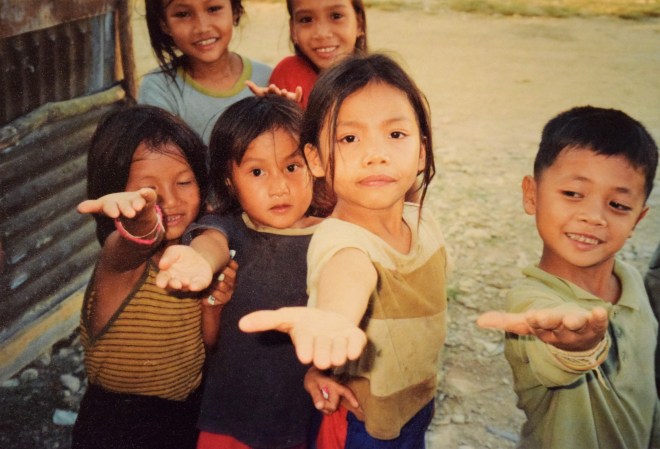
Once in the town I wandered around trying to find anything resembling the famous pottery or weaving, but no one spoke English and there did not seem any obvious I came upon a small boy who must have never seen a white person before.  Normally this results in shrieks and screams and running away (I have had this happen many times) but for him it resulted in absolute incredible delight.  He began laughing and laughing and laughing.  Pointing at me and saying something to some other boys.  He ran up and threw his arms around my leg and looked up at me continuing to laugh with un-abandoned delight.  I took his picture with my Polaroid and tried to give him the picture, but he didn’t understand, so I kept it. (and I still have it taped in my journal).

After being unable to find anything of note in Twante I prepared to head back and hopped into a truck for the ferry.  It was not full and I would wait a long time for it to fill up and return to the ferry.  An Indian man in the truck asked if I had been to the pagoda and since I had not, I decided to get out and go in search of it.  I walked and walked but without any luck.  No one seemed to know where the location of the pagoda.  Several children ran after me screaming “I love you,” so I stopped to blow them a kis,s which threw them into hysterics and made them follow me all the more. Somehow, I ended up being invited to a wedding reception.  Soon I was in a large covered all seated next to the newlyweds eating ice cream and having our picture taken together.   I left with the whole party waving goodbye to me.  I returned to the ferry in a truck chartered by an Italian couple, stopping at a monastery along the way.

I ended up staying a few extra days in Rangoon than expected because with the work and school holidays it turned out difficult to get a bus ticket out.  The earliest ticket I could get was on December 23rd.  I did meet Tin Tun one last time, back at the tea shop.  Then it was off to the next stop: Lake Inle.

Golden Triangle Travel 2002-2003 Part Two: Large Jars and Long Bus Rides

dsc_0803

Touring in style in Phonsavan

In Luang Prabang I was finally able to eat again and what a joy to do so.  Two days on a slow boat while recovering from the mumps can do funny things to one’s brain.  I had begun to imagine Luang Prabang such a paradise on earth, at least in Laos, that we would be greeted off the boat with Laos women carrying steaming plates of pizza with real mozzarella or spaghetti or lasagna.  (For some reason I confused Laos with Italy.)  While no one welcomed me from the boat with fresh pasta, once I found a place to stay, I did find pizza that only caused my still recuperating jaw just a wee bit of trouble.  Apparently, there was a bit of a scandal when this Italian place opened on the Luang Prabang main street as the town is a UNESCO world heritage site.  I also found myself a bookstore, thank goodness. 

I must confess I don’t remember much of what I did in Luang Prabang.  It is a lovely laid-back town on the banks of the Mekong, with the dusty colonial architecture amongst dozens of Buddhist wats and temples.  Luang Prabang lies between the Mekong and a tributary, almost an island.  I did go to the former palace, now a museum, which was small, but enjoyable, though the opening hours were challenging.   The first time I arrived just before it closed for lunch, later just before it closed for the day.  My persistence paid off the third time.  I did not make it to the famous Pak Ou caves or to the Kuangsi waterfall.  Though I tried, I always called at the tour operator at the wrong time, too early or too late.  After all that time cramped on the boat, I was just happy to wander the streets, sometimes talking with novice monks. 

dsc_0802

Hanging out in the Plain of Jars

The bus from Luang Prabang to Phonsavan was nine hours.  NINE.  A friend of mine told me he had taken the trip a few years before me and at the time it took him two days in the back of a truck.  I suppose nine hours was an improvement.  Funny though, weeks and even years later, it is the boat ride and the bus rides that stood, and stand out.  And though we were well into the digital age I traveled a bit more old school.  While I saw younger travelers with electronics – Kindles and iPods – I still had just paper books and my own imagination to while away the hours.

There were twenty seats in the bus, excluding the driver seat, and yet we had 25 people including the driver and three bus attendants.  I am not sure why this works like this, but there was the driver, and another guy who I assumed was the relief driver, whose primary job seemed to be either to sleep or amuse the bus driver.  Then there is the guy who gets of the bus at official check points and hands over paper and puts people on the bus.  If we pick up other people, he hangs out the bus door and yells at these people we pick up along the way, to check their destination and hurry them on the bus.  Then there is the woman who collects the fares.  I had heard the departure was 8 AM, another passenger said it was 8:30, while another insisted it was 9:00, though we were all told to arrive at the bus station by 7:30.  We were full by 7:45 and just sat there.  We left at 8:30, drove 10 minutes to the gas station, then drove a few meters down the road to have the tire fixed, and then another five minutes to the police checkpoint.  Surely there is another way to do this?

dsc_0804

Early morning at a Laos bus station

It was a long trip.  Though I slept at least half the journey, it was not easy. Whenever I began nodding off, the driver would blast Lao pop music.  The second half was through the mountains–around and around and around curves.  I am talking about curves with drops down hundreds of feet without a guard rail in sight.  We went through many hill tribe villages — their front yards the road, their backyards the hundred foot drop.  When we sped through these tiny villages we laid on the horn so anyone on the road would scatter.  Besides people, there were also many animals on and alongside the road: chickens, turkeys, pigs, dogs, cattle, and goat.  Once we even passed an elephant! 

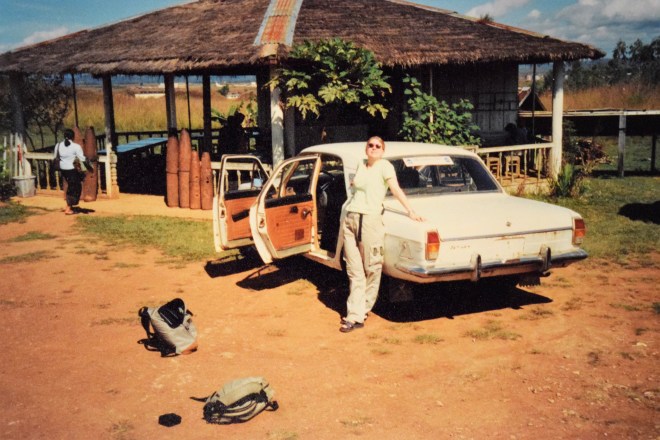
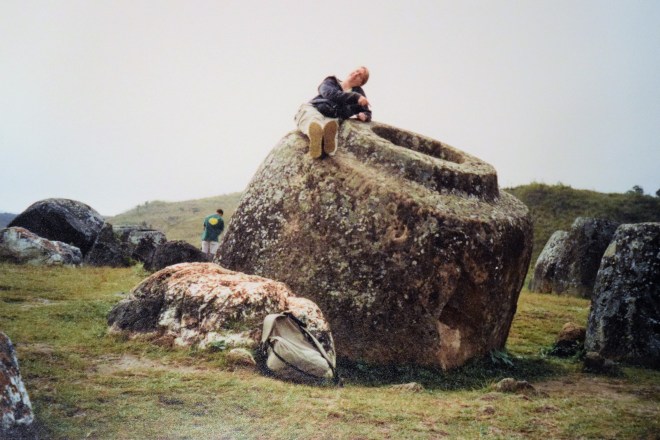
Like my arrival in Luang Prabang, I was extremely happy to arrive in Phonsavan. I secured a room, ate, and went to bed.  Electricity at the time ran only five hours a day, from 6 to 11 pm.  Reading that now, it sounds rather generous.  I was in bed long before 11.  The following day I had a tour of the Plain of Jars.  It was really just a guy in an old Russian car who drove three of us foreigners around to the sights.  And by sights, I mean we visited plains with large and small stone jars littered across them.  Then I knew it only as a place of unknown purpose – though now I read it is one of the most important prehistoric sites in Southeast Asia.  It was a good day; I was fascinated.

dsc_0811

Hmong girls lined up to play ball

While in Phonsavan I also happened to stumble upon a Hmong gathering.  It was the Hmong New Year’s and Hmong tribes from Laos and even Southern China, were gathered to celebrate.   Young Hmong women, between approximately 14 and 20 years of age, dressed in their finest, lined up to play a game of catch.  My guide informed me this was a way for the girls to find husbands.  Though many of the girls were tossing the balls to each other, a man could step in and begin the ball toss with the girl.  He might toss the ball and say “I do not have much money.”  The girl would throw the ball back and tell him “That is okay.”  He would say “You will have to work in the fields.”  “That is alright,” might be the answer.  And back and forth they toss the ball until some decision is made.

I had planned to head to Vientiane the following day, but the thought of another ten-hour bus journey was more than I could bear; I chose instead to take a detour to Vang Vieng.  This ride was worse.  The bus to Phonsavan had been small, full of foreigners.  On this larger bus, I was the only foreigner.  Though it was to depart at 9:30 AM, it was full by 7:45 AM.  The passage in front of the door already blocked with sacks of rice that everyone had to climb over to get on or off the bus.  I watched two motorcycles being loaded onto the top of the bus.  We all sat there, or walked around the bus, until it left, half an hour early at 9 am.  And we promptly drove to a gas station!

dsc_0842

Vang Vienh, a good place to stay awhile

Most of the Laos seemed inexperienced in bus travel.  Perhaps they made the trips only rarely?  As a result, most passengers were sick.  The bus assistants passed out plastic bags – they served the same purpose as the bags found in airplane seat back pockets.  As we passed over the hills and the narrow roads with steep drops, the Lao people would ooh and aah and stand up and lean over to that side of the bus to examine the drop.  I thought it would surely tip the balance and down we would plunge.  The woman in front of me and a man behind me were sick out the windows, making it hard for me to look outside and try not to be sick myself.  We had one pee break on top of the hill in the middle of nowhere, where each person ran off to find their own peeing bush.  There was more Lao pop music– I was getting thoroughly sick of it.  I was extremely happy to get off the bus at Vang Vieng seven hours later.

I meant to stay only a day in Vang Vienh, to break up the long journey to the capital.  However, I ended up staying a three.  I took a tube down the river with an Irish girl named Claire.  I am fairly sure Claire was high as a kite for the duration, and though I do not generally relish being trapped alone with strangers for hours on end, I had not laughed so hard in ages.  We made a game of our 3.5 HOURS float down driver, paddling furiously with our flip flops to maneuver around obstacles.    The following day I was aching from a bad sunburn, a sore knee where I had hit a rock, and a huge scratch I received from a submerged stick.  I signed up for kayaking the next day, but it poured rain and the trip was cancelled.

Then I headed to Vientiane and what a relief it was to spend only THREE hours on transport after so many marathon long trips.  I spent two quiet days in the quiet capital, resting up for the travel to come, often enjoying a dinner looking across the Mekong to Thailand as the sun set.  Then I crossed the Friendship Bridge back to Thailand and returned to Bangkok for the next phase of the trip.

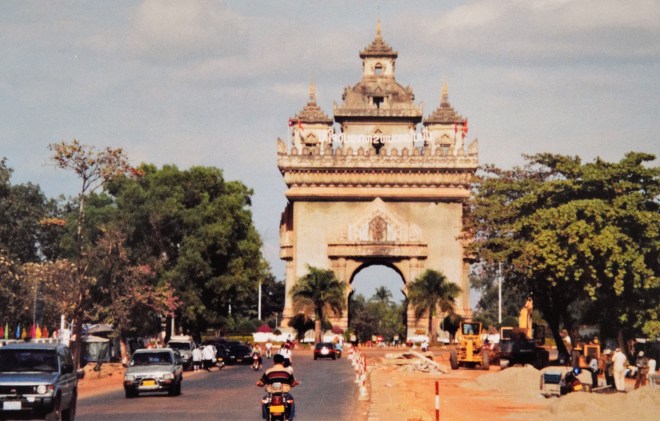
Vientiane Victory Arch

Patuxai – The Victory Gate of Vientiane

Golden Triangle Travel 2002-2003 Part One: Mumps in Thailand, Boat Down the Mekong

From July 2002 to July 2003 I was in graduate school in Singapore.  Over the winter break I took seven weeks to travel solo in northern Thailand, Laos, and Burma.  I sent out fairly regular email updates to my friends and family during my trip and these are the edited stories – a combination of email and diary excerpts, reminiscences from my admittedly faulty memory, and thoughts from today.  I find it curious, with the passage of time, what I wrote and took photos of, what I have remembered and forgotten.

dsc_0796

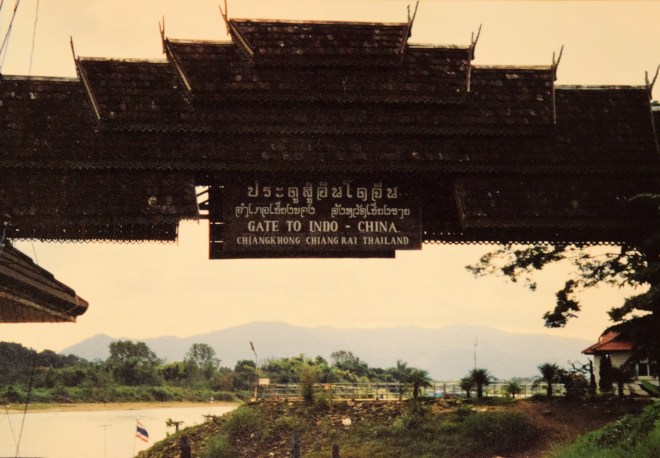
The border crossing

I had plans to stay only a few days in Thailand before heading to Laos.  I meant to spend 3 weeks in Laos, starting with a Mekong river voyage, some two weeks in central Laos, and then a third week down the slender tail where the Mekong hugs the border between Thailand and Laos to the Si Phan Don (Four Thousand Islands) area.  But things did not go at all as planned.  As so often happens with travel—and really one of the key reasons to do it—I could not have anticipated the people I would meet and the adventures, including coming down with a serious viral infection for which I had been (supposedly) inoculated against as a child…

On Friday, November 23 I flew from Singapore to Bangkok, Thailand to begin the first phase of my journey.  After checking into my guesthouse, I notice the right side of my jaw is swollen; it looks like a gumball is lodged in there and it feels tender and sore to the touch.    I write: I appear to have a minor bout of the gout.  The next day I flew from Bangkok to Chiang Rai.  My jaw hurts even worse; I feel ill and uncomfortable on the flight.  As I disembark at my destination it takes nearly all my energy to drag myself from the plane through the airport to transportation to take me to my Chiang Rai guesthouse.

At the guesthouse I can barely drag myself from check in up the stairs to my room. I know I should see a doctor and ask at the front desk.  The man informs me there is a clinic just 300 meters away, within walking distance.  I tell him I cannot make it.  He insists it is not far.  I walk a few steps, my knees buckle, and I vomit.  In an extraordinary show of kindness from a stranger, the man gets his motorcycle and takes me to the clinic.  He waits with me there and afterwards takes me to a pharmacy, then back to the guesthouse.  With medication and some beverages, I hole myself up in my room and fall asleep.

dsc_0800

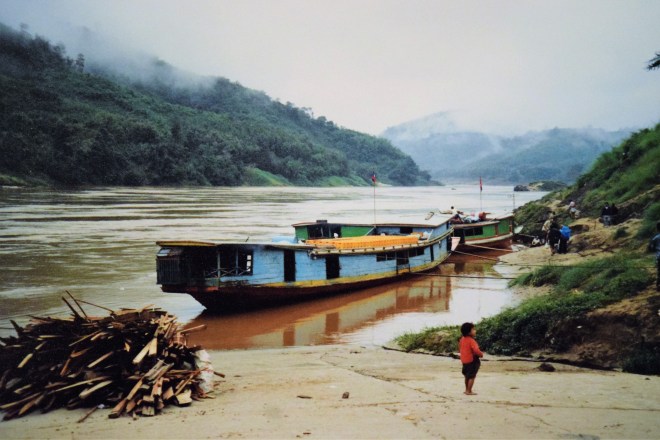
The slow boat — aka, my ride

The doctor told me I had Mume.  The following day I head to an Internet café to see if I can learn more about my illness.  Since my face is so swollen I grab a hoodie so I can wear it to mask my face.

I type in my symptoms and what should pop up but mumps!  I almost laughed.  That is if laughing were not so painful.  Both sides of my jaw are completely swollen.  It is very painful.  I cannot eat.  The day before in a fit of desperation I bought a bag of potato chips.  I ate about 10 and was sorry for over two hours, my jaw throbbed horribly from the effort.  I stood in front of a restaurant yesterday staring at the food through the window, then went to buy instant ramen at 7-11 which I gobbled up with great glee back in my hotel room.  I carried the little cup with boiling water the three blocks back to my guesthouse like it was my most precious possession. 

I spend two days in my room.  I read a book.  I play solitaire.  I write in my journal.  I nap.  I think about eating but do not dare because it hurts too much.  But slowly I begin to feel better.  I make plans to move on.  I buy some supplies, check bus times, and prepare to collect my passport with my visa to Laos.  But the next day was not to be.  I could barely drag myself down to the travel office and when I did it was closed.  I gave up and went back to my room.  Later someone brought my passport to my room—I merely rolled over in bed, unlocked the door, took the passport, closed the door, and went back to sleep.

dsc_0798

One of the few times I saw people along the way

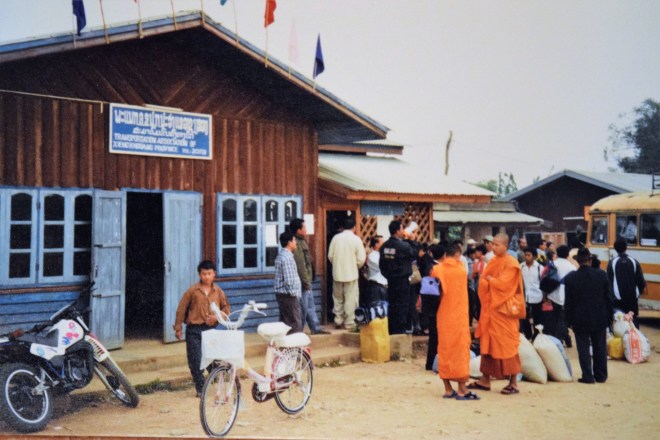
The next day I wake at 6 AM and head to the bus station to catch the first bus to Chiang Kong, the Thai border crossing.  The slow boat down river departs at 10:30; the bus should arrive on the Thai side at 10 AM.  But it arrives at 10:15. I quickly catch a tuk-tuk to the boat landing, but then the immigration official takes a short break.  Then shoots the breeze with his colleague.  10:30 comes and goes.   The slow boat has surely departed.  I head up the steps to Laos immigration and then wander in to town.  I went into a guesthouse to ask a woman about the boat.  She told me “It already leave.  Stay here.  Stay the night.  You are tired, right?  Don’t you want to rest?”  And she lured me.  Because I was tired and I did want to rest.  My first day in Laos was not off to a good start.
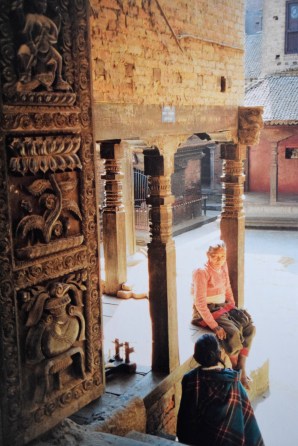
The Laotian town of Huay Xai is a one road town.  A road into town and a road out, a single intersection.  There were a few guesthouses and restaurants catering to all the people who “missed the boat” (literally!) and that is about it.  Seemed a nice enough place to rest up for the two day boat ride commencing the next day.  There were speed boats, but the riders are strapped in, immobile, with life vests and crash helmets, their baggage pinned against their feet as they hurdled down the river for six hours with the deafening motor in their ears.  While I thought for adventures-sake this might be fun for all of maybe 5 minutes, and interesting for maybe an hour, but with my stiff neck, swollen jaw and extreme tiredness, I could not think of subjecting myself to that torture.  It was to be slow boat torture for me.
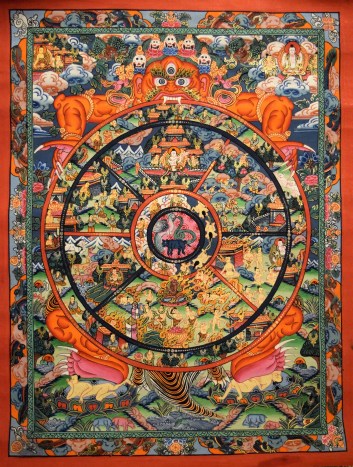
The next day the slow boat departed at 11:15 AM.  I could have made it the day before.

We were packed in like cattle, sixty of us, sitting on hard wooden benches.  I left my book in the hotel.  Few people were in the mood to talk.  Looking around every available space filled with a person with a book balanced on their lap; I was so envious.  I would try and look out the window for awhile, to give my bum a rest from the plank, and within fifteen minutes my knees felt as if they were welded to the wood and moving them was extremely painful.  The muddy river, the green banks, slid by minute after minute, hour after hour with little change in scenery.

dsc_0801

Colonial building in Luang Prabang

After six hours the boat arrived at Pak Beng, where we stayed the night.  I still was not 100%.  I had some soup but I could not sleep.  Under a mosquito net I felt too hot.  I thought a shower might help.  There was a huge cement cistern.  And a shower head.  In the corner a huge spider sat on the wallI had my glasses off so I could not make it out very well, though I kept my eye on it as well as I could.  The water was so cold I felt unable to stand and found myself squatting on the floor, shower head in hand, my mouth gaping open and closed like a fish out of water, just to brace myself against the icy coldness of the liquid running down my scalp and neck. Shampooing up, I didn’t know if I could stand to run the water over my head again to rinse, but again in silent screams I washed my hair.  I was certainly cooled off then and fell into a lovely slumber, despite the sound of rats scurrying overhead…

I thought the day before as I got off the boat that someone would have to drag me kicking and screaming to the boat the next day, with me screaming “no, not the boat, not the BOAT!”  But I walked on of my own accord the next day.

The second day on the boat was much like the first, except that I managed to procure myself a book.

I am on the boat again – we have been going for four hours, though I do not know what that means in terms of the journey as there is a debate over whether we are to travel six hours or eight today.  I sincerely hope it is only six.  I inherited a book from another person and read the whole thing before noon…The boat meanders lazily down the Mekong.  The water a muddy hot tea with milk color, on both sides thick green jungle.  Only rarely does a house appear, and even more rare, people.  It always surprises me when there are people because they appear smaller than I expected, dwarfed by the scenery around them.   I cannot even begin to explain the mind-numbing boredom of those two days.  Nor how much my bottom hurt from sitting on the wooden plank for so many hours.  And I paid for the experience.

We pulled into Luang Prabang 7 hours later and I gratefully got off the boat, scrambled up the bank at a sprint, and never looked back.


The Trip in Inappropriate Shoes

dsc_0610

As part of my blog I am adding edited excerpts of emails I sent on past travels.

In December 2001 and January 2002 I took the five week winter break between my first and second semesters of graduate school to travel in Southeast Asia. I spent the first two weeks in Indonesia, on the island of Bali, with my then-Balinese boyfriend. Originally we had planned to travel together for the rest of the weeks, but soon after my arrival it was apparent the relationship was not going to last. So, we broke up and on January 1 I flew into Bangkok to begin three weeks of travel split between Cambodia and Thailand.

I started this trip with only one pair of ill-advised shoes — a pair of cheap sandals I had purchased in a mom-and-pop store in northern Bali the spring before.  They were two inch high pieces of foam rubber with a wide blue band with no grip whatsoever on the bottom.  One time while walking in Lovina, the town in northern Bali I lived in for several months, I slipped on the sidewalk and landed on my behind in 2 seconds flat.  These were clearly some high quality shoes and just perfect for some backpacking.  I have long wanted to write a story of this trip with this title, though the shoes are only a minor actor in the tale.

On January 1 I flew to Bangkok.  I was exhausted and did not have the energy to do much searching for a cheap place.  The place I stayed the last two times appeared to be closed so I went a few doors down and paid $8 for a room.  I believe this is the most I have ever paid for a room in Thailand.  I did not do much for the next two days but eat and sleep and read.  I needed a rest.  Then I booked a bus ticket to Siem Reap.

dsc_0609

Me and my backpacks at the Thai/Cambodian border

The bus was supposed to pick me up at 6:45 am.  I was a little anxious as the last time I was to be picked up early for a bus in Bangkok it failed to arrive.  But at 10 til 7 a man showed up in front of me and asked “Siem Reap?”  I nodded and I was moved about 10 feet from where I had been standing.  Ten minutes later another person came up and asked “Siem Reap?” I nodded and was ushered along with another group of groggy foreigners shuffling down the street.  We walked about 10 minutes and crossed a rather busy road to wait in a highway circle.  There were buses there but the herders made no move to get us on them.  We stood for about 15 minutes and then the selection process began.  We were asked to show our tickets.  Some people got yellow tape or a badge to place on their shirts.  I received neither and was held back in a smaller group.  I began to wonder what was going on.  Then we were motioned to move onto a second bus.  The first bus looked more posh, but ours was less crowded and I actually had two seats to myself.  Our tickets were checked again and we were given orange pieces of paper, and then we were off.

We drove to the Thai/Cambodia border where we disembarked for lunch and visa applications.  We went through immigration on the Thai side and then walked across to the Cambodian side.  It seemed a strange border as all kinds of people were simply walking across without checks.  Unfortunately one person from our bus was denied entry and had to return to Bangkok.  We changed to a mini bus on the Cambodian side and our orange pieces of paper were collected.  Unfortunately some riders had lost the paper, were berated by our “guide” and were forced to pay more money to continue.

dsc_0612

Me among the ruins of Angkor

This time we were squeezed in shoulder to shoulder and the road was incredibly worse, if it could be called a road at all.  We were told we would arrive at Siem Reap at 7 pm, but instead finally made it at 9.  The trip had been fun for the first few hours and then it became very tiresome.  I guess that it is part of the beauty of travel, it was easy to get there then some of the fun is lost, at least then fun in re-telling the journey, and everyone would do it.  Again, exhausted, I took the first guesthouse I found.

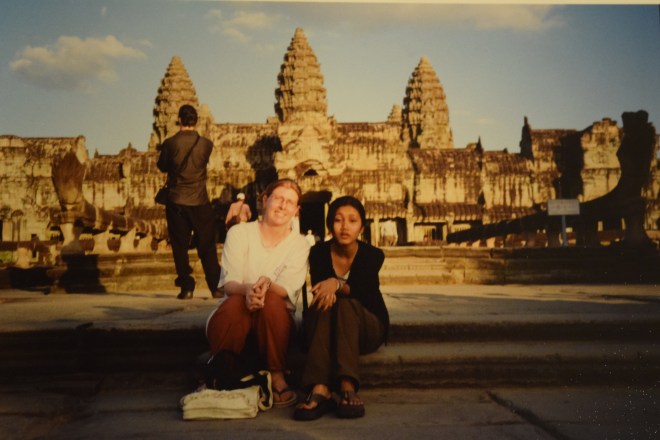
I stayed three days in Siem Reap and saw the incredible temples of Angkor.  I spent hours examining the amazing carvings in the largest of the temples and clamoring over ruins in those ridiculous shoes of mine.  And yet I wrote very little of this part of the trip. 

On January 8, I had a 5:30 am pick-up for a truck to take me to Tonle Sap lake and then the boat to Phonm Penh.  I had a choice seat in the back with my legs crushed awkwardly under other people’s backpacks.  As we bounced over the steadily worsening road, I was sure I was going to bounce out backwards into a rice paddy, but after some 30 minutes we all made it safe and sound.  We boarded small boats to ferry us out to the “BIG” boat, which turned out to be not all that big.  I sat in the very last row in the back of the boat where the boat vibrated so loudly I could not hear the Cambodian karaoke movie properly (a blessing?).  I tried sleeping bu the vibration made my nose itch beyond control.  Instead I read my book (which I left behind and I will never know what happened in Mexico) and watched the mute videos.  Four hours later I gratefully disembarked in the capital.

dsc_0613

The sobering country map at Cheoung Ek

The same day I went to visit the Killing Fields of Cheoung Ek.  After a bumpy 25 minute motorbike ride I arrived at the field where the Khmer Rouge killed thousands of people, bludgeoning them to save bullets.  There is just the excavated graves and a pagoda with 17 shelves of skulls, almost 9,000 of them.  And 43 graves yet to be excavated.  My guide lost his parents there.  The weather was beautiful – a sunny day with blue skies, the fields green.  It reminded me of when I visited Auschwitz and Birkenau.  On the 9th I visited the Tuol Sleng Museum, which used to be a school but was turned into a prison for interrogation and torture.  Not a day of lightness.  Is it strange that this country boast the architectural achievements of the Khmers in monuments of beauty and grace and yet is also home to some of the sites of the most atrocious horrors done by humans to other humans.  Not uplifting, but it should be seen nonetheless.

I flew from Phnom Penh to Bangkok, stayed one night, and then flew to Phitsanulok in Thailand, where I took a bus to Sukhothai.

As soon as I step off the bus in Sukhothai I am accosted by a woman who demands to know where I want to go. I look at my guidebook.  Yupa guesthouse?  OK.  Forty baht.  I look at her dubiously but agree.  As we head to the “taxi” I realize it is a little truck, a songtheaw.  I also notice another songtheaw full of Thai people though I am being led to an empty one.  I aks her, how come all the Thai people are over there?  Farang (foreigner) 40 baht and Thai 5 baht, I ask her.  She laughs as she helps me into my own personal truck.  You must walk far if you take Thai truck, this truck right to door, no walking!  I wearily agree and off we go.

I do not have much energy for the day so I have lunch and take a nap.  I meet a woman from Belgium and we agree to have dinner.  She tells me the truck from the bus station is 10 baht.  The woman from Belgian tells me that the guesthouse is blissfully quiet.  I can hardly wait.  As I lay down to sleep after a furious storm a concert begins.  It is Children’s Day and some pop star from Bangkok is in town and there is nothing more enjoyable to do on Children’s Day then to set up a huge outdoor concern and keep all the children and everyone else in town awake until after midnight.  I put in my earplugs and try to get some sleep.

dsc_0614

A bridge at Si Satchanalai

iOn January 13 I decide to visit Si Satchanalai, another town 56 kilometers north of Sukhothai, where there are some nice ruins.  I consult someone at the guesthouse down the road and discover I can take a bus in the direction of Chiang Rai.  The owner of my guesthouse gives me instructions to the bus station.  He tells me “PingBaBaBuKaLa.”  I look at him.  He repeats “PingBaBaBuKaLa.”  I repeat after him.  He looks at me.  I realize he is saying “Pink Purple Bus Color.”  Ah ha!  I am set.

I write nothing about my time in Si Satchanalai or Sukhothai.  I am always curious of my choices to record some things and not others.  I remember renting a bicycle and riding around the ruined city and my ridiculous shoes constantly fell off as I cycle and I walk right out of them when I get stuck in some mud. 

I travel next to Chiang Mai.  I take part in a Thai cooking course.  I take a three hour Thai massage introductory course at the handicapped center.  I visit Doi Suthep, the temple on the top of the mountain, where I assist an Italian woman bitten by a dog.  I then follow it with my unexpected trip to the Chiang Mai Women’s Correctional Facility, which I chronicled in another post.  As I sit in a hotel room, once again in Thailand many years later, I feel nostalgia for this trip, for the kind of travel I used to do.  Though this time I have some better shoes.


Palau – Islands on the Edge (2011) Part Two

On my second day I was signed up for a snorkeling tour in the Rock Islands including a visit to Jellyfish Lake.  I was just a tad apprehensive about the jellyfish bit, but had no time to think on it.  Best for me not to think too much.  The first stop was at a Japanese Zero, submerged where it crashed in WWII, just 10 feet beneath the surface.  At first we just stopped to look at it, but one of the guests asked if we could snorkel there and after just a few seconds of hesitation, and a quick scan at the sea, our guide said “Sure, why not?”  The others quickly threw on their fins and masks and jumped in.  I was a bit slower – I am always hesitant before jumping in the sea.  But once I was in, it was, of course, really cool.  And it was my first chance to test out the underwater camera a friend from work had loaned me.

32. mimicking mudmen

Hamming it up with the mud ladies

We continued on to an area called Rainbow Reef for snorkeling – and it was stunning, like swimming in an aquarium.  Then on to the “milky way” where the limestone mud just a few feet below the surface of the water is supposed to have therapeutic properties.  We all slathered up and then washed it off with a dip in the crystal clear waters.  Then it was on to Jellyfish lake.

Many, many thousands of moons ago, Jellyfish Lake was open to the ocean.  Over time it became closed off and a species of jellyfish became enclosed and isolated inside the lake.  With no predators, over time, they evolved to no longer have a sting.  Our boat docks at Eil Malk island and we walk up a small staircase trail and then down again to a dock jutting out into the saltwater lake.  “Ok,” our guide says, “go ahead and get in and swim out in that direction and we will swim with the jellyfish.”  Right.  I stare at the water.  I am not the only one of the group just staring at the murky green water, where underneath the surface teem millions of rumored-to-be-sting-free jellyfish.  Oh, and possibly a crocodile.  Thanks Tour Guide for that wonderful story about the crocodile sightings here at the lake.  I jump in and start swimming.

79. jellyfish

Surrounded!

Perhaps ten or fifteen feet in I see my first jellyfish and my instinct is to jerk back and dart in another direction.  I swim around it. But then I see two.  And then five.  And then more and more and more.  No turning back now.  I reach out and touch one.  Nothing.  It feels like thick, flexible latex.  It slides benignly along my hand and away.  I am giddy.  All of us are giddy.  We swim among them.  Through the swarm.  It is amazing.  I completely, well almost completely, forget there might be a crocodile lurking in the depths ready to take me down.  After half an hour or more we swim back to the entrance point and return to our boat.  Once settled and ready to move on to our lunch area, we spot a moon jellyfish floating in the water.  I want now to reach out and touch it and it takes a moment to realize we are back in the real world where jellyfish are not our friends.

It was lunch time and we headed out once again in the boat.  Our stop was a small, flat, palm covered islet.  From the small beach, the drop off is steep and quick.  Maybe 30 to 50 feet deep within 10 feet of the  shore.  Several beginner scuba diving classes were in progress when we arrived.  After lunch I ventured into the water.  This was a big deal.  Our guide had called it Shark Island or something like that.  If you know me at all, you know that I have an irrational fear of sharks and the ocean.  I know it is irrational but I have the fear all the same.  When I was five years old my parents took me (and my younger siblings) to see the movie Jaws.  Apparently I had been hounding my mother for weeks on end to see it.  So she did, and I had nightmares for weeks, maybe months afterwards.  [I used to think my mother was half crazy to do this but now that I have a 4 ½ year old child myself, I completely get it].  It complicates matters that I wear glasses and once they are off, as they are for snorkeling, I cannot see all that well.

43. sharks

Sharks just below me — unclear due to being underwater and not my my shaking or anything

So there I am in the water, halfheartedly paddling about, trying very hard to appear at ease, while pushing back the scenes running through my head of my impeding loss of life and limb by shark attack.  And there below me I spot a circle of divers practicing some basic scuba lessons.  And off to the side is a circle of black tip reef sharks doing what appears to be staring at the divers.   I felt a flutter in my chest.  I might have peed myself.  Wait, it is the ocean, I did pee myself.  I felt terribly brave and slightly panicked at the same time.  But I stayed put.  I willed myself to stay put and watch them.  I took pictures with the underwater camera a colleague had loaned me.  I had just seen sting-less jellyfish and touched them and now here I was in the water within quick swimming distance of some sharks and I was relatively, surprisingly calm.   Would wonders never cease?

50. bloody nose ridge memorial

Monument at the top of Bloody Nose Ridge.

On my third day in Palau, I joined a full day WWII tour to Peleliu island, the site of one of the fiercest battles of the Pacific War, resulting in the largest casualty rate of any amphibious assault in US history.  It was here that 1000s of marines were met with an entrenched Japanese force of nearly 11,000, all on an island only 6 miles long and 2 miles wide.  Over two months of fighting resulted in 40% of the 28,000 marines killed or wounded.   Although I am not a WWII buff I am very interested in history and before my trip I had watched the miniseries “The Pacific” and read the autobiography Hemlet for My Pillow by Robert Leckie, one of the true characters from the documentary who had served and was wounded on Peleliu.

An hour speedboat trip from Koror brought us to the shores of Peleliu, the southernmost of Palau’s main islands.  It looked like any other tropical island with palm trees and a short sandy beach.   Like any other place in history that has seen atrocities, I felt strange standing there looking at the beautiful sea and sky and greenery and trying, completely in vain, to imagine the horror that both sides faced and wrought upon one another.   The divers in the group headed off for their morning dive, which just left me and a family of 3 for the full land tour.   We walked with our guide through the small town, investigated several caves (one with a large spider that I might never get over),  to the old airfield, through the jungle to see rusted out tanks,  downed planes, armaments, and gutted bunkers and buildings.  We lunched and the divers returned to join the second half of the tour including a hike up Bloody Nose Ridge and to the small, but informative museum.   Our hike up Umurbrogol Mountain or Bloody Nose Ridge, a 300 foot high peak, took maybe 30 minutes.  During the US offensive, military leaders planned on 72 hours to take the ridge, but instead it took 73 days.  It was a sobering day but well worth the trip.

DSC_0111

Storyboard depicting Ngibtal

My fourth day was a lazy no-tour day.   I got a lift down to the town center for a visit to the Palau Aquarium.  I love aquariums and I try to visit them wherever I can.  It was a nice little place, part of a larger coral reef research center, but after actually snorkeling around the actual reefs of Palau, the aquarium could not hold a candle to the real thing.   I then walked over to the Koror Prison, an important stop on any tourist to-do list of Palau.   Unlike my visit to the Women’s Prison in Chiang Mai I was not here to see a specific prisoner but to call on the prison workshop where you can browse the beautifully wood-carved storyboards made by the prisoners as part of a rehabilitation program that benefits them and their families.  I hemmed and hawed between two particular storyboards while chatting with the carvers before deciding to purchase one depicting the legend of the fish-bearing breadfruit tree.  From the prison I meandered through some neighborhoods before getting lunch and then visiting the pleasant Belau (as Palau is sometimes spelled) National Museum.

Pouring rain that looked like it would not end but suddenly did, almost sunk my kayaking and snorkeling tour on day five.  Four people cancelled.  Luckily one other person had not as the tour company required a minimum of two.  My tour companion was an American working on a US naval vessel who just wanted a quiet day of swimming and boating in the Rock Islands.  We stopped first for snorkeling above a reef and then at a partial cave, more an opening in one of the smaller islets.  At another location we picked up the kayaks to begin our trip along the mile-long Long Lake, a saltwater lake surrounded by mangrove forests.  It was quiet and relaxing.

24. Badrulchau monoliths (2)

Some of the stone monoliths of Badrulchau amongst the lush greenery of Babeldaob

Rain the next morning nearly washed out another tour but again the skies cleared just in time.  This time it would be just me.  I agreed to pay extra for a solo land tour of Babeldaob, the country’s largest island, and the largest island in Micronesia (other than Guam).   Despite its size, only about 30% of Palau’s 18,000 residents live there, and is one of the least developed islands in the Pacific Ocean.  Babeldaob.  It is a mouthful but it sounds exotic.  Unlike the other islands of Palau, which are limestone, Babeldaob is volcanic.   It is hilly and still very much covered in foliage.  Here in 2006, Palau established its new capital of Ngerulmud, moving it from the most populous town of Koror.   Though the capital is the only settlement to have its own zip code (the country is serviced by the US postal system), and it has a few capital-looking buildings, it does not have the feel of a bustling capital city.

My tour took in the capital, ruined Japanese WWII sites, the mysterious stone monoliths at Badrulchau dating back to 161 A.D. (sort of like Palau’s version of Stonehenge), waterfalls, and traditional Palauan meeting structures, it was my conversation with my young tour guide as we drove around the island that stuck most in my mind.  “A” spends most of her time leading scuba dive tours.  Her father, also a scuba dive tour leader and instructor, worried about his daughter spending too much time underwater and the toll it might take on her body.  He wanted her to find another job.  So “A” did go the United States for college.  Palau, with its small population, only has a community college but no four year institutions.  But there are special considerations and scholarships for Palauans to attend university in the US.   Many go to Hawaii, but not all.  “A” went to the mainland, but quickly became homesick and after a year or so called it quits and returned home where she returned to the job she loves, much to her father’s consternation.

On my final day, I was picked up once again by representatives of Sam’s Tour, the company with which I had taken every single one of my tours.  My flight to Manila, like the one I arrived on, would depart in darkness, after the sun had set.   I would spend the day at the Sam’s Tour headquarters – where they have their dive shop, gift shop, bar and restaurant facing the marina with beautiful views of the water.  I arranged one final tour – a helicopter flight over the Rock Islands.  I was joined on the tour by two 20-something Japanese girls whom the pilot inexplicably assumed were my daughters.  Seeing the islands from the air was breathtaking.  And it was a great end to having experienced Palau from land, sea, and air.  I spent the rest of my trip awaiting transfer to the airport, sitting in the bar, nursing beverages, as I looked out at the water.

27. sunset (2)

Sunset at the Sam’s Tours marina


Palau – Islands on the Edge (2011) Part One

[As part of my blog I am posting stories from my past travels.  These are edited, augmented, versions of email stories I sent to friends and families, or in some cases meant to send but were never completed.  They are at times supplemented with information from my diaries and/or memories.  This trip to Palau was one of my last before I started carrying a baby on board and joined the Foreign Service.  It was a trip in which I pushed up against my comfort zone (swimming in the ocean with a twist), bent to convention (signing up for lots of tours – because the nature of the islands make it nearly impossible to get to places on your own unless you have your own boat – and realized what things I might be too old for (like running after Taylor Swift in the Manila Airport during transit–I did not do it in case you were wondering. I only thought about it.]

19. placid Palauan waters

The incredibly stunning and calm waters of Palau

“The Caroline group includes, besides coral islands, five mountainous islands of basaltic formation, beautiful and fertile with rivers and springs…They look very picturesque as you approach them, with the white shining sands of the beach in the foreground dotted with their queer-looking canoes; then the cocoanut [sp]palms, lifting their tufted feathery heads seventy or eighty feet in the air, the long drooping leaves of the pandanus trees, and the dark, shining foliage of the bread-fruit, while beneath all one can here and there catch glimpses of thatched huts of the natives.  With a closer inspection, however, the beauty vanishes, and the barrenness and isolation of the island are realized.  The heat is intense, and there are heavy languor and lifelessness in the air, which is heavy with the odors of decaying vegetation and the rancid copra, as well as the odor which seems inseparable from heathenism…To establish protectorates over any of these groups must be purely philanthropic work—a laying up of treasure in heaven for there will certainly be none to lay up on earth.” —Harper’s Weekly, November, 20 1900

Palau.  A string of small sun-kissed islands in the Western Pacific Ocean.  Who wouldn’t want to visit?  Certainly not the author of this Harper’s Weekly article over 100 years ago!!  Funny, how our visions of far-flung tropical islands (and heathenism) have changed.   I suppose if more than just a few die-hard divers, WWII history buffs, and Asian honeymooners knew the place existed (and I am none of the above), I expect many people would like to make their way there.   Yet these days even many guidebooks seems to have given up on Palau.  Perhaps a decade and a half ago I had myself a Lonely Planet guidebook to Micronesia.  I was going to visit Guam and had visions of myself soon after somehow making my way to these other difficult to reach islands.  That did not happen.   But it must not only have happened to me because Lonely Planet no longer makes a guide book to Micronesia.

4. sunset at hotel

Sunset view from my hotel

I had a number of reasons to visit Palau.  I love visiting different countries and cultures.  But I do have a particular interest in the South Pacific after spending 6 months in Hawaii as a visiting fellow and then visiting the Cook Islands and Samoa in 2004.  I am not quite sure when Palau came on my radar – but it was sometime after 2004, just 10 years after Palau’s independence from the United States, after 47 years in trusteeship status.  Just a few years ago I started thinking I would really like to visit Palau, but it seems a long way from anywhere.  Unlike Hawaii, which, although it is the world’s most remote island chain in the sense of distance,  is connected to many places by daily flights, Palau has but a few flights a week, some only by charter, from Manila, Guam, Tokyo, Seoul, and Taipei.  Although it is perhaps closest to Indonesia (they share a maritime border!) there are no air connections between the two countries.

I love that Palau is home to the longest river and second largest island in Micronesia.  And amazingly enough there are bridges between several of the main islands!  I find this extraordinary in the Pacific.  Also the famed Rock Islands, featured in multi-years of my National Geographic Islands calendars, are here.

Another interesting tidbit about Palau is that in 2009 the country offered asylum to the 20 Uyghurs held at Guantanamo.  Eight took them up on the offer (and on my first day a guide took me by the apartment where they all supposedly reside.  According to the guide, they are all “very nice”.)  Several months later the US offered Palau something along the lines of $240 million in long-term assistance and in September 2010 the first permanent U.S. Ambassador to Palau started work.  Previously, the US Ambassador to the Philippines also covered Palau.

Palau is different.  Most flights arrive in the darkness.  Mine landed right on schedule at 2:05 am.   Despite that, I noticed something was off as soon as I got into the car to take me to my hotel.  My driver got into the right side of the car, but we also drove on the right side of the road…  Uh, what?  When I asked him why he was driving on the wrong side of the road he said he was not.  So I asked him why his steering wheel was not on the other side of the car.  Turns out, a majority of the vehicles in Palau are from Japan.  i.e. for the Japanese market.  Though the traffic patterns of Palau are those of the US.  I found this confusing because well, the Philippines is perhaps Palau’s closest neighbor (though parts of Indonesia might be just as close, there are no direct flight connections) and they manage to have their steering wheels and their lane directions matched up.  But this is just one of Palau’s many idiosyncrasies.

17. german consulate

Clothing store downstairs and the German Consulate upstairs.  Old school representation in Palau

Like when I went into a souvenir shop and looked at the postcards.  First, the selection was really limited.  But then I noticed that some of the cards were not even of Palau!  I noticed three cards were of Yap, Micronesia.  Okay, I guess that is relatively close by, but it is a different country, the Federated States of Micronesia.  And then I noticed a card that showed an aerial view of a village.  I picked it up to look at it closer – and thought there was far too much land visible for it to be of any island in Palau or Micronesia.  And, wait, the houses looked European.   What?  I turned it over and the card information was not in English, but I noticed the words C. Krumlov.  Oh my goodness.  I have been to Cesky Krumlov.  It is in the Czech Republic!  Why in the world would they sell a postcard of the Czech Republic in Palau?

I had only a few things planned for my first day.  Buy sunblock, get my watch battery replaced (it died the day before I flew to Palau), arrange a few tours, and take a walking tour of Koror.  The live-in-manager of the hotel, Maisa, drove me down to the main shopping center in Koror around 10 am.  (well, at 10:15 am she told me she wanted to leave at 10 am! – but hey, I got a free lift to town).   I browsed through the supermarket to check out what was available, had my watch batter replaced (check) and bought the sunblock (check).  Then I decided to talk a walk around town.  Funny, but that morning as I looked out from the hotel balcony, to see swaying palms and the crystalline sea, I thought, “I could live here”.  After about 10 minutes of walking in the blazing heat, along the main road lined with nondescript buildings, I thought, “there is no way I could live here.”

Koror reminded me of Suva, Fiji, and even parts of Hawaii.  Blessed with beautiful blue skies, warm trade winds, palm trees, and stunning vistas across clear aquamarine seas – but cursed with ugly, functional concrete block architecture.  Maybe it is a result of so many WWII battles being fought in the Pacific that so many of the buildings resemble bunkers? Tall, often colorfully painted, bunkers.

I had a delicious lunch at an Indian restaurant staffed by Filipinos before calling Maisa to come and pick me up.   She let me know that she had arranged a river tour for me that afternoon and they would be picking me up in about 40 minutes.  I was thrilled.

The River Tour was great!  First, on the way there, the self-employed Polish couple from Chicago with whom I shared a pick-up service regaled me with their hilarious tales of tourism in Palau.  When asked how long they would stay in Palau they said 2 months – but so far it was three weeks and they wryly said they were not sure how much longer they would stay.  They said that Palau is odd because it thrives on tourism and yet is not very helpful to tourists.  There are few, if any, maps available.  Many tourist sites have no signage.  For example, they told me how they tried 3 times to visit the Crocodile Farm.  The first 2 times they went it was closed.  So, on the third try they called the place at 8:30 am to ask their opening hours and were told until 11 am that day.  But when they showed up an hour later it was locked up tight!  So they parked the car, scaled the fence, and took a look around themselves!  They also told me when they arrived and the immigration officer asked them how long they were staying, he laughed and asked them “what are you going to do here for that long?”  They loved my story of the postcards!

9.

I am quite sure I would never grow tired of seeing tropical flowers

Once at the river boat tour site we had an opportunity to hold a juvenile fruit bat and a baby crocodile.  I think fruit bats are cute.  I really do!  Their faces look like puppy dogs.  It is just when they spread their leathery wings and reach out with their clawed toes that things start to get a bit scary.  Still, I held him as he pawed my shirt, then licked and nipped my hand.  Until the nipping got a bit too hard.  However, better than the little crocodile, which I dropped as soon as he started to squirm…

So, yes, there are crocodiles in Palau!  I was rather surprised myself.  As part of preparing myself for snorkeling in Palau, I googled “sharks in Palau” and came across some articles about the crocodiles, which some divers seemed a little concerned about.  I know I certainly became concerned as well.  I get that the Philippines and Indonesia and Papua New Guinea and the Solomon Islands have crocodiles – they have some fairly large islands – but the little islands of Palau, a minimum of 400 kilometers from anywhere?  However, an online search of the worldwide habitat of saltwater crocodiles revealed that they were in fact in Palau.  Though there has not been an attack, at least a fatal attack, on a human being since the 60s.  That attack turned the Palauans against the crocodiles, nearly wiping out the island population.

While meandering down the river we saw only one crocodile.  On the way down river, we saw him sunning himself on the bank, on the way back he swam up to the boat.  Otherwise there was little to see along the river – a few birds and fruit bats, but mostly lush green vegetation on either side.  It was quite relaxing.  The tour was supposed to last around an hour, but I think our guide took at least twice as long.  Time seemed unimportant.  There was no hurry.

Back at the hotel, the owner told me that she would be going to the supermarket at 6 pm and I could join her.  I told her it was already 6:10 pm.  That’s Palauan time.  Her friend ended up taking me at 7:30!

Kathmandu 2002: Part Two

I should have known better.  I went to the same restaurant.  Again I had the same plans for the following day:  to visit the Buddhist Boudhanath Stupa and the Hindu Pashupatinath temple.  Clearly I was tempting fate.

Well, I have certainly learned a very valuable lesson, and that is DO NOT eat a second time in a restaurant from which the first time you received food poisoning.  I thought perhaps to give the New Orleans Cafe another go.  It might have been a coincidence to become sick after one meal, but twice?  I woke up about 1:30 in the morning and dragged myself to the bathroom.  Despite my illness I did notice that my two handsome neighbors were playing, of all things, the Greatest Hits of Whitney Houston!  So while ridding myself of my dinner I could enjoy the Greatest Love of All and the theme song to the Bodyguard.  What a strange place is Nepal!

6

Buddha’s eyes watching from Boudhanath

The day after my visit to the “Poison Café,” I could barely get myself up.  But I managed to eat a few pieces of fruit and have some tea before heading out to Boudhanath and Pashupatinath, the most famous of Nepal’s Hindu and Buddhist temples.  Boudhanath is apparently the second largest Buddhist stupa in the world.  It is also home to a large Tibetan community in Nepal.  All around were monks of all ages in their red robes and women with their traditional garb with colorful aprons, some carrying their wooden beads.  I walked up onto the stupa and looked around at this amazing little Buddhist village.  It was very charming.  I even saw people walking their dogs, when I thought in general dogs were not pets, but just street animals.  A sign on the stupa tells visitors in English to not do immoral things while there, such as smoking, gambling, spitting and the like, while all around me I saw people doing these exact things.  Several young novice months, maybe 6 to 12 years of age, stood around a gambling area, placing their bets.  And I saw many people smoking, some quite young.  And spitting, of course!  The sound of the throat clearing and the spit is as common as car horns!  I walked around the stupa about three times, soaking in the atmosphere and decided to then try my luck walking to the Hindu temple, which I had been told was about 30 minutes on foot.

I headed off in the direction of Pashupatinath along a gravel and dirt path between two store facades.  Immediately I was transported into the real life of Nepali people, away from the tourists.  The first scene I came upon was a group of boys throwing stones at another boy.  Without thinking I intervened, telling the offending stone throwers “No!”  They hesitated and slyly threw a few more stones for good measure.  I then came upon also three people washing in a stone bath outside, though they were all wearing saris, and a woman bathing in an area outside her house. There were lots of children playing.  Along one side of the road a bus stood broken down, though for how long it had been there, who knows, and three men stood talking conspiratorially behind it.  On the other side, three young women stood gossiping with each other.  Perhaps they, the men and the women, actually wanted to talk with each other.  It reminded me a bit of a scene I had seen on the first day as I walked to Kathmandu Durbar Square.  One one side of the street a young man sat on the stoop of a store smiling shyly.  On the other side of the street, a lovely young woman in an all red sari stood, brazenly flirting with the man.  It was enchanting to watch.

7

Nepalese children

Further along the path I saw a boy hitting some cows hard with a stick.  I thought here was a boy who had not learned that cows are sacred in Nepal!  I took a picture.  This did not make the boy shy; he only hit the cows harder.  As I walked, I would come to a fork in the road and would just ask someone “Pashupatinath?” and I would be pointed in the right direction.  A few children yelled hello to me, but for the most part I seemed to pass by unnoticed.  This was such a relief after the constant “Hello friend,” “Tiger Balm, cheap for you madam,” “Where are you going? Rickshaw?” and “Come inside, just looking, very cheap” calls in Thamel.  Also the interesting proposal I received of “Tour? Sightseeing? Marriage? Madam” from a rickshaw driver.  Tempting, but no. 

I began to grow tired and feel sick.  My legs began to feel like lead, my stomach to hurt, and my head to pound.  Just at that time by my side appeared a Nepali man who spoke English and told me the temple was not farther.  Thank goodness!  Although a 30 minute walk would usually be a piece of cake for me, this one was beginning to feel it would never end.  The man asked me questions along the way, and showed me the path to the temple and the way inside.  I knew I was earning myself a “guide” but I did not have the energy to tell him to go away.

Those who are not Hindu cannot enter the temple grounds proper but only the area alongside the river and up to the cemetery.  I paid the entrance fee and he led me inside, immediately to the right of the ticket booth we went to the riverside where the cremations are performed.  I looked over the side of a wall and there lay a body almost burned and another wrapped in white cloth being prepared for cremation.  My guide points out to me a hand on the pyre.  “Can you see it?” he asks.  “No,” I say, “and I am not sure I want to…ah there it is.”  My stomach churned.  “Can you see the foot?” my eager guide asks.  “I need to sit down,” I say.  That the smoke in my face is coming off the burning pyre and the ashes as well are from this just burned body, is too much for meI sit down and my head spins and my stomach leaps about.  I tell my guide I think I need to go.  “No, no, I have more to show you.”  I tell my guide that I am going to call it a day.  I pay him some money and catch a motor-rickshaw back to town.  I feel every bump in the road and I slide further and further into the depths of the rickshaw clutching my stomach and moaningThen the rickshaw breaks down.  A policeman watches the driver tinkering with the engine but does not offer to help, while I slump in the back holding my head and wondering at it all.  After perhaps 10 minutes the driver gets us going again and we bump our way back to Thamel and my hotel.  I dragged myself up to my room for a long nap. 

8

Cremation at Pashupatinath

The following day I woke up quite late, about half past eleven.  I was still tired.  I think the air of the Kathmandu valley quite tires me out.  I have to use my asthma inhaler quite frequently and I feel lightheaded at times.  I was not too worried about getting up late, I am here after all to relax, and I had been sick the day before.  I was just worried about being sick still.  I decided I would return to Pashupatinath.  It took me a couple hours to get going and I did not arrive at the temple until about 4 pmAgain a guide joined me almost immediately and though I tried to shake him, he hung on tight.  But he was very informative and I was glad I had him to tell me about the temple.  I saw a cremation on the commoner side of the river.  Though actually on the same side of the river as those for the rich, in government positions, or in the royal family, the cremations for the commoners are separated from the others by a bridge.  For each caste there is a separate platform.  On the commoner side there are four platforms for the four castes.  On the other side were three platforms, one for rich and high government positions, one for, I believe, the sons and daughters of royalty, perhaps for the queen as well, and one for the king. 

My guide told me what a sad time it was last year when so many members of the royal family, who had been murdered in the palace, were cremated.  That royal homicide occurred just weeks after I last left Nepal, and things have become even more difficult for the struggling country. I was not the only spectator; there were many more, most Nepali.  How strange I thought to watch a funeral.  But I thought this in Bali too.  I sat and watched a Newari cremation ceremony until the sky grew very dark and the first fire was lit under the pyre.  Beforehand each member of the family and friends had gone down to the holy river (which flows to the Ganges in India) to dip their hands in and to carry a handful of water to the lips of the deceased.  At last the eldest son dressed all in white and being supported by another man, walked three times around the pyre and then placed the first flame beneath the head of the deceased.  He then fled to the back of the crowd wailing; his loud cries could be heard across the river. It was very sad and very strange for me to be sitting across the river from this rite of passage.  When I said this to my guide, he told me not to worry for this is human life, part of the cycle of life. 

That evening I enjoyed a nice dinner in a cafe overlooking one of the main thoroughfares of Thamel.  Enjoying Mexican food, writing in my journal and reading for my exams (yes I did in fact study) it was hard to reconcile the life on the street below, the shops, loud music, strands of blinking lights and people preparing for or returning from a trek or others selling their wares, with the end of life I had just witnessed, but there it was – the cycle of life.

11

Riding in style – Kathmandu public buses.  See the goats?

The next day I had plans to go to Bhaktapur, the UNESCO World Heritage city about 18 kilometers from Kathmandu.  Last year my friends and I had decided to skip it because we were too angered by the entrance fee.  The fee is 750 rupees (or $10) for foreigners and 50 rupees (.75) for citizens of SAARC countries or China. This time however I was prepared to payThis time I would not take a taxi.  I was determined not to take the easy traveler’s way.  I had hoped to take the bus there, and the trolley car back, but was disappointed to learn the decrepit trolley had finally seen its last days.  I walked down to the City Bus Park in Kathmandu and asked the first police officer I saw to help me find the bus to Bhaktapur.  He kindly helped me find one.  I was delighted because it looked to be about a century old!!  Well actually it looked as though it was rather newly made, welded together from other century old buses, pieces of wood and carpet, which with grinding gears and horrible exhaust belched its way down the highway.

10

Beautiful carved door opens to a courtyard in Bhaktapur

The 18 kilometer trip to Bhaktapur took about 45 minutes.  I arrived though in good spirits right outside one of the city gates.  Who needs to take a 300 rupee taxi ride when they can take an 8 rupee bus ride?  My first glimpse of Bhaktapur, just inside the entrance, was disappointing. It looked shabby and the houses in disrepair.  But on my left a courtyard opened up, with an old woman sitting on a wooden parapet and weaving on an old loom.  Beside her a young girl stood, just in the doorway to this courtyard.  Inside women were threshing rice and the yellow grain littered the ground beside Hindu temples.  Ah, this is Bhaktapur!  From the courtyard I hurried up the street to see more of the city’s treasures and came upon a square I mistakenly took to be Bhaktapur’s Durbar Square.  It was wide and open with some big temples and a totem like pole in off center.  A lovely tea shop set up right into an old building with beautiful windows, porticos and balconies to my right.  I thought I would come back there for lunch, but I did not.  As it was still too early to eat, I headed off down a side street.  I saw two boys rolling thin rubber tires with sticks; they spun their tires quickly up another side street and away. 

9

Hanging out in Bhaktapur

Off I went down another street and I came upon the true Durbar Square.  It was truly beautiful.  There were some temples there which seemed like those I had seen in Lopburi, Thailand or Angkor in Cambodia.  Along the steps were parades of animals.  Once again I acquired a guide, though this one, a student, said he wanted no payment, only a chance to practice his English.  He told me his name was Dave.  Dave gave me a wonderful tour around Bhaktapur, telling me many wonderful things about the city I would never have known on my own.  And he told me about himself. Seventeen, he just taken his high school exit exams and is waiting to go to university.  We had cokes in a cafe overlooking the Durbar Square.  We had a nice conversation and I watched the school kids just let out of school scatter across the square.  I also bought a Thangka painting, painted by my young guide.  It was not expensive and it will help him to go to school.  Dave brought me out another of the gates to another bus park and I hopped aboard a smaller bus back to Kathmandu.  This time I had to stand the whole trip.  It was fine.

Tomorrow is my last day in Nepal.  Then I fly back to Bangkok for an evening and back to Singapore the following day.  Back to the exams.

The trip must have worked.  I scored very well on my exams.  Quite well in fact.  When I graduated I received a gold medal for achieving the highest score in my program that year.

13

My Thangka painting by Dave


Kathmandu 2002: Part One

1

One of my favorite pictures from the trip: Temple bells.

As part of my blog I am adding edited excerpts of stories I wrote on/of past travels.  I have been thinking a lot on the person I was before I joined the Foreign Service.  The person I was before I became a mother.  My by-the-seat-of-my-pants travels, the ones without hotel reservations, the ones where I carried everything in a single mid-sized backpack, the ones where I stayed not in hotels but in shared dorms or cheap guestrooms, sometimes with shared facilities, sometimes without hot water.  The trips where I would walk for hours instead of taking a taxi or tuk-tuk or rickshaw that I thought cost too much.  The trips on which I might wear the same pair of pants or shirt for days.  I sometimes really miss those footloose and fancy free vacations.

Still I am, and was, a planner.  I poured over maps and guide books, train time tables and bus schedules.  Once on the road things could change.  If I arrived somewhere and I did not like it, I could leave a day earlier, even that afternoon, off to somewhere else.  If I liked a place a lot I would stay longer.  But I still had a very good idea of what I would find in any given place.  I was prepared.  Yet my 2002 trip to Nepal is the least planned of all my trips (except maybe that time I went to Albania).   I always wondered if I could be one of those people to show up at an airport and simply buy a ticket and fly to anywhere same day.  This is the closest I have come.

2

Look at those snazzy hiking pants!  One of my first acts in Kathmandu was to buy two pairs.

I was a graduate student in Singapore and we all had one week off between classes and our exams.  I wanted to get away, out of the country.  I decided to fly to Thailand.  Inside my bags I had my class notebooks.  My plan was to sightsee during the day and then study for my exams in restaurants and in my guestroom in the evenings.

After a day in Bangkok listening to the thumping sample CDs competing with the bars and restaurants on Khao San Road, I knew Bangkok was not the place I wanted to be.  The day before, I had met a Japanese rafting instructor who was on his way to Katmandu.  I had been considering going to Brunei, but who goes to Brunei for a week?  So I went to one of the Khao San Road travel agents and instead of asking about a ticket to Brunei I asked about Kathmandu. A day later I was on the plane.

Now about 30 minutes before landing at the Kathmandu airport I am wondering if this trip was a good idea.  For one thing, I have no guide book.  For another, I have no cool weather clothes with me.  The pilots just announced the weather is in the 70s.  I look around the plane to see the majority of people dressed in khaki pants, long sleeved shirts with pullovers or jackets and hiking boots. I look down at my own knee length skirt, a short sleeved shirt and sandals.  I have one jacket in my checked luggage.  The flight attendants hand out the customs forms.  One question asks me to declare how much currency I am bringing into the country.    I realize I have about US$50, (US$30 is to cover the cost of the visa on arrival) and 50 Singapore dollars. I cannot recall if Kathmandu has ATM machines. Thailand has them on every street corner so it had not occurred to me.  Until now.

4

I sought calm and inspiration in Durbar Square.  I am not sure who I liked more: the uber cool Sadhu chillin’ out at the temple, or the young man just below him staring up in rapt attention

But it was enough.  I bought some pants, found a place to stay, and have managed. It turns out there are two ATMs in Katmandu, although I was in a bit of a panic when I went to the first outside of the Kathmandu Guest House and found it out of order.  However the owner of the Thamel guesthouse where I found a small, quiet room on the third floor with a wooden desk perfect for studying and a window that looks out on a busy pedestrian street, told me not to worry and to just pay him the following day once I located the other ATM (which thankfully worked because it turns out that the banks are closed for two or three or four days for a holiday). 

I am so glad to be here in Nepal.  I love the atmosphere.  I am a bit envious of all the people I see heading off or returning from treks.  There is the excitement of starting something so amazing and the uncertainty of whether one will be able to complete the trek.  Then for the returnees there is the joy of accomplishment, of having the smiles and pain and blisters and stories about the journey.  I spent some time last night with some women about to head off on a two week trek to Everest Base Camp, and how much I longed to bunk my exams and head off to the hills.  I think they would have made lovely companions.  But as spontaneous as I can be on travel, I usually remain practical. No, this trip is just for a week.

3

Festive colors for Diwali and the Newali New Year

I feel lucky to have come to Nepal at this time even though I had not planned on this trip.  It is a week of celebrations.  First, it is Diwali.  The streets are full of lights.  Candles and carpets of yellow flowers lie at the entrances to many shops.  Groups of children are caroling from door to door for tika, a blessing and a small amounts of money.  Tomorrow the boys will receive tika from their sisters. They give a small present to the sister, who will then give them some small amount of money.

Today Kathmandu Durbar Square was full of holiday makers buying fruits, flower garlands, and new clothes for the occasion.  The last time I was in Kathmandu, although there were certainly people in the Square it was more of an oasis from the crowded narrow streets, but today the Square rivaled the streets in energy and raucous noise.  It was rather wonderful. On the way to the square I was blessed by a Sadhu, who planted a tika on my forehead, put some flowers in my hair and doused me with holy water.  I returned the favor with a “donation.”

 It is also the Newari New Yea.  At first I was a little confused.  New Year?  I thought it was New Year the last time I visited Nepal, in April 2001.  And it was.  Then it was the Baishakh New Year 2058.  Now instead it is turning 1132.  What luck to always turn up during such celebrations.

Because I have been to Kathmandu before and am a little familiar with the

5

I felt pretty blessed to receive “tika” from this happy fella

streets and restaurants, I can sit and study in a cafe enjoying a cup of Nepali tea or in a Kashmiri’s shop having lemon tea, do a little studying, but still enjoy a different atmosphere..  It feels just right.  I hope I feel the same after a week (or even tomorrow because I tempted fate by having dinner in the same restaurant that A&P had our last dinner together the last time I was in Kathmandu, and the following day I was extremely ill.  I sat at the table beside the previous table.  I think I even had the same surly waiter!  But it was a delicious meal then, and it was tonight too.)

I am growing a bit tired. Although it is just 8:45 Nepali time, it is 11 pm Singaporean time (Nepal doesn’t like to have the same time as India, so it is 2 hours and 15 minutes different from Singapore).  It’s time to head back to my hotel and sleep.  I want to get up early tomorrow and head out sightseeing.

Namaste & Happy New Year