A Hard Year

Cherry blossoms in Spring 2025; nature (particularly trees and flowers) and nature photography are two things that help me cope with life’s challenges

It has been a hard year.

Although the year isn’t over yet—and I may be tempting fate by writing this now—I’m hoping that putting these thoughts down will do two things: first, keep any more surprises at bay; and second, help me process everything that has already happened.

The first big moment of the year was Inauguration Day on January 20. I rarely wade into politics on my blog, and it’s perfectly normal at any time not to feel enthusiastic about a particular candidate taking office. But this year, I felt particularly anxious about the start of this administration and the policies it would sweep in. Even so, I wasn’t fully prepared for some of what followed—but more on that later.

At 8:47 PM on January 29, an Army Black Hawk helicopter collided midair with American Airlines flight 5342 over the Potomac River, just minutes before the plane was to land at Ronald Reagan Airport. All 64 people on the flight and the 3 aboard the helicopter died. Among them were 28 skaters, coaches, and family members from the figure skating community—11 of the youth skaters were ages 11-16.

My 13-year-old daughter began figure skating in Arlington last year. Although she didn’t know the skaters personally, she had seen them on the ice. The MedStar Iceplex in Arlington—where she practices—was also the home rink of many of those skaters. At the memorial, as she stood taking in the names and photos of skaters her age, my daughter sobbed. I felt helpless to guide her through a loss of this kind; there was nothing I could say that would make it understandable. The tables of stuffed animals, flowers, photographs, and memorial books remained at the rink for about two weeks, a quiet reminder of how many lives had been intertwined there.
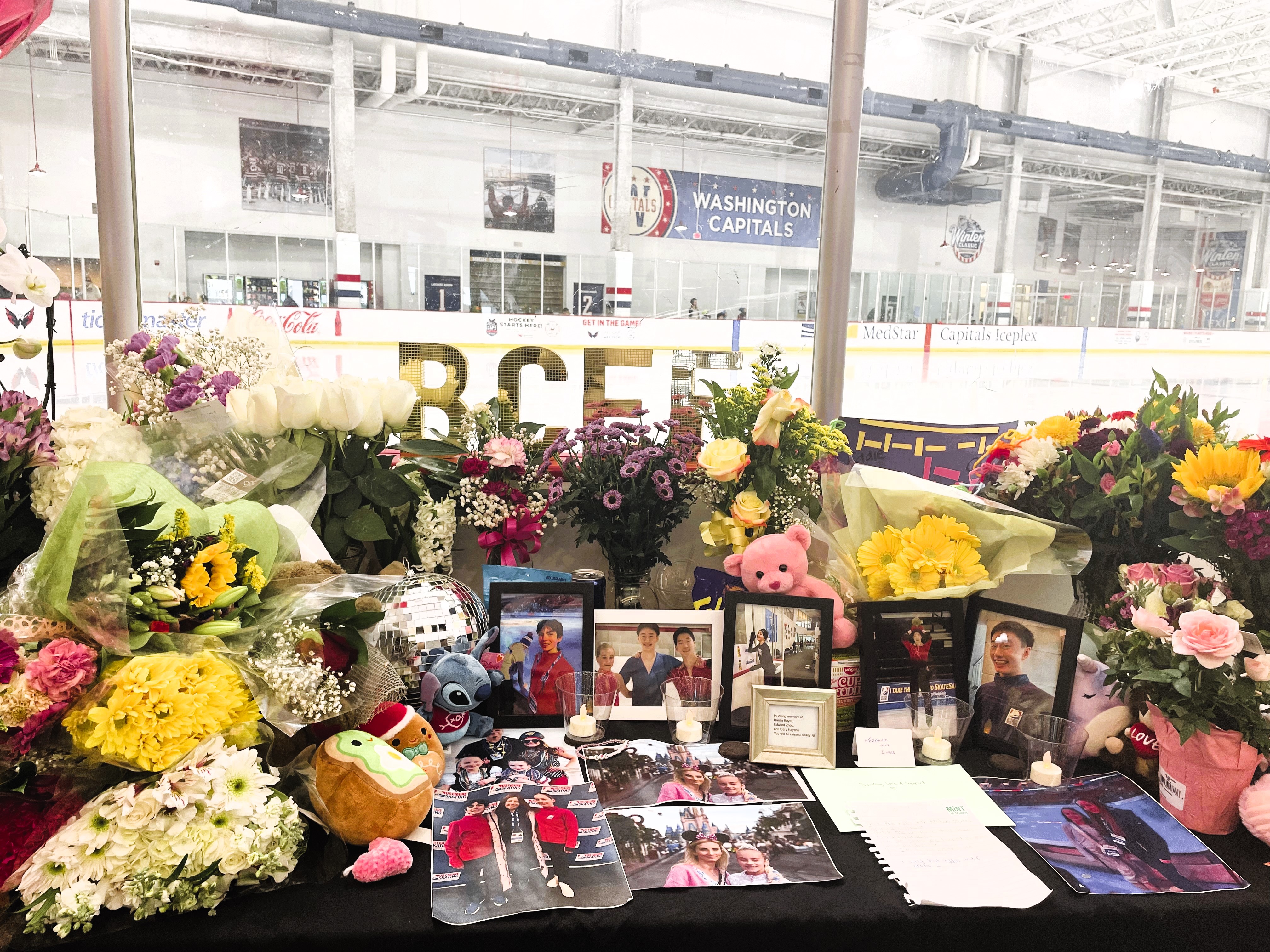
In the aftermath of the Flight 5342 disaster, the Medstar Iceplex remembered those lost.

In June, when my daughter performed in the annual Ice Show, several competitive youth skaters put on a beautiful program to honor their friends and teammates. The photos of the skaters and community members we lost still hang on the rink’s walls and will soon be included in a permanent memorial to Flight 5342.

Two weeks later, things became more difficult. On the evening of February 13, a doctor called to tell me that my mother—who lived in a memory care unit—had been admitted to the hospital. This wasn’t unusual; ever since her fall in January 2024 and her hospitalization on February 14, 2024 for severe infections and psychosis, she had required ongoing care in various facilities and continued to experience medical complications. I had been the main point of contact for her care and had received many such calls over the past year. But this time, the doctor explained that she was in respiratory failure and was not expected to recover.

After speaking with him, I informed my siblings and aunt, then called my father. When I told him my mother was back in the hospital, he became distressed and started breathing rapidly, and I had to call 911. Emergency responders forced entry into his home and transported him to the same hospital.
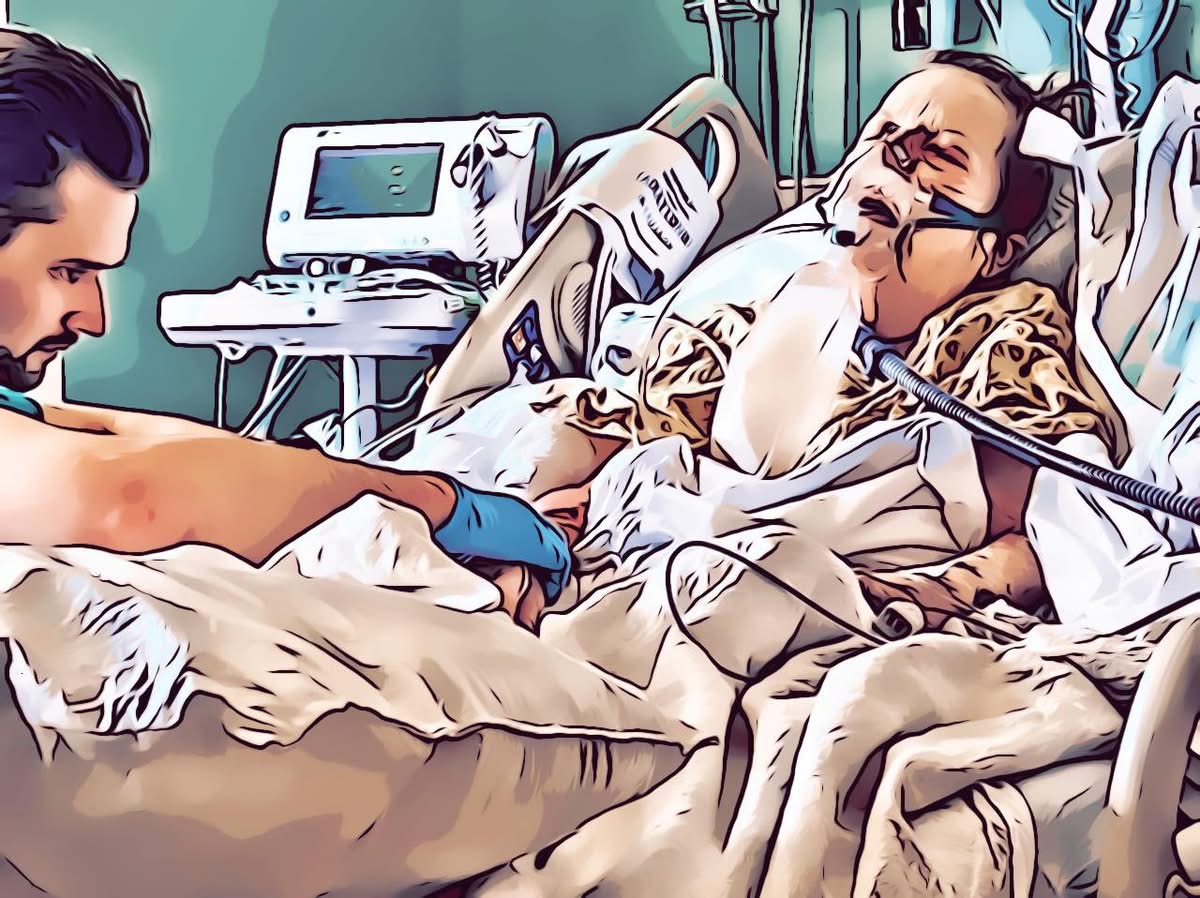
Mom receiving care in her final days.

I spent most of the next two days there, moving between my father’s room on the second floor and my mother’s on the third, coordinating with medical staff and notifying family. On February 15, around 5 PM, the nurses made my mother comfortable and we turned off her oxygen. My sister CH and I stayed with her for several hours. She rallied unexpectedly, and I left around 11 PM.

My mother lingered until the evening of February 19, when she passed away. My father stayed in the hospital for two more days before being transferred to a rehabilitative facility, where he remained for six weeks.

In the first weeks after my mom passed, I was busy managing the bureaucratic details that come with death. As the point person with the crematorium, I provided and reviewed the information for the death certificate, handled the billing, and arranged for the collection of her ashes. I also closed out her room at the assisted living facility. At the same time, I was supporting my dad—visiting him during his rehabilitation, coordinating with his care team, and eventually taking him back home. It wasn’t until several months later that I was able to think about my mom herself.

We had not been close for a long time, but certain things still stay with me. She didn’t have an easy childhood as the youngest of seven in a working-class family outside Pittsburgh. She worked hard, often two or three jobs at a time. When we were little, she told us stories and made up songs—good enough that my sisters and I once performed them in our elementary school talent show. She made excellent handmade Halloween costumes, and when I was ten and my sisters were eight and six, we swept the local contest with first, third, and fourth place. I was a bag of McDonald’s French fries (and it was I that won first!).

Tulips next to mom’s urn; Co-workers sent me tulips after mom’s passing, not knowing that they too were her favorites

She loved yellow corn on the cob (not the terrible white kind!) with plenty of butter, Big Macs, stove-popped popcorn drenched in real butter, and those pink wintergreen candies that tasted vaguely like Pepto-Bismol. And she loved Coca-Cola. When I was a kid, we kept two two-liter bottles in the fridge at all times—one for her, and one for the rest of the family. And when she visited me in Jakarta in 2010, an animal handler at the Taman Mini Indonesia Reptile Park invited her into the Komodo dragon enclosure, and she enthusiastically said yes! And then she forced me to go in as well (she called me “chicken” and I could not let that stand), even though I really did not want to get into a cage with a 9-foot-long lizard whose bite could kill me.

I had little time to mourn my mother, though, because other difficult things were unfolding—this time in my professional life. The new government administration began rapidly cutting the federal workforce. It wasn’t done with care or coordination. USAID was quickly dismantled, leaving many of my friends and colleagues—people I had worked alongside in Indonesia, Malawi, and Guinea—suddenly without careers. Across the State Department, others took early retirement, resigned, or were abruptly fired.

The stress and uncertainty were constant, and there was real sadness in seeing so many good people lose the work they had devoted their lives to. And underneath all of it was the worry that my own job might be next. It was a different sort of grief.

Sign in Washington, DC, in June showing support for federal workers

I have been a near-daily meditator since 2018, and I started seeing a therapist in the fall of 2024. At the start of 2025, I added ice skating to the mix. My daughter was learning, so I figured I might as well try it too, and maybe pick up something fun that pushed me a bit. I love getting out on the ice—with no cell phones, I couldn’t read the news, doom scroll, get caught up in cat videos for far too long, or really think about anything other than remaining upright and finding joy in that. These activities helped, but halfway through this year, I knew I needed more to help me cope.

I started with some 5Ks with my daughter. She had asked to see my old running event tees and medals, and after looking them over, she asked if we could run together. Back when I started this blog, I was a runner. I had participated in numerous 5K, 10K, 10-miler, and half-marathon races. But once I left Shanghai, went into training, and then moved to Malawi, the running fell by the wayside. I am not in great shape now, but C and I have already done 4 5ks in the latter half of this year.

We also went ahead with our vacation to Europe in August. With everything that had been happening, including the uncertainty swirling around continued federal government employment, I had debated about canceling. I am extremely glad I did not. Going on that Balkans travel adventure with my daughter was amazing and restorative.
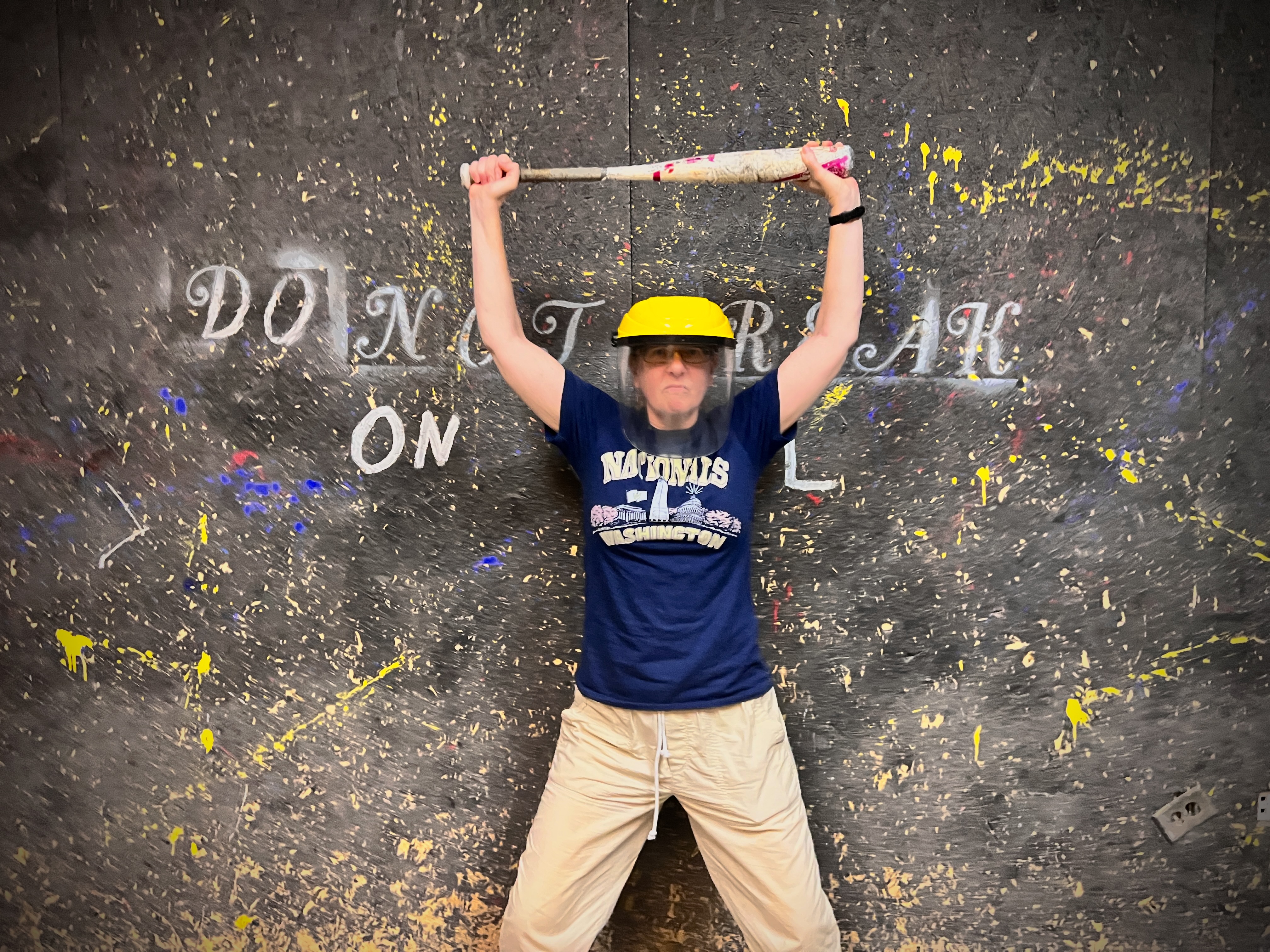
I prepare to get my Rage Room on

My sister was struggling with the grief, too. She had lost her job, a close family member on her husband’s side, and two friends in the same timeframe as Mom. I had been looking into a grief circle for both of us, but the timing did not work at first. So I asked her if she wanted to go to a rage room with me. I thought she might think it was dumb, but she did not even know what a rage room was. When I explained it, she agreed without hesitation. So in early August, the two of us went to a place out in Winchester. With the music turned up loud, we took baseball bats and smashed a bunch of things for thirty minutes. It was certainly not a solution to everything, but it was very therapeutic.
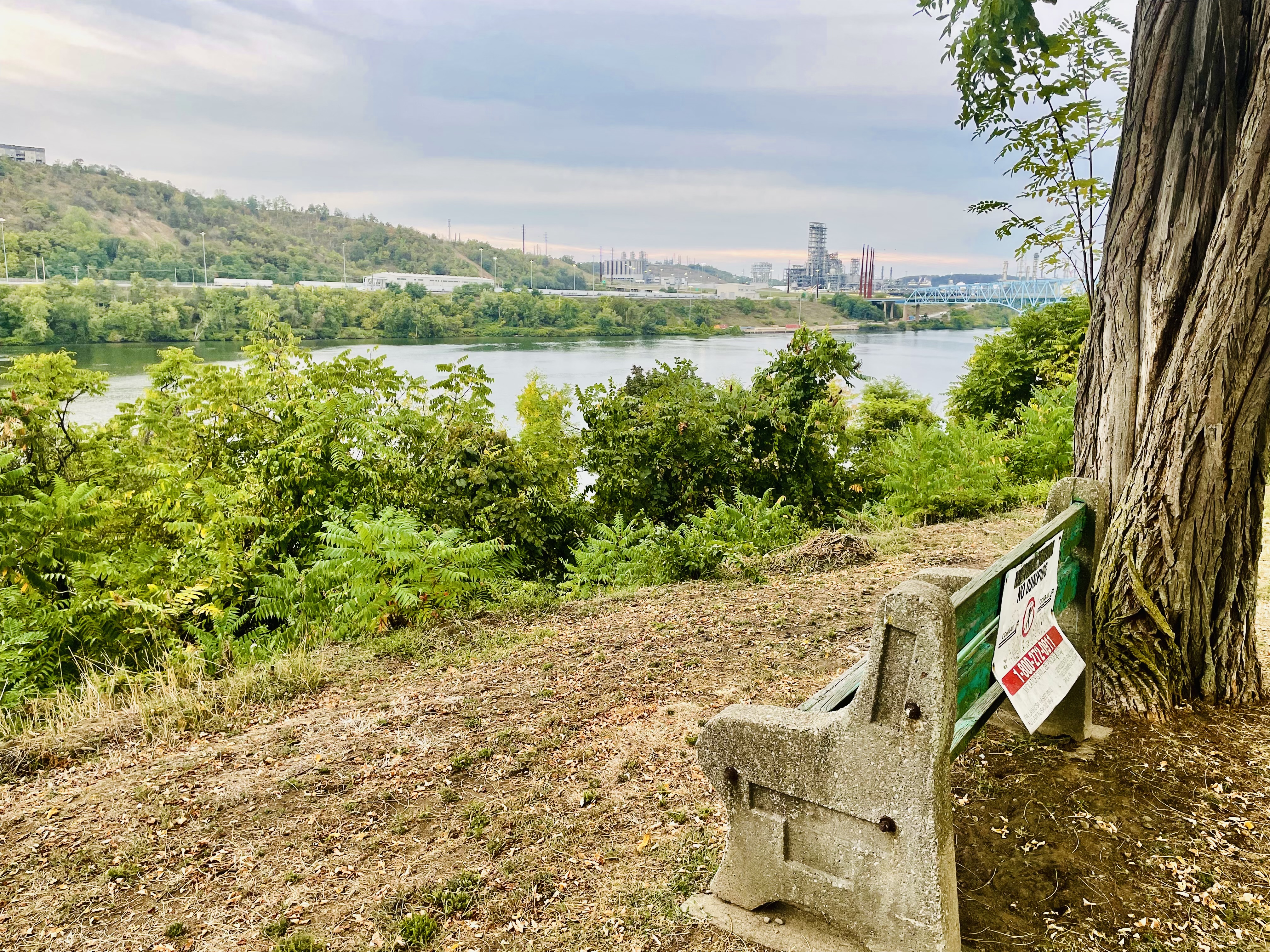
The overlook of the Ohio River near my mom’s childhood neighborhood in Beaver, PA

In September, C and I drove to and from Toledo for the wedding of a college friend of mine. Along with enjoying a ceremony and reception at the Toledo Zoo and Aquarium, I planned a few activities connected to my mom. While we were in Toledo, I visited my Aunt Julia, my mom’s only living sibling (my mother’s brother passed away in May), and my cousins. We spent a Sunday morning at her house and then had lunch together. On the drive home, I stopped in Beaver, Pennsylvania, where my mom grew up, and sprinkled some of her ashes along the river overlook near her childhood home.
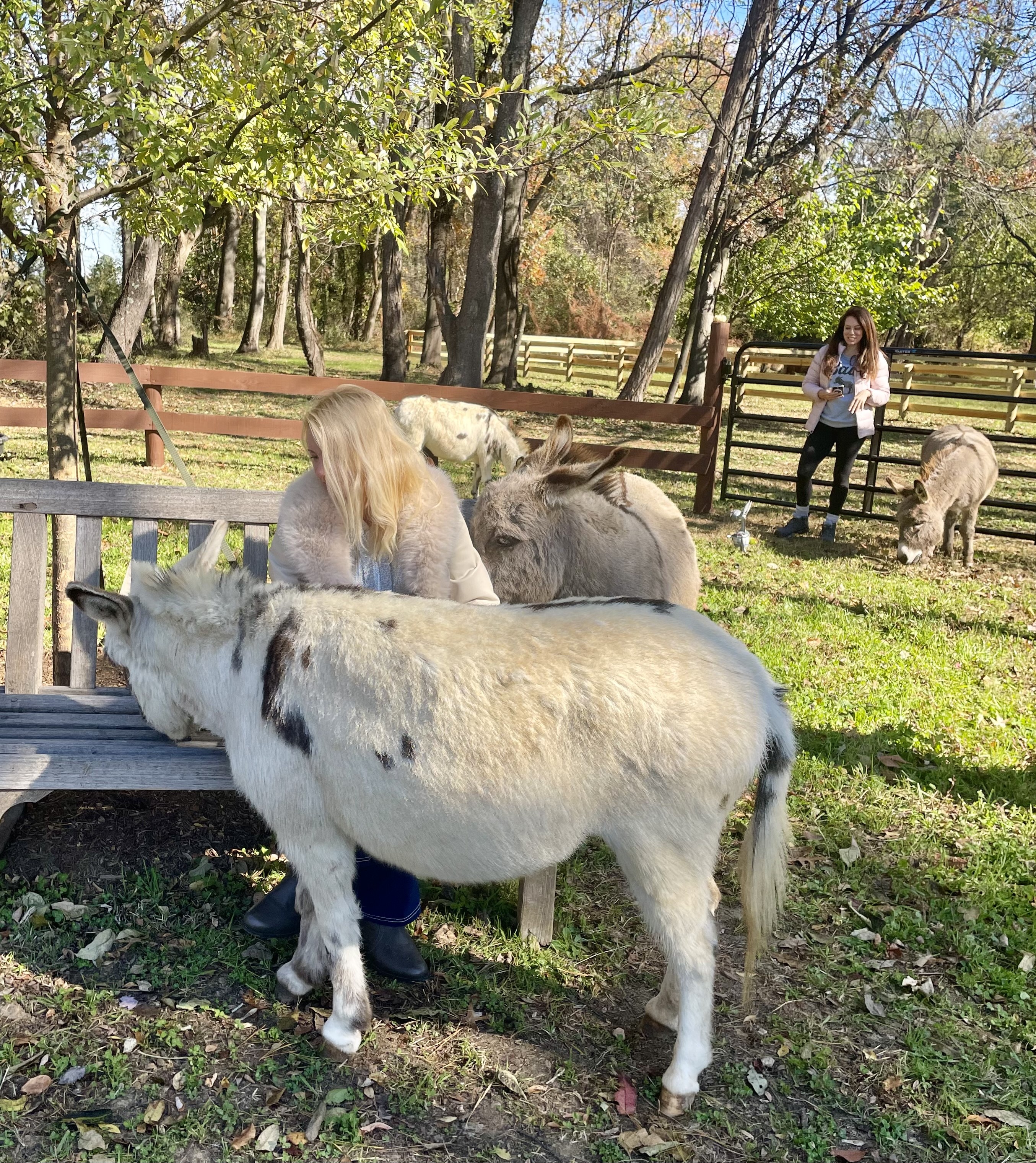
My sister would have preferred horses, but the donkeys sure did take a shine to her

Finally, in October, my sister and I joined a grief circle led by a Foreign Service friend of mine. JS and I began our Foreign Service careers in the same orientation class years ago. During her second tour, she experienced three devastating personal losses in a short period of time. After moving through the initial stages of grief, she sought more ways to live with and accept the losses, from running a marathon to writing a book, and then helping others by becoming a certified yoga and grief coach. We joined her and four others who were experiencing loss at a small farm near Purcellville, Virginia. We meditated, shared our grief stories, and then took part in equine therapy with several sweet and friendly rescue donkeys.

None of these activities alone solved the grief or completely lifted the weight of the year, but each one helped me keep moving. Meditation, therapy, ice skating, time with family, the rage room, the trip to Toledo, and the grief circle all gave me different ways to breathe and stay grounded. Together, they helped me find small moments of steadiness during a very hard year. Here’s to hoping 2026 is a little lighter.


A Mini Spring Break in North Carolina

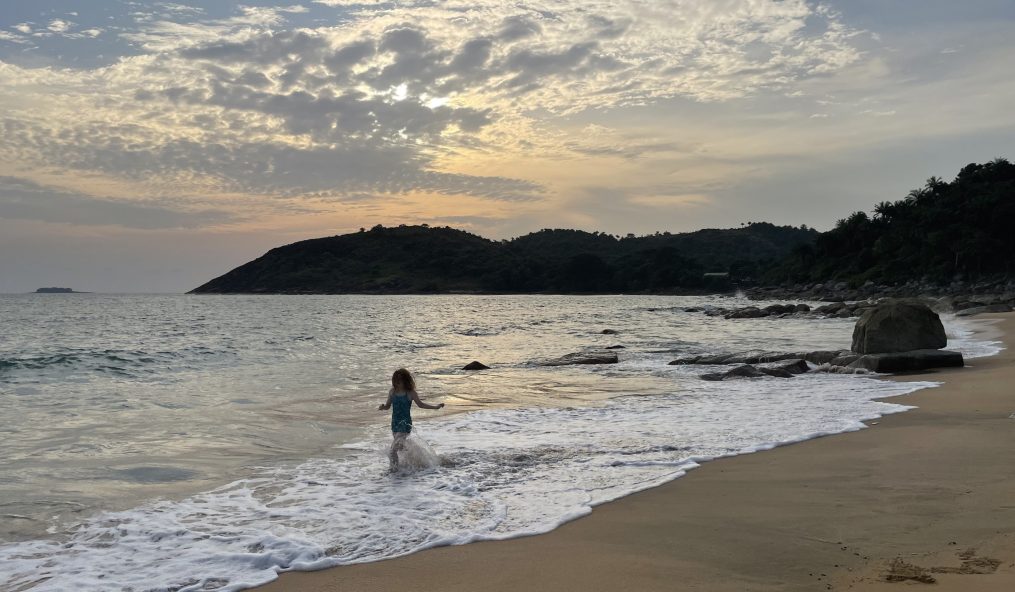
Sunset on Sand Dollar Island

Spring Break. I do love that term and the possible adventures it opens up. For the past two years, my daughter C and I have opted to spend her Spring Break in the Caribbean, first in Grand Cayman and then in Roatan. However, this year, we stayed closer to home.

From the beginning, this year has thrown me some personal and professional challenges, so I did not have either the time or the energy to plan a big getaway. In addition, I had already taken some time off work to manage those personal challenges and did not want to be away for long in case I was needed. Still, I very much wanted and needed a break.

I opted to take only two days off, during which C and I drove south to the beautiful town of New Bern, North Carolina, to visit our long-time friends and travel companions CZ and Little CZ. The aim was simply to spend time with people who mean a lot to us and to be away from home because the whole “change of scenery” idea really does work for me.

At Latham-Whitehurst Nature Park

Another perk of this trip was the drive. Like many Americans, I do love driving and the excitement of a road trip. In many of my overseas postings, road trips are often limited, so while posted in the U.S., I want to take advantage of this option. Also, to be honest, I am currently quite annoyed by plane travel. I do not yet know if this is only a temporary irritation or something more permanent.

On the Wednesday night of the Easter week, C and I packed up the car to join the rush hour commuters heading south on I-95. I do not even remember the traffic; we really did not care. We were in the car, on our way to see friends, and singing our favorite songs at the top of our lungs. We stayed in a hotel just outside Rocky Mount, NC, for the evening. I could have pushed on to New Bern that evening, but the stress of the first few months of 2025 had worn me out. The journey, even staying the night in a nondescript, but clean and comfortable, hotel off the highway, was a big part of the break. Well-rested the following morning (more rested than I had been in months), we made the last two hours to CZ’s house the following morning.

Our first day was low-key. We arrived a bit before lunch and settled in. CZ and I began to catch up. Then, we all headed out to Sara’s, a restaurant serving up hearty portions of Italian and American comfort foods. It was a lovely, warm day and we sat outside. CZ and I did some more catching up. Afterwards, we drove just a short way down the road to the Latham-Whitehurst Nature Park, where we strolled and talked along wooded paths and boardwalks. Then back to the house for more talking. I am sure C and Little CZ were catching up as well; we weren’t worried about them. They have spent so many trips together over the years, they are almost like siblings.

For our second day, we decided to spend the day visiting Edenton. CZ said it had long been on her list of places to visit, and I am a huge fan of historic towns.

Left: The Cupola House, a Georgian-style home built in 1758.
Right: A 1905 bronze teapot commemorating the 1774 political protest organized by Penelope Barker—one of the first organized acts of female political action in American history.

Just outside of town, we stopped at the Edenton National Fish Hatchery. This might seem like an odd stop, but when I visited South Dakota in 2014, I also visited a fish hatchery. That one was established by none other than the famous Seth Bullock of Deadwood fame. The fish hatchery in Edenton also has a rich history, having been established in 1898. There is a small aquarium on the premises, and one can take a self-guided walk among the hatchery ponds. Unfortunately, several of the ponds were drained and we couldn’t see the fish in those that were filled. Though CZ and I tried to make it fun, the kids were bored fairly quickly. I admit is was no where near as interesting as the one in North Dakota.

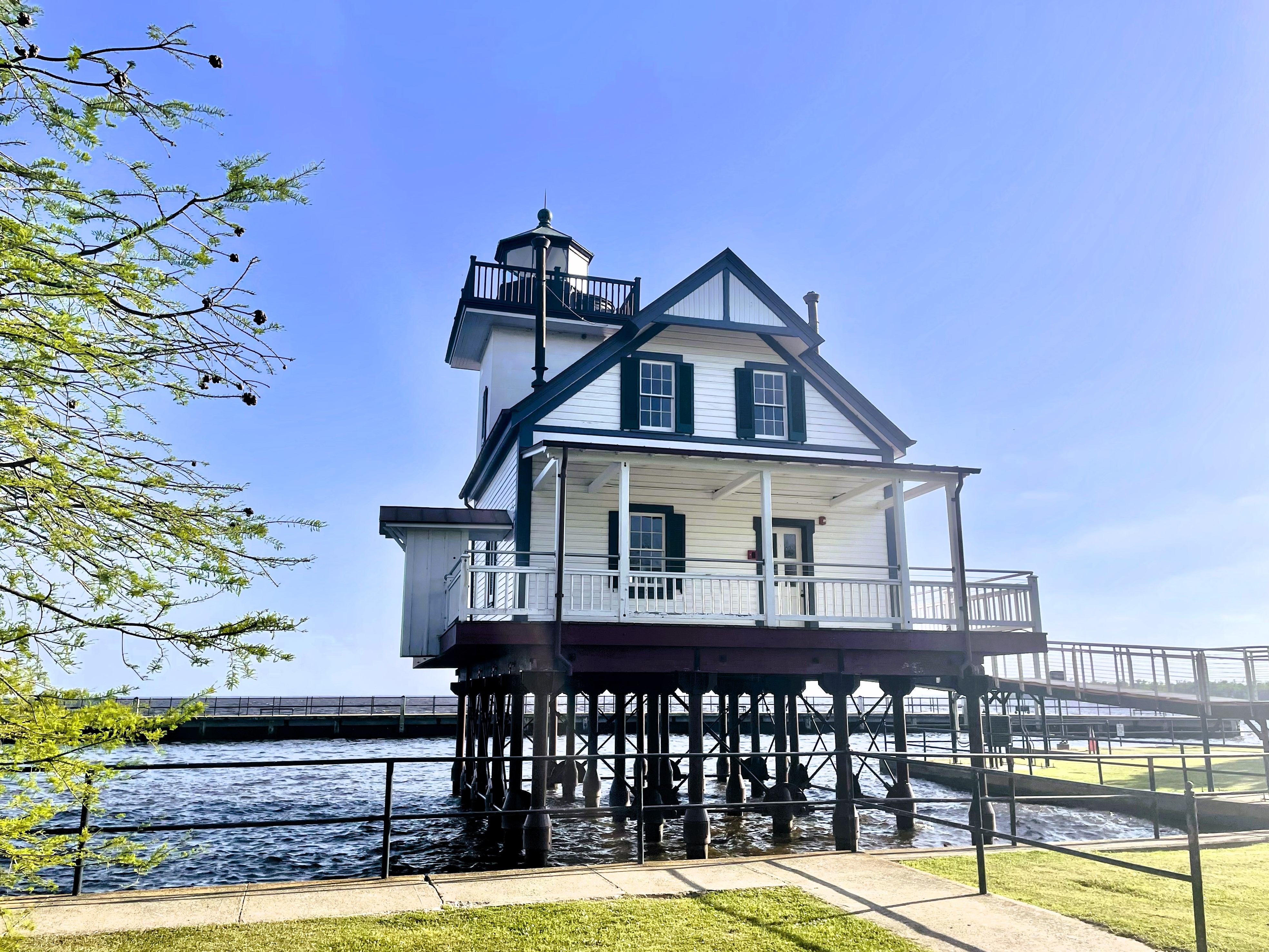
The 1898 Roanoke River Lighthouse on the Edenton waterfront

The town of Edenton, however, is a different story altogether. We visited the welcome center and then took an hour-long trolley tour to learn about Edenton. Our trolley guide was a chatty woman, retired from nursing, who had grown up in the town. Though new to guiding, she knew her stuff. She filled us in on both the town’s and her family’s history.

Founded on Albemarle Sound in 1712—making it the second-oldest town in the state—Edenton served as the second colonial capital of the Province of North Carolina from 1722 to 1743. Often hailed as the prettiest small town in North Carolina, Edenton may be small, but it is rich in history, with nearly every street featuring multiple sites listed on the National Register of Historic Places. The 1782 home of Penelope Barker, the organizer of the 1774 Edenton Tea party, serves as Edenton’s Welcome Center. The 1776 Chowan County Courthouse, a beautiful example of public Georgian architecture, is the oldest courthouse still in use in the state. Lane House, the oldest house in North Carolina, is found in Edenton.

At the Herringbone restaurant, which is located in a 19th century herring icehouse

After the tour, we took a stroll up the main street to do a bit of window shopping. Fronted with coffee and dessert shops, restaurants, cute boutiques, and Bryum’s Hardware Store (owned by the family of our trolley guide), which has been a town staple since 1912, the compact street offers more than most towns of comparable size. We all had a nice time on the walk; each one of us bought ourselves a little something. Afterwards, we ordered dinner from the Herringbone (our guide said it is the most popular dining establishment in Edenton), and ate outside with a view of the sun setting on the waterfront. We loved our visit to Edenton!

For our final day in North Carolina, we chose another waterfront destination—the historic town of Beaufort. Established in 1713, it is the fourth-oldest town in the state and is known for its rich maritime (and pirate) history. On our previous visit with our friends, we explored the North Carolina Maritime Museum, took a silly tour aboard a replica pirate ship, and spent time at Shackelford Banks enjoying the beach and spotting wild horses. This time, we came for a late lunch before catching a ferry out to Sand Dollar Island.

Sand Dollar Island is a barrier island in the Beaufort Channel. It not really an island, but instead a sandbar, which is only accessible at low tide. And it has the highest concentrations of sand dollars (flat burrowing sea urchins) in North Carolina.

Sand dollars at Sand Dollar Island

To get there, we took a 30-minute ferry ride. Along the way, a pod of curious dolphins treated us to a bit of excitement. I doubt I could ever tire of spotting dolphins. The ferry “docked,” or rather rolled up to the sandbar, and we disembarked for our two-hour visit. Already after 5 PM and the tide on the rise, we had maybe a soccer pitch’s length and a maximum of fifty feet in width of sand to explore. The water around Sand Dollar Island was only a few inches deep so one could “wade” out a few dozen feet and still have the water only up to one’s ankles, giving the impression that visitors were walking on water. Though nearly everyone was bent over double in search of sand dollars.

Being the last boat of the day, there were not many left to be found. Visitors are warned to leave the living sand dollars, though we could pick them up and hold them to feel their tiny velvety spines, like hair, tickling the palm of your hand. C and I had never before found or held a sand dollar, so this was a very special experience. Especially walking on a sandbar at sunset as warm waters lap over your feet.

Sand Dollar Island disappearing beneath high tide as we depart

I will admit feeling just a tinge of worry as the sun set, the wind kicked up, and the water rose, and the return ferry was not yet in sight. But soon enough, we could see the ferry puttering towards us on the horizon. As we pulled away, Sand Dollar Island was certainly thinner than when we had arrived, and would surely be completely engulfed by the sea at high tide.

We drove back to CZ’s house, giving my oldest friend and I another hour to while away in conversation. C and I started our drive back home that evening, stopping again to spend one more night away from home, extending that different scenery feeling just a little longer. Then we were back home on Easter morning.

In & Around DC: Autumn 2024 Activities

C sits in the autumn splendor of Gulf Branch Park

Autumn is when Foreign Service Officers about a year out from the end of an assignment bid for their next position. As I had just started a new job, I was exempt from taking part, but soon I began to see a flurry of excited postings online about where my friends would be going next. I am not a fan of how we go about obtaining our next assignments (I honestly do not know anyone who is), but I do feel a twinge of envy when others are going through it. Next year I will be bidding again, and the realization made me think about how quickly the time here in the U.S. might pass. I have often been posted to places that do not have an autumn, and thus I really want to make the most of the ones we have.

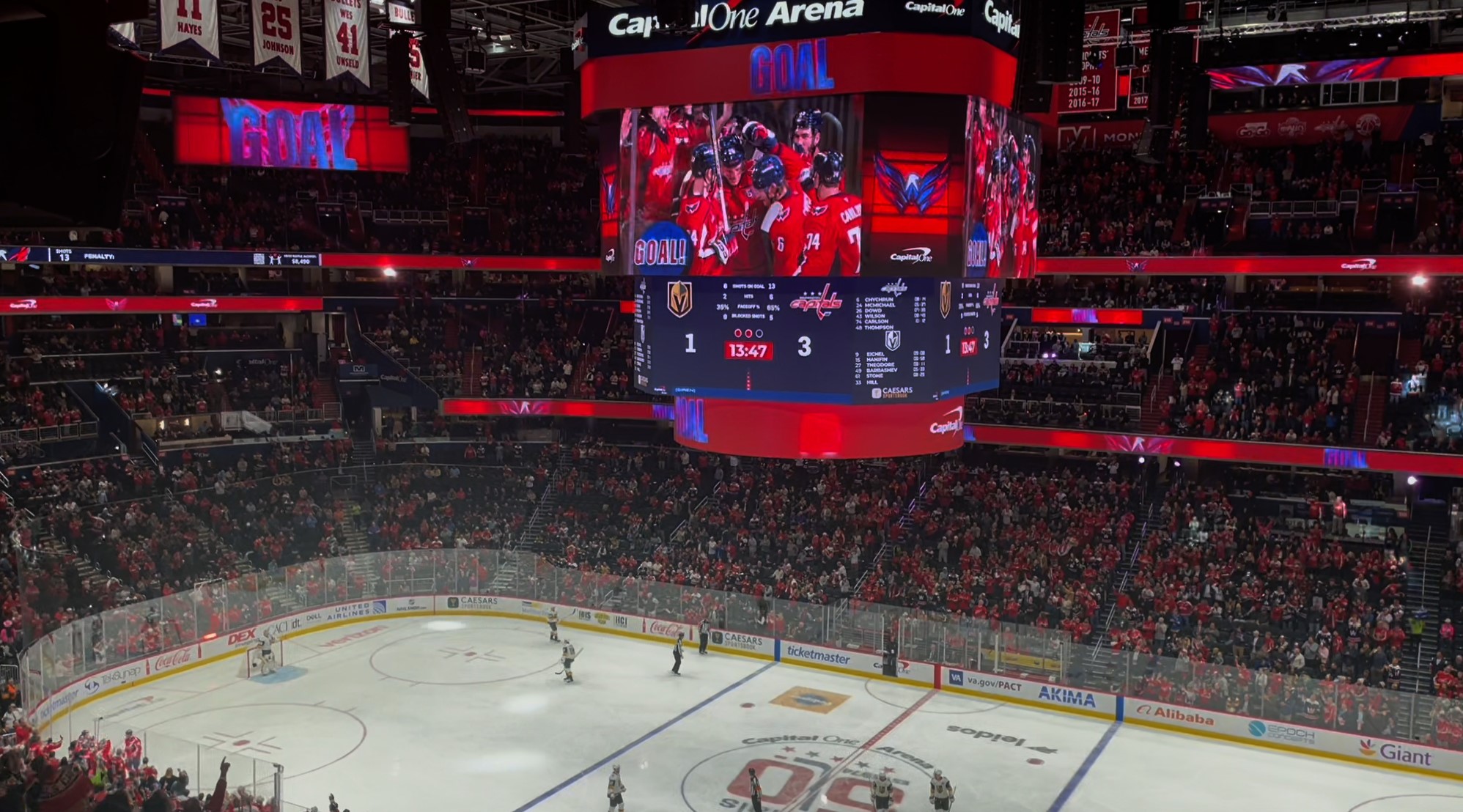
I may not know much about hockey but Caps fans really love the sport and it was exciting to be there in person!

In August, my daughter C started ice skating lessons at the Medstar Iceplex, where the Washington Capitals, the national ice hockey team in the area practice. She told me she would like to attend a hockey game. As luck would have it, an old friend from college reached out to ask if C and I would be interested in joining him at his company’s box for a Washington Capitals game in early October. I have taken C to see a good number of baseball games, but never to a hockey game. I had never been to one in my life. My friend also had two extra tickets for C to invite two friends. Though it was a school night, her friends’ parents let them join us and the girls had an amazing experience that surely gained them some cool points at school.

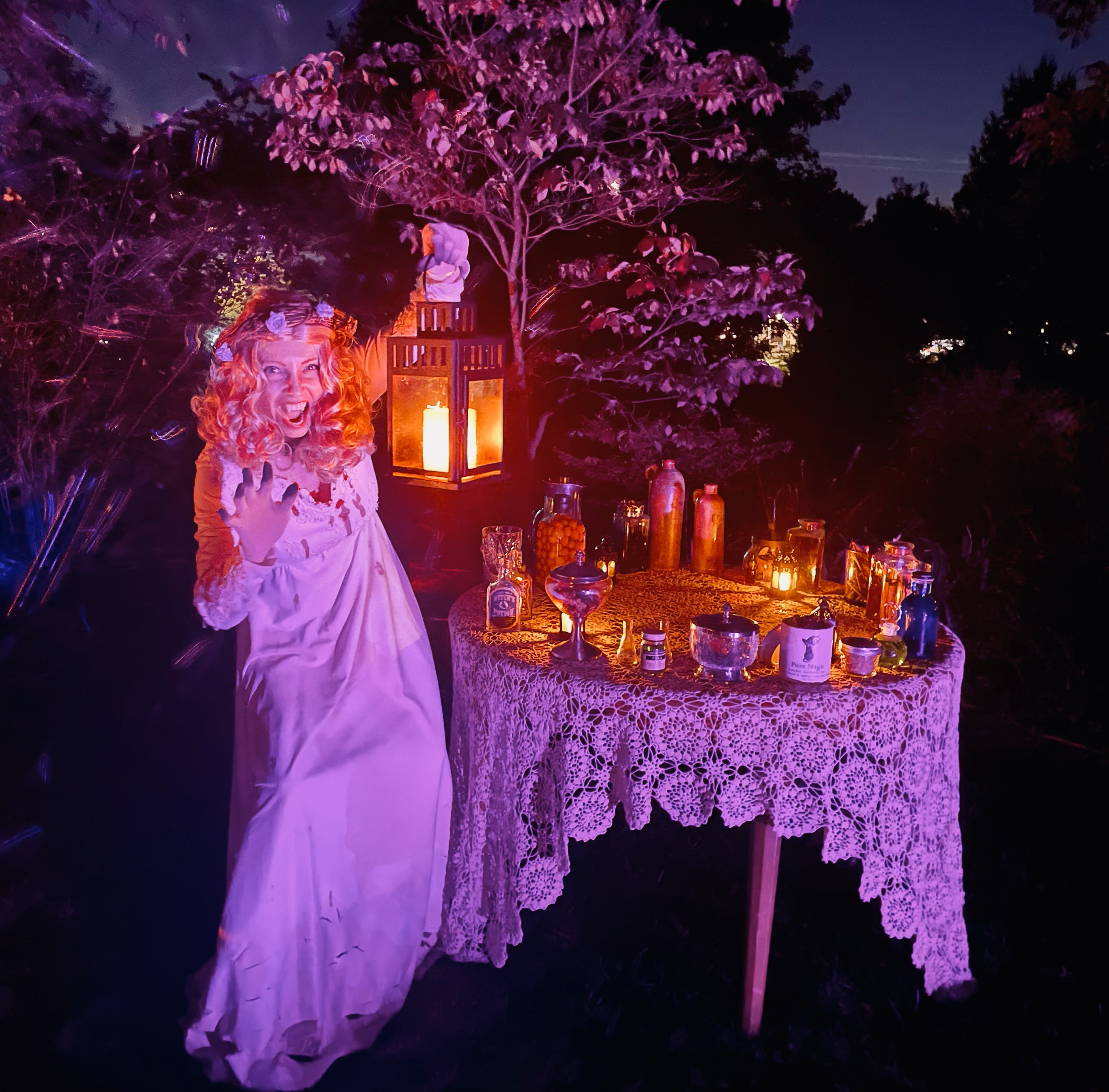
My sister scaring the beejeezus out of attendees at the Dracula Experience

I thought I might like to take C on a haunted walking tour in the area — there are plenty of ghost tours around. She has recently told me she was old enough to do one. As I cast around for which would be the best tour for a pre-teen, my sister posted that she had been cast in a “Dracula experience” in Leesburg. It would be part performance play and part Halloween-y experience in the garden of a historic manor. We met my brother-in-law and nephew at the location to see my sister play one of the three brides of Dracula. It was spooky, corny, and fun and another great opportunity to share something with family while supporting my sister in her acting passion. These are the kinds of things we could not just decide to do while living on another continent.

Two weeks later, I returned alone to that historic manor in Leesburg for a house tour. What was this manor? Dodona Manor, a National Historic Landmark that served as the residence of General George C. Marshall from 1941 until his death in 1959. Marshall served as the Army Chief of Staff, Secretary of State, Secretary of Defense, and U.S. special envoy to China. He was the architect of the Marshall Plan, an economic recovery act to assist with the support and reconstruction of Europe after WWII. He was Time Magazine’s Man of the Year twice and a recipient of the Nobel Peace Prize. It seemed weird that just a few weeks before we had been screaming in the rose gardens as we watched a spooky play and people jumped out of the bushes at us. I had grown up in this area and had not known this site existed until I attended my sister’s performance. Granted, Washington, D.C. and its environs are chock full of historic sites and the former homes of our nation’s leaders. There really is not enough time to see all that this area has to offer; we really are spoiled for choice.

Dodona Manor from the rose garden in early November

On Veteran’s Day, we joined my friend NP and her family for a hike at Gulf Branch Park. NP and her husband BP, also a Foreign Service family, are into spending time in nature and finding fun and interesting low-cost or free things to do. We love hanging out with them. They introduced us to Donaldson Run Park in September and gave us another education on the incredible local parks available in Arlington. Although by this time it was late fall, the autumnal colors of the trees were still very much on display. C needed to learn about some plants for a Scout requirement and BP, who knows a lot about flora and fauna, patiently talked to her about them while I talked with NP and their kids ran and laughed. C and I are a small family unit, just her and I, so it is fun to spend time with NP’s big, joyous family.

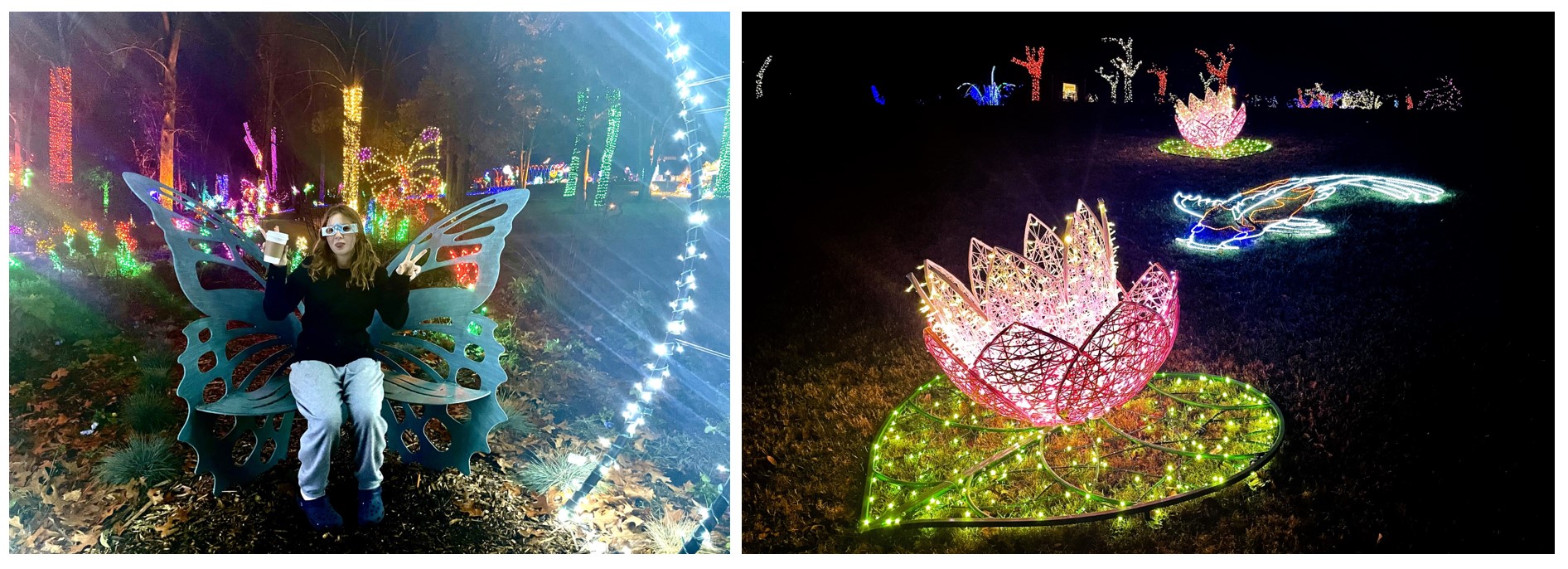
Later that week, C and I joined another of our long-time Foreign Service friends on an outing to Meadowlark Botanical Gardens in Vienna, Virginia. Once again, I grew up in this area and had never heard of nor been to this place. While searching for something fun to do, I came across this place and read they put on a great holiday light show called the Winter Walk and I invited the JKs, who are currently in D.C. for training. The JKs served with me on my first tour in Ciudad Juarez and we later visited them in both Chiang Mai, Thailand and Harare, Zimbabwe. We had dinner with them and then headed to Meadowlark. The organizers had done an amazing job decking out the park with elaborate light displays. We stopped at a beverage stand for some hot cocoa, and towards the end of the walk bought marshmallows for roasting over a large fire. It was just the right kind of cold – chilly, but not too much so. Perfect for warm drinks and good company. I expect the park is also really great to visit in Spring and we may do that.

Meadowlark Botanical Gardens puts on a lovely lights display

On that weekend, I took C and her friend AH to an archery merit badge class at Burke Lake Park, a local park in Fairfax, VA. As the girls did their course, I took a long walk. It was another gorgeous fall day and the park, another in the area that I have no memory of visiting, is a large one at 888 acres. I read that the land was originally set aside for an international airport but then another site was found in neighboring Loudoun County for Dulles International Airport. And Burke Lake, with its golf course, hiking trails (including nearly a 5-mile one around the lake), playgrounds, picnic areas, fishing pier and marina, and mini train, became this incredible public park. With the weather as good as it was, golfers, walkers, joggers, cyclists, archers, ultimate frisbee players, and families were taking advantage. Yet, though there were many people, I still felt I had space to enjoy it on my own, and I enjoyed a good two hours of walking meditation and forest bathing.

Burke Lake Park – fantastic for autumn forest bathing; C and her friend practice archery at the park

C and I wrapped up our fall activities with a magic show at the Kennedy Center. I think we managed to do a little bit of everything from sports to art, history and nature. It was a great fall. I hope others take advantage of and not take for granted the amazing wealth of activities available in the Washington, D.C. area.

In & Around DC: Sights & Activities of August 2024

August was a busy month for C and I what with my starting my new job as an entry-level Career Development Officer at the State Department while managing C’s final three weeks of summer camps then the start of seventh grade, and C pursuing several merit badges for Scouting. It still sometimes feels a little strange to me to be posted to Washington, D.C. and to have so many activities at our disposal. Had we remained in Guinea we would have had one more year left. There would have been no summer camps and we would have had only a fraction of things to see and do.

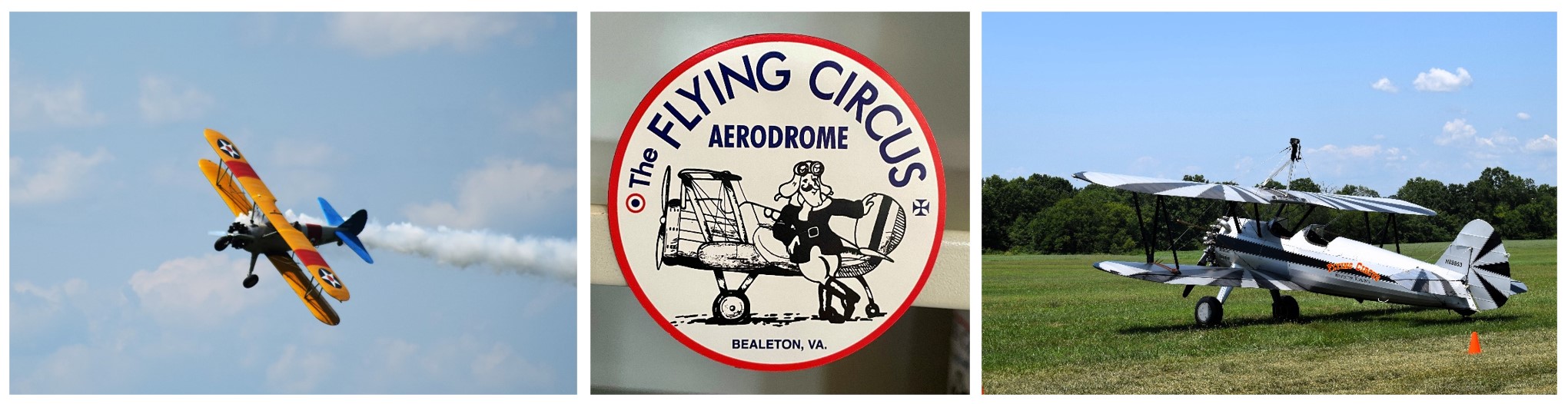
Our first activity of the month (actually the tail end of July), was a visit to the Flying Circus Air Show in Bealton, Virginia, about an hour southwest of DC. One of C’s merit badges, in Aviation, had a requirement to either tour an airport, visit an aviation museum, or attend an airshow. In Malawi, C had a tour of the airport and control tower for a school field trip and we had been to the National Air & Space Museum a few times, so an air show sounded like something different to do. A quick Google search brought me to the Flying Circus. How lucky that there was an air show every weekend throughout the summer within an easy drive. Of course there was. I wonder sometimes if there is anything this area doesn’t have?

Photos from our afternoon at the Flying Circus

C and l located our lawn seats, last used when C was a toddler, and headed out to the air field. It was a real hot and muggy mid-summer day, perfect for grabbing some food truck goodies and hiding in the shade of one of the free trees to watch the aeronautic acrobatics. These daredevil pilots go up in their WWI replica open air planes every weekend to demonstrate the barnstorming tactics of the early airmen and women. Pretty fantastic stuff.

Gunston Hall from the garden

Three weeks later C had her merit badge event in Lorton, Virginia, on the expansive grounds at Gunston Hall, the residence of U.S. founding father George Mason. As C would be there a good eight hours, I decided to make excellence use of the time and do a little sightseeing. I had not visited Gunston Hall before, so I booked myself a house tour with access to the gardens and grounds. As luck would have it, I was the only person on the tour that morning; I very much enjoy historic home tours, especially when I get the guide to myself.

Gunston Hall sits on a plain overlooking a slightly over a half-mile tree-covered slope down to the Potomac River. It’s a grand location about eight miles south along the Potomac from George Washington’s home at Mount Vernon. Though river travel was the way to go, Mason didn’t like to do it much as his father had died when his boat capsized on the same river and I learned he was a bit of a homebody. I suppose with an estate like Gunston Hall (and the wealth and privilege it conveyed) it was not so bad hanging out at home. I enjoyed the tour and a little meandering outside before heading over to the small historic town of Occoquan for lunch.

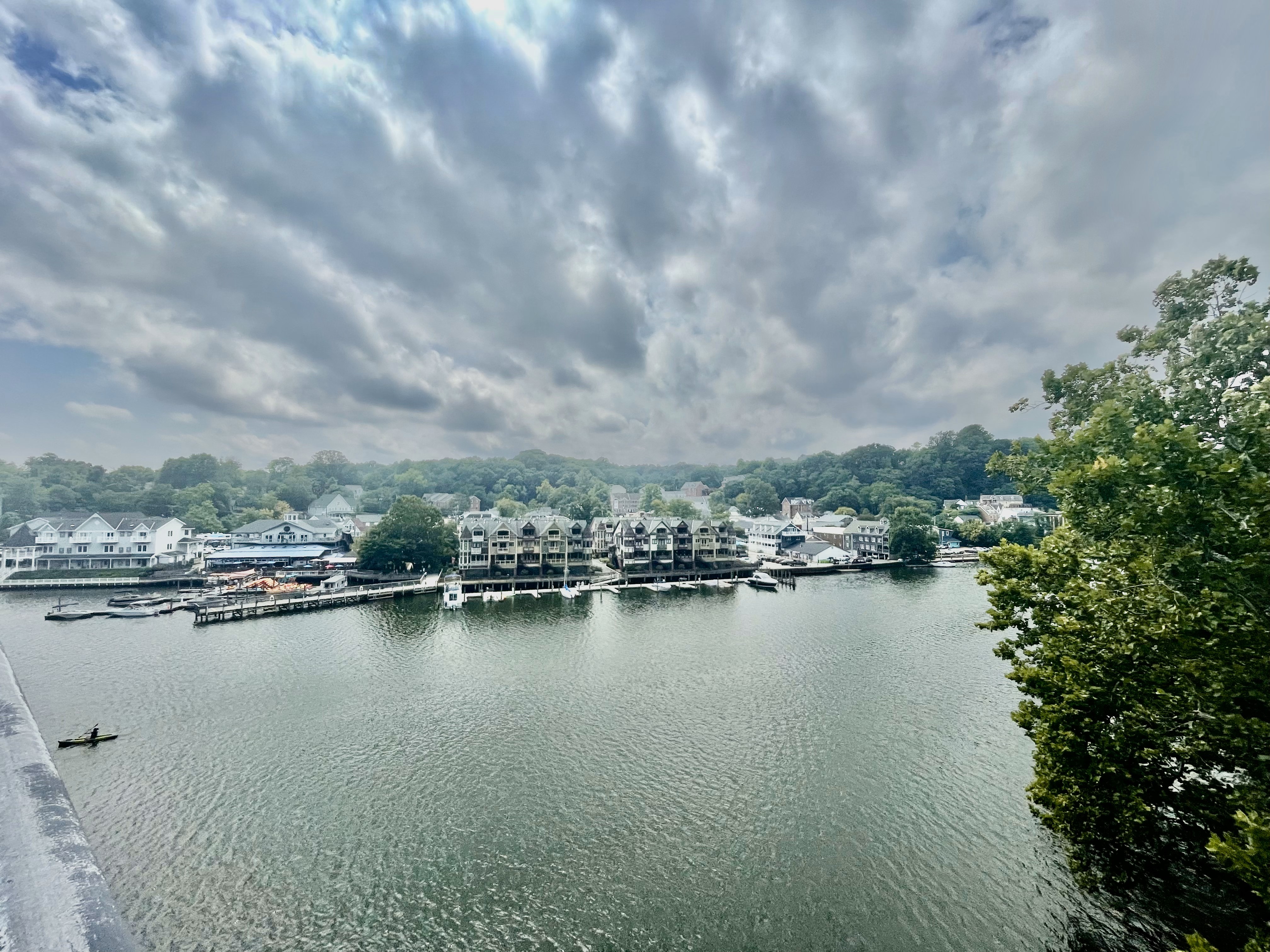
A colleague recently told me how much she enjoys walking in and around Occoquan, with its lovely location alongside the Potomac tributary of the same name. I found a nice table at a restaurant on the water, to enjoy a delicious meal and take in the view. Boats of families were coming and going in the small marina, and visitors were kayaking or stand-up paddle-boarding. After lunch, I took a long stroll through town, including a loop using the footbridge across the river, up back to the highway, and then back over the pedestrian sidewalk on vehicle bridge, ending with a big cup of frozen custard. I spent the last bit in the small local museum and a riverside park. The history of the town, established in 1804 but with colonial tobacco warehouses and mills set-up as early as 1734, is well worth a stop. I would have liked more time to visit both Occoquan, maybe getting out on the water, and Gunston Hall, where the numerous trails on the property beckoned for a long walk.

We wrapped up the month of sightseeing with a visit to the George Washington Masonic National Memorial located in Alexandria, Virginia. I remember in the early 90s dropping off a boyfriend at the Amtrak Train Station across from the memorial and thinking, I really ought to visit there someday. I grew up in northern Virginia and spent several parts of my life here, but it took until now to finally visit this extraordinary memorial to both masonic traditions and the first president of the U.S.

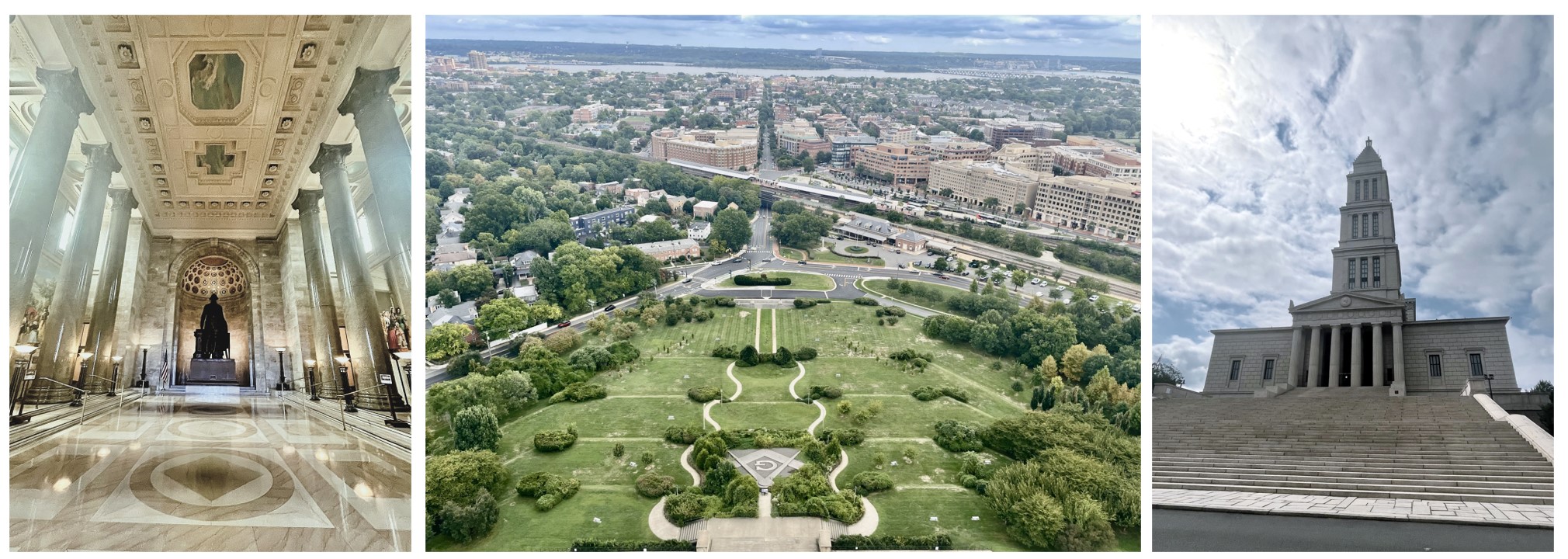
The fantastic George Washington National Masonic Memorial– left: the grand hall; center: the view; right: the memorial itself

In the early 1900s, American freemasons decided to build a monument to George Washington, not only the country’s first president but also a prominent freemason. They hired a famous New York skyscraper architect, who went on to also work on 30 Rockefeller Center, and its rumored the building is at least partially inspired by the ancient lighthouse in Alexandria, Egypt. Work began in 1922 but was not completely finished until 1970; in 2015 it was designated a National Historic Monument. Sitting on Shuter’s (or Shooter’s) Hill, the 333-foot tall building is at once both imposing but also seems smaller than its true size. Standing in the grand hallway, with its 40-foot high columns flanking either side and a much-larger-than-life statue of Washington at one end, the place feels so much bigger than expected. The tour took us to the replica of the Lodge room where the freemasons of the area would have met (Washington was often too busy being president to attend), including a chair of Washington’s. On other floors we could visit a chapel, a small museum to freemasonry and other related fraternal organizations, and to a platform on the top floor allowing 360 views of Alexandria, the Potomac River, and off into Maryland, and Washington, D.C.

C sporting her new nationals football-style jersey at Nationals Park

But that is not all! Oh no, we really had a very full month. We also caught another Washington Nationals game. C and I love to catch a game at Nationals Park and we try to go to 2-3 a season. C especially likes to go on promotion nights. We also attended a performance of MJ the Musical at the National Theater, where each season they bring Broadway blockbusters from New York. MJ is a biopic about Michael Jackson told through his songs and music. There are several of these types of Broadway plays out there such as about Tina Turner, Britney Spears, Neil Diamond, and the show We Will Rock You, which uses the music of Queen and we saw on our cruise ship to Norway last year. I don’t now how many of those C would like, but she lists “Smooth Criminal” among her favorite songs of all time, so I figured this would be a hit, and I wasn’t wrong. At the end of the month we also took in the Cat Video Fest at the Alamo Drafthouse Cinema in Crystal City, Virginia. The film was just 90 minutes of video clips of cats. Like watching one really long YouTube Video. BUT, the money goes to support shelters and other cat support organizations. We went with Foreign Service friends we met the year I was here for French training and who have just returned to the States for another year. It was an hour and a half of wholesome fun in comfy theater seats and yummy, not-all-that-healthy food.

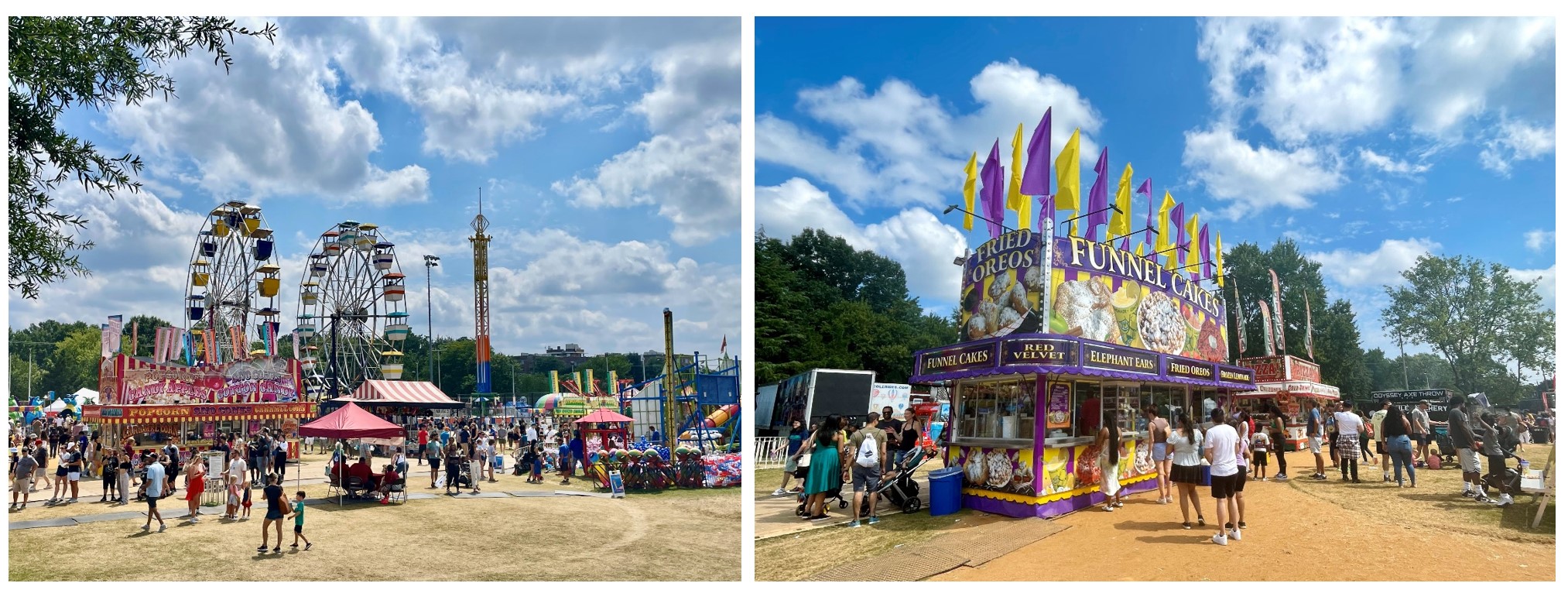
C and I rounded out our month with a visit to the Arlington County Fair. I could not remember when I last went to a county fair! As I try to recall, the last I remember was in Frankfurt, Germany, in the 90s. Foreign Service friends of ours on a domestic tour who were volunteering at the fair invited us to spend the afternoon with them. They had been given some ride tickets for volunteering and their eldest daughter received a bunch of ride tickets as a prize for her winning photograph. The forecast had been for a bit of rain, but the weather turned out spectacular! Carnival rides, games of chance, and fair food like corn dogs, pizza, nachos, funnel cakes, deep fried oreos, and cotton candy were in abundance. Ah, so, very, Americana!

All in all, we had a great final month of summer; we really made the most of it. As of now, the spring and the summer have felt like they have been around a long while, and I love it. The weather will remain warm for another month or so, but soon enough things will cool down. It is, I think, harder for me to appreciate being in the D.C. area when the cold of late fall and winter roll around. Still, I will continue my attempts to make the most of our domestic tour in Washington.

In and Around DC: Escapades of May & June 2024

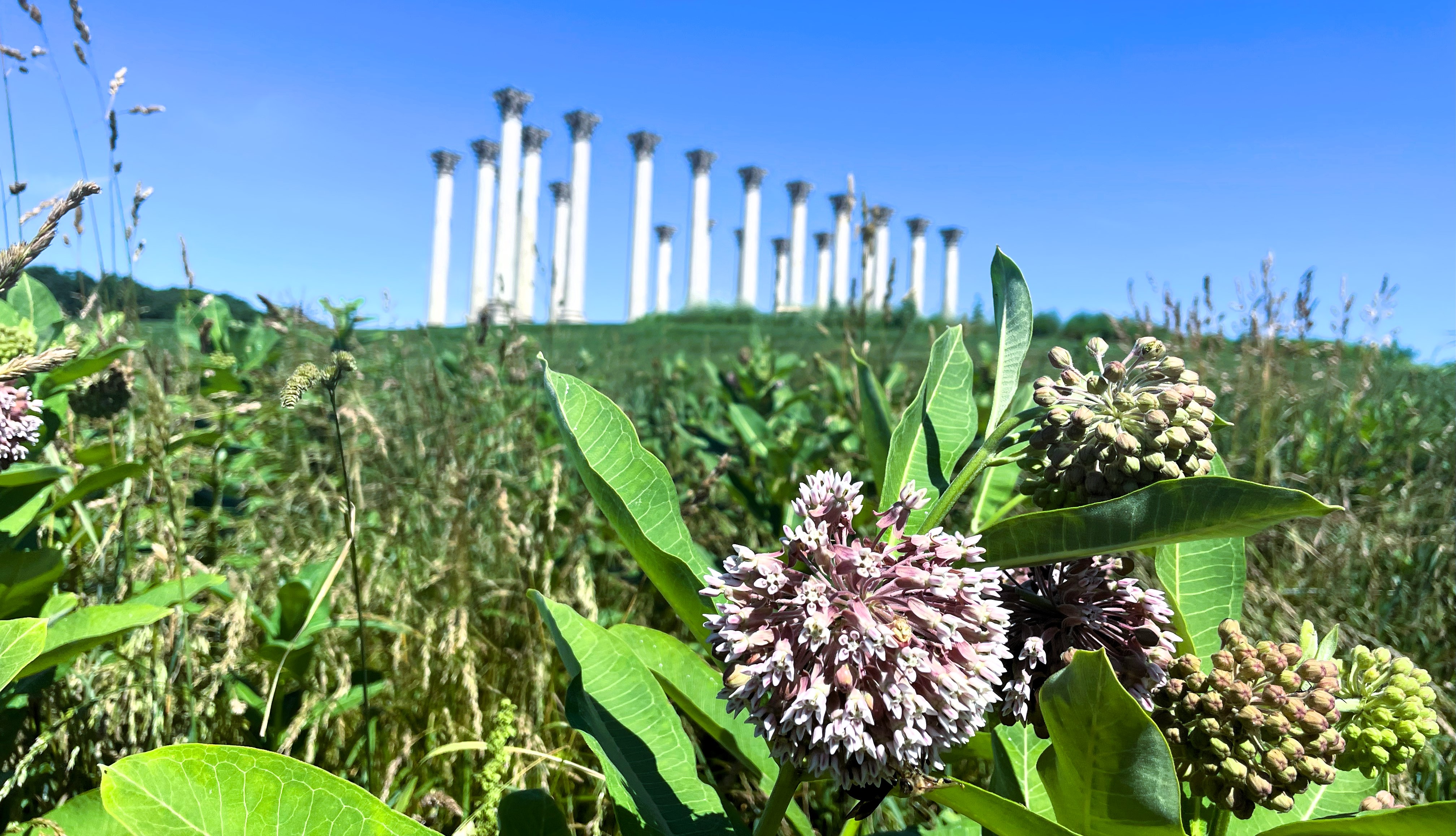
The National Capitol Columns at the National Arboretum

As we come up on a year and a half back in the United States, C and I are embracing living close to Washington, D.C. As I grew up and spent some of my early 30s in the area, there are places I long planned to visit, but put off doing so, figuring I would do so eventually. But then I spent so many years away, and the places I had put off until “someday” did not become a reality. Until now. By shifting my mindset to seeing Washington, D.C. as an assignment, I feel more inclined to get out and about while we are here.

I had big plans for May, unfortunately, Mother Nature had other ideas. It seemed as if the old adage “April showers brings May flowers” had been reversed. We had an April of glorious weather, then May began with lower temps, overcast skies, and scattered showers. The first weekend was a washout, so I was especially keen to do something the second weekend. We headed to the Oatlands Historic House and Gardens located in Leesburg, Virginia, about 45 miles outside of D.C. I had fond memories of Oatlands; my parents have photos of me there as a baby, my mom took me as an older child, and I am sure there was a school fieldtrip there at some point. I really wanted to take my daughter there.

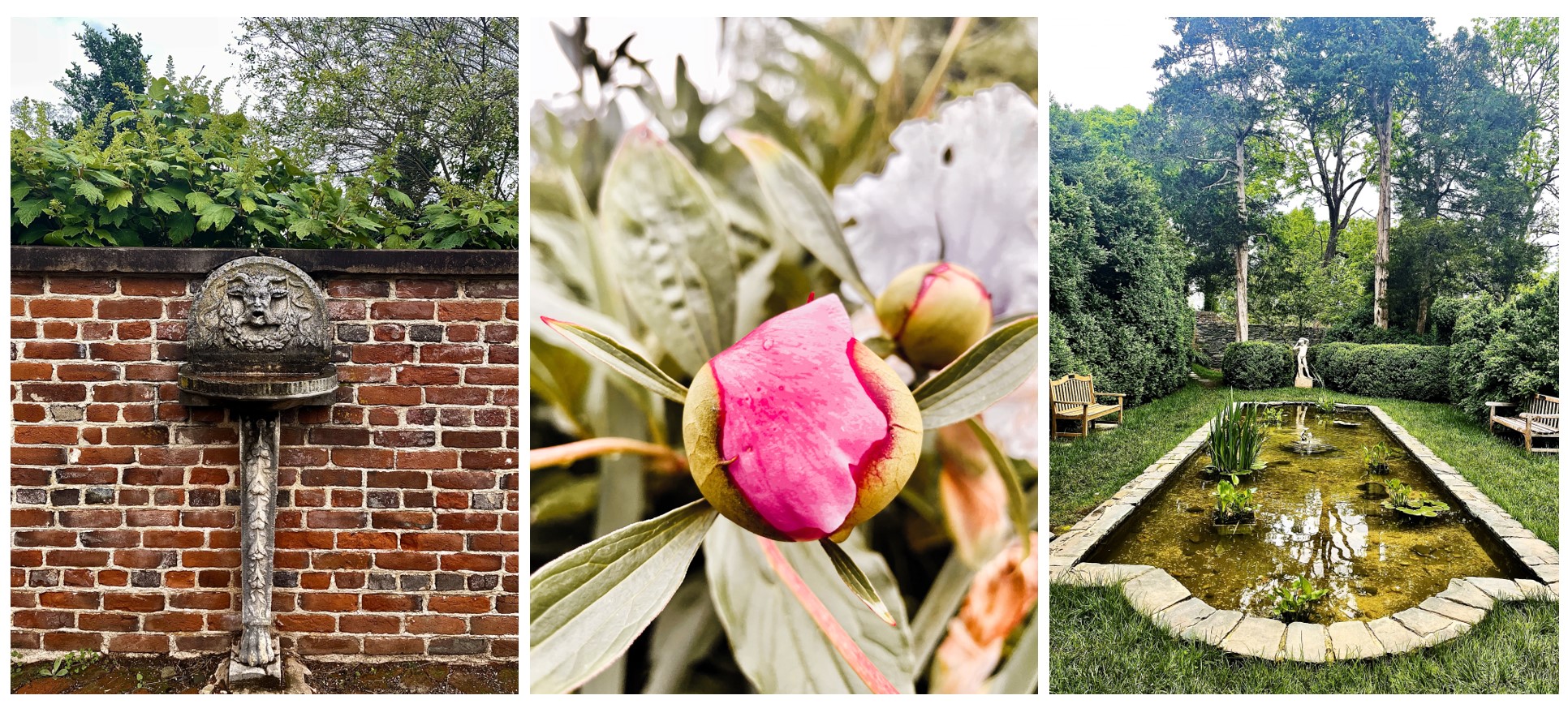
Sights around the historic Oatlands garden

Fortune though was not on my side. The mansion, built in 1803 and listed as a national historic landmark, was undergoing renovations; the scaffolding made even exterior photos unattractive. We had tickets to self-tour the garden and it was still pretty beneath the overcast sky, but then my plans to stroll the grounds afterward were foiled by the cooler than expected weather. We cut our losses and went to lunch.

Strawberries galore at Wegmeyer Farm’s Leesburg location

Luckily, the sky cleared and the temperatures warmed for our next activity – picking strawberries at the Wegmeyer Farms plot just down the road from Oatlands. I had a vague memory of strawberry picking when I was a young child, and I really wanted to do it with my daughter C. It was not quite what I had been expecting; I thought there would be a farm, maybe some attractive buildings or fences, something, but it was just rows of strawberry plants. We were handed a bucket and told to stay in one assigned row for the picking. Still, we did have fun and the strawberries were delicious.

The following weekend C had a Scout camping trip so I had hoped to do some sightseeing on my own, but the weather did not cooperate. Therefore, we planned to make the most of Memorial Day weekend. On Friday evening, we had the great pleasure of seeing my sister and nephew grace the stage in a community production of Anastasia. The show was fantastic and it was incredibly fun to see our family members take part. This is something we really missed out on when hundreds of miles away overseas.

On Saturday, C and I visited the Clara Barton National Historic Site in Glen Echo, Maryland. After we had both been to Antietam, where Clara Barton ministered to wounded on the battlefield, this made a good follow-on visit. The site preserves the home where Ms. Barton spent the last years of her life and also an early headquarters of the American Red Cross, which she founded. We were able to take a very good National Park Service (NPS) ranger-led tour that covered the first floor of the home, but unfortunately, the floor was bare of any furnishings and the upper floors were off limits due to upcoming renovations.

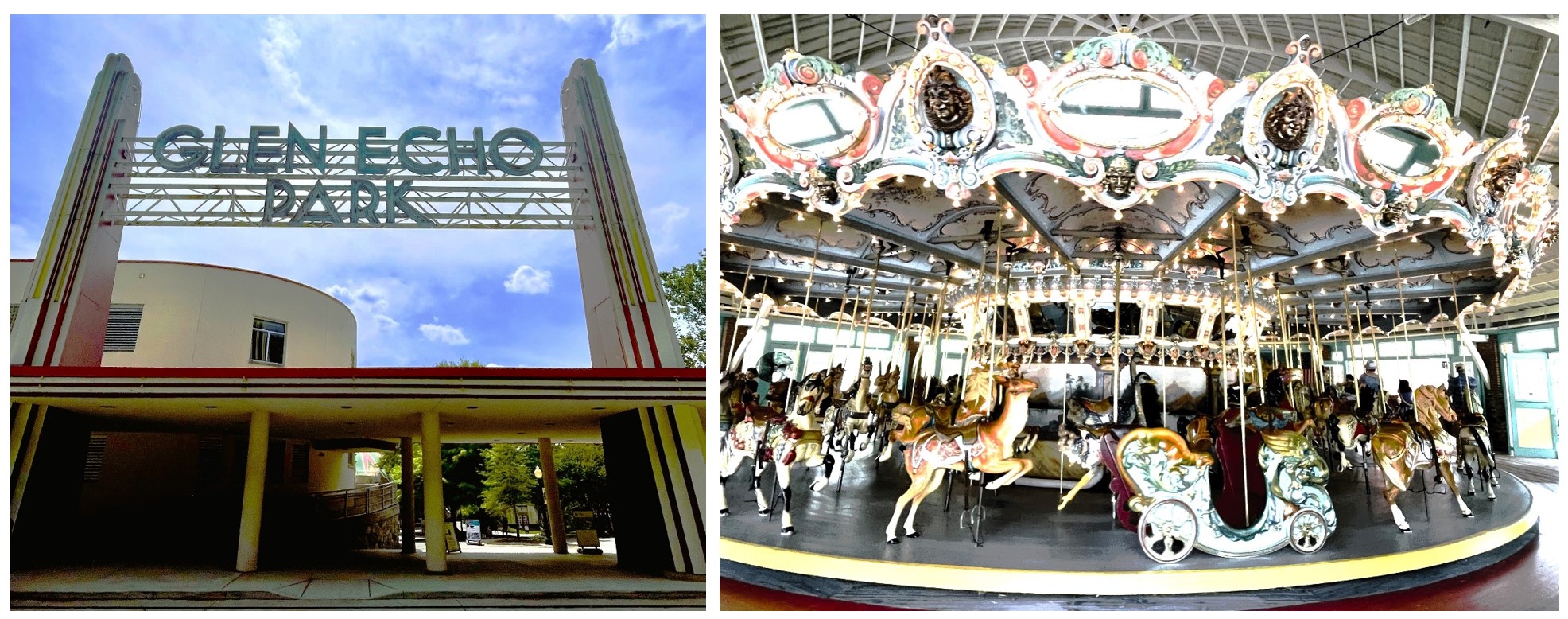
No worries, I thought, the Clara Barton site sits next door to another NPS-run Glen Echo Park. The park started first as an educational institute for adults called the Chautauqua in 1891. From 1911 to 1968, the site served as an area amusement park and was a site of civil rights protests in the latter years. It became a NPS-managed site in 1971 and then a place for arts and cultural performances in 2001, coming nearly full circle from the Chautauqua days. C and I though were primarily there for the 1921 Dentzel menagerie carousel, a National Historic Register site in its own right. C and I have long been a fan of historic carousels (or maybe it is mostly me; see also here and here). We did ride the carousel twice; we would have gone a third time except the carousel operator gave a very generous 20 or so times around each go, which was almost too much of a good thing. We walked a bit more around the park, but we found it sadly underutilized.

Jefferson did not have to contend with warning signs and prohibitions – he could just get right up on that rock

On Sunday, C and I headed to Harpers Ferry, West Virginia with friends. I absolutely love Harpers Ferry; its preserved history and attractive location at the confluence of the Shenandoah and Potomac Rivers just 65 miles from DC, make it a great place to visit on a beautiful weekend. And it is another NPS-managed site. With 6 kids in total, my friends and I walked the 1.6 miles from the main parking to the lower town. It was another lovely day, warm, but not hot, and the trail through the trees and then alongside the road was pleasant. We visited several key sites in the town to include John Brown’s fort and the industry museum, walked across the bridge over the Potomac River to Maryland and back, up to Jefferson’s Rock, where our third president Thomas Jefferson reportedly stood in October 1783, had lunch, and, of course, got some ice cream.

We rounded out our month-and-then-some of getting out and about with our first professional soccer match when we went to see DC United play against Toronto at the six-year old Audi Field. C and I have been to the nearby Nationals Stadium for baseball games at least a handful of times, but had never seen a live soccer match before. Our seats afforded us a great view of the goal line and several corner kicks and the thrilling penalty kick by DC United that tied up the game. I expect we will see more games in the future!

Finally, I dragged C to the National Arboretum in D.C. for some walking and photography. It’s another site in the area I had long heard of and wanted to visit and at long last got around to. The highlight of the National Arboretum are the Capitol Columns, 22 Corinthian columns which were part of the United States Capitol building from 1828 to 1958, which now stand arranged in a meadow alongside a reflecting pool. It is a popular spot for photographers, walkers, and picnickers. I managed to walk a bit with C along a pretty trail near the columns, again in the Asian collection, and then the National Bonsai Museum, but she protested any further exploration for the day.

Sites at the National Arboretum – at the Asian collection, the Capitol Columns, and a bonsai tree

I continue to be grateful to be here in the DC area, where we have such opportunities for recreation and excursions practically in our backyard or within a day’s drive. It is a great reminder that travel need not involve many hours on an airplane.

Tulips, Falls, and Hallowed Ground: April 2024 in DC

April is usually the real beginning of spring in Washington, D.C. This April also marked 15 months since our abrupt departure from Guinea and just a little over a year since we moved into our permanent apartment in the northern Virginia area. It was that last marker that feels the most significant. While my daughter C and I have been in and out of the northern Virginia area many times for training, some shorter, some longer, this April signaled a real milestone: the longest we had been in one place in the United States. For my daughter, it would be the longest in her 12 years. For me, the longest since 2008.

There are times when it feels strange indeed. To be a U.S. Foreign Service Officer who is not overseas. Of course, many U.S. FSOs work at headquarters in D.C. It is just the first time I am doing so, and I am still trying to wrap my head around it at times.

I decided I should be taking more advantage of the area with all of the history, culture, and nature close by and within just a few hours drive.

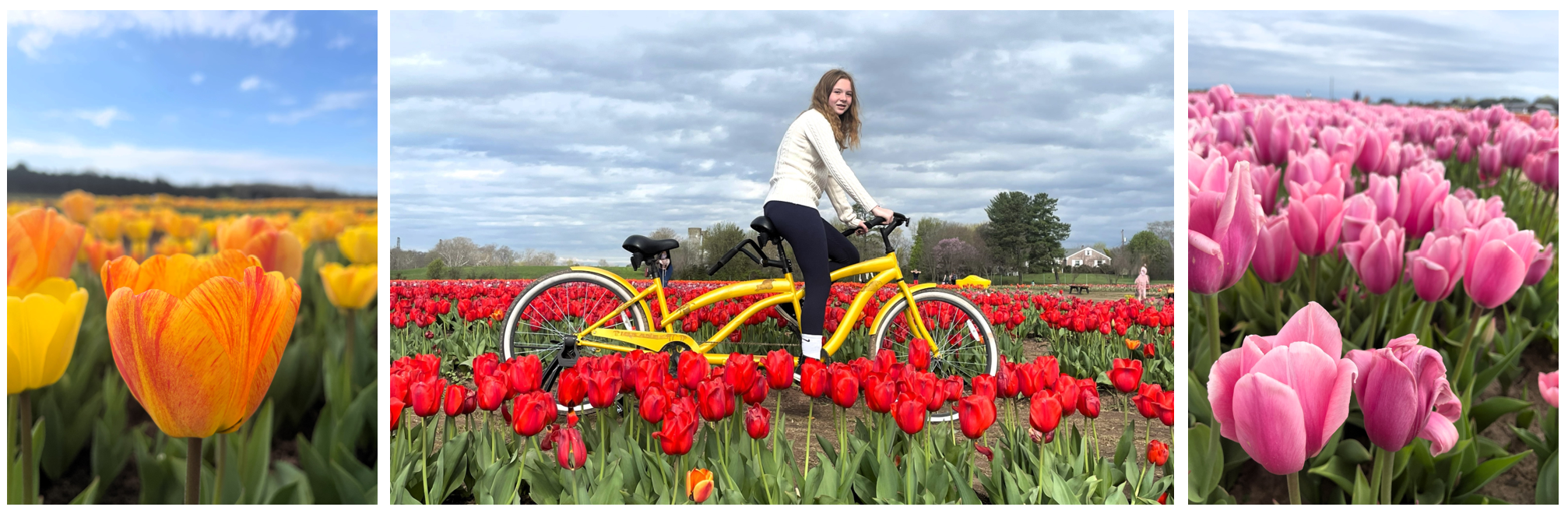
A sea of multi-colored tulips at Burnside Farms

Our first stop this month was the Burnside Farms’ Festival of Spring. I first heard about it last spring, but had not been quick enough to get tickets before it sold out. Yet for the first time in a long time in America, I could tell myself, well, there is always next year! Lucky for us, this year my daughter had a day off school scheduled in the middle of the festival and Wednesday morning tickets were much easier to come by. And when I found out a friend of mine was in town from Nicaragua for training and had brought her son along, we took her son with us to see the flowers. Rain was in the forecast, but again we lucked out; it was partly cloudy at first and then blazing blue skies.

I have long wanted to see the tulip blooms in the Netherlands. I have been to the country twice, but both times were in July, far too late to see the tulip fields. Burnside Farm’s spring festival was a nice substitute.

High and fast waters churn over Great Falls

The following Monday, C again had school off. I took her and her friend visiting from Nicaragua to Great Falls National Park for a short hike. With our annual National Park pass bought for our visits to Joshua Tree and Death Valley last December, we could visit Great Falls for no additional fees. It is extraordinary to me that these falls on the Potomac River and the protected wilds around them lie just 17 miles outside our nation’s capital. So close, and yet a world away. I came here a few times as a kid, with my mom and sisters I am sure, possibly with school groups. I came here again with C’s dad when she was a baby. We visited here when we were back from Malawi to hike with friend’s from there. C and her friend seemed to have a good time — the falls were cool of course, but there also seemed me to be a lot of Pokemon in the area they could catch with Pokemon Go… Well, sigh, they were still in nature.

The War Correspondents Memorial Arch

The next weekend, C and her Scouting troop had a two-day camping and bicycling at the Antietam National Battlefield, just outside of Sharpsburg, Maryland. I had often thought of visiting Antietam. Even once, maybe fifteen years ago (?), I drove to the entrance gates and grabbed a brochure intending to get out there sometime soon. I opted then to volunteer to drive my daughter and other Scouts to and from the campsite, but spend two nights in a nearby hotel doing some sightseeing on my own. I promised my daughter that should I see her at Antietam, I would pretend not to know her.

Getting C into Scouting has been one of the highlights of being in the U.S. The Antietam trip would be her fourth camping trip in the six months since she joined. I have been so impressed with all the skills, camaraderie, and confidence she has gained. And I loved the idea of us both seeing the same place around the same time, but in different ways.

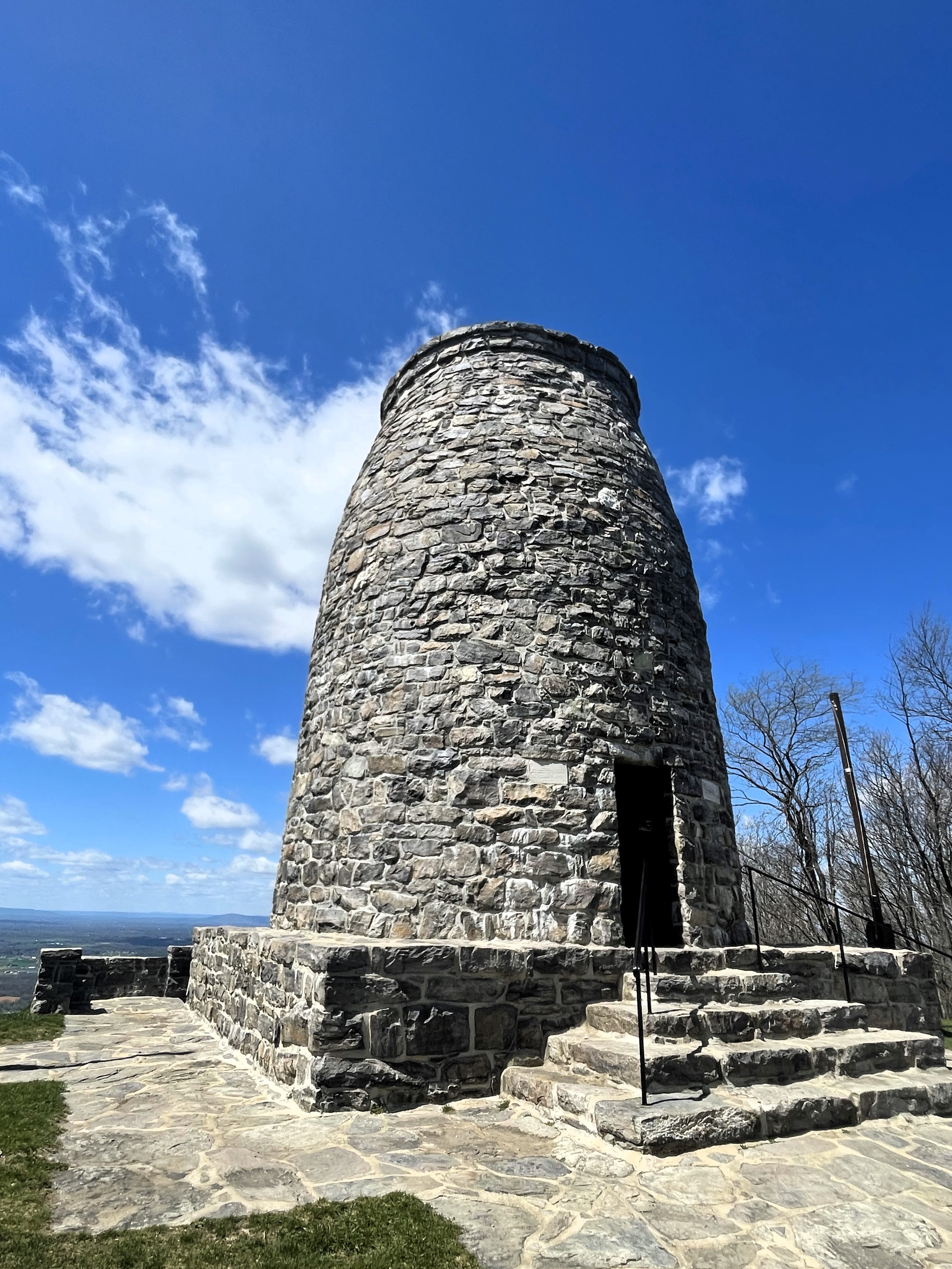
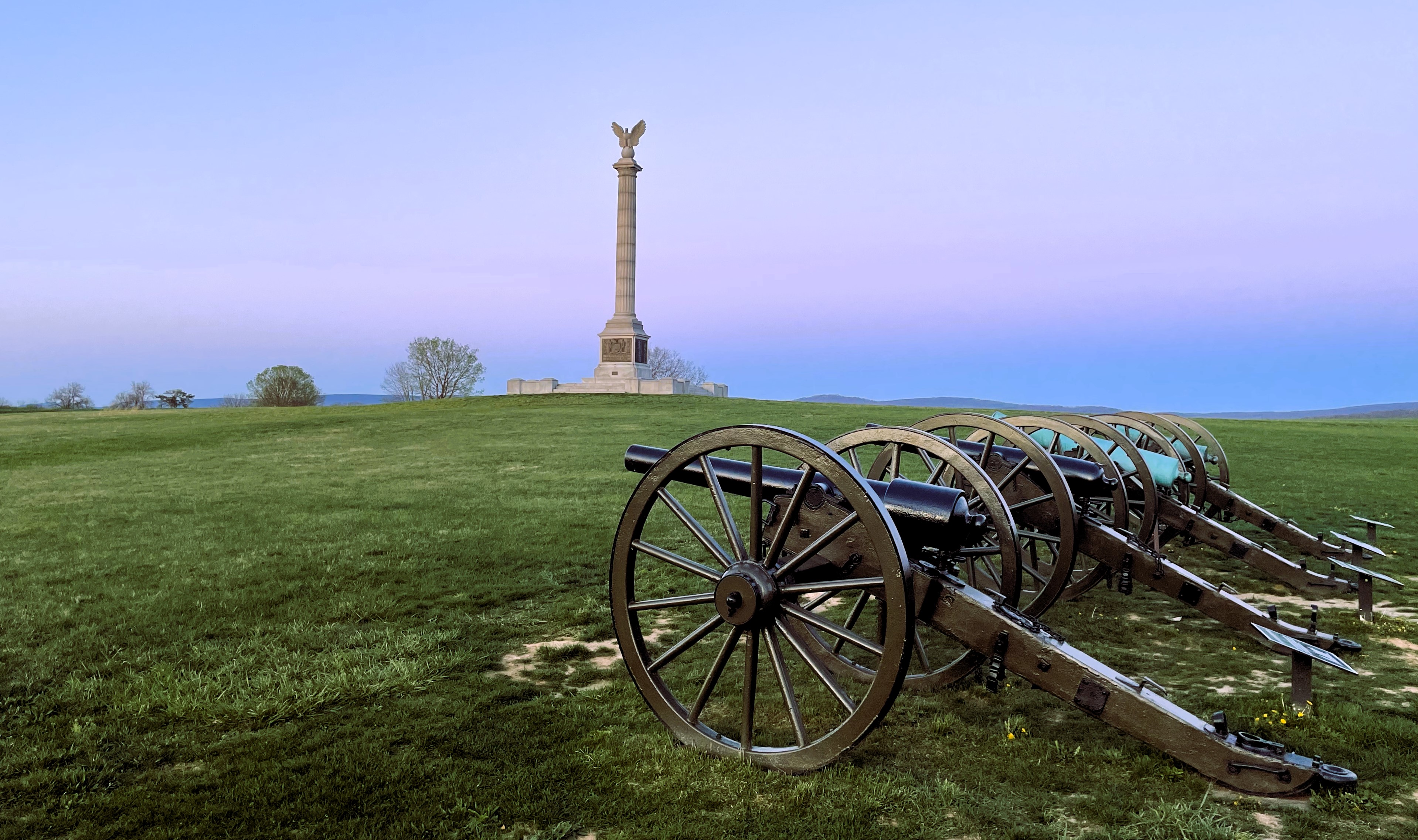
Unlike C, who was camping at Antietam and traveling by bicycle, I had a car and decided to make the most of my day on my own. It turned out to be a day full of American history. I first headed to George Washington Monument State Park, just outside of Boonsboro, Maryland. Along the way, I drove through Gapland and stopped at the site of the War Correspondents Memorial Arch, built by George Townsend in 1896. Townsend worked as a Civil War correspondent in his early 20s and at just age 24 became famous for his articles on the Lincoln assassination. Outside of Boonsboro, I made my way to the site of the nation’s first monument to our first president. The squat 40-foot tall stone tower was reportedly built by the townsfolk of Boonsboro in a matter of days in 1827, twenty-one years before construction began on the more famous monument in Washington, D.C.

Though the temperatures were a comfortable warm and the skies a dazzling blue, the wind was high, especially atop South Mountain, and it whipped around the monument making it difficult to stay long to enjoy the view. And time was of the essence; I just had the one day to make the most of it.

On my way to Antietam, I made a quick stop at the Kennedy Farm, the location where for three months abolitionist John Brown and his fighters planned and practiced their doomed raid on Harper’s Ferry. Though part of the National Park Service, I was the only person there at the time. There are no park rangers or staff on the site; there is just a small lockbox just inside the door where visitors can leave a donation. Given its importance, I had expected more. But I suppose it is enough that it is preserved.

I made sure to return to Antietam as the sun was setting to experience it without the crowds and capture a sunset photo

Then it was on to Antietam, where I spent the rest of the day, some walking, some driving. I never did run into C or her troop, though we talked about their visit on the hour and a half drive home the next day. We talked about the Potomac River, which we had just seen the frothing at Great Falls a few weeks before, to where General Robert E. Lee had crossed into the North, and the river as it passed near the battlefield. We talked of the significance of Antietam, the U.S.’ bloodiest single day in American military history, from the first battlefield photography to the role of Clara Barton, who would go on to found the American Red Cross. It is important to me that while we are in the U.S., that my daughter, who has spent thus far the majority of her life overseas, gets to experience the conveniences of our country but also is exposed to our history.

Fast moving small falls heading to the Great ones

C and I wrapped up our April 2024 local sightseeing with a trip to the portion of the Chesapeake and Ohio (C&O) Canal National Historical Park on the Maryland side of the Potomac, across from Great Falls I remember as a kid wanting to visit this spot (and for some reason I was desperate to ride a canal boat through the old locks), but only recall us ever visiting Great Falls on the Virginia side. With C spending so much more time outdoors with the Scouts and her love of scrambling over boulders after our trip to Joshua Tree, I figured we were up for a hike along the Billy Goat Trail.

We were blessed with yet another incredibly gorgeous day, perfect for a hike by the falls. While there were a good number of other folks on the trail, it was not what I would call crowded, so it had just the right amount of hiking without a lot of waiting or noise from other hikers without the “oh my goodness, I haven’t seen another person in an hour, I hope I am not lost forever” feeling. We saw a good amount of wildlife from a black snake to a great blue heron and frogs to geese, had a wonderful workout, and some great mother-daughter time.

C surveys the Potomac River front an overlook on the Billy Goat Trail

All-in-all it was a great month for activities around our area. And while this might seem to some not to be the most exotic of blog post destinations, especially considering the locations we have traveled to, for us, who have spent so much time outside the country, the ease in planning and executing visits to such places and the variety of places to go and things to do, is not something I want to take for granted. In the majority of places where we lived, we had only a fraction of these sorts of things to do. We are looking forward to seeing more!

Escape and Escapades: Spring Break in Roatan

Late last September, with the summer firmly over and our Christmas train trip arranged, I turned my eyes to planning our spring break getaway.

I knew I wanted to be somewhere warm, but also someplace not too taxing or far from home, so I zeroed in on the Caribbean. We would have only a week for the Spring Break / Easter week and early on the airfares and mile redemptions for the week were a disappointment to say the least. (Perhaps prices will never return to pre-COVID levels? It sure feels like it.) Honduras looked to be a good choice and initially, I had planned on time in both the Bay Islands and on the mainland, but quickly realized that to secure a lower airfare and a less stressful holiday, it would be best to shorten the holiday and just stay in one place.

I am glad I kept it simple. Early in 2024, my mom ended up in the hospital and I became the primary point of contact for calls with various medical staff, case managers, and more. With the daily medical discussions and issues that could take from one to six hours, I began to contemplate canceling our trip altogether. In the end, I got her treatment to a certain point where I felt I could split the difference such that I would still have some much-needed rest and relaxation and mother-daughter time, while also making daily check-ins related to my mom’s care. It was far from ideal, but I believe it was a good compromise.

Roatan from the air–demonstrating some of the reef system surrounding the island

Roatan is a fascinating place. It’s history, which includes a visit by Christopher Columbus, serving as a hangout for infamous pirates like Blackbeard, and once being a British colony, has shaped Roatan differently than the Honduran mainland. Although the British ceded the Bay Islands, including Roatan, to Honduras in 1861, it took nearly a hundred years before Spanish was taught on the islands’ schools. Today, English is still the first language of the islanders.

Roatan is a popular tourist destination for nature and adventure activities. It’s location along the world’s second largest barrier reef, the Mesoamerican, makes it an extremely popular scuba diving site. Roatan also boasts two cruise ship terminals, the first opening in 2008 and the second two years later. For an island only 40 miles long and 5 miles wide and a population somewhere between 50,000-100,000 people, two cruise ship terminals disgorging some 3,000 to 10,000 passengers a day in high season is astonishing. All these North American travelers have made the U.S. dollar the currency of choice on Roatan, vice the Honduran lempira.

The pineapple seller heads home

I knew none of this. I usually research the heck out of where I am going. I like to know the history and current situation; I like to know the language, currency, and exchange rate. But this time, with all the stuff going on with my mom, I left much up to chance. I booked our flights, reserved our hotel, and looked up, but did not schedule, a thing for us to do.

On Sunday morning, C and I celebrated Easter a week early and then that night flew to Houston. We stayed the night then flew on to Roatan early Monday morning, arriving at our hotel, the Bananarama Dive and Beach Resort in West Bay, in time for a hectic lunch rush during a steamy tropical beach day. Ahhhhh…it felt amazing to be warm.

I struggle with stepping back and doing little. I like to keep engaged. But here it was our first day on the island and I had nothing at all planned. I had not even booked transport from the airport to West Bay. It only occurred to me as we boarded our plane in Houston that it could be a problem. Luckily I quickly checked the interwebs, reserved and paid for a taxi, and hoped for the best. I really thought it was 50-50 anyone would actually come and figured I might have just thrown $25 away. I was pleasantly surprised to find a driver with a cute handwritten sign with my name waiting for us in arrivals!

C holds Charlie the Sloth

Therefore on our first day, all C and I did was make reservations for some activities on following days, walk on the beach, checked out the nearby shopping plazas, and lie about in the hammock or chairs on our bungalow porch.

On our second day, we headed to Jungle Top Adventures for an exciting few hours of ziplining and animal interactions. There seem an abnormally high ratio of zipline locations per population on Roatan, due to all those cruises. When we booked the zipline, we were not told which we were heading to, and I was a tad disappointed to find ours was located in Coxen Hole, the island’s main town, directly across from one of ports where two massive cruise ships were docked.

As I had read it is best to visit the animal park first because the sloths — the main attraction — can only be held by a limited number of persons before they are too tired, that was our first stop. While we did enjoy seeing to coati and the Yucatan white-tailed deer (Honduras’ national mammal) and meeting the monkeys and macaws, the sloths were the star of the show and one of the top reasons we chose to visit Roatan. C and I were both able to hold a sloth for about five minutes. With their arms around our necks and their legs around our waist, it was almost like holding a baby. The experience did not disappoint.

Next we headed to the zipline. We had to wait about 10 minutes before we could join the truck taking participants to the first of 16 zipline platforms. While the guides kitted us up, two more truckloads of adventurers arrived. All in all we had to wait 30 minutes before all our zipline guides arrived and zipped off to man the various platforms. However, once everyone had their gear and the guides were in place, we were zipped across the lines rapidly, like an assembly line. I had hoped to get a photo or video of my daughter, but she was hooked up and then off with such speed I hardly had time to react before it was my turn. When I arrived at the platform, C was already zipping on to the next. At the midway point though we all crowded together again. This time I was able to video C taking a running leap off the platform and then flipping upside down — of all the ziplines I have done in various places this was the first and only place I had heard of that being allowed.

C and I and our group prepare for our submersible scooter experience

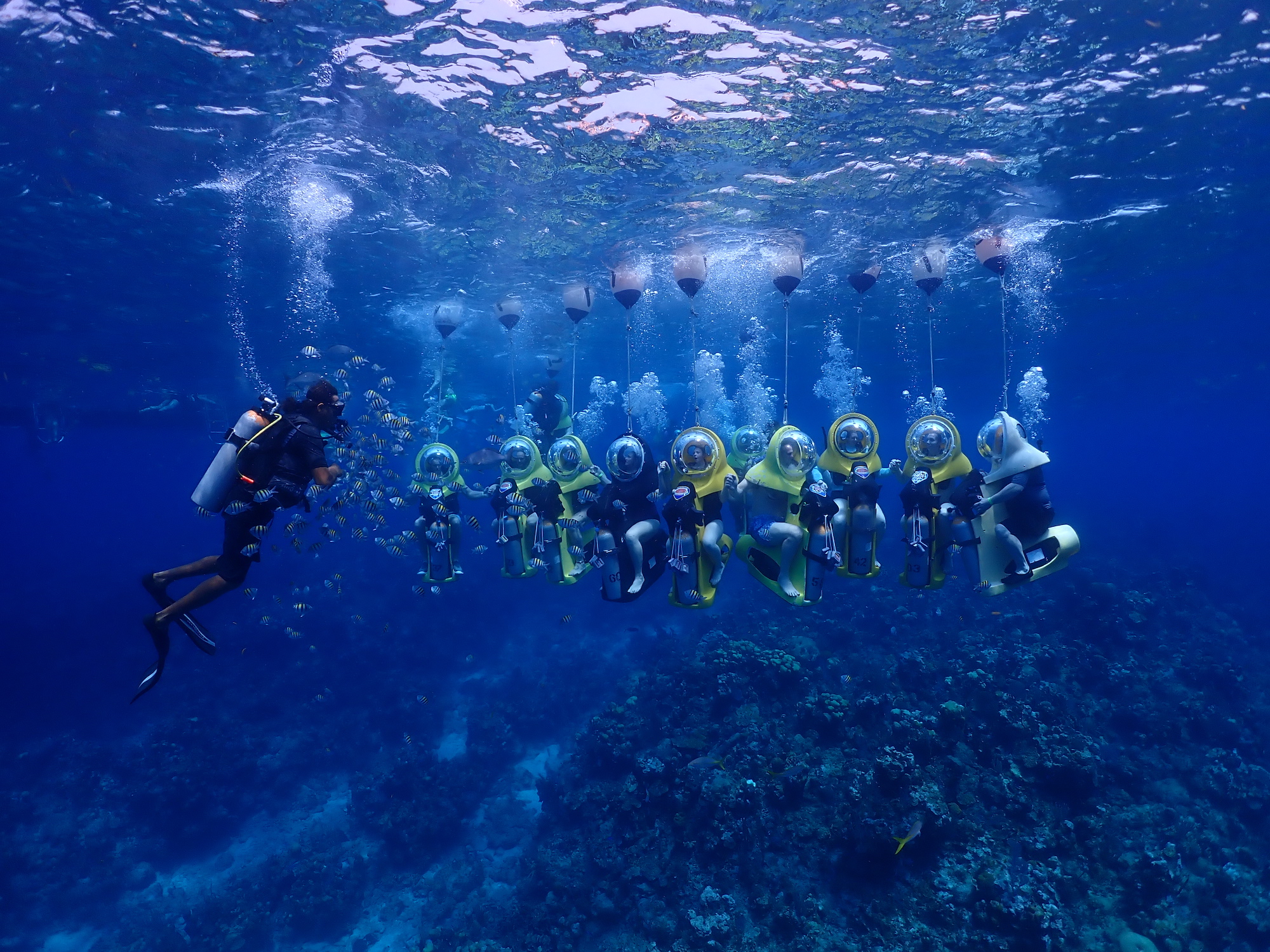
On Wednesday, we did the most extraordinary activity! We glided through the water in a Breathing Observation Submersible Scooter (BOSS). I had initially booked for Friday, but the company emailed me on Tuesday afternoon to inform me that Thursday and Friday were predicted to be poor weather, but they could accommodate us earlier.

I have to admit, I was a wee bit scared to do this. I enjoy being warm and near the water; to feel sand between my toes, but I am not comfortable in the ocean. I get sea sick on boats. I am not comfortable in the ocean. I once tried to learn to scuba dive in the Philippines and kept freaking out during the basic water practice. I am just much more a landlubber and I get most of my fish experiences at aquariums (which I LOVE to visit). But C was excited to give it a try and so I thought I should be brave and give it a go.

The scooters work on the principle of an air pocket forming in a glass underwater. To get in, the scooters are held just below the water’s surface with the air pocket already formed in the large diving bell-like helmet. Then compressed air, just like the tanks used for diving, is pumped into the helmet. One has to hold one’s breath for just a few seconds to duck under and bring their head into the helmet. Well, it sounds simple. C did it in one go. I freaked out. It took me five times to get up the courage to get in. Thankfully, C went first and did not see that. Once everyone is in, the scooters are lowered to their maximum depth of ten feet. Then one can controls the scooter just like a scooter on land — with a toggle switch for speed and moving the handle bars to the sides to turn.

We visited the Roatan Chocolate Factory in West End after our underwater scooter experience

I wear glasses and unlike in snorkeling, where I have to accept blurred vision because I am not going to spring for a prescription mask, I could wear my glasses while operating the underwater scooter! I also have a lot of ear and sinus issues and that (along with a fear of sharks and running out of air and drowning) is what keeps keep from scuba diving. At the depth of the scooters, I could feel the pressure on my ears and I struggled to pop them, having to do so repeatedly, but I could manage. I have never been able to see a reef and fish underwater like I could on the scooter and I found myself laughing with delight. Also, because the giant helmets made everyone’s heads look really tiny on top of their bodies.

Thursday and the first part of Friday did turn out to have poor weather. Though it did not rain during the day, the winds picked up substantially, up to 25 mph, making the seas very choppy. Nearly all activity stopped along the beach. Though West Bay is a nice beach, it is not very wide, and on sunny days the beach chairs take up a good third to half of the sandy real estate and the crowds of beachgoers take up most of the rest. So though it was very breezy, it was still nice and warm, and I took strolls along the shore, while C chilled out in our hammock. I welcomed the respite. If the weather had been perfect, I would have felt compelled to be doing something, but as it wasn’t, I was off the hook. I did have to make several phone calls and emails related to my mom and I had time to do them, while also feeling sand between my toes and a deliciously warm wind all around.

The wind kicks up the waves around the water taxi pier in West Bay

The sun returned on Saturday, our last day, so C and I headed out to parasail. This would be C’s first time ever and my second, but my first time parasail in tandem. During my first time, in the Bay of Islands, New Zealand, the boat motor stopped when the woman after me was up, and her parachute slowly sunk back down to the ocean. She had to unfasten herself and swim back to the boat. I had thanked my lucky stars it had not been me, but admit that I had been a little scared to parasail since. I am happy to report that C and I did it without a single incident.

That afternoon C wanted to stand-up paddleboard (SUP). It had been on our list for the trip in a large part because our hotel had advertised it as being readily available. And yet throughout the week we had not seen anyone paddleboarding. When I went to ask at our activity kiosk I was told they didn’t have any paddleboards, and then the guy corrected it to, um, no paddleboards that work well. I really wondered about their secret defective paddleboards. At the next kiosk they told me they could get me paddleboards, but could they have ten minutes to “find” them? Turned out they could only locate one, so I left it to C to show me how it is done.

C looks pretty cool doing SUP at sunset

Unfortunately, C had only done SUP once before – at the lake during last summer’s camp. Doing it in the ocean on a busy beach turned out to be a whole new level. Still she managed pretty well. She took a little break after 15 minutes and let me give it a try. I only made it to a crouching position before falling off and struggled to maneuver around the crowds of bobbing heads. It became clear pretty quickly why SUP seems to have fallen by the wayside in Roatan, at least during the busy season.

Then just like that our six days in Roatan was over. Afterwards, once we returned home, it felt short, but during the trip it felt just right. It gave me just the right amount of time to rest, deal with issues at home, and spend mother-daughter time with C while doing amazing activities or just chilling out together.

The Mechanics of Settling into DC

The Washington Monument from the fountain at the WWII Memorial

This post is long overdue. One could even say it has become OBE or Overcome By Events in State Department parlance. And yet I cannot quite shake the thought of putting pen to paper in an attempt to explain at least some of the processes we went through to unexpectedly curtail from an overseas tour to Washington, D.C. To explain what is largely a bureaucratic logistical exercise based on policies and procedures laid out in the State Department’s Foreign Affairs Manual but can become exasperating and stressful.

Moving the Cats from Guinea In a Hurry. Traveling internationally with pets has never been without its challenges. {see here and here and here for example] On airplanes, my cats have traveled cargo, excess baggage, and in-cabin, but also in the car when we drove across the U.S.-Mexican border to Ciudad Juarez. Transportation though is just one piece of the puzzle. The greater challenge is the @%$&! paperwork. It has to be done quickly and correctly in a short timeframe within the 3-7 days of travel. Before going to Guinea, Europe had instituted new rules that required all pets transiting the EU to meet the same requirements as if they were entering those countries. Though we needed an extra document endorsed by the United States Department of Agriculture / Animal and Plant Health Inspection Service (USDA-APHIS) for the plane change in Brussels, that was all given that our travel originated in the U.S. However, coming from Guinea, designated as a high-risk rabies country, one needs to have a titer test completed at least three months before travel. This would not be possible with my shortened departure timeline. Therefore, we could not fly to the U.S. through Europe. Instead, we took Ethiopian Airlines via Addis Ababa, which required us to fly nine hours in the opposite direction first, subjecting ourselves to 34 hours of travel time door to door. And the cats to 34 hours in their carriers. This included Ramen, our new diplo-kitty. It was stressful, as usual, but we managed, again.

Temporary Lodging. When transferring from an overseas posting to the U.S., a Foreign Service employee can utilize the Home Service Transfer Allowance or HSTA. It helps employees and their families to defray costs upon their return. It can cover lodging and some per diem for up to 60 days, with some possibilities to extend should household goods not yet arrive. This gave C and I a place to stay while I worked out my next steps.

Before our arrival, I had reached out to the same company that provides temporary lodging for government workers that had housed us the year before. I wanted us to be in the same apartment building we had lived in during my French training as I figured it would provide the easiest post-curtailment landing for my daughter. I did not know where we might be after the temporary lodging, but at least I could initially ensure she would be somewhere familiar and would start at the same elementary school she had been at before we went to Guinea. We move so frequently in the Foreign Service that living in a place more than once is a rarity. Not only were we able to get the same building, but when we checked in we found we had been assigned the exact same apartment we had vacated only 7 months before! Alas, the HSTA covers for only so long and I needed to find something more permanent.

Enrolling the Kiddo in School. Once we moved to Guinea, I thought I was done doing the school enrollment for a few years. Yet here we were suddenly back in northern Virginia. Luckily, I had been through the process once before when preparing for my Guinea assignment at the Foreign Service Institute in Arlington, and the schools in the area are very familiar with military and foreign service families moving in and out of the area. Thus the paperwork was pretty straightforward. One thing I could not do in advance though was the tuberculosis test, which is mandatory for enrollment. Though our Health Unit at the Embassy in Guinea could perform the test before departure, a test conducted while still in a country with a high incidence rate of TB will not be accepted.

It had taken longer to arrange the curtailment than expected – with bureaucracy it is always a waiting game – and thus our flight got us back to the U.S. after school had been in session for a week after winter break. To get my daughter C enrolled as quickly as possible, the TB test was a top priority. After landing, we went through immigration, gathered our belongings, got a taxi to the hotel, and then with my father’s car waiting at the hotel, we headed straight to a clinic to get that blood draw. C was then able to start school a few days into the following school week.

[Not so fun fact: Later screenings found that my daughter has latent TB, most likely as a result of our serving in Guinea. The majority of persons with latent TB in the U.S. acquired it overseas. She had to undergo long-term monitored treatment for it. Just one more gift from Guinea and an unexpected side-effect to our lifestyle.]

The Search for Permanent Housing. As a Foreign Service Officer, there is not really any housing that is permanent until one leaves the service, thus permanent housing refers to the lodging one lives in for the majority of the tour. Overseas that is one’s assigned housing. In the U.S., it is the housing the employee finds to live in.

With my 4 years of college living in dormitories, my 7 years living overseas with various study, work, and travel, and the combined 14 years overseas with the government, I have not had a whole lot of experience looking for housing. Though I had found a remote assignment and could have lived anywhere, like my condo in Florida, I felt that 1. professionally it would be better for me to be in DC, and 2. personally it would be better for my daughter to be where she had been before. When I took her to school the first day back, a friend of hers from the year before spotted her, ran toward her, and they hugged while spinning around as if they were in a movie. I knew then that staying in the DC area would be 1000% the right decision.

However, knowing you want to be in a certain area and finding housing there are two very different things. House hunting is exhausting. There is research into what one is looking for and then checking out what is actually available on the market. Then setting up viewings. Each place has positives and negatives and I imagine C and I living in each one. In many ways, it feels similar to the bidding process we go through to get our next assignments. Then one finds a place and has to apply and hope the other side likes you too.

Thankfully, I absolutely lucked out and the fourth place we look at is a gem and the owner likes us and picks us over the other potential renters. Then, because I have lived in furnished places for decades, I had to buy furniture. I had odds and ends such as a rocking chair, a decorative bench, two wood storage cabinets, a piano, and many wall hangings, but I did not own a sofa or a bed, end tables or a TV stand, dressers or desks, bookcases or lamps. I expect that seems odd for someone my age, but it must be fairly common among those with this kind of nomadic life, right? Even though I tried to buy economical pieces, all the expenses did add up. Still, there was a bit of fun to the shopping spree.

After all that, it is little wonder that I was not very keen to pull up stakes again only six to 12 months later and decided instead to remain in DC. Every move just comes with so many challenges; it never seems to get easier. It might indeed be getting harder the older I and my daughter become. Yet there are many positives to being here and C and I look forward to spending some more time here before we head back overseas. Now that the mechanics of settling in have given way to feelings of being settled.

2023 Winter Vacay: A Trip Down Memory Lane, Part 3, La-la-land

Los Angeles’ beautiful Union Station: where I arrived in the city in 1984 and 2023

In 1984, when my family traveled to Los Angeles by cross-country train, we stayed with my mother’s cousin in Dana Point, about an hour south of the city center. This was not a part of the trip I wanted to recreate. Though C and I did visit that cousin when we went to California in 2016, she had moved to Carlsbad. That house from 1984 later slid off the cliffside. 

Instead, I had booked a hotel very close to the Hollywood Walk of Fame and the Chinese Theater, two sights I do remember us visiting in 1984. I did not want to drive around Los Angeles if I could avoid it. In 1984, mother and aunt rented an automatic transmission car that neither could drive very well (they were used to manual cars and my mom kept hitting the brake thinking it was the clutch), which made city driving even more….challenging. C and I could get to the sights we wanted to see on foot or by Uber.

Arriving three hours late following a 43.5-hour train ride, C and I were very eager to get off the train, get to the hotel for showers, and then for a walk to really stretch our legs. The sun was shining, the palm trees were swaying, and the temperature was in the mid-60s. 

Grauman’s Chinese Theater – it looks much the same as in 1984, only with some added digital screens and some shorter and more efficient cars driving past

Our luggage arrived quickly and I called an Uber. Our driver had his GPS set to Mandarin Chinese so I thought I would speak a little and this delighted both myself and the driver. At the hotel, we were lucky to be able to check in early, something we probably would not have been able to do had we arrived on time, so we also freshened up before hitting Hollywood Boulevard. 

Most of the walk to the Chinese Theater was quiet, that is until we turned onto the Boulevard itself. It was packed full of tourists, vendors, and folks in cosplay working the crowd for paid photo-ops. We saw people dressed as Freddy Krueger, The Mask (the Jim Carrey movie), Michael Jordan, the Joker, Spiderman, Mickey Mouse, a Transformer, and many more I just do not recall. There were a lot and it was hard to get past some of them. We popped into the Chinese Theater courtyard – mostly so I could tell C it was the same place I had visited when I was 11. And that was it. That was all we did in 1984, too! 

We got lunch at the Hard Rock Cafe. It has become a bit of a tradition for C and I, with us having dined in at least six Hard Rock establishments in the past three years. We were rather desperate to sit down at a table and eat in a restaurant, i.e. not fruit and granola bars from a bag at our coach seats. And there was the sensation still of rocking back and forth as if we were still on the train. The food and drink restored us and we were then able to get out and about.

I focused on seeking out the Hollywood stars that would have been on the Walk of Fame in 1984

We spent the rest of the day checking out various shops, especially Japanese and Korean fashion and goodies shops, and looking at the various celebrity names on the stars of the Hollywood Walk of Fame. At the time of my visit in 1984, there were around 1,770 Walk of Fame stars; but in December 2023 there were 1,000 more. We walked down to Thai Town, the only such ethnic Thai neighborhood officially recognized in the U.S., as C had a specific store she wanted to visit. On our walk back, we passed lines of vintage cars along the Boulevard. It was Saturday night and the classic and lowrider vehicles were out cruising.

Hollywood Boulevard lighting up as the sun goes down

On our second day in Los Angeles, C and I went to Universal Studios Hollywood. During my 1984 visit with my family, a visit to the theme park had been one of the highlights. This would be C’s first visit to a Universal Studios amusement park and we were eager to get on as many of the rides as we could. I especially wanted to take C on the famous Tram Tour, one of the few parts of the visit I remembered. The part of the tour with the mechanical great white shark from JAWS was seared into my memory.

Once in the park, I realized almost none of the current attractions would have been part of my 1984 visit. C and I were really looking forward to the Wizarding World of Harry Potter, but think about it, the first Harry Potter book was published in 1997, 13 years after my trip to Los Angeles. The Revenge of the Mummy ride, the one C and I made a beeline for as soon as we got into the park, is based on the popular Mummy movie franchise; the first of those movies was released in 1999. The Kung Fu Panda Adventure? Based on a movie released in 2008. C and I were able to get on nearly all the rides at the park. Because the temperatures were in the 60s, we opted to skip the water-based ride as we did not want to get wet. I remembered teasing my younger brother about the Jurassic Park movies way back when, but then with the first one released in 1993, it did not go back quite as far as our 1984 trip. Even the Simpsons ride, though based on television’s longest-running American primetime show, would not have been around back then. The show first aired in December 1989. Oh my, I was starting to feel old.

This building facade is based on the Despicable Me movie, which came out in 2010

The Universal Studios Park of 1984 (there was no need to designate it as the park in Hollywood as it was the only one of its kind: the park in Florida opened in 1990) was largely just stage shows. Animal shows, stunt shows, shows based on specific TV shows, and the tram tour. I remember seeing an Indiana Jones show. The first movie opened in 1981 and I had seen it probably 20 times. It was my favorite movie!

At least the tram tour through the Universal Studios backlot still has a few stops from 1984 – JAWS, the flash flood, and the Bates Motel. The icy tunnel, the collapsing bridge, and the terrible Battlestar Galactica sets were no longer there. It was kind of a shock to me to pass by the courthouse square that was such a huge part of the Back to the Future movies (my second favorite after Indiana Jones) and realize it would not have been there in 1984, as the first of the movies was not released until the following year. And yet my almost 12-year-old kiddo stared blankly at the set, as she was unfamiliar with the movies.

We spent all day at the park. It was Christmas Eve, and though the weather had been lovely all day with the sun up, as the sun set, it grew chilly. It was time to head back to the hotel to get some shut-eye before the next phase of our trip.

5 Pros and Cons on Being Posted to D.C.

It has been a year since C and I returned to the US after curtailing from Guinea. Now that we have been here awhile and begun to really settle in, I think its time to talk about the positives and negatives of Washington, D.C. as a place of assignment such as I did for Ciudad Juarez, Shanghai, and Lilongwe. (Sadly, we were not in Guinea long enough for me to experience many of the “pros.”)

The Pros

1. Greater Autonomy.  Living overseas as part of a diplomatic mission comes with a few extra rules, requirements, and restrictions.  There are the mandatory radio checks – call ins to the Marines Post using the Embassy-issued radios to make sure they are in working order in the event of an emergency.  These could be weekly or monthly depending on the Post.  We also must submit an “out of town locator” every time we travel, domestically or internationally, for security and accountability. 

In some of my posts, like Ciudad Juarez, Malawi, and Guinea, mission personnel were prohibited from taking public transport.  In Malawi and Guinea, one could not drive outside the city limits between sunset and sunrise, which within 15 degrees of the equator means half the day.  When I was in Ciudad Juarez, we were unable to drive beyond the city limits further into Mexico and even some parts of the city were off-limits to us. 

At each of my posts, due to either high visa numbers (Shanghai and Ciudad Juarez) or a small staff (Malawi and Guinea), scheduling vacation has been quite the production.  Taking a big chunk of time off during the busy summer transfer season, like this past summer, was very unlikely.  Even during my previous stints in the U.S. with the State Department I could not as the Foreign Service Institute allows for little leave during training. 

But now?  No radio checks, no phone trees, no out-of-town locators, no special travel restrictions.  And vacationing is a whole lot easier!  While not all D.C. offices might be so accommodating, I am very glad for mine.  It is nice to have, at least for a little while, far fewer persons from work involved in my free time. 

2. Mail That Arrives Fast. Gone are the days of waiting weeks and weeks for our mail to arrive. In Ciudad Juarez, we had a post address in El Paso, Texas, just across the border, and mail staff would pick it up every few days, so it might take only a week to receive our mail. In Shanghai, we had the Diplomatic Post Office (DPO) but our post was routed through Hong Kong, so the delivery times were closer to 10 days to two weeks. Yet, in Malawi and Guinea, mail took quite a bit longer; on average it would take 3-4 weeks, though sometimes longer.  For Halloween, I would ask C what she wanted to be in August so we would be sure to have a costume. I would place orders in early November for Christmas and her birthday or risk them not arriving in time. But now? I can now place an order online with a retailer and have it within a few days, if not sooner. It seems quite miraculous. 

3. Public Services and Spaces. While some Foreign Service Officers may spend their careers wholly or in part in developed countries, I have leaned toward the less developed, more off-the-beaten-track locales. There have been positive aspects to every place I have lived and served, but one category of things, which are often taken for granted when one has them and greatly missed when one does not are public goods. For example, sidewalks. One of my favorite activities is a nice long walk. Shanghai had many great sidewalks. Ciudad Juarez had a limited number. But they were nearly non-existent in Malawi and Guinea. While I do enjoy walking in an urban environment, there are also many public walking and hiking trails. Or biking, if I ever get around to buying myself a bicycle again. I also rather like public transit and although the U.S., with Americans’ love of the automobile, isn’t exactly a mecca of such, in Washington, D.C. and the cities immediately surrounding it, the bus and metro system is pretty good. Then there are the public libraries (oh, be still my voracious reader heart), public parks, and playgrounds. And museums! The Smithsonian museums of Washington are amazing and free. And schools: my daughter attends a wonderful public school she loves and is thriving in. Even consider emergency services. While the somewhat regular sounds of firetrucks and ambulances (my apartment building is within a mile of two fire stations) might sometimes be annoying, I recall how limited fire, rescue, and police vehicles were in Malawi and Guinea, and I am grateful we have these services. 

4. Activities Galore. I have tended toward serving in more “make your own fun” kind of posts where there are often fewer locally organized activities and places to visit. One of the (quite a few) reasons we left Guinea were the few activities for my daughter. There were no summer camps or community centers or parks. While the school offered a limited number of after school activities, there was no late school bus for those who participated in them. I worried my daughter was missing out. Now that we are in Northern Virginia, she is spoiled for choice! The school offers many after school clubs and sports activities and that very important (especially for a working single mom) late school bus. C is participating in chorus and technical theater at school as well as math tutoring, guitar, and Scouts in the community. This past summer she attended summer camps focusing on space, tennis, and writing code. She has expressed interest in getting involved in some of the school sport teams and also maybe taking skateboarding, ice skating, or Irish dancing in the community. All of that and so much more is available!

There is also just more for C and I to do in and around town. In the year we have been back we have visited the Museum of Illusion, the National Portrait Gallery, the National Museum of Asian Art, the National Natural History Museum, the U.S. Holocaust Memorial Museum, Planet Word Museum, the National Zoo, and the U.S. Botanical Garden. We also attended two Washington Nationals baseball games, and saw Cirque du Soleil, the musical Evita, and a traditional concert of the Christmas Revels. There are just endless opportunities for recreation here.

5. Friends and Family. Living the nomadic life we do with so much time far from the U.S., we often miss out on seeing our family; and with so many friends also in the Foreign Service (FS) it is often difficult to catch up with them as they are scattered around the world. But an upside of now living in Washington, D.C. is my family is from the area and live not too far, there are friends from different parts of my life living here, and every FS family has to cycle through Washington at some point. In the past year, C and I have twice been able to see my sister perform on stage with her community theater group. We also attended my brother-in-law’s birthday party. My aunt came up to stay with us for a few days and we traveled down to her in Jacksonville for the Labor Day weekend. In March, we went roller skating with a group of people we served together with in Malawi; in June we met up with a FS friend and her kids at the Natural History Museum for a “Night at the Museum” family event. When friends from Guinea spent a few days of home leave in D.C., we got together with them and another family who had served in Guinea for a day of food and conversation. When other friends from our Malawi days visited D.C. in October, we headed out to Cox Farms for some traditional American fall festival fun. C was able to spend several days in New York with her paternal grandparents during the summer and Thanksgiving at her dad’s in Kentucky. There has been so much more, but the point is that being in the U.S., and especially in D.C., has given us the opportunity to spend more time with friends and family than we have in the past few years combined. 

The Cons

#1 Cost of Living. Moving to Washington, D.C. has meant an adjustment in the personal finance department. Depending on which index you look at, D.C. may be listed as the fifth, seventh, or tenth most expensive city in the U.S., but it all points to shelling out more bucks to live here. Rents are particularly high and as a single mom, I am feeling the pinch. When overseas, our housing is part of our benefit package and when I have been in the U.S. on training between assignments, the Department has paid for my housing as part of per diem. This might sound a bit crazy (and I know after I say this I may lose quite a bit of sympathy points from non-Foreign Service readers), but this is the first time I am paying rent and electricity in over a decade. I do get the full Washington, D.C. locality pay, a bump in pay based on the cost of living in certain locales, but I, of course, am no longer receiving the plus up in pay from post differential (added compensation for service in foreign areas that differ substantially from the U.S.) or the cost of living adjustment (COLA; a bump in pay to counteract higher costs in another location). I am also just paying more in activity costs for all those great things we can do. But, I will say, with our wonderful library, my book costs have gone way down. 

Ramen surveys the chaos of the living room after delivery of our HHE

#2 Smaller Housing and ALL Our Stuff. As previously mentioned, when foreign service officers work overseas our housing is provided as part of our benefits. With the exception of Guinea, I have been provided a lovely (sometimes quirky) three bedroom house or apartment; though our Guinea apartment was a two bedroom, it was very roomy. In D.C., I was lucky to find a nice two-bedroom just outside the city right by a metro (subway) station. It is an older build, so more roomy than many of the newer apartments, but it is still smaller than every one of my Embassy/Consulate homes. When we are in training in the U.S. between overseas positions, the majority of our things are kept in storage. This time though, every one of the 100 plus boxes of our household goods would be delivered to us. I have not had all of my things in the U.S. with me since I first went overseas to work for the government in early 2009. And I have bought quite a few more knick- knacks since then. And acquired a daughter with her own accoutrements. But with the help of a storage room in our building and giving away items in our local Buy Nothing group, we have made it work. 

#3. Doing all the chores. I know this one, too, will not make me popular among the non-expat readers, but I keenly feel the lack of household support. As a single working parent, I have chosen posts overseas where I have been able to hire staff to help with the chores. I have had a housekeeper/nanny the previous four postings. In Malawi, I also had an amazing gardener who worked wonders with our yard. C has basically outgrown the nanny and we have no yard to garden, but the chores – the dishes, laundry, vacuuming, taking the garbage out, and more – are all now for me. Well, C is certainly old enough to help, so there is that. And, shhhhh, its a bit of a secret, but sometimes I find I even like to do some of it. There is also the lack of support from the Embassy on household repairs. When something needs fixing in our housing overseas you submit a work order and the facilities staff will take care of it. It isn’t always as fast as one would hope, but they get it done. Here, even though I am renting, I do have to manage the apartment more. When we first moved in, a handle broke off the closet door, the fridge water filter needed replacing, the oven started to smoke upon first heating, and the shower curtain bar fell (on top of me). It’s fine. It is just adulting without Embassy support – what the majority of people deal with. But it is something different. 

#4. Winter. I am not a fan of the cold. For years now, I have tried my best to implement a winter avoidance strategy. Having lived in Hawaii, California, Florida, the Philippines, Indonesia, Singapore, Malawi, and Guinea, I think I can say that I have done a fairly good job. Even Ciudad Juarez and Shanghai were rarely very cold and the snow that came once or twice a year was light and short lived. Returning to middle of winter Northern Virginia from always tropical Guinea had been a shock to my well-laid plans. Having culled many of our winter clothes for a multi-year tour in West Africa, we were somewhat unprepared. Though 2023 was fairly mild, the winter of 2024 is predicted to be snowy. I missed D.C.’s major snow storms of the past few years like Snowmaggedon in 2010 and Snowzilla in 2016, but it is possible with several planned years in Washington, that my luck will run out. 
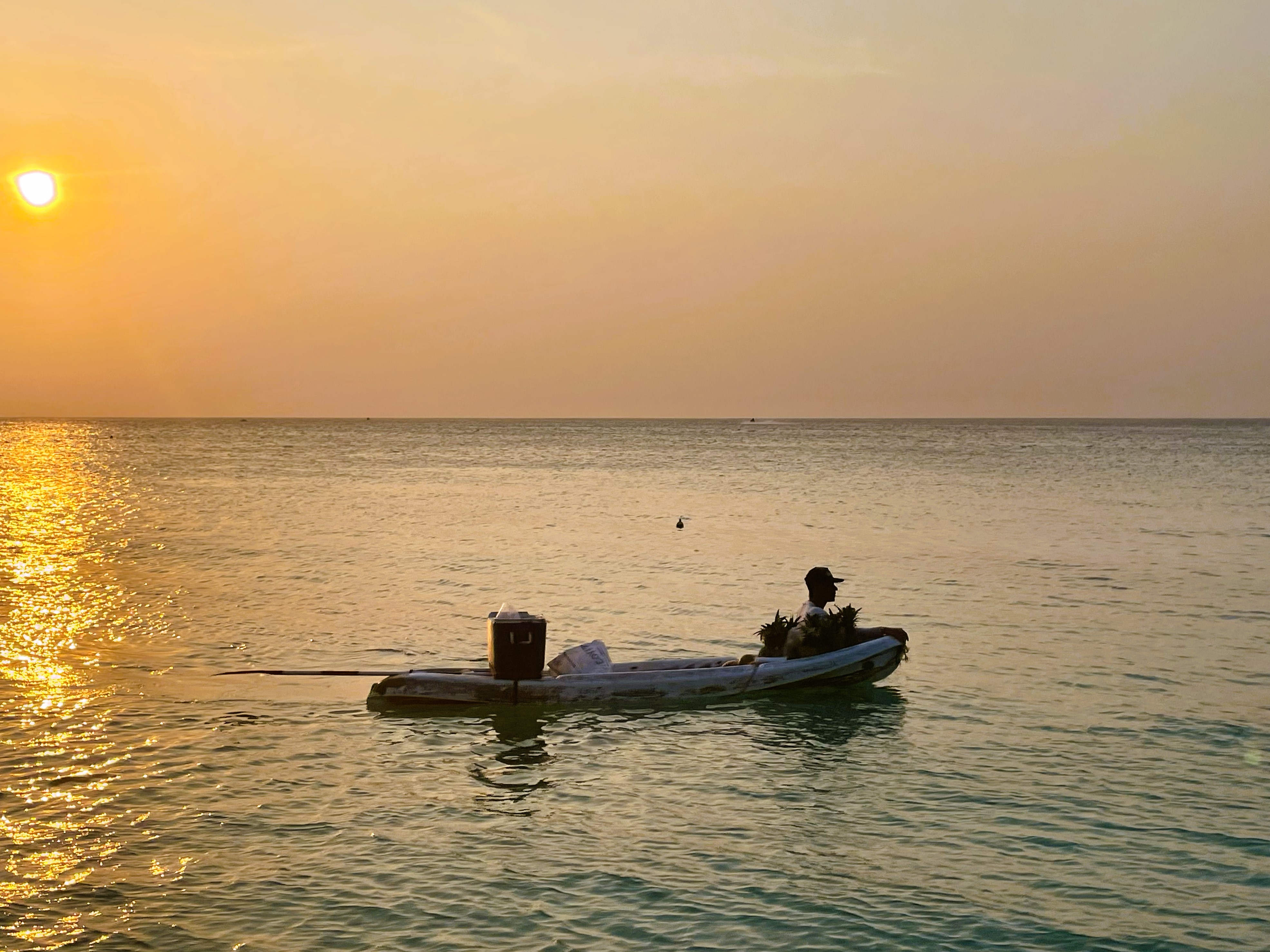
#5. Fear of Missing Out (FOMO). I love living overseas and have done so for nearly 19 years in the past 30 in nine different countries. Though we have been back in the States for vacation and training, the longest stint, since January 2009, was the year I joined the State Department. I am a Foreign Service Officer, with the key word being “foreign.” In the past year, we have seen friends move to new countries like Ghana, Turkmenistan, Nicaragua, Kazakhstan, Cameroon, and Nigeria and others announce their next move to locations such as China, Mongolia, Germany, and Laos. I feel a twinge of envy reading every one of these, knowing the mix of excitement and trepidation when one gets a new assignment and then starts it. I know though that staying here in Washington a bit longer was the right thing to do for myself, my daughter, and the cats. Believe you me, the cats really would like to prolong the time before I next shove them into a carrier for another 30-hour journey. 

All-in-all, although I do miss the good things we experience overseas, every place comes with the good and the bad, and the positives far outweigh the negatives here in D.C.