The seventh installment of my daughter and my August 2026 visit to Sweden.
Over the past several posts, I have shared our adventures exploring Stockholm, Uppsala, Falun, and Göteborg. But another part of our Swedish journey deserves some attention: traveling between those destinations via train. Instead of renting a car, I chose to travel by train, aiming to combine comfortable journeys and beautiful scenery, and experiencing unexpected stops and one significant disruption.
As I mentioned at the beginning of this series, I have long enjoyed traveling by train. During my travels around the world in 2000, I spent part of that time backpacking through Europe, most often traveling by train. I have wonderful memories of those journeys, and I wanted C to experience a little of that kind of travel herself. Of course, traveling through Sweden in 2026 was not quite the same as my backpacking adventures from decades earlier, but there was something familiar about navigating railway stations, making train connections, and settling into the gentle rocking of the railcars or stumbling down the aisle.
Swedish rail would deliver us a combination of comfortable and easy journeys, beautiful scenery, expected and unexpected stops, and one significant disruption.
All Aboard!
Sweden’s trains were clean, modern, and very comfortable. We traveled in second class, with assigned seats on just one of our journeys. C took the train journeys and transfers in stride, while I appreciated being able to settle into a comfortable seat, relax, and enjoy the ride.
One of the biggest differences between this trip and my earlier railway adventures was the technology. When I backpacked around Europe in 2000, I relied on printed timetables, station departure boards, and the kindness of railway employees or fellow passengers. There were times when things did not go quite according to plan. I missed trains, missed stops, and got schedules wrong, sometimes because of unexpected time zone changes or simply being on the wrong platform. I had one particularly memorable experience when the car I was riding in was uncoupled from the train during a midnight stop somewhere in Romania…Those experiences certainly made for interesting travel stories, though they were cause for some anxiety at the time!
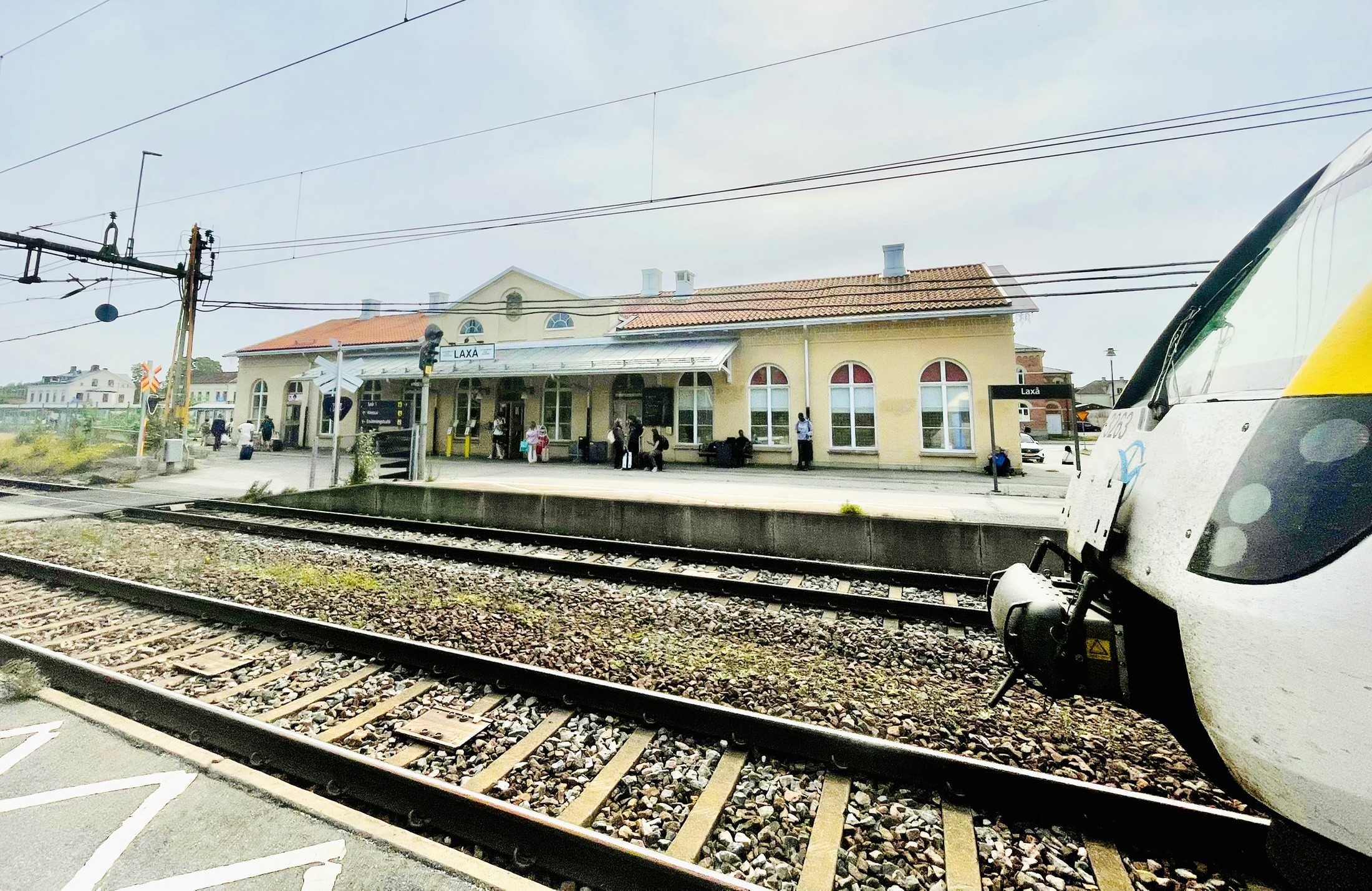
Traveling through Sweden in 2026 was considerably easier, largely thanks to the SJ app. SJ or Statens Järnvägar (Swedish State Railways) is Sweden’s national passenger railway operator, and its app became an invaluable travel companion. I could search for journeys, purchase tickets, and view schedules, including connections involving other railway operators. Once aboard, I could follow our progress along the route, see the remaining stops, and check scheduled and updated arrival and departure times.
The app also showed us which platform to use and, in some cases, exactly where to stand to board the train. That might sound like a small thing, but when faced with a long platform, a relatively short train, and only a few minutes before departure, knowing where to wait was enormously helpful. Most of our trains ran on time, and I rarely felt rushed or uncertain about where we needed to be. Compared with trying to interpret railway announcements in an unfamiliar language in the middle of the night, it was remarkably easy.
Of course, even the best technology cannot eliminate every complication, as we would discover.
An Unexpected Introduction to Gävle
Our journey from Uppsala to Falun included a connection in Gävle, a small city on Sweden’s eastern coast. We had approximately 40 minutes between trains, leaving perhaps half an hour to explore. Rather than wait around the station, we headed out with our backpacks to see what we could find. Speed sightseeing.
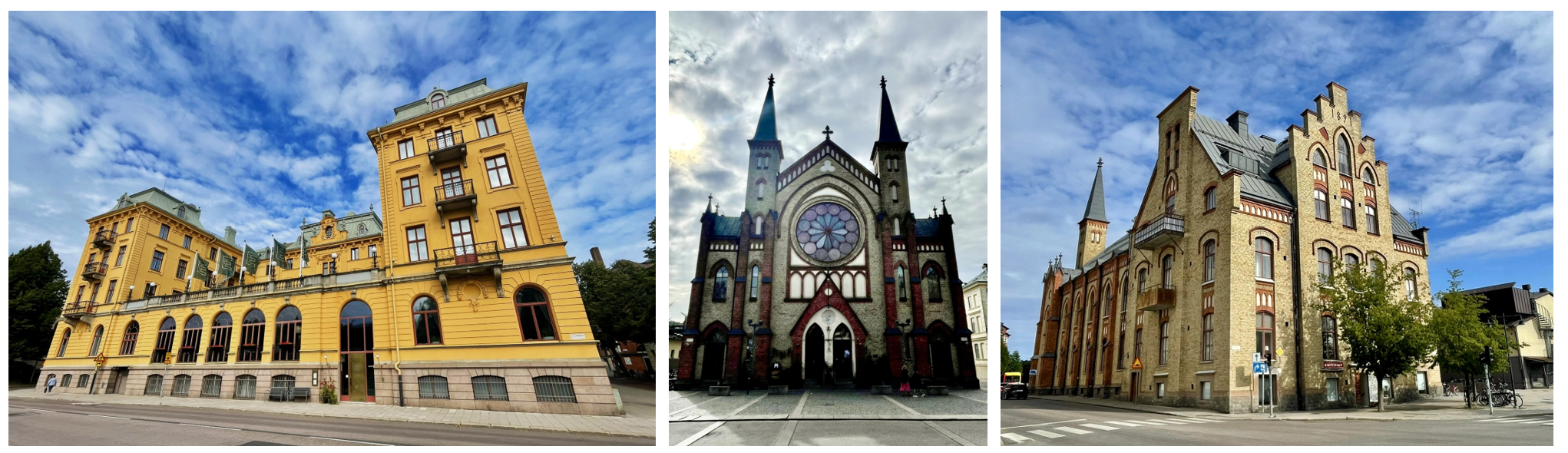
I was immediately struck by the beautiful architecture around the station. Just adjacent to the station stood a pretty and imposing Gothic Revival building with twin spires, a magnificent rose window, and unusual brickwork. I learned it was originally the Sjömanskyrkan, or the Mariners’ Church, built in 1891 to serve sailors visiting Gävle, then an important Swedish port. Threatened with demolition in the 1970s, the public rallied to preserve the building, and it is now a cultural and music venue.
Another building that caught my attention was the gorgeous yellow Elite Grand Hotel. Opened in 1901, the hotel was considered exceptionally modern for its time, with electricity and an elevator! After years of being used for other purposes, it was restored and reopened as a hotel in 2013. Another beautiful survivor!
I later read a little more about Gävle and learned that it is actually the oldest city in Norrland, dating back to 1446. Much of the city center was destroyed by a devastating fire in 1869, and many of the beautiful buildings we saw dated from the city’s reconstruction. I also learned that Gävle is the birthplace of Gevalia coffee, which takes its name from the Latin name for the city. I do not drink coffee, but I always enjoy learning where familiar brands originate. It is a bit like my interest in visiting the World of Volvo, even though I have never owned a Volvo and have no desire to own one.
Our whirlwind excursion barely scratched the surface of Gävle, but it prompted me to look into the city and discover how much more there was to see. What had begun as a simple railway stop introduced us to a place with beautiful architecture and an unexpected amount of character. The city deserved more than the 30 minutes we had given it.
Sweden Through the Train Windows
One of my favorite aspects of traveling by train was watching the Swedish countryside unfold outside our windows. Our itinerary focused largely on cities and towns, but between them lay an entirely different Sweden.
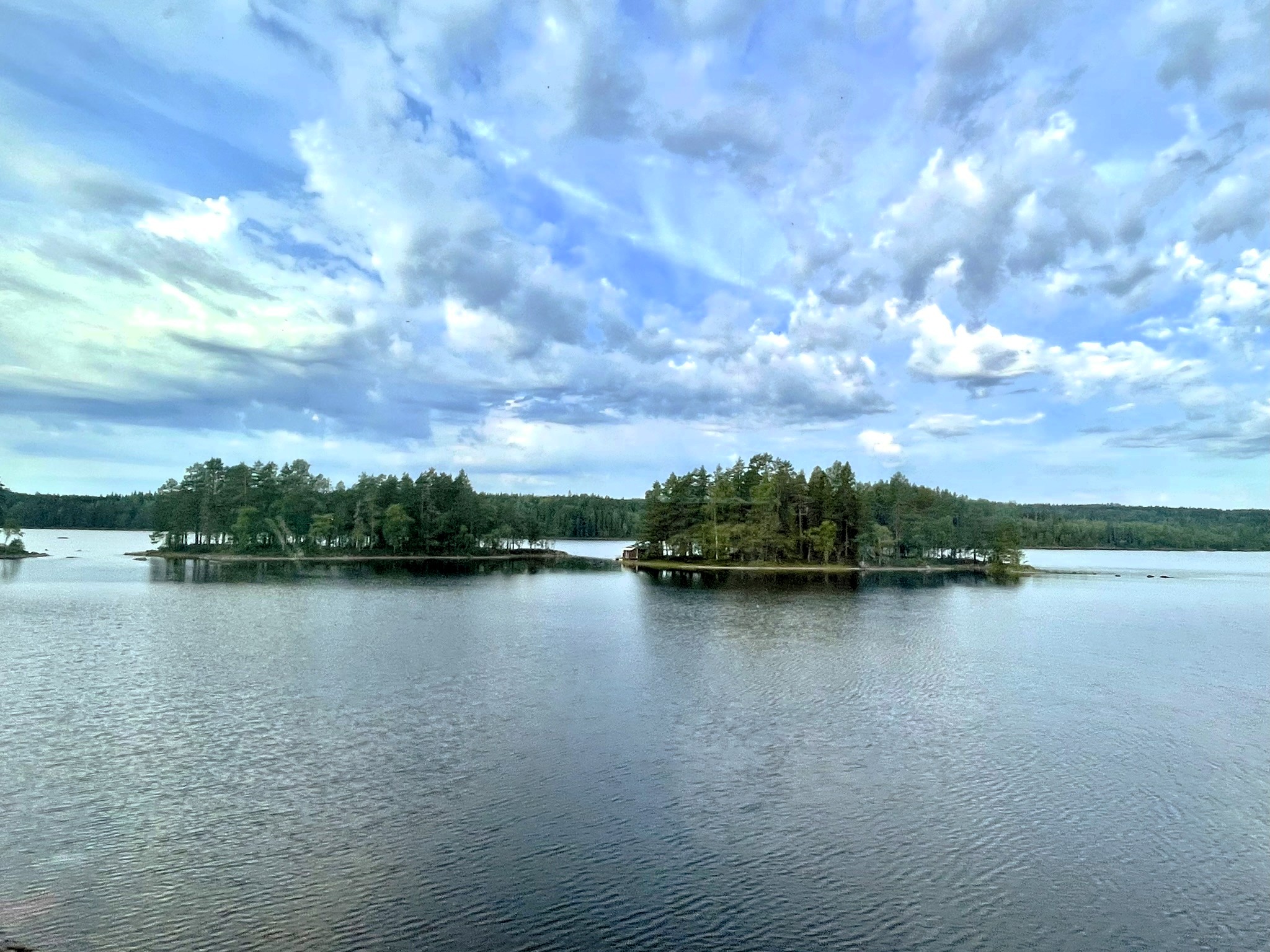
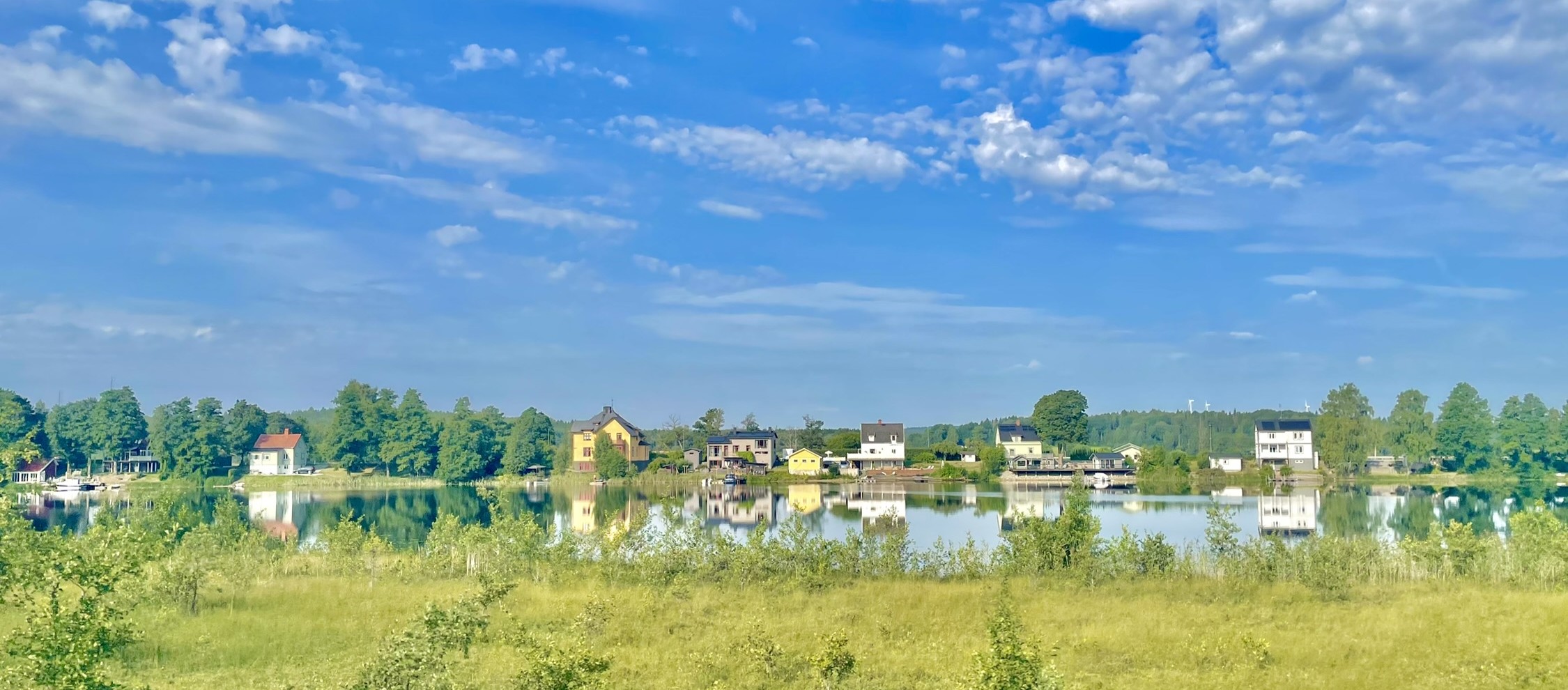
We passed through forests, alongside beautiful lakes, and across stretches of farmland. There were fields of green and gold, weathered barns, clusters of traditional red wooden houses, and occasional glimpses of small communities nestled among the trees. Some lakes seemed to stretch endlessly into the distance, while others were dotted with tiny, wooded islands. On several occasions, the still water reflected the surrounding trees and clouds so perfectly that it was difficult to distinguish the landscape from its reflection.
This was precisely the sort of experience I had hoped for when I chose to travel by train. I could sit with my journal, writing about our adventures, and then look up to discover another beautiful scene framed by the window. Unfortunately, the train journey I had been looking forward to the most did not go quite as planned.
When I originally researched the route from Falun to Göteborg, I looked forward to a nearly six-hour train journey through western Sweden, with reportedly some fantastic scenery along the way. Unfortunately, scheduled summer railway maintenance meant that the route I had expected was unavailable. Instead, we faced a substantial detour and a complicated combination of trains and replacement buses. The changes added an hour and a half of travel time and meant missing out on much of the uninterrupted scenic train journey I had planned.
I found it surprising that Sweden would undertake major railway maintenance during the summer tourist season. Why schedule such disruptive work during one of the nicest times of the year? But as I learned, there was a good reason for it. Sweden has a relatively short window of favorable weather for certain types of railway work, and with so many Swedes away on summer vacation, there were fewer commuters and business travelers to inconvenience. By late August, however, the traditional Swedish summer holiday period is coming to an end, schools are reopening, and people are returning to their usual routines.
Of course, understanding the reasoning did not make me any happier about missing out on the scenery I had anticipated. But at least the decision made more sense. And while our journey was not the relaxing, uninterrupted train ride I had planned, we still enjoyed some beautiful countryside along the way and reached Göteborg without too much difficulty.
Three Hours in Örebro
On our return journey from Göteborg to Stockholm, we had a three-hour stopover in Örebro, giving us time to visit two places on my sightseeing list: Örebro Castle and Wadköping. We left our backpacks in lockers at the train station and headed off to explore.
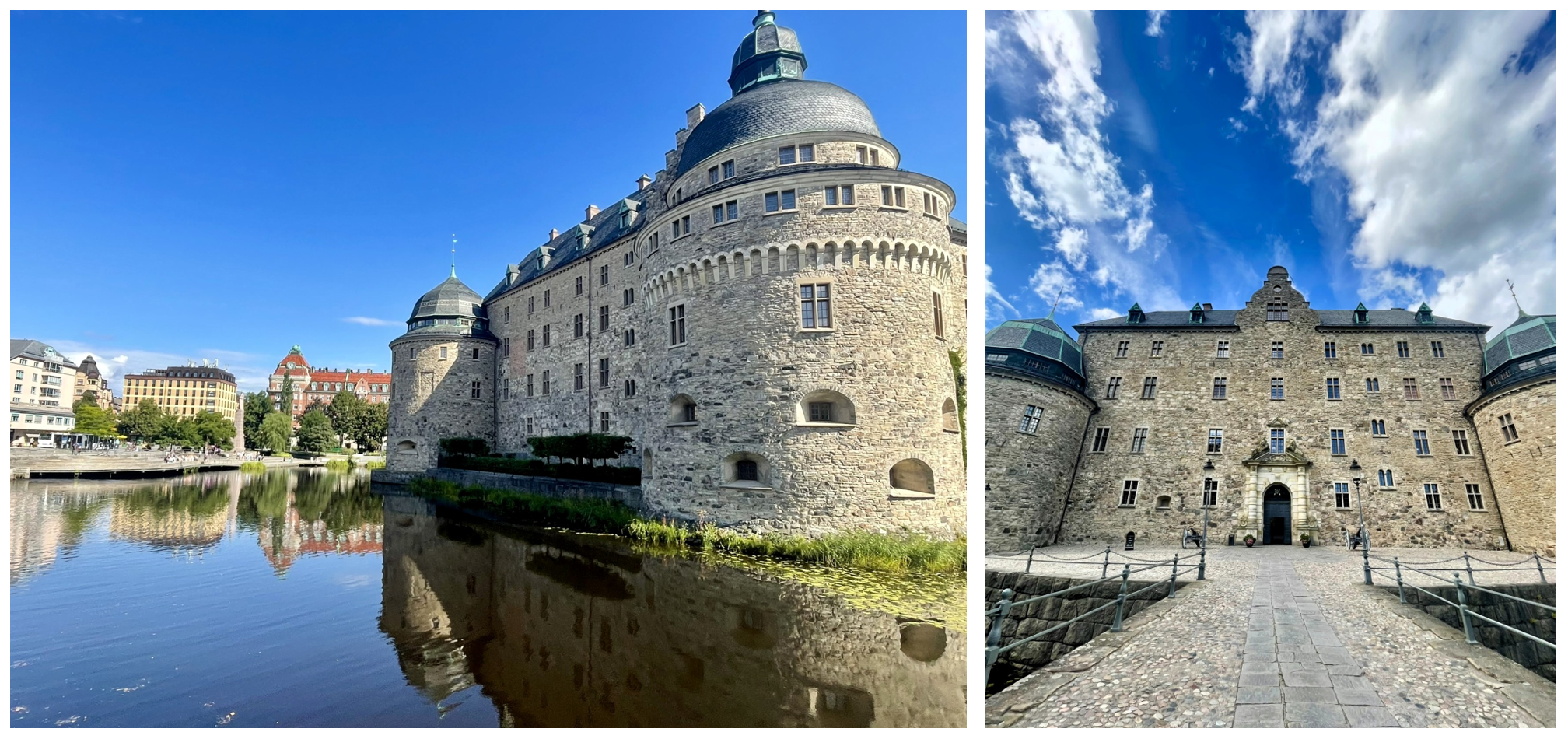
Örebro is one of the most perfectly preserved, water-locked Renaissance castles in Europe and it sits smack dab in the middle of one of Sweden’s largest cities. The castle sits on an island in the Svartån River, surrounded by water that gives it the appearance of being protected by a moat. Its massive stone walls, rounded towers, and distinctive roofs make it an impressive sight, particularly when reflected in the water. It was really a lovely sight.
The castle has a long and fascinating history, with origins dating to the late medieval period. It began as a defensive stronghold and was later transformed into a Renaissance castle under Duke Charles, who became King Charles IX. Another curious chapter in Örebro’s history occurred in 1810, when a French marshal who had served under Napoleon was selected as Sweden’s crown prince. He eventually became King Charles XIV John, establishing the Bernadotte dynasty, which remains Sweden’s royal family today!
Although we did not have time for a guided tour, we did venture inside the castle to wander on our own. The rooms we visited were sparsely furnished, and not of much interest. Still, I was very glad we had made the stop as the exterior was very much worth it as the castle was every bit as beautiful as I had hoped.
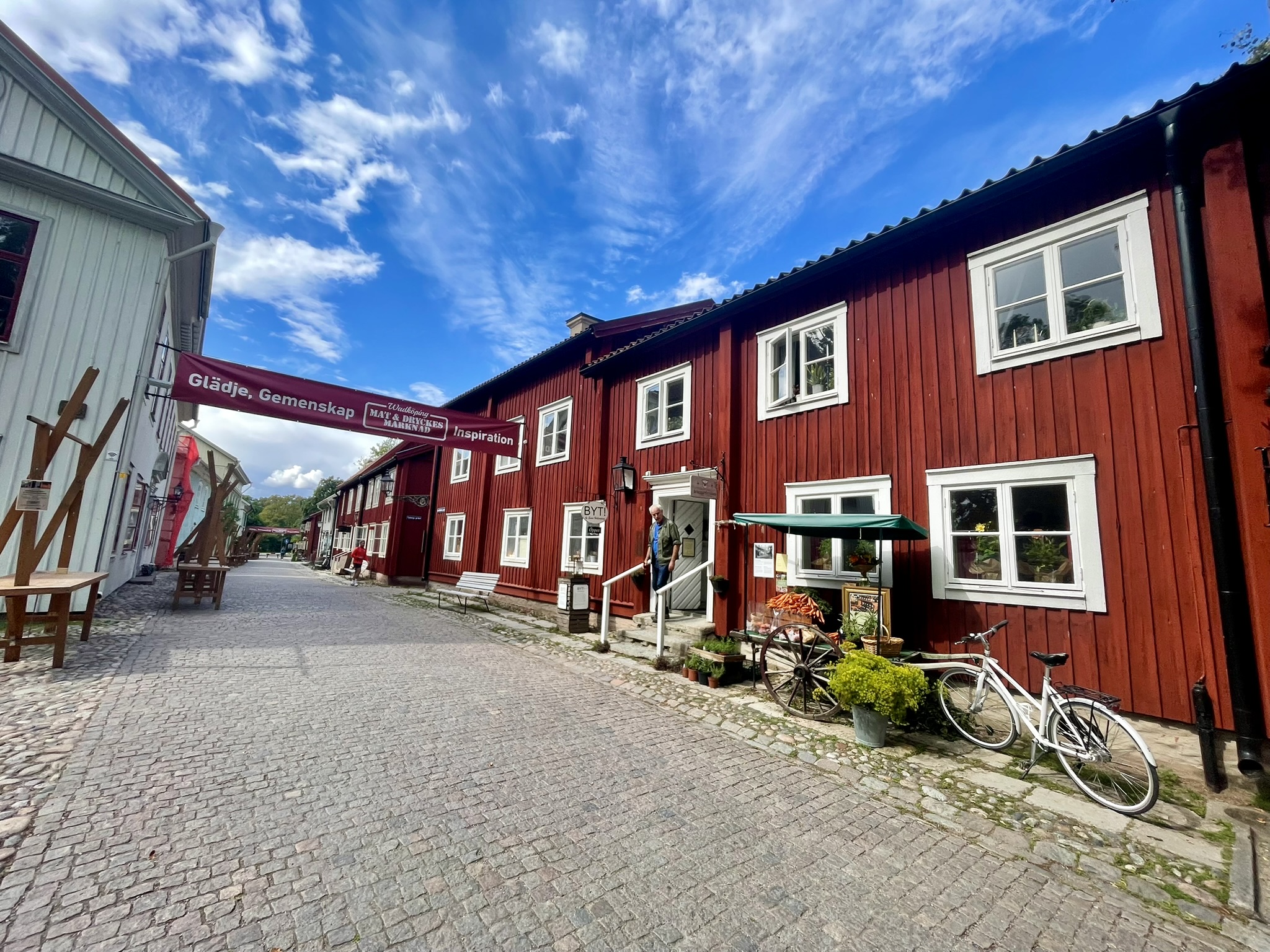
From the castle, we made a rather brisk walk to Wadköping, an open-air museum of historic wooden buildings. Established in 1965, Wadköping brings together older buildings relocated from different parts of Örebro, creating an impression of what the city’s historic neighborhoods once looked like. I had expected something more along the lines of Colonial Williamsburg or Jamestown in Virginia, perhaps with people in period costumes or demonstrations of traditional crafts. Instead, it was exceptionally quiet. Though of course we were visiting on a random weekday in late August, after the Swedish summer holidays had largely ended.
In some ways, the quiet was probably just as well. We had a train to catch, and had there been an interesting performance or activity underway, I might have been disappointed to leave. We had also already explored Ellsborg, an actual historic neighborhood of traditional wooden houses in Falun, so Wadköping felt a little less distinctive than it otherwise might have. It was nonetheless pretty and picturesque with the Falun-red painted buildings against a bright blue sky.
With our sightseeing complete, we returned to the railway station, retrieved our backpacks, and continued toward Stockholm. We were off on the next stage of our Sweden adventure.
The End of the Line
Our arrival back in Stockholm marked the end of our railway travels in Sweden. Although the journey had not gone entirely as planned, we had explored some wonderful destinations and enjoyed beautiful countryside along the way. Our brief excursion in Gävle was also a reminder that even a short stop can introduce us to somewhere worth exploring further.
While our rail journey had come to an end, our Swedish adventure was far from over. From Stockholm, we would continue our travels by another means of transportation, this time heading for the island of Gotland.

